Image

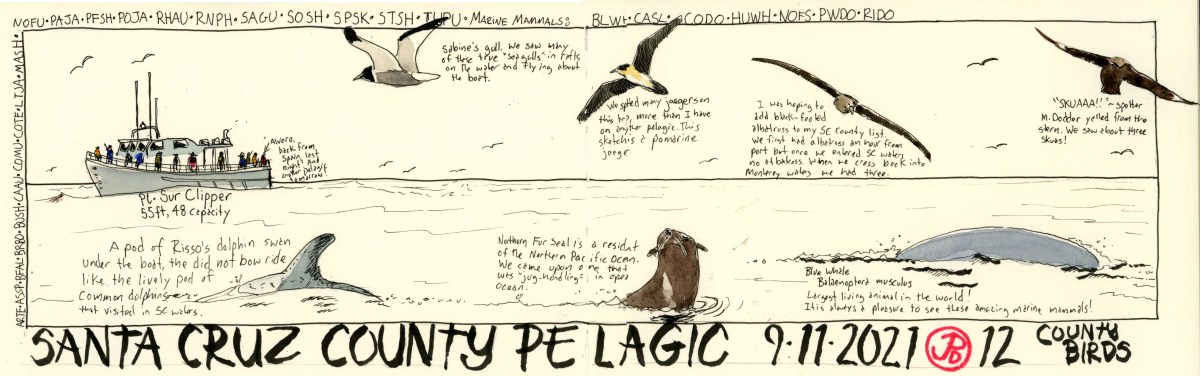
Santa Cruz County Pelagic

County lines are a bit strange when it comes to off shore waters. They can seem arbitrary in the same way that county, state, or country lines can be. Only these county lines are drawn over deep water.

One of Alvaro’s pelagic boat trips was scheduled to head north from Monterey Harbor into Santa Cruz County waters. So I had to take this trip on my quest fro 300 Santa Cruz County birds.

Pelagic birding can be sublime and maddening in equal measures. For one, you are birding from a platform that is pitching in constant motion and the birds are often on a surface that is undulating where birds appear and disappear at a blink of an eye. Some birds fly to and over the boat while other birds, that had been resting on the water, take off at the first sight of a boat and you get a view of a retreating bird. Also because the bird boats are really designed for fishing and not pelagic birding, it is impossible to be two places at once. So if you are on the starboard rail and a rarity is seen on the opposite side of the boat, you have to make a mad scrabble on a surface that make one look like a drunk sailor, and only to find that the bird is gone with a spotter pointing to the spot where the Manx shearwater used to be!

I suppose this is the draw of pelagic birding. It is challenging and it can often give you incredible memorable experiences. Such as the time when our boat was surrounded my a pod of Pacific white-sided dolphins that numbered in the high hundreds or the time when we kept pace with two blue whales or another time when a black-footed albatross flew in and rest in the water a few yards from the boat.

We where scheduled to depart at 7:30 AM and at 7 a group of Santa Cruz Bird Club members where milling about, cleaning their optics and looking at gulls in the harbor. Our leader, Alvaro walked down the wharf. I was surprised to see him upright because he had flow in the night before from Spain, having just finished a birding trip. He said he felt fine but joked that if we found him asleep later in the afternoon we where to kick him awake.

We left on time and we where only about an hour from port when we saw our first pelagic gem: the black-footed albatross. We soon crossed into Santa Cruz water and I wanted to add this albatross to my county list but unfortunately the four that we saw where all in Monterey waters. There where large numbers of shearwaters throughout our trip, the most common being sooty and pink-footed but with sightings of Buller’s and just one short-tailed and Manx shearwaters.

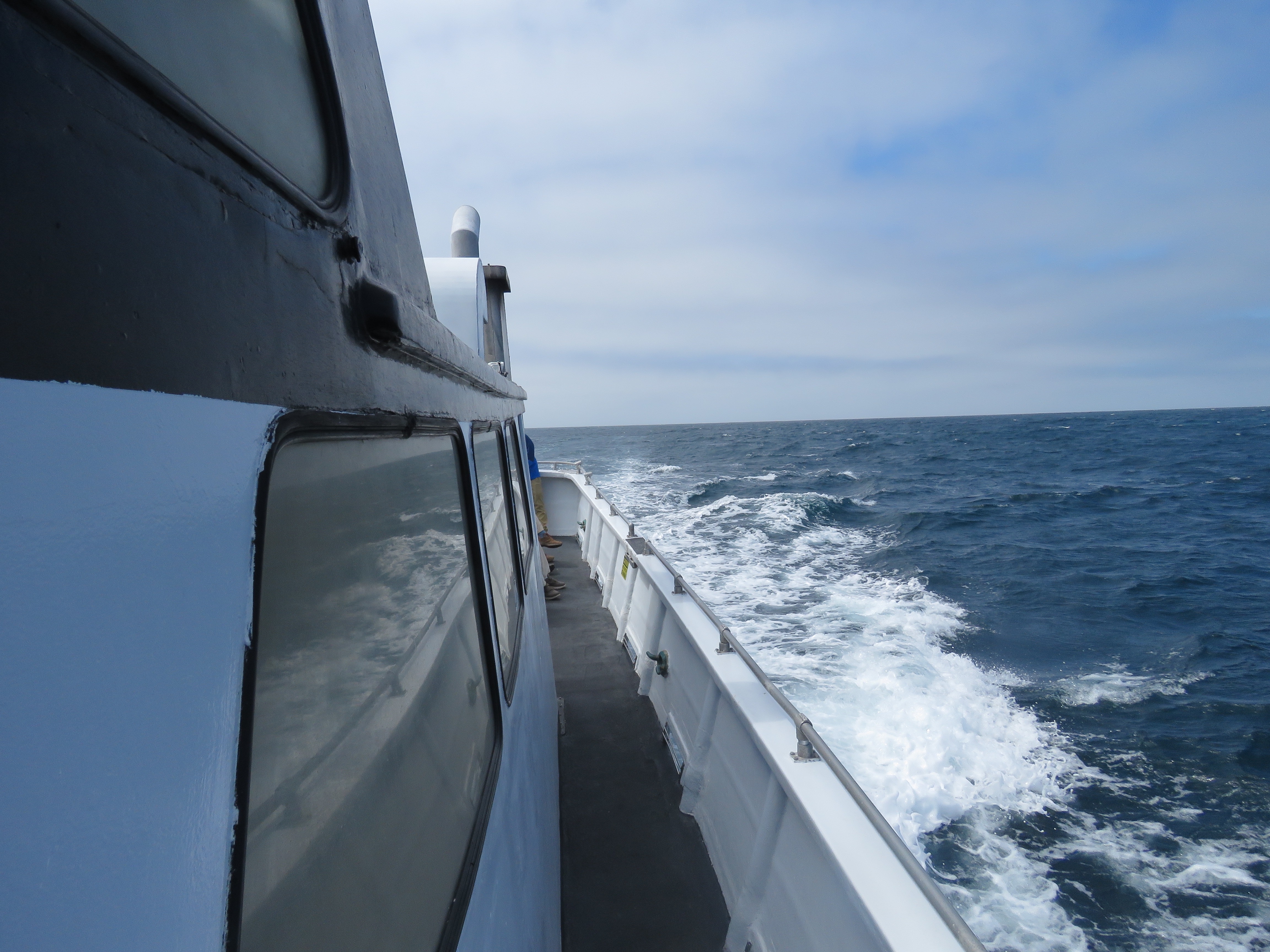
Looking down the port side of the Pt. Sur Clipper, or in pelagic birding parlance, 6 o’ clock to 9 o’clock. Here we are cruising above the Monterey Bay submarine canyon.

In all it was a very pleasurable cruise, even though I did not get an albatross over Santa Cruz waters, I did add 12 new county lifers, including: south polar skua, Arctic and common tern, Sabine’s gull, two jaegers, northern fulmar, Manx, Buller’s, and pink-footer shearwater.

As we headed back towards Monterey Harbor and the pelagic species where being replaced with inshore species like brown pelican, Brant’s cormorant, and western gull, there was one last surprise for use. One of the spotters picked out a far off brown booby flying along the coast. Not a bad way to ended a productive pelagic.

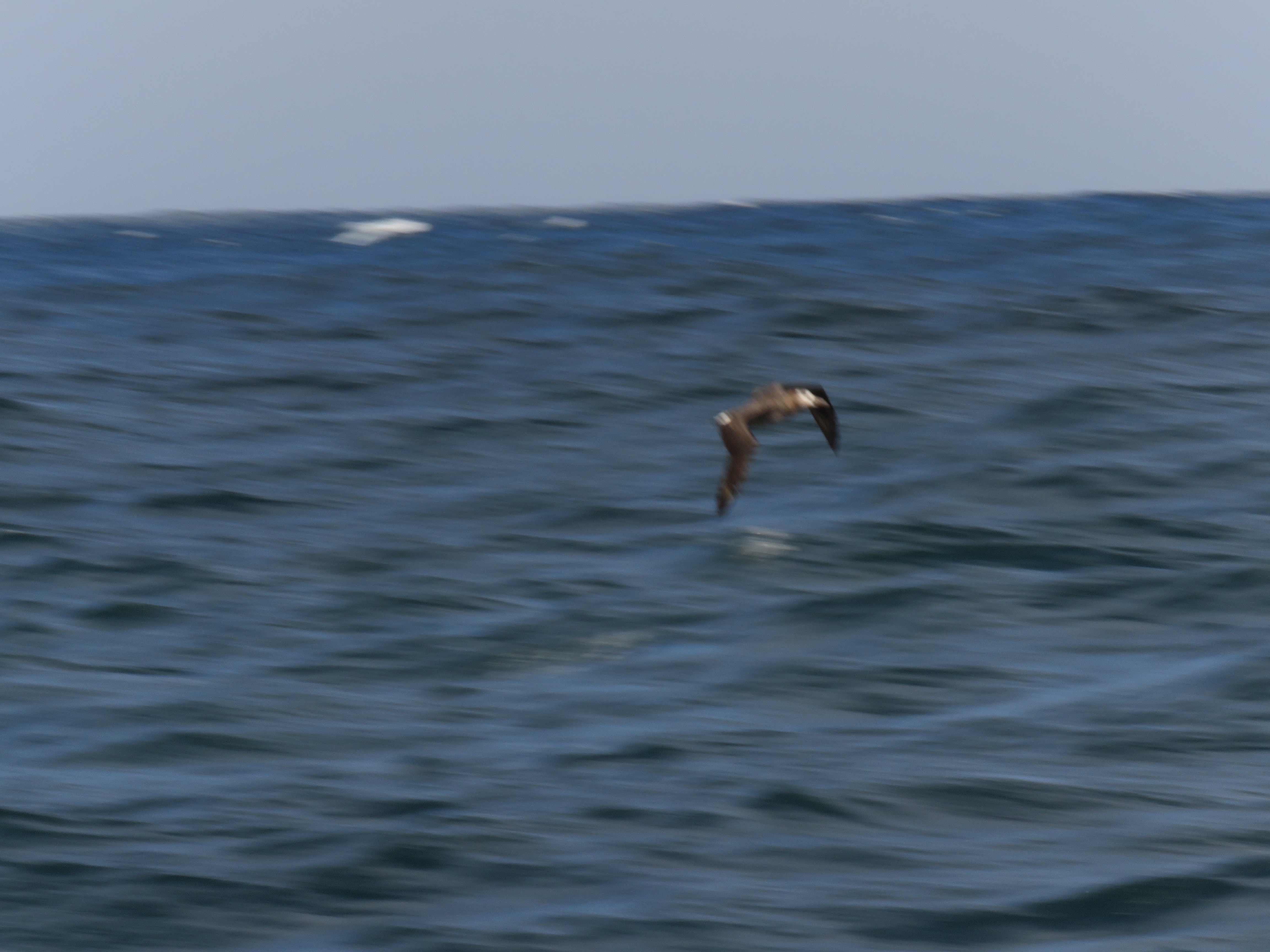
While we whiffed on black-footed albatross in Santa Cruz County, this photo of an albatross, blurred in motion over Monterey waters, sums up the motion and excitement of a classic Monterey Bay Pelagic.
Image

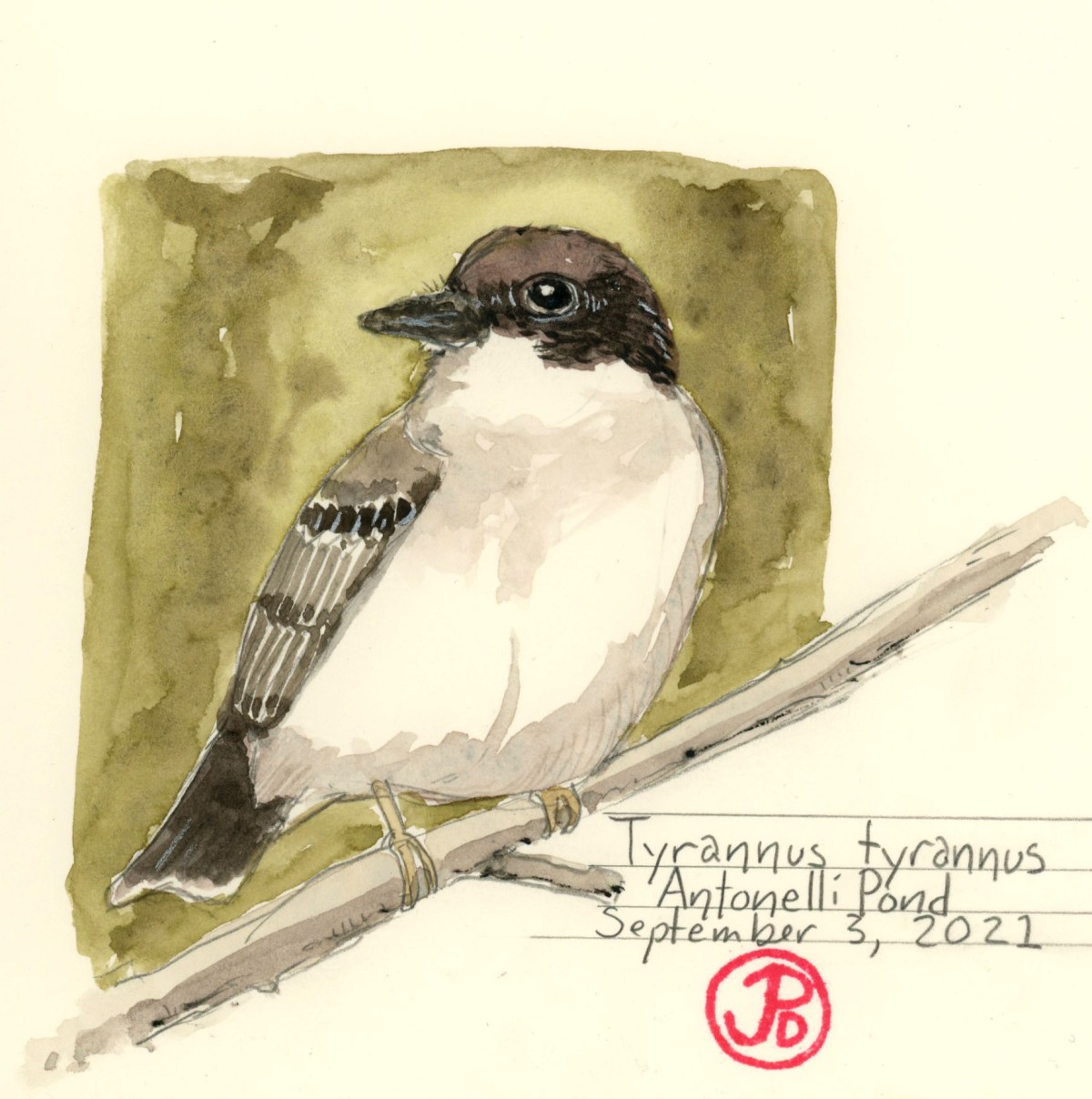
King of Tyrants: Tyrannus tyrannus

On a Monday, Trrannus tyrannus was first seen in a coffeeberry bush (Rhamnus californica) in the northwest corner of Antonelli Pond in Santa Cruz’s westside. I just hoped this county rarity would stick around until Friday when I could get down the coast to look for it.

The Eastern kingbird, like it’s name implies, breeds on the eastern side of the United States. This kingbird is a neotropical migrant where it spends winters entirely in South America. On their winters grounds, the kingbird travels in flocks and eats berries. (In the north it feeds mainly on insects taken on the wing).

Tyrannus tyrannus, means “tyrant, despot, or king” (take your pick) is named for the kingbird’s aggressive behavior during breeding season. While defending their nesting territory, they will attack birds that are much larger than itself, including hawks, great blue herons, ravens, crows, and even squirrels. There have been reports of kingbirds landing on the back of hawks and vultures, pecking and pulling out feathers. This is the King of Tyrants with a major Napoleon Complex.

So at about five PM I found myself in the northwest corner of Antonnelli Pond reflecting on the long journey this 40 gram bird had made, from the Amazon, eating fruit in flocks to it’s long journey up the Pacific Coast to forage for a few days near a pond in Santa Cruz. So far the coffeeberry bush was sans kingbird.

After about a 15 minute wait, a pied bird flew from the north into the bottom of the bush. I attempted to flank the bird to identify it as the wayward tyrant. A bird shot up from the bush, dark above and light below was a fine white border on it’s tail, Bingo! Eastern kingbird! The bird flew to a chain linked fence that bordered the Homeless Garden, where I was able to get a few distant photos.

A common perch for a kingbird: a fence.

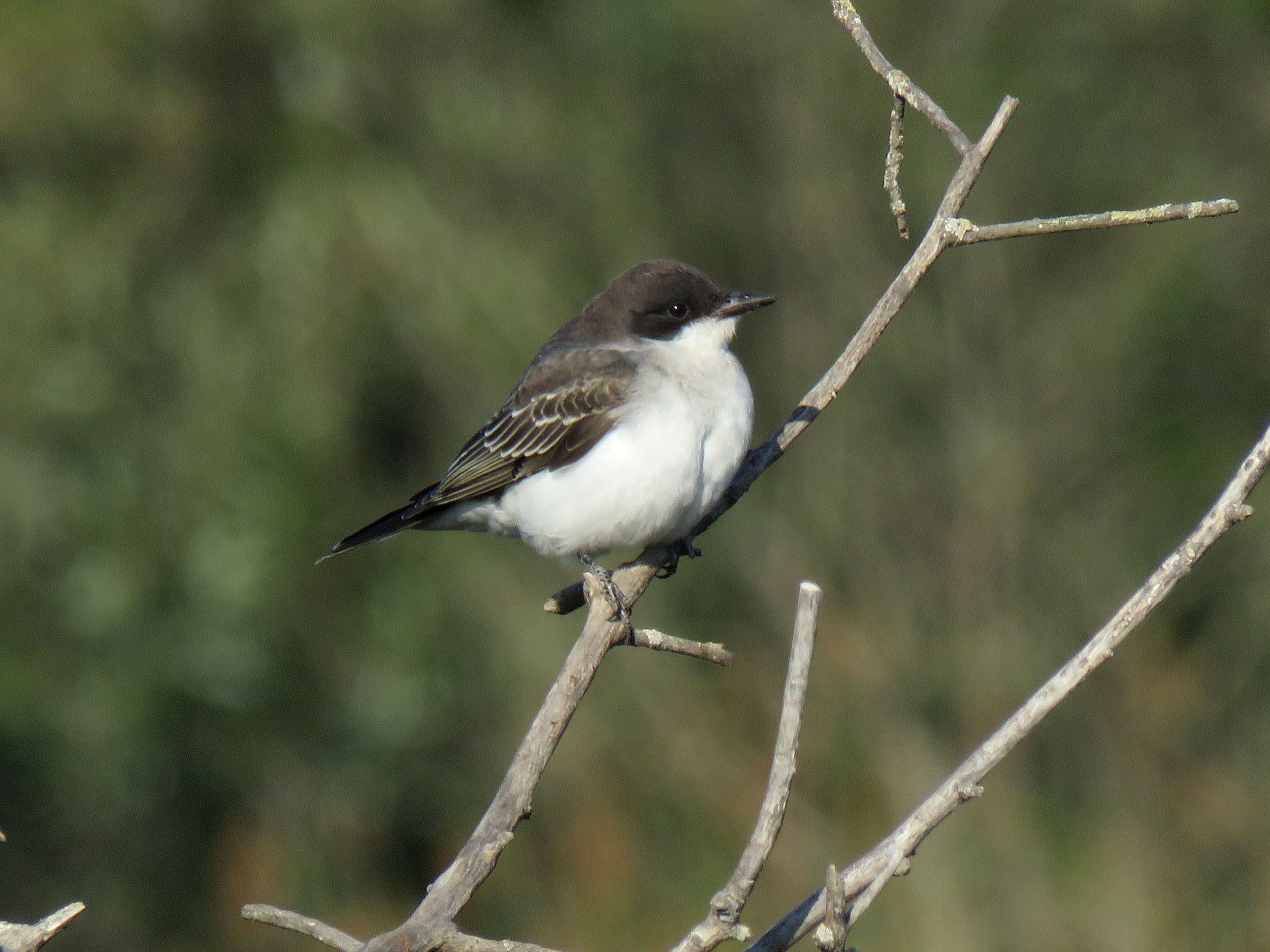
The kingbird foraged for a bit in the garden and then flew back and landed on top of the coffeeberry bush in perfect late afternoon light, so I had to take a few photographs to confirm it’s misplaced existence. It stayed on it’s perch for a few minutes and it then flew across the pond and my encounter with the wayward (is their such a thing in nature?) eastern kingbird was over.

The eastern kingbird in great light, showing off it’s kingbird profile.

Often when we are looking for one thing in nature we see so much more. This was the case on Saturday morning, when I returned to Antonelli Pond to look for the eastern kingbird again (and the willow flycatcher that had also been report). While the coffeeberry bush was lacking a kingbird, some movement in the brush in front of me caught my attention.

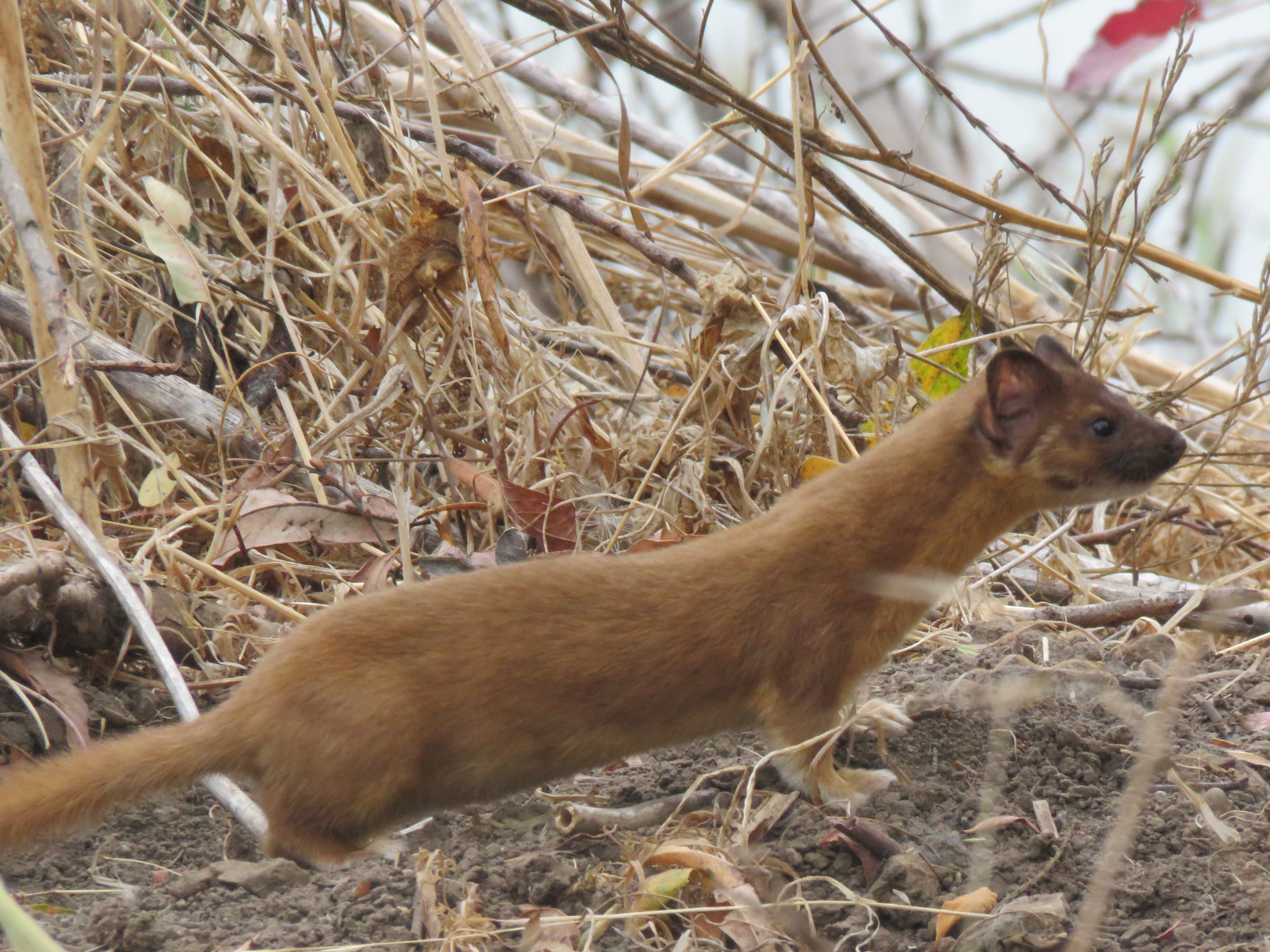
A caught a glimpse of a long mammalian predator. I wanted to entice it out to get a better look so I did my best impersonation of a wounded rodent (I was thinking mouse) and within seconds, it’s snake-like head, ears alert, appeared out of the brush. It was almost licking it’s deadly teeth with delight (I call anthropomorphism on myself!)

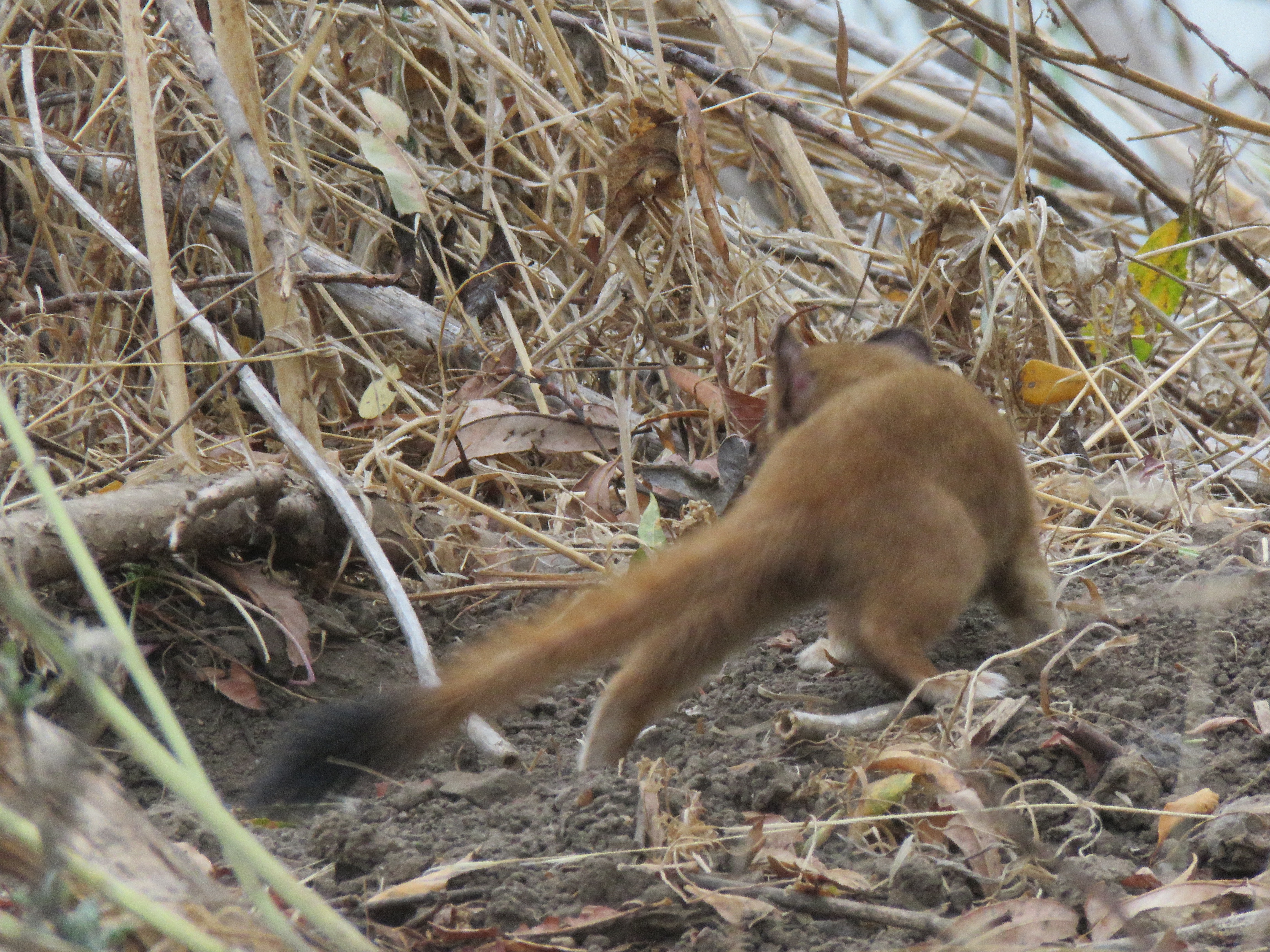
It was a long-tailed weasel (Neogale frenata)! I had seen this predator on two other occasions but both sightings (at Wilder Ranch) were fleeting and I just got a flash of it’s dark-tipped tail as it disappeared into coyote brush.

The long-tailed weasel is an aggressive predator which can take prey twice it’s size such as rabbits and squirrels. On one occasion at Wilder Ranch on the Old Cove Landing Trail, a weasel was hunting bush rabbits and I heard a lagomorphic scream that was hard to forgot. I was not sure if the weasel’s hunt was successful.

The long-tailed weasel, coaxed out of the brush with my wounded rodent impression.
The long-tailed weasel showing off it’s black-tipped tail.
Image

Flexing my Sketching Muscles

Before I headed out on my Trails, Roads & Rails Roadtrip I wanted to get into sketching shape. To do this I made it my daily practice to do a sketch in and around Santa Cruz.

Each sketch took no longer than 15 minutes and I chose subjects that would force me to take a complicated subject and simplify it into a quick sketch. Some of my subjects were architecture, trees and foliage, marine mammal anatomy, and old brickwork. I figured that this range of subjects would give we practice for some of the subjects I would be encountering on my trip along Highway 80.

I combined these short sketches with hikes in order to get into birding shape to search for the Himalayan snowcock, which required an early morning two mile hike to get to it’s alpine territory in the Ruby Mountains.

Architecture: Holy Cross Church, Santa Cruz.

For this sketch I wanted to make sure I was getting my angles and perspective right so I held out my pencil at arms length to take measurements and transferred these “measurements” to my journal. Because it was architecture, I worked in pencil to make sure the sketch held together. I was then was freed up to work in pen to capture the backside of Santa Cruz’s namesake church. Then I added watercolor washes and within 20 minutes, I had a sketch.

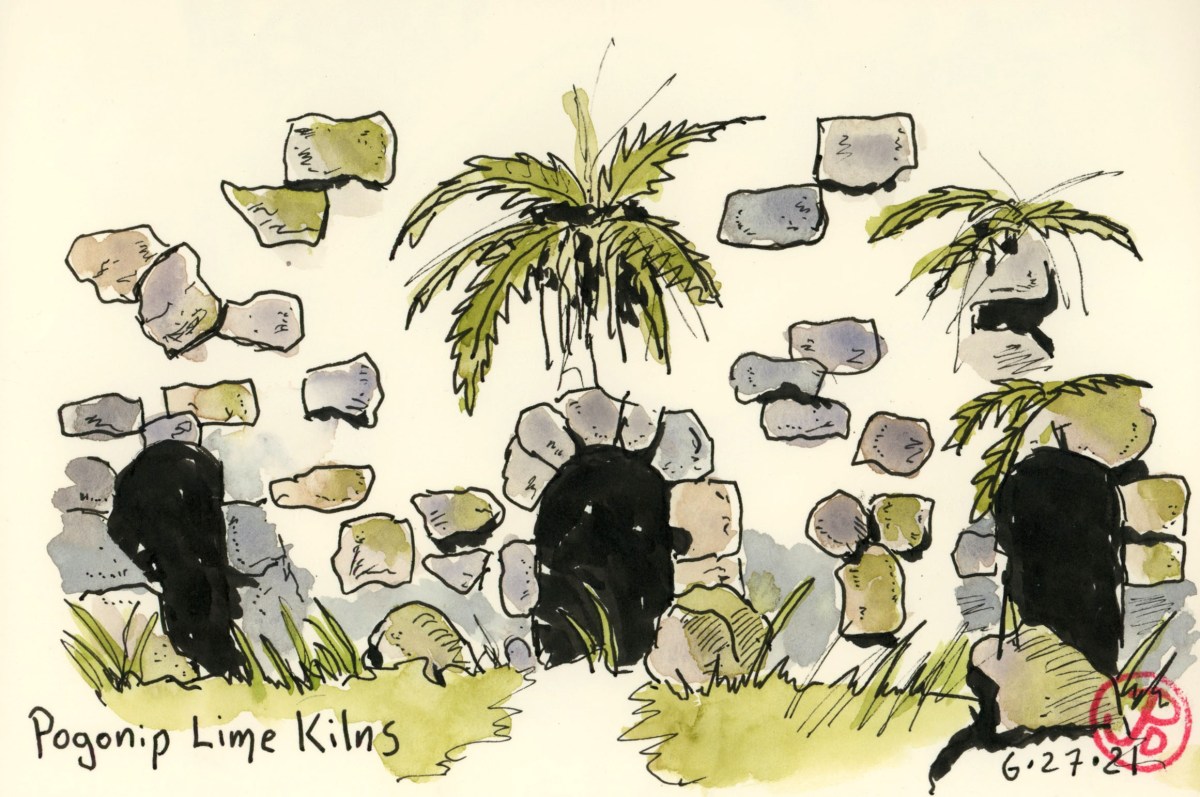
Lime Kilns, Pogonip. (Featured sketch)

After a hike up the Spring Trail at Pogonip Open Space Preserve, I turned off the trail to head up to the abandoned lime kilns. After timber, producing lime for building was Santa Cruz County’s biggest industry in the 20th Century. There were a few signs of this history at Pogonip but there was none better than these kilns.

For this sketch, I worked in pen and I used a bit of sketcher’s license on this one. In reality the ferns in the center were higher up but I though of this quick sketch as capturing little vignettes or details of the kiln, ferns, and brick work. All these details, when put together, tell the story in representing the lime kilns.

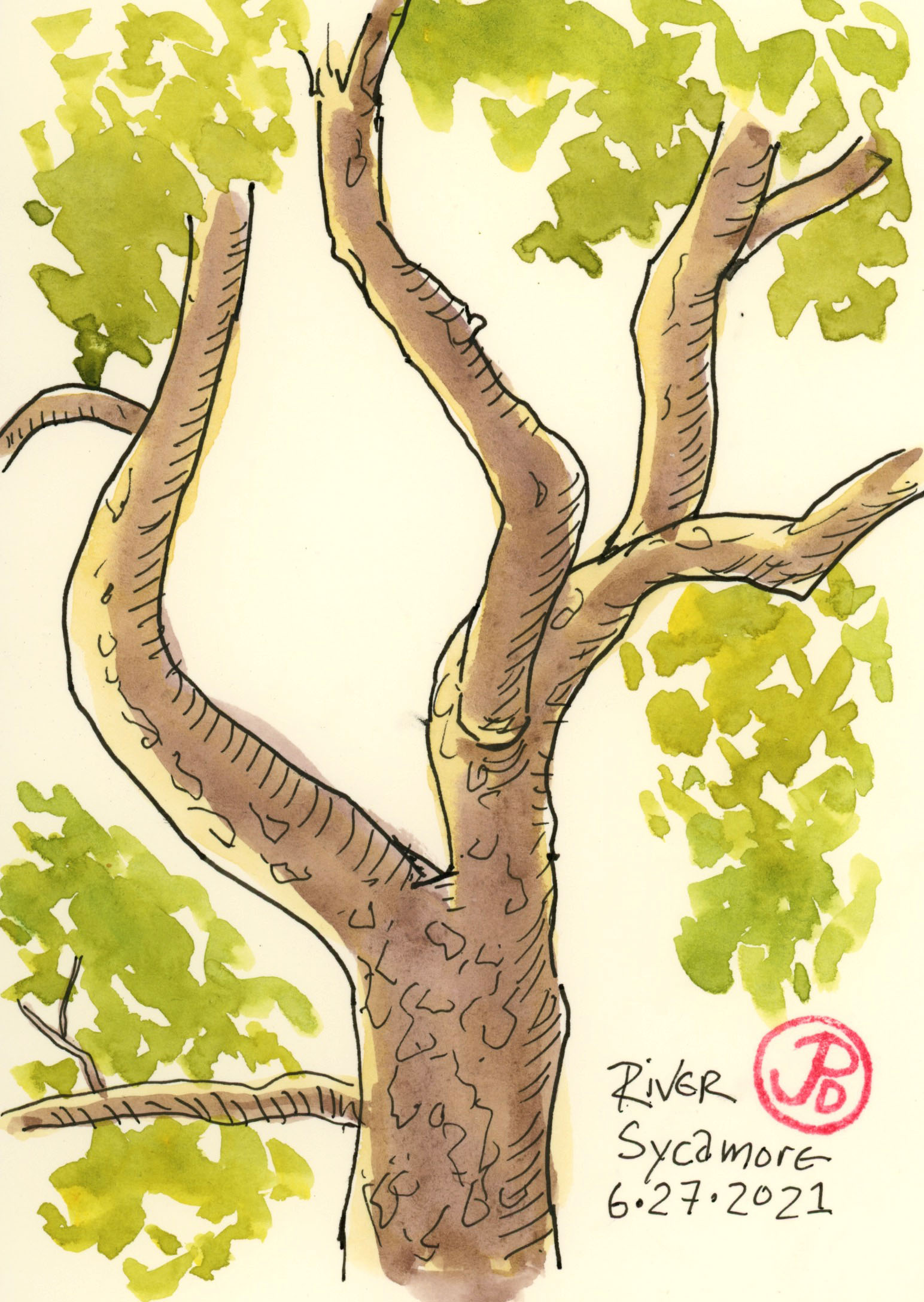
River Sycamore, Paradise Park.

I walked by the sycamore many times on my walks on Washington Way. I thought this grand, old tree would make a good subject for a quick sketch. Working on this sketch had a very organic feel, no pun intended, as I captured the shape of the limbs and let them lead off the page. I only worked in pen on this one.

I have sketched redwood, the most dominate tree in Paradise Park, many times so working on a sycamore just helped me understand the tree just a little bit more.

Image

Underpainting

I wanted to experiment with underpainting for some recent field sketches. First I put down a loose, cool, blue wash and on another page a warm orange-red wash. I kept it loose with some paint splatter and some ghosting.

Now I had to find a subject to lay over the wash.

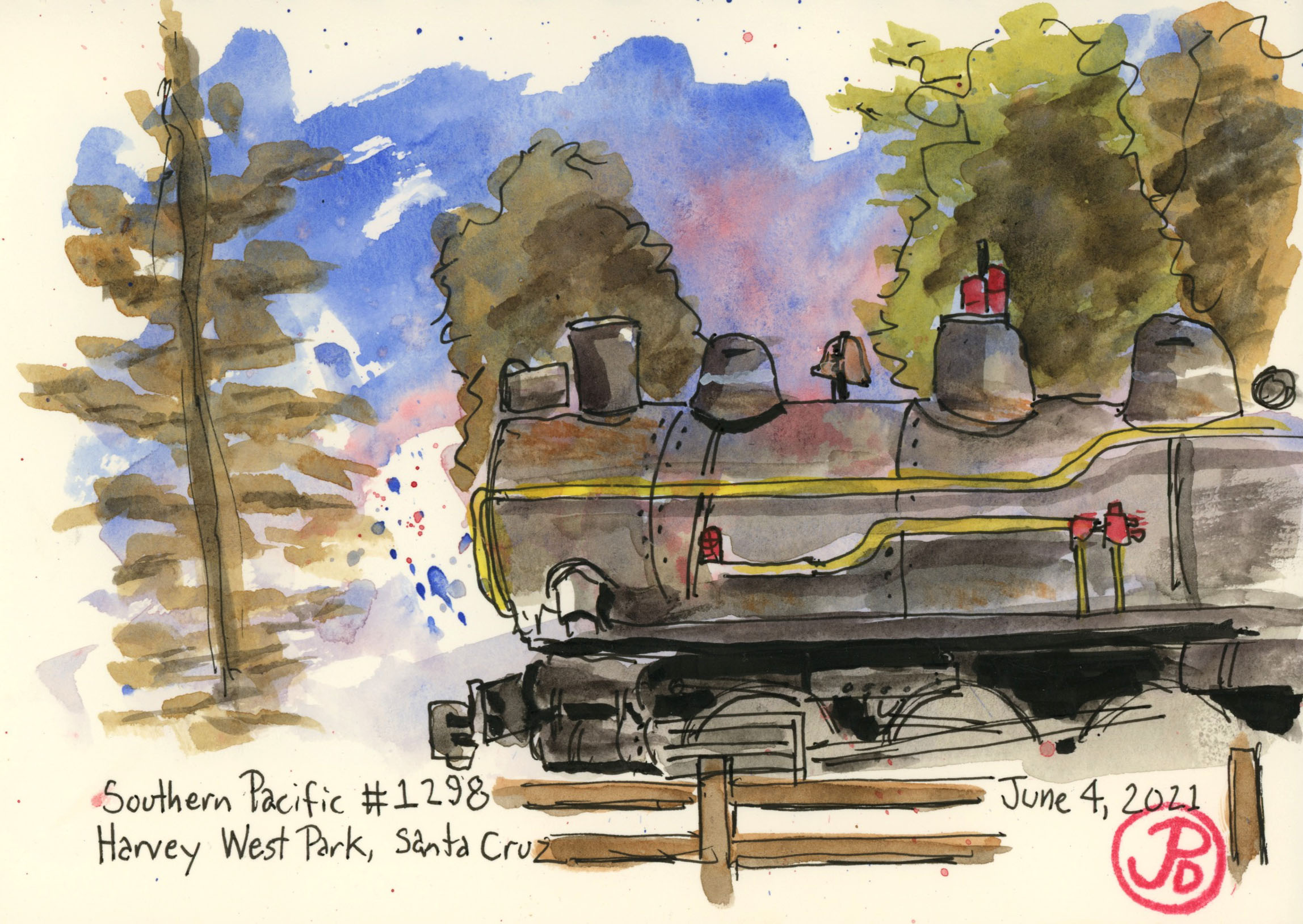
My first subject was to be found at Harvey West Park in Santa Cruz. It was a Southern Pacific 0-6-0 switcher that is on static display in the picnic area. Southern Pacific Number 1298 is an S-10 class yard switcher that was build by Baldwin in 1917. The locomotive was retired in 1956 and was put on static display in Santa Cruz in 1961. In an earlier era, when things was less litigious, children where able to climb on the locomotive and tender. Now the tender was sold and the rusting Number 1298 sits fenced in, in need of a lick of paint.

The word static, implies “not moving”, which is a perfect sketching subject because, well, 1298 is not moving. It was a great subject to capture the form of the locomotive and the trees in the background. For this sketch I chose the page with the cool blue underpainting. I figured it would also work with the sky.

I loosely sketched in the form of the locomotive, tiring to keep details to a minimum. I failed to some degree because I think I added too many details, a problems I have with sketching a highly detailed subject like a locomotive or architecture. The running gear (the driving wheels that propel the locomotive) I simplified and left out a lot of information.

When you put wet watercolor paint over dried paint, it is called glazing. When you glaze in watercolor you can build up layers and depth. Because watercolor is transparent, the underpainting shows through in unexpected ways. And with using a fairly random underpainting the result can be a bit jarring but somehow seems to work. It’s just a sketch, after all.

For my sketch I laid over the warm orange-red wash I choose a jarring subject.

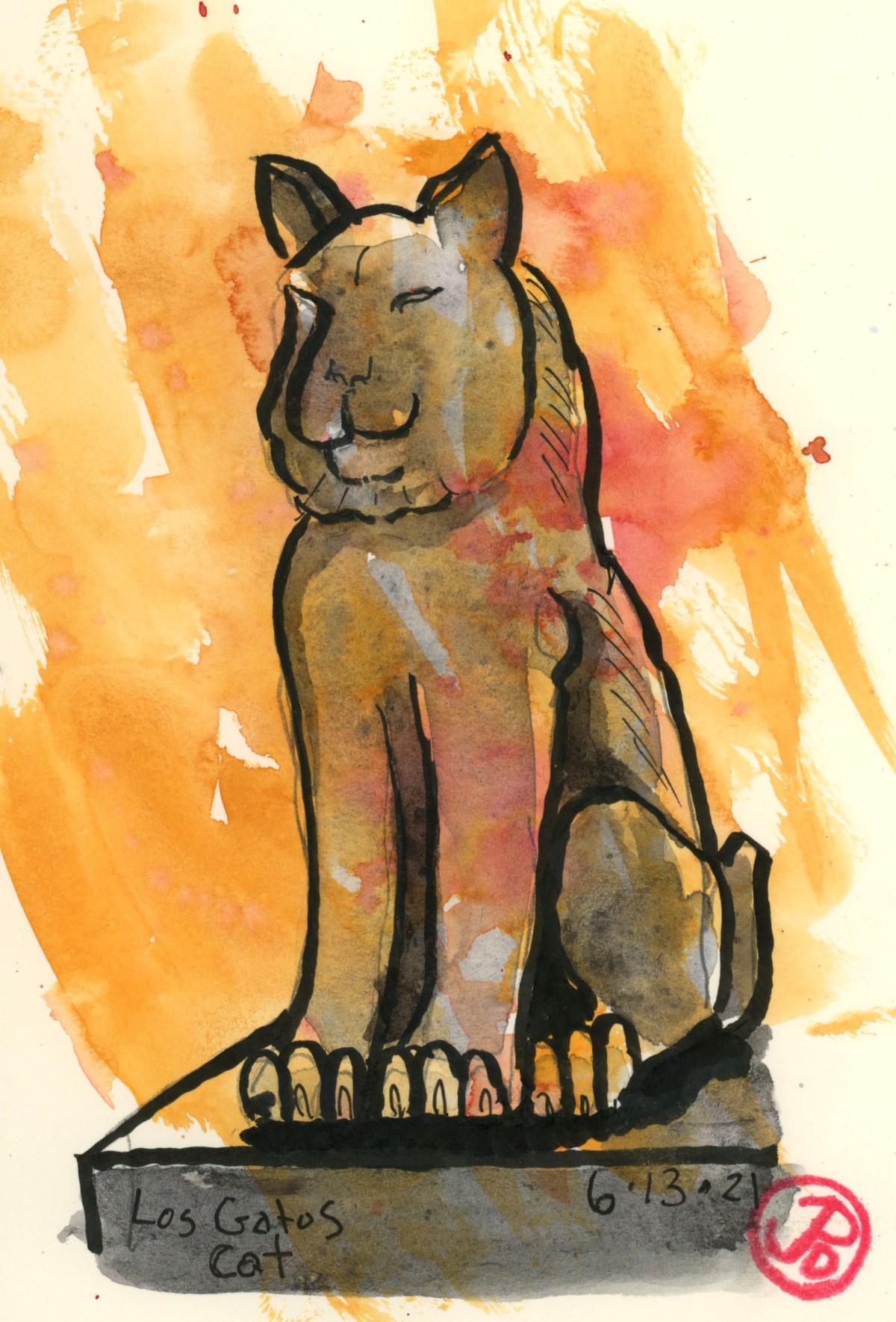
Just outside of Los Gatos, off of Highway 17, are two stone lynx-like statues that guard the driveway to Poets Canyon. The sculptures where created by Robert Paine and are named “Leo” and “Leona”. The sculptures have been in place since 1922. To get to this location is challenging because you can only turn west on Highway 17 (the direction whence I came).

Lucky for me, two 8 foot replicas are to be found at the Los Gatos Shopping Center on Santa Cruz Ave. The new cats are carved out of white marble and weigh in at 6,500 pounds each!

The underpainting is warm and I made no concessions to the true color on the statues. I like the way the sketch turned out (featured sketch).

Image

Meder Canyon

With my inward focus on county lifers I begin to realize that I had many common and uncommon species on my life list that now became new targets for the county.

In Santa Cruz County I had five species of owls: great horned, barn, burrowing, short-eared, and saw-whet. I had two more that I had not yet heard in the county, when owling, hearing is believing. These are the western screech-owl and northern pygmy-owl.

As day turned to dark, I headed to the slopes of the Santa Cruz Mountains near Corralitos. Owling is a new kind of birding madness that makes one wake up at an ungodly hour or head up into the hills on one lane, windy roads in the darkening night. My destination was Hazel Dell Road, a productive owling road in the county.

I stopped at the intersection of Hazel Dell and Mt. Madonna Road and got out to listen of my target owling. I heard nothing except for the din of frogs just down the road. I struck out on both species.

Seeing a recent online birding post, I was reminded that I did not have white-throated sparrow in county. So on a Sunday morning, I headed out early to looking for this beautiful but uncommon Santa Cruz County sparrow.

I headed up Meder Canyon and turned right into the side canyon. This spot reliably produces California thrashers, except for today. I did hear the cat-like “mew” of a blue-gray gnatcatcher. I climbed up the slope to get a better vantage point to see the gnatcatcher and that’s when I first heard the northern-pygmy-owl!

If the toot-toot call of a saw-whet sounds like a owl on too much coffee, then the northern pygmy-owl has had too much NyQuil. I could clearly hear the slow toot-toot call coming from across the canyon. It was just 8AM.

It may sound odd that a nocturnal predator like an owl would be active in the day but northern pygmy-owl is noted for it’s daytime dalliances. According to David Sibley in his Sibley Guide to Birds, pygmy-owls are “active in daylight” and it’s song is “often heard during the day”.

I headed back down slope and to try to locate the owl. It sounded like the owl was calling from brush or trees further up slope. After about two minutes, the pygmy-owl stopped calling and I was unable to locate it. It was a great encounter anyway.

Now it was time for my next target bird, white-crowned sparrow. I returned to the main canyon and headed up to a location were the sparrow had been recently seen.

It was a warm morning and it had a feeling of a spring morning and I was surrounded by the calls of birds: Steller’s and scrub jays, wrentits, yellow-rumped warblers, a Bewick’s wren, a pair of oak titmice, and a northern flicker.

As I neared the end of the trail at Meder Street and University Terrace Park I stopped at the “bird feeder” house. The back of this house faces the trail and the owners put out seed and suet on the upper balcony. There were some juncos and an acorn woodpecker feeding at the feeder when walked up.

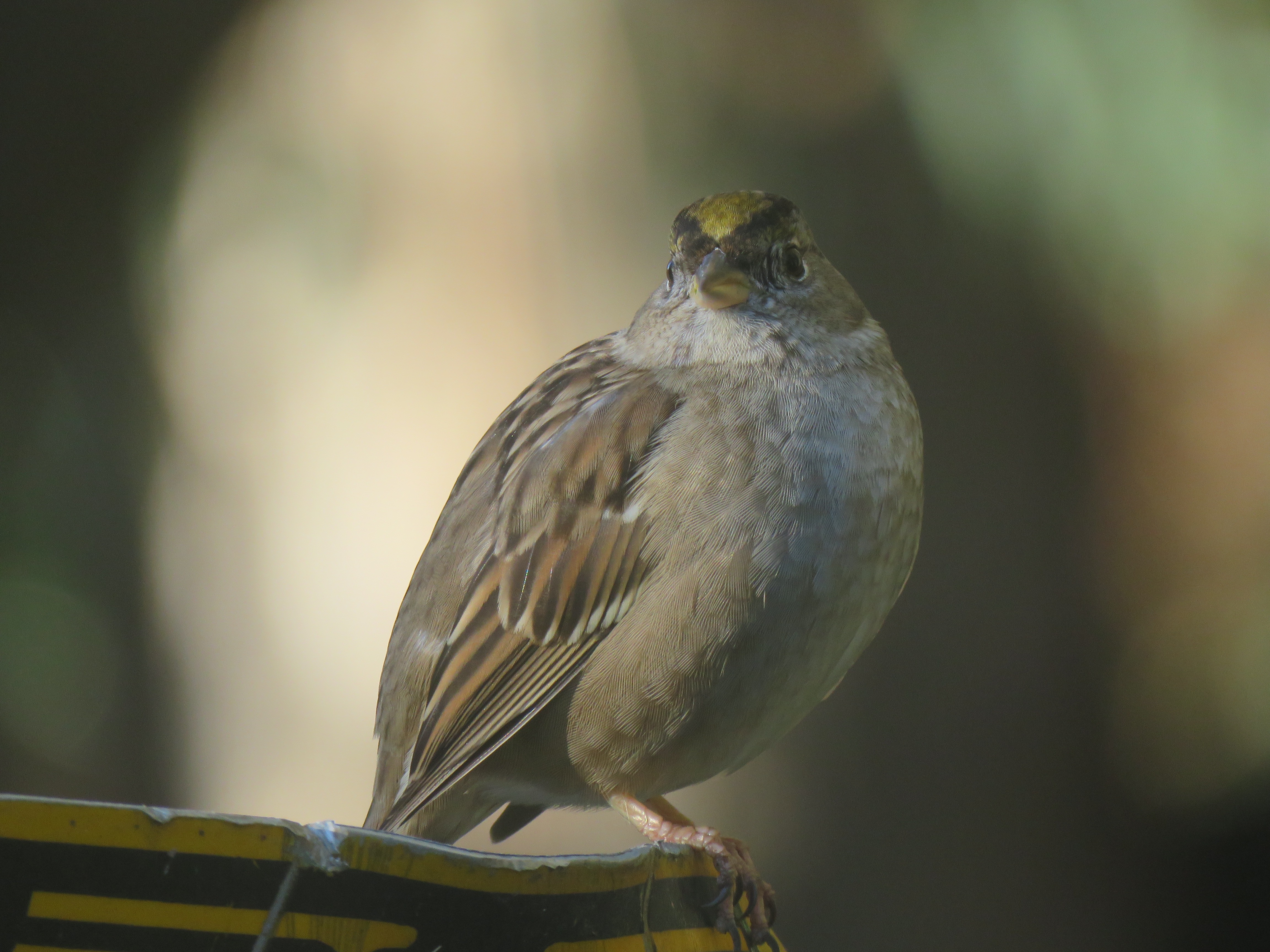
On the right side of the trail was a golden-crowned sparrow perched on a sign. This was a good sign. I was hoping the white-throated was loosely associating with other sparrows.

Golden-crowned sparrow.

I saw a sparrow fly into the eucalyptus about ten feet high. I tried to get a better vantage point. I got bins on the bird: white suplercilium, yellow lores, and the the distinctive white throat! A new county lifer: white-throated sparrow.

White-crowned sparrow singing in the eucs.
Image

Santa Cruz County Beach Birding

A towhee had taken up winter quarters on Laguna Creek Beach. This beach is close to Davenport on Highway One and 10.2 miles from my cabin (I checked).

Two towhees, a large, sparrow-type bird, are common on the California Coast. The appropriately named California towhee and the spotted towhee. Neither of these two species were the reason I headed north on Highway One on a Saturday morning.

I was here, hiking into a headwind on a sunny but blustery winter’s morning, to see a rare towhee on the coast. It is said that every bird is rare somewhere and the green-tailed towhee is rare here on the California coast. I have seen many green-tailed towhees at elevation in the Sierra Nevada Mountains but I was going to attempt to add this species to my Santa Cruz County list. I wanted a green-tailed towhee at sea level!

Who knows how long this wayward towhee had been on the Santa Cruz Coast but on January 12, 2021, two birders happened to be birding this beach and also happened to know that this towhee was out of place in this location. They reported it and other birders searched for it, some getting momentary looks of this sulky towhee. There where even less quality photos of this ever-moving and scrub-loving bird.

So the bar was low for a quality sighting and capturing great photos was an even lower bar. That’s if I didn’t whiff on this towhee altogether, for any sighting is never guaranteed. As one birder noted, “Ducked into a bush and never reappeared.”

The bird was seen on the northern part of the beach, north of the creek and just left of an “AREA CLOSED” sign. The sight was described as being where the sand meets a six foot high cliff. So here I was, peering into the bushes. Flanked by two nude male sunbathers.

The first bird I saw was a blue-grey gnatcatcher as is foraged and called at eye level in the coyote brush.

I turned on my bluetooth speaker and selected a recording of the towhee’s “cat-like ‘mew'” call. I hit play and after a single call, the green-tailed towhee shot out of a bush in front of me and stood before me on the sand. Sometimes birding is just this easy.

I had amazing views of the towhee as it foraged on the sand and I was able to get great photos in amazing light. The towhee stayed out in the open for about two minutes before disappearing into the coastal brush.

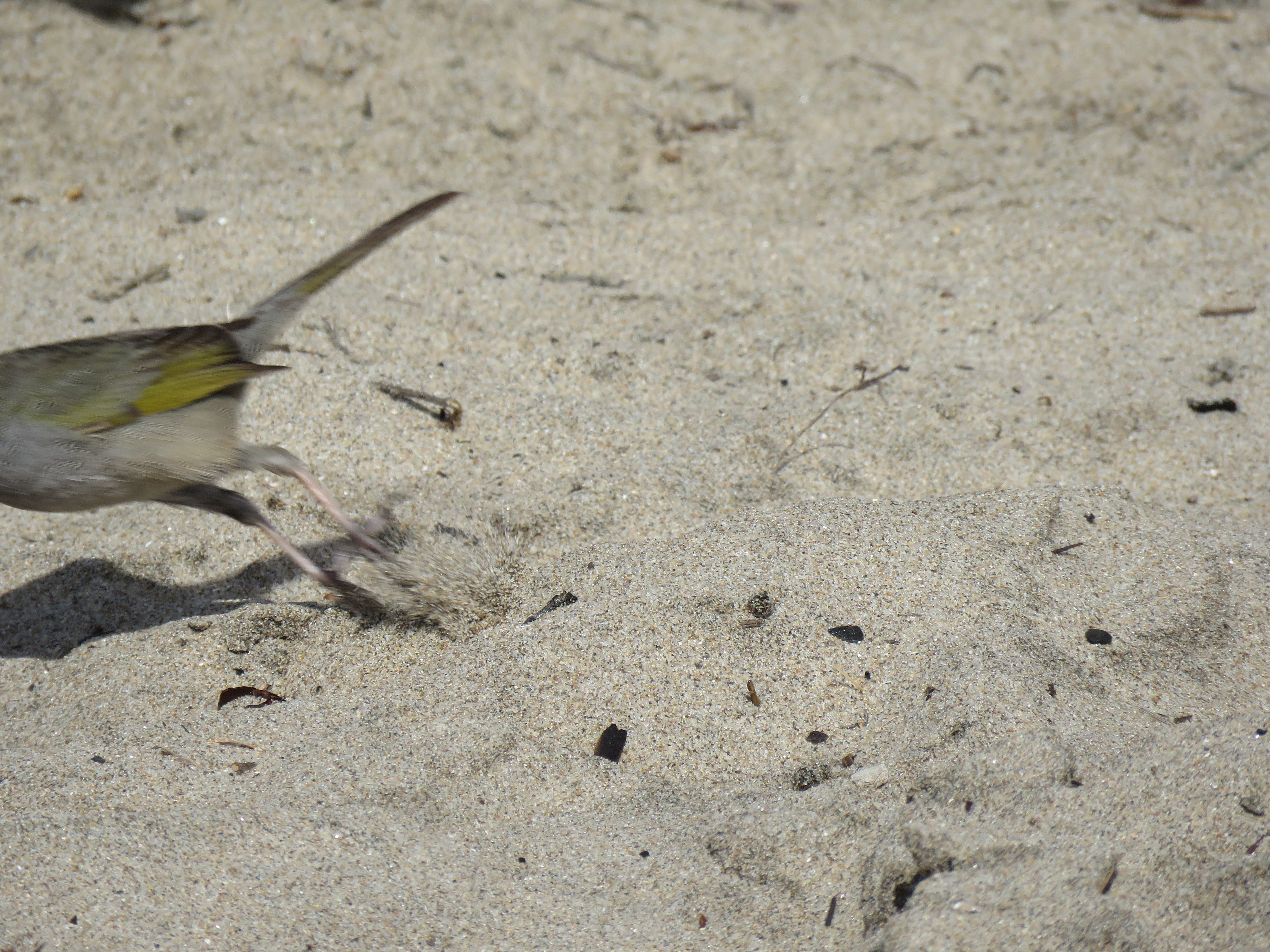
This photo proves just how elusive the green-tailed towhee can be! Now you see it, now you don’t. You have to be quick to photograph this bird.
The green-tailed towhee with it’s rufous crest, white throat, and greenish wings. This bird almost seems to be posing for me.
The profile view would have made Roger Tory Peterson proud. Here you can see the greenish tail.

Image

Saw-whet in Paradise

In mid- January, my neighbor from down the hill from my cabin, emailed me that she heard an owl calling, just after dark.

She thought it could be a saw-whet or a western screech-owl. On following evenings the mystery owl called again and again, just after dark. She confirmed that she thought that the owl calling was a northern saw-whet owl (Aegolius acadicus)!

This would be an amazing Santa Cruz County bird to add to my list and especially so to hear this diminutive owl in my own backyard! Well, close to it anyway.

The Northern saw-whet owl is can be common or uncommon resident of the California coast, favoring mixed conifers and deciduous woods. This owl may be much more common than believed because if it isn’t calling, this owl goes undetected. It is one of our smallest owls with a length eight inches and weighing in at 2.8 ounces. In other words, this owl weights as much as three standard sized envelopes.

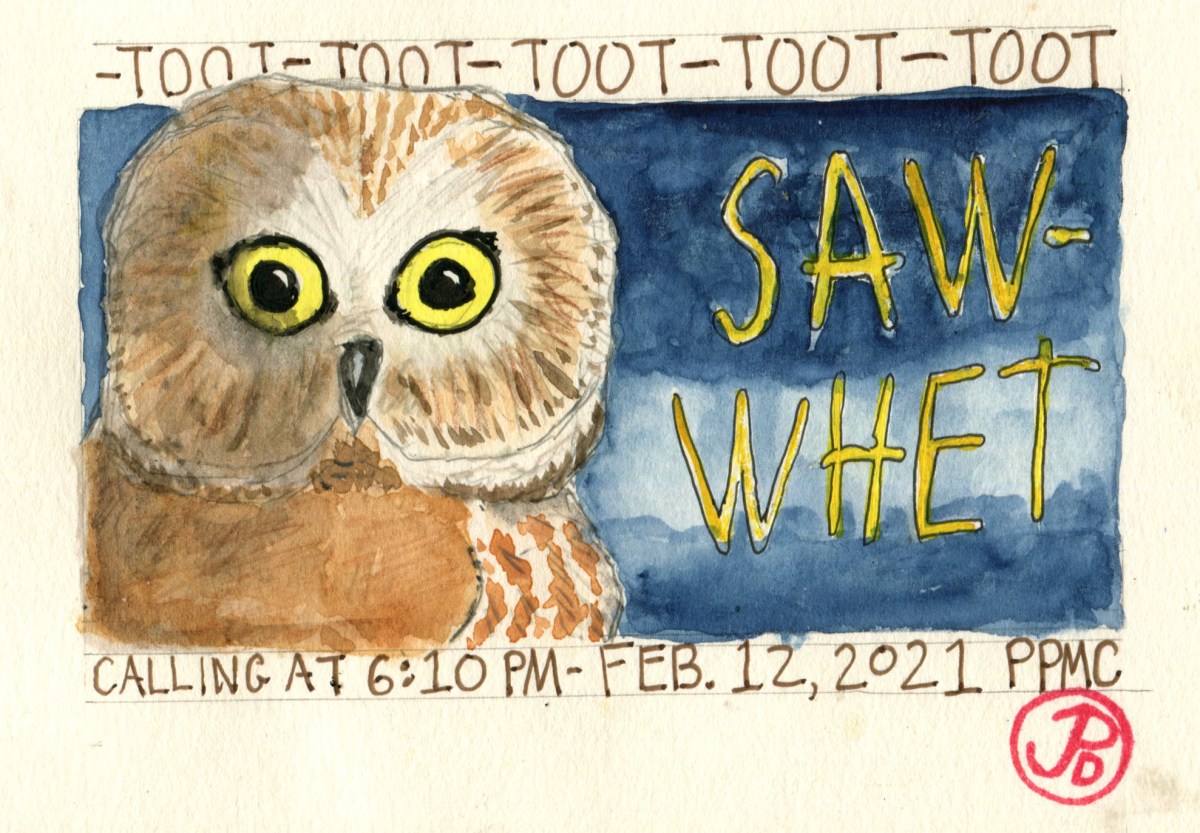
The northern saw-whet gets its common name because it’s incessant “toot-toot-toot” territorial call that reminded early ornithologists of the whetting or sharpening of a saw; a common sound in the forests as lumberjacks felled trees to fuel a growing nation.

I have never heard a saw-whet call in Paradise Park. This may be because wildlife has been displaced by the destructive CZU Lighting Complex Fire. This fire burned in the late summer of 2020 for 44 days, consuming almost 400,000 acres of the western side of the Santa Cruz Mountains. Some of those animals are now wildfire refugees and are now establishing a new territories.

I planned to head down to Santa Cruz and do some owling, to see if I could confirm the existence of a saw-whet in Paradise Park. So I set out at 5:30 PM and walked around as the diurnal birds stopped calling, one by one as they sought out their nighttime roosts. The last diurnal call was the “chip” of a California towhee. It was now time for the night shift.

I centered my search at the picnic grounds. This is where my neighbor had recently heard the saw-whet. Now it was a matter of waiting a time with patience. A time to focusing the senses, to filter out the sounds of traffic on Highway 9 and seek the repetitive toots of the saw-whet.

At 6:10 I heard the first call of the saw-whet. It seemed distant and tough to locate. The saw-whet’s call is very loud for such a small bird, it can be heard from half a mile away.

I moved along the road to try and locate the owl, but as always, owls are elusive. At times it seemed the saw-whet was close and at other times far. As if the owl was frequently changing locations. In reality the owl was probably changing the dynamics of it’s song. It would be silent for a short time and then resume it’s name token song. I now had a new Santa Cruz County bird in my own backyard!

On Saturday evening, I went out for another owling ramble, to reconfirm the saw-whets presence in my world. Would I hear it two nights in a row? I also wanted to get a better sound recording of the owl. The evening before I recorded a faint but distinctive recording.

This time I set out a little later. I was at the picnic grounds at 6:30 pm and it wasn’t long before I heard the saw-whet calling up the hill.

I walked up the road toward where I thought the sound was coming. Hanging from my belt loop was my bluetooth speaker (an indispensable piece of equipment for any tropical bird guide).

I was going to use a recorded call of a call-whet to try to bring the owl closer so I could get a better recording of it’s call. In birding terms this is called using “playback”. When I played the recording through the speaker, the saw-whet seemed to accelerate it’s song. The call was getting louder as if the owl was coming closer to my location.

An owl’s flight is silent so I could not hear if the saw-whet was flying towards me. But what I did hear was the owl’s wings brushing against the branches above me. I was able to get two recordings with my iPhone and then I left the saw-whet to it’s “day”of establishing it’s territory and hunting for small rodents.

Here is a link to my eBird checklist with the two recordings I made: https://ebird.org/checklist/S81289488

I headed back to my cabin, satisfied with my night revels but I had one last trick up my sleeve. I stopped outside my neighbor’s house and I turned my bluetooth speaker on and played the saw-whet call at full volume! Within a minute, she came out surprised that it was just me and not a saw-whet. I thanked her for telling me about the saw-whet owl in our backyard!

Image

Albatross

At length did cross an Albatross, 
Thorough the fog it came; 
As if it had been a Christian soul, 
We hailed it in God’s name.
 

~The Rime of the Ancient Mariner, Samuel Taylor Coleridge

“Into each life some rain must fall, but too much is falling in mine.”

~Ella Fitzgerald and the Inkspots

Albatross.

Most people know the word. Some know that it is a bird. Fewer know that is is a bird of the sea. And even fewer have ever seen one in the wild.

I have seen albatross. But only two species, of the almost 21 species that ride just above the seas. They are a bird to behold. Long and thin, graceful wings that rarely flap as they soar on the ocean’s winds. A turkey vulture of the seas.

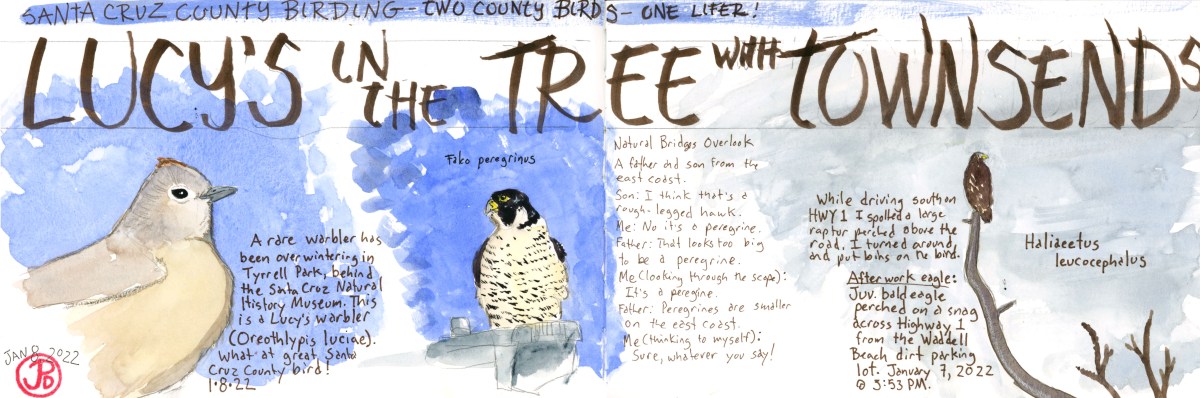
The most common albatross in the northeastern Pacific Ocean is the black-footed albatross (Phoebastria nigripes). It is uncommon to see Laysan albatross on an all day pelagic boat trip.

I had booked a pelagic trip out of Santa Cruz Harbor that was scheduled for August 30th. This trip was sponsored by the Santa Cruz Bird Club (founded in 1956) and was open to members only. The trip was limited to 18 birders because of the continuing pandemic. It sold out in a very short time.

This trip is a reconstituted version of a very popular “Albatross Trip” which was an annual pelagic trip first taken by the club in the 1950’s. As many as 60 club members would depart the Municipal Wharf in June on one of the Stagnero’s fishing boats. They headed out 12 miles to the rock cod fishing grounds and the bird on everyone’s wish list was black-footed albatross.

The albatross is the figurehead of the Santa Cruz Bird Club. Since the club’s inception in 1956, the newsletter is named “Albatross”. And the only way to see an albatross in Santa Cruz County is to get on a boat and head offshore. Most pelagic birding trips leave from Monterey and not Santa Cruz. So this Santa Cruz pelagic trip was a rare treat.

Albatross is a species I like to see at least once a year and I have never recorded a black-footed in Santa Cruz County waters and this pelagic trip was my chance! Along the way to the fishing grounds we also had a chance to pick up shearwaters, storm-petrels, jaegers, skua, murrelets, Sabine’s gull, and Arctic tern.

An adult black-footed albatross seen on an August 17, 2018 pelagic trip off the coast of San Mateo.

And then came a fierce, dry electric storm on the morning of Sunday, August 16. I was at my cabin the Santa Cruz Mountains and I first heard the deep rumble of thunder at 3 AM. This was a rare treat in the Coastal Region of California: thunder and lighting. I walked out on my deck and reveled in the sights and sounds of the power of nature.

This treat came with a trick. Lighting struck the extremely dry earth many times and ignited a forest fire, that was named the CZU Lighting Complex. At the time of writing the fire has consumed 78,769 acres and had been burning for eight days. 330 structures had been destroyed, including the Big Basin State Park Visitor’s center and taken one human life. (There is no tally for the lives of trees, plants, and animals killed in the fire.)

So with distance learning starting during a global pandemic, and a fire slowly creeping towards the cabin that has been in my family for almost 80 years I was especially looking forward to the opportunity to escape to the sea and look at the marine life; the whales, dolphins, and pelagic birds (including the black-footed albatross).

But it was not meant to be as the trip was postponed because of the wildfire and the displacement caused by mandatory evacuations in Santa Cruz County.

But this gives me hope. The fire is now 17% contained and I look forward to heading out to sea with the Santa Cruz Bird Club to see our first albatross appear through the rolling waves!

Image

Black Swift

Birding is a form of maddness.

It can make us wake at ungodly hours, spend ten hours in an ocean going fishing boat, or drive hours to search for a rarity! All for adding birds to a list or seeing a species for the first time.

This evening I was driven to hike a mile through fields and farmhouse to stand at the edge of the ocean, my face to the wind (a small sacrifice I know). I was standing above the sea caves at Sand Hill Bluff, about five miles from the city limits of Santa Cruz.

The caves are used as a nesting and roosting site for a Santa Cruz County target bird: the black swift (Cypseloides niger).

The black swift is our largest swift and is not often seen because it forages for insects high up in the air column, sometimes as high as 10,000 feet. They live much of their life on the wing, including copulating on the wing. But they return to terra firma to roost and nest. They have a limited distribution in North America, hugging the western side of the continent. Sadly, the black swift population has diminished by 90% since 1970.

I arrived on the bluff at 6:30. The black swifts seemed to be returning to roost just before sunset, which was going to be at 8:10, so I had a little time to wait.

I reflected on the fact that there is so much that is unknown about the black swift. It’s nest was left undiscovered until 1901 when a swift nest was found on the cliffs near Santa Cruz.

After reflecting I set up my sketching stool and sketched the cliffs looking west (featured sketch). Western gulls and Brandt’s cormorants where roosting on the rocks and off shore a steady line of sooty shearwaters where heading west. I estimated that there might be 2,000 shearwaters in this flock. Closer in, there where four sea otter foraging in the kelp beds.

At about seven I was joined by another madman, err, I mean birder. He had come from Sacramento to see the appearance of the black swift. It is always great to have a second set of eyes. In the past the swifts appear for a short time before flying into the sea caves to roost.

At about 7:30 I noticed an uptick in bird movement. The movement of westward sooty shearwaters had diminished and disappeared. The always vocal Caspian terns were heading east to their roost sites and long lines of “checkmark” formations of brown pelicans were flying low over the water heading west. I was waiting with anticipation as I scanned the skies for the arrival of the black swifts. Nothing yet.

At 7:55 PM, the Sacramento birder alerted me of the presence of a lone swift that disappear into a sea cave. I missed it. This was followed quickly by two other swifts that flew just east of the bluff and stayed in sight for about four minutes. County lifer 210!

Image

The Voices of the Steller’s Jay

Depth and nuance. That is something I strive for when journalling and sketching. And spending time in nature, on my deck in the Santa Cruz Mountains, for instance, really deepens my understanding and appreciation of nature.

Depth and nuance. When the casual observer, if they are observing at all, will hear the loud call of the Steller’s jay they might describe their call as “jarring”, “annoying”, “unmusical”, or “head-splitting”. But spending time with these birds really makes you love the depth, variety, and dynamics of this western jay’s vocabulary.

For me, this comes with time and awareness. Depth of time and the nuance of the subtlety of sounds these birds produce.

One morning, when the Steller’s jays were thick around the trees near the suet feeder, I decided to log the different sounds the jays made during a 15 minute interval. I tried to give a name or a onomatopoeia facsimile of the sounds I was hearing. Purely a subjective and unscientific exercise but a fun one at that!

The jays were especially vocal and I could only wonder at the meanings of their varied sounds. Even ornithologists do not fully understand the meaning of all the Steller’s jay’s calls. Why, for instance, do they imitate the red-tailed and red-shouldered hawk call?

In the space of 15 minutes, I counted about 15 different calls. I scribbled down in those 15 minutes calls such as: Faster chirp, Red-shouldered Call, rusty huge (Old gear), One grunt, Alarm clock (old school), tri-chump, Accelerated tri-chump, shirk-shirk-shirk, Reep!, red-shoulder whisper, silent whispser-ramble, Reet-Reeet!, and Ray-gun.

The “Reet-Reeet!” call was the call that called attention to an avian predator is close proximity. This was most likely the local Cooper’s hawk. This warning call not only alerted other Steller’s jays of the threat but also other birds in the area that seemed to know the jay’s warning cry.

Pygmy nuthatches can be tough to photograph well in low light because they are always in constant motion and images contain lots of motion blur. That is not the case then the nuthatches are frozen.

A few days before I noticed two frozen pygmy nuthatches on and near the suet feeder. Upriver I heard the masses mobbing calls of the Steller’s jay. This seem to be a warning that there was a predator in the area. I wondered what makes a pygmy nuthatch freeze? Was this a response to a predator in the area, just to hold absolutely still.

This is the duality of the Steller’s jay. On one hand they are nest robbers and on the other, they are the avian warning system of the confer forest than saves other bird’s lives.