Image

Albatross

At length did cross an Albatross, 
Thorough the fog it came; 
As if it had been a Christian soul, 
We hailed it in God’s name.
 

~The Rime of the Ancient Mariner, Samuel Taylor Coleridge

“Into each life some rain must fall, but too much is falling in mine.”

~Ella Fitzgerald and the Inkspots

Albatross.

Most people know the word. Some know that it is a bird. Fewer know that is is a bird of the sea. And even fewer have ever seen one in the wild.

I have seen albatross. But only two species, of the almost 21 species that ride just above the seas. They are a bird to behold. Long and thin, graceful wings that rarely flap as they soar on the ocean’s winds. A turkey vulture of the seas.

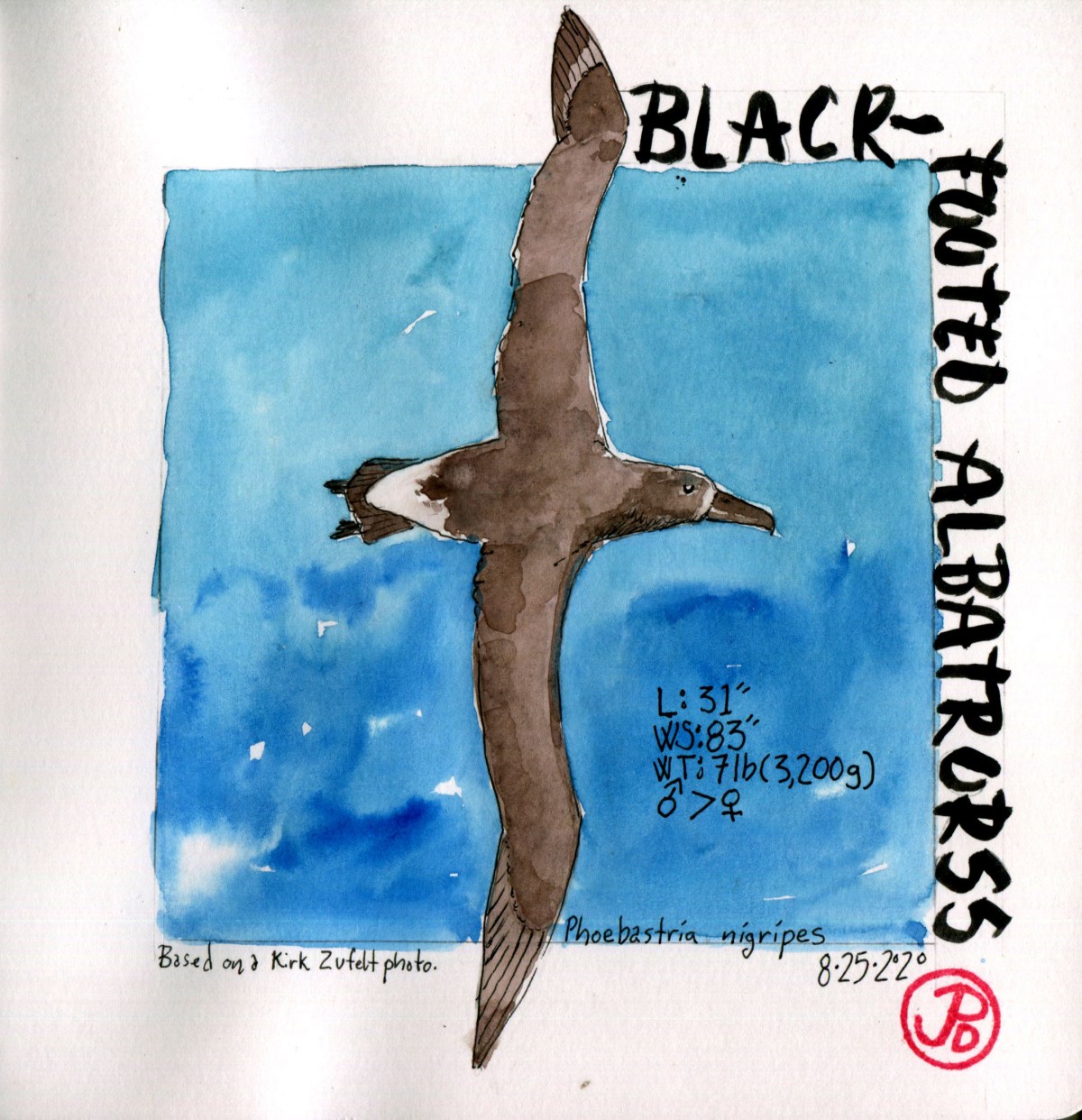
The most common albatross in the northeastern Pacific Ocean is the black-footed albatross (Phoebastria nigripes). It is uncommon to see Laysan albatross on an all day pelagic boat trip.

I had booked a pelagic trip out of Santa Cruz Harbor that was scheduled for August 30th. This trip was sponsored by the Santa Cruz Bird Club (founded in 1956) and was open to members only. The trip was limited to 18 birders because of the continuing pandemic. It sold out in a very short time.

This trip is a reconstituted version of a very popular “Albatross Trip” which was an annual pelagic trip first taken by the club in the 1950’s. As many as 60 club members would depart the Municipal Wharf in June on one of the Stagnero’s fishing boats. They headed out 12 miles to the rock cod fishing grounds and the bird on everyone’s wish list was black-footed albatross.

The albatross is the figurehead of the Santa Cruz Bird Club. Since the club’s inception in 1956, the newsletter is named “Albatross”. And the only way to see an albatross in Santa Cruz County is to get on a boat and head offshore. Most pelagic birding trips leave from Monterey and not Santa Cruz. So this Santa Cruz pelagic trip was a rare treat.

Albatross is a species I like to see at least once a year and I have never recorded a black-footed in Santa Cruz County waters and this pelagic trip was my chance! Along the way to the fishing grounds we also had a chance to pick up shearwaters, storm-petrels, jaegers, skua, murrelets, Sabine’s gull, and Arctic tern.
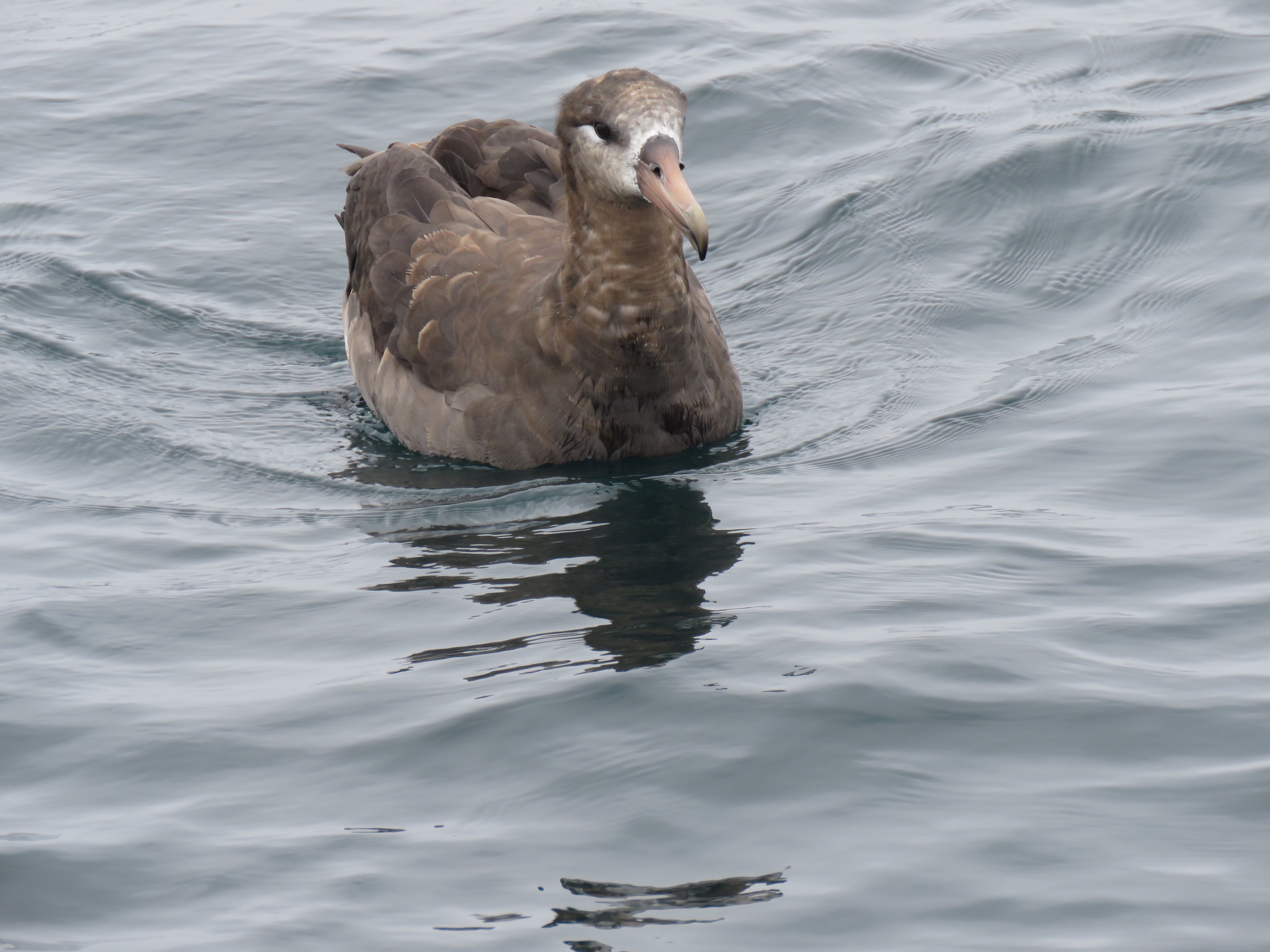
An adult black-footed albatross seen on an August 17, 2018 pelagic trip off the coast of San Mateo.

And then came a fierce, dry electric storm on the morning of Sunday, August 16. I was at my cabin the Santa Cruz Mountains and I first heard the deep rumble of thunder at 3 AM. This was a rare treat in the Coastal Region of California: thunder and lighting. I walked out on my deck and reveled in the sights and sounds of the power of nature.

This treat came with a trick. Lighting struck the extremely dry earth many times and ignited a forest fire, that was named the CZU Lighting Complex. At the time of writing the fire has consumed 78,769 acres and had been burning for eight days. 330 structures had been destroyed, including the Big Basin State Park Visitor’s center and taken one human life. (There is no tally for the lives of trees, plants, and animals killed in the fire.)

So with distance learning starting during a global pandemic, and a fire slowly creeping towards the cabin that has been in my family for almost 80 years I was especially looking forward to the opportunity to escape to the sea and look at the marine life; the whales, dolphins, and pelagic birds (including the black-footed albatross).

But it was not meant to be as the trip was postponed because of the wildfire and the displacement caused by mandatory evacuations in Santa Cruz County.

But this gives me hope. The fire is now 17% contained and I look forward to heading out to sea with the Santa Cruz Bird Club to see our first albatross appear through the rolling waves!
Image

Black Swift

Birding is a form of maddness.

It can make us wake at ungodly hours, spend ten hours in an ocean going fishing boat, or drive hours to search for a rarity! All for adding birds to a list or seeing a species for the first time.

This evening I was driven to hike a mile through fields and farmhouse to stand at the edge of the ocean, my face to the wind (a small sacrifice I know). I was standing above the sea caves at Sand Hill Bluff, about five miles from the city limits of Santa Cruz.

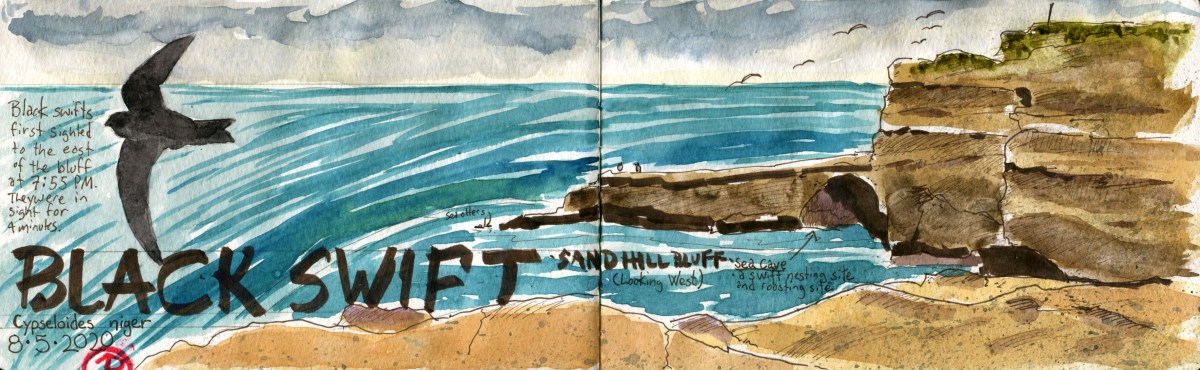
The caves are used as a nesting and roosting site for a Santa Cruz County target bird: the black swift (Cypseloides niger).

The black swift is our largest swift and is not often seen because it forages for insects high up in the air column, sometimes as high as 10,000 feet. They live much of their life on the wing, including copulating on the wing. But they return to terra firma to roost and nest. They have a limited distribution in North America, hugging the western side of the continent. Sadly, the black swift population has diminished by 90% since 1970.

I arrived on the bluff at 6:30. The black swifts seemed to be returning to roost just before sunset, which was going to be at 8:10, so I had a little time to wait.

I reflected on the fact that there is so much that is unknown about the black swift. It’s nest was left undiscovered until 1901 when a swift nest was found on the cliffs near Santa Cruz.

After reflecting I set up my sketching stool and sketched the cliffs looking west (featured sketch). Western gulls and Brandt’s cormorants where roosting on the rocks and off shore a steady line of sooty shearwaters where heading west. I estimated that there might be 2,000 shearwaters in this flock. Closer in, there where four sea otter foraging in the kelp beds.

At about seven I was joined by another madman, err, I mean birder. He had come from Sacramento to see the appearance of the black swift. It is always great to have a second set of eyes. In the past the swifts appear for a short time before flying into the sea caves to roost.

At about 7:30 I noticed an uptick in bird movement. The movement of westward sooty shearwaters had diminished and disappeared. The always vocal Caspian terns were heading east to their roost sites and long lines of “checkmark” formations of brown pelicans were flying low over the water heading west. I was waiting with anticipation as I scanned the skies for the arrival of the black swifts. Nothing yet.

At 7:55 PM, the Sacramento birder alerted me of the presence of a lone swift that disappear into a sea cave. I missed it. This was followed quickly by two other swifts that flew just east of the bluff and stayed in sight for about four minutes. County lifer 210!

Image

The Voices of the Steller’s Jay

Depth and nuance. That is something I strive for when journalling and sketching. And spending time in nature, on my deck in the Santa Cruz Mountains, for instance, really deepens my understanding and appreciation of nature.

Depth and nuance. When the casual observer, if they are observing at all, will hear the loud call of the Steller’s jay they might describe their call as “jarring”, “annoying”, “unmusical”, or “head-splitting”. But spending time with these birds really makes you love the depth, variety, and dynamics of this western jay’s vocabulary.

For me, this comes with time and awareness. Depth of time and the nuance of the subtlety of sounds these birds produce.

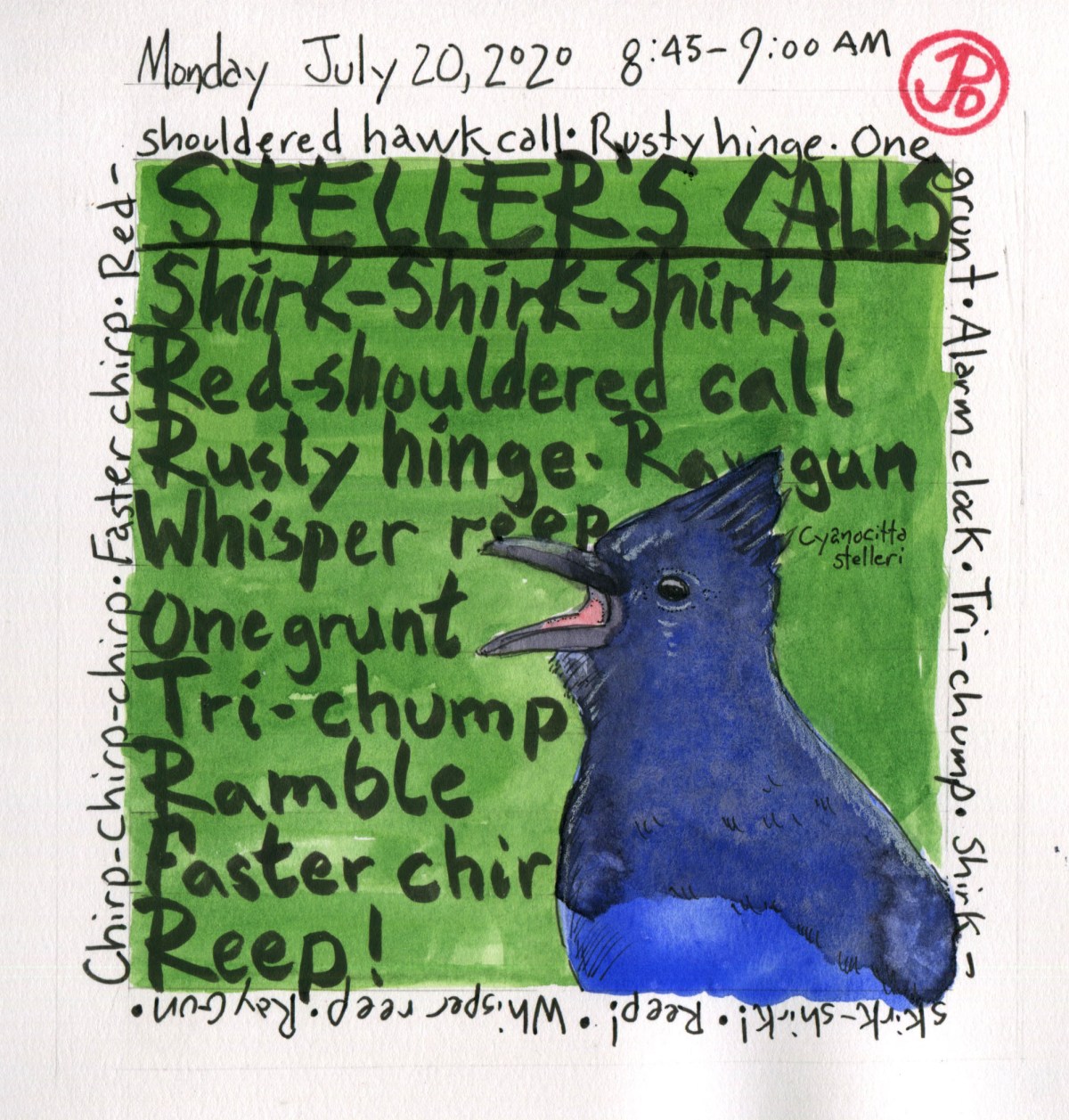
One morning, when the Steller’s jays were thick around the trees near the suet feeder, I decided to log the different sounds the jays made during a 15 minute interval. I tried to give a name or a onomatopoeia facsimile of the sounds I was hearing. Purely a subjective and unscientific exercise but a fun one at that!

The jays were especially vocal and I could only wonder at the meanings of their varied sounds. Even ornithologists do not fully understand the meaning of all the Steller’s jay’s calls. Why, for instance, do they imitate the red-tailed and red-shouldered hawk call?

In the space of 15 minutes, I counted about 15 different calls. I scribbled down in those 15 minutes calls such as: Faster chirp, Red-shouldered Call, rusty huge (Old gear), One grunt, Alarm clock (old school), tri-chump, Accelerated tri-chump, shirk-shirk-shirk, Reep!, red-shoulder whisper, silent whispser-ramble, Reet-Reeet!, and Ray-gun.

The “Reet-Reeet!” call was the call that called attention to an avian predator is close proximity. This was most likely the local Cooper’s hawk. This warning call not only alerted other Steller’s jays of the threat but also other birds in the area that seemed to know the jay’s warning cry.

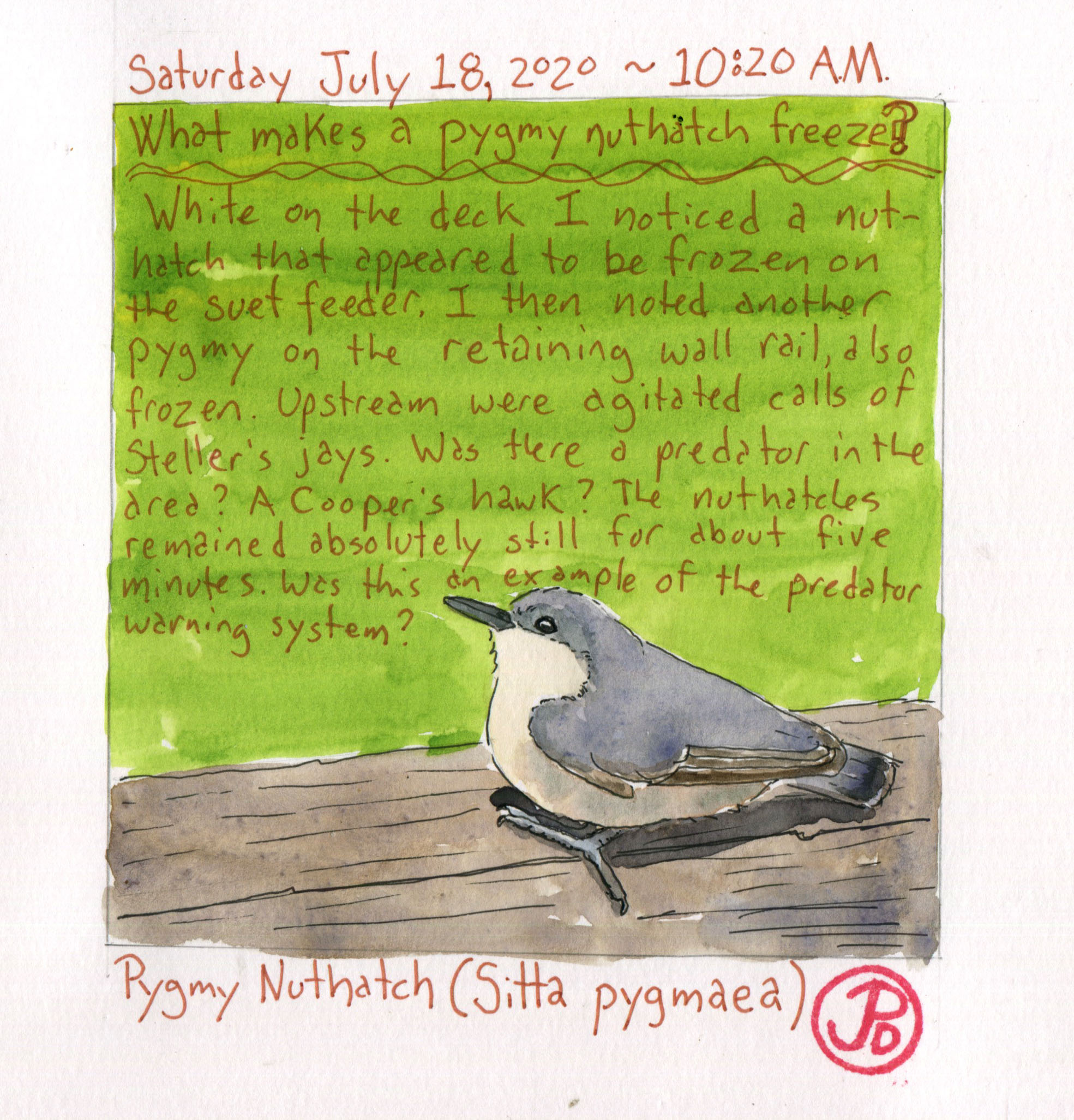
Pygmy nuthatches can be tough to photograph well in low light because they are always in constant motion and images contain lots of motion blur. That is not the case then the nuthatches are frozen.

A few days before I noticed two frozen pygmy nuthatches on and near the suet feeder. Upriver I heard the masses mobbing calls of the Steller’s jay. This seem to be a warning that there was a predator in the area. I wondered what makes a pygmy nuthatch freeze? Was this a response to a predator in the area, just to hold absolutely still.

This is the duality of the Steller’s jay. On one hand they are nest robbers and on the other, they are the avian warning system of the confer forest than saves other bird’s lives.

Image

DIY Birdbath

I wanted to add a new birdy feature to my cabin so headed to the local hardware and garden stores for a birdbath.

Some stores were out of stock while other had baths that were of the cutesy type with frog or bird figurines on the rim. These baths were about three feet of the ground. There was one bath that caught my attention, it was shaped like a whale’s tail rising out of the ground but the high price tag had me moving on.

I finally went to the local big box hardware store thinking they would have a large selection of birdbaths; they did not.

Now it was time for Plan B: which was to repurpose something in the garden section that was not designed as a birdbath. I was drawn to a large 16 inch terra cotta saucer. The type of saucer that you would rest a large pot on. This seemed to me to make a perfect birdbath that could be placed in the ground.

I placed the saucer in the middle of the freshly weeded dirt patch between my cabin and my neighbors. I leveled the ground with a spade and set the bath so it was slightly unleveled, so there was a “kiddie” end and a deep end. In the deep end I placed four small rocks, I was thinking of them as the ladder at the deep end. I then stabilized the bird bath with larger stones and rocks.

Now it was time to fill it with water and wait for the first bathers. I figured it would take a good two week before the local birds became used to the new water feature in their environment.

A song sparrow was the first bird I saw using the birdbath. Not to bathe but to drink.

I was away in Tahoe for a week and when I returned my neighbor reported that she had not seen any birds in bath but noted feathers in the bath and most of the water was gone. That was certainly promising news!

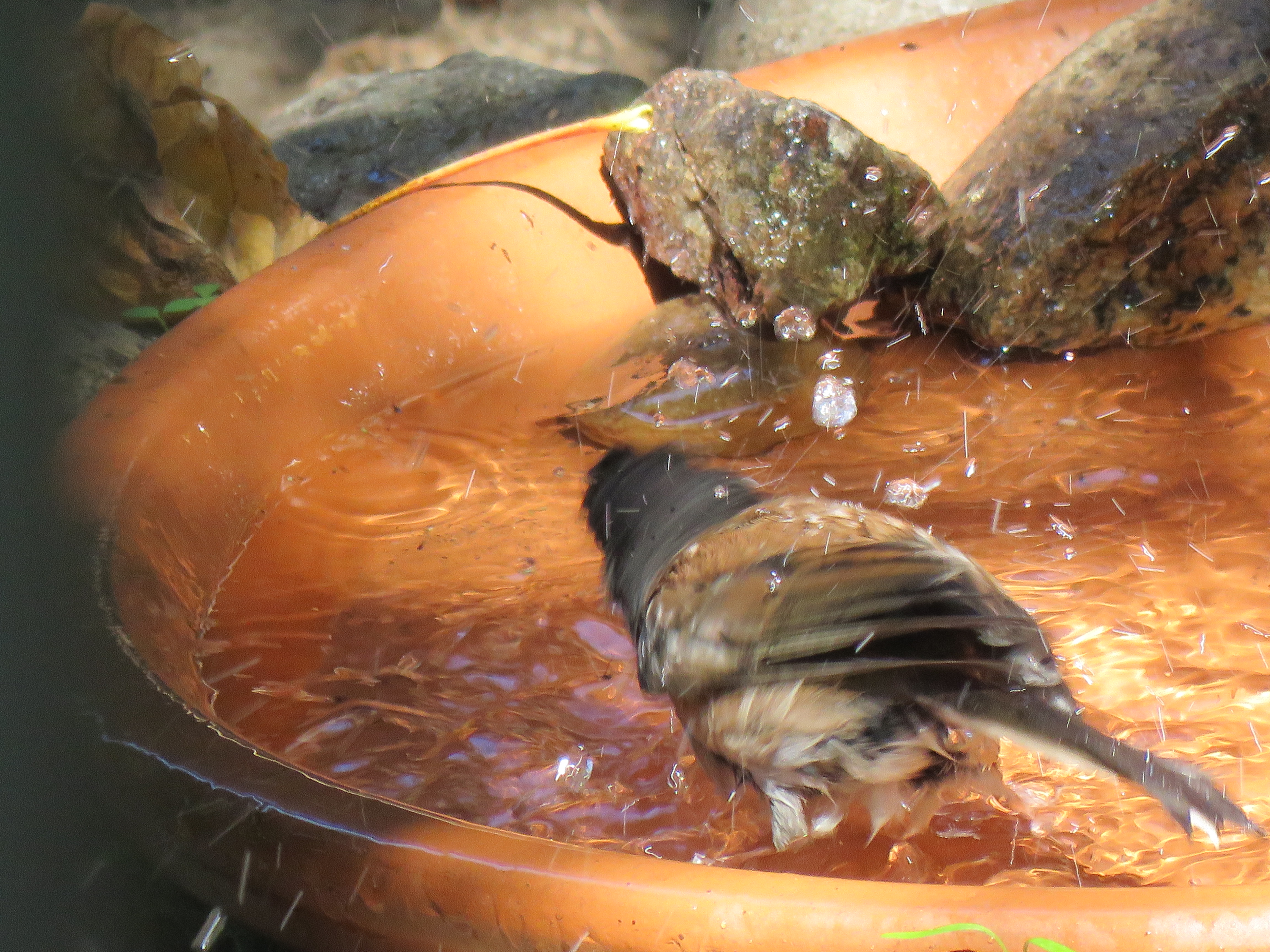
The first bird I saw using the bird bath was not a bather but a drinker. It was one of the local song sparrows coming in for a sip on a warm summer afternoon!

The first bather I saw came a few days later. It was a dark-eyed junco. There is nothing more enjoyable than watching a bird bathe, propelling water droplets in all directions.

A dark-eyed junco taking an afternoon bath!

I noted that the species that used the bath to bathe or as a drinking fountain were song sparrow, dark-eyed junco, and California towhee. These were bird species that spend time on or near the ground. I wondered if the bath was too low to the ground to be used by species that foraged further up in the trees, such as Steller’s jay, chestnut-backed chickadee, and pygmy nuthatch. It will be interesting to see if there birds could be lured down for a bath, especially on a warm summer’s afternoon.

A few days later I saw a California towhee taking a bath. It gives me such joy, in a joyless time, to see nature using something I’ve made. It’s just a small gesture to help species get along in life.

Image

Bat Map

I have always loved that crossover between the ariel insectivores, between the swallows and the bats. Between the diurnal and the nocturnal. In a word: twilight.

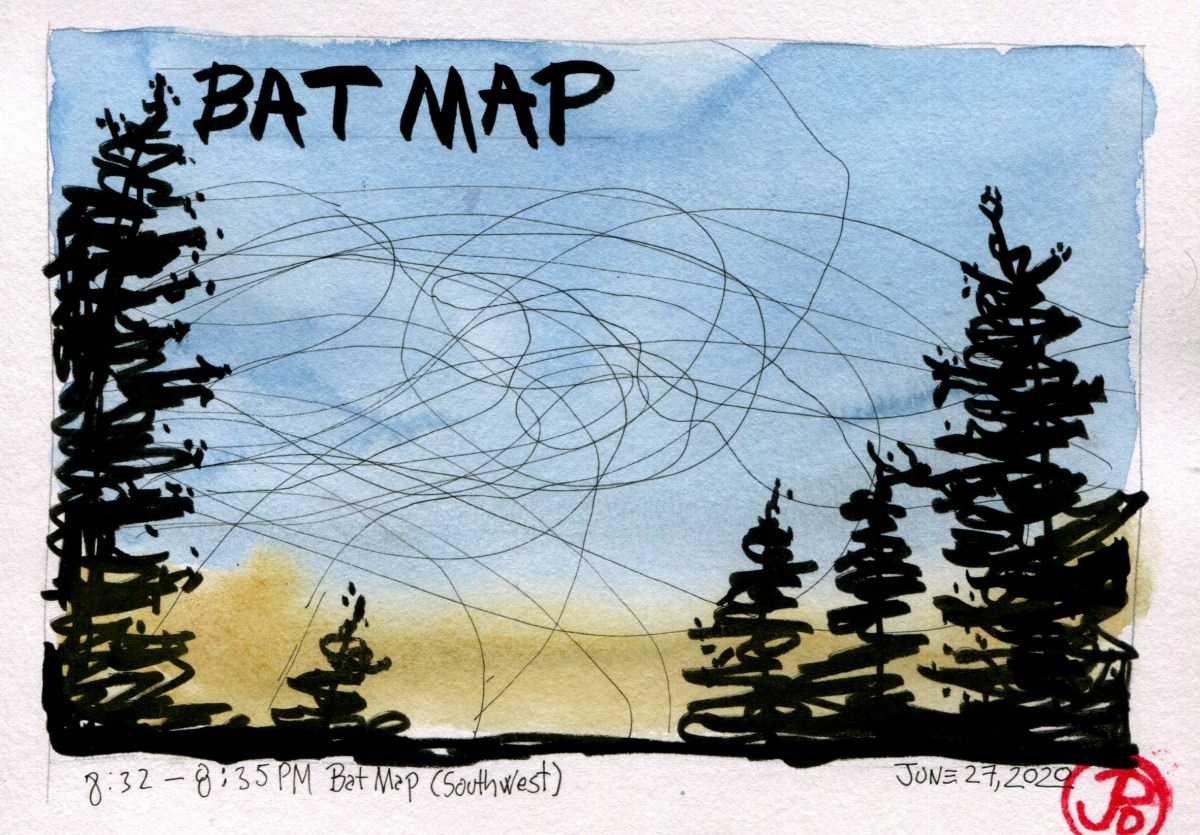
Looking to the southwestern skies, framed by silhouetted redwoods, I watched for the appearance of the first bat. The change over of swing to graveyard. At 8:30 PM there were still a few violet-green swallows catching insects on the wing. At 8:32 the unmistakeable flap-flap-flap of a flying mammal appeared from stage right, while the last swallow made it’s last foray. This is the time of the bats!

I wanted to sketch a bat map, a record of bat movement over a finite time period. I mean really finite, I mean three minutes.

Before the bats appeared, I sketched the silhouetted redwoods as a way to frame the composition and as a way to give me points of reference when it came time to map their flight across the sky.

I may be able to identify all the common species go birds by sight and sound that inhabit the area around my cabin but I have no clue how to identify the 12 common species of bats that live in Santa Cruz County. There are over 1,400 species bats worldwide and the are the second numerous order of mammals after rodents! I know, by default, that they are micro bats because mega bats don’t occur in North America.

Once the two bats appeared it was about going from the eye to the hand as I traced their path in the twilight sky, a sort of flittermouse Etch A Sketch. I felt like a vessel and the bats were dictating the line through their flight path. The bats were creating the sketch, I was just taking notes!

Image

Back to Basics: Graphite

Most of my sketches start with graphite (pencil) but soon disappears under ink work and watercolor and any stray graphite lines are erased.

My generation is very familiar with graphite in the form of the Number 2 pencil used to shade in answer sheets on standardized tests in school. An HB pencil is the equivalent to the old school Number 2 (I really shouldn’t say “old school” because the Number 2 pencil is the go-to pencil for my students today). The HB pencil is usually the first pencil I start with.

It was time to sketch with a form for drawing stemming from the 17th century. This form of mark making was given it’s name in 1789 by a German Mineralogist named Abraham Werner. Graphite comes from the Ancient Greek graphein, meaning to write or draw.

Sketching in graphite and painting in watercolor bears some similarities. Both conveys depth through the building up of layers and use the white of the paper for highlights. But graphite is much more forgiving, you can erase your mistakes in graphite and you can’t in watercolor. The nuances of blending the graphite with a blending tool such as a blending stump or tortillons, make etherial and realistic tonal transitions.

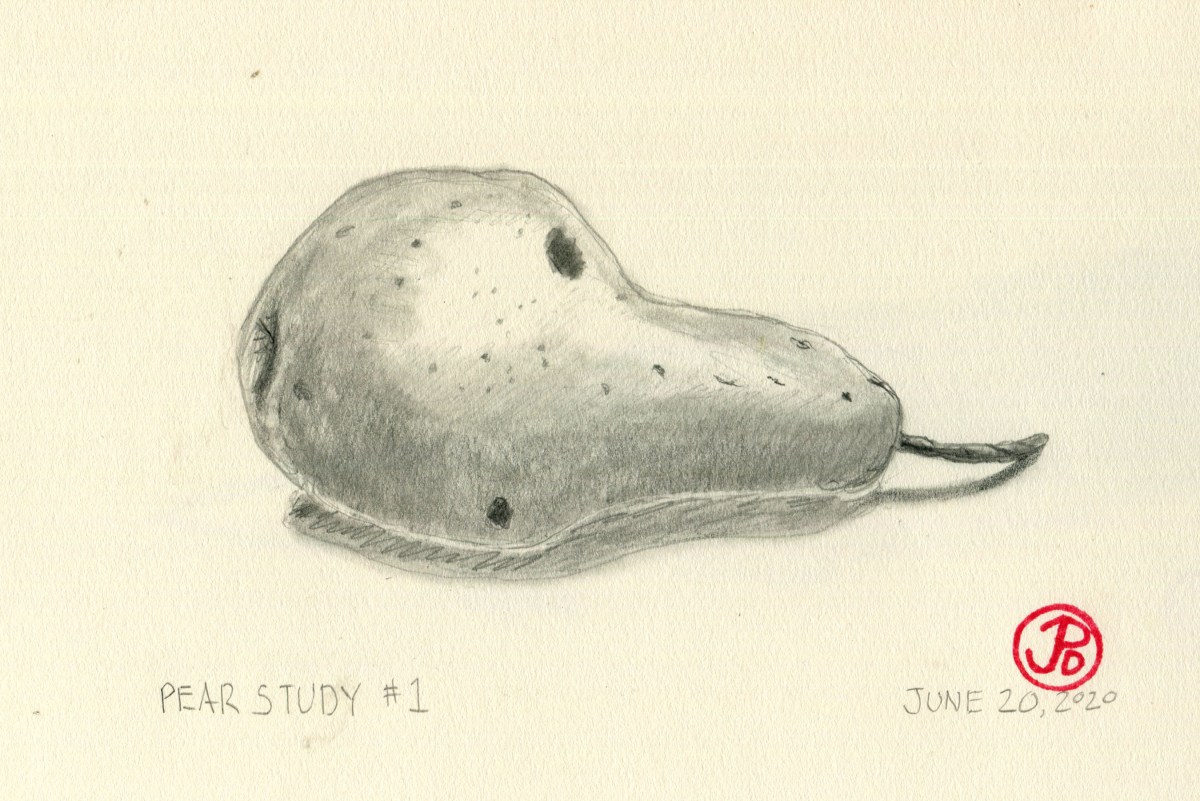
Now that Palace Arts was now open after three months, I headed over to Capitola to pick up some graphite drawing tools and drawing paper. On the way back to the cabin I stopped at Whole Foods to pick up two Bosc pears, not to eat, but to draw.

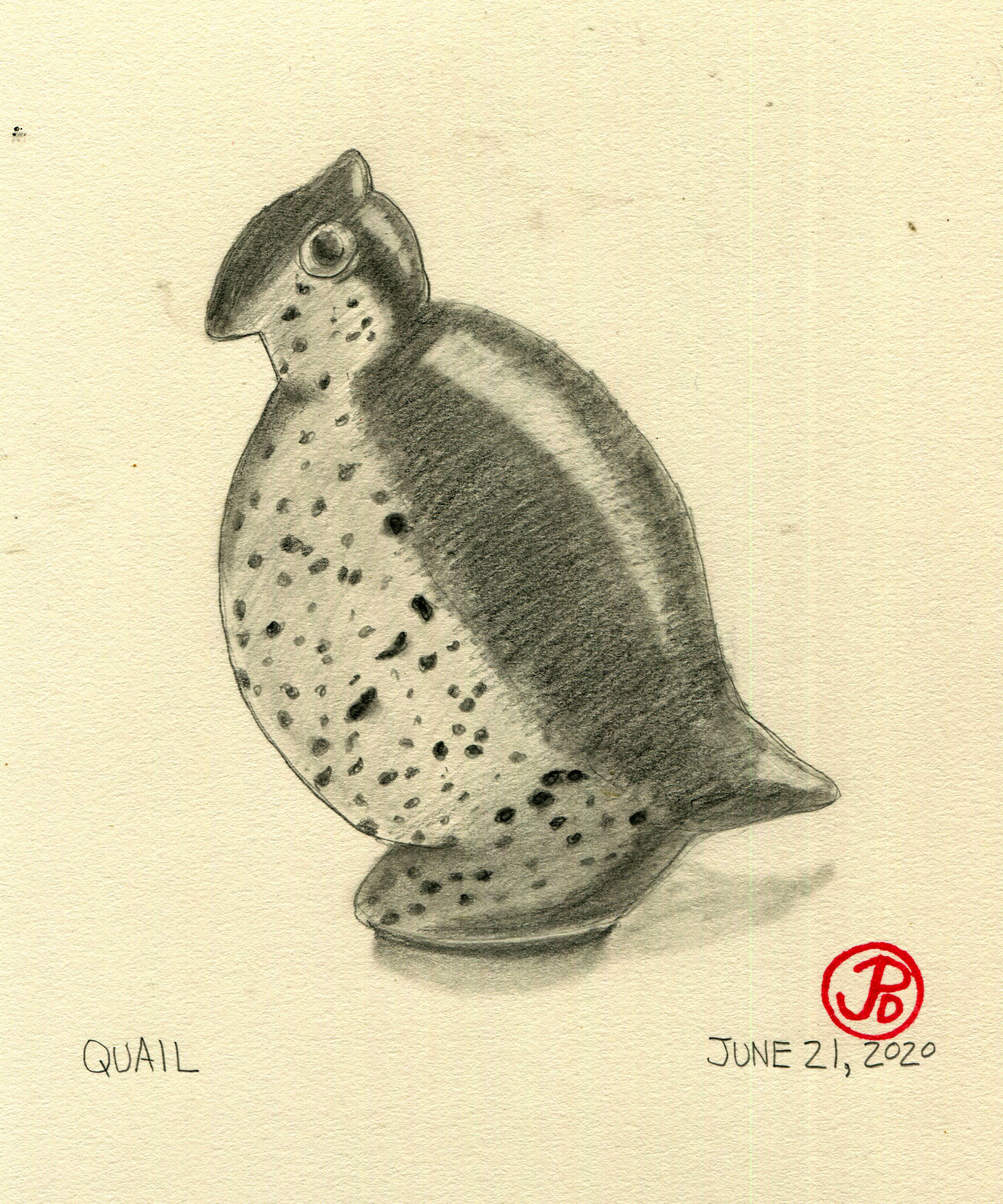
A graphic sketch of a quail sculpture that my grandma collected, I often hear the “Chicago” call of California’s state bird: the California quail from my deck.
Image

The Wreck of the La Feliz

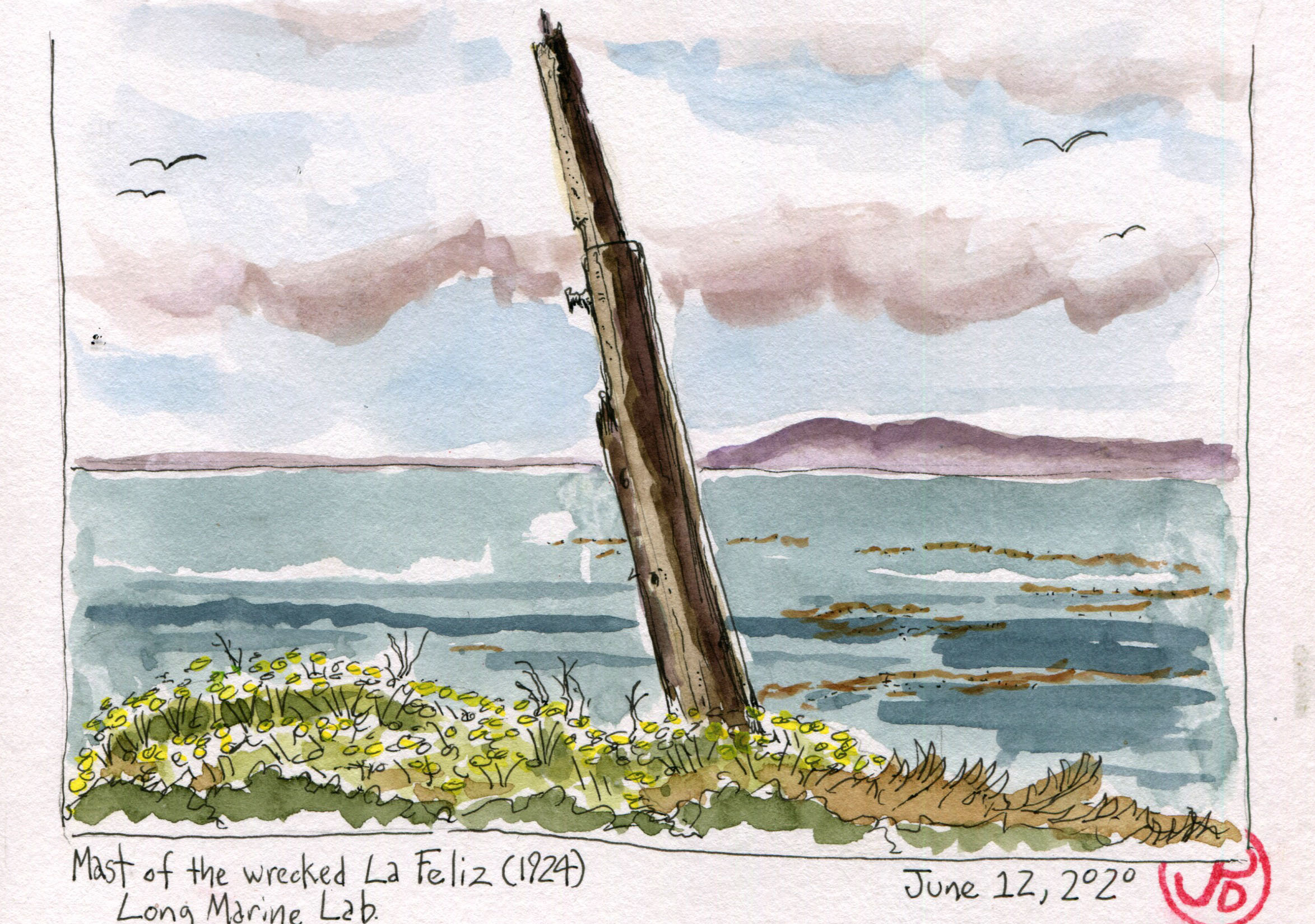
Along the Santa Cruz coast, just northwest of Natural Bridges State Beach, is a historic relic that is just shy of 100 years old.

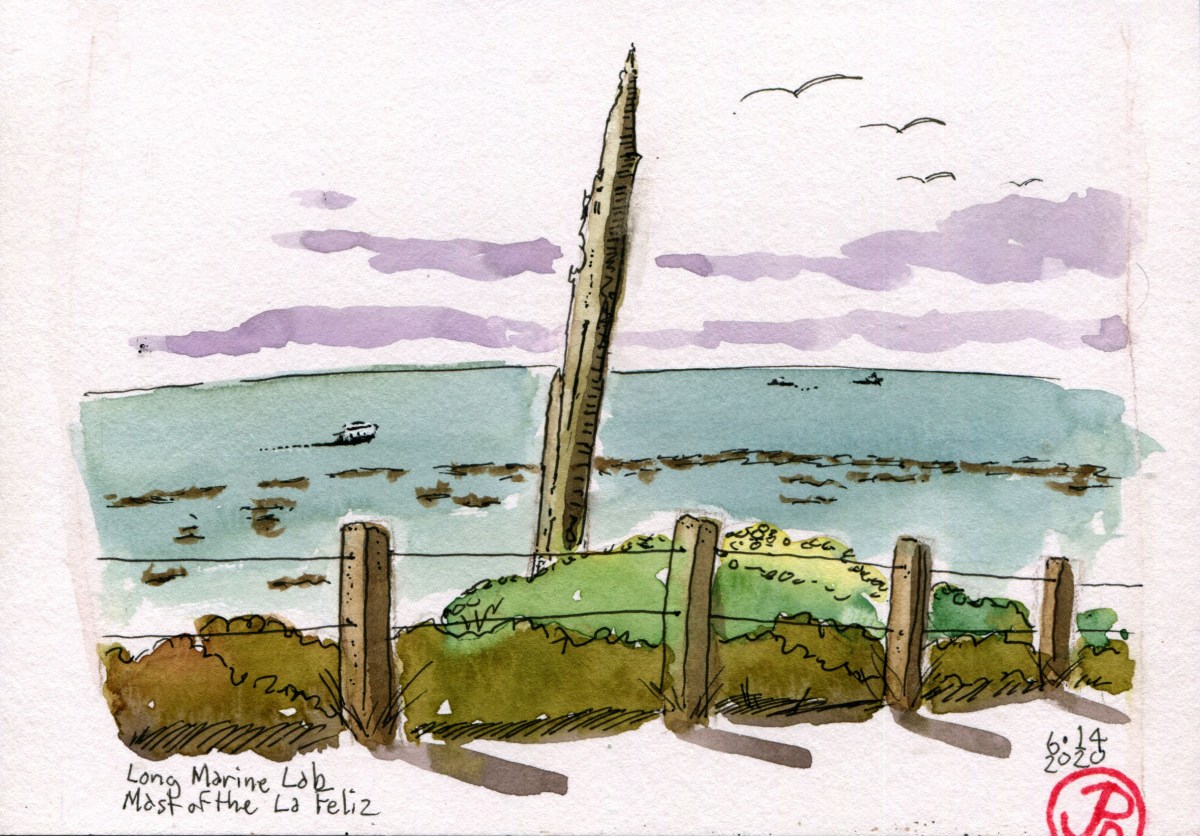
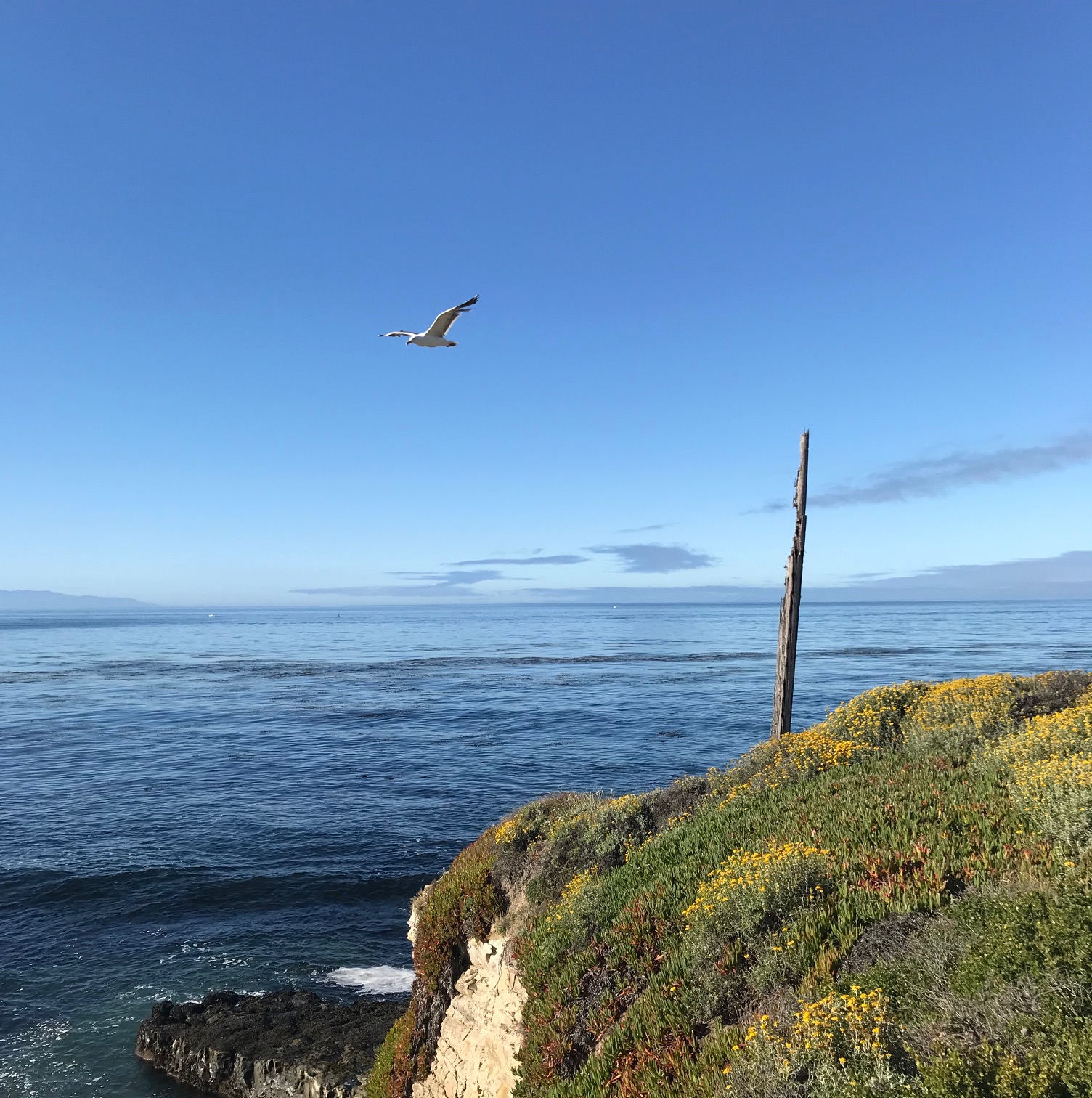
It looks like a weathered flag pole that is leaning slightly shoreward, placed on a cliff above the rocky reefs. In reality it is the mast of the 72-foot freighter La Feliz, leaning against the cliff.

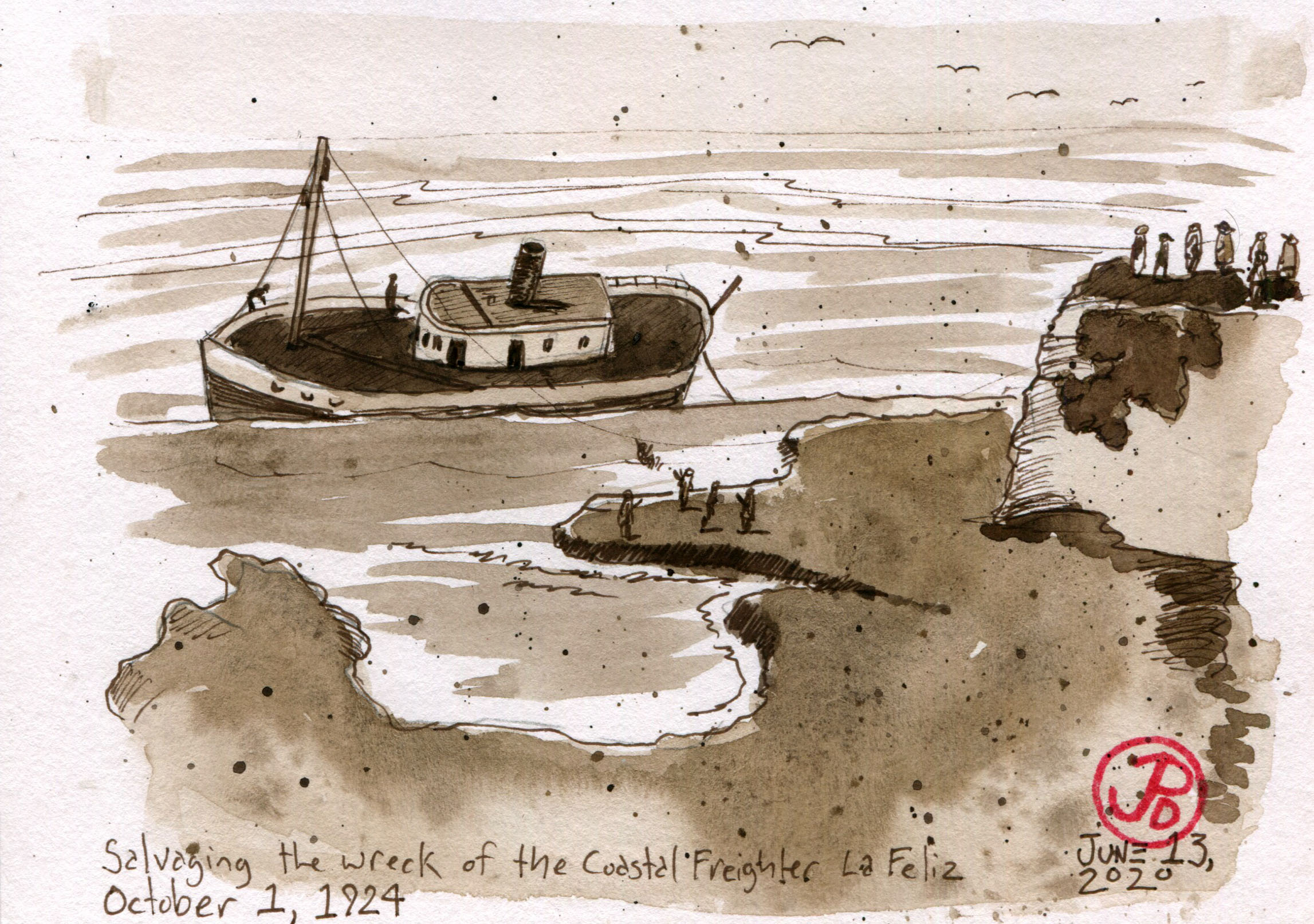
On the night of October 1, 1924, violent waves pushed the coastal freighter onto the rocky reef below where the Seymour Center at the Long Marine Laboratory (temporarily closed) now sits. Locals helped rescue all 13 crew members from the floundering ship.

Sketched and painted in sepia from a period photograph of the salvage of the La Feliz.

The mast was laid against the cliff in order to salvage the cargo and other equitment of the La Feliz. The cargo consisted of 3,100 cases of sardines from Cannery Row in Monterey.

There have been over 450 shipwrecks recorded in the Monterey Bay National Marine Sanctuary. Few relics of these wrecks exist today, except for the La Feliz auxiliary mast.

A beautiful Sunday morning, looking to the Northwest.

I did what I always do when I want to learn more about something, I sketch it! I hiked out to the mast on two different occasions and sketched it both times. It is always nice to sketch something more than once. I feel each time that I understand the subject at little more and each time I learn more and more about the mast of the La Feliz.

A Friday after work sketch of the mast of the La Feliz, looking south.

For my first sketch of the mast, I first drew with pencil them inked in the lines with a Uni-ball Micro Deluxe pen. I erased the pencil lines and then added watercolor the scene.

On my next sketch (featured image) I did the exact opposite. I loosely sketched in the scene with a water-soluble colored pencil (walnut brown) and then I painted the scene, letting some of the watercolor washes run into each other. Once the paint dried, I added ink lines with my Uni-ball. Both were sketched on location.

Image

The Banana Slug

Around my cabin there is a gardener that eats weeds. At a slow but steady pace. And dead weeds at that.

There are a few slugs that favor the steps, entry way, and pathway to the cabin. This is the second largest slug in the world, growing up to 9.8 inches (25 centemeters) long. And one of the world’s slowest animals, moving about 6.5 inches a minute. This is the California banana slug Ariolimax californicus.

Their slow pace means that are easier to sketch than the other animals around the cabin such the hyperactive Wilson’s warblers or the violet-green swallows that are always on the wing or the common mergansers that seem to disappear underwater as you are about to put pencil to paper. When sketching banana slugs you can take your time, they’re not going anywhere, anytime soon.

As I was going for a noon time walk, the local banana slug was climbing up the front steps, so I headed back in and got my sketching things. Oddly enough, the slug was still where I found it (banana slugs are hermaphrodites and prefers the pronoun “it”).

A banana slug on the front steps. I sketched this slug.

I am an alumni of the University of California at Santa Cruz. This youthful university (founded in 1965) was built on land that Henry Cowell donated to the state of California; a land in the moist forests of Douglas-fir and coast redwood. This is the ideal habitat for the banana slug.

The University’s chancellor supported name “Seal lions” as the mascot of the University but this was slowly overruled (in slug time) by a strong and determined student body that eventually caused the banana slug to be adopted as the UCSC’s mascot.

Now when I return from my walk, I always look down as I head towards the front steps and I see the two banana slugs on their patch. One is about twice the size as the other and I’m not sure what the relationship is between the two but I am glad to see them, slowly munching away at the weeds that line the pathway.

Fiat Slugs!

Image

The Osprey’s Nest

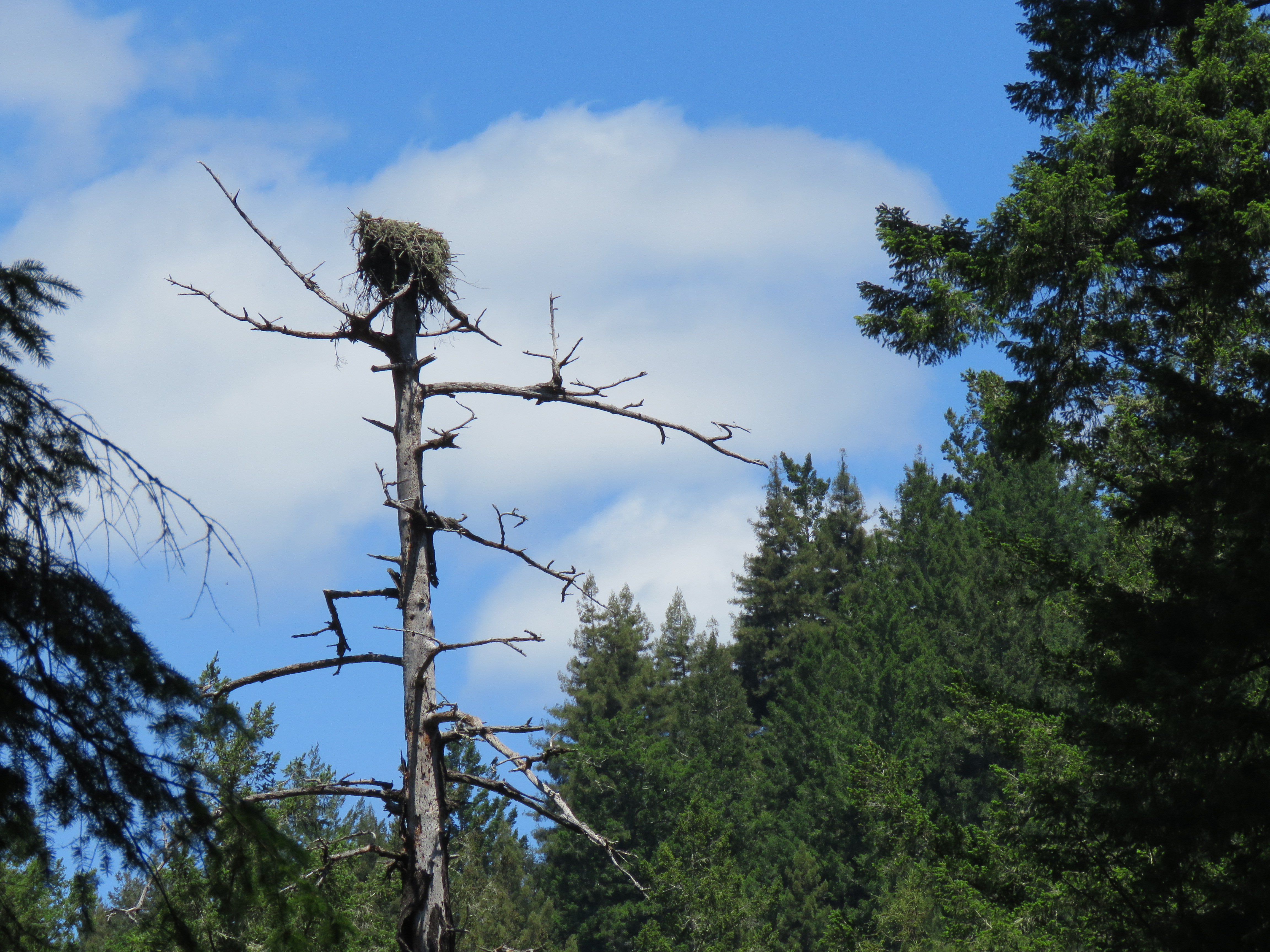
One of my neighbors knew I was struck with the affliction of birding and told me about the osprey’s nest on top of a Douglas-fir along the railroad about a 30 minute hike up river from my cabin.

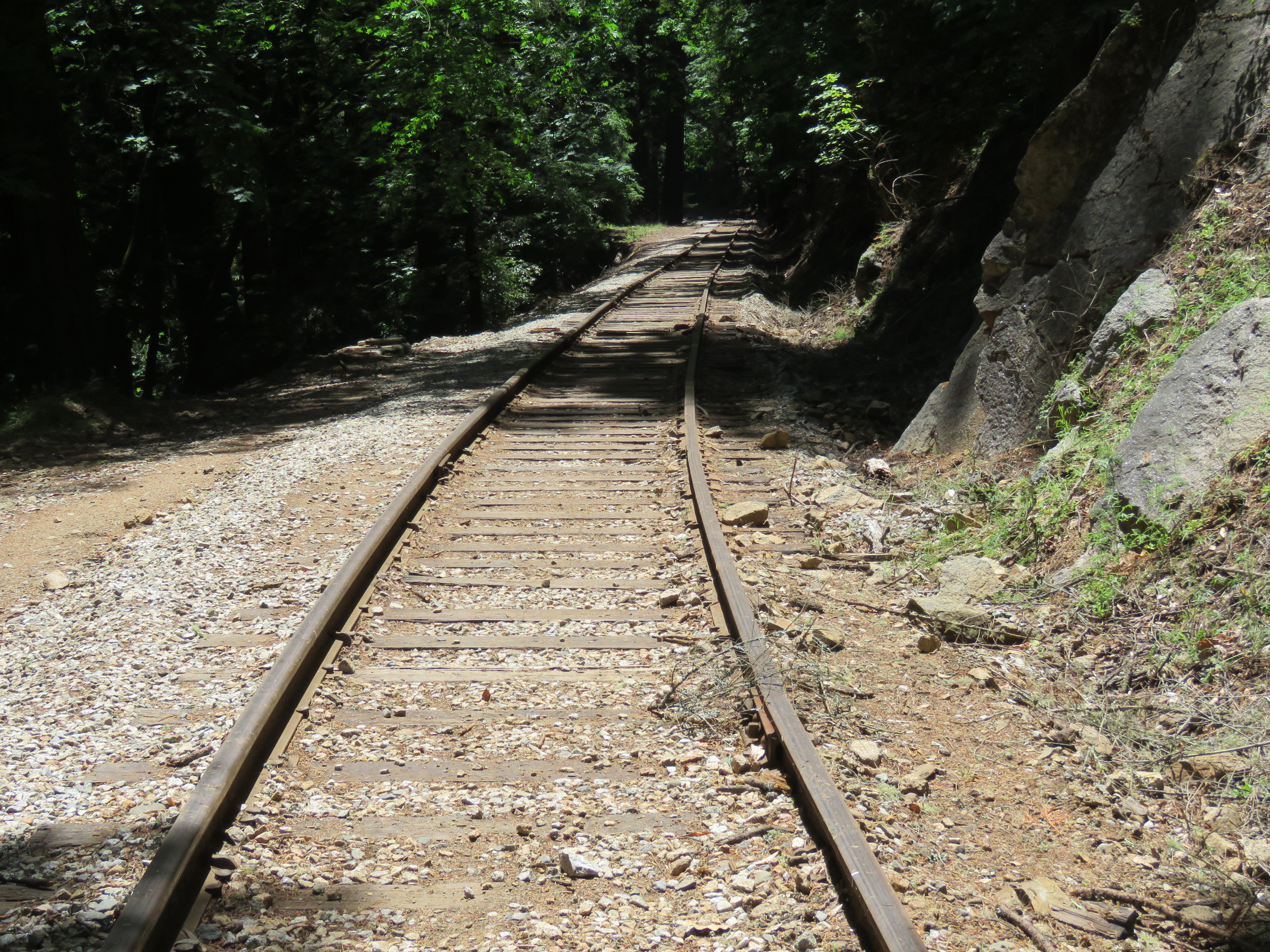
After work on Friday, I hiked out of Paradise Park via the fire road and scrambled up a deer trail to the even grade of the railroad. This railroad is now operated by the Santa Cruz, Big Trees and Pacific Railway and takes tourists from Felton to Santa Cruz Beach Boardwalk. At one time the railroad went over the Santa Cruz Mountains to Los Gatos but now does not go very far beyond Felton. I have hiked this railroad since my youth and it had been a few years since I played hopscotch on railway ties up the San Lorenzo Valley.

Walking along this rustic railroad always feels like I’m participating in a scene from Stand By Me on a quest to find a dead body. But in this case I was in search of a big bunch of sticks on top of a fir, high above the San Lorenzo River.

I kept one eye on the rails and one on the trees off to my right. My neighbor had given me good directions to the nest and when I was 30 minutes out of Paradise, I thought that maybe I had passed the nest. But how could I miss it? So I continued hiking upstream.

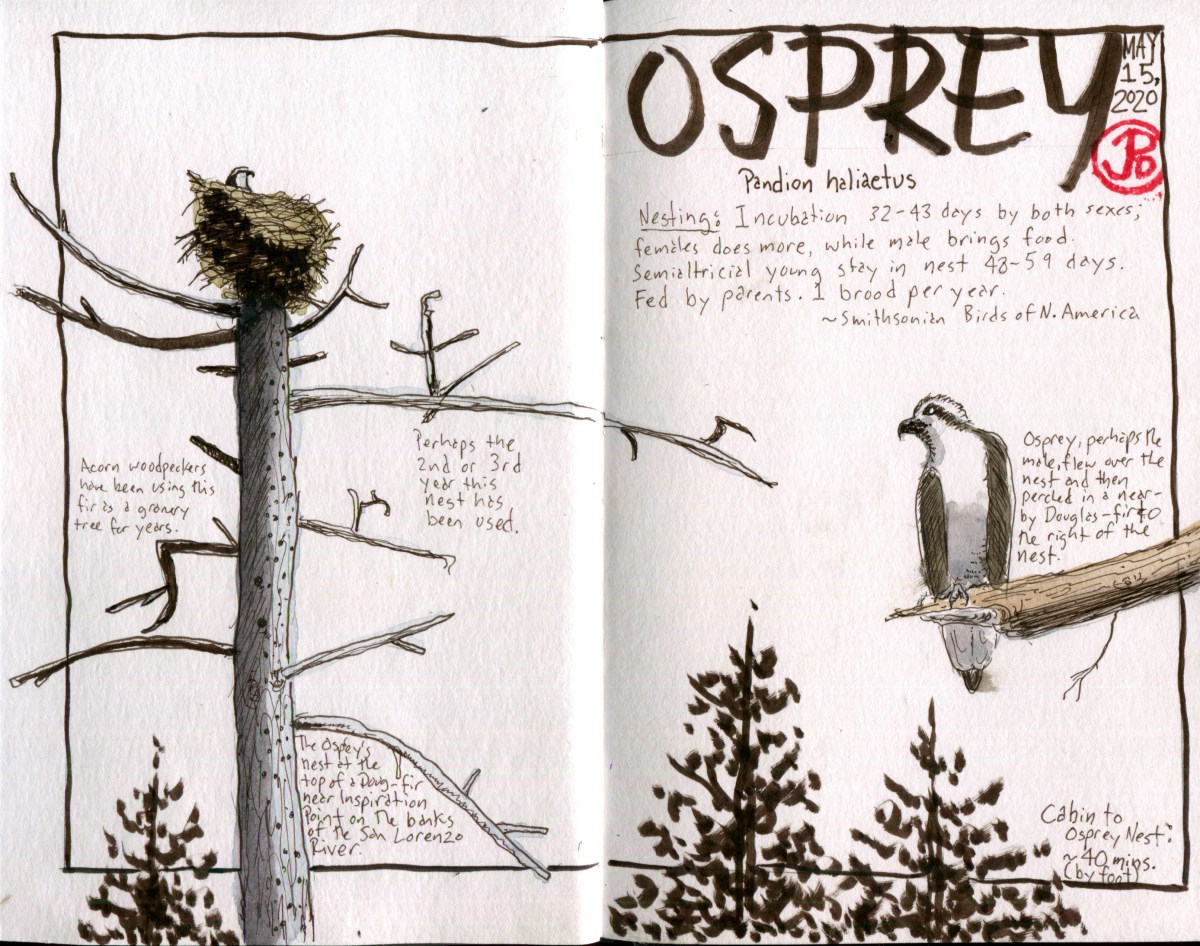
Ten minutes later the osprey nest appeared across the river between a break in the redwoods and firs. I put bins on the nest and could not detect any occupants. But osprey nests are deep and the osprey could be laying low. The only sign of life were the acorn woodpeckers that looked to have used the fir as their granary tree, their acorn larder, for years.

I was at a point in the line where the railroad curves gracefully over a curved viaduct. The concrete arched bridge was build by the Southern Pacific Railroad in March of 1905 and spans Coon Gulch. At this point the San Lorenzo River takes a turn and you can get an amazing view upstream. This point in the line is known as Inspiration Point.

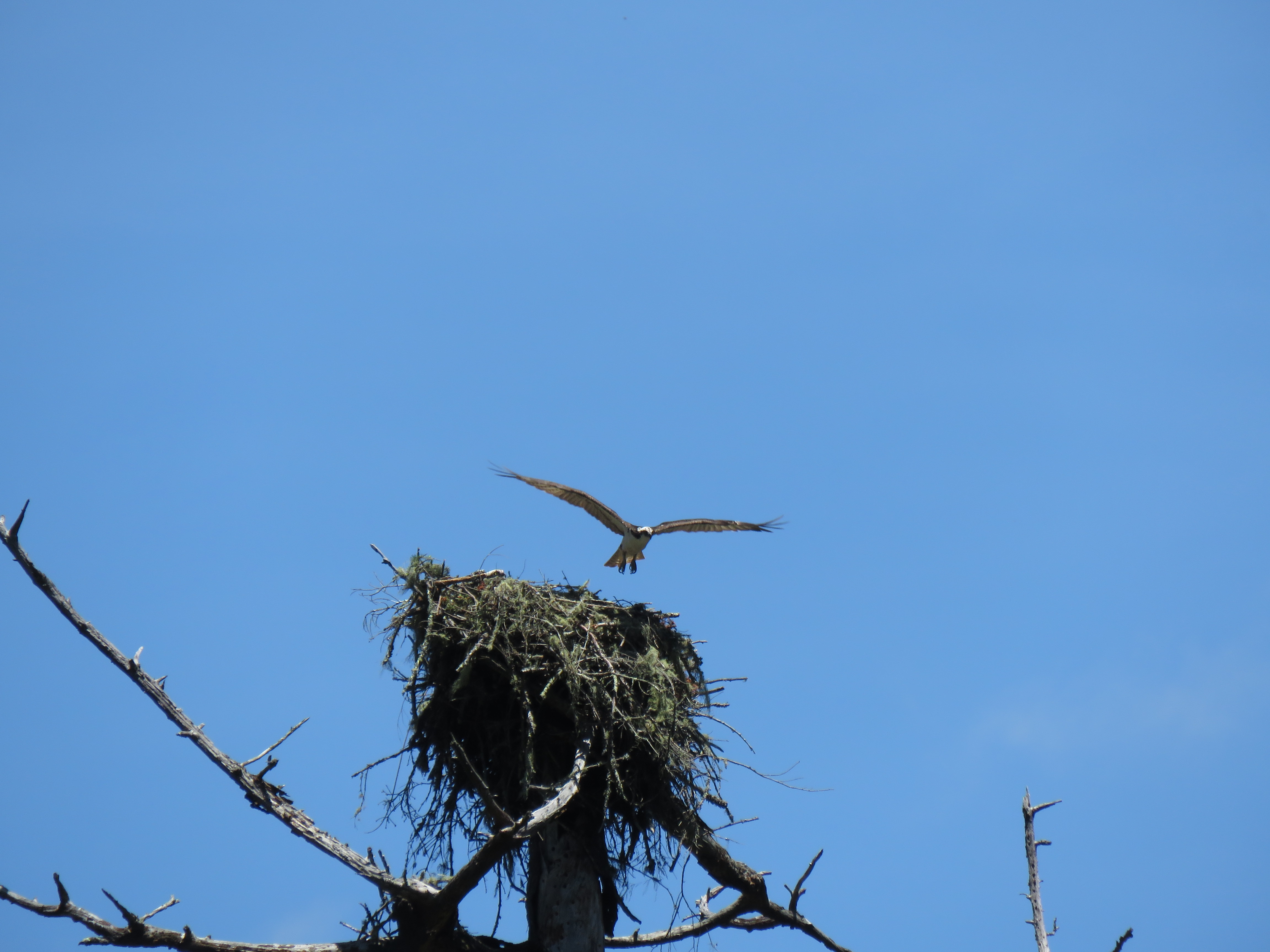
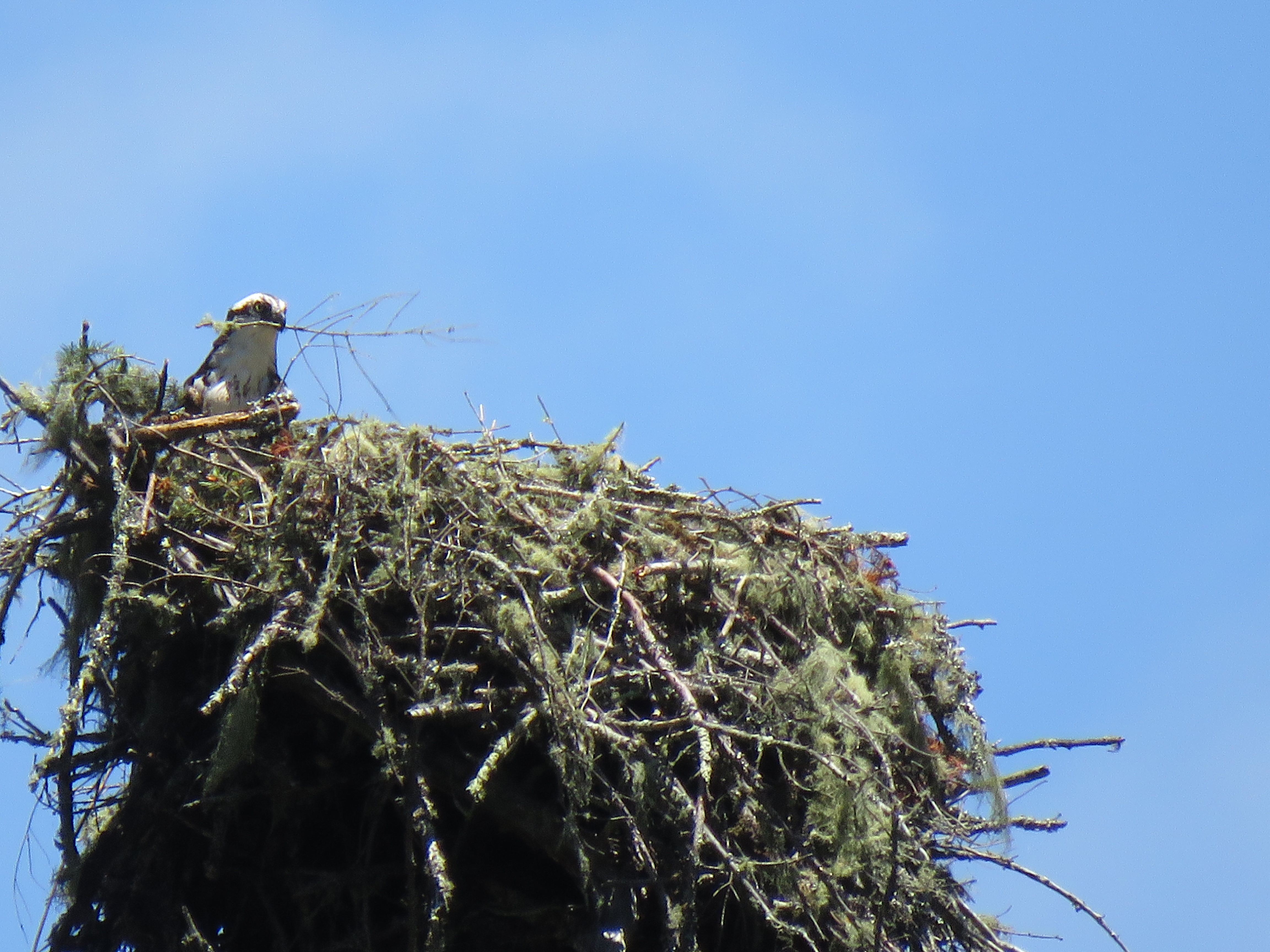
It didn’t take long to see signs of life. An osprey flew in and briefly alighted on the nest. Bingo! The nest is occupied after all. The unseen osprey, presumedly sitting on eggs, sat up in the nest and became visable.

The osprey that flew in could have been the male who is responsible for bringing fish to the nest while the female does most of the incubating of the two to three eggs. The male perched near the nest on a Doug-fir and preened.

First sign of life at the osprey’s nest. Perhaps the male dropping off fish.

I stood by the railside and sketched the nest. On the left side of the spread is my field sketch (first in pencil then in dark sepia pen) of the Douglas-fir crowned by the osprey nest. The osprey perched on the right was drawn from a field photo I took of the presumed male. The title and text were added back at the cabin. In the end, I decided to create a spread that is almost monochromatic. I resisted the urge to paint in the sky because I didn’t want anything to distract from the form of the Doug-fir and nest.

The osprey doing a little housekeeping at the nest. This is presumedly the female who does most of the incubation of the eggs. Both sexes build the nest. A hiker who stopped to look at the nest told me that the nest had been there for past two or three years.
Ospreys reuse their nests each breeding season. A lot of work has gone into this nest over the past two or three seasons.
Image

Mothers

On Mother’s Day I saw the merganser ducklings for the first time.

I was on Washington Way, a footpath that runs parallel to the San Lorenzo River. There was the female, in a cloud of young ones. The common merganser ducklings where actively diving and foraging so it was hard to get an accurate count but I estimated I counted 12 heads.

Common merganser nests in cavities near water and females may lay 6 to 13 eggs. The hatchlings may stay in the nest for a day and then the downy young jump out of the nesting cavity and they immediately can swim and hunt for themselves. No failures to launch in the merganser world.

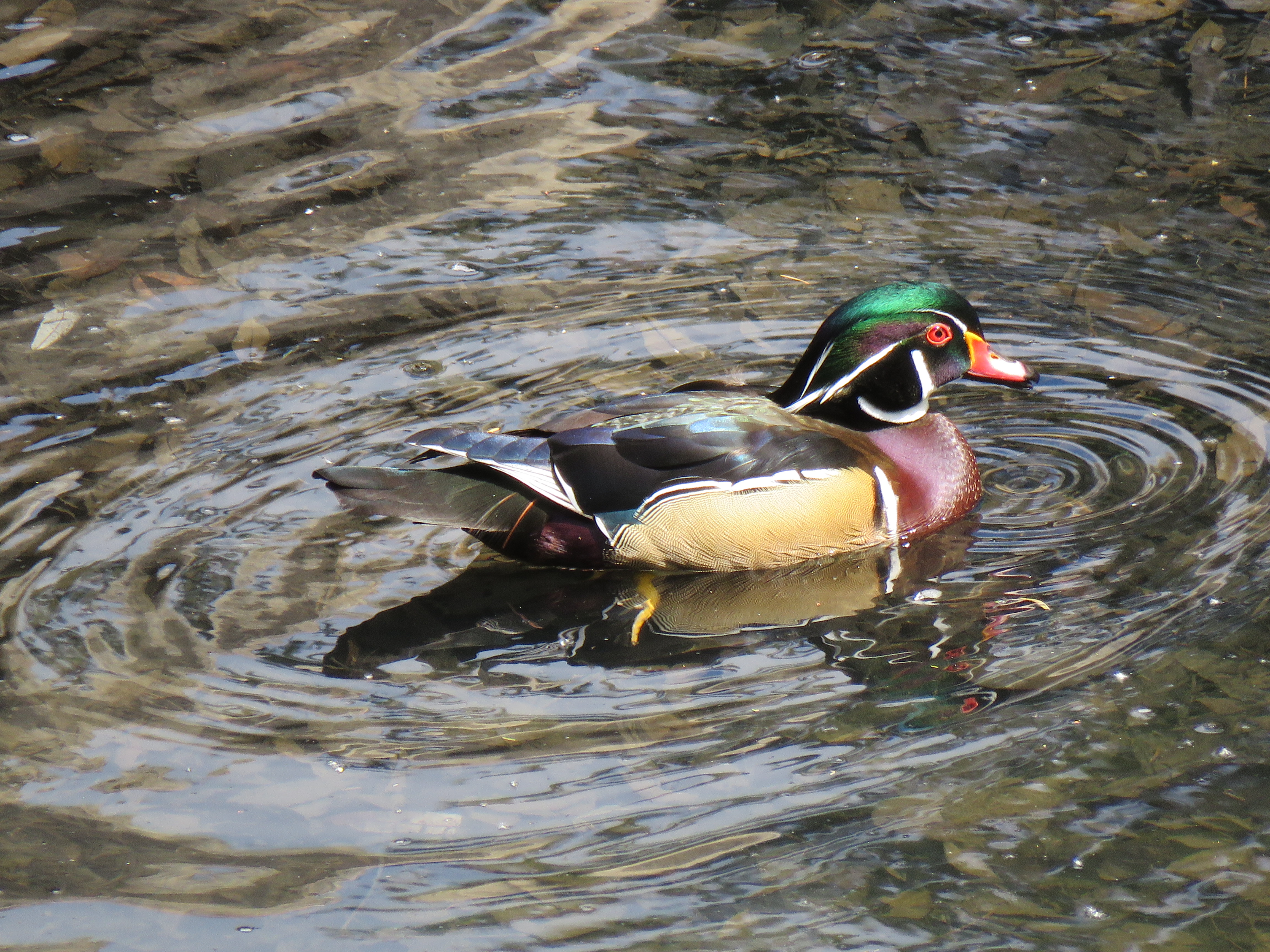
The next day, on my daily walk, I saw the wood duck family from Washington Way. They were foraging on Middle Beach. The group included two adult males, a female, and three ducklings.

The wood ducks with two of their three ducklings. The ducklings were actively foraging on their own on Middle Beach.
The male wood duck is considered to be the most beautiful duck in North America, if not the world. There’s a lot going on with this duck.

Later that day, at about four in the afternoon there was a late spring rain. I stood at the backdoor, looking out past the deck and the trees towards the river and I wondered how the wood duck ducklings were handling their first rain.

So I did want I always did when I am inspired by the natural world: I wrote a poem and did a sketch. What else should I have done? (As Mary Oliver would have asked).

Mother

To the three wood
duck ducklings on
the river, this was
their first rain.

Did it seem odd
to them that it
was wet from above
as well as below?

Did they wonder
if the whole world
was river?

I imagine that
before they got
lost in thought
(as much as ducks
get lost in thought)

mother presented
her downy breast
and they sought shelter
before an answer came.