Image

Cabin Birds (Earth Day 2020)

My love of birds was born by spending time at my family’s cabin above the backs of the San Lorenzo River in the Santa Cruz Mountains. My grandma put up a feeder on one corner of the deck that attracted the local chestnut-backed chickadees, pygmy nuthatches, and Steller’s jays.

While I was planning to spend my Spring Break traveling on the California Zephyr to Chicago, the coronavirus pandemic threw a wrench into the works (and changes the lives of others across the world). Instead I headed down to my cabin to shelter in place.

The spring is one of my favorite times at my cabin. Things are finally starting to dry out and temps are gradually warming up. You really start to feel, see and hear the changing of the seasons.

First you feel the air warm against your skin. You start to see the world of green slowly coming alive on the trees and bushes from the desk. And you start to hear the sounds of the neotropic migrants arriving on there summer breeding grounds.

These are the birdsongs that I have not heard in almost a year and I sometimes have to become reacquainted with them, like hearing the voice of a forgotten friend.

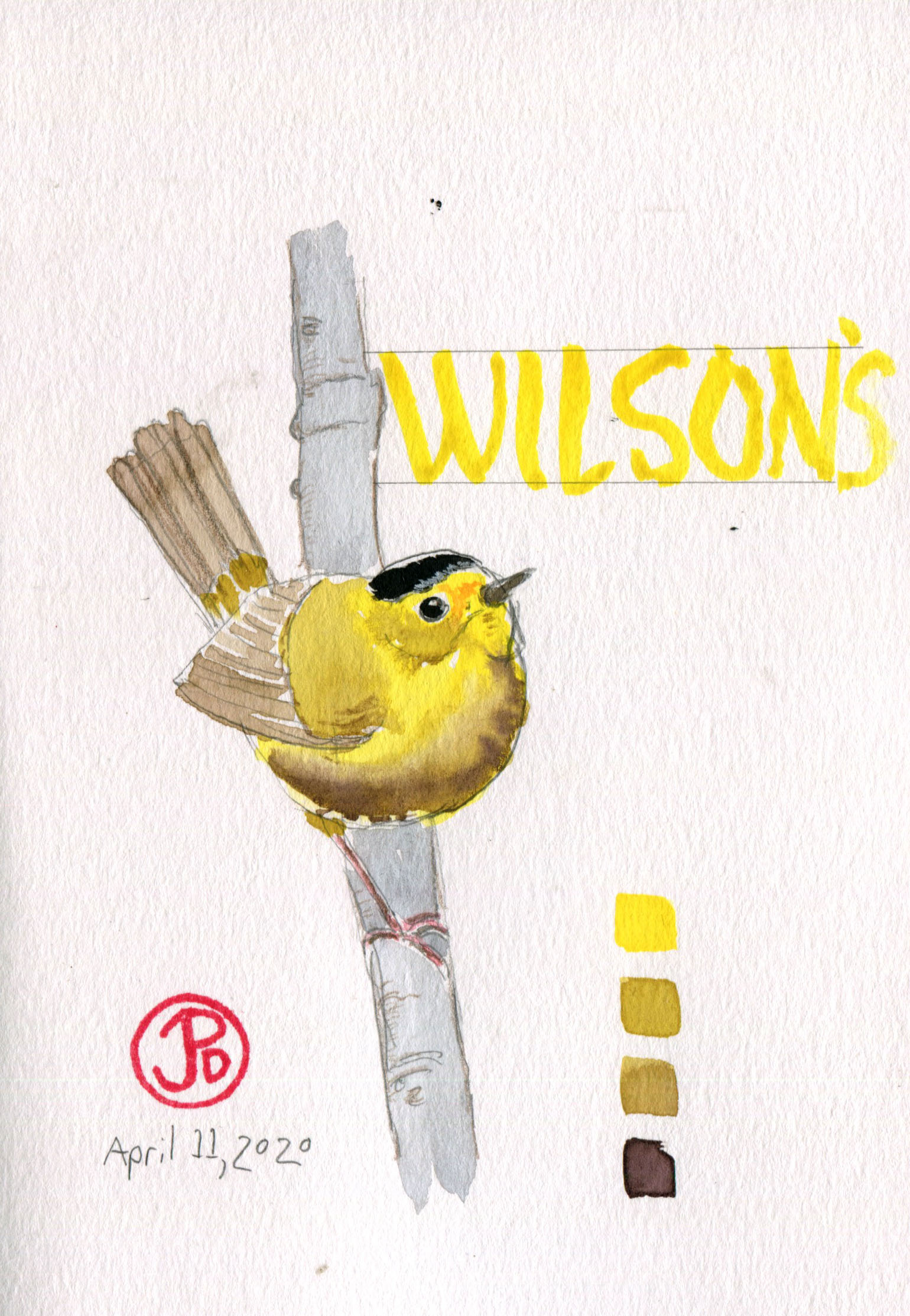
The most vocal newly arrived avian member is the diminutive Wilson’s warbler. This little flash of gold is a very vocal member of the spring choir. It calls constantly from the midsts of trees out back. The males at this time of year are setting up their breeding territories and also hoping to attract new-arrived females.

Another migrant is the Pacific-slope flycatcher, of the tricky genus Empidonax. Most of these similar flycatchers can be identified by call alone and I far more ofter hear the “pee-wheet” call of the Pac-slope. Welcome home.

A resident that becomes very vocal at this time is the diminutive Pacific wren, which boasts one of the fastest songs in the avian world at about 32 notes per second! What is amazing is that such a small, drab looking bird can create such a loud and splendid song. I painted a wren from a photograph of a singing male in my backyard bramble.

A pair of common mergansers roosting near the waters of the San Lorenzo River.
Image

Paradise Park

With the current pandemic and the shelter in place order, I chose to shelter in Paradise during my Spring Break. My family cabin is in Paradise Park, just up Highway 9 from downtown Santa Cruz.

Here I have more legroom than my digs in San Francisco and the population density here is far less than the 7 by 7 mile County and City of Saint Francis. Another factor was that San Francisco had almost 1,000 Covid-19 cases and the larger (by size) County of Santa Cruz had just 90 (at the time of writing). This seemed like a no brainer! Head to Santa Cruz for my two week Spring Break.

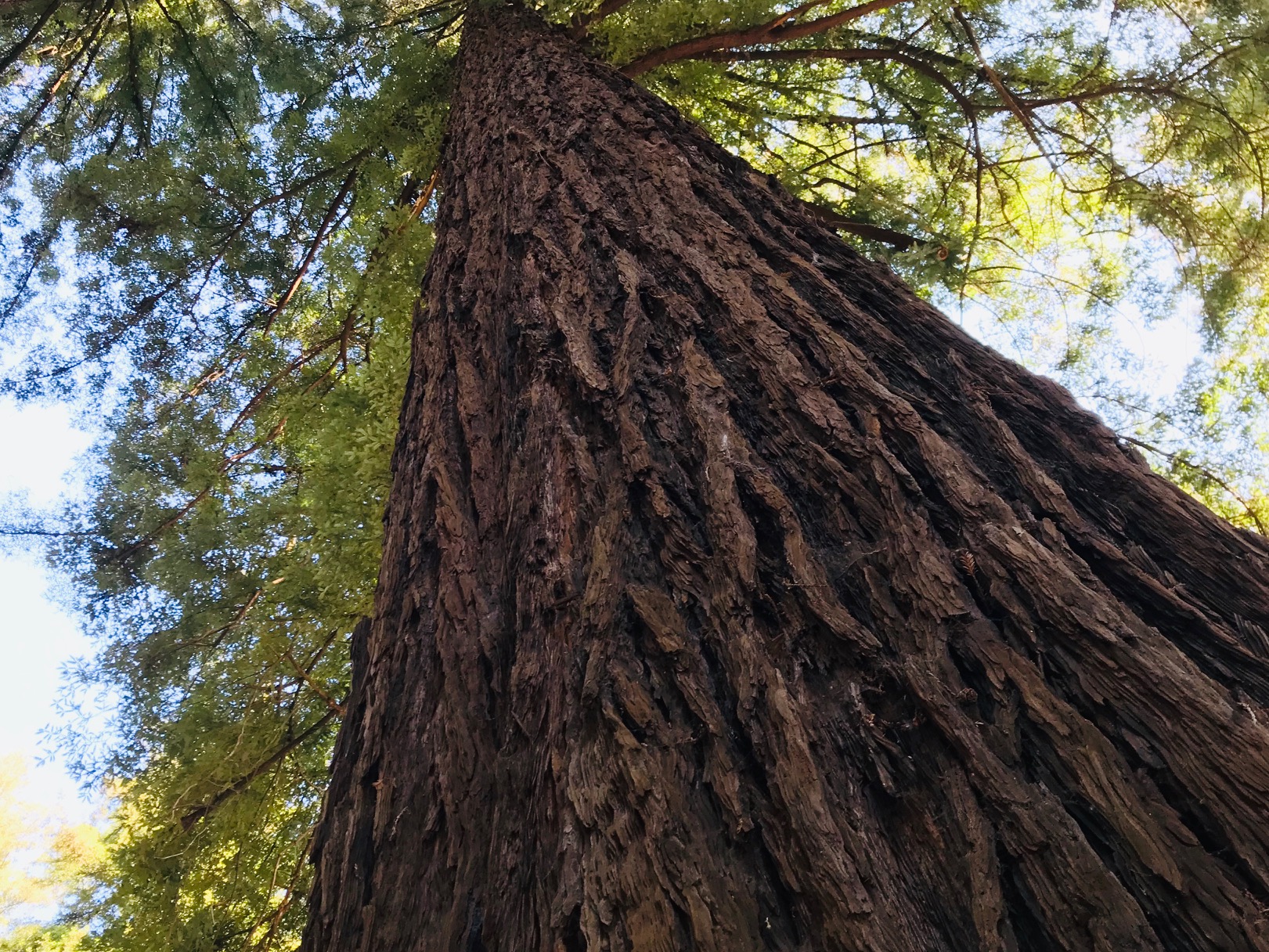
This move allows me to spread out, breath fresh air, and be amongst the redwoods and river. It also gives me a very familiar patch to sketch from. Here I know all the birdsongs and paths, all the secluded river beaches, and the places of solitude and rest. And I certainly needed both after three weeks of distant teaching.

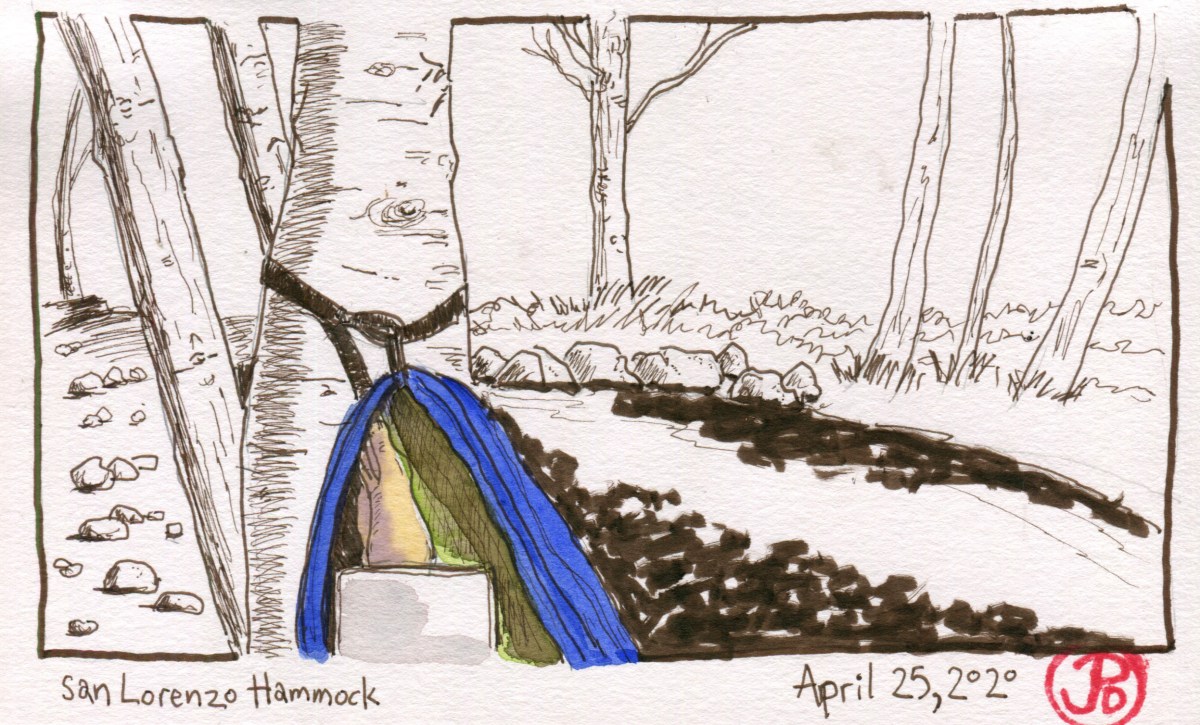
Some of my favorite sketching locations in the Park are my redwood deck and different locations on the San Lorenzo River, certainly the most important landform that runs through the Park. A beach that I have always loved both as a place of repose and sketching is what is known in my own person geography as Corona Beach (this was named long before the infamous virus).

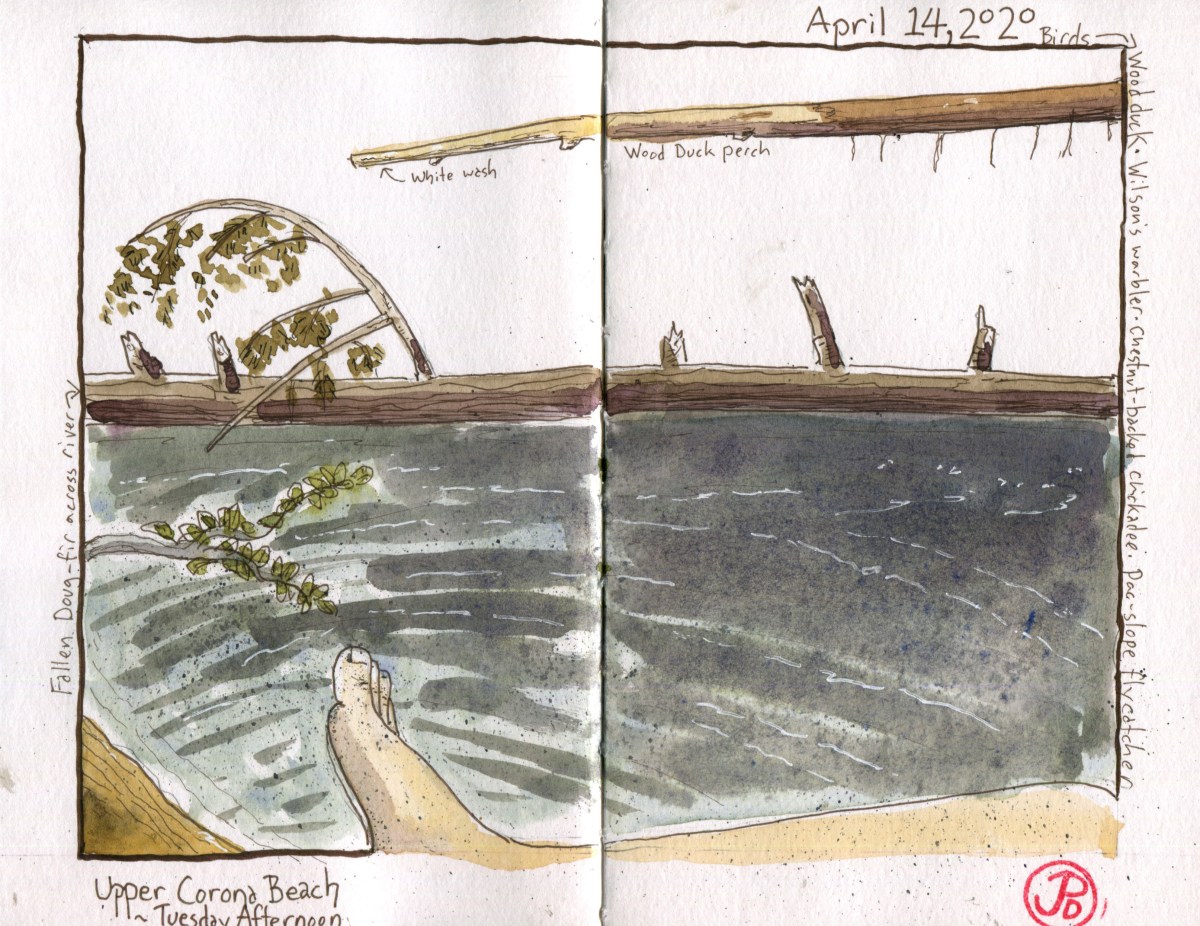
To get to Corona Beach involves heading up stream with some bush whacking, fording the San Lorenzo (which was trying to take my feet from under me), and then a little more bush whacking to arrive at a small, sloped river beach. Today it was occupied by a young couple, so I headed up stream (social distancing, dontcha know) and arrived at Upper Corona Beach. A smaller bit of sand on the river side. This is clearly a feral beach, wild, rugged, and something Mary Oliver might write a poem about. Well Mary is no longer with us so I guess I will have to give it a go. . . . a poem hasen’t blessed my brain at the moment (the trouble with poetry) so I did a sketch instead (featured sketch).

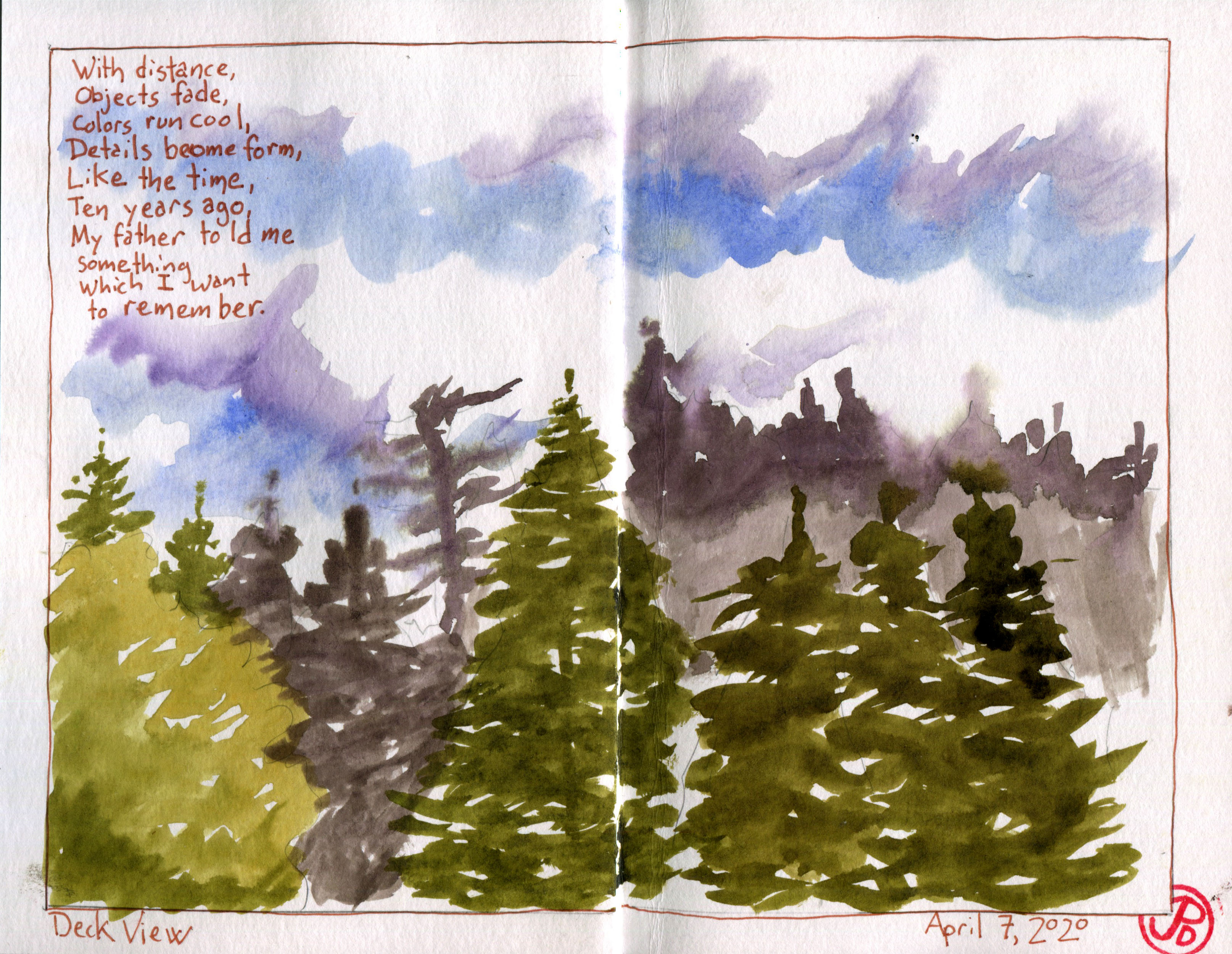
I also like to be in open air and sketch the green treescape of the view. This was a excise in creating depth in a sketch. In this desk sketch I included a poem:

With distance,

Objects fade,

Colors run cool,

Details become form,

Like the time,

ten years ago,

My father told me

something

Which I want

to remember.

With this deck sketch I tried to work with creating depth with warm and cool colors and tone. I also worked on my brush work to create the treescape.
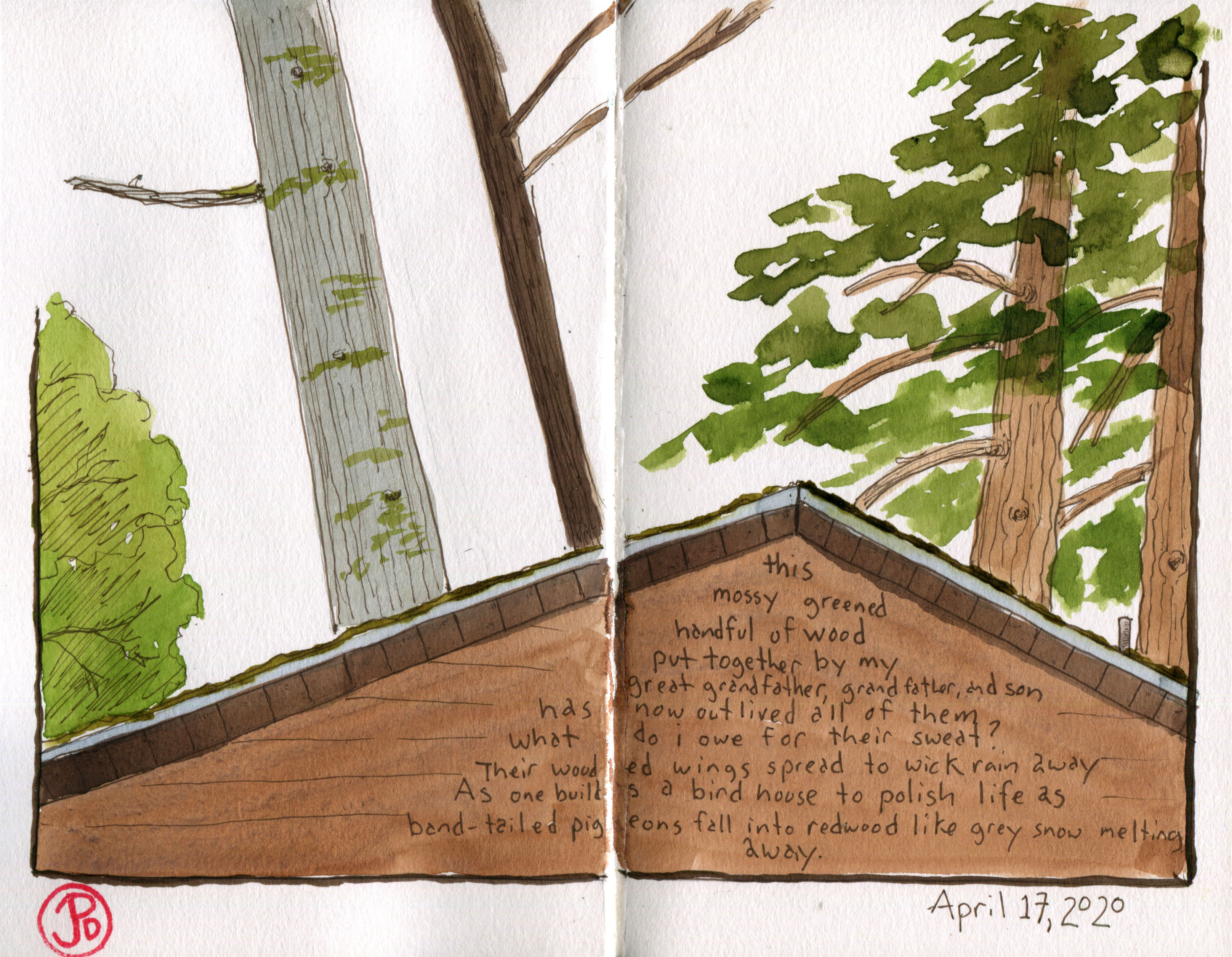
Roof view of my cabin surrounded by big-leaf maple, douglas-fir and redwood. The redwoods on right contains Bird Box #2 (the redwood on the left). More on the box in a later post.

Cabin Birds Part Two (Audubon’s Birthday)

“Spring work is going on with joyful enthusiasm.” —John Muir

“to live in this world
you must be able
to do three things
to love what is mortal;
to hold it
against your bones knowing
your own life depends on it;
and, when the time comes to let it go, to let it go”. -Mary Oliver

Spending two weeks during my Spring Break at my cabin in the Santa Cruz Mountains gave me the opportunity to slow down and notice the most important things in life. That is life itself. (A nod to you Mr. Ebert)

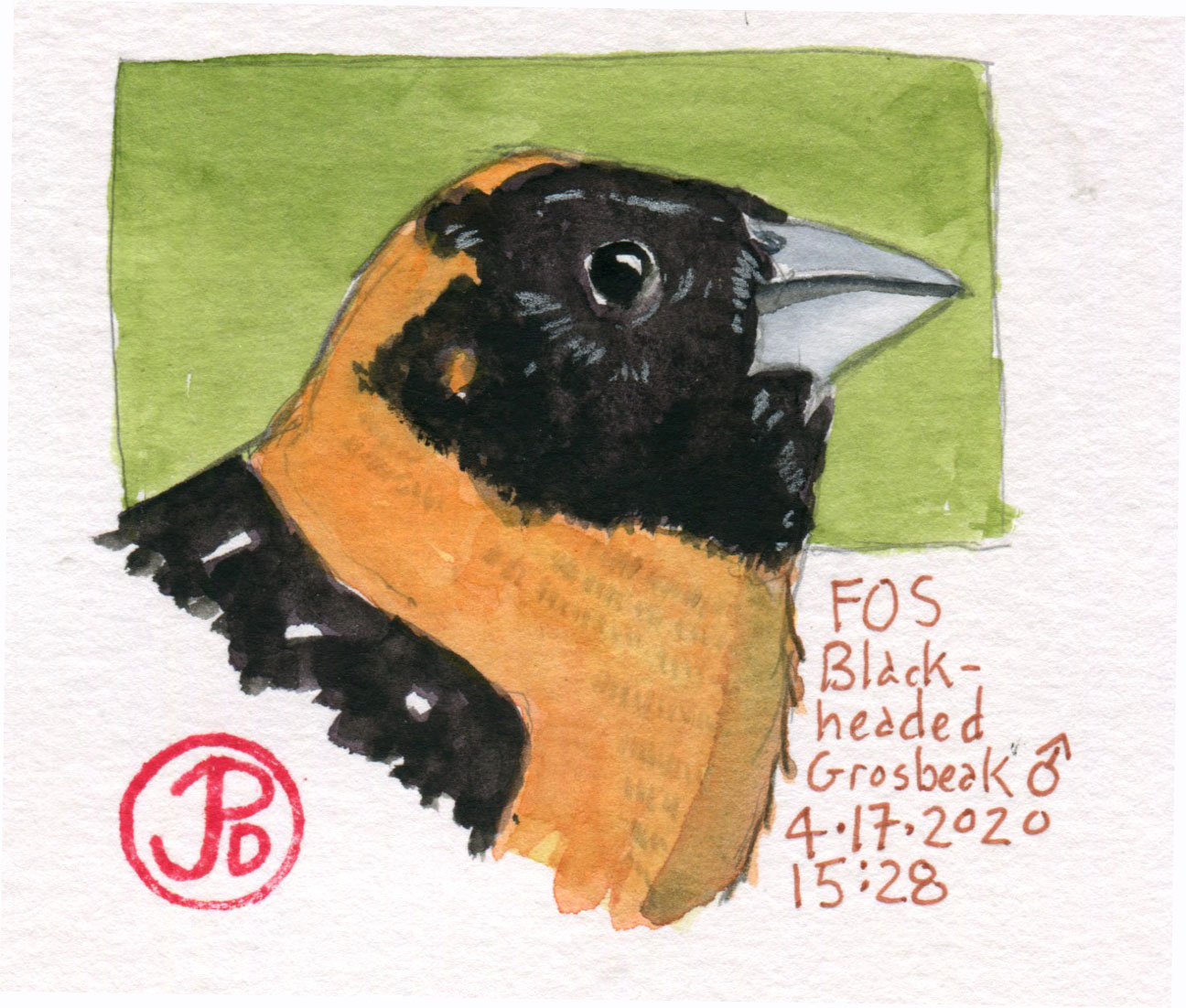
Birding just adds another layer to experience. It is a soundtrack that not many hear. To those aware, the signs of spring are everywhere. To the calls of the Pacific wren and dark-eyed junco to the sounds of the newly arrived neotropic migrants like Wilson’s warbler, Pacific-slope flycatcher, and black-headed grosbeak. The latter bird I heard on my last day at my cabin, when I heard a district “clip” contact call. I headed out to the deck to see this beautiful flash of orange, back, and white.

This was a First of Season (FOS) bird for me. The males arrive on their breeding grounds from Mexico just ahead of the females and the males proclaim their place in the world with their robin-like song. This has always been a favorite cabin bird and it arrives in mid April most years.

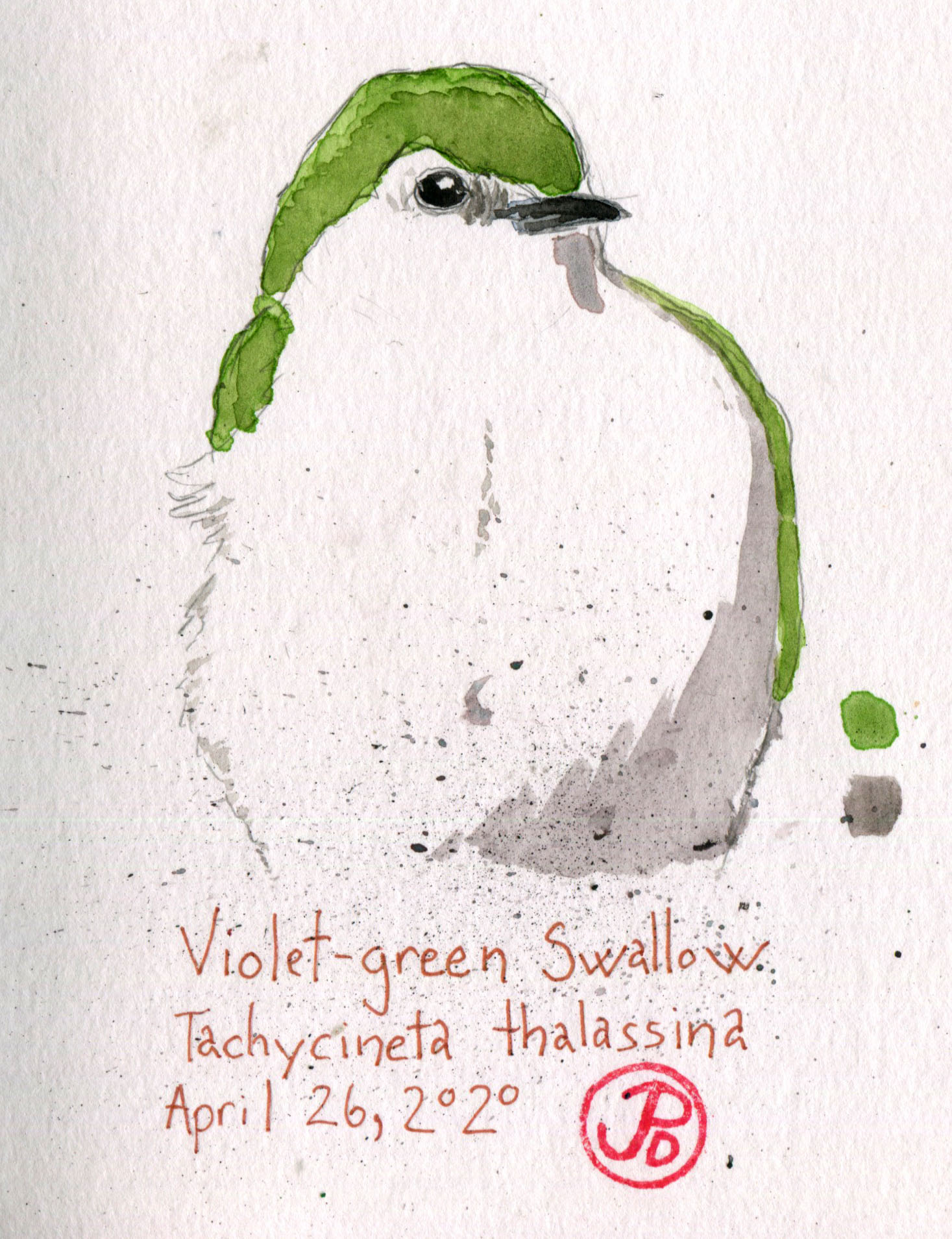
The sky above the San Lorenzo River is filled with newly arrived swallows at this time of year. The most common species are tree and violet-green swallows. Swallows are insectivores and are aerial acrobats that catch flying insects on the wing. Like the Swallows of San Juan Capistrano, swallows are a sign of renewed and the turning of the season from winter to spring.

The aerial insectivore, one of North America’s most beautiful swallow.

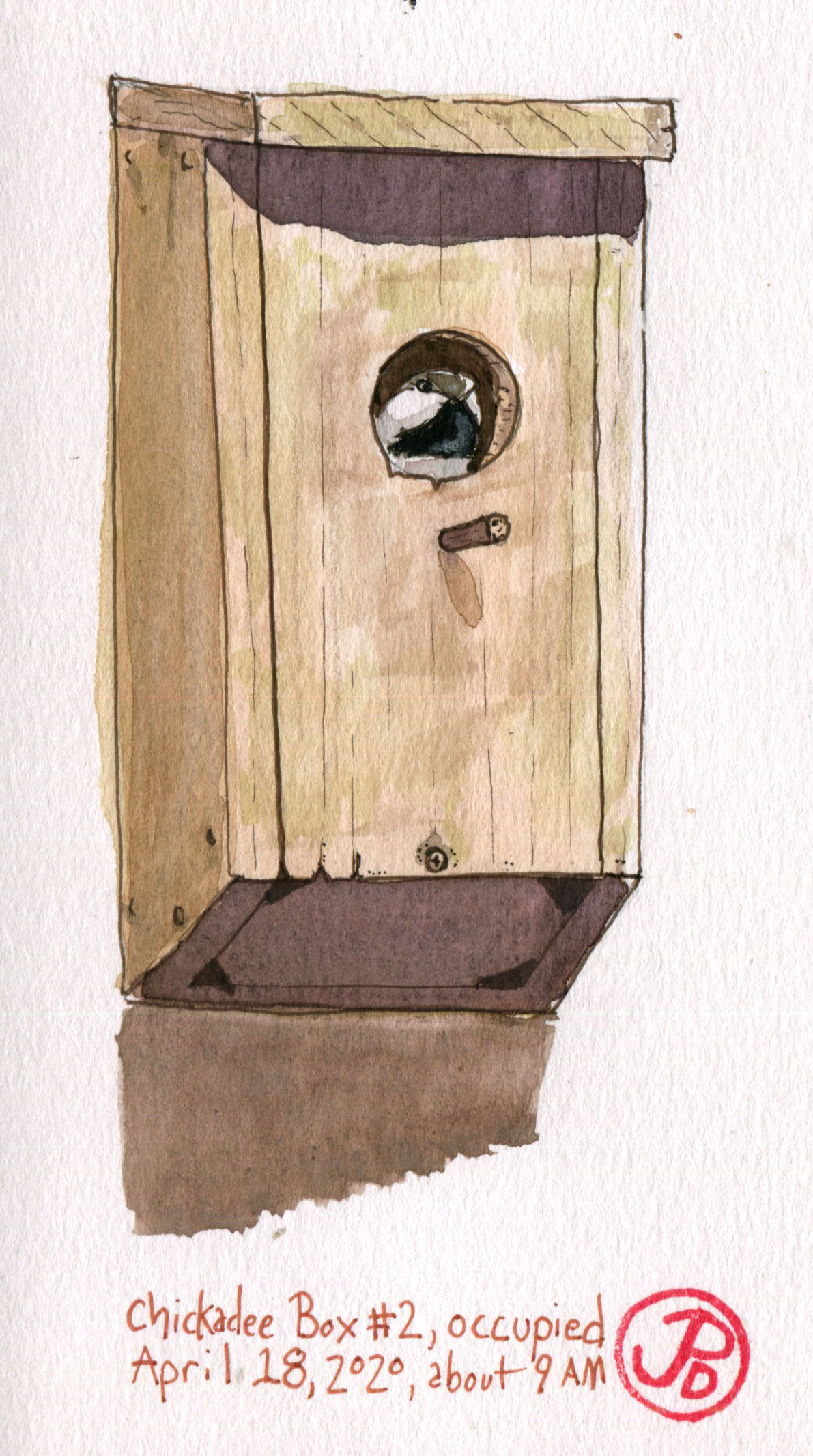
Just as I was packing up the car to return to San Fransisco, the natural world gave me a parting gift. I noticed that a pair of chestnut-backed chickadees were cleaning out one of the nesting boxes that I had built and hung on a redwood near the parking lot. This gives me such a sense of joy that I have played a small part in helping to create life.

The two weeks I spent in Paradise was a great was to slow down and really appreciate life.

Image

Art of Rain

Simplicity is not a simple thing. ― Charles Chaplin

I have always wanted to paint with rain. A cloistered spring break at my cabin in the Santa Cruz Mountains, with rain in the forecast, provided the opportunity.

All I had to do is create the stage and let nature do the rest. I love to think of this as a collaboration with something I can’t control. Which really sums up the medium of watercolor. It is a medium that often controls you. If you work in this medium, you have to accept the unacceptable!

In the past I have painted in drizzle and have loved the added texture which can be unpredictable. The last time I was on my school’s campus, before we were relegated to distance teaching, I painted the scene from my recess duty view. There was a light drizzle that specked the wash which really became an added memory of the time and place. This sketch was posted in my “Distance Learning” post.

This time I wanted to work with purpose. This meant that the process was not just left to pure happenstance. I had to plan and be prepared to capture spontaneity. Pure oxymoronic painting.

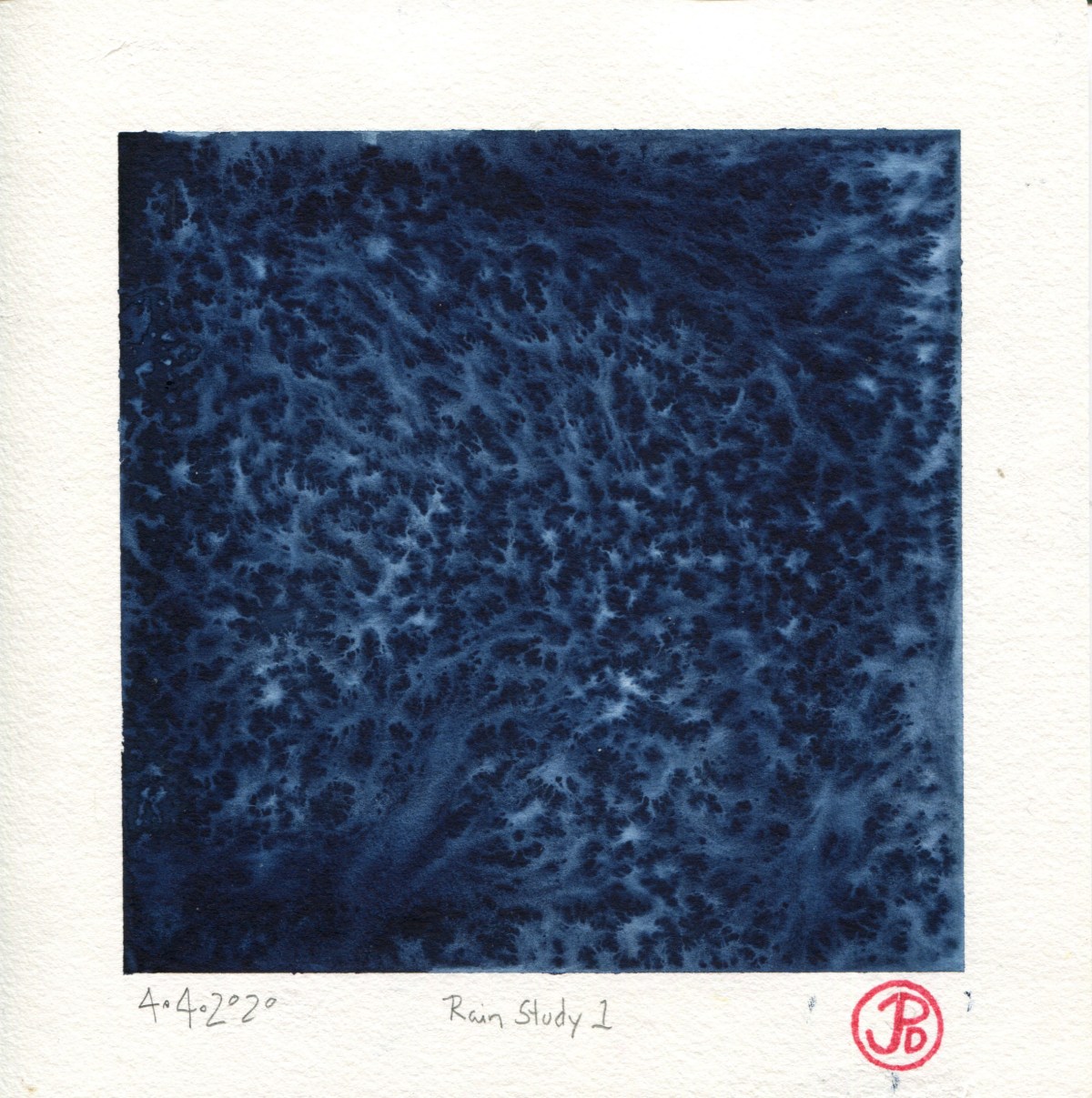
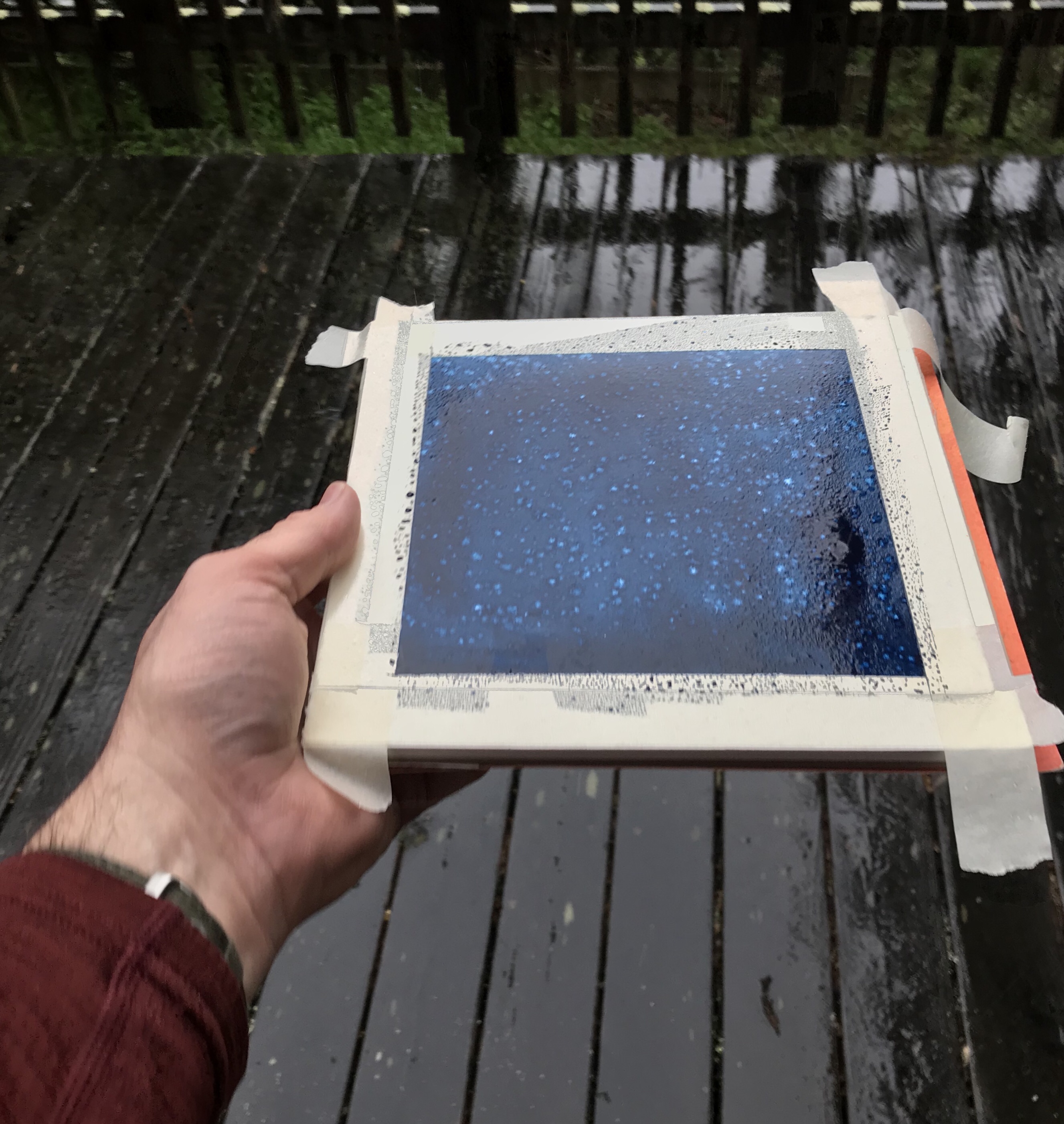
With the first few sprinkles hitting the deck, I used drafting tape to create a border on a Fluid 8 x 8 inch, 140 lb watercolor block. I laid in a thick wash of indigo. I walked out to the deck and exposed the still-wet-wash to the elements. Now the wet elements do her magic.

Setting the stage: a wash of indigo framed in with drafting tape. I held the paper to the skies and let the rain do the work.

When I look at this simple painting I’m amazed at its brilliance. And I say that without any ego because I had very little to do with the creation of this piece of art. And for me that’s why it is amazing and transcendent because it deals with the force that is beyond my control yet creates something absolutely sublime.

The painting grew into it’s finished state as the paint slowly dried. And the finished painting is something I could have never envisioned. It surprised and delighted me!

This experience has taught me that sometimes you just need to get out of the way! Let nature do the work, like she always does.

And to my artist friends out there. Go and make your own expressions and let Mother Nature be your guide! She is a great teacher!

Image

Spring Birding

I took young Grasshopper Sparrow to one of my favorite birding locations in Santa Cruz County, the Old Cove Landing Trail, at Wilder Ranch State Park.

Birding in the spring is a pleasure as you see returning migrants and signs of newborn life. Males are defending their territories in song and are frequently seen perched on prominent singing perches giving a birder great views!

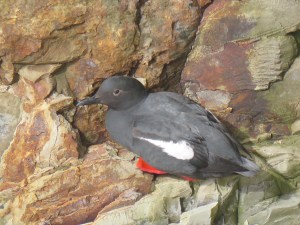
One lifer on Grasshopper’s list was a pigeon guillemot, an alcid that is not a pigeon but a bird of the near shore. Once we hit the coast the guillemots were an easy tick with many on the water or resting on cliffs. We had sensational views and we moved on down the coast in search of more signs of spring.

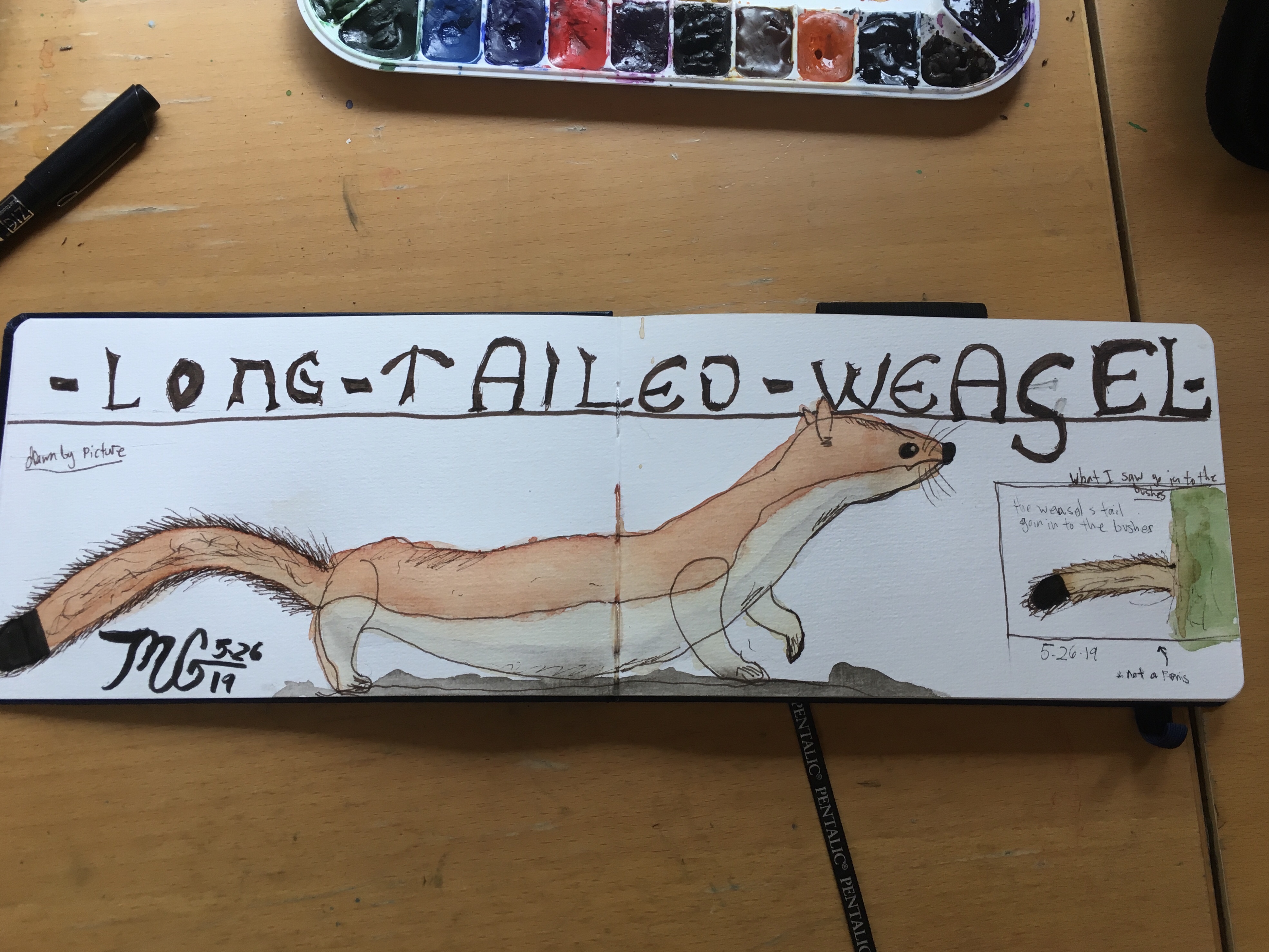
The spring pleasures are not only reserved to the avian world. As we were about a mile down the trail which follows the contours of the coast, a long-tailed weasel crossed our path! Perhaps an adult hunting to feed its growing kittens. We watched as it’s black-tipped tail disappeared into the green grass.

My young acolyte, Grasshopper Sparrow’s spread about our brief encounter with a life mammal.

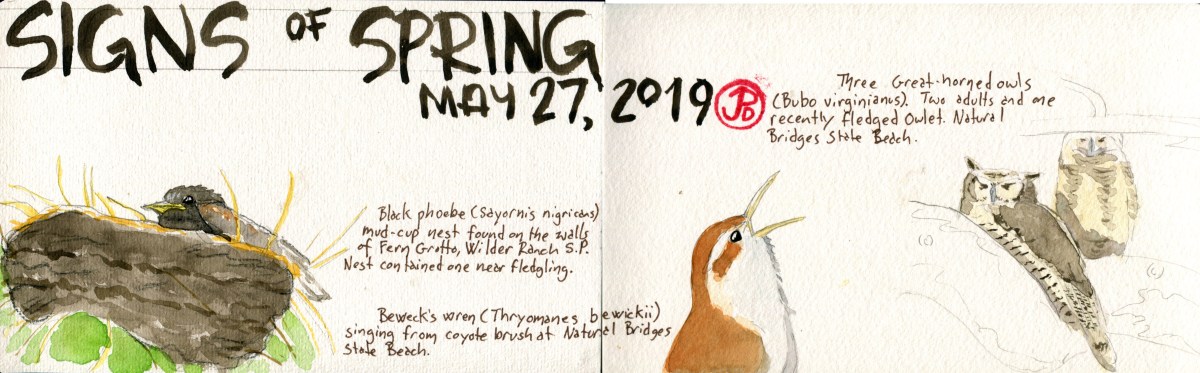
We continued on and were rewarded with a black phoebe nest with a near fledgling. Grasshopper thought the chick was dead but I suggested it was just in instinctual frozen mode at the sight of two large bipeds approaching.

We then headed back, adding more lifers to Grasshopper’s growing list and I wanted to check in on another sign of spring just south on Highway One at Natural Bridges State Beach. The eucalyptus grove here is known for the 150,000 wintering monarch butterflies. Most were gone now. We were here for owls!

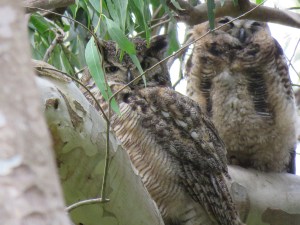
From the butterfly viewing platform we easily spotted the two adult great horned owls with their recently fledged owlet. These owls start their breeding cycle early as the don’t construct their own nests. Instead they borrowed a red-shouldered hawk’s nest.

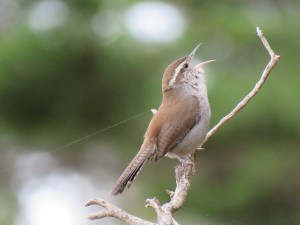
As we headed out, the local male Bewick’s wren was perched up, proclaiming his place in the world.

Image

Where the River Ends, a Gull Bath

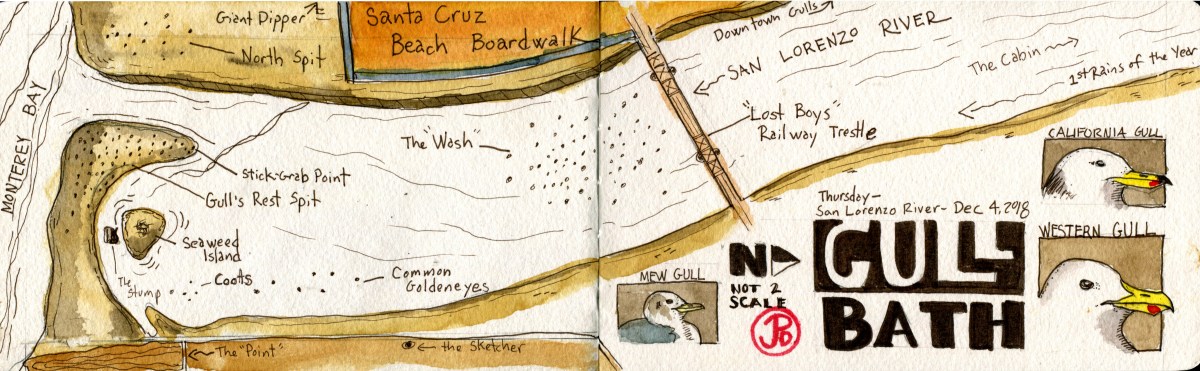
I headed to the bluff on the east side of the San Lorenzo River. This is where the river ends into Monterey Bay.

On my left was the Monterey Bay and beyond was the Municipal Wharf (sight of great fork-tailed storm-petrel sightings last year) and to my right was Santa Cruz Beach Boardwalk, now in winter dormancy. I knew that any time a large river entered the ocean, where fresh water meets salt, there would be bathing gulls. Lots of gulls.

Down below, there were hundreds of gulls. This multi age and many specied gathering contained mainly California, herring, mew, and western. I scanned the gathering and found no rarities. But it did give me an opportunity to observe the dynamics of gull bathing and preening.

The mighty San Lorenzo River is a major winter gull bathing and resting location on Monterey Bay. The Santa Cruz Beach Boardwalk is on the west side. The Logger’s Revenge to the right and my favorite roller coaster, the Big Dipper, is on the left.

Using my not-so-secret powers of observation I noted two areas that the gulls used: river and sand. The river is used for washing and the sand for preening, resting and playing.

The gulls used the river right in front of the railway trestle which was featured in the 80’s vampire flick Lost Boys. The birds were doing their indelible flappy wing dance followed by a head plunge and a wiggle. Yes very scientific I know.

The gulls on the sand spit where resting or preening. I noticed a few juvenile gulls playing with slicks on the spit point. They would carry a stick around and then drop it and pick it up. Repeat. I can only guess that they are practicing their eye-beak coordination.

The spread I sketched was a not-to-scale gull’s eye view of the river mouth. I love to make my own maps, using my own names for the land. This map contains my own: Seaweed Island, the “Wash”, Stick-Grab-Point, Gull’s Rest Spit, North Spit, and the “Stump”. Most of these land and watermarks are ephemeral, changing and disappearing with the tides and the winter rain, washing down from the Santa Cruz Mountains.

Image

Put a Fork-tailed in It

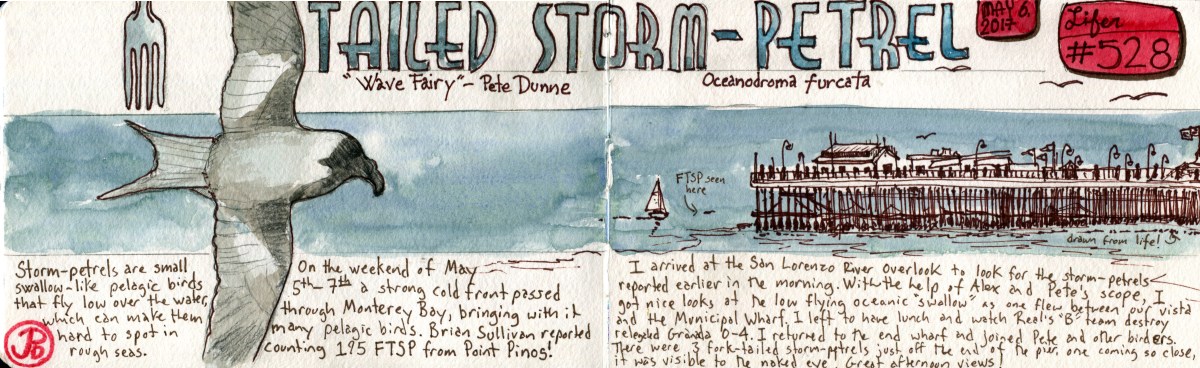
This lifer was a parking lot bird in a manner of speaking. I looked at the text from Dickcissel: “fork tailed storm petrel san lorenzo river mouth. you going?”.

I really needed a pair of black pants but they could wait for a possible lifer so I left the Capitola Mall parking lot and headed to the San Lorenzo River overlook, which was about 15 minutes away. 

At 9:52 AM a fork-tailed storm-petrel was seen again, two were first first reported from the rivermouth at 8:23 AM, one was being stooped on by the local peregrine. It was now 10:15 AM and I hoped the pelagic petrels would stay close enough to shore to be seen.

I parked, grabbed my car binos and headed out to the overlook. The first thing I saw was two birders, which was a very good sign. I walked out to the point and scanned the waters between the buoy and the Municipal Wharf, looking for a grayish low-flying petrel. One birder had it and I soon had the sea-swallow in my binos, tracking it as it flew to the right. The bird passed in front of the wharf and one birder suggested heading off to the wharf to get closer looks.

I was off to lunch to watch a Real Madrid “B” team slaughter already relegated Granada 0-4. It reminded me of the time I was in Bilbao last Spring, on a Sunday afternoon after the home team, Athletic Bilbao had drawn 1-1 with Granada. I was walking up to the Federico Moyúa Plaza, the town’s center, as the Granada team bus circled the plaza, quietly making it’s way out of town and now the Spanish minnows were quietly making it’s way out of the Spanish Primera Division.

A shop front in Bilbao sporting the crest of the local all Basque team. Futbol is a religion in this northern part of Spain. But I digress. . .

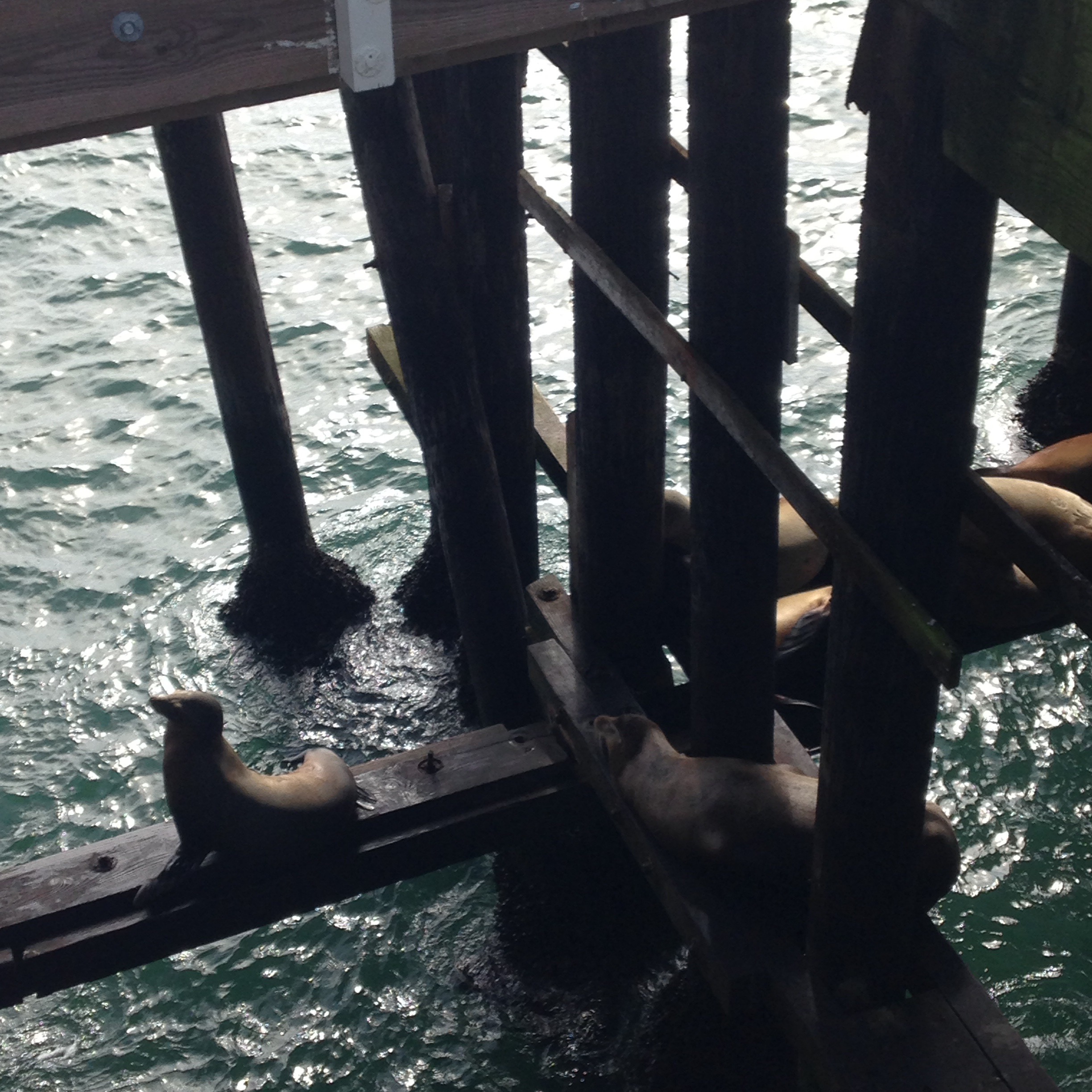
In the afternoon I decided to head out to the wharf, which was a popular destination in my childhood. I have many memories of eating burgers and fries with my dad and brother and then heading to the end of the wharf to watch the snoozing California sea lions. This area and the Santa Cruz Beach and Boardwalk is the tourist side of Santa Cruz and I now rarely visit this part of town, but close looks at a rare Monterey Bay petrel drew me to the very end of the west coast’s longest pier at 2, 745 feet. That’s 2,745 feet jutting out into the Monterey Bay was almost like being on a pelagic boat trip but without the rocking and rolling. Dramamine not needed.

The sealions of my youth. Under the wharf of the West Coast’s longest pier. 

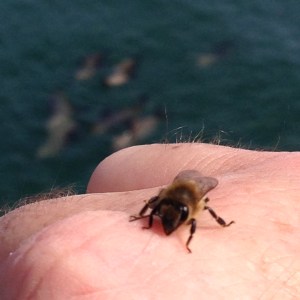
When I walked to the end of the pier, there were two good omens.the first was that there with about eight birders peering off to the waters (always a good sign). And the second was a honey bee that alighted on my right hand (can’t ask for a better blessing). And I just kept birding with my pollinator guest.

Show no fear, don’t get stung. It’s a lesson I  teach all my students: don’t be afraid of nature, nature has more reasons to fear us.

It didn’t take too long, with so many scopes and binos  trained on the waters to find a fork-tailed storm-petrel. One was sighted as I walked up, in fact there were three of them foraging off the pier. One came so close that I lowered my glasses and watched it with the naked eye. Amazing for a pelagic species and not being on an ocean going vessel!

We were frequently asked by the tourists if we where looking for whales. The standard response was, “No, just a small ocean bird. ” That answer usually struck them dumb and they hurriedly walk off as if we had the Pneumontic Plague.

As a nice bonus I spotted a humpback’s blow on the horizon, followed by its flukes as it dove. So I  now could say we where looking at whales. But they didn’t ask and I didn’t answer.

Image

PEFA

“No flesh-eating creature is more efficient, or more merciful; it simply does what it was designed to do.”

-J. A. Baker

On one Saturday I was birding Natural Bridges State Park when I saw a bird in direct flight. Stiff wingbeats, with prey clutched in it’s talons. It perched in the top of a Monterey pine at the back entrance to Natural Bridges. I knew what the bird was and I headed closer to affirm my hunch and see what it had taken for it’s mid afternoon repass. Dark helmet with sideburns, a bird that is affectionately called “Elvis” by hawk watchers on Marin Headlands Hawk Hill. Peregrine Falcon, Falco peregrinus, the fastest animal on planet Earth.

Continue reading

Image

Covered Bridges of California

There are about 12 covered bridges in California. And like much else such as the coast redwood, giant sequoia, bristlecone pine, and Mount Whitney, these bridges contain a superlative. Now as I teach my fourth graders, a superlative contains “est”as a suffix, and shows that something is without comparison. Such as tallest, largest, oldest tree or the tallest mountain in the lower 48.

California contains the longest single span covered bridge in the United States. The Bridgeport Covered Bridge spans 229 feet across the South Yuba River.

Brigdeport Covered Bridge

I set up my camp chair on Family Beach and using the waters of the chilly South Yuba River, I painted the span. The beach was lacking families on this December morning and an American dipper kept me company as this amazing aquatic songbird dove in the wintery rapids of the river as if it were a summer’s day. The dipper provided entertain while I waited for my washes to dry. I even included Muir’s favorite bird in the sketch.

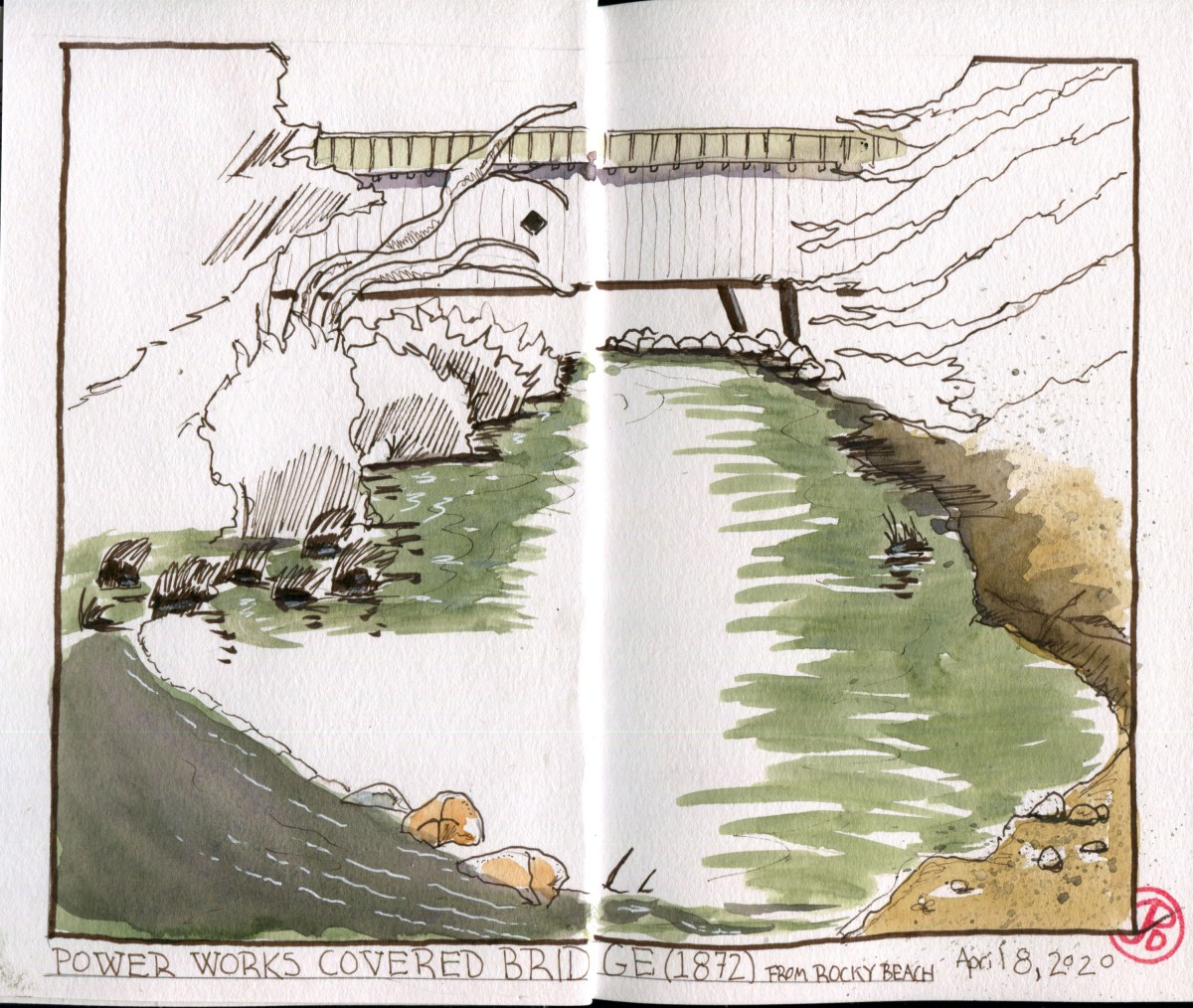
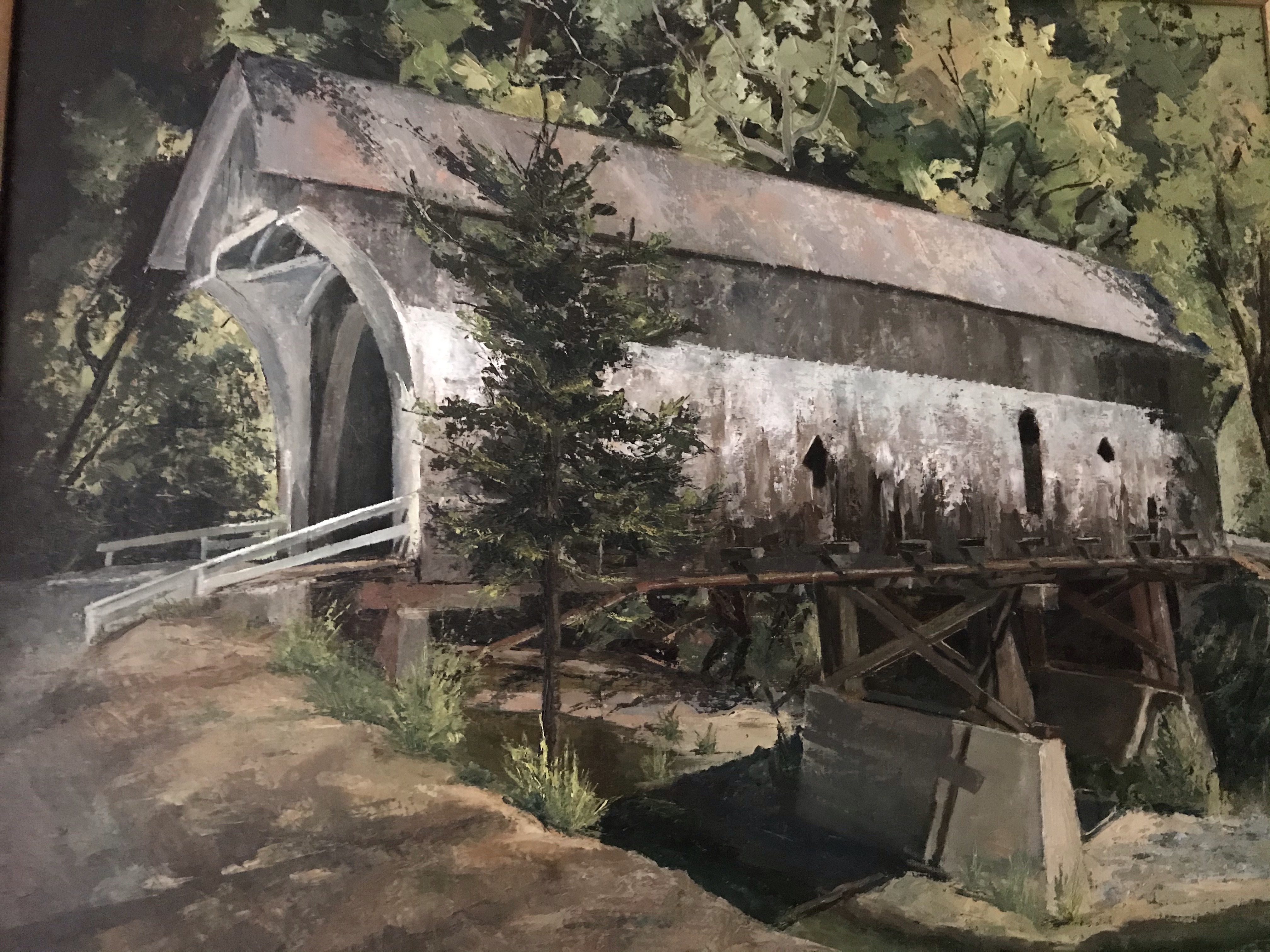
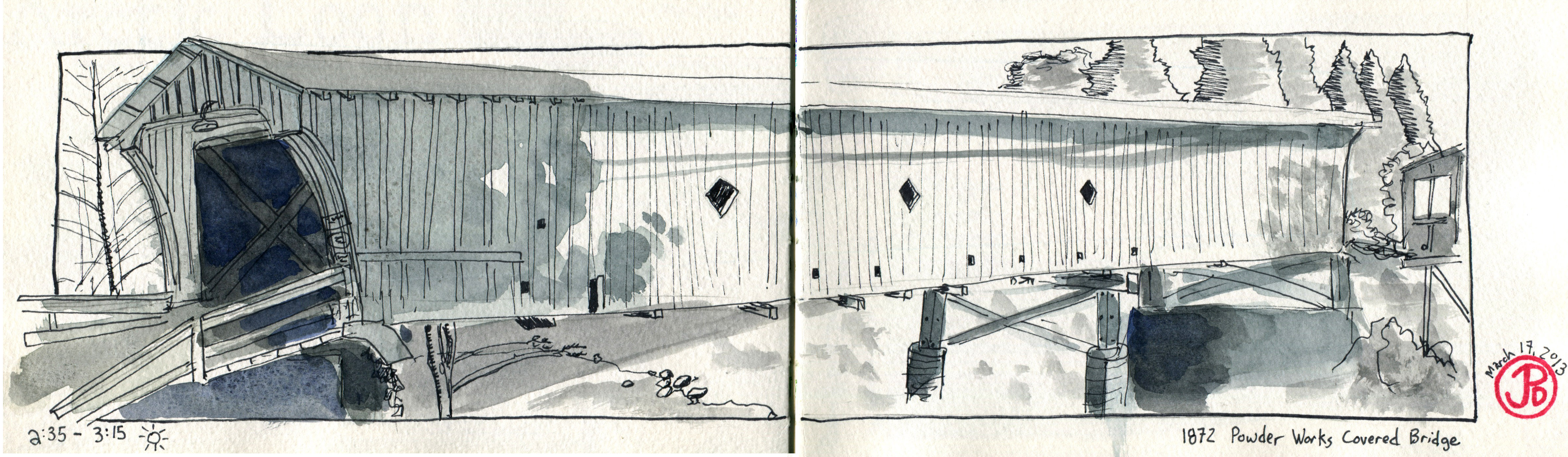
I have been familiar covered bridges from an early age. The covered bridge in Paradise  Park (featured image), near Santa Cruz, has been the only way to cross the San Lorenzo River without getting wet. This bridge was originally built for the California Power Works which formerly occupied the site. The 180 foot span was built in 1872. Unlike the Bridgeport bridge, this bridge is open to foot and automobile traffic making it a bridge in continual use for 143 years.