The Central Pacific Railway had to bore thirteen tunnels through the Sierra Nevada, this proved to be the biggest challenge of the Transcontinental Railway. None is more of an engineering feat than Tunnel #6, known as the Summit Tunnel, the longest tunnel on the Central Pacific.
Like it’s name implies it is on the summit of the Sierra Nevada at Donner Summit (7,017 feet). This 1,659 foot long tunnel was bore through granite with Chinese laborers using, at first black powder, and then later the more powerful but more volatile, nitroglycerin. The tunnel was started both at the west and east portals and when they finally met, the two bores were just an inch off.
I hiked up from Donner Summit Road, old Highway 40 (the highway is the last incarnation of the Emigrant Trail), to the east portal. I walked through Tunnel #7 heading west along the abandoned railway grade. The single track was abandoned in 1993 when the line was double tracked to the south.
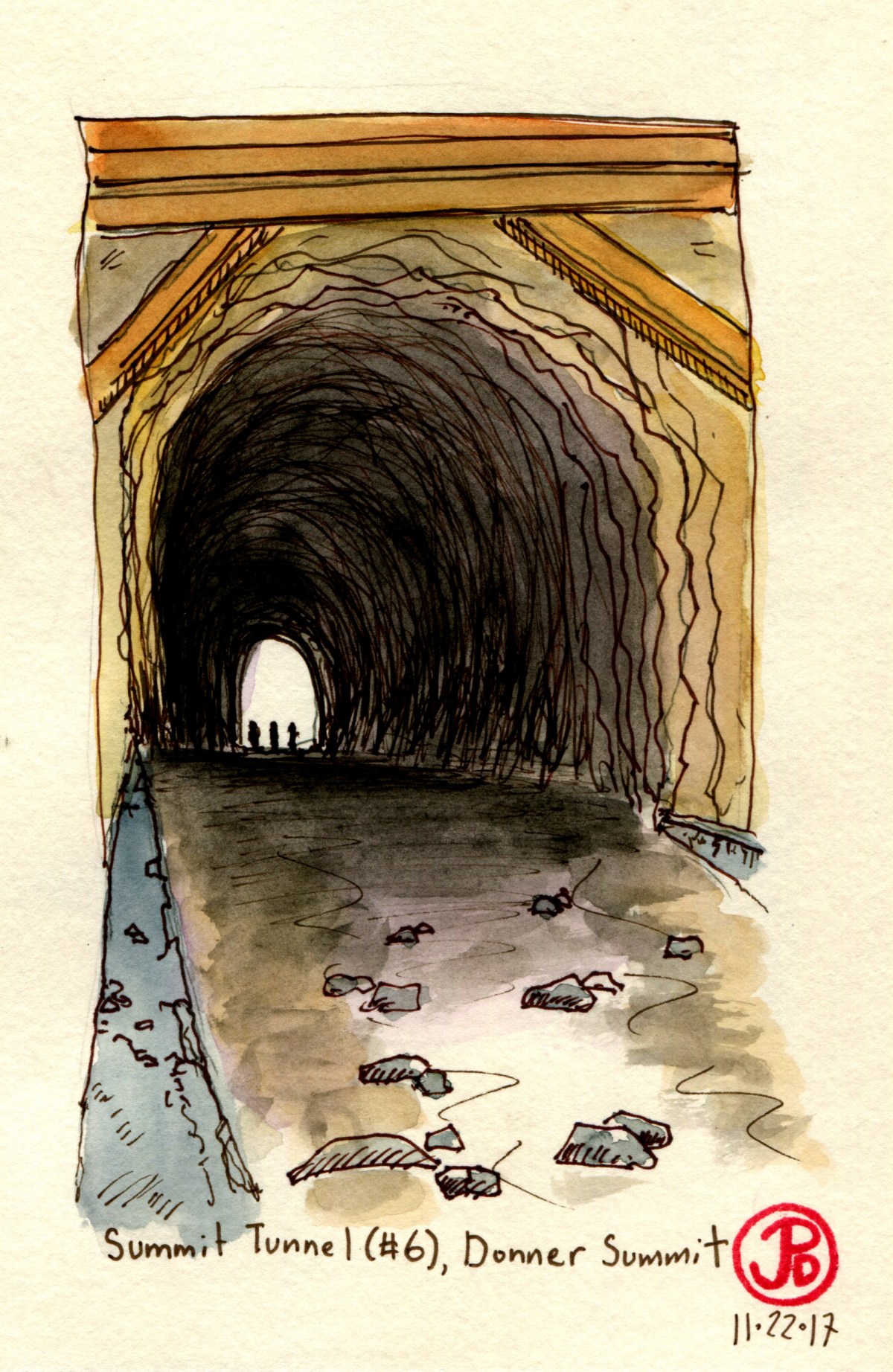
I entered the Summit Tunnel, found a dry place to sit, and started to sketch the tunnel from the east portal (the featured sketch).

Looking west down the 1,659 feet of the Summit Tunnel (#6).
What impressed me about this tunnel was the sheer effort that went into conquering the Sierran Monolith. Over 12,000 Chinese labored in the mountains, year round, 24 hours a day to will this tunnel into existence. It took just over a year to complete the tunnel (November 30, 1867). The first passenger train passed through on June 18, 1868.
After my sketch, I headed east through Tunnels # 7 and 8 and into the snow sheds that hugged the mountainside down past Donner Lake and into Truckee. The snowsheds are now abandoned and are now canvases for mountain/ urban artists.
The snowsheds where the brainchild of Stanford and despite their cost, were essential to keeping snow off the line during the massive snow falls that are almost a seasonal tradition in these parts. Think: Donner Party. The first sheds were built of wood.

Snowsheds looking east where now a stream instead of trains now runs.