Image

Gateway Arch, St. Louis

You can’t visit St. Louis without visiting (and sketching) it’s city symbol, the Gateway Arch.

And that’s what I did.

The arch was designed by Finnish architect Eero Saarinen when his design was selected in a competition. Construction started in February of 1963 and the arch was completed in October of 1965.

The arch signifies the beginning of the west as many explorers left from Missouri to California, Oregon and other points west.

I arrived well before my 9:20 ticket to the top to do some sketches of the Arch from different perspectives.

My shadow and the Gateway Arch from the Banks of the Mississippi. This was perfect sketching light.

At 630 feet tall, the arch is a perfect shape (and the largest arch in the world) and is an intriguing shape to sketch because walking 20 feet north or south, offers such a different perspectives. During my three hour visit I sketched the arch five times.
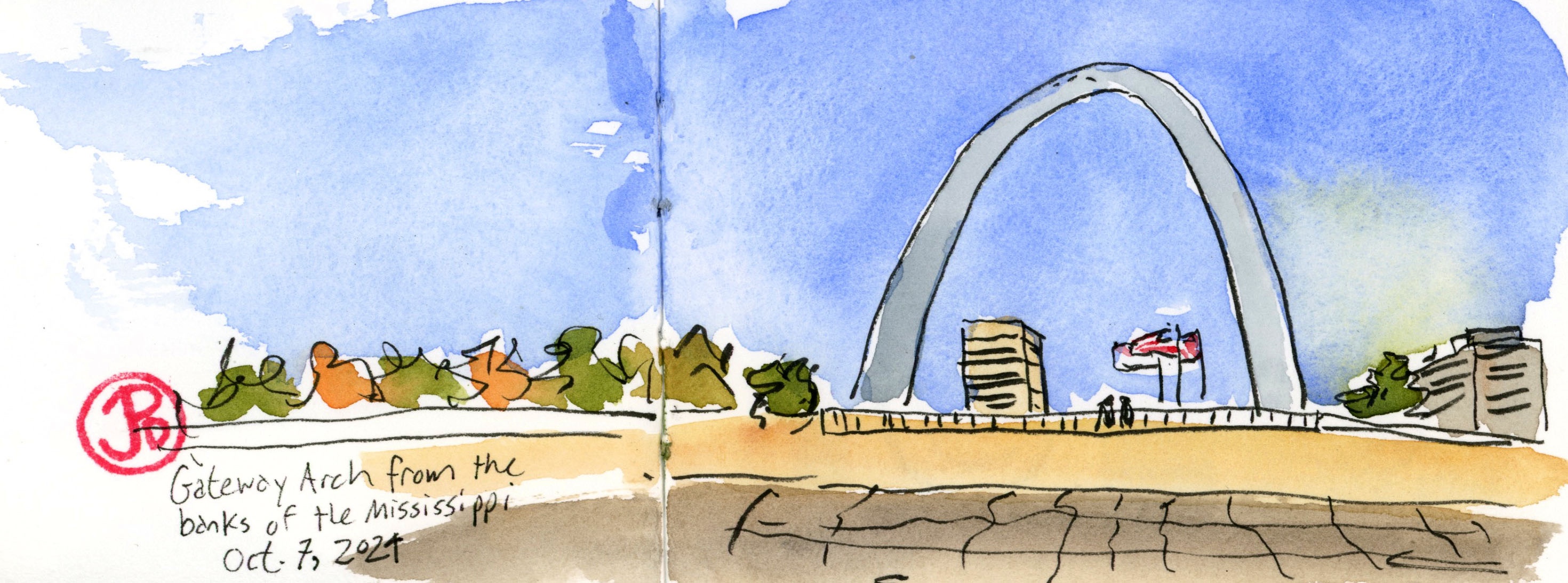
A sketch from the banks of the Mississippi in my “point and shoot” journal.

I headed to the victor’s center, I had a 9:20 ticket at the north span. I was a little early and I went in with the first group. Eight pods, seating five visitors each, rises to the apex of the arch. The pods are a tight fit, one visitor compared them to the pod in Mork and Mindy!

Once in, rubbing knees with total strangers, the door closed and we climbed to the top. The journey took about four minutes. This is definitely not a ride for the claustrophobic or anthrophobic!

At the apex there are viewing windows both east and west. To the east lies the Mississippi River and the State of Illinois. The view to the west is of downtown St. Louis where the shadow of the arch falls below at this time of the morning.

I was with the first group up to the top and with the rising sun behind us, the arch’s shadow enters the cityscape.

The views from the top were amazing in the morning light.

The mighty Mississippi looking towards the Land of Lincoln. The river is an important waterway for barge traffic.
Image

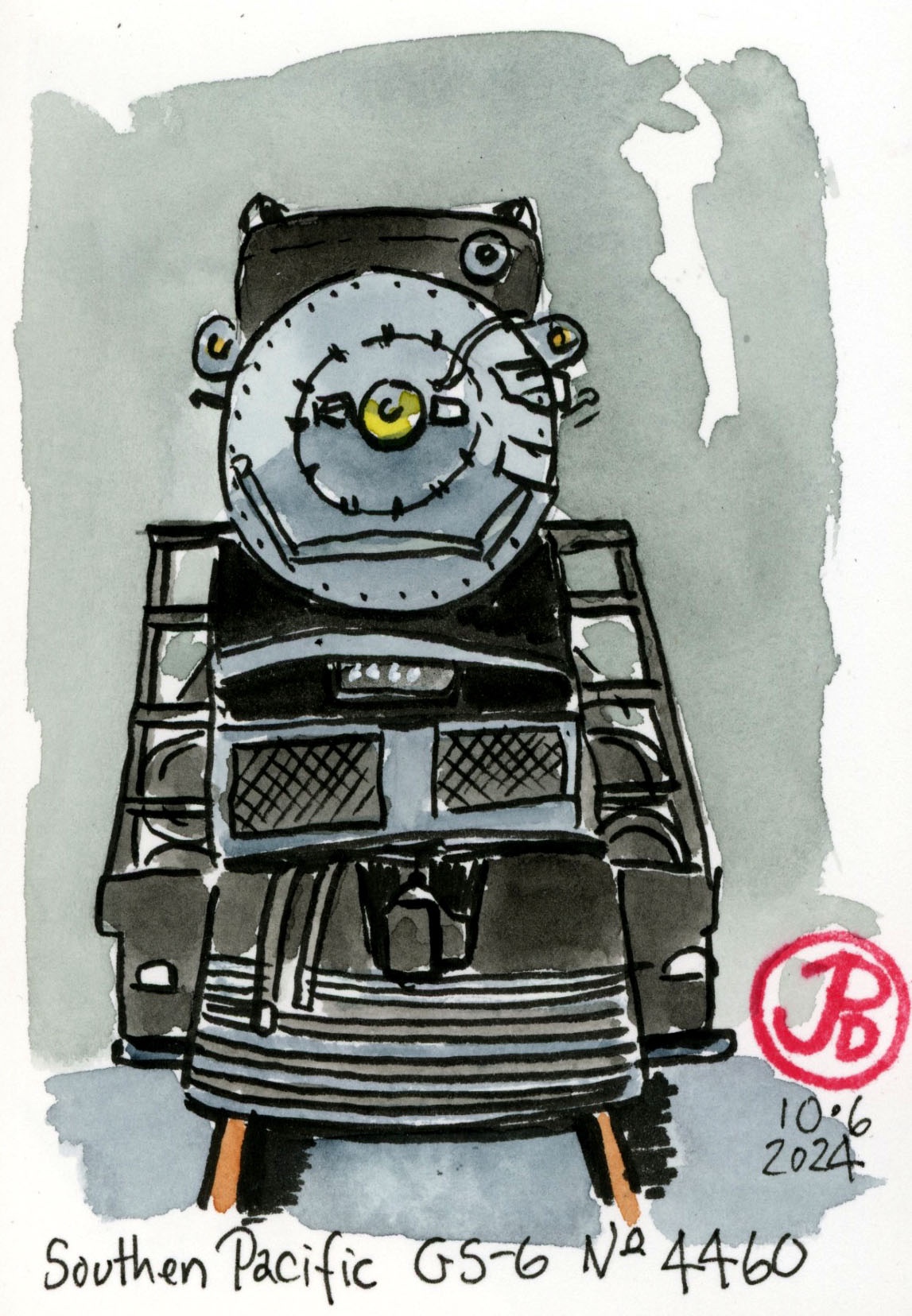
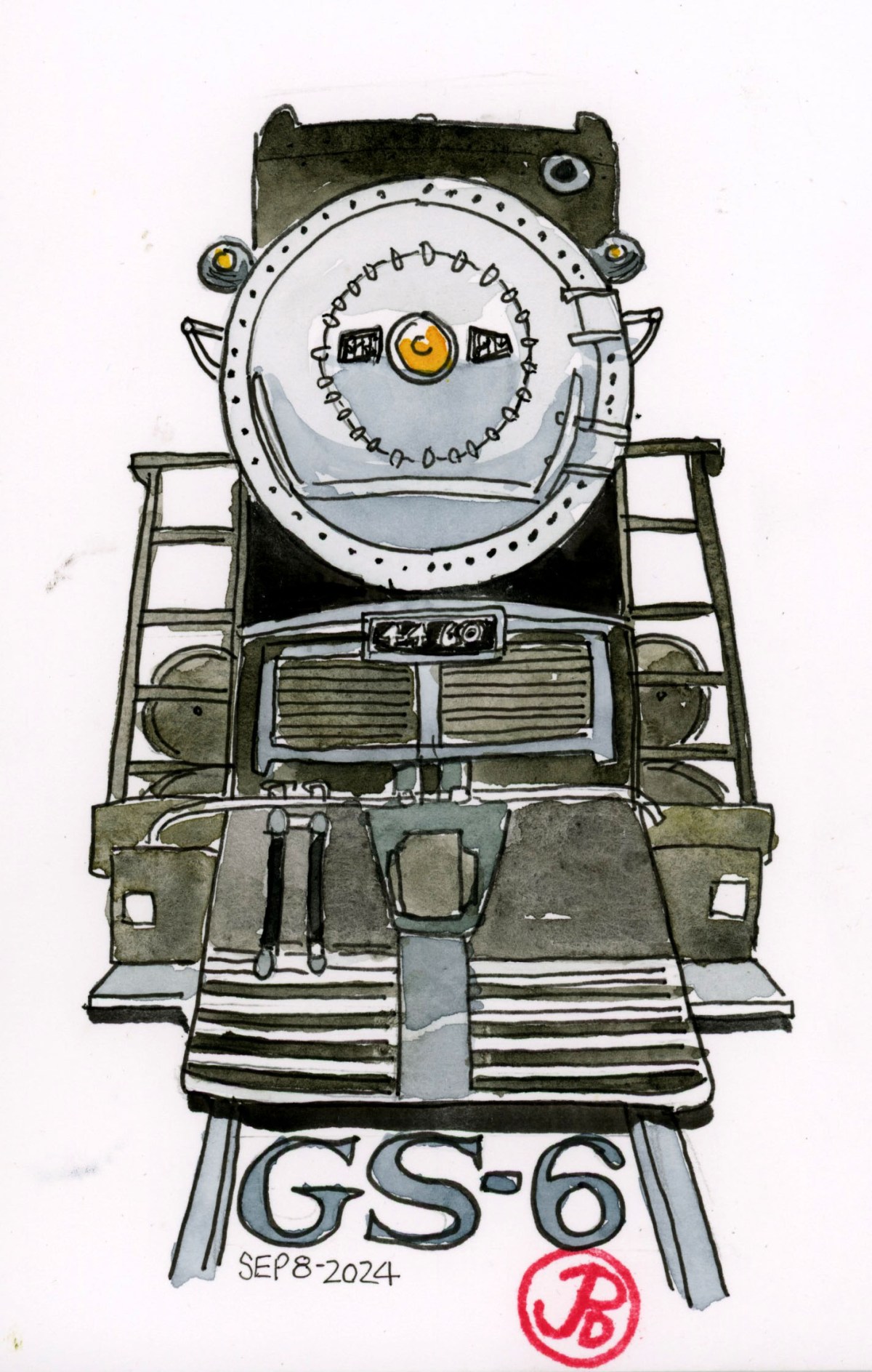
Southern Pacific GS-6 No. 4460

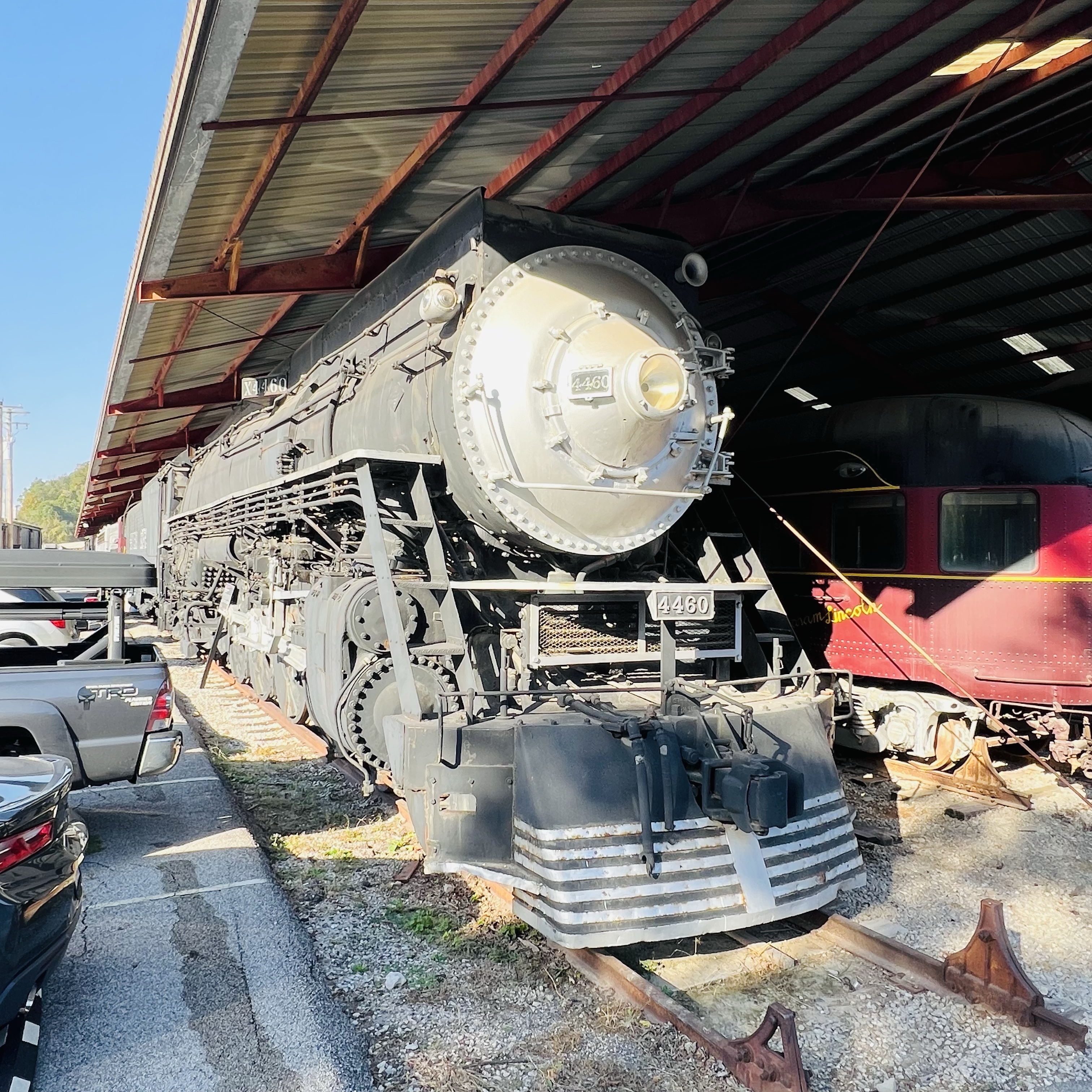
I had to journey to the very edge of the 42 acres of the National Museum of Transportation to see the number one locomotive on my museum sketch list. (Ironically it the first locomotive I saw driving in from Barrett’s Station Road.)

The Northern type 4-8-4 GS-6 (only ten were built) was in the far corner of the engine shed bordered by the employee parking lot. This was an unfortunate and sad location to display one of only two of Southern Pacific’s “Golden State” or “General Service” locomotives in existence.

Another name for 4460 is the “Forgotten Daylight” because it gets far less attention than her famous relative, GS-4 No. 4449. It’s placement in the corner of the engine shed, hemmed in by parked cars at the museum, gives a new meaning to the “Forgotten Daylight”.

No. 4460 with employee’s cars preventing you from getting a nice broadside view of the running gear.

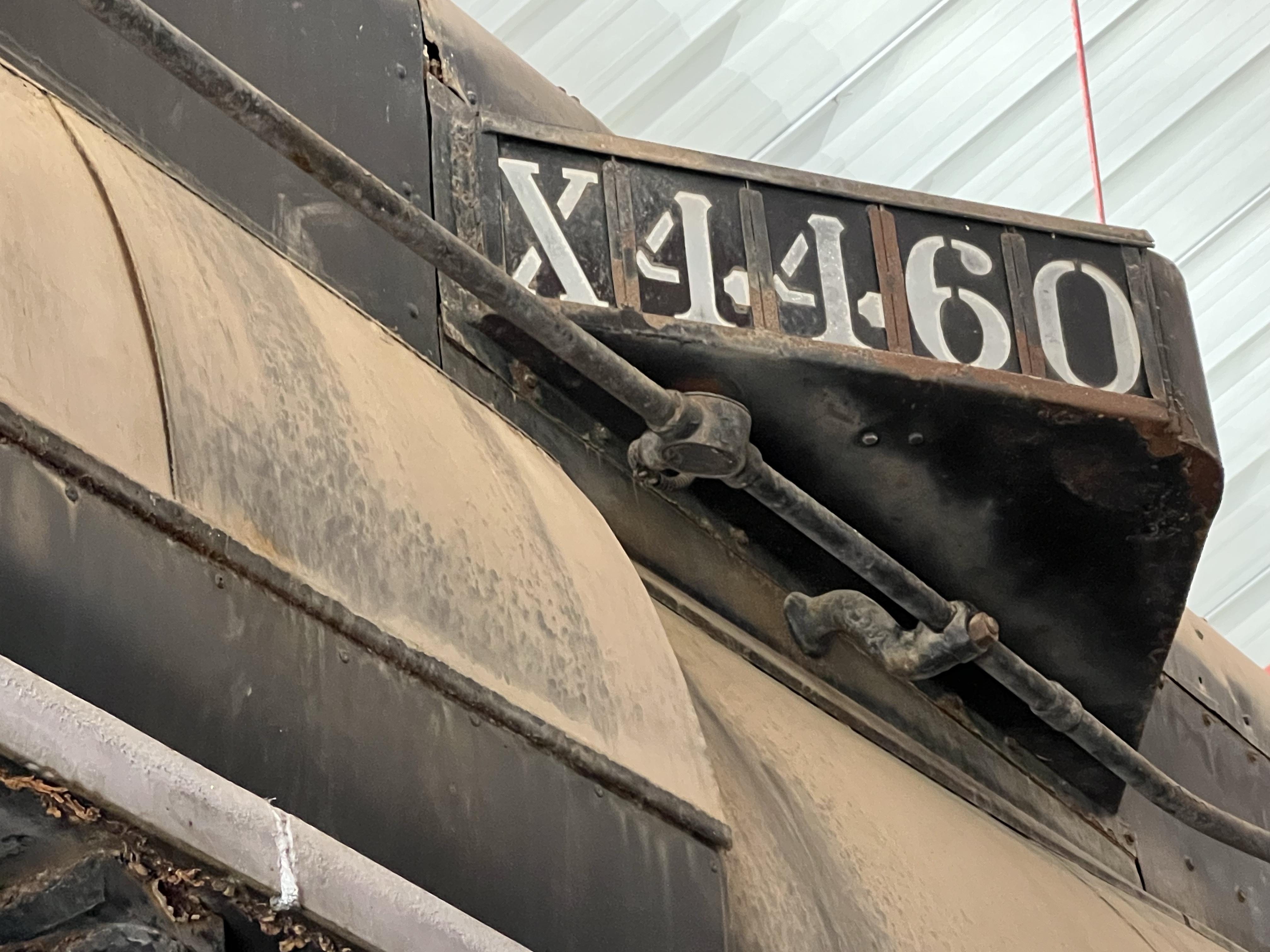
The “War Baby” was built in 1943 by Lima and had to work within the limits of the War Production Board. The side skirting of the previous GSs was removed and the locomotive lacked the mars light of the GS-4, resembling the GS-2s. 4460 was the first GS-6 built at the Lima Locomotive Works in Lima Ohio. These locomotives could be used for passenger and freight trains.

4460 is the last steam locomotive operated by the Southern Pacific. In October 1958 the last run of an SP steam locomotive was between Sacramento and Sparks, Nevada over the famous Donner Pass. This was on a Goodbye to Steam excursion. 4460 ran to Sparks and then back to Sacramento, unassisted.

The iconic GS-6 was not scrapped like so many other steam locomotives but was donated to the Museum of Transportation in April of 1959.

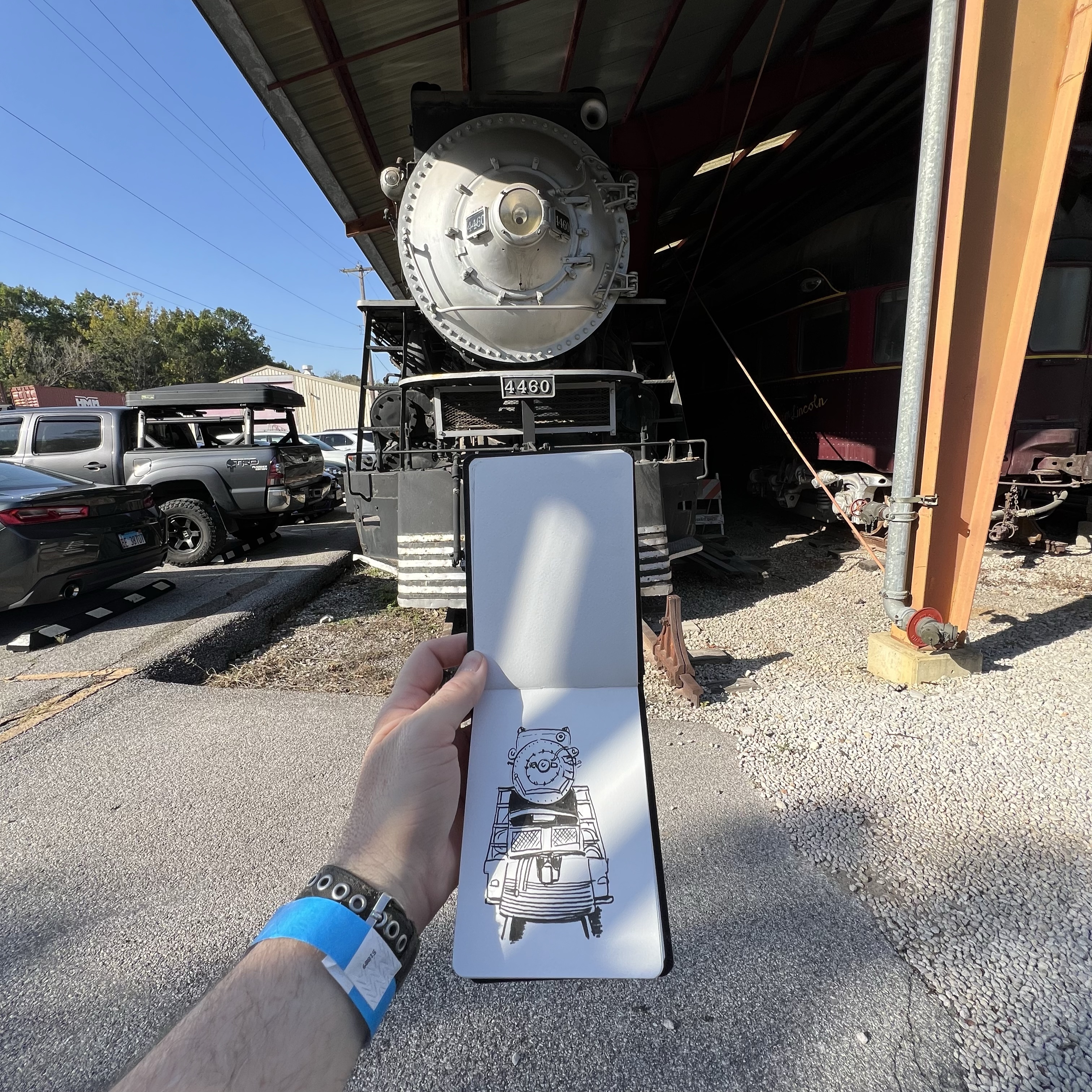
Sketch in progress at the NMOT. This was in my “point and shoot” Hahnemuhle 100% cotton sketchbook.
The finished field sketch with watercolor.

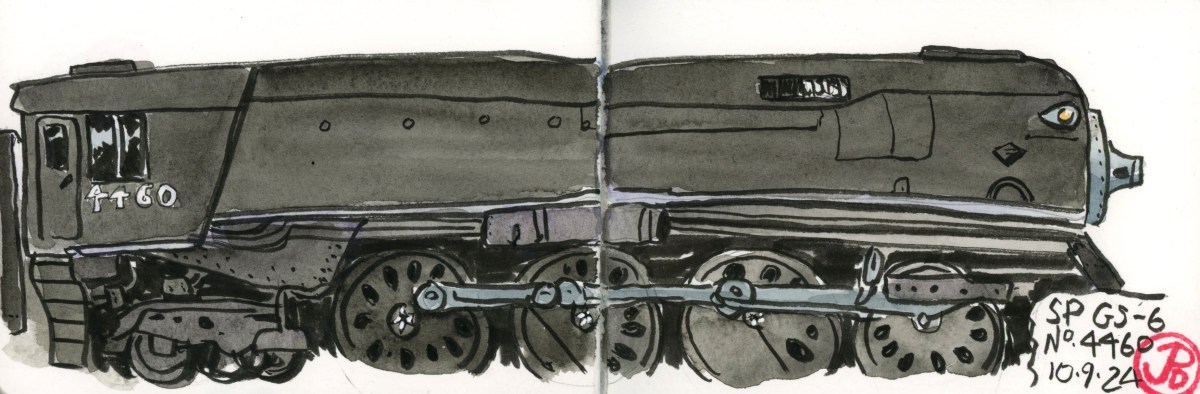
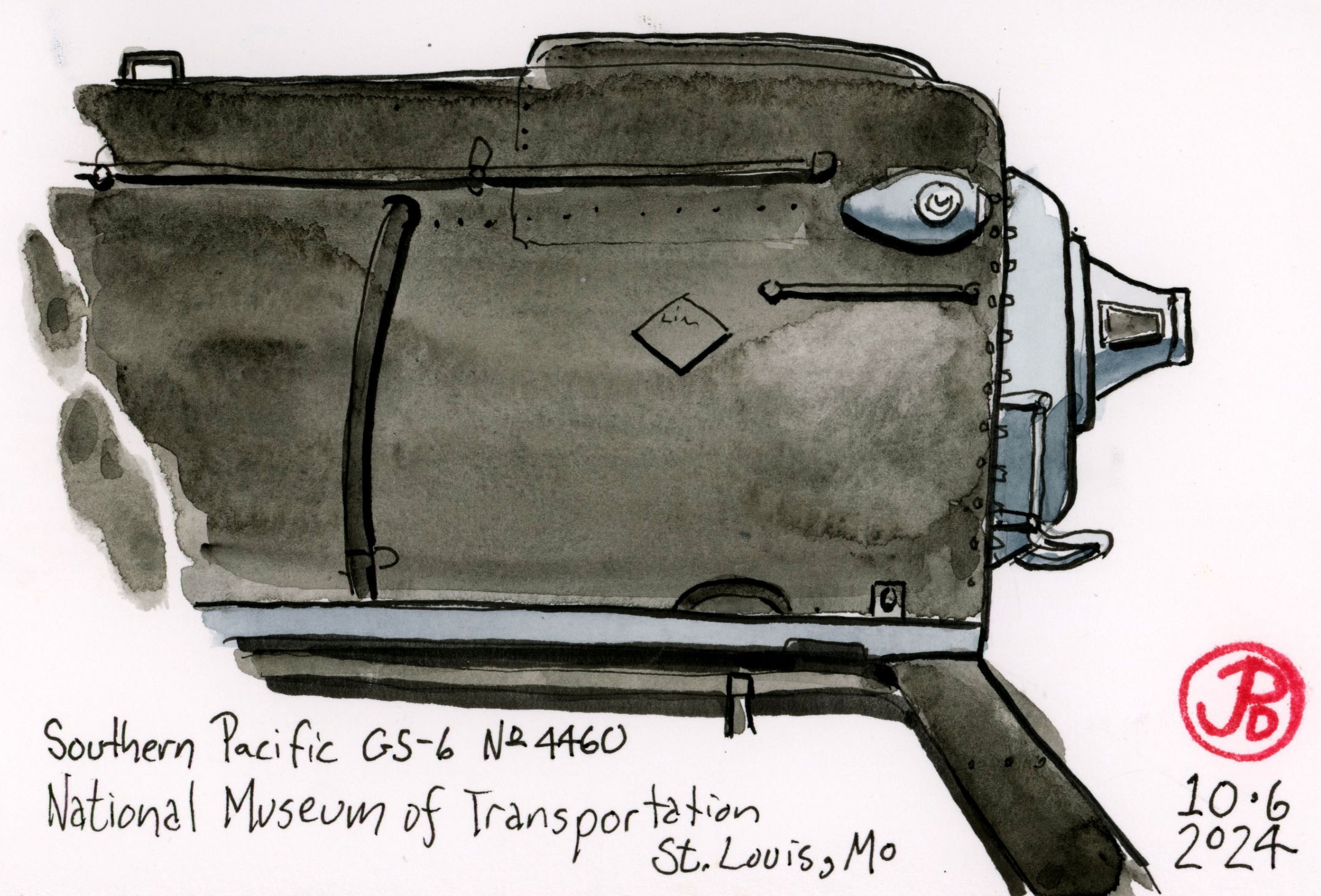
I also sketched 4460 in profile, focusing in on its classy smoke box and headlight.
Image

The National Museum of Transportation

There has been a museum on my sketch list for a long time and I used my fall break to finally visit it.

The National Museum of Transportation is in the St. Louis suburb of Kirkwood, Missouri. The 42 acre museum was founded in 1944 and has a large collection of railroad history (and cars and planes).

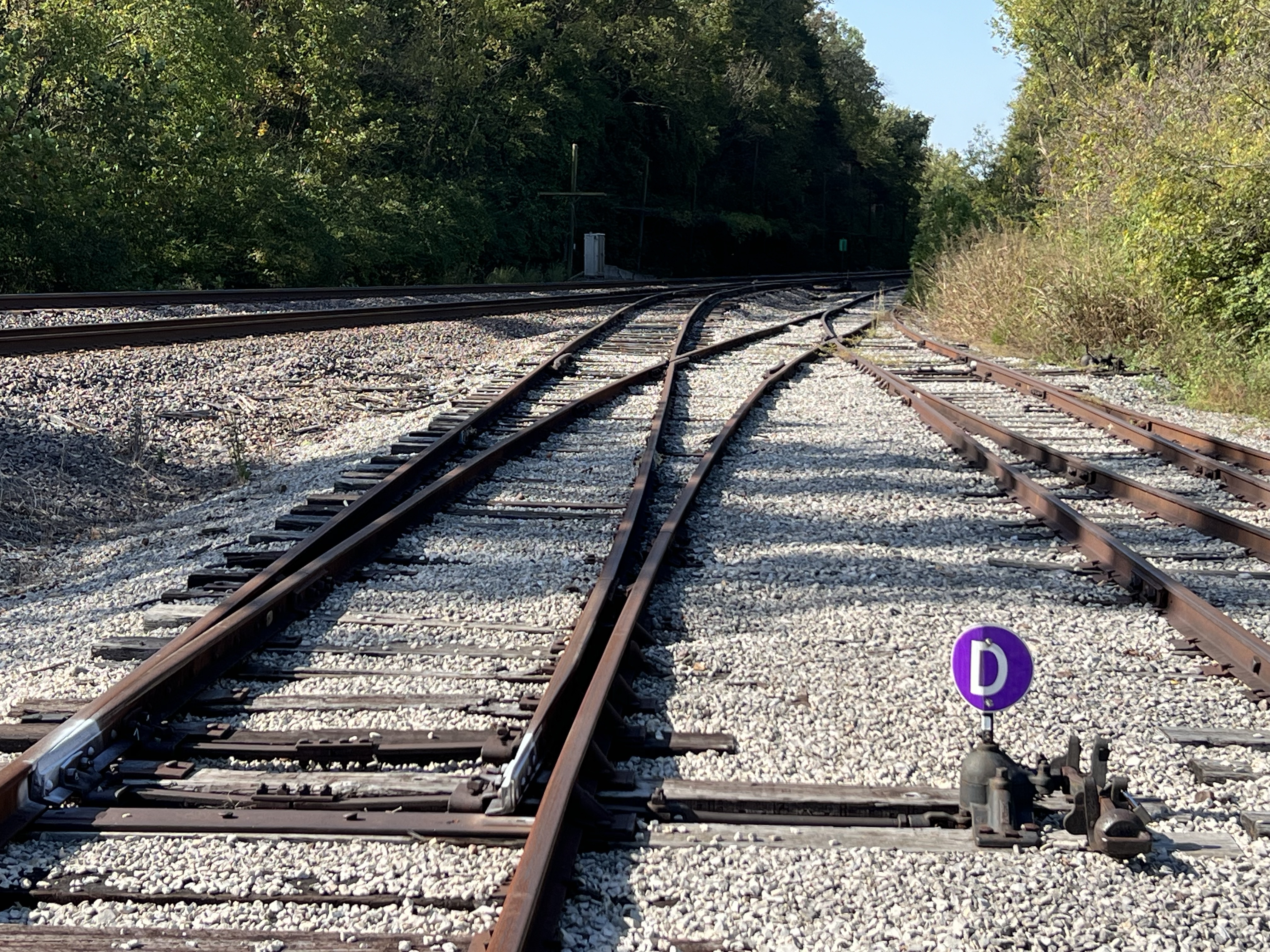
The museum has it’s own railroad spur to the Union Pacific mainline (formerly Missouri Pacific Railroad) so the larger locomotives in its collection can be shipped on rail.

The railroad spur connecting the museum to the UP mainline.

I made up a sketch list before my visit and there were a lot of iconic locomotives to render in ink and watercolor.

I was going to be busy, very busy!

Visiting this museum is like having my favorite train book as a child, The Illustrated Encyclopedia of North American Locomotives by Brian Hollingsworth, come to life. As a child I thought: “I’d like to see that locomotive!” And now I was about to! In fact the museum has 13 iconic locomotives featured in this book. The reason I knew this museum even existed was the common refrain in the book, “now displayed at the Museum of Transportation at St. Louis, Missouri”.

One of the electric locomotives featured in the book is the Chicago, Milwaukee, St. Paul & Pacific Railroad’s Class EP-2. This is the only preserved unit in its class in existence.

I planned to spend a good deal of time on my Sunday visit at the museum sketching. I would do all the line work in the field and then add watercolor back at my hotel.

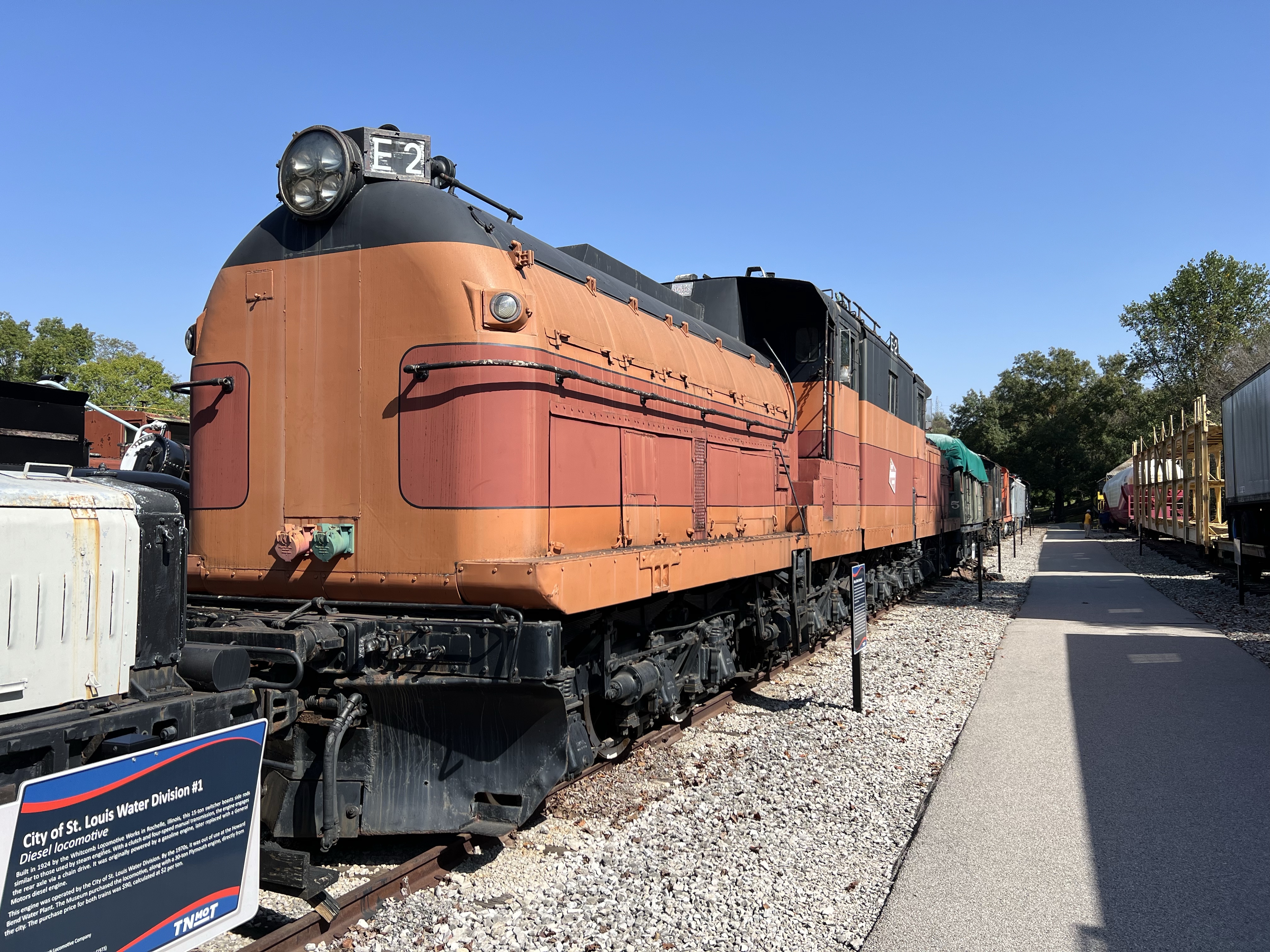
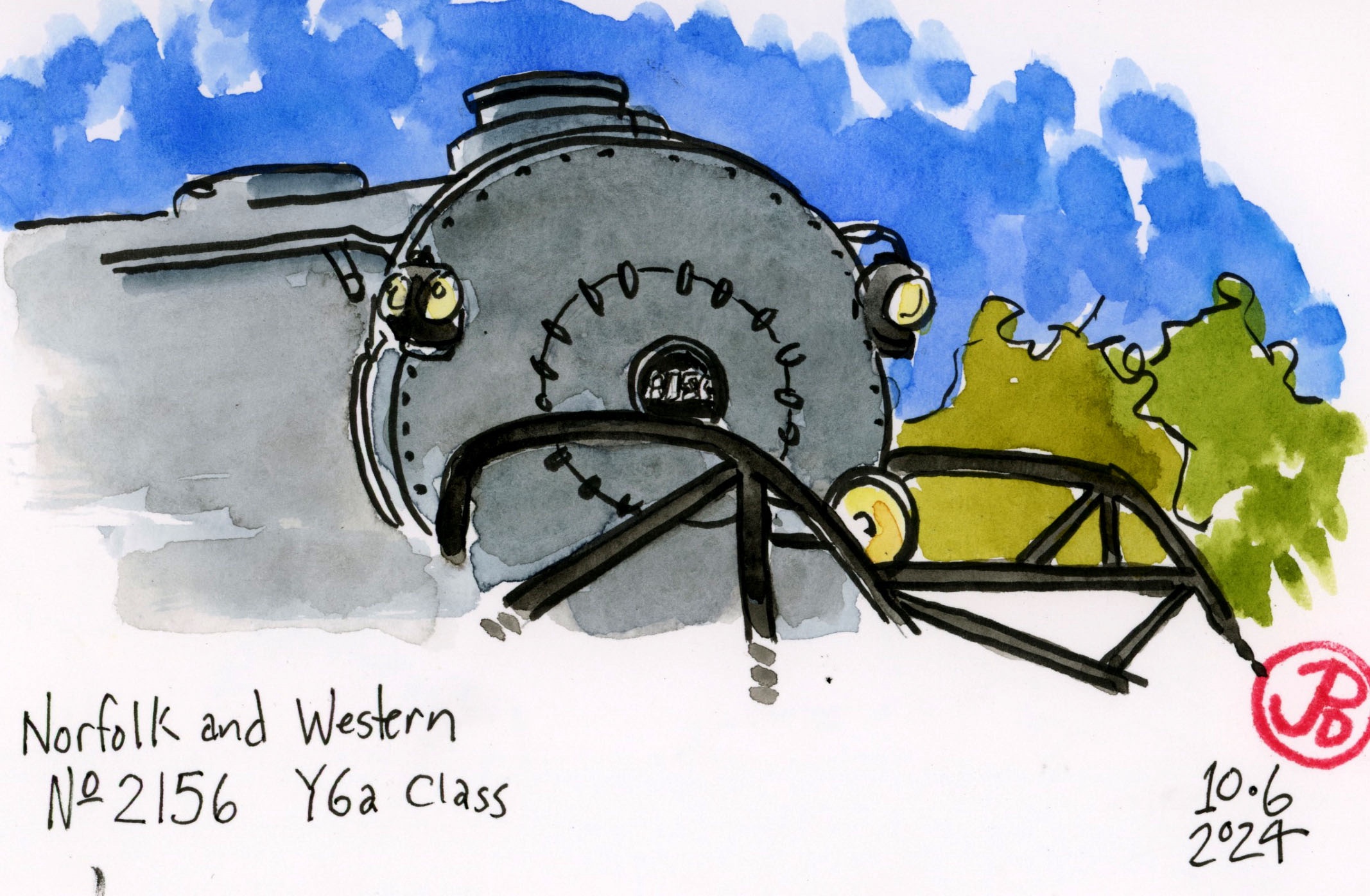
The museum has an amazing collection of large steam and diesel locomotives to sketch. One of those sketches completed the Norfolk & Western triad of A- Class, J-Class, and now Y-Class.

The N & W Y-Class was designed to haul long and heavy coal trains. While it is slightly smaller than Union Pacific’s Big Boys, the Y Class is more powerful than the UP articulated.

The NMOT is also one of the places to see a Union Pacific Big Boy. I have now seen and sketched four of the eight remaining Big Boys.

Freshly painted Big Boy No. 4006 with Centennial No. 6944 reflected in her black livery. This museum is one of the few places to see one of the largest diesels and largest steam locomotives displayed side-by-side.

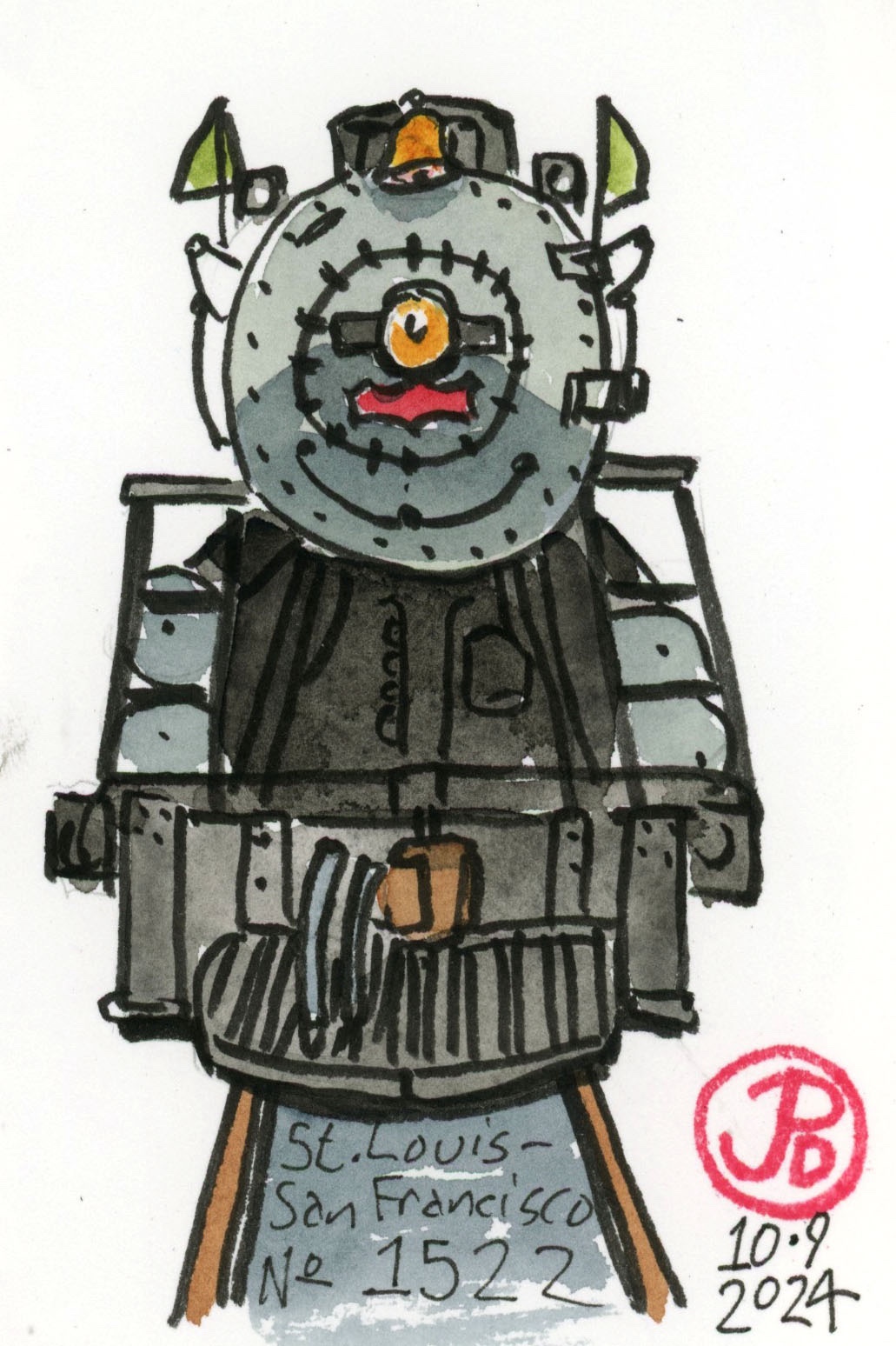
While the Big Boy is a big draw to the museum, there is one locomotive that is the most loved and best known. This is the St. Louis-San Francisco Railway (“Frisco”) No. 1522. This 4-8-2 Mountain type was built in 1926 by Baldwin. The locomotive logged over 1.7 million miles in passenger and freight service. She was restored to working order and was in excursion service from 1988 to 2002 around the Midwest, where many saw and rode behind her.

Image

Midwestern Presketching

Before any great or small journey I do some presketching.

On my October Fall break I planned to visit two midwestern states: Missouri and Illinois. I had been to Illinois before but only to Chicago. Now I planned to visit it’s capital, Springfield. And Missouri, Gateway to the West, would be a first visit for me.

My starting point would be St. Louis, Missouri. I had a few sites, destinations, and sketches on my list, chief among them was the National Museum of Transportation.

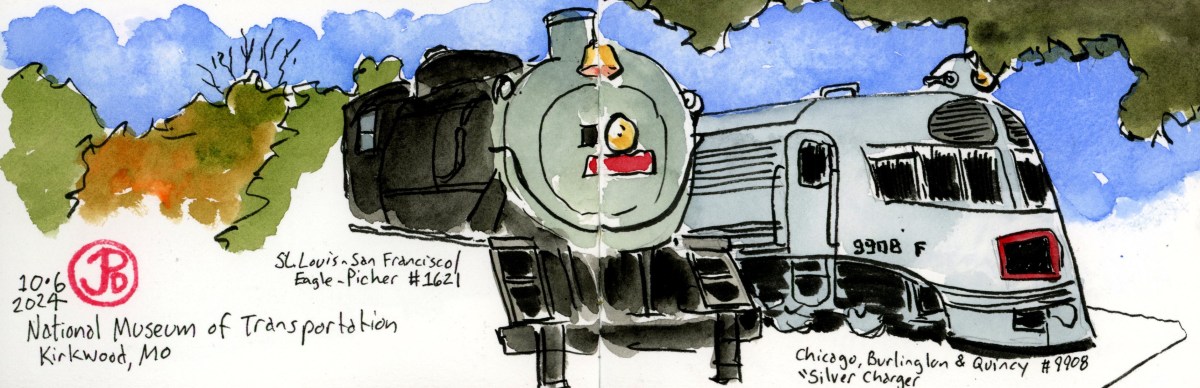
This 42 acre museum is in the St. Louis suburb of Kirkwood. Its collection of railroad history includes: Aerotrain No. 3, Big Boy No. 4006, Norfolk & Western Y-class No. 2156, UP Centennial No. 6944, the Silver Charger No. 9908, and the steam locomotive that I was really looking forward to seeing/ sketching: Southern Pacific’s GS-6 No. 4460 (featured sketch).

I also want to sketch the world’s tallest arch, the 630 foot Gateway Arch in St. Louis. I booked at ticket to take me up to the top to see the city of St. Louis and the mighty Mississippi River.

Illinois is known as the “Land of Lincoln” and the epicenter of Lincoln is the state capital of Springfield. It was here that Lincoln lived for 17 years before he left from the Great Western train station to become the 16th President of the United States. In Springfield are the station where he departed, his home, Presidential Museum and Library, and his tomb.

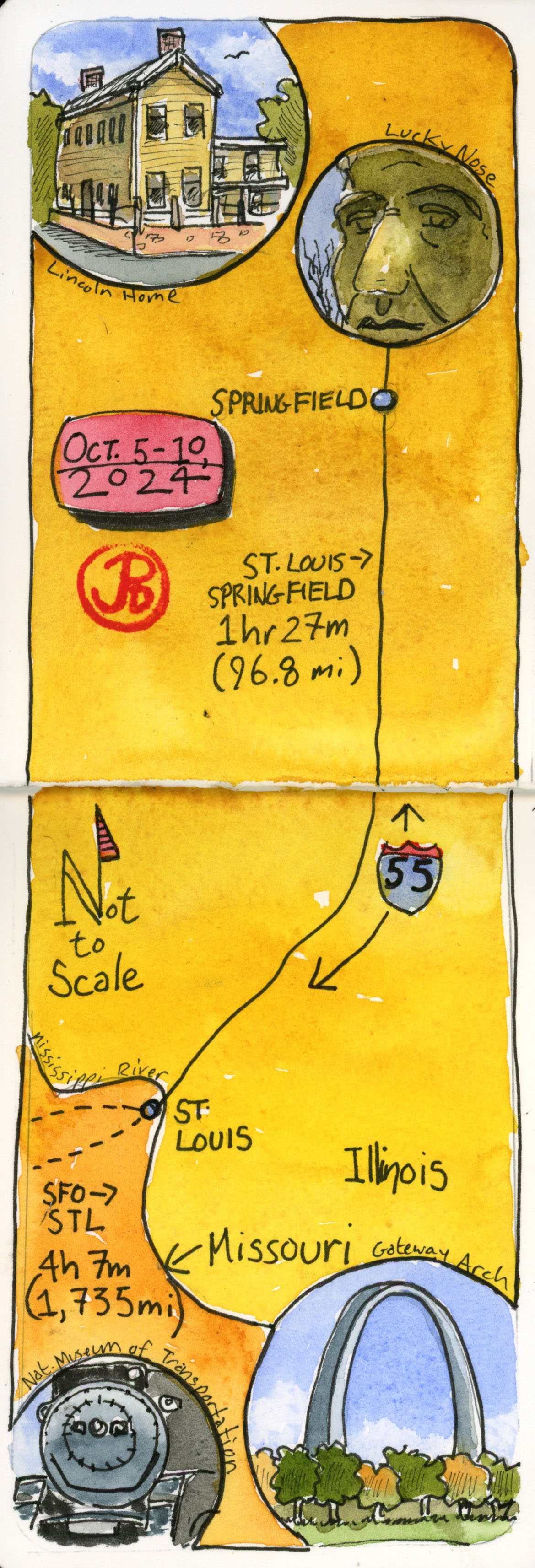
I had much to sketch and many miles to traverse on my short Midwestern jaunt so I drew it out as a map.

Before any trip I like to draw a map to help me visualize where I am going. I like to add travel times (St. Louis to Springfield: 1 hr 27 min) because it helps me plan my time deciding how much time to spend in either city. I’ve always been about seeing less while having quality time on the ground.

In circular inserts I illustrated four of my sketching targets: Lincoln’s house in Springfield, the Lincoln bust at his his tomb (visitors rub his nose for good luck), the National Museum of Transportation (featuring Southern Pacific’s No. 4460), and the Gateway Arch on the banks of the Mississippi in St. Louis.

Let’s go!

Image

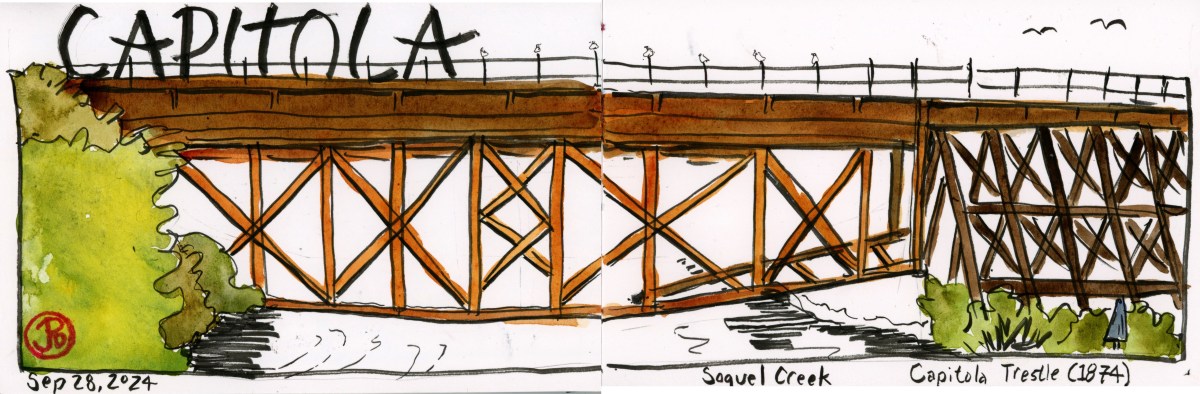
Capitola Trestle and Soquel Creek Bridge

Early Saturday morning found me in Capitola Village.

Capitola was founded in 1874 as a beachside resort and in the age before the personal automobile it owed its early popularity to the railroad.

The Santa Cruz Railroad, opened in 1876 and brought sun worshippers to Camp Capitola.

Southern Pacific took over the railroad in 1882. The SP brought beach goers to the small seaside town, passengers detraining at the new depot near the east end of the trestle, this location is known as Depot Hill.

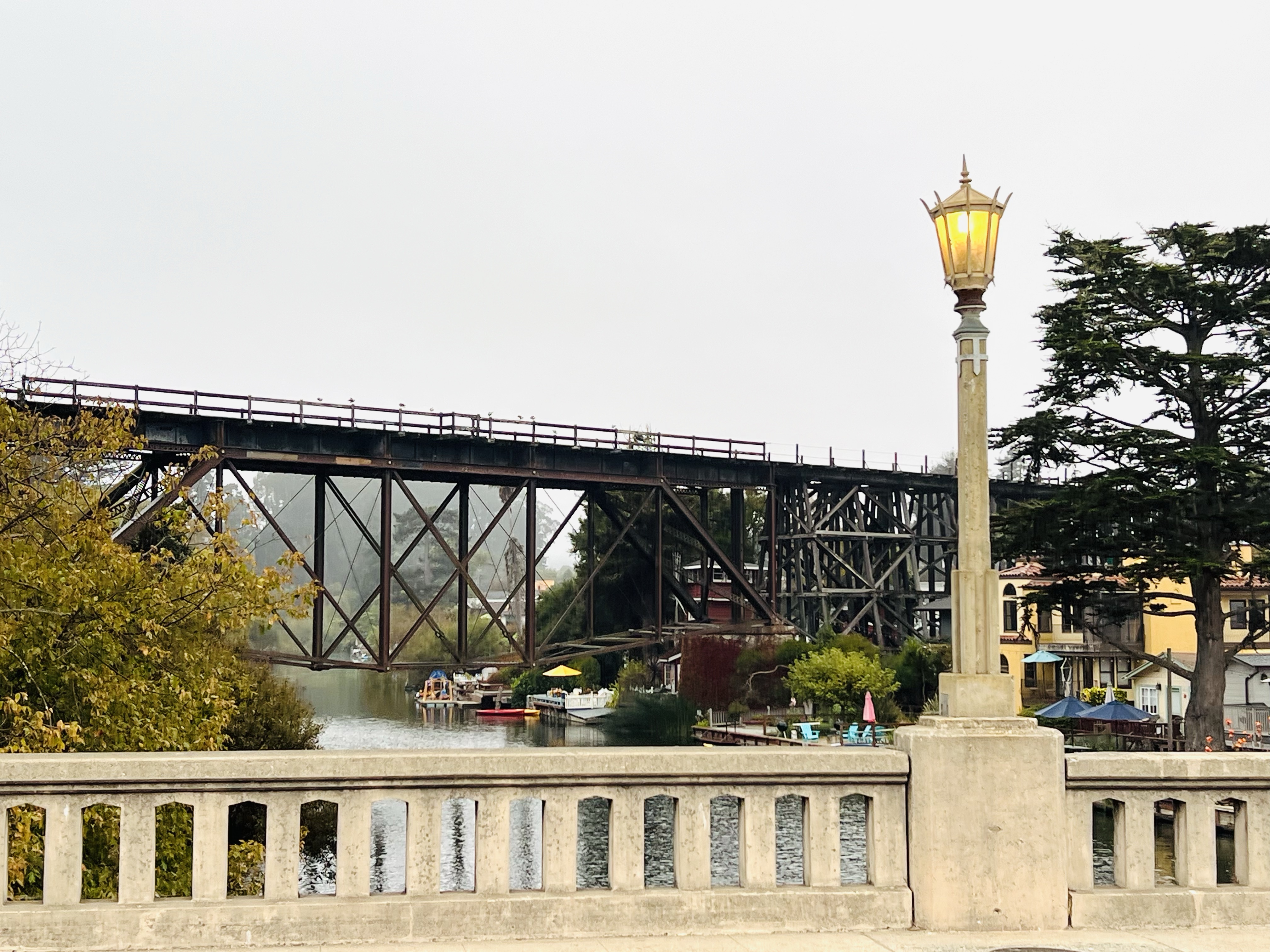
I chose my sketching position above Soquel Creek on the historic Stockton Avenue Bridge (1934) which parallels the trestle. The seaside air was wet with fog, I hoped it wouldn’t smear my ink drawing.

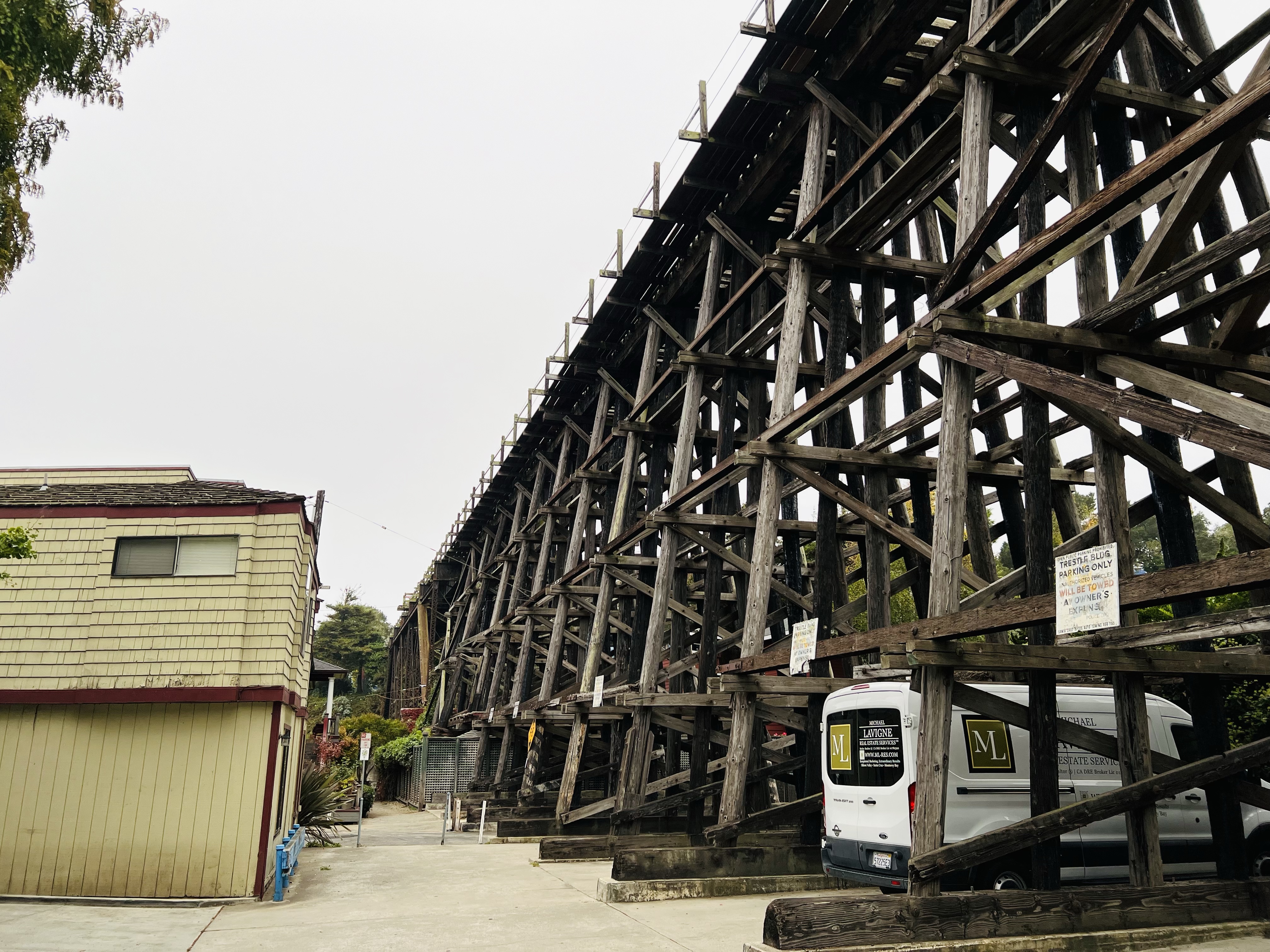
The wooden trestle over Capitola Avenue looking towards Soquel Creek. The Capitola Depot is about 100 yards behind me and up the hill. I have always loved the parking spots under the trestle (parking is a premium in Capitola Village).
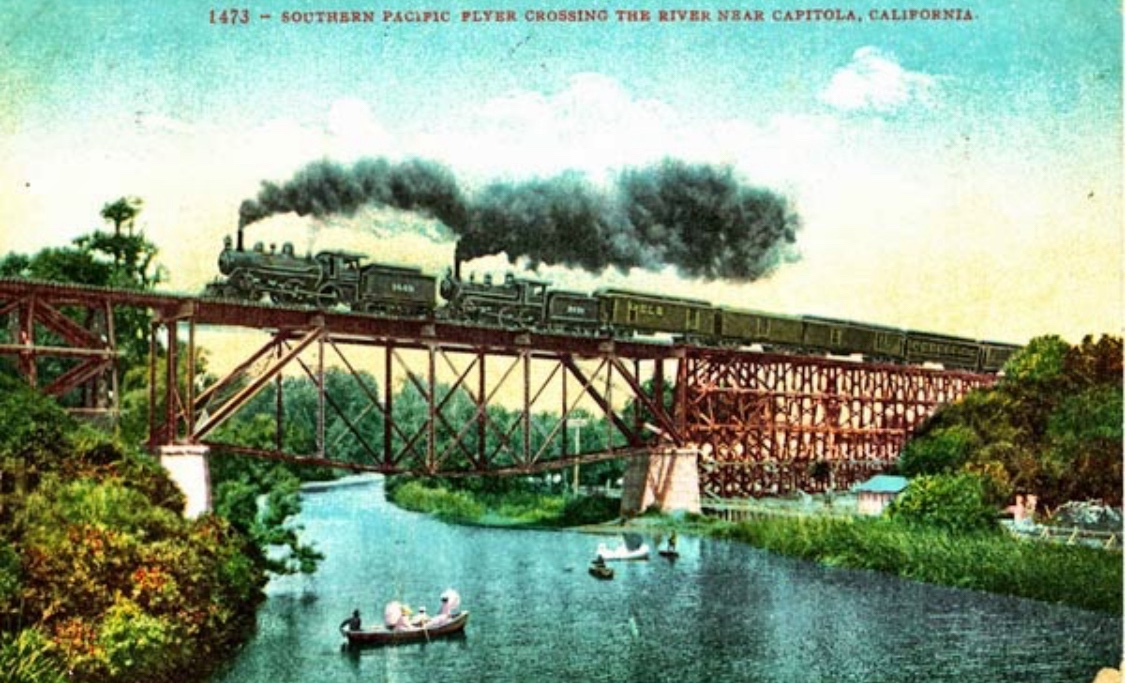
Colorized postcard (early 20th Century) of a double header passenger train with three baggage cars, crossing the trestle over Soquel Creek taking beach goers to Santa Cruz. This perspective is close to where I chose to sketch.
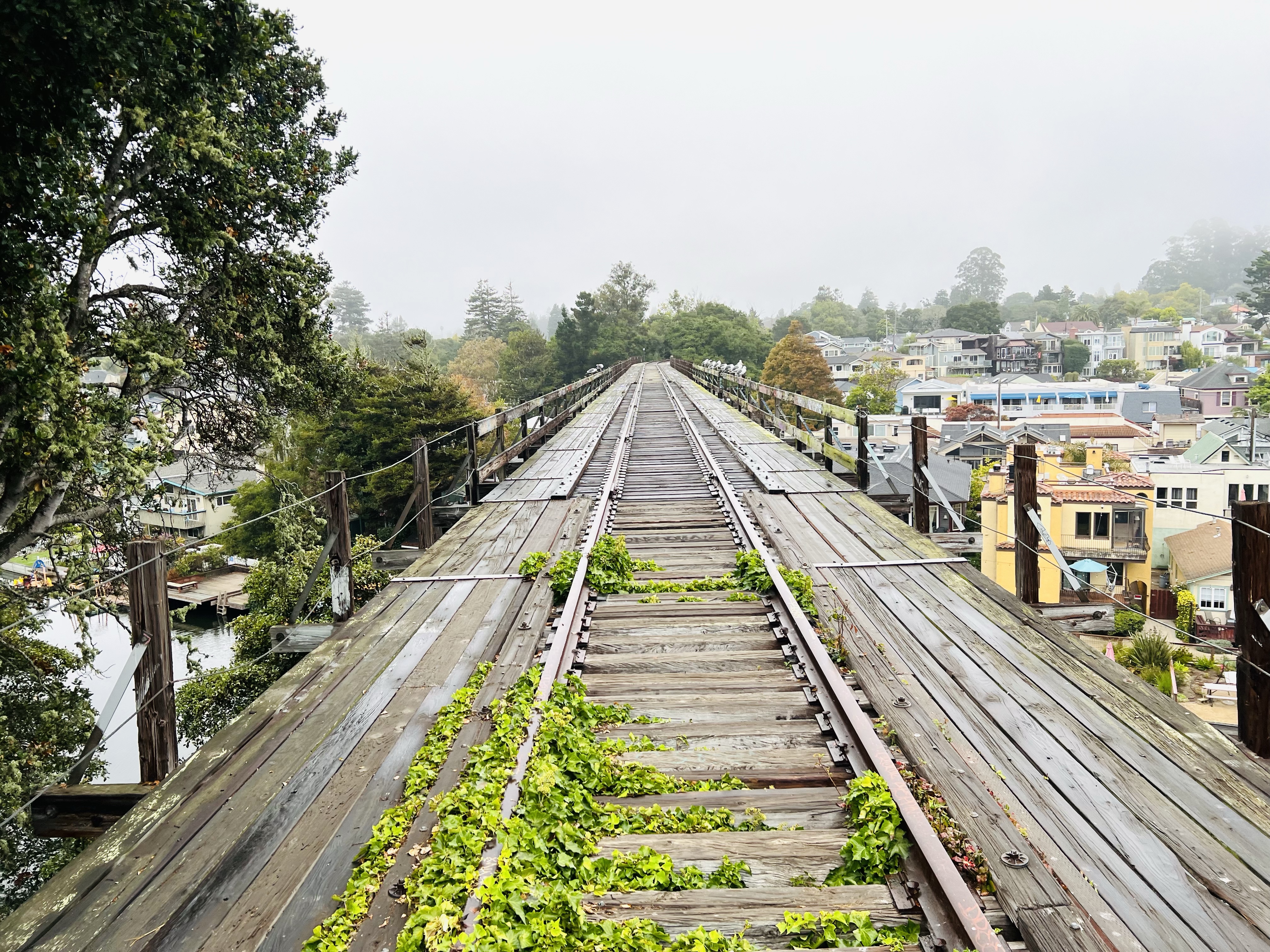
Looking down the trestle in direction of the Capitola Depot and beyond, the connection to the mainline at Watsonville Junction (15.7 miles down the line). The green growth around the tracks shows this track has not been active in over ten years.
Image

Steve 9-22-24

Sunday September 22, 2024. First day of Autumn.

As I was walking up the drive from my mother’s house I heard a call, distant, that I had not heard in a year.

It took a few seconds to place it. It was a bugle of Sandhill cranes. Their rattle can be heard from two and half miles away.

I looked up and in the blue sky I picked out the V shaped line of Sandhills migrating southwest to their wintering grounds.

I had just come from my stepfather’s room in a memory care facility in Grass Valley. I had been with him near the end. So had my mother.

I was there, someone had to be, as he left this room of nine months on his final migration.

Someone had to be there and I was.

So I wrote a poem and illustrated it.

Steve. 9.22.24

Bugle calls

in clear blue

draws my eyes skyward

a clarion call

of season’s change.

I pick out the southwest

bound flying V-

looking now like a

comma

punctuating

a beginning, an end.

Godspeed Steve, Godspeed

Image

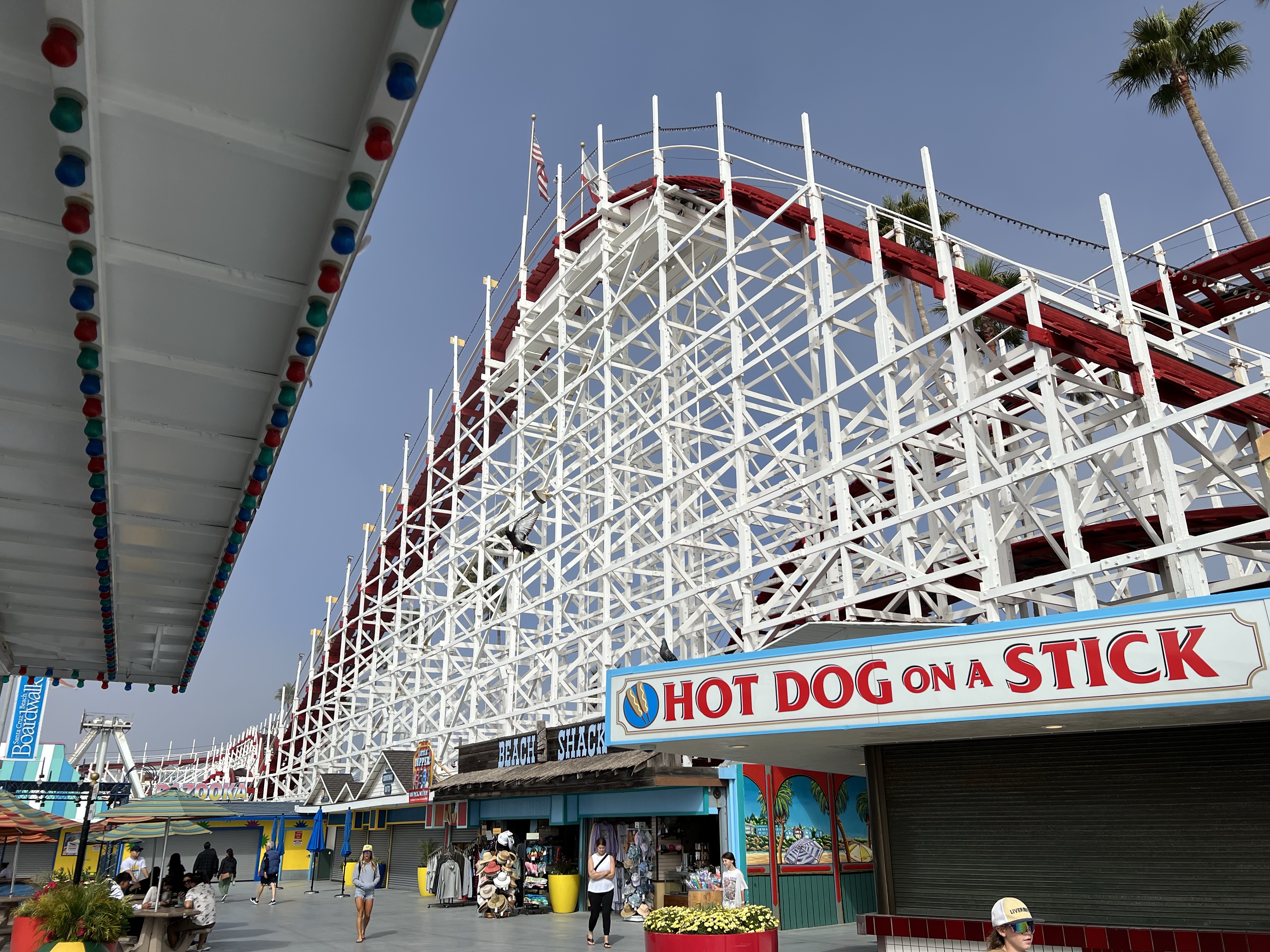
The Giant Dipper at 100 (My 700th Post)

A recent Labor Day tradition has been to ride one of my favorite roller coasters of all time. It’s also my birthday weekend.

This is not a steel coaster with high speeds, loops, and corkscrews. This is a 100 year old wooden roller coaster at the Santa Cruz Beach Boardwalk.

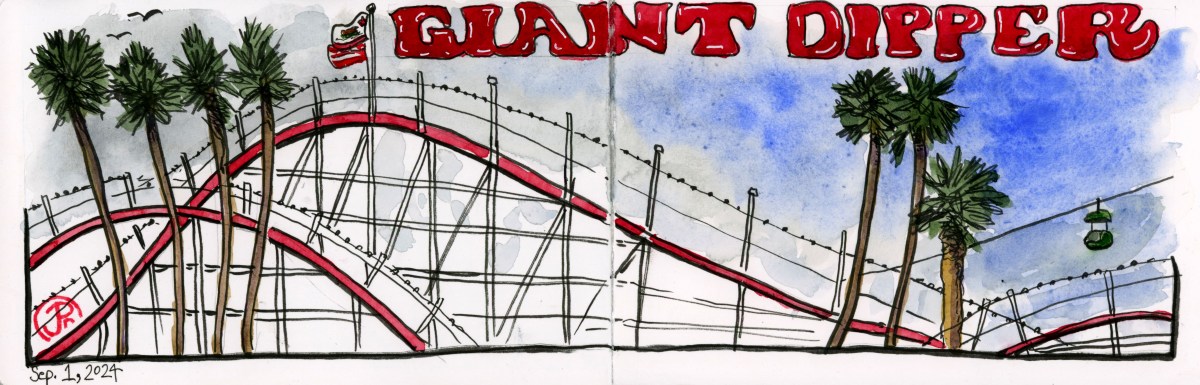
The big dip of the Giant Dipper.

This is the Giant Dipper and is the oldest roller coaster in California.

I have ridden the Dipper many times since I was tall enough to ride it and like my father before me I ride it every summer. And the ride remains as thrilling now as when I was young!

Partly because I’m not sure how this elderly ride still remains safe and standing. This is a testament to the care and maintenance that keeps the dipper rolling.

The ride starts off dropping into a pitch black tunnel and when it rounds a curve you see the lift incline to take the train to the top of a 65 foot drop. There is a slight pause as the coaster drops, reaching speeds of 55 miles an hour before accelerating up a banked curve and the the coaster takes some rises and dips that nearly lifts you out of your seat. The coaster returns to the boarding station one minute and 52 seconds after leaving it, leaving most riders out of breath and with a hoarse voice from screaming!

Since 1924, more than 66 million riders have ridden the crazy train that is the Giant Dipper.

The Boardwalk and Giant Dipper have been featured in some films including: The Sting II, Harold and Maude, Sudden Impact, The Lost Boys, Us, and Dangerous Minds.

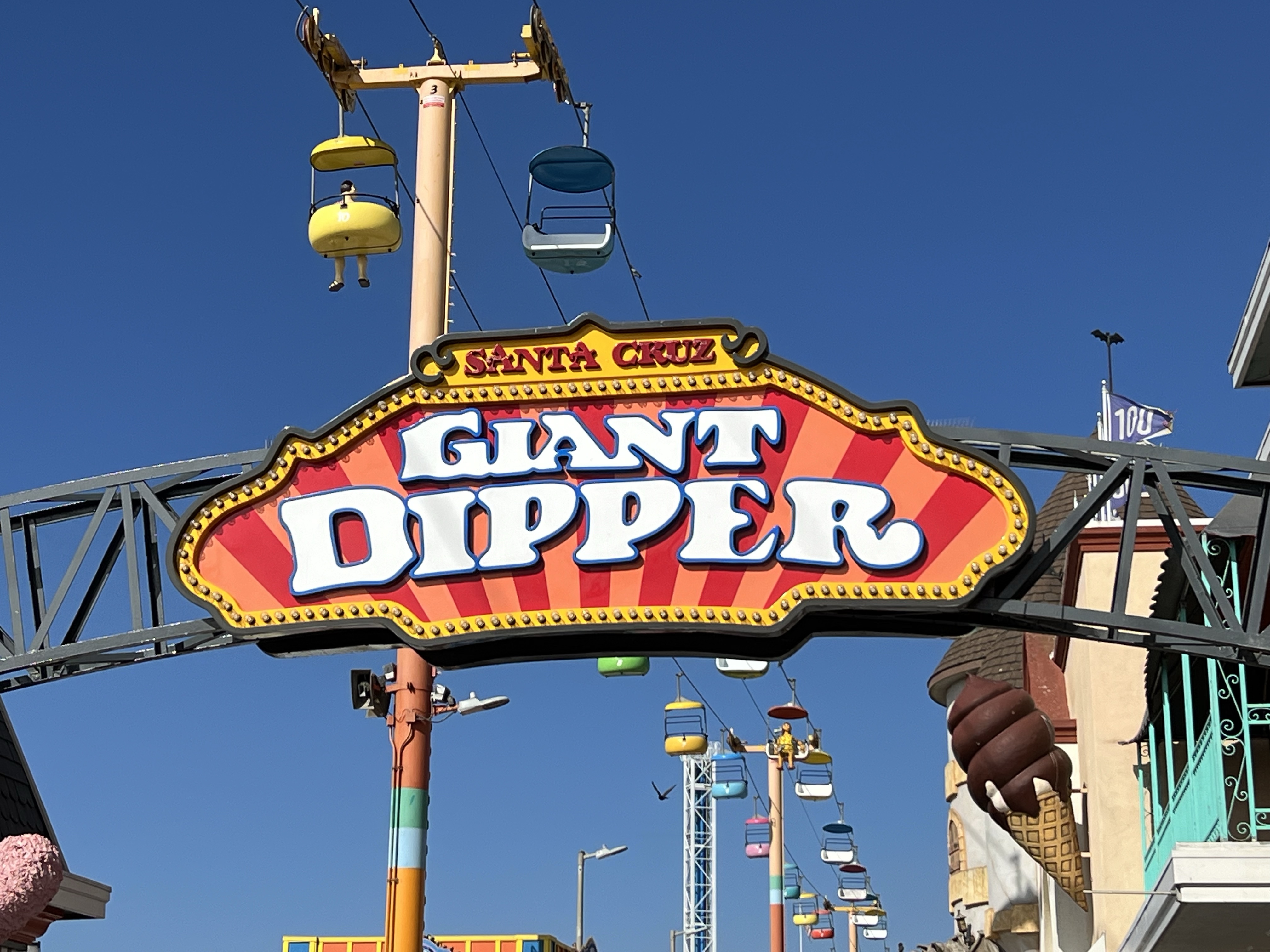
The classic sign was featured in the finale of the fourth Dirty Harry film Sudden Impact.

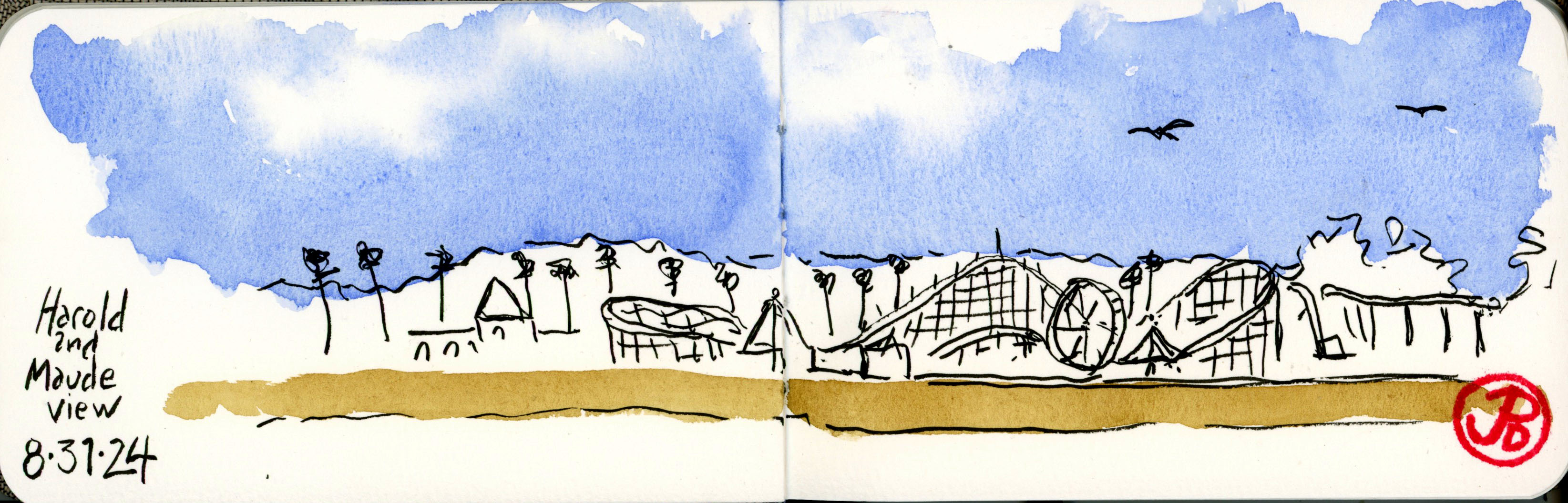
Over the Labor Day weekend, I sketched the Giant Dipper three times. Two were in a small “point and shoot” journal (a gift from my students). One sketch was from the perspective of one of my favorite movies featuring the Dipper, Hal Ashby’s Harold and Maude.

There is a scene filmed on the Santa Cruz Wharf with the lights of the Giant Dipper in the background. This is the scene where Harold gives Maude a token that says, “Harold Loves Maude” and Maude proceeds to chuck it into the ocean saying, “Now I’ll always know where it is.”

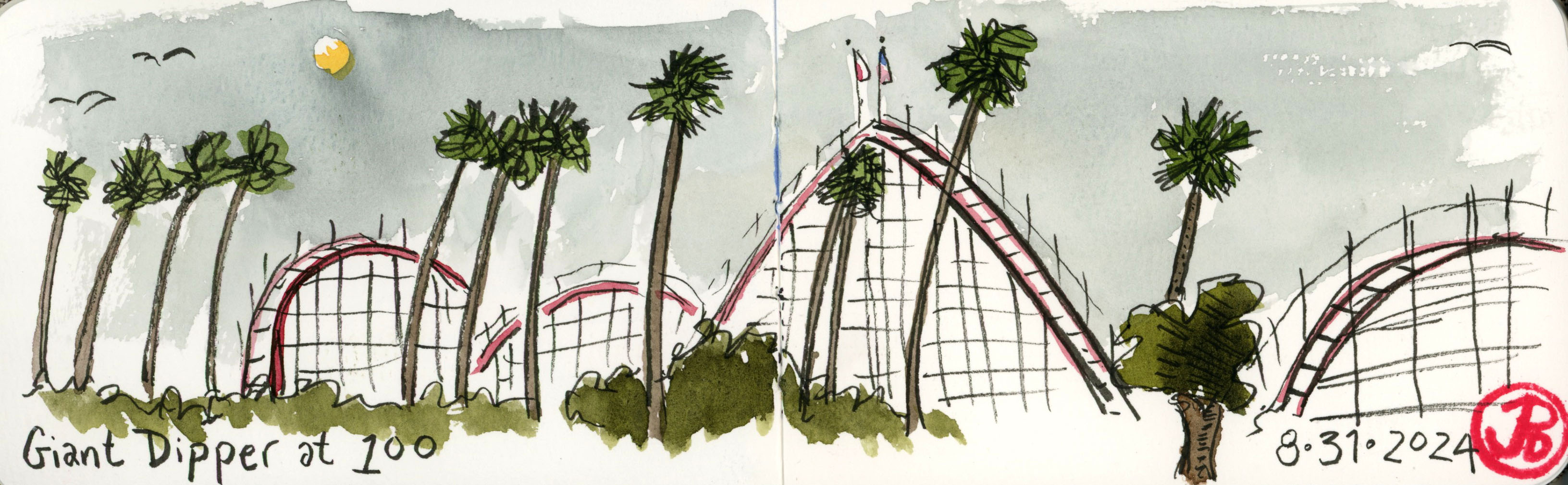
I returned on Sunday morning with Grasshopper and sketched the Dipper from the empty parking lot off Beach Street (featured sketch).

A point and shoot sketch from Beach Street.
Image

Muir Trestle, Martinez

I was meeting a friend in the East Bay city of Martinez and I had a little time to sketch before lunch.

Martinez is a hotbed of railroading with both the Union Pacific and BNSF passing through as well as some marquee passenger trains such as the Coast Starlight and the California Zephyr making stops at the Martinez AMTRAK station. And the Capitol Corridor commuter takes on passengers traveling north and south on shorter journeys.

The California Zephyr Train No. 6, at the old Southern Pacific Depot in Martinez. This train is heading east to Chicago. To the right in the background is SP switcher 1258 on static display.

There would certainly be something to sketch here and I was going to start with a historic train trestle.

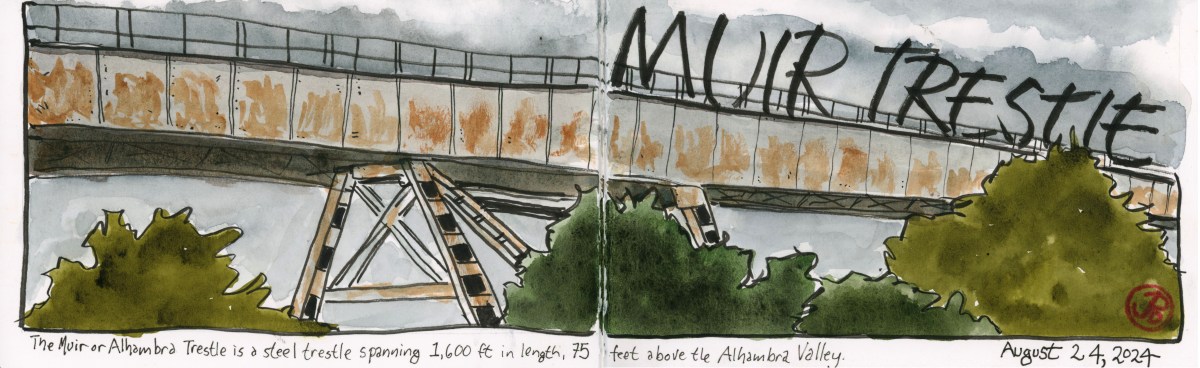
I parked at the Mount Walda Trailhead. Soaring above me was the 1,600 foot long steel Muir Trestle (aka the Alhambra Trestle). The single track trestle was so long that I could only see and sketch one section of it before it disappeared into the trees to the east. The trestle rises 75 feet above the roads, trees, and houses it crosses over.

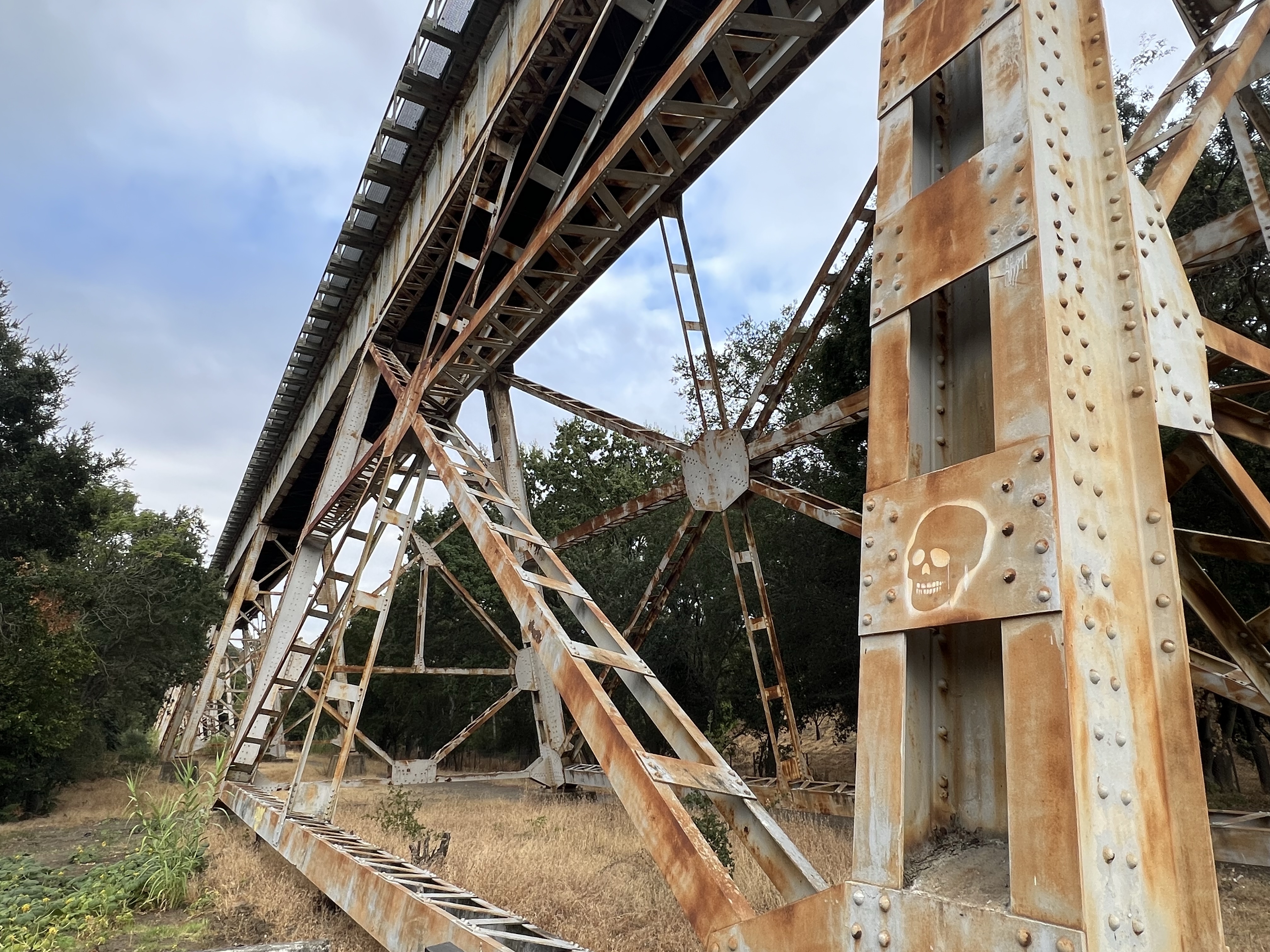
A detailed view of the steel supports of the Muir Trestle.

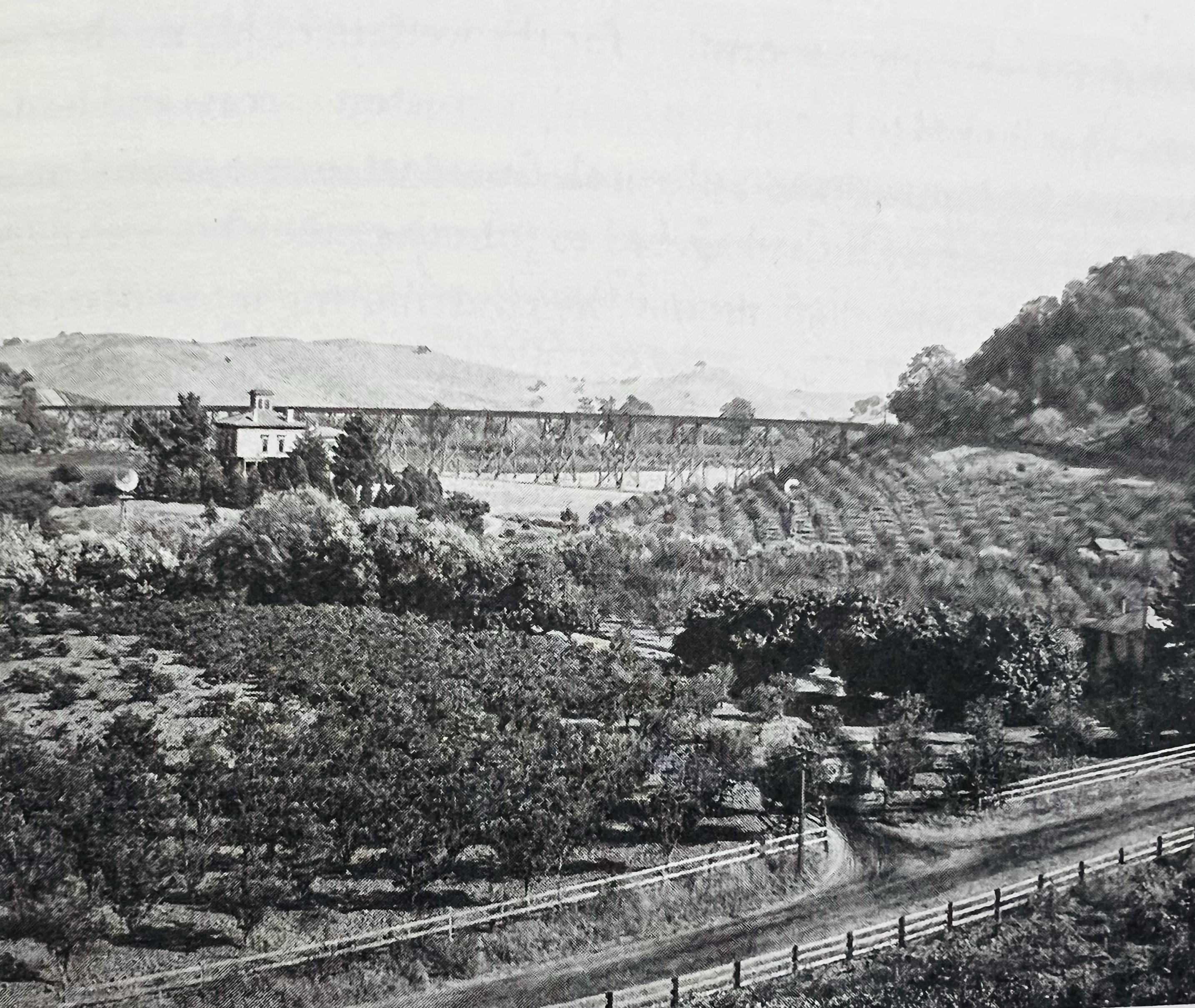
The trestle is within the John Muir National Historic Site. To the north is Muir’s Martinez home. Muir and his wife Wanda sold the land for the trestle for $10 and a lifetime rail pass to the San Francisco and San Joaquin Valley Railway. The original wooden trestle was built through a pear orchard and completed in 1897.

This is a historic photograph of the Stengel-Muir ranch in 1897. The Muir house is on the top left and the trestle is viable behind the house. At the time of the photograph, the trestle was constructed of wood.

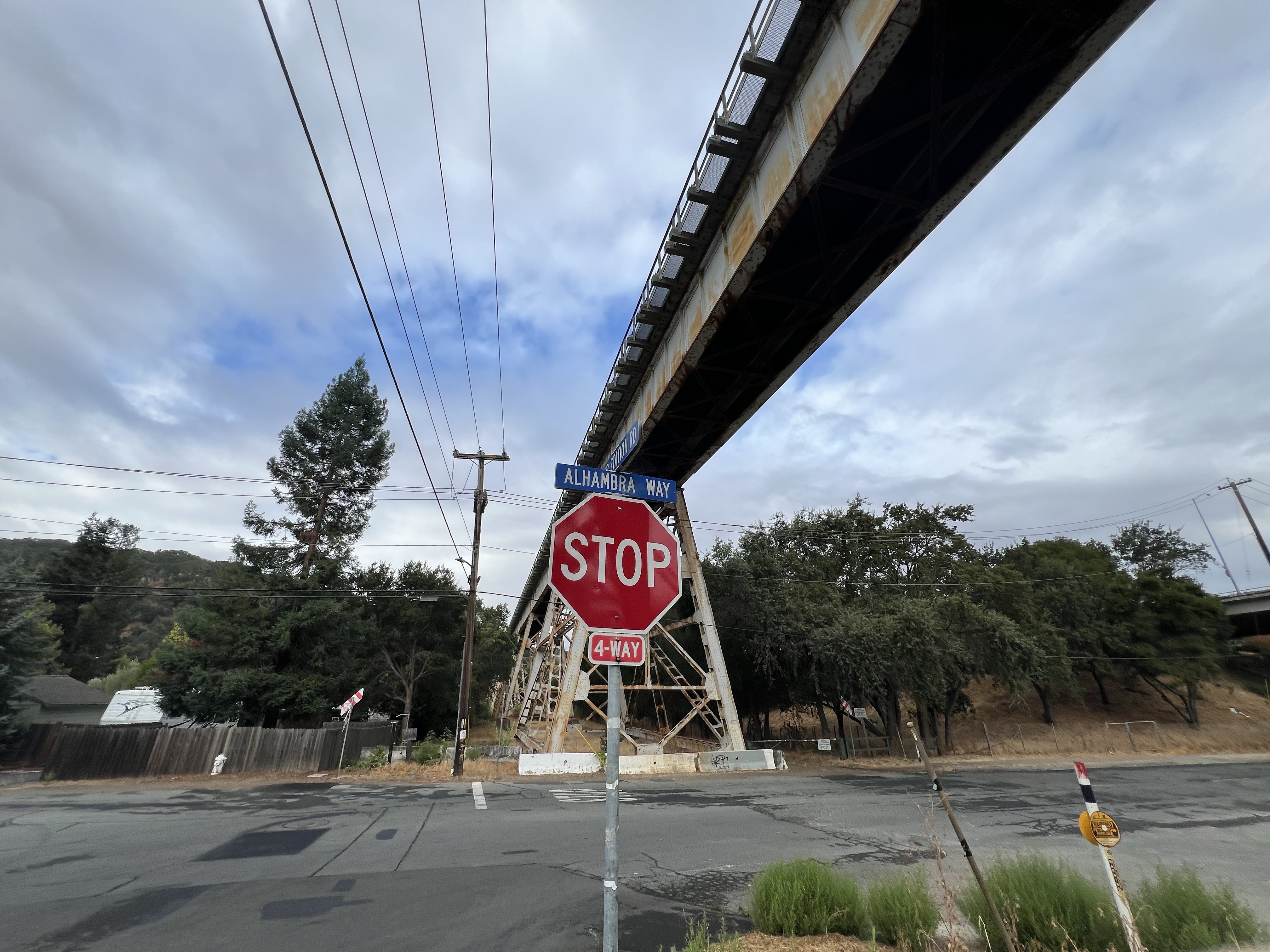
At the eastern end of the trestle there was a passenger and freight station named Muir Station. The station is now long gone but is immortalized in a street that parallels the rails named Muir Station Road.

From this station Muir could ship his produce to Oakland or to the port in Martinez.

One of Muir’s neighbors in the Alhambra Valley was John Swett, Muir close friend. Swett was the State Superintendent of Public Education and is known as the “Father of California Public School”.

In 1898, Santa Fe purchased the line and it became their Valley Division. This division still exists as BNSF’s route from Richmond to Fresno.

The Muir Trestle from the intersection of Alhambra Way and Muir Station Road.

I took up a sketching position near the trailhead and started my drawing. The trestle above me is on the Stockton subdivision and is used by BNSF intermodal freight. There was no train crossing during my sketch.
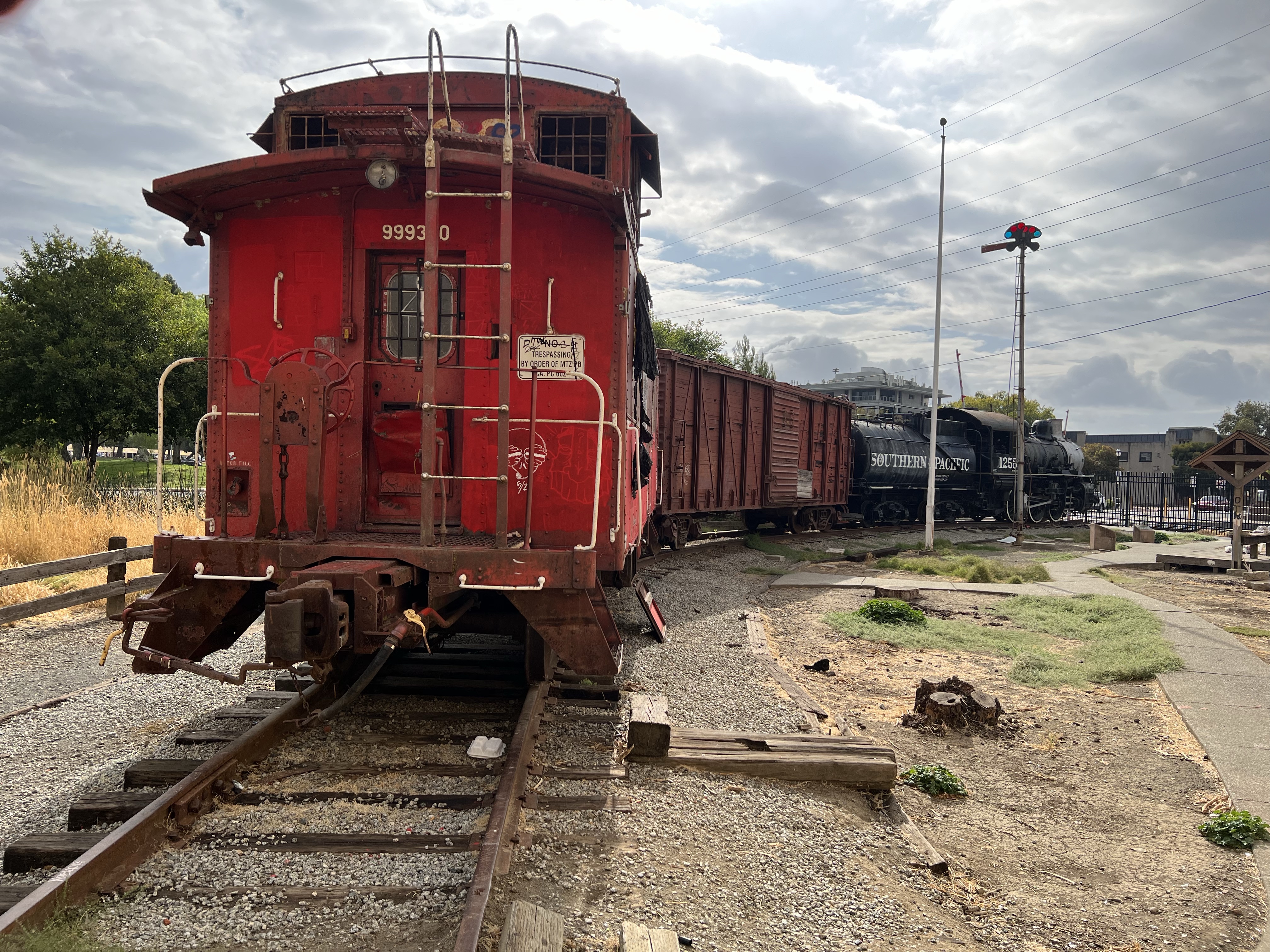
SP 0-6-0 switcher No. 1258 and its consist of a wooden box card and Santa Fe caboose 390 on display across the tracks from the AMTRAK station. The locomotive is in sad shape, missing some hardware like her bell and whistle.
Image

Keddie Wye

One of the Seven Marvels of the Feather River Route is to be found a few miles north of Quincey.

The Feather River Route, also known as the Canyon Subdivision, stretches between Oroville and Portola, Ca and competed with Southern Pacific’s route over the Sierras at Donner Pass.

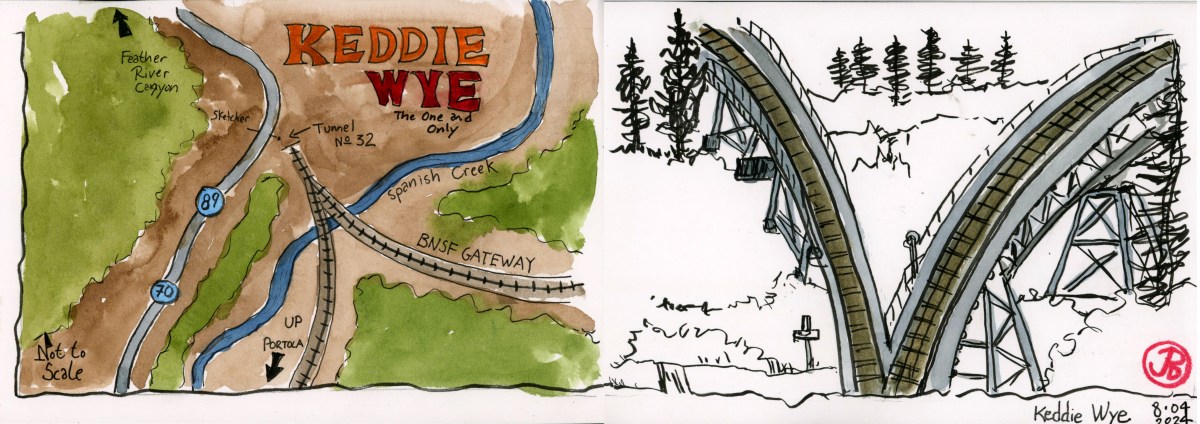
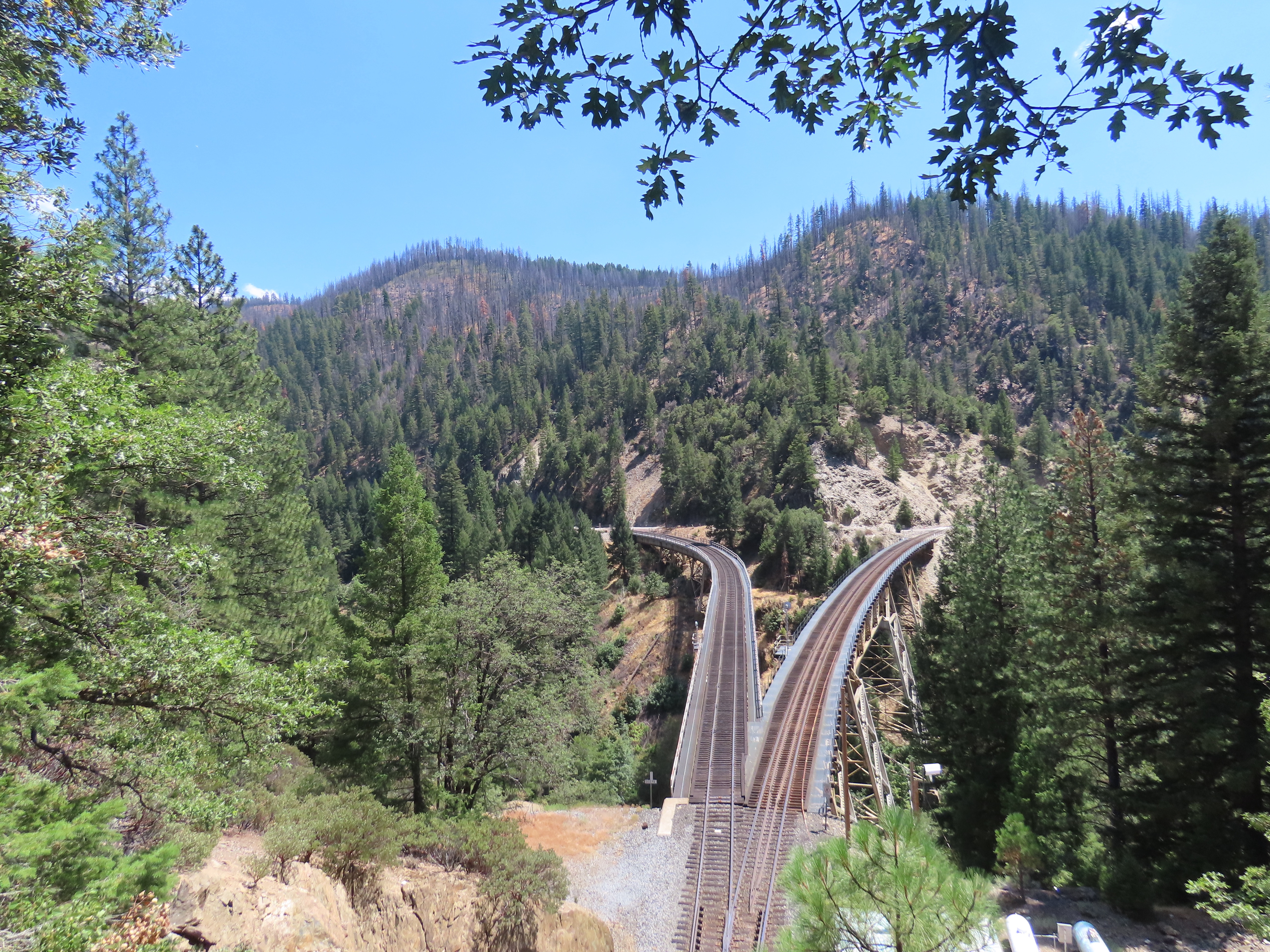
The Marvel is known as the Keddie Wye. This is where two tracks comes together to form one track, looking like the letter “Y”. Now this in itself isn’t much to write home about but when both sides of the “Y” are on trestles above a creek that joins together before entering a tunnel and then you know this is a special piece of railroad engineering.

The two forks of the “Y” are also where two different railroads meet. On the right is the former Western Pacific Railroad, now Union Pacific, and one the left is the BNSF (Burlington Northern and Santa Fe).

After about a 45 minute drive from Portola on Highway 70, the famous Keddie Wye appeared to my right. I pulled over and found a vantage point to sketch. I perched on a narrow trail above Tunnel No. 32 looking out to the two forks of the wye.
Now the only thing missing was a freight train. It would have been nice to see a train traverse one side of the “Y”. As I was told at the Western Pacific Railroad Museum, Sunday is a quiet day on the high iron.

After my sketch (right side of the spread), I headed down Highway 70 into the Feather River Canyon proper. The Highway parallels the railroad and the Feather River. This is a beautiful drive and I periodically looked off to left at the rails across the river. No trains.

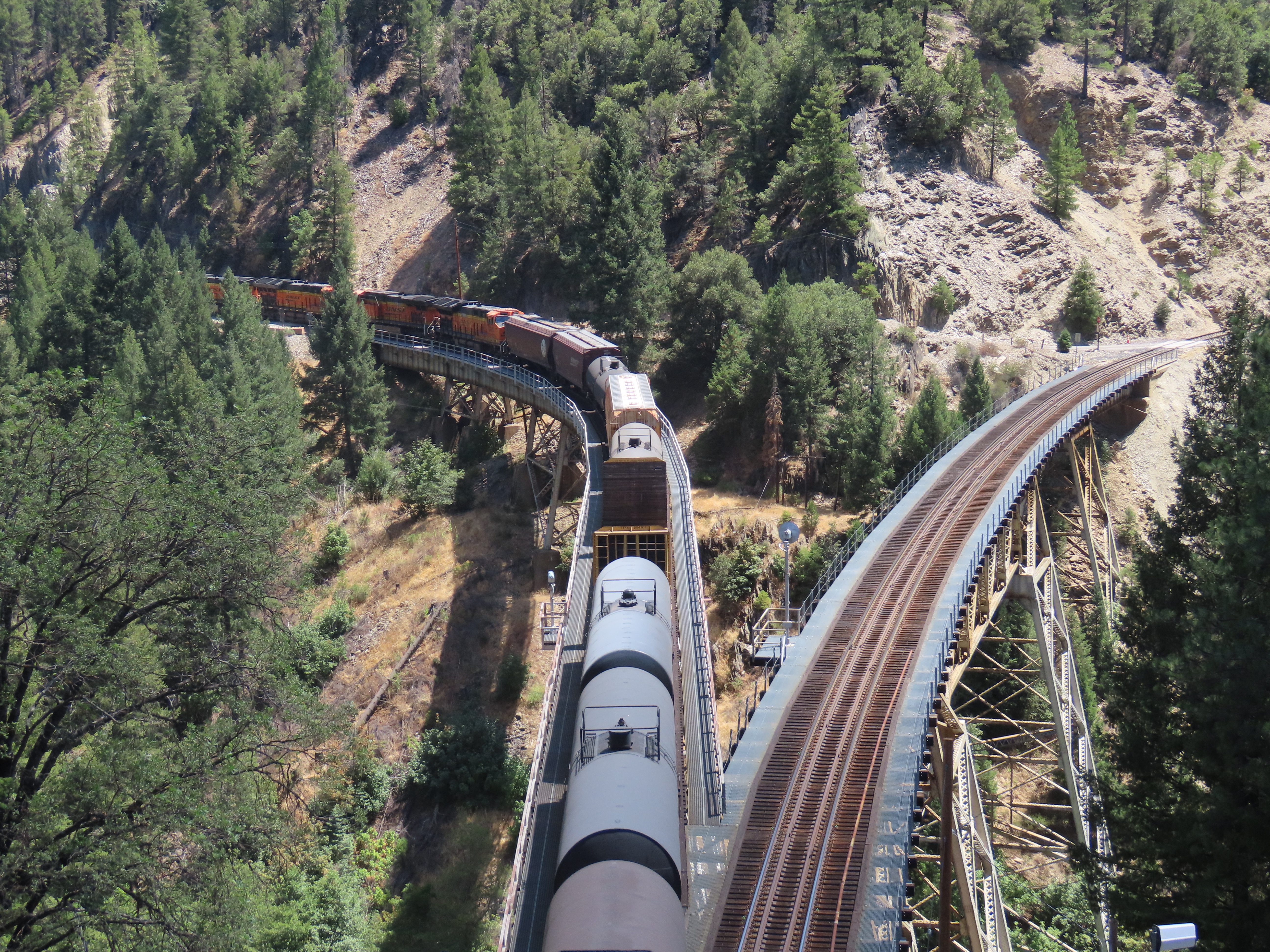
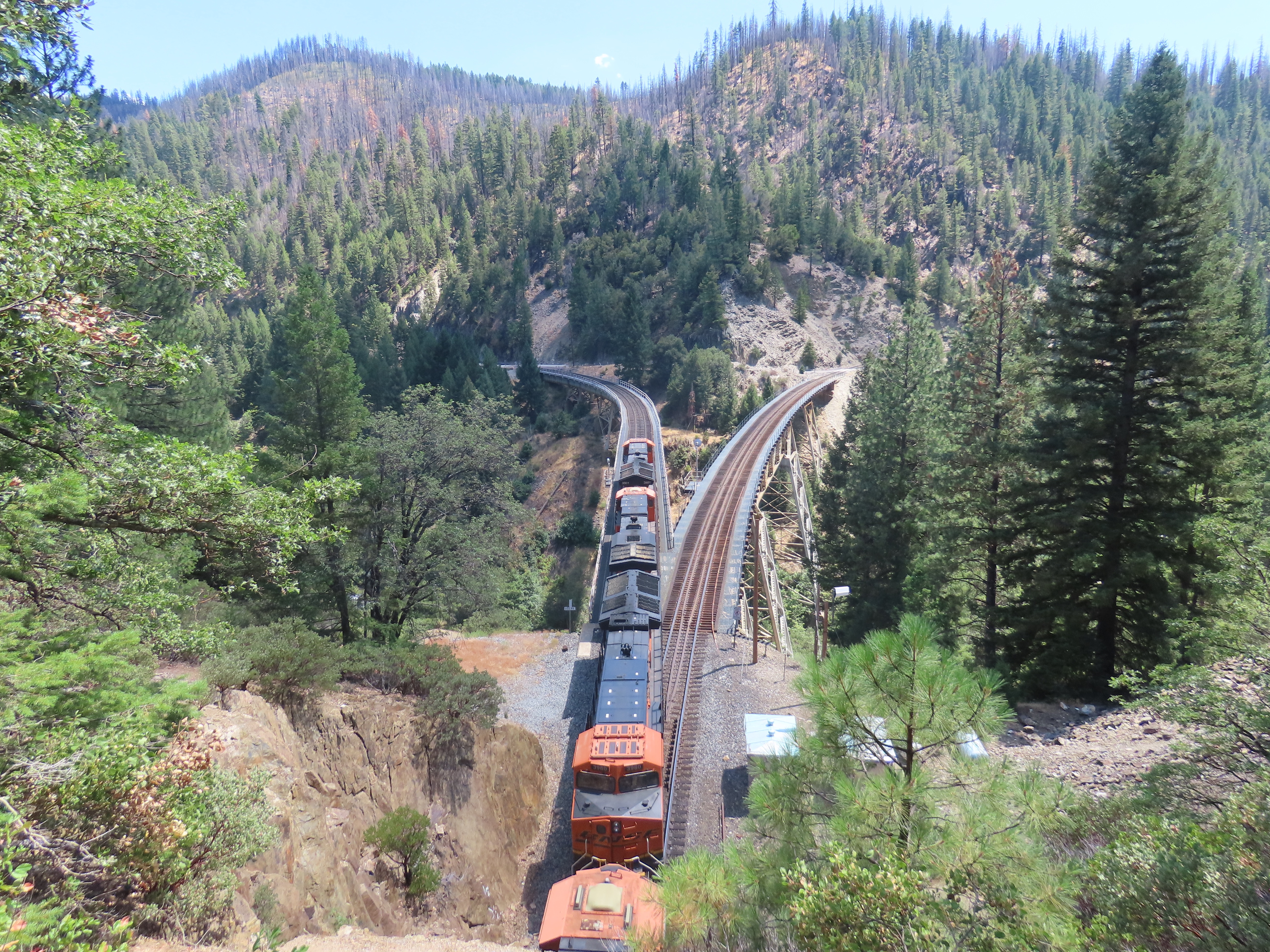
I was about 20 minutes from the wye when I heard the screech of steel wheels on rail. I looked to the left and a Burlington Northern and Santa Fe (BNSF) was climbing up the canyon with a mixed freight consist.

I found the nearest pullout and then reversed direction as I chased the BNSF up canyon. I wasn’t going to miss the freight on Keddie Wye!

As I climbed up Feather River Canyon I kept an eye to my right for glimpses of the train. I should have no problem overtaking the train as the line speed limit was 25-30 mph.

I soon came to the end of the train and before long I was approaching the five bright orange diesels on point. I passed them with time to spare.

Once I reached the wye I reversed direction again and parked at the pull out. I figured I was about ten to fifteen minutes ahead of the freight and I took my position on the narrow path above Tunnel 32. Now I had to just wait, wondering if I would be able to hear the approaching freight from my position.

Within ten minutes I could hear the diesels working up grade and the first locomotive appeared below me. The train headed onto the left side of Keddie Wye onto the BNSF Gateway heading north towards Lookout and Klamath Falls.

What a memorable experience to see a piece of railroad history that is not a static museum piece isolated in time but in use today.