Image

The Big Loop

In the last post I was reexploring the Old Ways, hikes and routes that I had travelled years ago, a pathway of the mind as well as the soil.

On the Saturday of the Memorial Day weekend, I decided to do the Big Loop, a route I had hiked with my friend Erik, at least 30 years ago when we were both much younger, full of confidence, and much closer to birth than death. Now I would do the Big Loop solo.

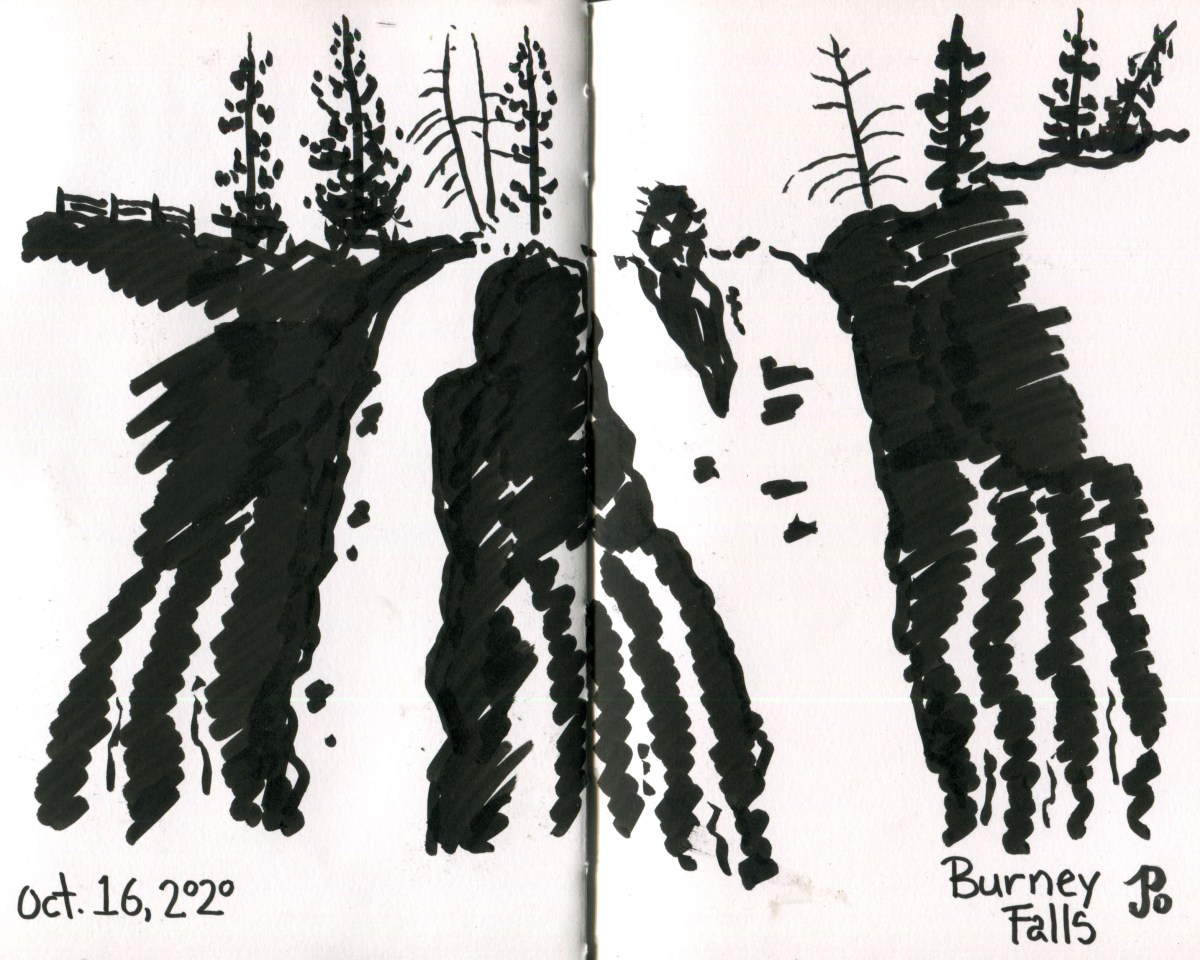
The start of the loop was heading up Shrine Way and then hiking up Powder Mill Creek. I had done this hike the week before but I had stopped at the falls, pausing to sketch and then turned back. But not today. Today I was going to scale the waterfall.

I’m sure in my 20s, climbing this three-tiered waterfall didn’t cross my mind as something that could be dangerous. I thought no more about the challenge than breathing. But now, the night before the hike, I knew that this was going to be the most challenging and technical part of the journey.

The three pitches required some unaided technical climbing. I had confidence in my climbing ability having spent hours in the climbing gym (a few years ago) but climbing outdoors certainly provides other challenges. The challenge on this route was that the rocks were wet and in some places I would be climbing in the waterfall. Here I was not roped in. A fall from one of the waterfall pitches probably wouldn’t kill me but it could introduce a bit of maim into my life. And I would have no one around to help me out to safety in the event of a fall, midway between the cascade.

These thoughts went through my mind as I headed up Powder Mill Creek. I reached the bottom of the falls at 8:15 AM. While the sky was clear, in the cold shade of the canyon, it was cold.

I folded up and stowed my trekking poles, bowed to the creekside alter, and started up the first pitch of the climb on the right side of the lower falls. Just to get to rock, I had to struggle through a fallen branch tangle to get a hand and then foothold on rock.

I methodically completed the first pitch, no need for speed climbing here. I was rewarded by the beautiful middle falls, which fell into a pool, surrounded in luscious greens.

The middle cascade of Powder Creek Falls. I paused here to catch my breath and did a brush pen sketch. On this pitch I climbed up the wet and mossy rock on the left side of the falls. The height of the middle falls was abut 15 to 20 feet.

Once up the middle falls I came to the final upper falls. This was the last technical part of the journey and once this was behind me, I could really get hiking. With each pitch I was gaining confidence as I understood the rock more and more.

It is all about keeping three points of contact with the rock. I read the rock, looking for the best hand and footholds. Often times, young trees where perfect handholds as I looked to place a foot in a position to raise me upward towards the point where the watershed flattened out.

I had made it, the toughest part of the journey was now behind me! Now the creek canyon flatten out and the only challenge now was climbing over or under fallen redwoods and not fully immersing my feet in creek.

Since I was a boy, I can never get close to water without getting wet. On the Big Loop I grabbed a fallen log that proved not be as secure as I thought and before I knew it, I was up the creek and in the creek! I know myself and my attraction to water well, so I came prepared. I had packed an extra pair of socks.

The whole hike, from the base of the lower falls to Pipeline Road, was perhaps just under a mile. I covered the distance in 25 minutes. The romance of the wild Power Mills Creek is dashed when you come to the point where Pipeline Road in Henry Cowell State Park, crosses over the creek. The creek is routed under the road in a pipe and falls out the other side into a pool.

I scrambled up and out of the creek on to Pipeline Road. I was now in Henry Cowell State Park. Pipeline is a paved road, a much different substrate than what I had just traversed. I not headed northwest up the road.

Twenty-five minutes later I was at the Overlook Bench. At this viewpoint you look out to south with wooded ridges overlapping wooded ridges giving way to the flats of Santa Cruz with the Giant Dipper roller coaster silhouetted against Monterey Bay.

I pulled out my Stillman & Birn Beta Series spiral sketchbook and sketched in the view with my sepia brush pen (featured sketch). This finished sketch has a Japanese feel to it, reminiscent of the sumi ink paintings of Japanese-Californian artist Chiura Obata.

To complete the loop, I continued northwest along Pipeline Road, off on a hiking trail to Cable Car Beach (where I swapped socks) and then along the River Trail to the 1909 Railroad Trestle which I used to cross the San Lorenzo River and then back south along the railroad. I passed over Coon Gulch with the osprey nest on my left. At this point I was about 40 minutes from my cabin.

I completed the Big Loop in three hours and 40 minutes. This included a few snack stops and sketches and a chinwag with a ranger who was guarding the entrance to Garden of Eden Beach from the hordes of three-day weekenders.

Image

The Old Ways

“No hay camino, se hace camino al andar” -“there is no road, the road is made by walking”. ~ Antonio Machado

As an omage to Robert McFarlane’s incredible book, The Old Ways: A Journey on Foot, I decided to revisit some of the old pathways traveled both by my father and my younger self.

To connect, once again, with the journeys on foot, made me feel a part of the landscape as well all who had also travelled this way, the people and the deer and mountain lion. These were the tracks that marked the land like the slime trail of the banana slug, weaving it’s way, often finding the path of least resistance.

The previous Friday I headed out of Paradise Park along the fire road to the railroad grade. This was a route taken by my father and his friends when he was a teenager. He would frequently hike up to the old rock quarry, which is now part the campus on UC Santa Cruz. (It is the quarry where my graduation ceremony was held). I’m sure he also hiked upstream, as I did, toward Henry Cowell State Park and the osprey’s nest.

Today afterwork, I wanted to hike up a water way to a waterfall. I had hiked up here, from my cabin, many times. Although it has been a while since I have hiked up Powder Mill Creek. My destination was Powder Mill Creek Falls, which was a short ramble up the creek.

From the very start of the hike, there is a clearly defined trail, but once you cross the creek it seems to be a “Choose-Your-Own Adventure” type of hike . There are no correct paths, it just depends on how wet you want to get.

I paused along the way to look at my favorite fern, the five-fingered or western maidenhead fern, (Adiantum aleuticum). This fern favors damp habitats usually near small turbulent streams. Native Californians use it’s dark veins to weave baskets.

The hike is maybe a quarter of a mile but it can be a tough scramble and progress is slow as I favored a methodical approach rather than a reckless bush-whack! (the path of youth). The way has been constantly reformed by the waterway and the trees that have fallen into the watershed, making the pathway ever changing and ever challenging. I was not traversing this old way in my youthful self but as a middle aged shelter-in-placer. This was the first time I had used trekking poles on this hike. I need all the points of contact I can get!

I made it to the falls and I love the feeling of arrival, like coming into camp after a long trudge with a 40 pound pack. I was here and I found a good vantage point and I do what all sketchers would do in my situation, I started sketching. I settled on using my sepia brush pen to keep things loose and bold. There was a lot to take in and I simplified the scene with ink strokes.

Try to keep it simple stupid. I succeed and fail in equal measures.

There is a price to pay with a bush-whack in the San Lorenzo Watershed on deer trails, and that was an unwelcome traveller, a deer tick, firmly attached to my left side. This was the first tick in almost 50 years to have found purchase on my flesh. A fair price to pay for a sketch I think.

Image

The Osprey’s Nest

One of my neighbors knew I was struck with the affliction of birding and told me about the osprey’s nest on top of a Douglas-fir along the railroad about a 30 minute hike up river from my cabin.

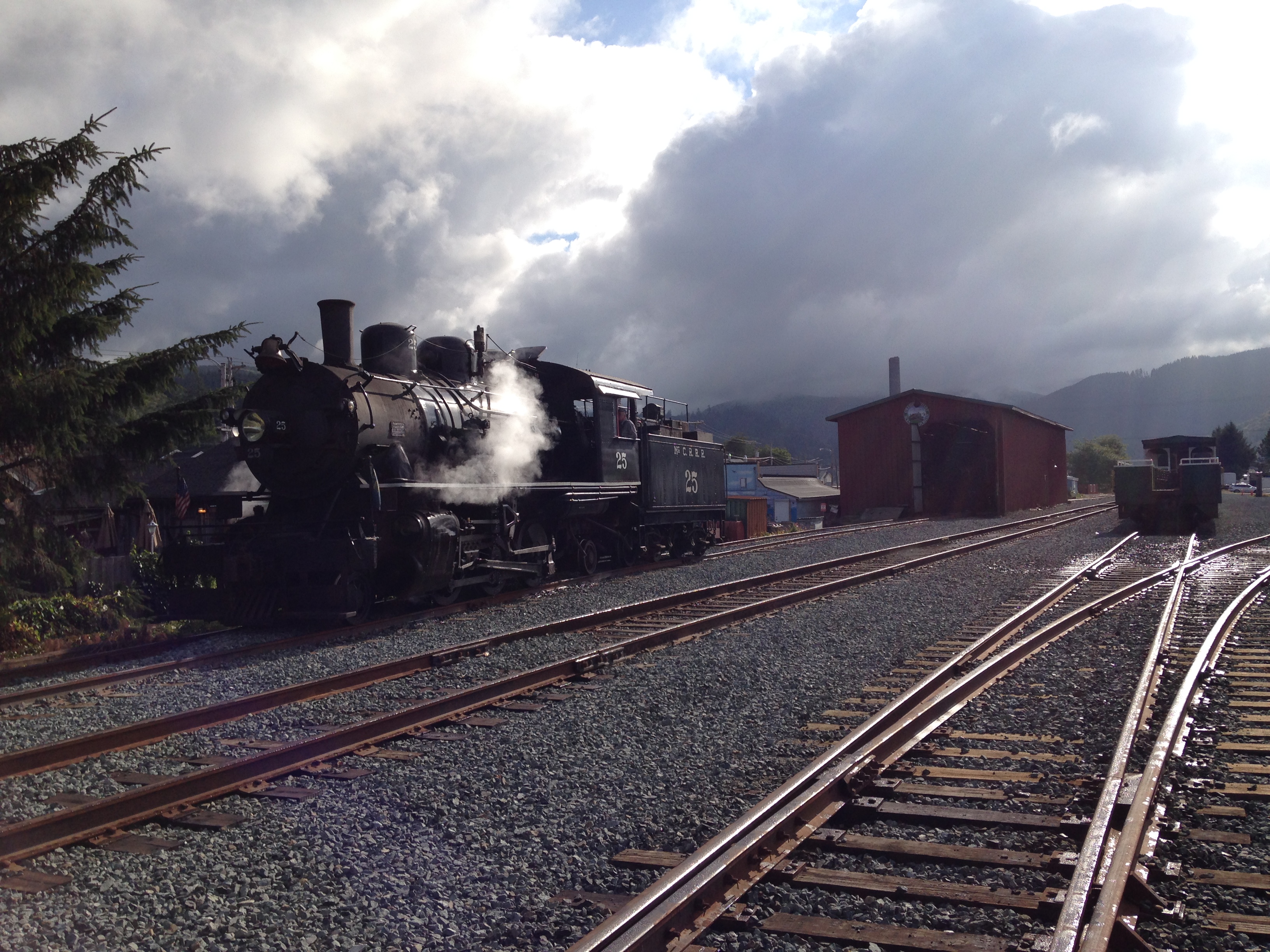
After work on Friday, I hiked out of Paradise Park via the fire road and scrambled up a deer trail to the even grade of the railroad. This railroad is now operated by the Santa Cruz, Big Trees and Pacific Railway and takes tourists from Felton to Santa Cruz Beach Boardwalk. At one time the railroad went over the Santa Cruz Mountains to Los Gatos but now does not go very far beyond Felton. I have hiked this railroad since my youth and it had been a few years since I played hopscotch on railway ties up the San Lorenzo Valley.

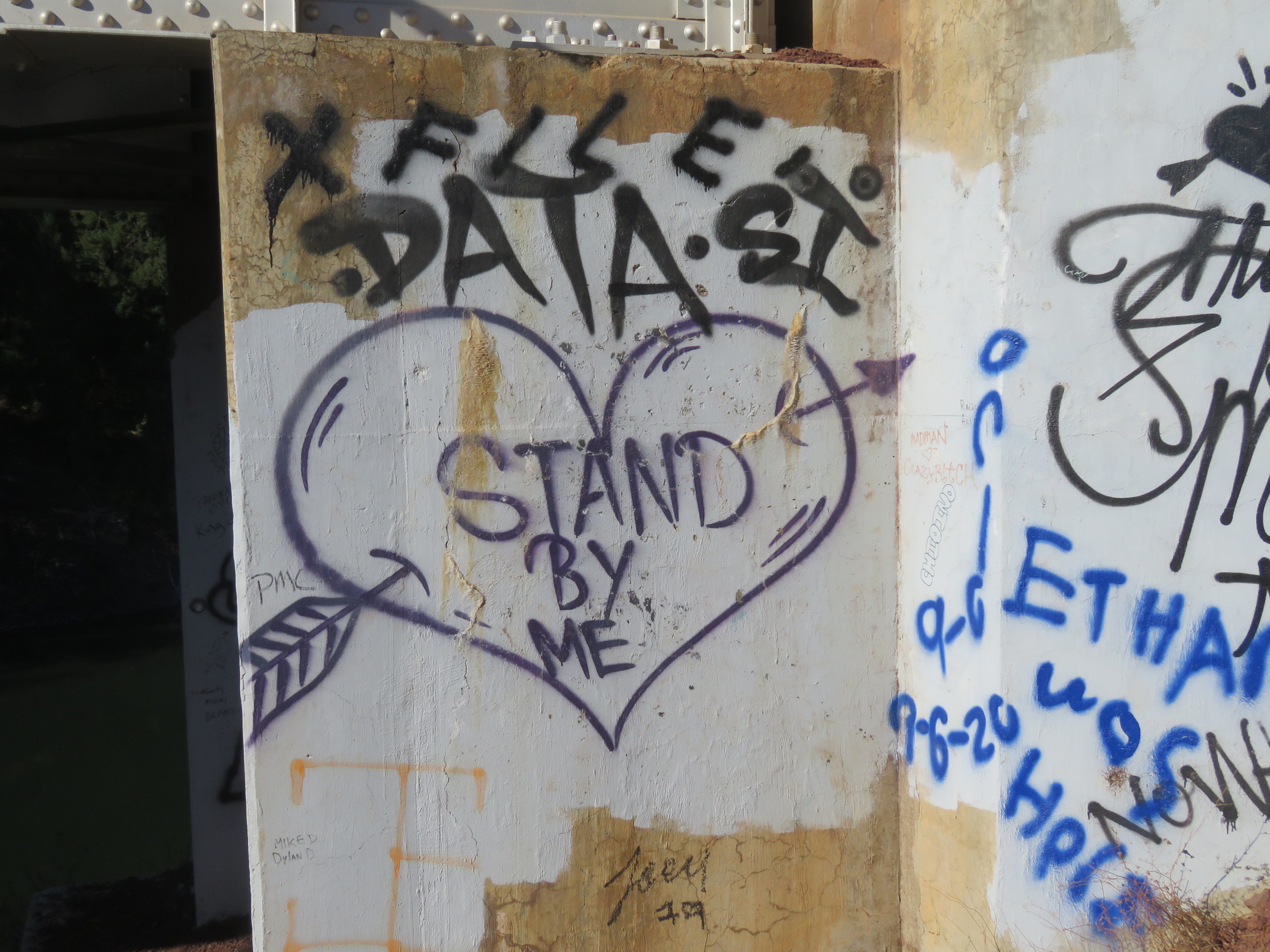
Walking along this rustic railroad always feels like I’m participating in a scene from Stand By Me on a quest to find a dead body. But in this case I was in search of a big bunch of sticks on top of a fir, high above the San Lorenzo River.

I kept one eye on the rails and one on the trees off to my right. My neighbor had given me good directions to the nest and when I was 30 minutes out of Paradise, I thought that maybe I had passed the nest. But how could I miss it? So I continued hiking upstream.

Ten minutes later the osprey nest appeared across the river between a break in the redwoods and firs. I put bins on the nest and could not detect any occupants. But osprey nests are deep and the osprey could be laying low. The only sign of life were the acorn woodpeckers that looked to have used the fir as their granary tree, their acorn larder, for years.

I was at a point in the line where the railroad curves gracefully over a curved viaduct. The concrete arched bridge was build by the Southern Pacific Railroad in March of 1905 and spans Coon Gulch. At this point the San Lorenzo River takes a turn and you can get an amazing view upstream. This point in the line is known as Inspiration Point.

It didn’t take long to see signs of life. An osprey flew in and briefly alighted on the nest. Bingo! The nest is occupied after all. The unseen osprey, presumedly sitting on eggs, sat up in the nest and became visable.

The osprey that flew in could have been the male who is responsible for bringing fish to the nest while the female does most of the incubating of the two to three eggs. The male perched near the nest on a Doug-fir and preened.

First sign of life at the osprey’s nest. Perhaps the male dropping off fish.

I stood by the railside and sketched the nest. On the left side of the spread is my field sketch (first in pencil then in dark sepia pen) of the Douglas-fir crowned by the osprey nest. The osprey perched on the right was drawn from a field photo I took of the presumed male. The title and text were added back at the cabin. In the end, I decided to create a spread that is almost monochromatic. I resisted the urge to paint in the sky because I didn’t want anything to distract from the form of the Doug-fir and nest.

The osprey doing a little housekeeping at the nest. This is presumedly the female who does most of the incubation of the eggs. Both sexes build the nest. A hiker who stopped to look at the nest told me that the nest had been there for past two or three years.
Ospreys reuse their nests each breeding season. A lot of work has gone into this nest over the past two or three seasons.
Image

Goldsworthy, Rivers and Tides

“We often forget that WE ARE NATURE. Nature is not something separate from us. So when we say that we have lost our connection to nature, we’ve lost our connection to ourselves.” ~Andy Goldsworthy

During shelter-in-place I made some time in the evenings to rewatch some of my favorite movies.

These consisted of independent films, foreign language films, and documentaries. Here is a short list of some of the films I have watched recently: Amelie, Being There, Butterfly (La lengua de las mariposas), Chariots of Fire, Cria Cuevis, Delicatessen, The Fog of War, The Lives of Others, Odd Man Out, Once Upon a Time in the West, The Third Man, Spirited Away, Sunset Boulevard, and Rivers and Tides.

The last is one of the best documentaries I have ever seen about the artistic process (and a profile of an amazing artist.) This 2001 documentary was filmed, edited and directed by Thomas Riedelsheimer and it’s full title is Rivers and Tides: Andy Goldsworthy Working With Time.

The English sculptor, Andy Goldsworthy, is an artist I am familiar with because I have sketched many of his pieces in the Bay Area. His medium is nature and his sculptures are often ephemeral, being destroyed (he would say altered) by the wind, rain, and the rising tide.

A sketch of Goldsworthy’s Wood Line in the Presidio from 2015.

Rewatching Rivers and Tides, made me want to go out into the San Lorenzo watershed and make a sculpture out of nature. To do that, I needed river rocks and there was no better beach for this than Rocky Beach.

Rock cairns at Rocky Beach, telling the river which way to flow.

I headed upstream from the beach to Upper Rocky Beach, to gather stones. I tried to “shake hands” with the place and the stone and I worked on making a stone cairn, a pale imitation of Goldsworthy’s work.

Once I finished my Apprentice-piece, I sat down and sketched the work, much like Goldsworthy does. I do love sketching rocks, attempting to get the lines, contours, and textures onto paper.

A 2015 sketch of another Goldsworthy sculpture on the campus of Stanford. Stone River (2001). This riverine design influenced the lines work under the title of the featured sketch. A very Goldsworthian motif.
Image

Mothers

On Mother’s Day I saw the merganser ducklings for the first time.

I was on Washington Way, a footpath that runs parallel to the San Lorenzo River. There was the female, in a cloud of young ones. The common merganser ducklings where actively diving and foraging so it was hard to get an accurate count but I estimated I counted 12 heads.

Common merganser nests in cavities near water and females may lay 6 to 13 eggs. The hatchlings may stay in the nest for a day and then the downy young jump out of the nesting cavity and they immediately can swim and hunt for themselves. No failures to launch in the merganser world.

The next day, on my daily walk, I saw the wood duck family from Washington Way. They were foraging on Middle Beach. The group included two adult males, a female, and three ducklings.

The wood ducks with two of their three ducklings. The ducklings were actively foraging on their own on Middle Beach.
The male wood duck is considered to be the most beautiful duck in North America, if not the world. There’s a lot going on with this duck.

Later that day, at about four in the afternoon there was a late spring rain. I stood at the backdoor, looking out past the deck and the trees towards the river and I wondered how the wood duck ducklings were handling their first rain.

So I did want I always did when I am inspired by the natural world: I wrote a poem and did a sketch. What else should I have done? (As Mary Oliver would have asked).

Mother

To the three wood
duck ducklings on
the river, this was
their first rain.

Did it seem odd
to them that it
was wet from above
as well as below?

Did they wonder
if the whole world
was river?

I imagine that
before they got
lost in thought
(as much as ducks
get lost in thought)

mother presented
her downy breast
and they sought shelter
before an answer came.

Image

The Founders Tree

“The redwoods, once seen, leave a mark or create a vision that stays with you always. No one has ever successfully painted or photographed a redwood tree. The feeling they produce is not transferable. From them comes silence and awe. It’s not only their unbelievable stature, nor the color which seems to shift and vary under your eyes, no, they are not like any trees we know, they are ambassadors from another time.” – John Steinbeck, Travels With Charley

Over the past 15 years I have spent much time sketching around my cabin in the Santa Cruz Mountains among the redwoods, douglas-firs, big leaf maples, and bay laurels. I have sketched all of the trees but one of these stands above the others. That would be Sequoia sempervirens, the coast redwood.

I have always loved sketching coast redwoods and I have sketched them many times and I understand their visual language. For one, they are not too hard to sketch, a straight trunk that reaches up to the sky like a giant sundial. These trees are so massive that when I sketch them, I only seem to capture a small part of them as the tree grows off the page. As Steinbeck noted, “No one has ever successfully painted or photographed a redwood tree.” I agree with this because I have attempted both, with mixed results. And I love the idea that you can sketch or photograph a subject but never truly capture it’s essence.

The coast redwood is a California native, growing along the coast (as it’s name implies) with it’s northern range just crossing the border into Oregon. In every sense the coast redwood talked about in superlatives. They are considered the tallest trees on planet earth. The tallest specimen is 379 feet high. They are also long lived, living between 1,200 to 1,800 years old. They are also one of the oldest species on earth.

In Paradise Park, most of the redwoods and Douglas-firs are second growth and are not necessarily considered superlatives of their species. The giants of the species are usually found further north. Except for one exception.

This redwood is known as the “Founders Tree” and it is believed to be the largest and tallest tree in Paradise Park. It is 24 feet in circumference and about 200 feet tall. The tree is estimated to be about 350 years old. Just for context, this tree is older than the government of the United States of American by about 100 years.

Your neck gets sore looking up toward the top of the Founders Tree.

The stone marker notes that the the Founders Tree was dedicated on August 12, 1974 and celebrated the foundation of Paradise Park on August 12, 1924. It is certainly a paradise for me in these tough and uncertain times.

Image

We Are All Pioneers

In distant learning we are always trying to make connections with our current situation and the curriculum we are studying.

So I made the connection of distant learning and all the new challenges of learning in a purely digital form to being a pioneer on the Oregon Trail, traveling to a better life in California.

Students became familiar with the Oregon Trail is a similar way in which I learned about the trail, by playing a video game. After a little research I learned that this classic game was created by  Minnesota Educational Computing Consortium (MECC) in 1971 to teach students about life on the Oregon Trail. The game is certainly very low-tech by today’s standards but it still really engages students and they are having fun and learning at the same time while dying of dysentery, breaking limbs, and getting lost (in the digital sense, of course.)

And this metaphor made me write this poem (what else can you do?):

I told them that
we were like
pioneers on the
Oregon Trail,
on an uncertain
path with an
uncertain endpoint.
If the axel broke,
we’d fix it.
If the oxen broke loose,
we’d find them.
If Jimmy got cholera,
we’d heal him.
If we thought of turning back,
we’d swallow the thought.
If we came to a river,
we’d ford it.
I told my class today
that we are pioneers
on the Oregon Trail
and we will get there.

I don’t know where poetry comes from. It is a mystery. It is sublime. Sometimes, and very rarely, I just feel like a medium in which the words flows through and all I have to do is write them down. That’s how I felt when I wrote this poem. This is a metaphor turing to reality.

A field sketch of the iconic Chimney Rock from my Oregon Trail Road trip in October 2017.

I see this poem as a pep talk to my students during tough times but I guess it’s also a pep talk to myself.

Image

DIY Suet Polefeeder

In the afternoon after school, I decided to do a little wood working and create my owe suet feeder, in hopes of luring in the local pileated woodpeckers, (although an acorn or a hairy woodpecker would be nice too) to partake in a little suet.

First I needed wood (easy to find in the woods), and a fully charged Makita with a 3/4 inch spade drill bit. Done and done!

Laying in the corner of my cabin was a two foot length of wooden pole. Looks like I didn’t have to go to the woods to find wood after all. Not sure what my dad bought this for and what purpose it originally served, but now it was to find it’s second life as a bird feeder.

I first drilled a hole through the top of the pole in order to put some rope to hang the feeder. I then drilled five holes, about one inch in depth, at 90 degrees from each other, along the length of the pole.

Now came the really messy part: I stuffed the holes with suet. Suet is like the blood on Lady Macbeth’s hand, impossible to wash off. “Out, damned suet! out, I say!” Once I had plugged the holes with bird candy, I hung it up and now it was a matter of waiting. Which would be the first customer? My heart said, “Chestnut-backed chickadee” but my head said, “Steller’s jay”.

A fully loaded suet feeder, waiting for customers.

It’s turns out that chestnut-backed chickadee was the first visitor to the feeder, followed closely by Steller’s jay.

And at the time of writing, the elusive pileated woodpecker (or any woodpecker for that matter) has used the suet feeder. Oh well, the best laid plans. . .

Image

Nature Loafing

“Adopt the pace of Nature. Her secret is patience.” ~Ralph Waldo Emerson

With the rest of the school year relegated to distant learning, I decided to spend the remainder of the last trimester at my cabin in the Santa Cruz Mountains.

This was an easy decision because I could be in a place that I love and also have access to everything I needed in my digital classroom to stay connected with my students, parents, and coworkers. In the wooded hills I could really stretch out and breath fresh air while experiencing the world coming alive as Spring was upon us in the San Lorenzo River Watershed.

The calls of Wilson’s warbler, California towhee, and song sparrow was the soundtrack to my mornings and the hoot of the great horned owl dueting across the valley was my evensong.

There is also much more elbow room in Santa Cruz County. A comparison of the population and area of Santa Cruz and San Francisco Counties is telling. The 2019 population of Santa Cruz County is 273,213 compared to 881,549 in San Francisco. The City and County of San Francisco is much smaller, it being hemmed in on three sides by water. The City is 231 square miles compared to the expansive 607 square miles of Santa Cruz County.

It also gave me a opportunity to do one of my favorite activities: nature-loafing. I define nature-loafing as being in nature and actively doing nothing. This definition really captures the oxymoronic nature of this non-pursuit. No agenda, no plan, just being there and being in the moment. All the stress and strain of sheltering in place and distant learning just drains out of me and flows downstream to the Pacific.

Of course I never just nature-loaf because I am also nature sketching at the same time. Like the feature sketch for this post of my hammock-view with my feet pointed upstream and my head downstream.

One of my favorite places to nature-loaf is on the banks of the San Lorenzo and one of my favorite actives is Power Hammocking.

Near Rocky Beach are two alders that are lined up parallel to the course of the river. They are about 15 feet apart and demand that a hammock be strung between; a perfect nature-loafing platform!

My nature loafing stage with the San Lorenzo River on the right.
Image

Powder Works Covered Bridge

Many think of New England as being associated with covered bridges. I certainly saw many during my fall trip when I was in New Hampshire. But there has been a west coast covered bridge in my life for as long as I can remember.

This is the Powder Works Covered Bridge, which was built in 1872. This bridge was built across the San Lorenzo River (the largest river in Santa Cruz County). The bridge was built by the California Powder Works in the site of the plant that produced black power. The plant operated for 50 years but as the population of Santa Cruz increased combined by the decreasing need for black powder the plant was closed down for good in 1914.

When the original bridge over the river washed out in 1871, the Powder Works Superintendent hired the Pacific Bridge Company (in Oakland) to build a new covered bridge. The bridge was constructed in 71 days, at a cost of $5,250.

Above the fireplace of my family cabin, hangs a 1960 oil painting by my great aunt Marjorie Close. This is probably one of the best paintings ever done of the Powder Works Covered Bridge. And I’ve always looked at it with wonder what it’s amazing thick strokes applied with a pallet knife.

My grand aunt was born in a mining town in Arizona on November 11, 1899. She moved to San Francisco and was trained as an artist at UC Berkley and the Art Institute of Chicago. She was known for her still life work as well as a prominent jeweler and furniture designer.

I have painted this bridge before. One sketch of the bridge was from roughly the same position as my great aunt’s painting. For my new sketch, I wanted a different perspective.

A 2013 sketch of the bridge. I used a limited monotoned color palette for this sketch.

I headed upstream to Rocky Beach, just upriver from the bridge. I found a spot on the beach and I looked downstream to the span. There was lot of trees and vegetation in my view. I did not go for realism when sketching in the flora, instead I wanted to sketch in the form and shapes that leads the eyes downstream to the bridge. So I embraced the form instead of each individual leaf.

I also took a minimalist approach to painting the sketch and keeping it loose was my objective. I left much of the drawing unpainted and I kept my paint palette to a few colors. It is a sketch after all!