Image

End of Wharf

In December of 2024 a winter storm hit the seaside city of Santa Cruz bringing with it 25 foot swells.

One structure that took the brunt of the surge was the Santa Cruz Municipal Wharf.

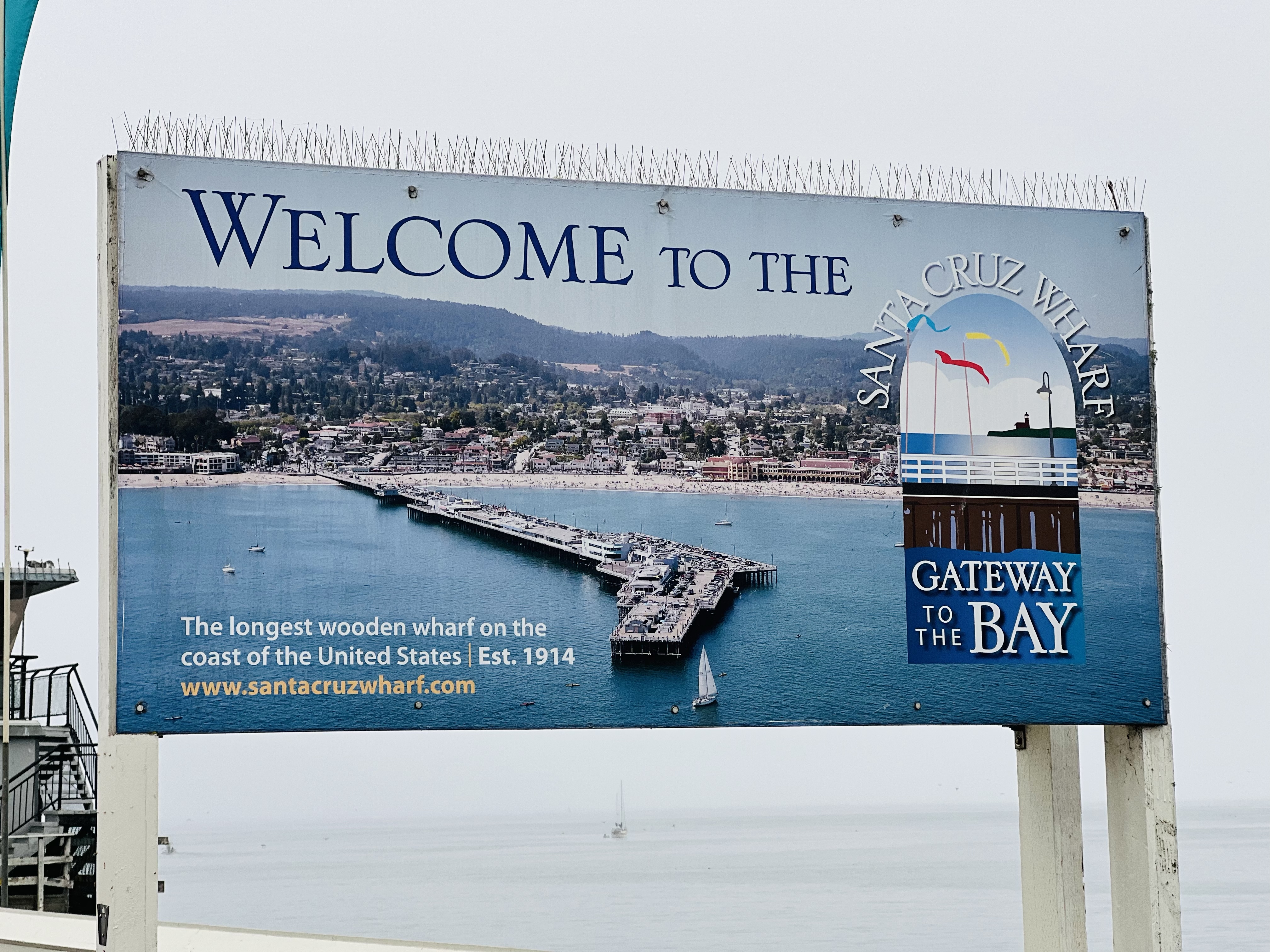
The current wharf was built in 1914 and at 2,745 feet is the longest wooden pier on the west coast of the United States.

Is the Santa Cruz What f still the longest wooden wharf on the west coast?

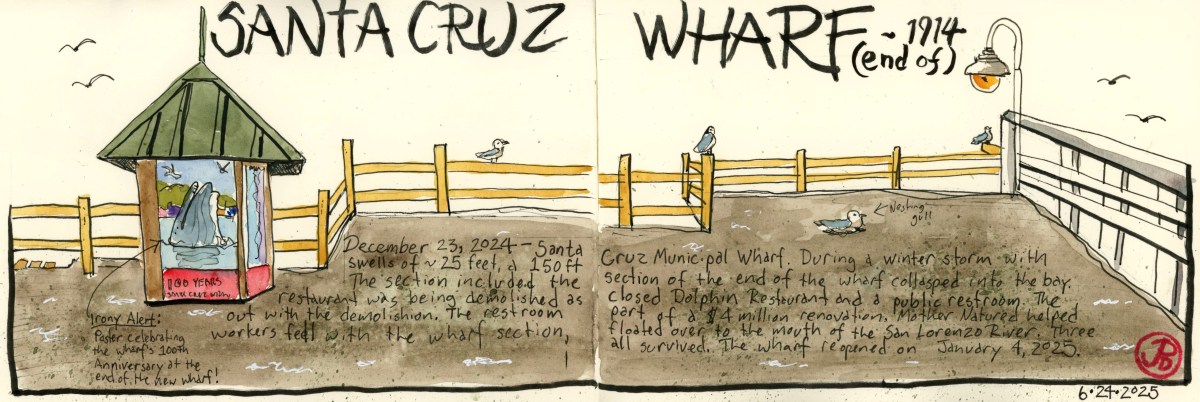
That all changed with the winter storms of December of 2024 which took 150 feet of the wharf into the bay on December 23. The section included the closed Dolphin Restaurant and a public restroom. The restroom washed ashore at the mouth of the San Lorenzo River, looking like a Mississippi River boat.

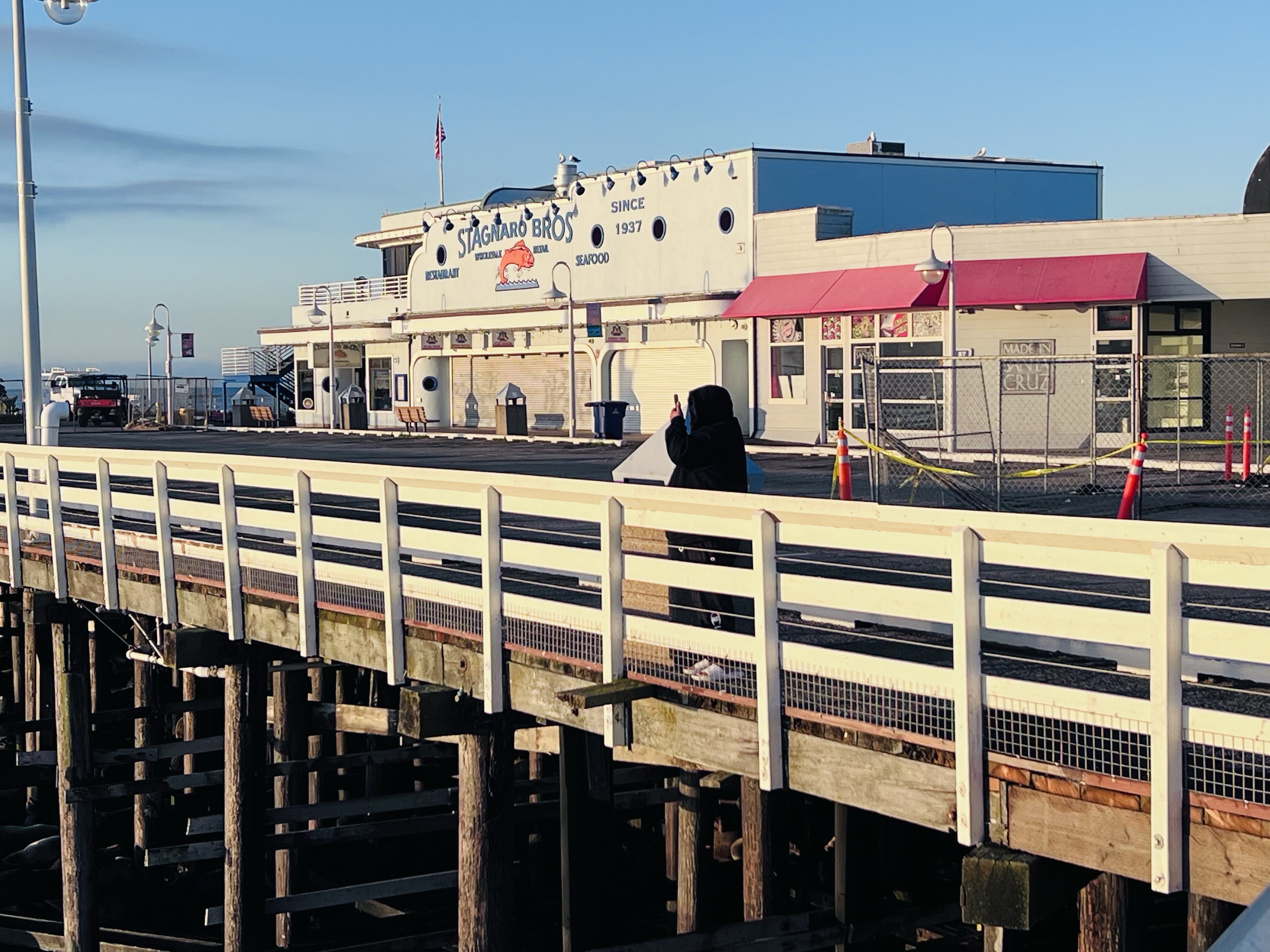
The wharf had been closed but then reopened January 4, 2025. I wanted to head out to the wharf, where I have many fond childhood memories, and sketch the new end of the wharf.

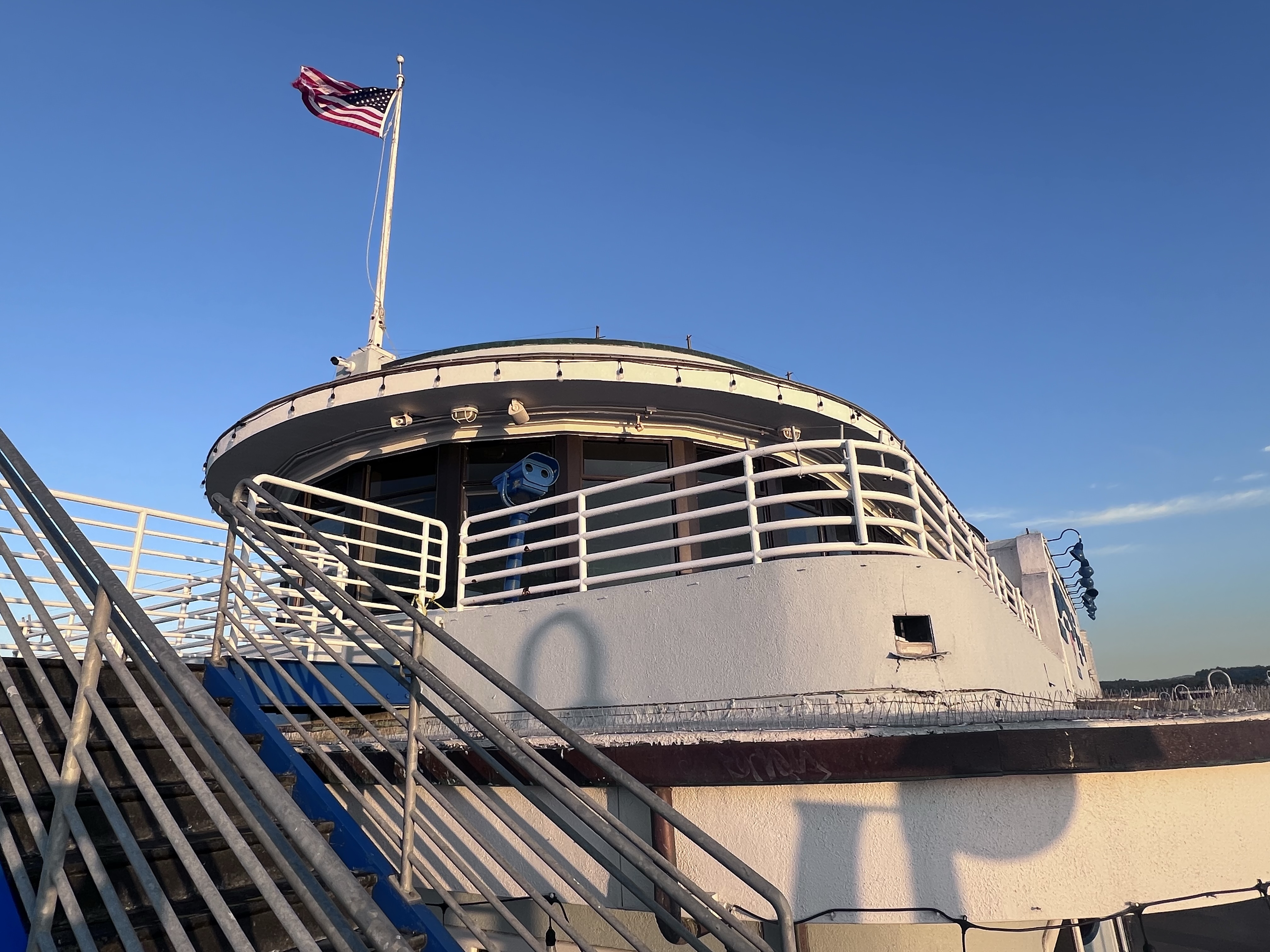
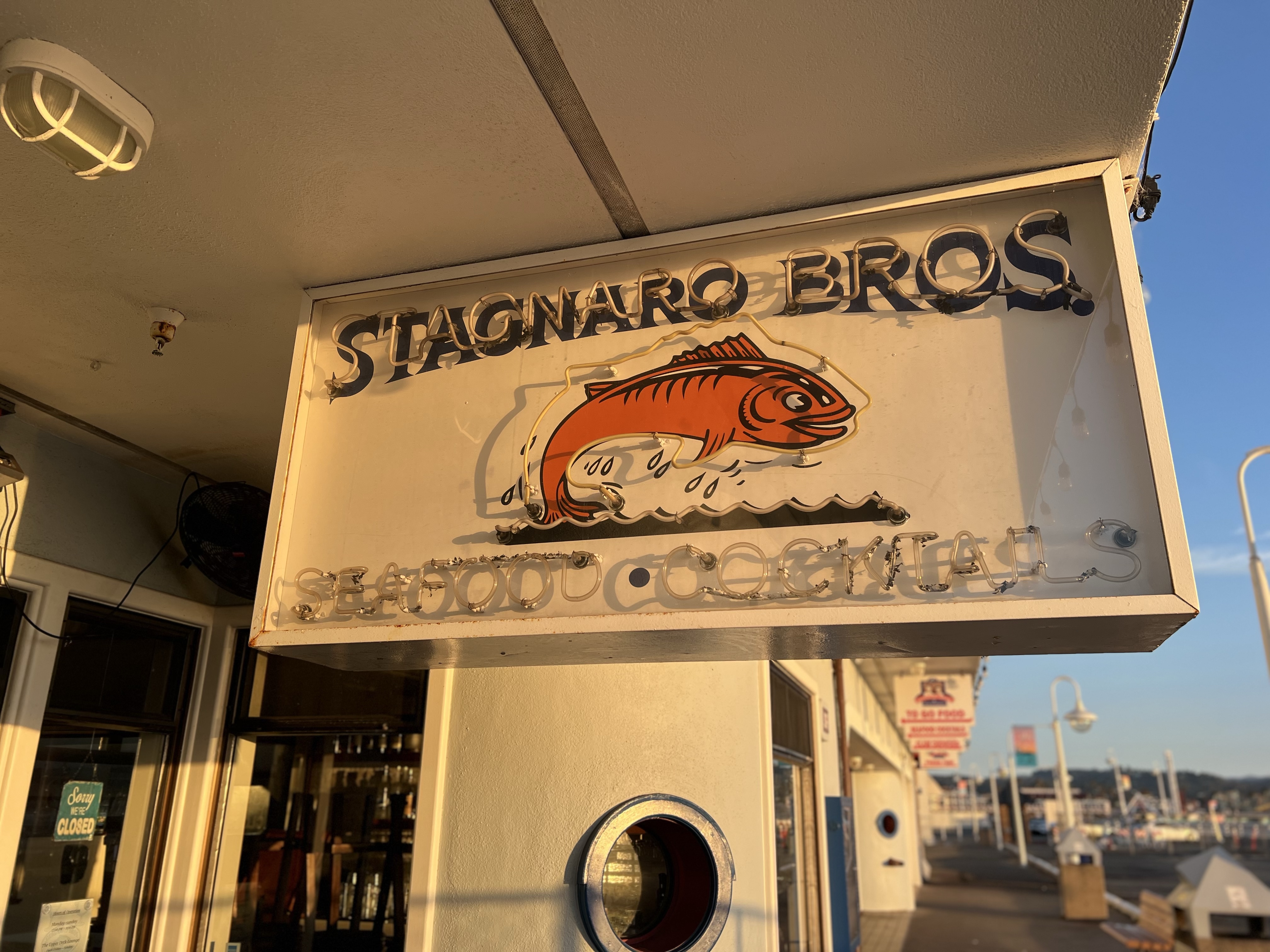
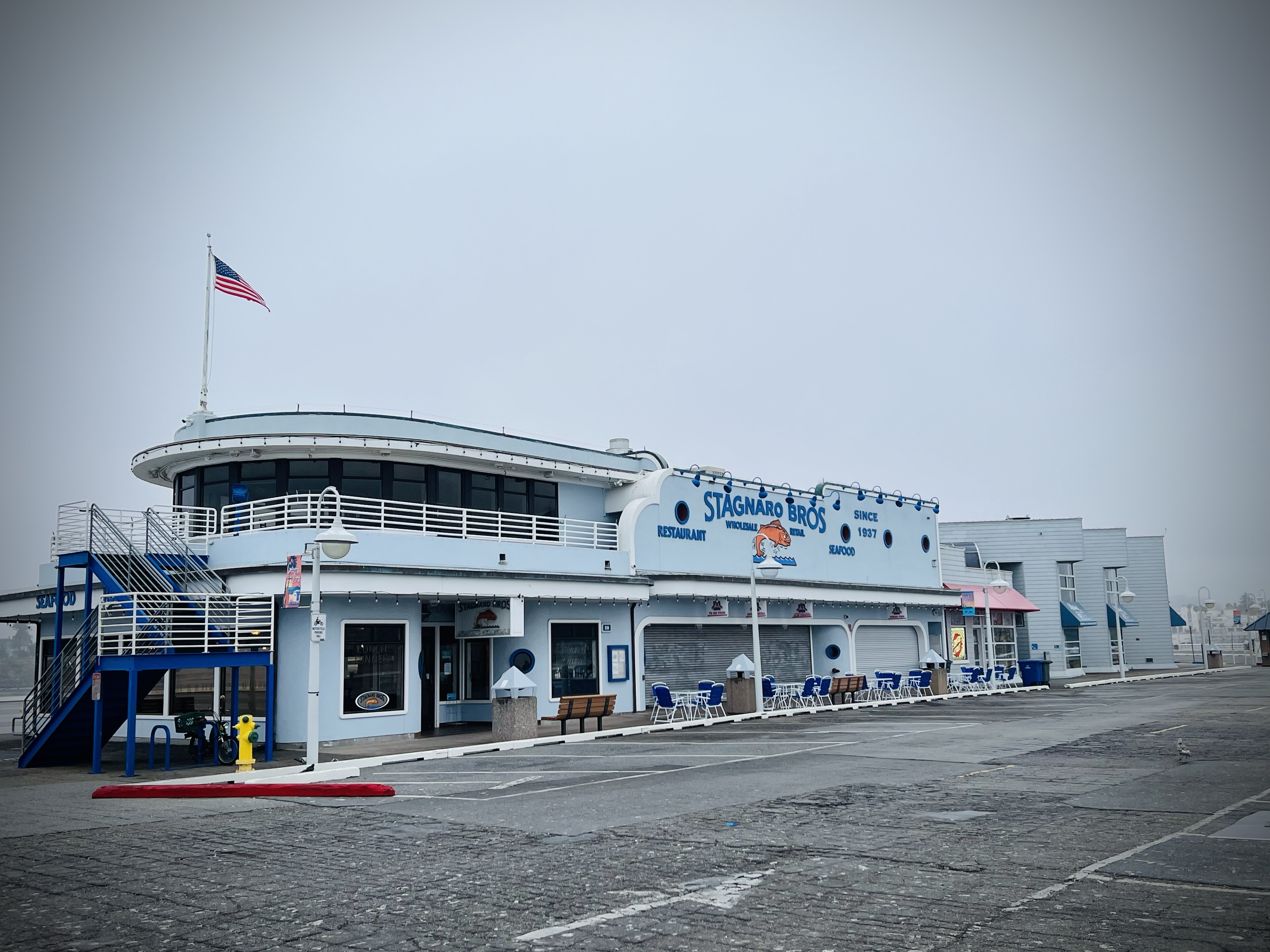
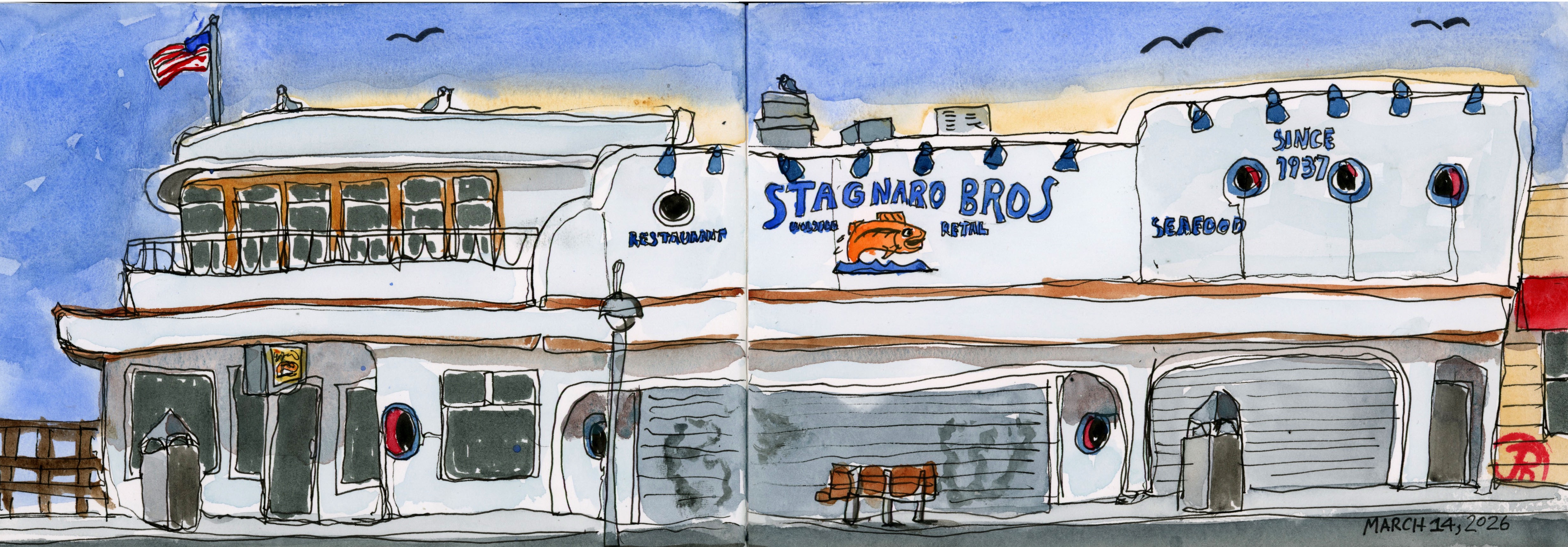
The Dolphin used to be the last restaurant at the end of the wharf. That honor now goes to the historic Stagnero’s. This restaurant and Gilda’s was a favorite of famed director Alfred Hitchcock who had a home in nearby Scott’s Valley.

The Stagnero Brothers restaurant is designed in a Streamlined Moderne style looking like an ocean-going vessel of the 1930s.

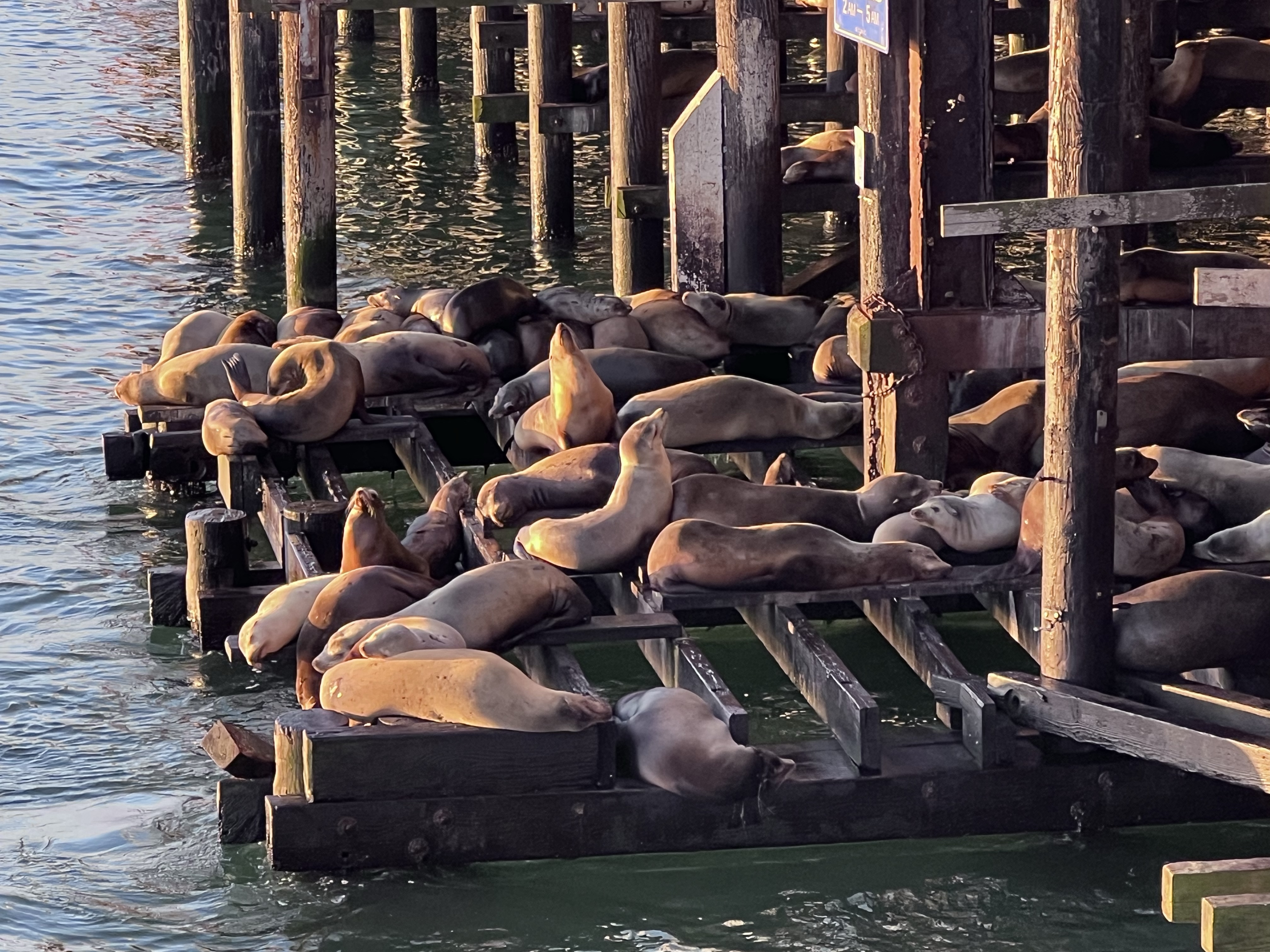
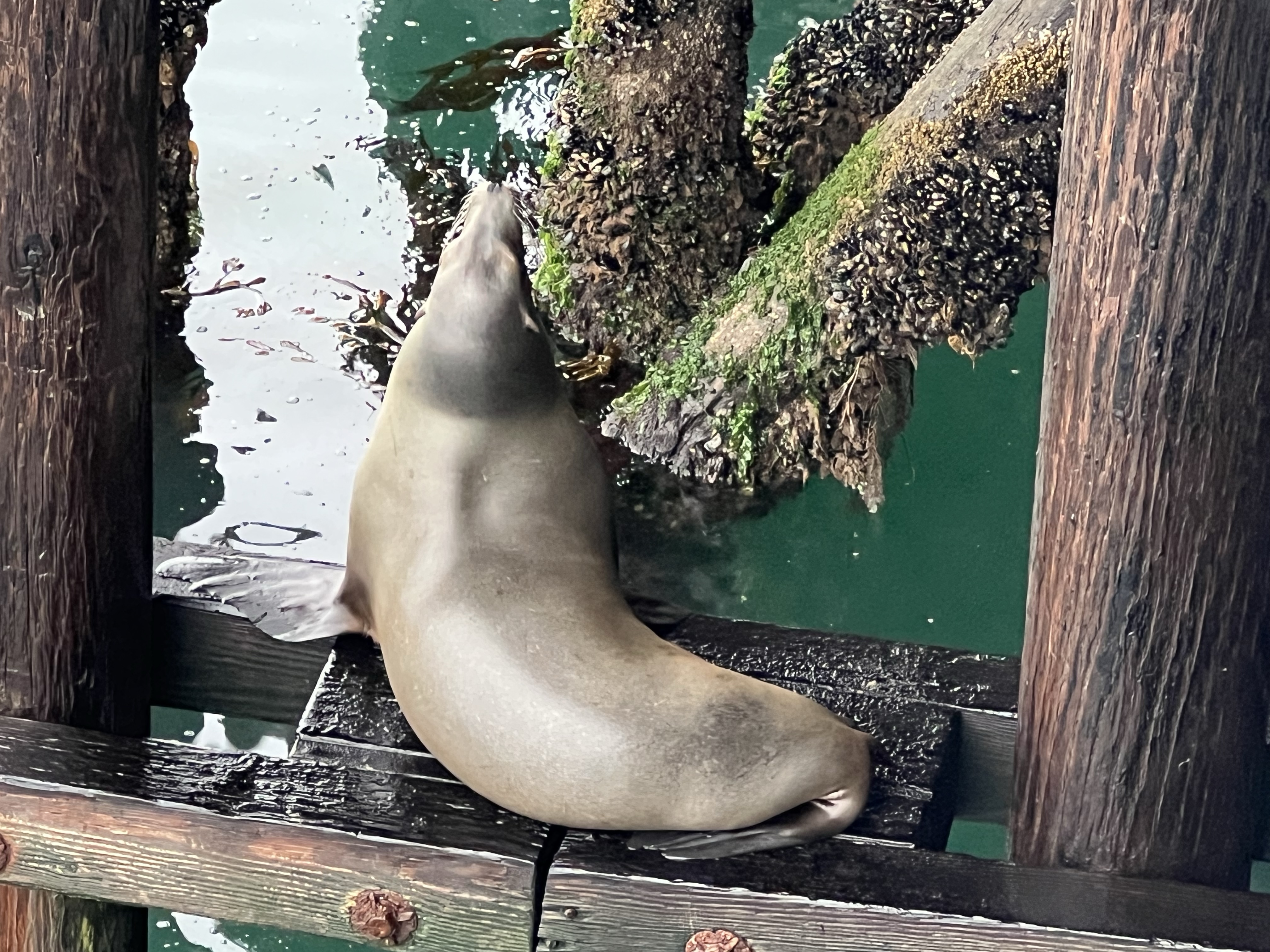
One of the draws at the end of the wharf where openings where you could look down at the resting California sea lions that used the wooden substructure as a haul out location.

The sea lions are still here, they use other sections of the wharf to haul out.

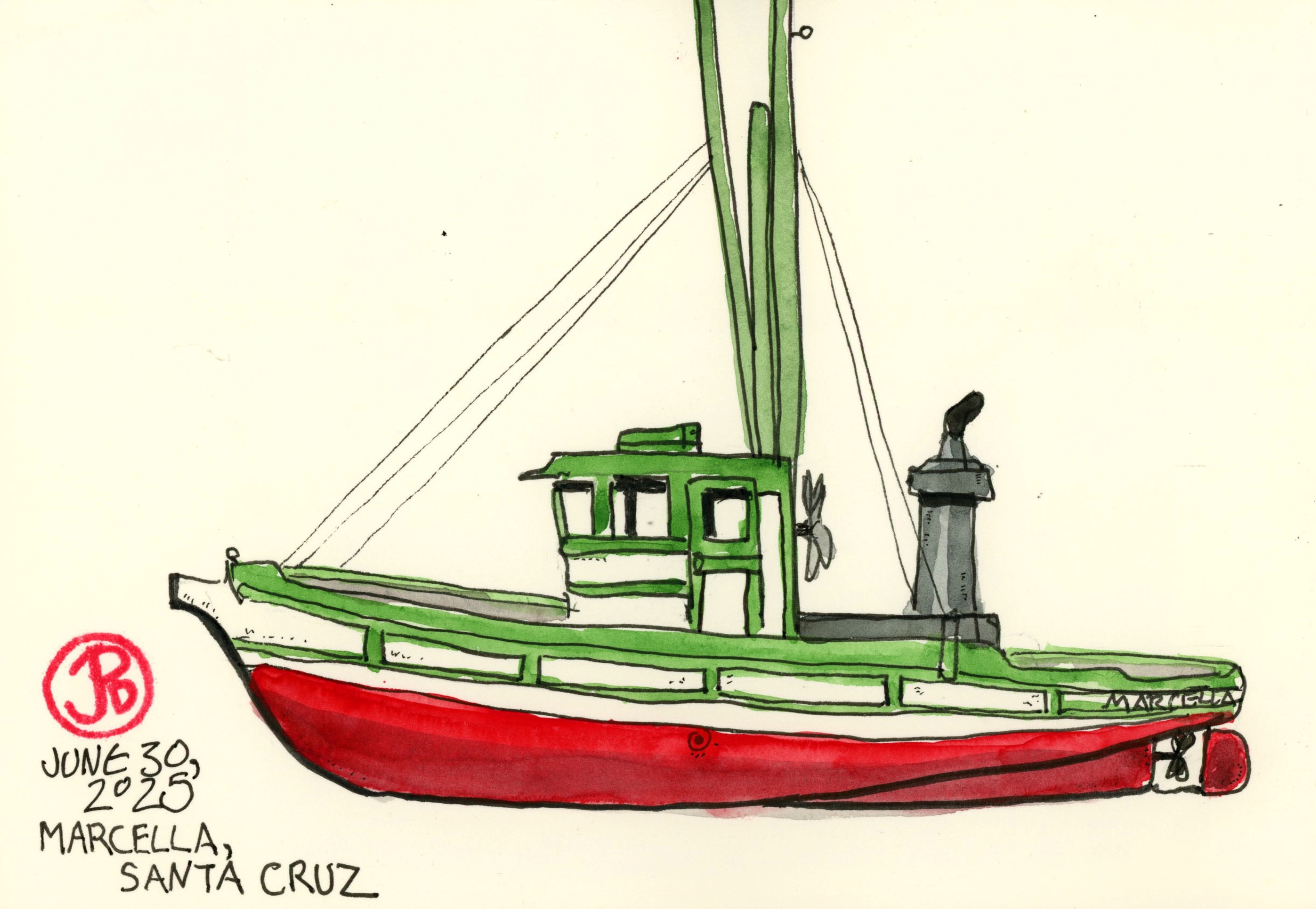
Near the beginning of the wharf there is an old wooden fishing boat which I also sketched.

It was early in the morning and there were already men fishing from the wharf. The wharf is no longer used for industrial fishing but is now used for recreational pursuits.

Image

Loma Prieta Bell’s Sparrow

In late May I made my annual pilgrimage to the birding hotspot Loma Prieta (Upper Saddle).

I left my cabin at 6:40 AM and 35 minutes later I pulled into the dirt parking lot on the ridge that straddles Santa Cruz and Santa Clara Counties.

It can be very windy and hemmed in by dense fog up here but not today. I could look down and see fog covering Monterey Bay. Today it was clear and warm without much of a breeze. In fact it was already getting warm.

My target was the pair of Bell’s sparrows that had recently been seen here since mid May. This would be a Santa Clara County bird for me.

I walked down Mt. Madonna Road and aside from singing spotted towhees and wrentits, and a far off babbling California thrasher, it was pretty quiet. I did not hear or see any black-chinned or Bell’s sparrows.

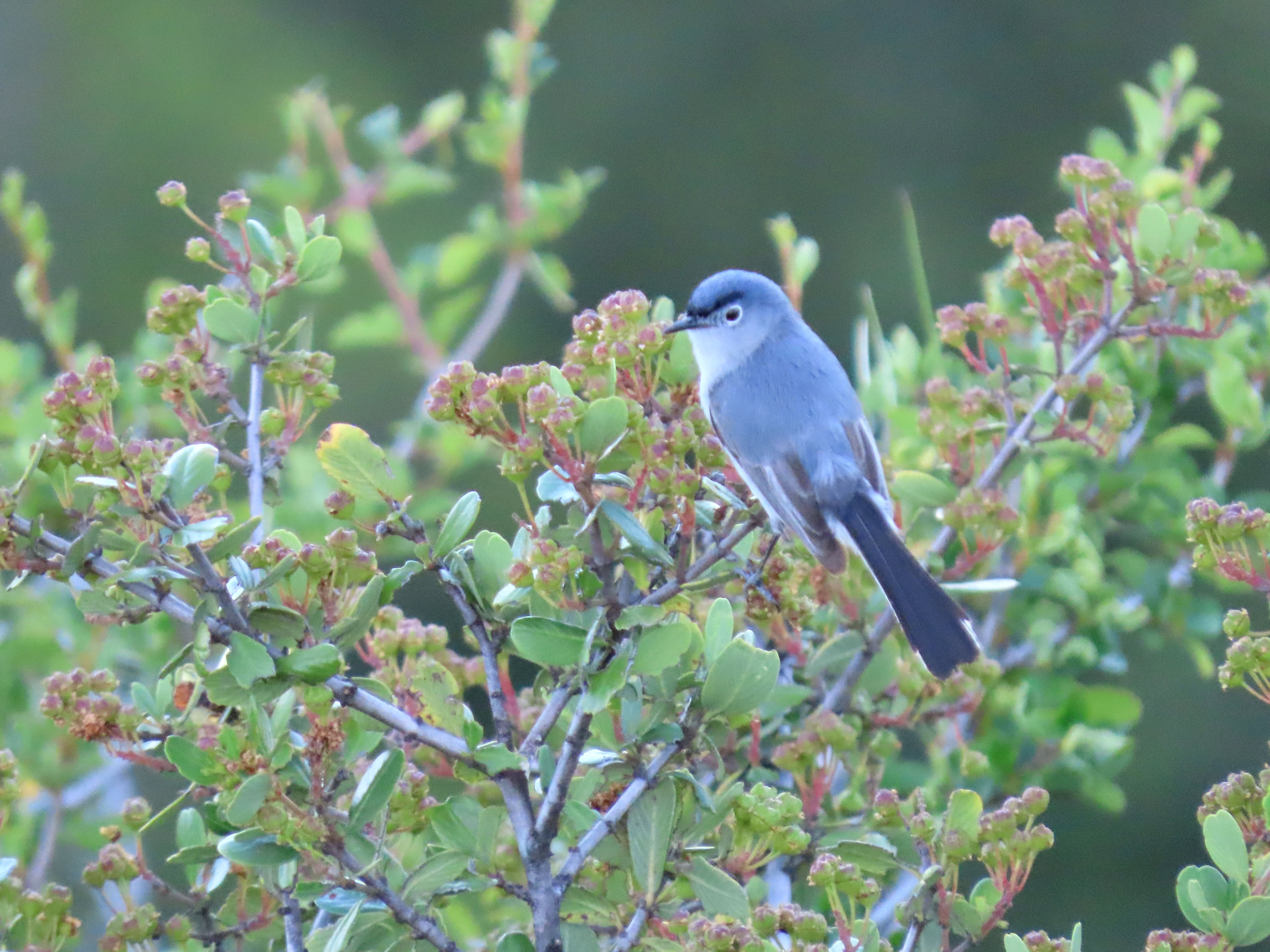
On my way back to the parking lot I first heard and then saw a blue-grey gnatcatcher.

Blue-gray gnatcatcher.

As I headed to the parking lot there were now six other birders in the area, looking for the Bell’s.

As I reached my car a pair of birders had just spotted a pair of Bell’s sparrows right from the parking lot. So I figured I’d stay a bit longer.

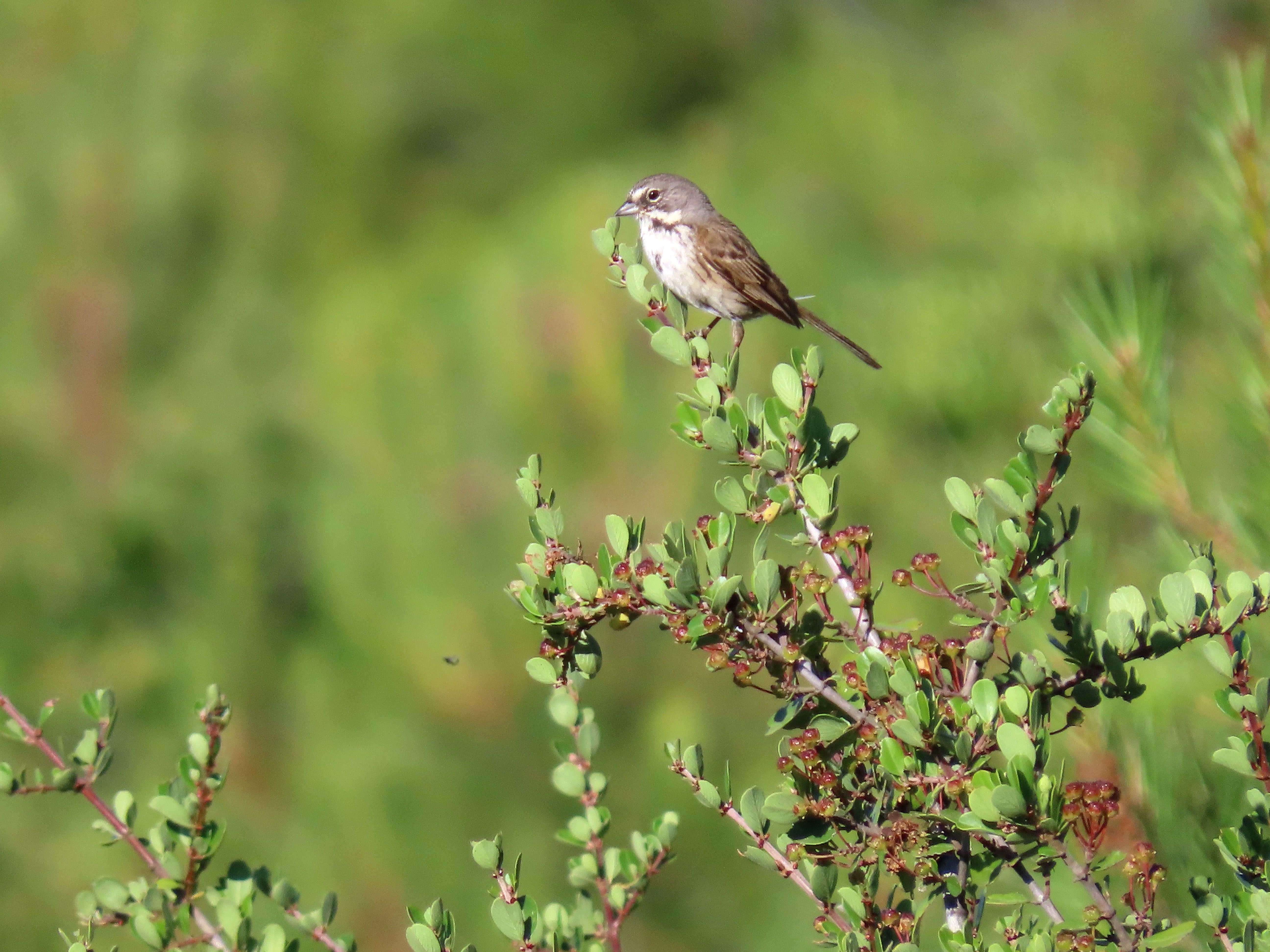
I was rewarded about five minutes later when a bird flew towards me and perched on a nearby bush in front of me. Bell’s sparrow! A new county bird!

Bell’s sparrow.

Sketching Notes

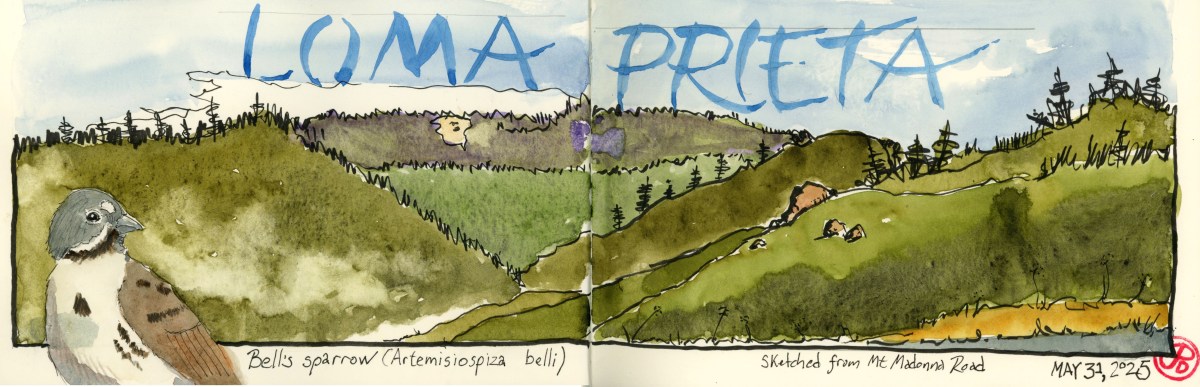
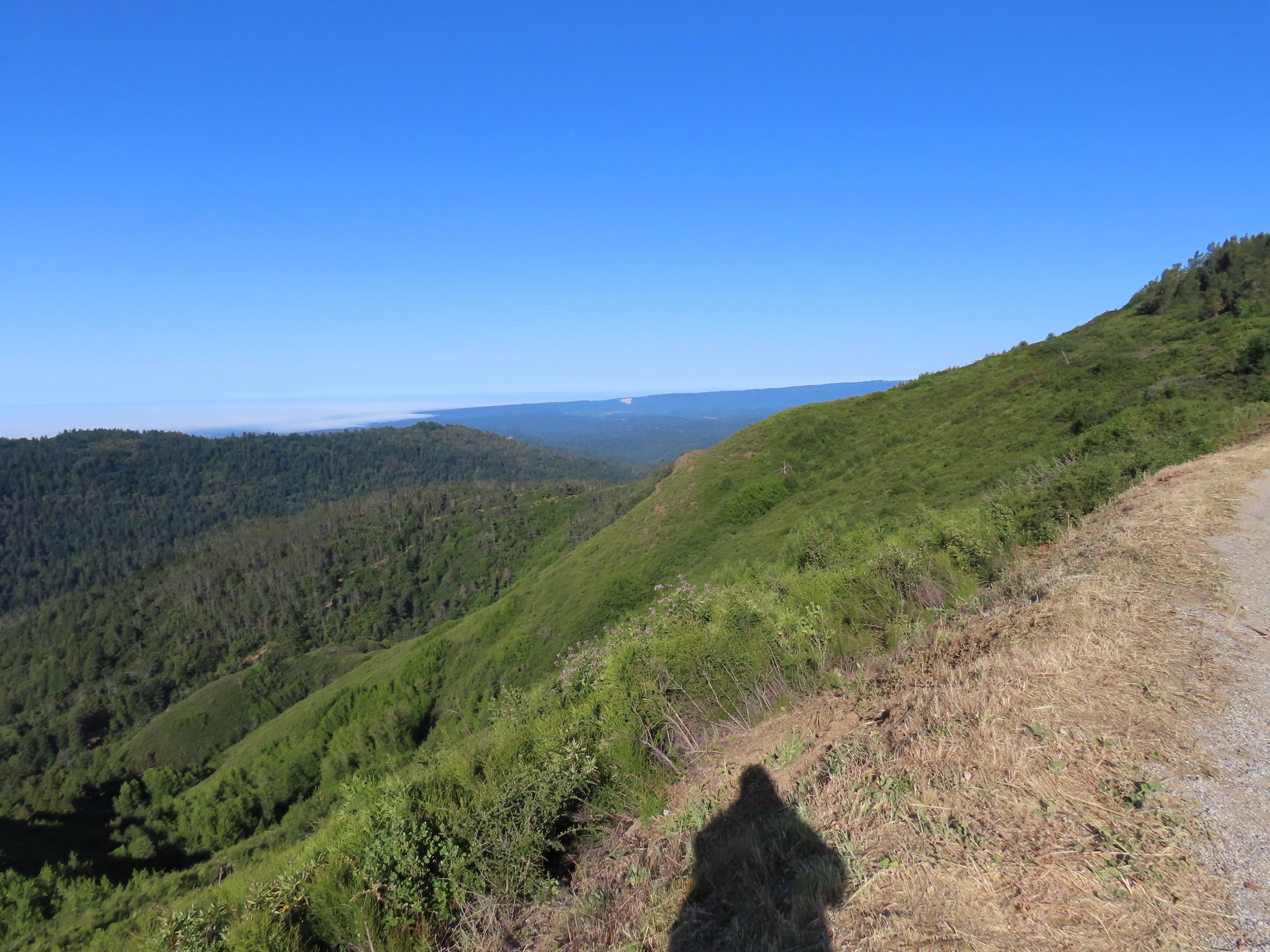
Loma Prieta Ridge is one of the best panoramic views in Santa Cruz County. So I took a pause in Bell’s sparrow spotting and opened my panoramic watercolor journal to capture the scene.

What a view, best in the county!

I left the lower left side blank. I initially was going to add a Bell’s sparrow but I hadn’t seen one yet. So I thought I would add a blue-grey gnatcatcher to that corner, based on my field photo.

After seeing the Bell’s from the parking lot, I returned to my original plan and the result is my featured sketch.

Image

Capitola Trestle and Soquel Creek Bridge

Early Saturday morning found me in Capitola Village.

Capitola was founded in 1874 as a beachside resort and in the age before the personal automobile it owed its early popularity to the railroad.

The Santa Cruz Railroad, opened in 1876 and brought sun worshippers to Camp Capitola.

Southern Pacific took over the railroad in 1882. The SP brought beach goers to the small seaside town, passengers detraining at the new depot near the east end of the trestle, this location is known as Depot Hill.

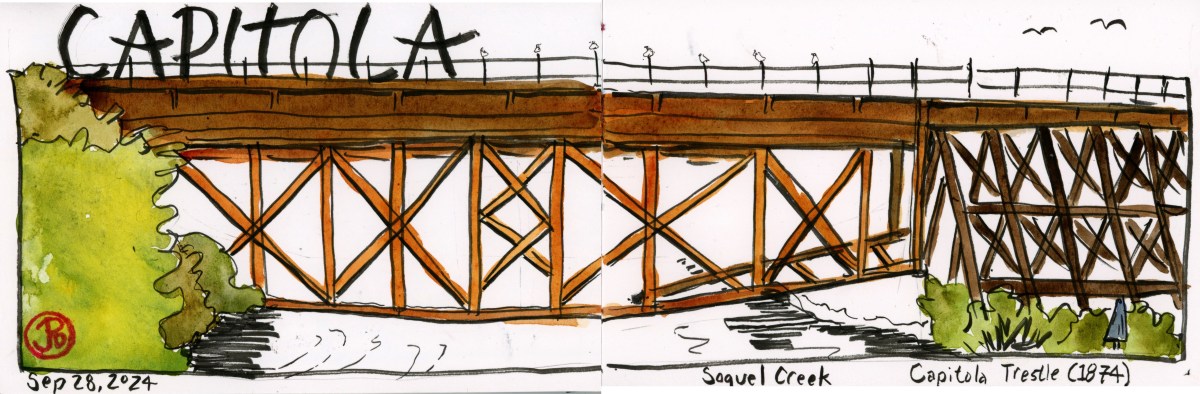
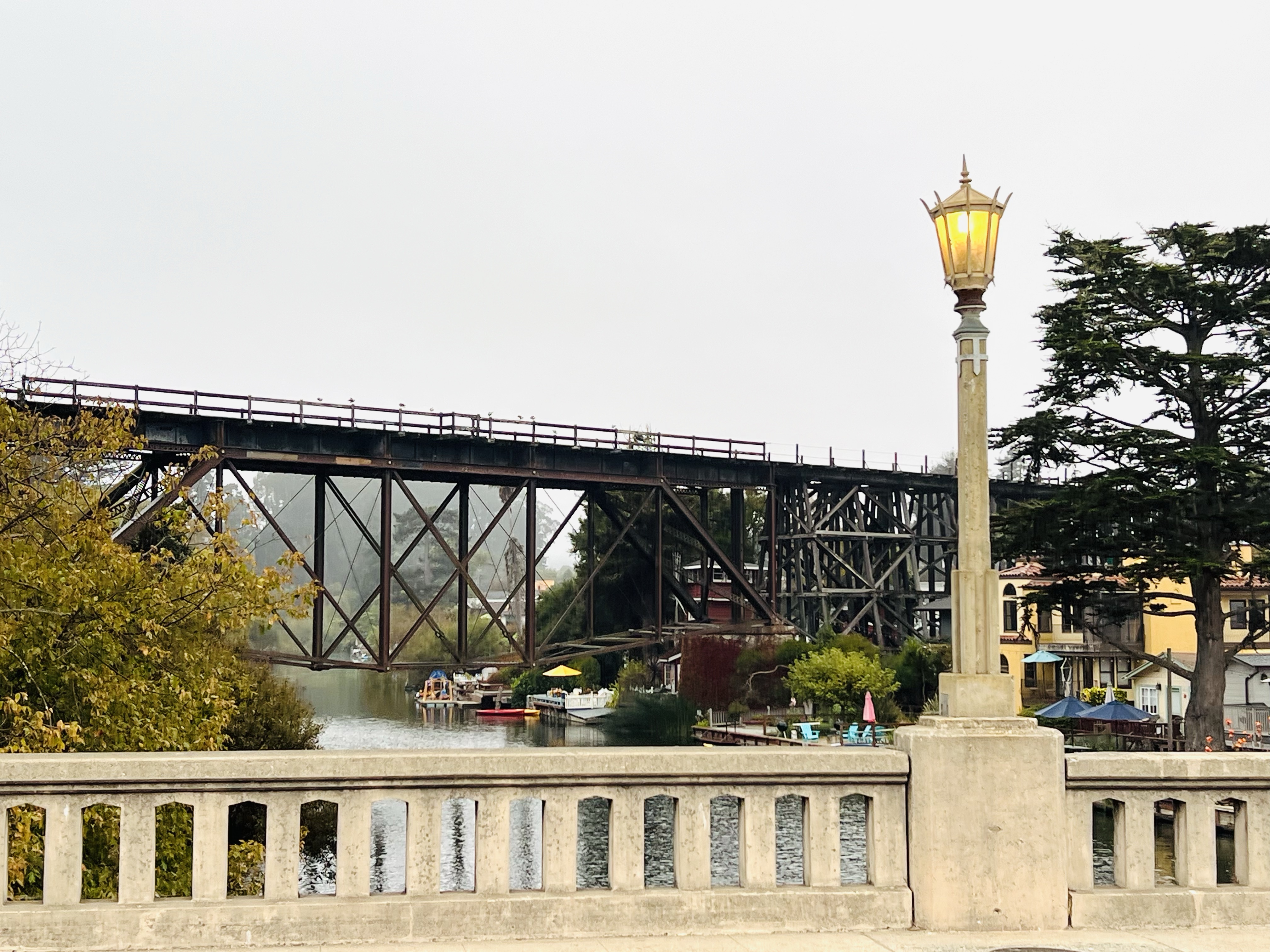
I chose my sketching position above Soquel Creek on the historic Stockton Avenue Bridge (1934) which parallels the trestle. The seaside air was wet with fog, I hoped it wouldn’t smear my ink drawing.

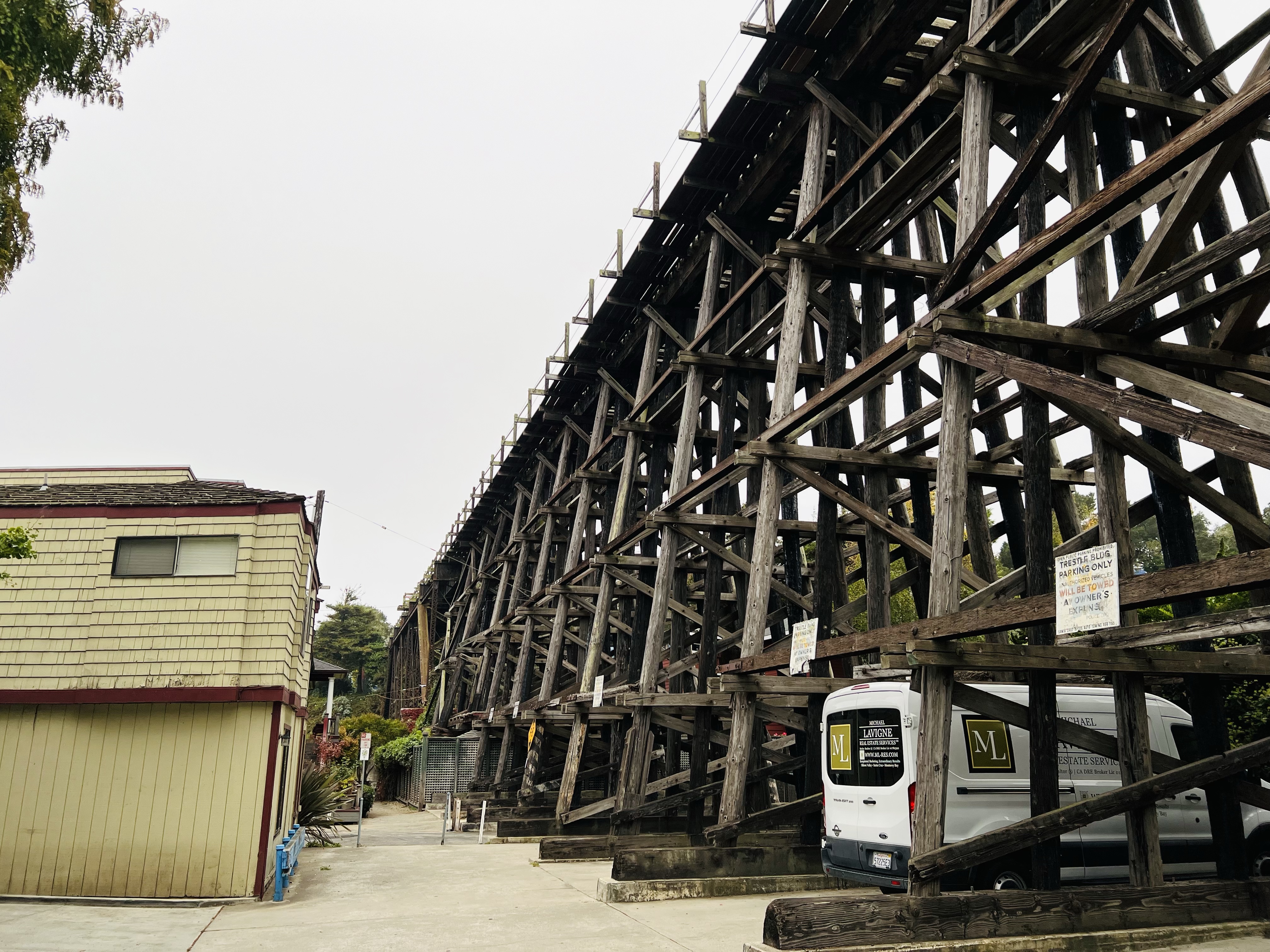
The wooden trestle over Capitola Avenue looking towards Soquel Creek. The Capitola Depot is about 100 yards behind me and up the hill. I have always loved the parking spots under the trestle (parking is a premium in Capitola Village).
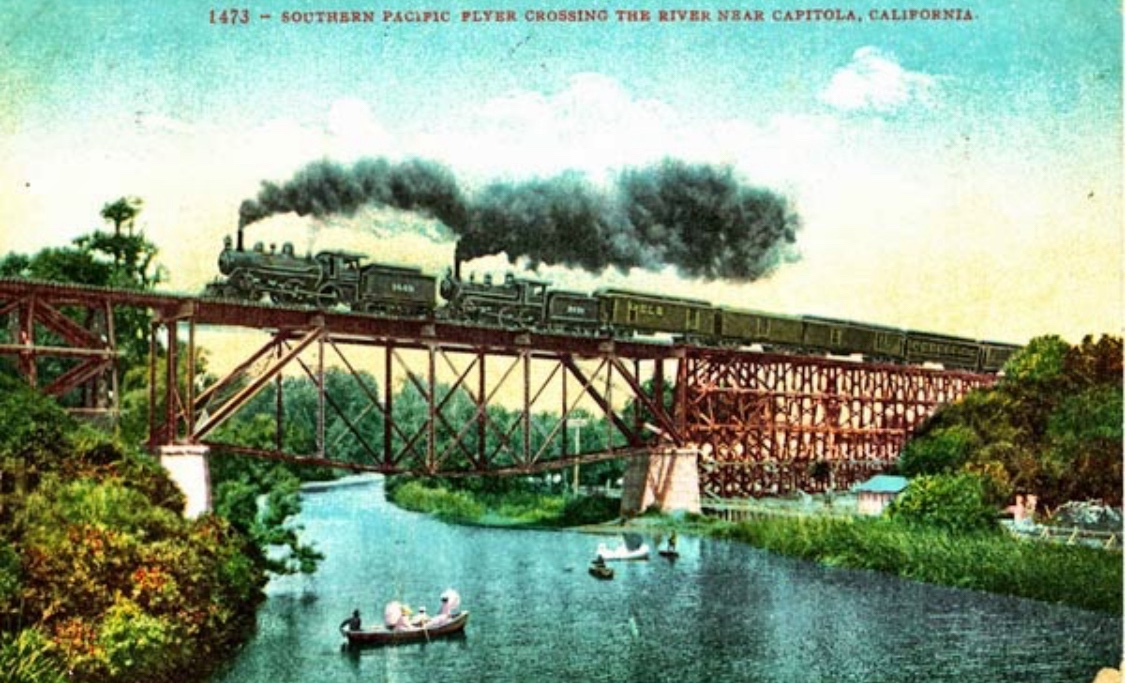
Colorized postcard (early 20th Century) of a double header passenger train with three baggage cars, crossing the trestle over Soquel Creek taking beach goers to Santa Cruz. This perspective is close to where I chose to sketch.
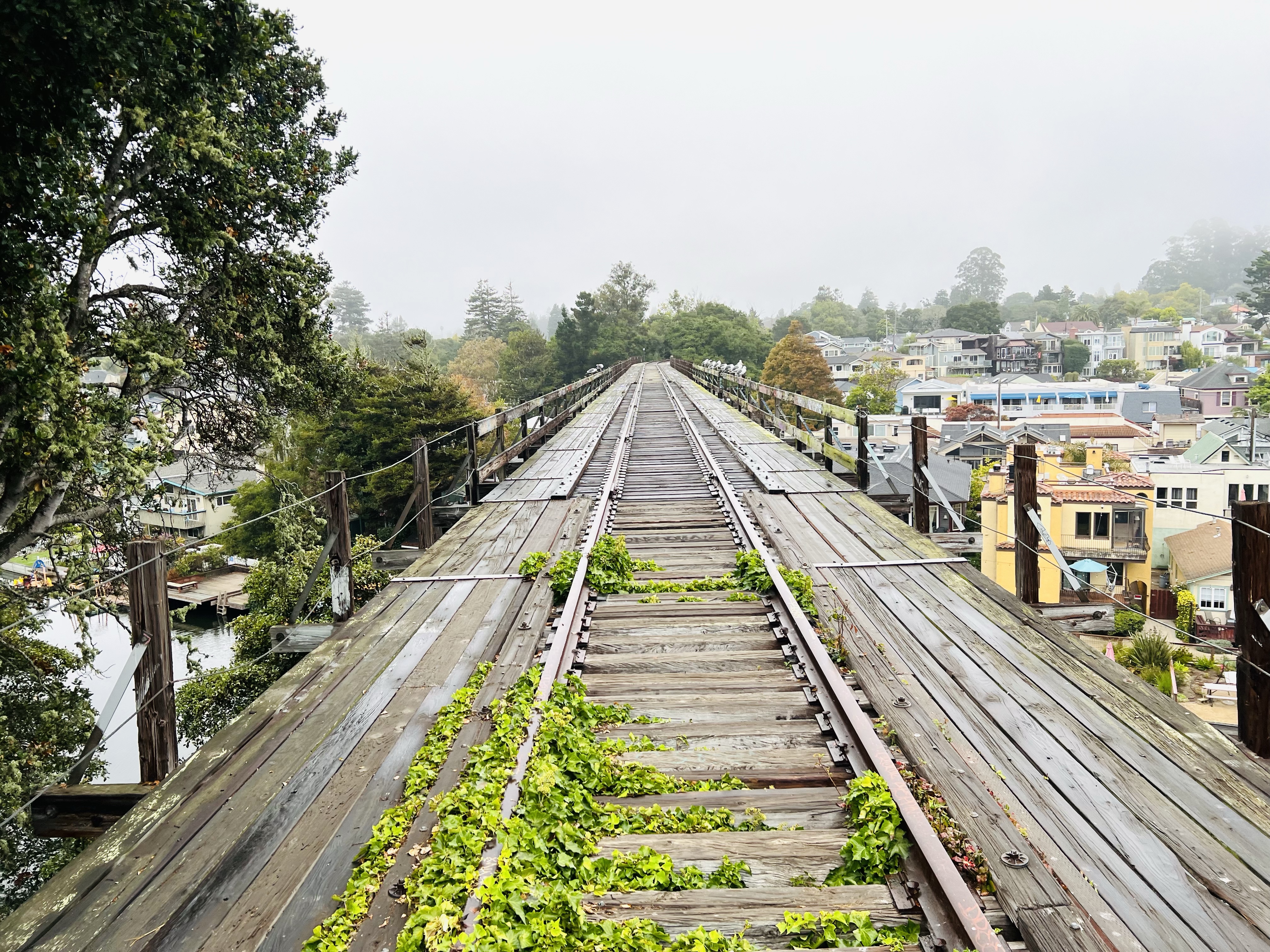
Looking down the trestle in direction of the Capitola Depot and beyond, the connection to the mainline at Watsonville Junction (15.7 miles down the line). The green growth around the tracks shows this track has not been active in over ten years.
Image

The Giant Dipper at 100 (My 700th Post)

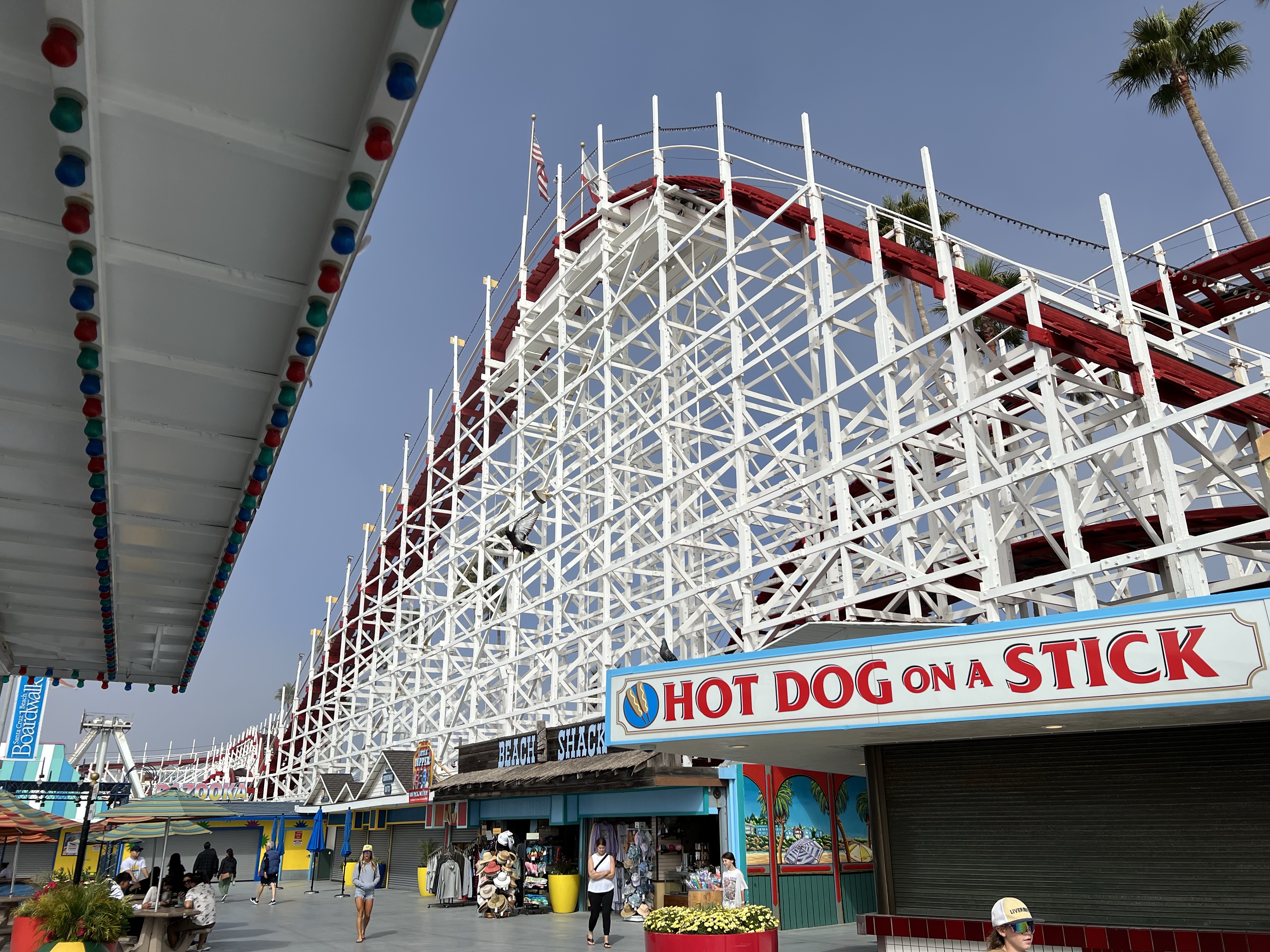
A recent Labor Day tradition has been to ride one of my favorite roller coasters of all time. It’s also my birthday weekend.

This is not a steel coaster with high speeds, loops, and corkscrews. This is a 100 year old wooden roller coaster at the Santa Cruz Beach Boardwalk.

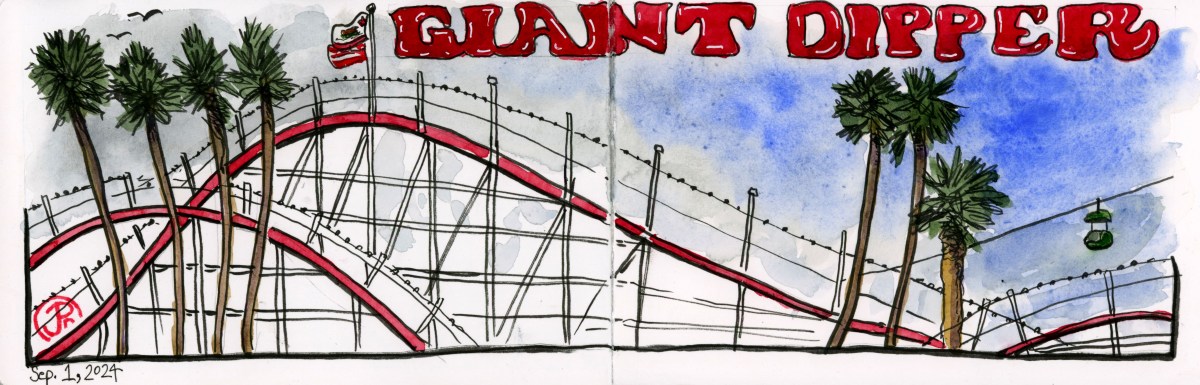
The big dip of the Giant Dipper.

This is the Giant Dipper and is the oldest roller coaster in California.

I have ridden the Dipper many times since I was tall enough to ride it and like my father before me I ride it every summer. And the ride remains as thrilling now as when I was young!

Partly because I’m not sure how this elderly ride still remains safe and standing. This is a testament to the care and maintenance that keeps the dipper rolling.

The ride starts off dropping into a pitch black tunnel and when it rounds a curve you see the lift incline to take the train to the top of a 65 foot drop. There is a slight pause as the coaster drops, reaching speeds of 55 miles an hour before accelerating up a banked curve and the the coaster takes some rises and dips that nearly lifts you out of your seat. The coaster returns to the boarding station one minute and 52 seconds after leaving it, leaving most riders out of breath and with a hoarse voice from screaming!

Since 1924, more than 66 million riders have ridden the crazy train that is the Giant Dipper.

The Boardwalk and Giant Dipper have been featured in some films including: The Sting II, Harold and Maude, Sudden Impact, The Lost Boys, Us, and Dangerous Minds.

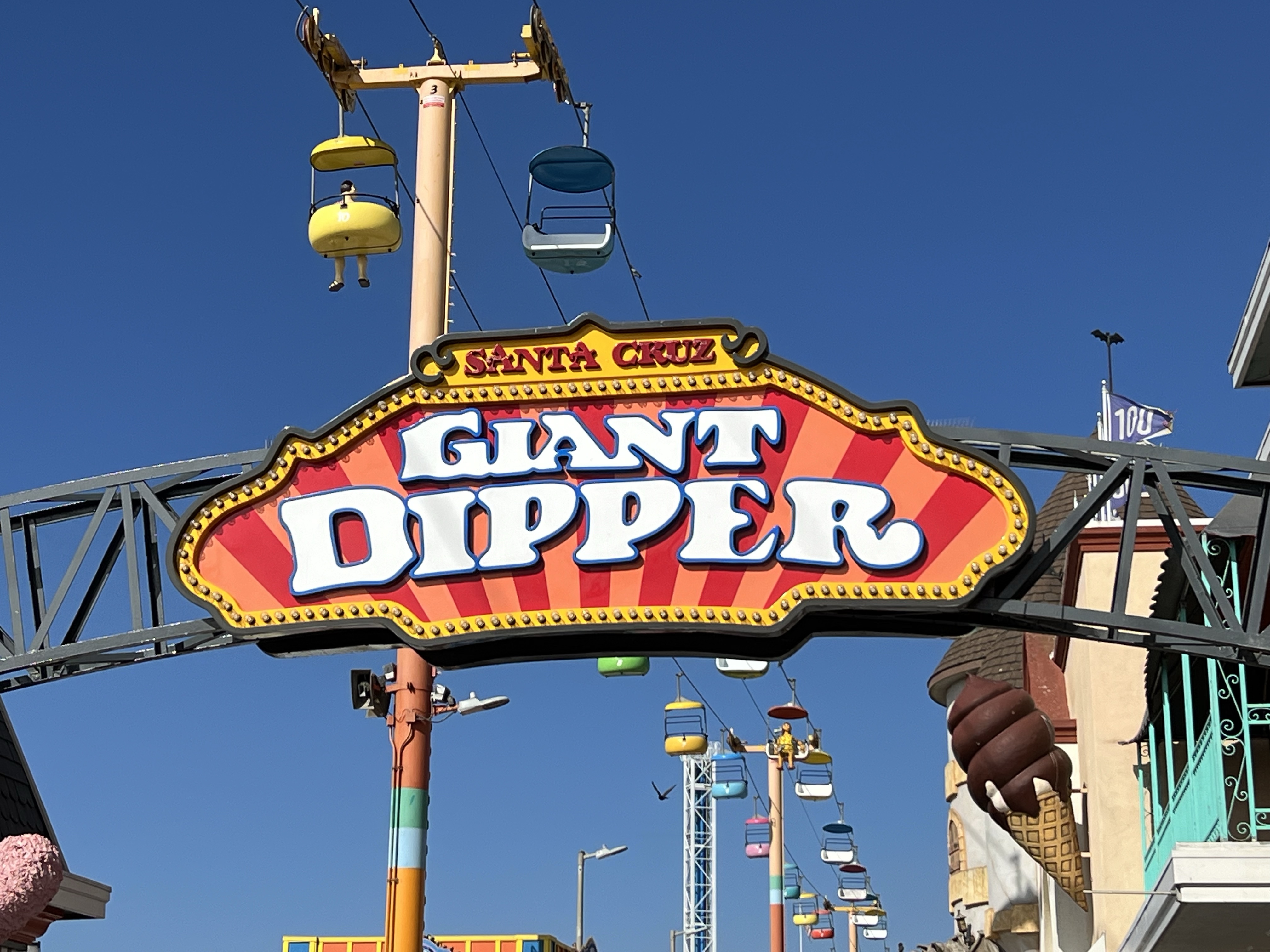
The classic sign was featured in the finale of the fourth Dirty Harry film Sudden Impact.

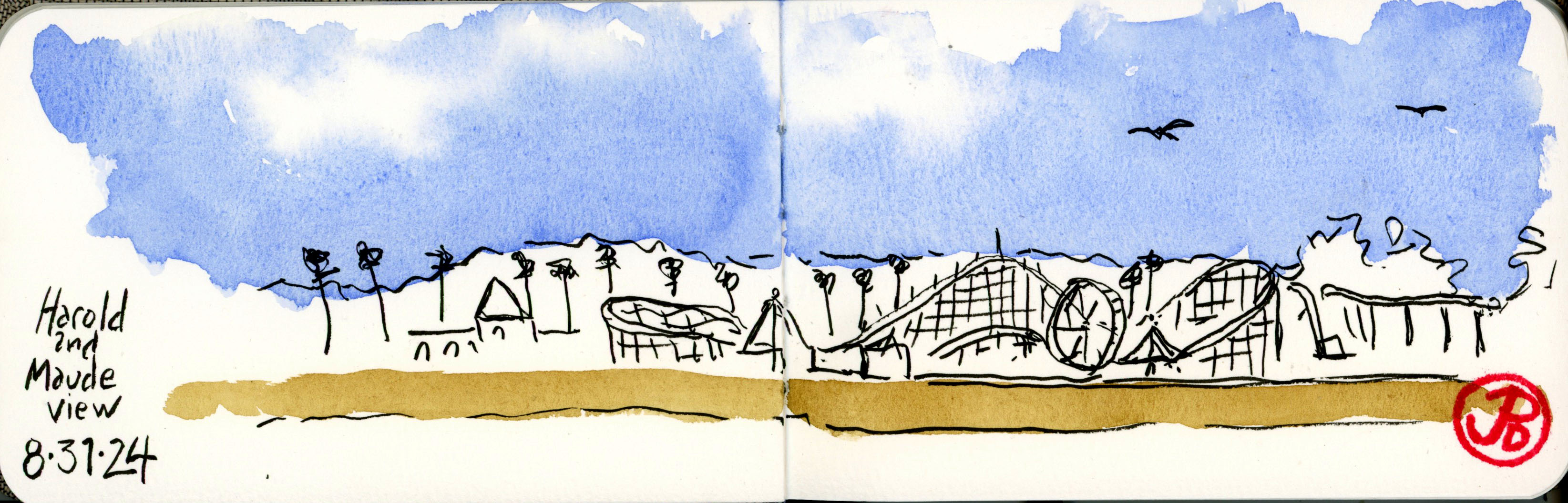
Over the Labor Day weekend, I sketched the Giant Dipper three times. Two were in a small “point and shoot” journal (a gift from my students). One sketch was from the perspective of one of my favorite movies featuring the Dipper, Hal Ashby’s Harold and Maude.

There is a scene filmed on the Santa Cruz Wharf with the lights of the Giant Dipper in the background. This is the scene where Harold gives Maude a token that says, “Harold Loves Maude” and Maude proceeds to chuck it into the ocean saying, “Now I’ll always know where it is.”

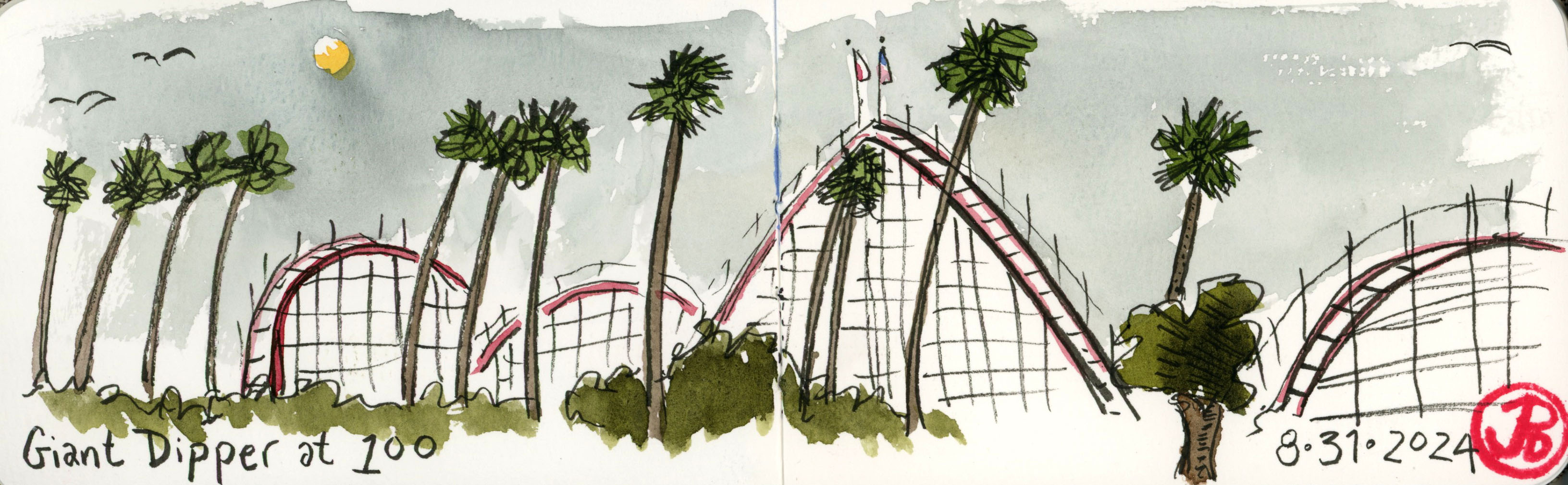
I returned on Sunday morning with Grasshopper and sketched the Dipper from the empty parking lot off Beach Street (featured sketch).

A point and shoot sketch from Beach Street.
Image

Coastal Rail Trail

On a gray Saturday morning I decided to explore a recently opened section (opened in December 2020) of the Coastal Rail Trail in Santa Cruz.

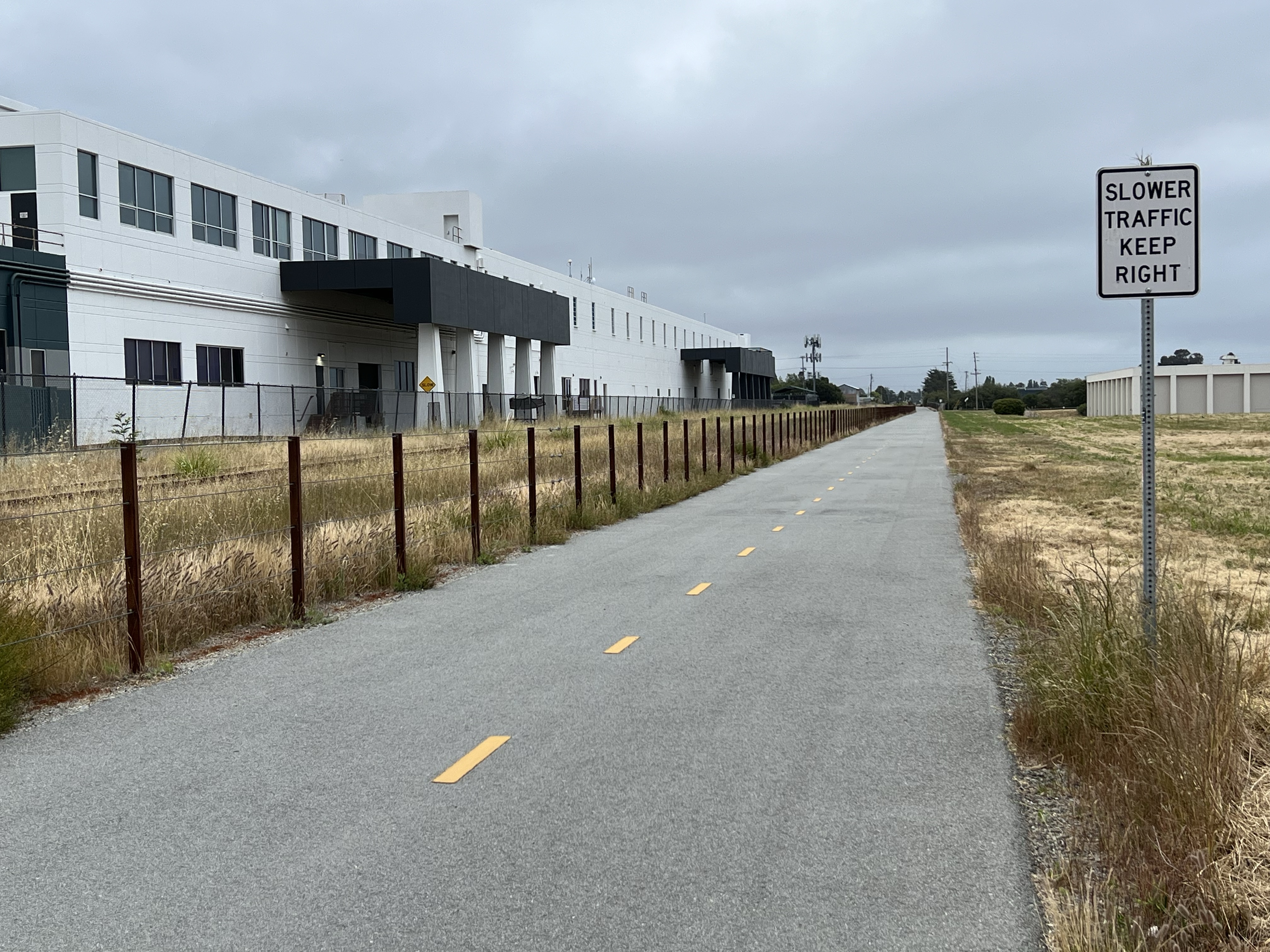
The section I was exploring (Segment 7) is between Natural Bridges Drive and Bay Street. The walk takes about 30 minutes and the round trip covers about two miles.

As the name implies, the paved pedestrian trail parallels the former Southern Pacific Davenport branch line from Watsonville to Davenport.

As of the date of writing only two sections of the trail have been opened, one in Watsonville and the section I was walking on in Santa Cruz.

At grade crossings there are pedestrian signals that stops cars so you can cross the street safely. Well that’s the theory anyway. With the trail recently open, pedestrians should still use caution and not assume all vehicles will stop for you.

When the trail is completed, it will cover 32 miles from Davenport to Watsonville. There are also plans to introduce electric rail service using the former Southern Pacific right of way and trackage.

I started where the rail trail ends: Natural Bridges Way.

The Rail Trail passes by the former Wrigley Chewing Gum plant (left). The plant was in operation for more than 40 years and produced 20 million sticks of gum per day. The plant had a rail siding that is still visible today.

In my college days I remember visiting the gum factory with my roommate in an unsuccessful attempt to get a plant tour. The receptionist told us that they didn’t give tours but asked us if we would like some gum! We answered in the affirmative and then opened a drawer full of gum. I went for Big Red while my roommate picked Juicy Fruit.

The trail is level as it parallels the rail grade. Railroad grades normally don’t exceed 2%. The steepest mainline railroad grade is 3.3% on the Raton Pass grade in New Mexico. A railroad grade is expressed as a percentage the grade rises or falls over 100 feet of horizontal distance. So a 2% grade rises and falls two feet over a 100 feet distance. These gentle grades are ideal for walking and biking.
I passed by the New Leaf Market at Fair Ave, often my first stop when I head into town, as the trail and line turns slightly to the left skirting the Westside Circles neighborhood.

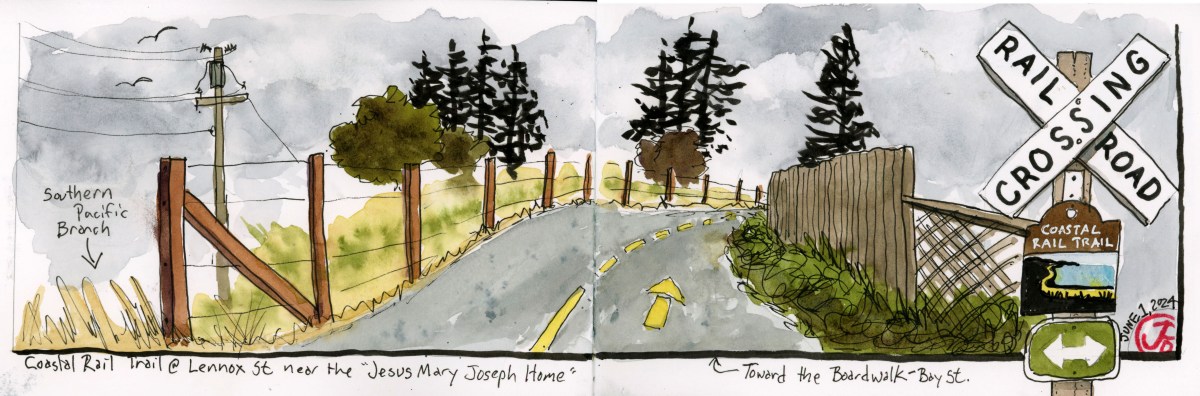
I came upon a scenic curve in the trail at Lennox Street as the rails and trail curve off to the right as it nears Bay Street. I pulled my sketchbook out of my bag and started sketching the view (featured sketch).

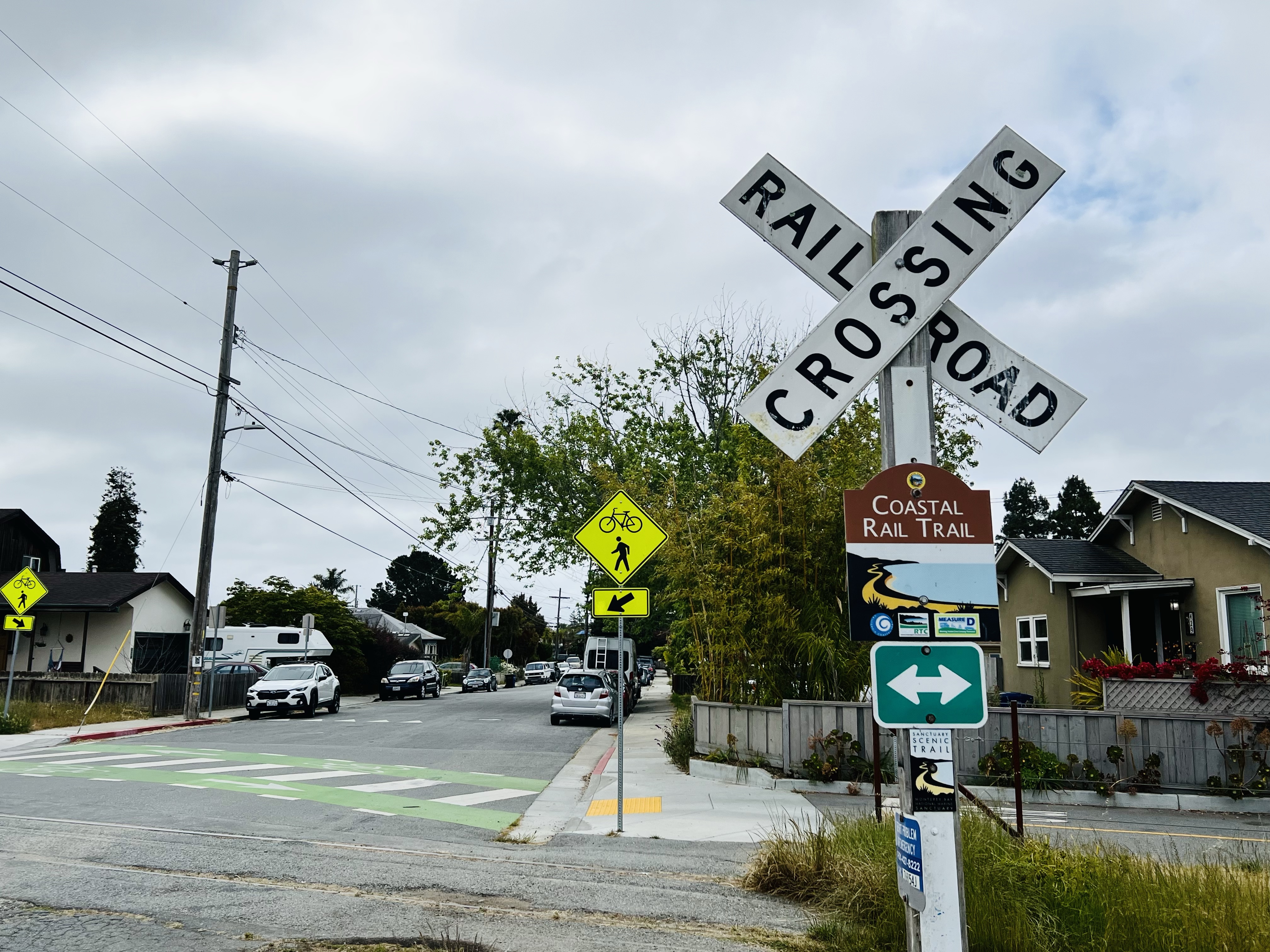
On the right of the spread I sketched the grade crossing sign at Dufour Street with Coastal Rail Trail sign below the crossbuck.

Image

Summit Fog Birding

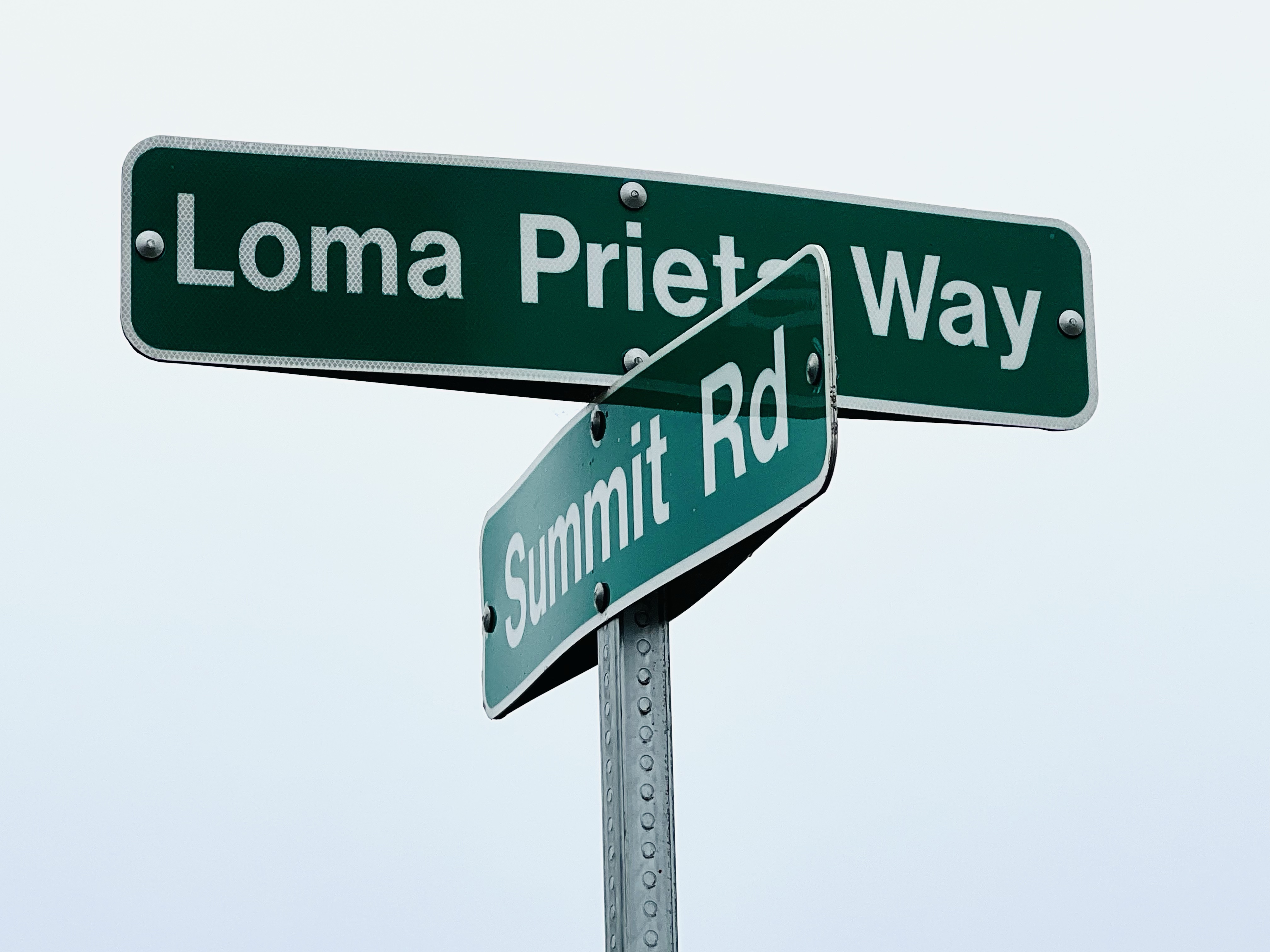
Early on a Saturday morning, Grasshopper and I headed up on winding Summit Road. Our birding destination the Bay Area birding hotspot: Loma Prieta and the “Saddles”.

About 10 miles in from Highway 17 the road devolves into a pock-marked rural ramble as it threads its way over the spine of the summit, defining the line between Santa Cruz and Santa Clara Counties. Near the junction with Loma Prieta Way the asphalt ends entirely and the graded dirt begins.

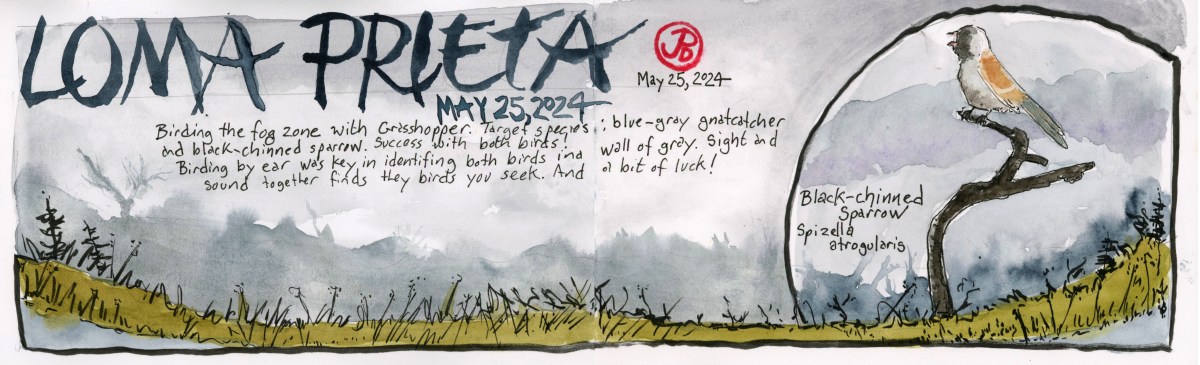
We parked in the dirt lot, light drizzle covering the windshield. This didn’t look like great birding weather. Wet, windy, with limited visibility. Would be able to pick out a blue-gray gnatcatcher or a black-chinned sparrow in these conditions? Both would be lifers for Grasshopper. And it was my goal to get him life birds number 321 and 322.

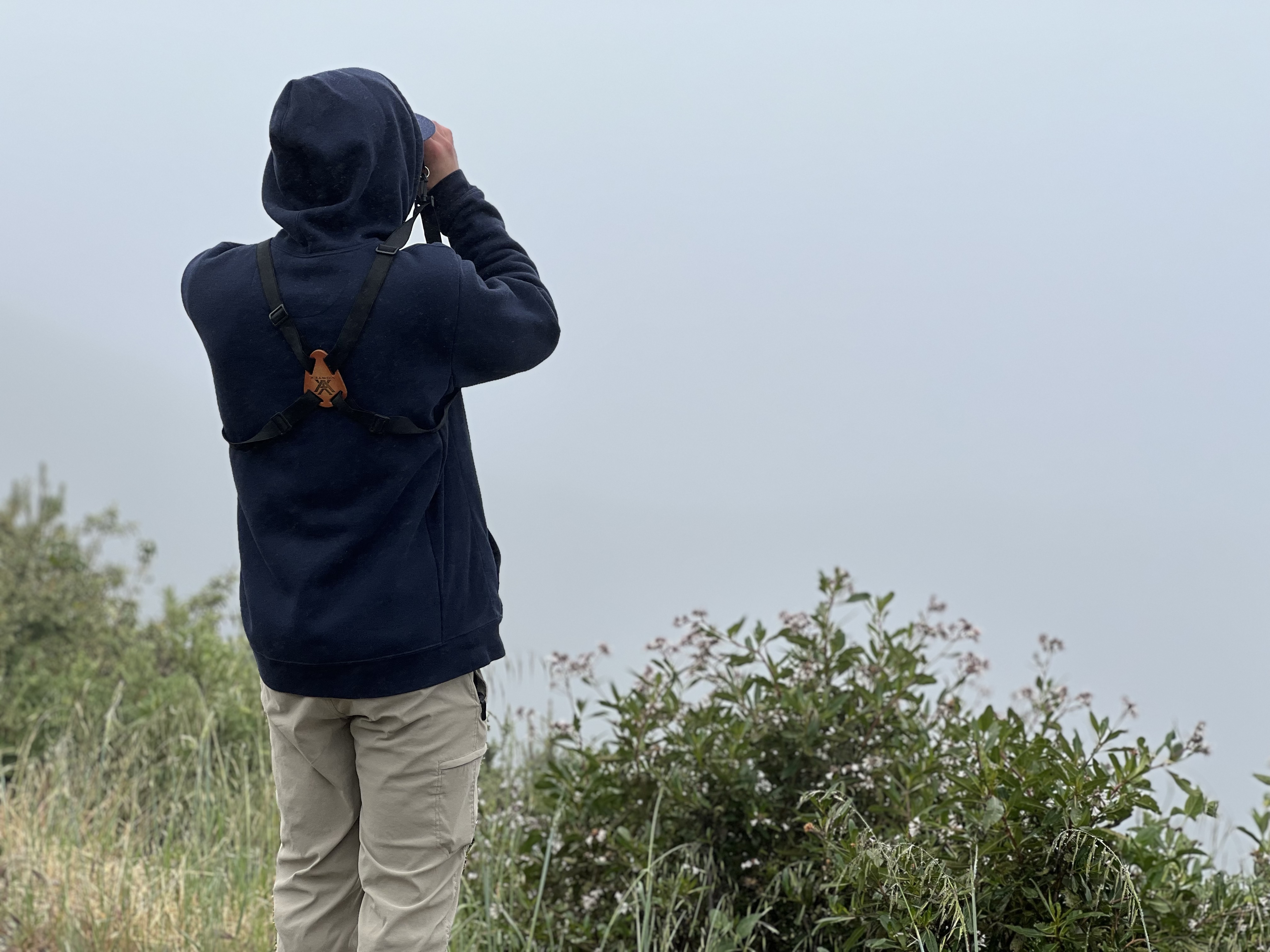
Grasshopper looking at water droplets.

We got out of the car, geared up, and surveyed the wall of grey to the west. I had a feeling we would be birding by ear, something Grasshopper can always get better at.

We headed down Loma Prieta Way stopping and listening as we went. Wrentits, spotted towhees, a far off California quail but none of our target birds, so we walked on. Luckily the damp, windy weather did not stop the birds from their spring songs.

After we were about a quarter of a mile down from the parking lot I heard something different, a cat-like mewing on the upslope. This was not the fooler Bewick’s wren (who had almost fooled me a few yards back) but one of our target birds!

Now we needed to get eyes on it. The younger eyes of Grasshopper found it out on a tree branch: blue-gray gnatcatcher!

After getting so-so looks of the energetic gnatcatcher, we headed a little further down and I first heard our second target bird far up the hill. An accelerated bouncing ball of a song.

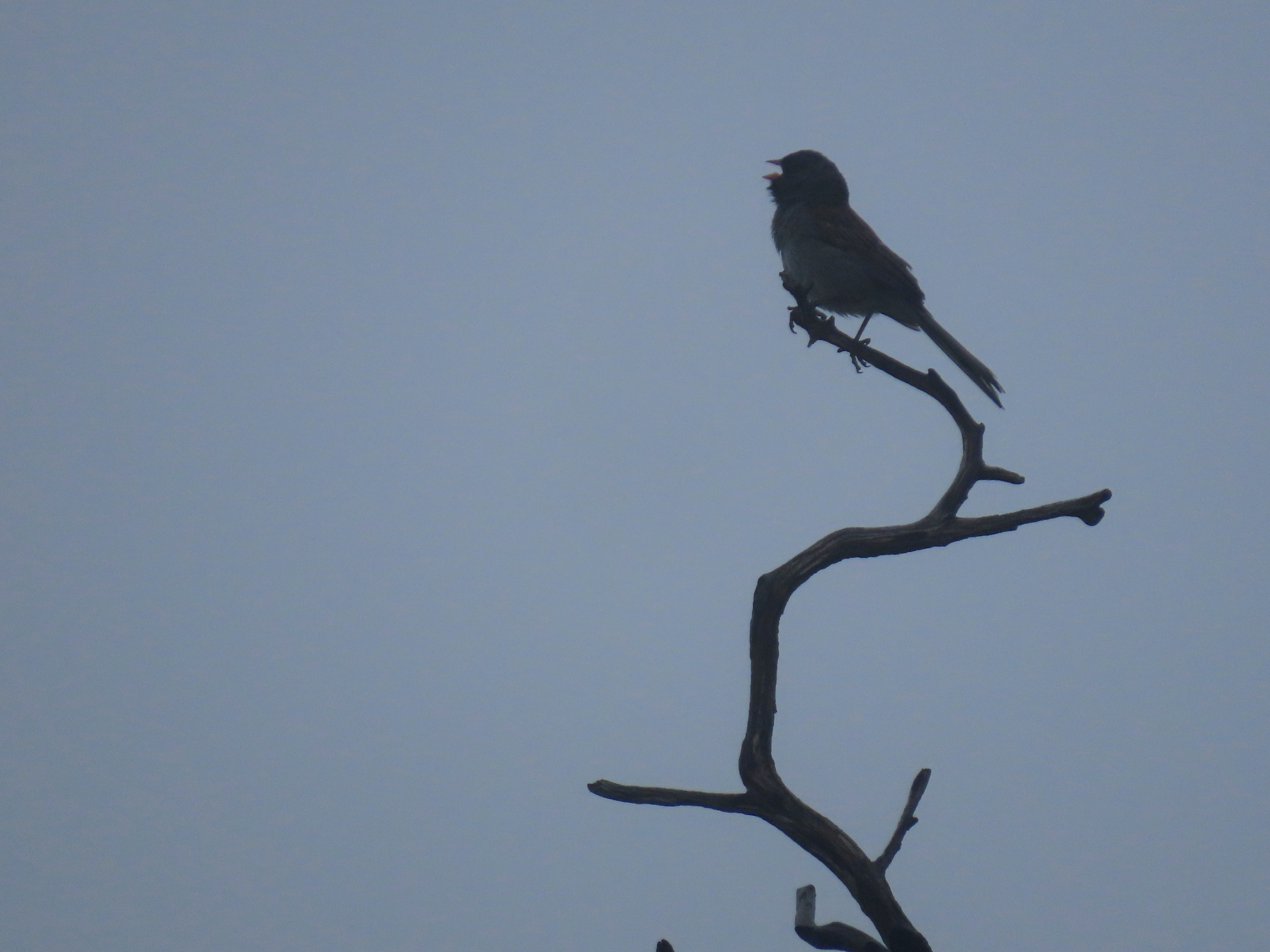
I willed the bird down by saying a little prayer to the Birding Gods and soon enough the sparrow flew over the road and landed downslope on a charred snag. Our binos swung up and we enjoyed prolonged views of a singing male black-chinned sparrow!

The foggy silhouette of one of our main targets: the black-chinned sparrow singing on a burnt snag. The black-chinned is an early adopter of burnt out areas.

Lifer number two for Grasshopper!

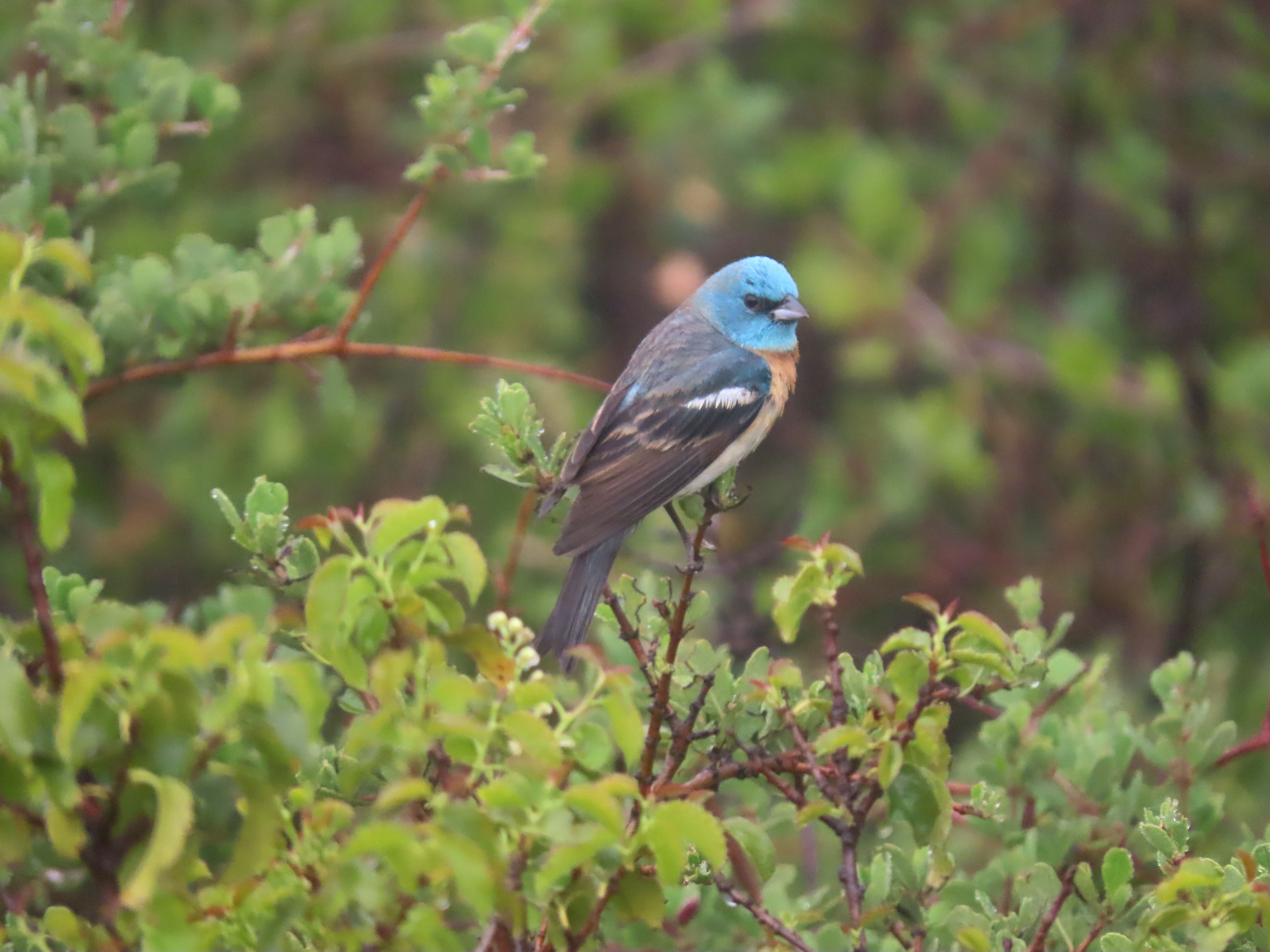
By this time we were coated with dizzily dampness and we headed back up to the parking lot. On the way up Grasshopper saw birds flying below the road. It was a pair of lazuli buntings! This is not a lifer for me or Grasshopper, but it has been a while since I have seen or heard this neotropic migrant.

A stunning male lazuli bunting. I never get tired of seeing and hearing this bird.

This is why birding remains a passion for me. I’m still excited to see and hear birds that I have seen many times before but the excitement remains.

And so it will always remain.

Image

First Flights Over Aptos

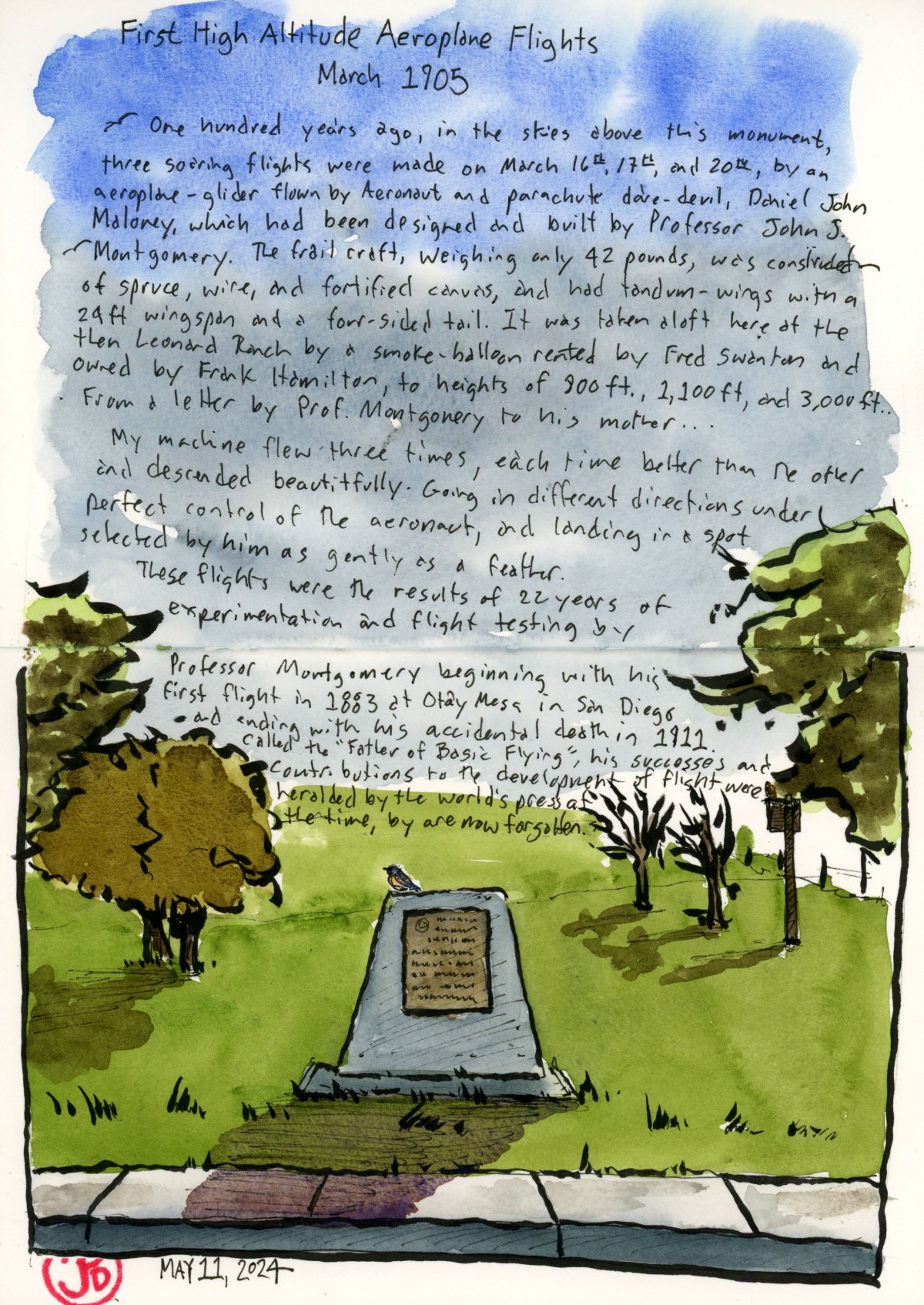
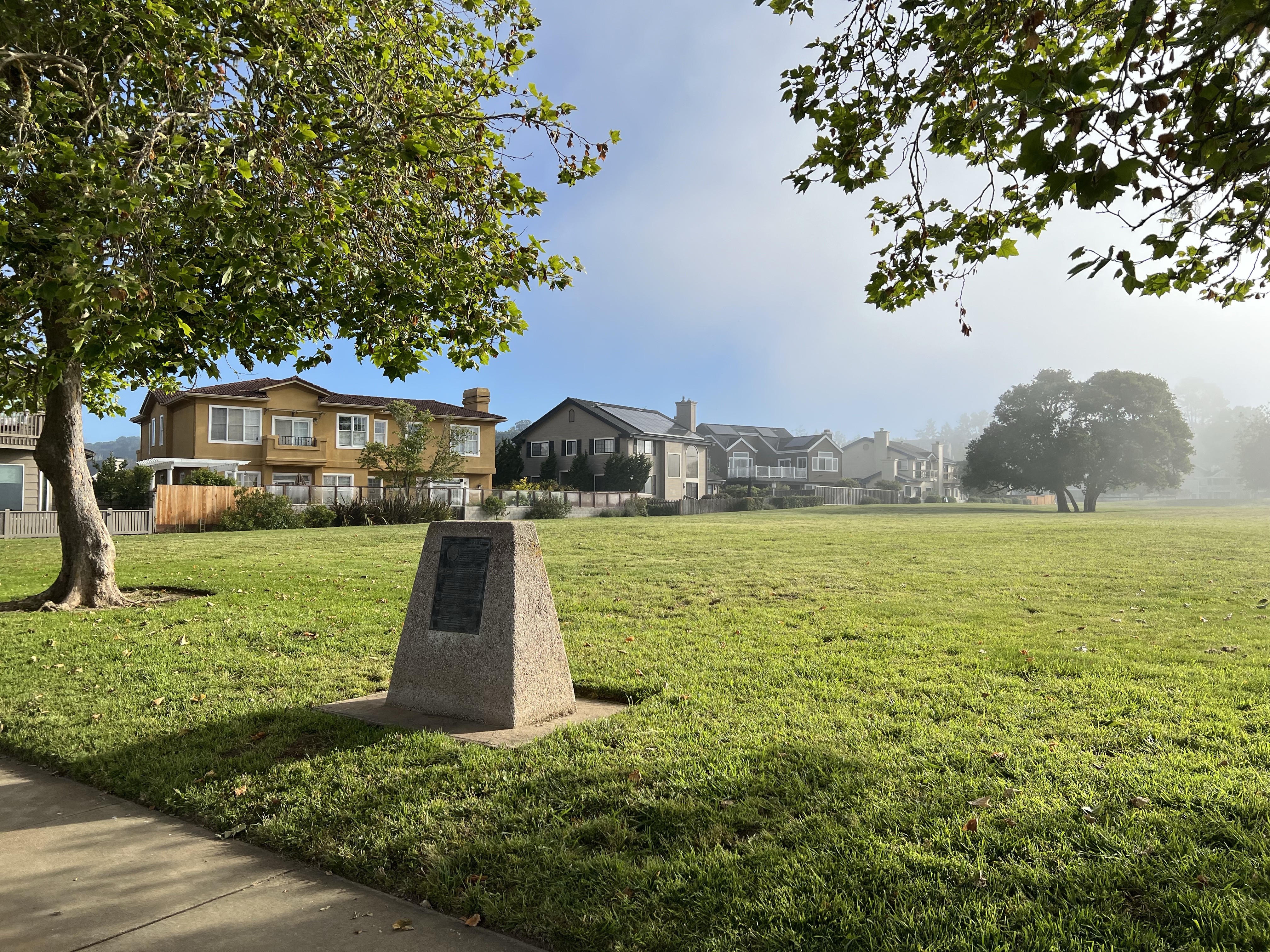
Down a cul-de-sac in a part of residential Aptos I have never explored before there is a monument to aviation at the edge of a green field.

This is what these hidden monuments are for, to reminds us of the anonymous people who have loved, lived, and lost who had come before us. The ones, on whose shoulders we stand, that have changed the world in ways we don’t understand or acknowledge.

The plaque on the monument reads:

One hundred years ago, in the skies above this monument, three soaring flights were made on March 16th, 17th, and 20th, by an aeroplane- glider flown by Aeronaut and parachute dare- devil, Daniel John Maloney, which had been designed and built by Professor John. J. Montgomery.

The frail craft, weighing only 42 pounds, was constructed of spruce, wire, and fortified canvas, and had tandem-wings with a 24 ft. wingspan and a four sided tail. It was taken aloft here at the then Leonard Ranch by a smoke-balloon rented by Fred Swanton and owned by Frank Hamilton, to heights of 800 ft., 1,100 ft., and 3,000 feet. The longest flight lasted over 18 minutes and covered over 2 miles…From a letter by Prof. Montgomery to his mother…

My machine flew three times, each time better than the other and descended beautifully. Going in different directions under perfect control of the aeronaut, and landing in a spot selected by him as gently as a feather.

These flights were the result of 22 years of experimentations and flight testing by Professor Montgomery, beginning with his first glider flight in 1883 at Otay Mesa in San Diego and ending with his accidental death in 1911. Called the “Father of Basic Flying”, his successes and contributions to the development of flight were heralded by the world’s press at the time, but are now largely forgotten.

The plaque was erected in 2005 by E Clampus Vitus El Viceroy Marques de Branciforte Chapter 1797, E Clampus Vitus Capitulus Redivivus Yerba Buena #1, Hiller Aviation Museum San Carlos Ca,. Aptos Chamber of Commerce and Museum Capitola/Aptos Rotary.

Now the monument serves as a perch for western bluebirds and the green field is used by a murder of crows for foraging. Off to the right is an owl box that a pair of red-shouldered hawks use as a hunting perch.

119 years ago, a frail, 42 pound glider soared above this field. Now it has been returned to the true masters of flight: the gulls, corvids, and hawks that effortlessly glide above.

But if you look further above you will see the great grand children of Montgomery’s passions: the modern passenger jet on final approach to SFO and SJO.

Image

Where the Rails End

Today the only way to get from Los Gatos to Santa Cruz is to drive over Highway 17. You can no longer take a passenger train. The last train ran in 1940.

On the other side of the Santa Cruz Mountains, you can board a train at the Santa Cruz Beach and Boardwalk and it will take you 6.8 miles north into the mountains to the town of Felton.

Detraining here you follow the line past the train shed and machine shop of the Roaring Camp and Big Trees Railroad and the old passenger and freight depot and then you cross Graham Hill Road and walk north on the rails toward Zayante, using the rusty rails as a guide.

The line begins to parallel Zayante Creek. The road builders used the watersheds of the Santa Cruz Mountains as a route to work up and down the summit. A good part of the Santa Cruz to Felton route parallels Santa Cruz County’s largest river, the San Lorenzo.

After a few miles you eventually come to a siding, this is the former stop of Eccles near Olympia Station Road. This was a flag stop as far back as 1901. There was once a passenger shelter (1913) and a freight platform.

The main line and siding at Eccles. The 310 foot siding was probably used to store lumber cars.

The station sign remained in place until 1942, when the station was decommissioned following the abandonment of the the railroad.

After World War II, passenger service was not resumed and the station shelter was torn down. The Eccles sign was saved and was on display at the Santa Cruz Museum of Art and History in downtown Santa Cruz.

Here’s where the Eccles station sign used to be at the Santa Cruz Museum of Art and History. It’s gone, like the rails that once reached over the Santa Cruz Mountains.

One a recent visit to the museum the sign was no longer on display.

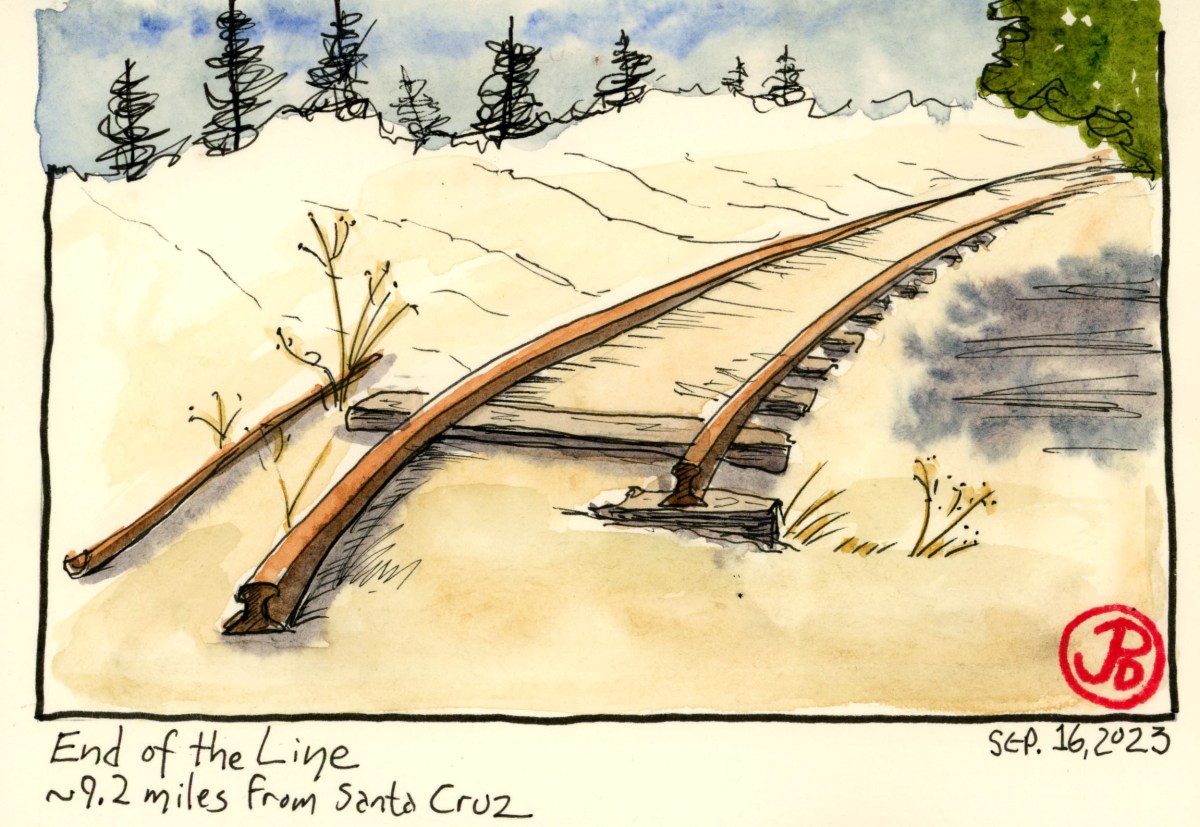
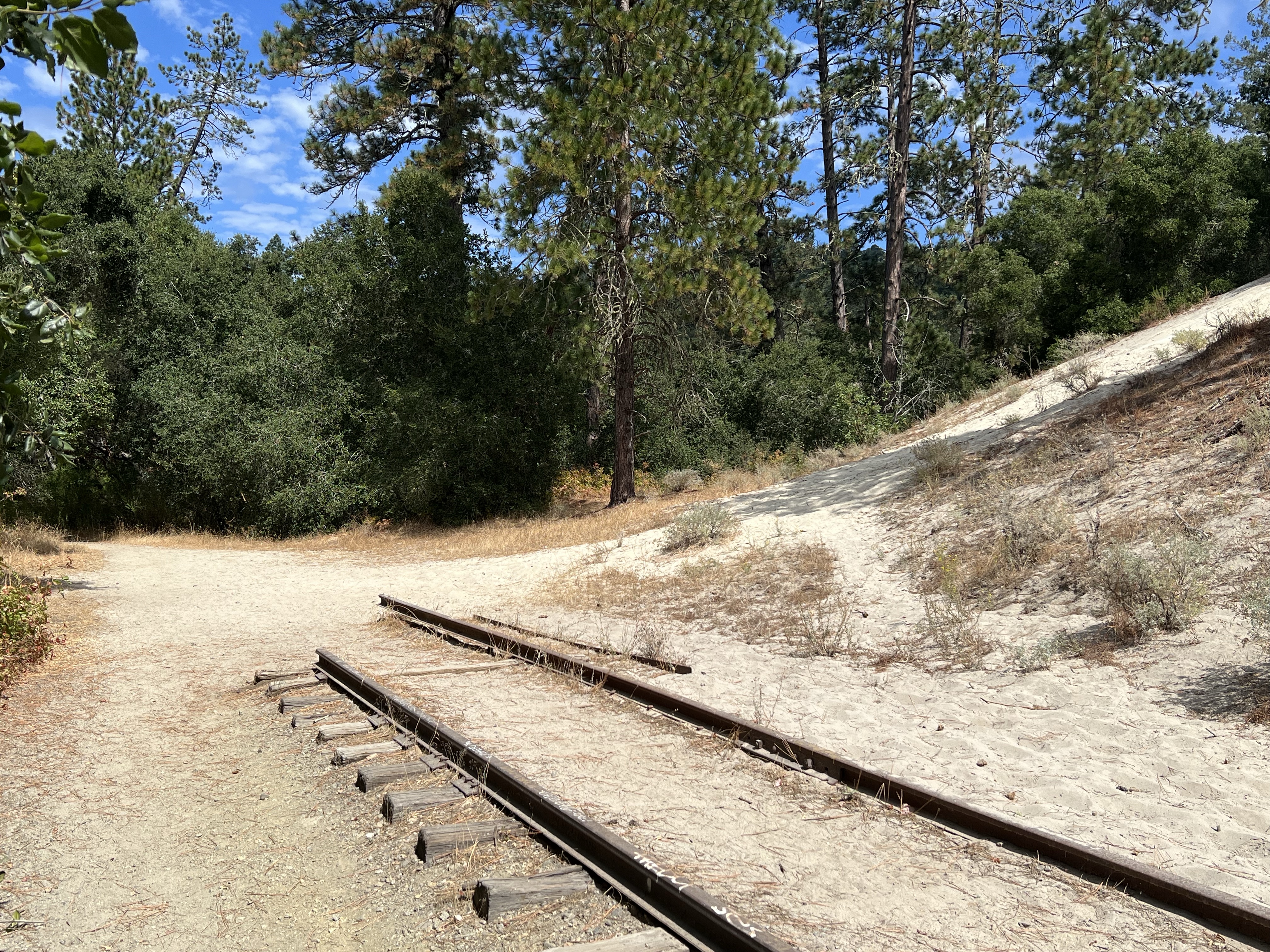
I continued north as the siding rejoined the mainline. And after about a five minute walk, the tracks end without much ceremony. There is no bumper stop to mark the end. And one tail is longer than it’s mate, 4 feet and 8 1/2 inches away.

This is the end of the line and as far north as the tracks go.

The end of the tracks and the end of an era.

Image

Tunnel No. 8

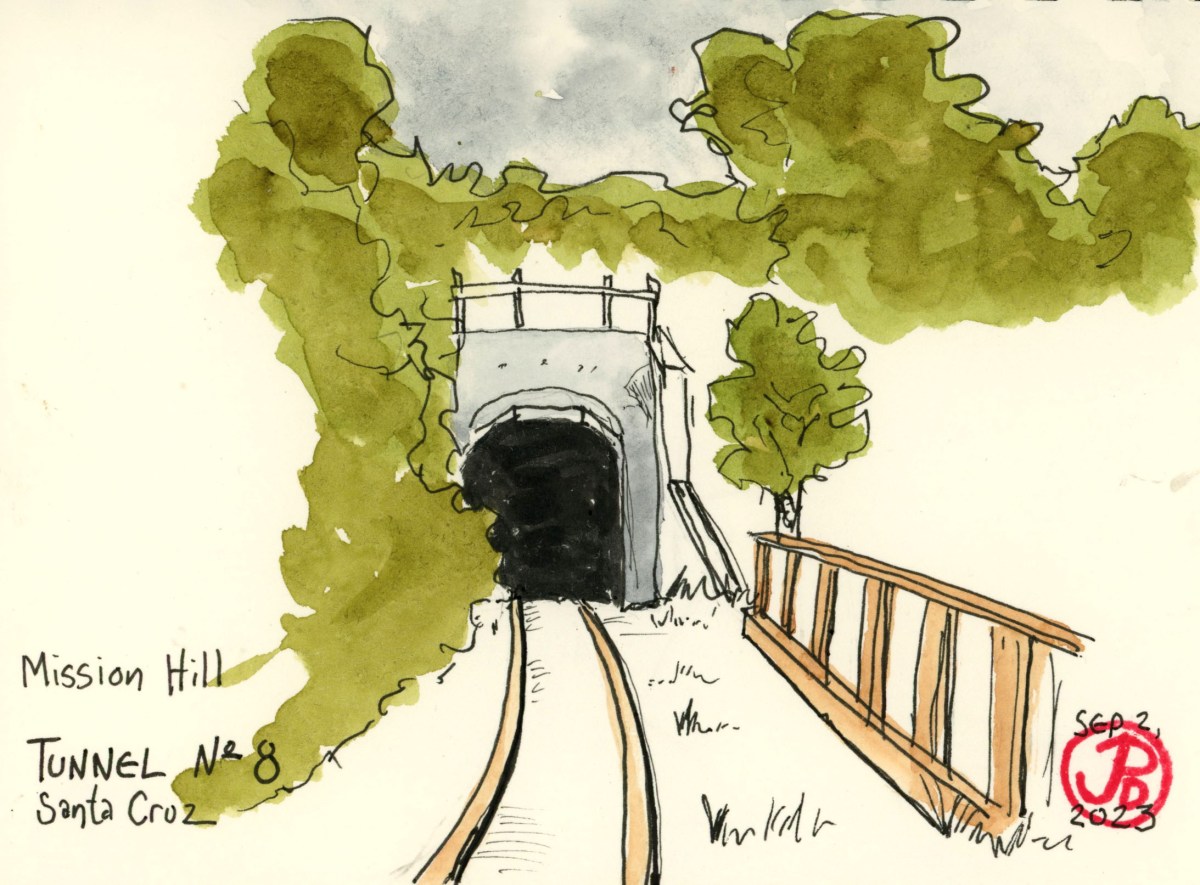
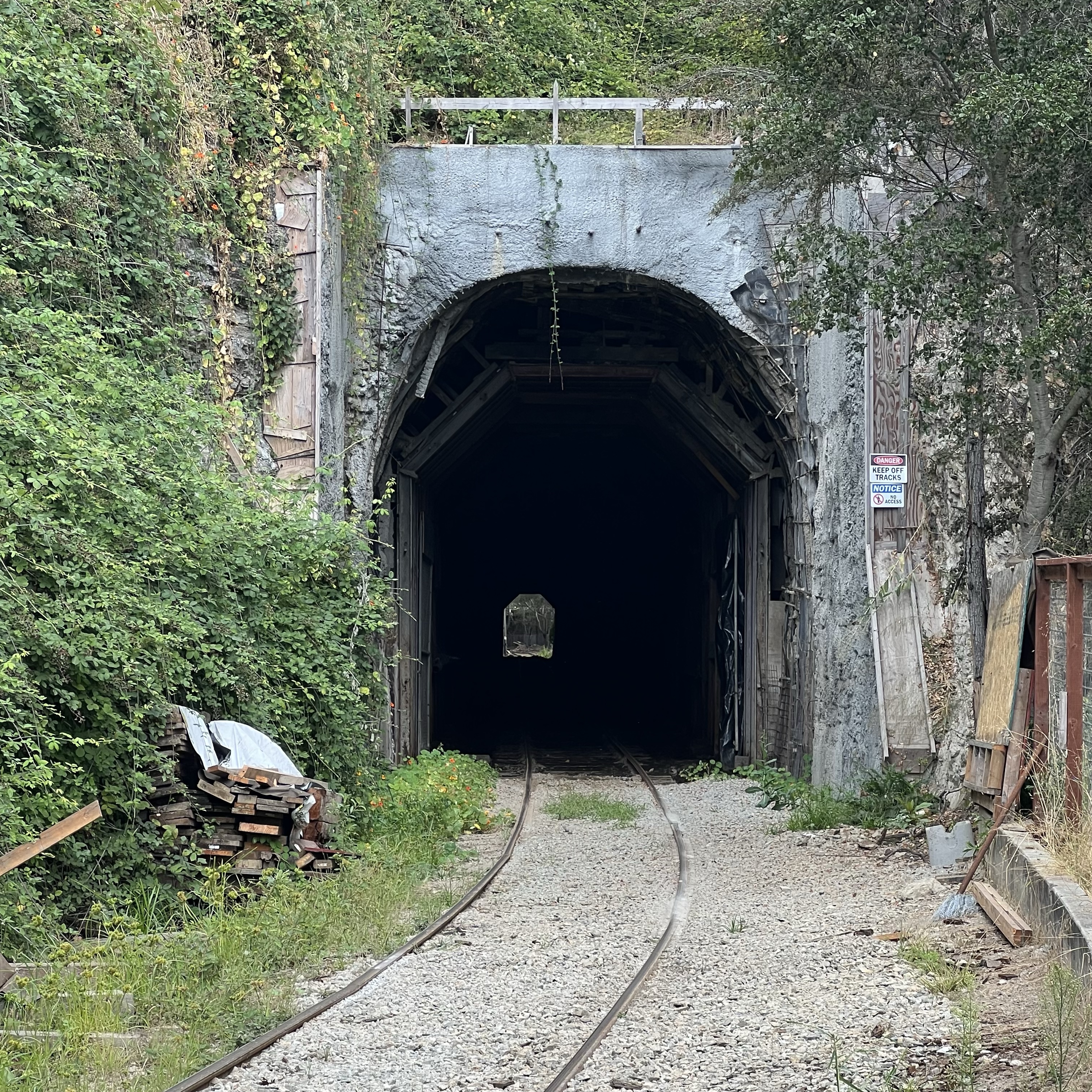
Of all the tunnels on the former South Pacific Coast Railroad there is only one that is still in use for it’s intended purpose. That is Tunnel No. 8, the Mission Hill Tunnel.

This tunnel takes the line through Mission Hill because the town of Santa Cruz did not want the railroad to run through downtown. So they had to bore through the sandstone of Mission Hill. This meant the tunnel was prone to caving in so it was reinforced with internal redwood beams.

The tunnel is built under the Mission Santa Cruz Cemetery and in the early days, steam locomotives passing though would rattle and shake up the earth and occasionally a bone or two would fall onto the line leaving a macabre find for rail crews.

In 1985 the Southern Pacific line was purchased by Norman Clark, owner of the Roaring Camp & Big Trees Narrow Gauge Railroad, and passenger service was revived from Felton to Santa Cruz, a round trip of 16 miles.

The Big Trees & Pacific coming off of Chestnut Street in Santa Cruz on it’s return to Felton. The railroad has some of the most street running rail of any tourist railway. The train is pulling into the right of way heading towards Tunnel No. 8.
The train disappearing into Tunnel No. 8 on its way to Felton.
Image

Shady Gulch Trestle

Just up the creek from my cabin is one of the remaining wooden trestles on the former South Pacific Coast Railroad (in 1887 the railroad became Southern Pacific). This is the Shady Gulch Trestle.

Not only does this trestle still exist but is still used for rail service on the Big Trees and Pacific Railway.

Shady Gulch Trestle with the Highway 9 concrete bridge (1930) in the foreground. The dirt road to the right is the former Eben Bennett toll road. The concrete highway bridge replaced the toll road.

The original trestle was built in 1875 to span Shady Gulch. At the time, the line was built for the narrow gauge South Pacific Coast Railroad. When Southern Pacific acquired the line they rebuilt the trestle in 1905 to accommodate standard gauge.

The trestle of today very much looks like the original narrow gauge trestle of the late 19th century, sans graffiti of course.

The afternoon Felton-bound Big Trees and Pacific crossing the Shady Gulch Trestle. This tourist train tends to stop traffic on Highway 9.

My father spend his childhood summers in the cabin in the 1930, 40s, and 50s. He would tell me of the time a freight would be climbing the grade on the trestle on their way to Felton on a foggy summer’s morning. The wet track would cause the locomotive’s driving wheels to slip. And after many slips and the hyperbolic “chuff-chuff-chuff” of the stream exhaust, the train would back down the grade, sanding the track as they reversed. The freight would make another attempt, this time slowly with the sanded rails helping the drivers grip the steel. And off they went to Felton.

There is a single one car pull off on the north side of the highway bridge. I made three attempts to sketch the trestle but was foiled by a camper van that was camped out in the spot.

Was this guy going to spend the night here? On my third attempt of the day, in late afternoon, the van was finally gone and I was able to park, set up my sketching chair, and start my sketch of the trestle.

I timed my sketching time with the Felton bound afternoon Big Trees and Pacific train.