Image

HWY 40, Donner Pass

Early on a Monday morning I drove to Historic Highway 40, around Donner Summit, to do some sketching.

I love this highway corridor, it’s full of deep California history (native, pioneer, railroad, and highway) as well as personal family history. My parents met at the South Bay Ski Club whose cabin is on Highway 40 near Soda Springs. Without this ski club I would not have come into being.

Historic indeed, there is so much depth of history here.

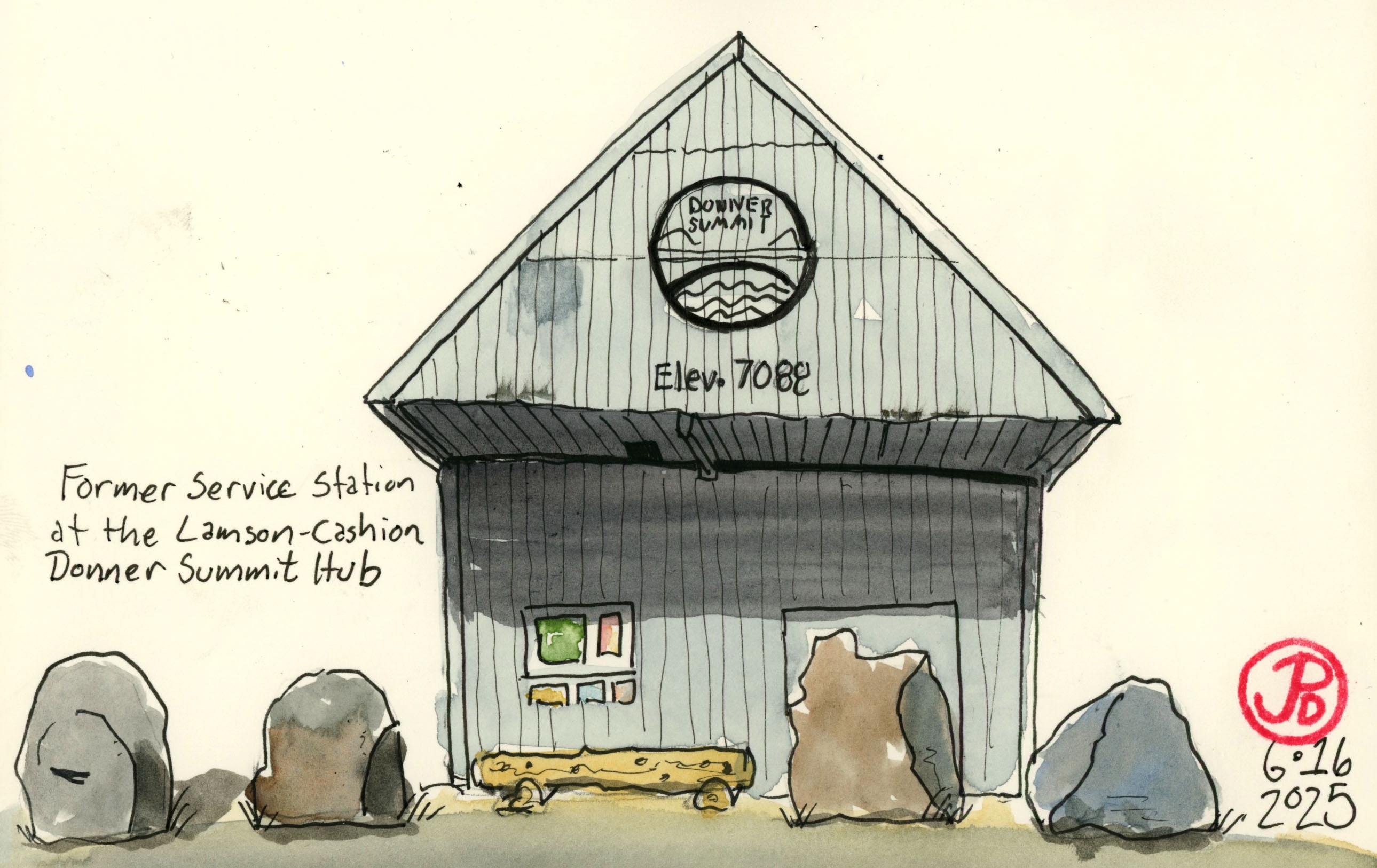
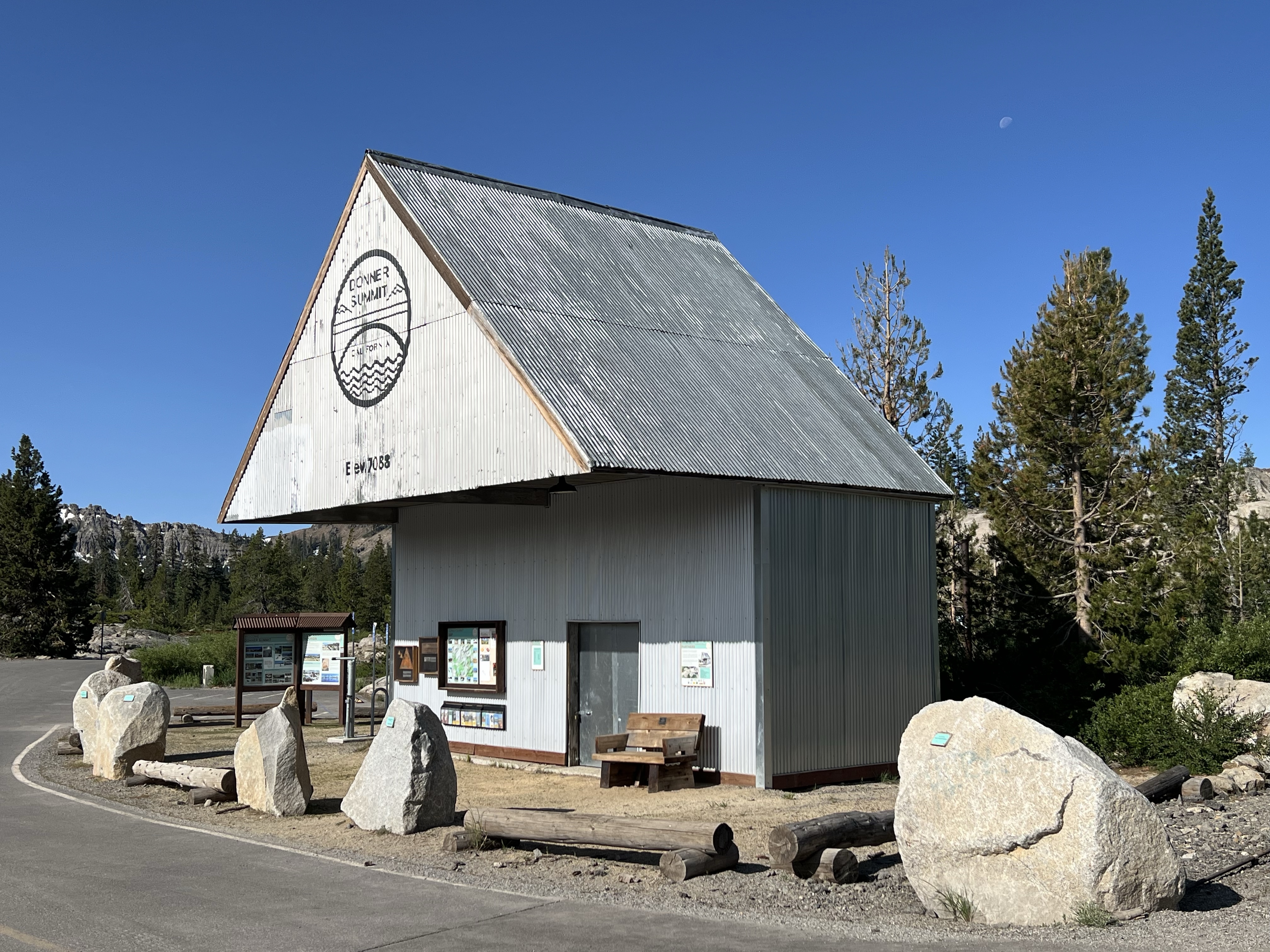
At the summit I sketched a former gas station. The station was used to fuel highway snow clearing equipment used to keep the highway open in the winter.

The Lamson Cashion Donner Summit Hub is where a lot of the threads of Donner Pass come together (hence the name). Just a short list of the points of interest in this general area are: the petroglyphs, Pacific Crest Trail, the Donner Summit Bridge (the Rainbow Bridge), west entrance of Summit Tunnel 6, central shaft of Tunnel 6, and the Donner Summit Trail.

The repurposed gas station is now an information center at the Lamson Cashion Donner Summit Hub.

I then headed down the pass and over the famed “Rainbow Bridge”. I was keeping my eyes (at least one eye) to my left, searching for the mass of rusted metal that has been here for about 75 years. There it was.

My father always pointed out this ominous artifact when we would summer here on the shores of Donner Lake. We were historic rubberneckers.

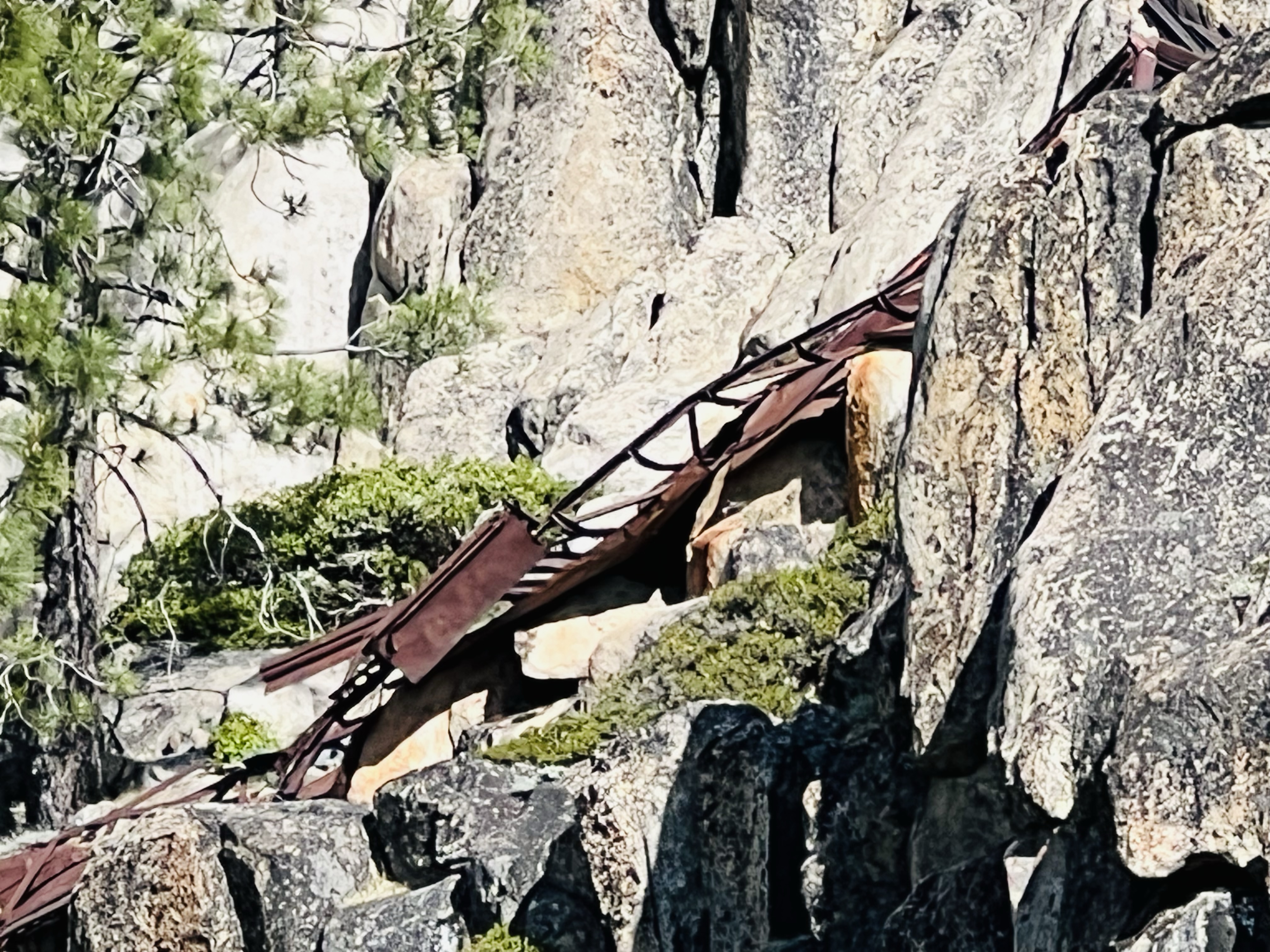
There it is, rusted and compacted by heavy snow loads for almost 75 years.

Highway 40, east of Donner Summit is treacherous, as the Donner Party found out when they attempted to scale the pass in 1846. It is also treacherous for auto traffic on the winding, wet, and icy roadbed while heading down grade.

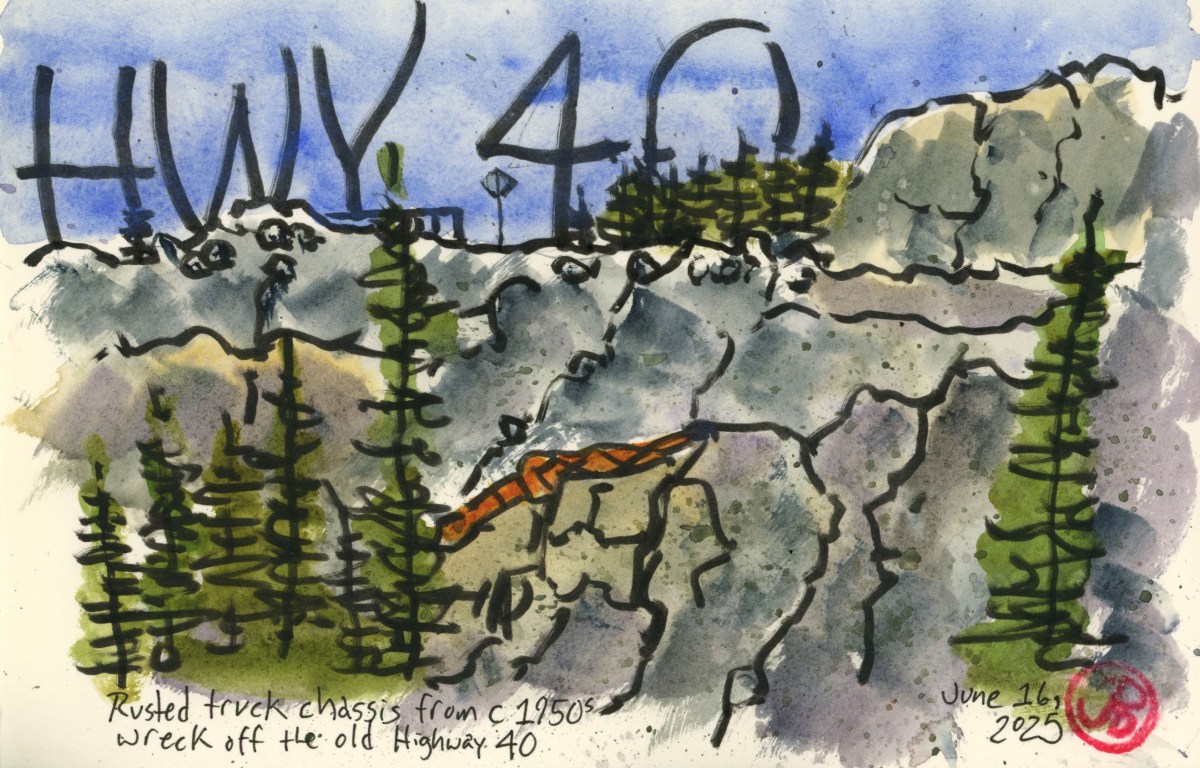
The wreck that my father pointed out is the truck chassis that went over the roadway and settled on a granite shelf sometime in the 1950s. There is not a lot of information about the truck, just that it’s not the “Turkey Truck”. That’s a story for a different post!

I pulled over and found a boulder seat to sketch from using a brush pen to keep it loose and sketchy to the soundtrack of the cooling winds through the pine branches and a male Wilson’s warbler emphatically singing from those branches. I was in Sierra heaven (featured sketch).

After sketching I headed down 40 towards Donner Lake and the Southern Pacific Railroad historic town of Truckee.

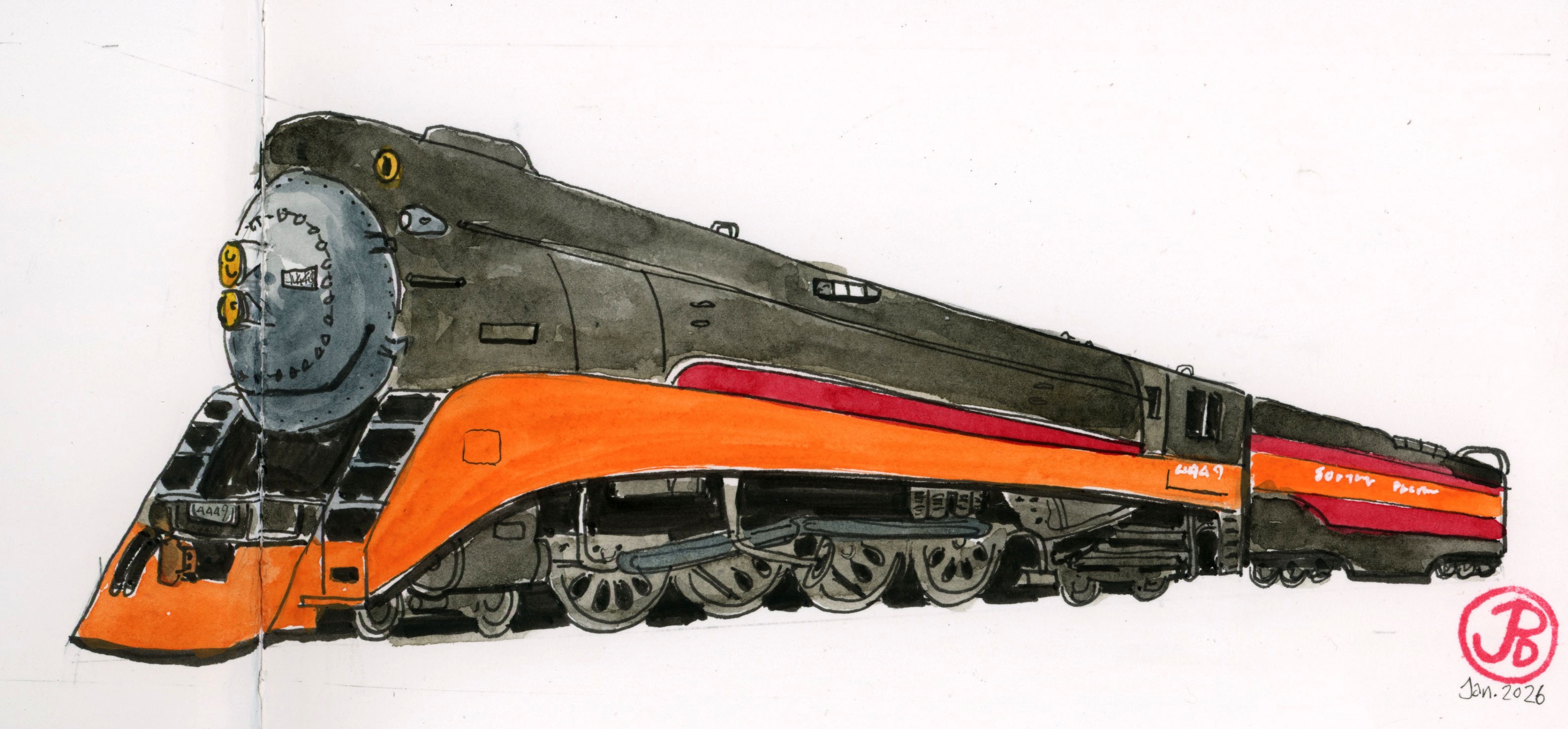
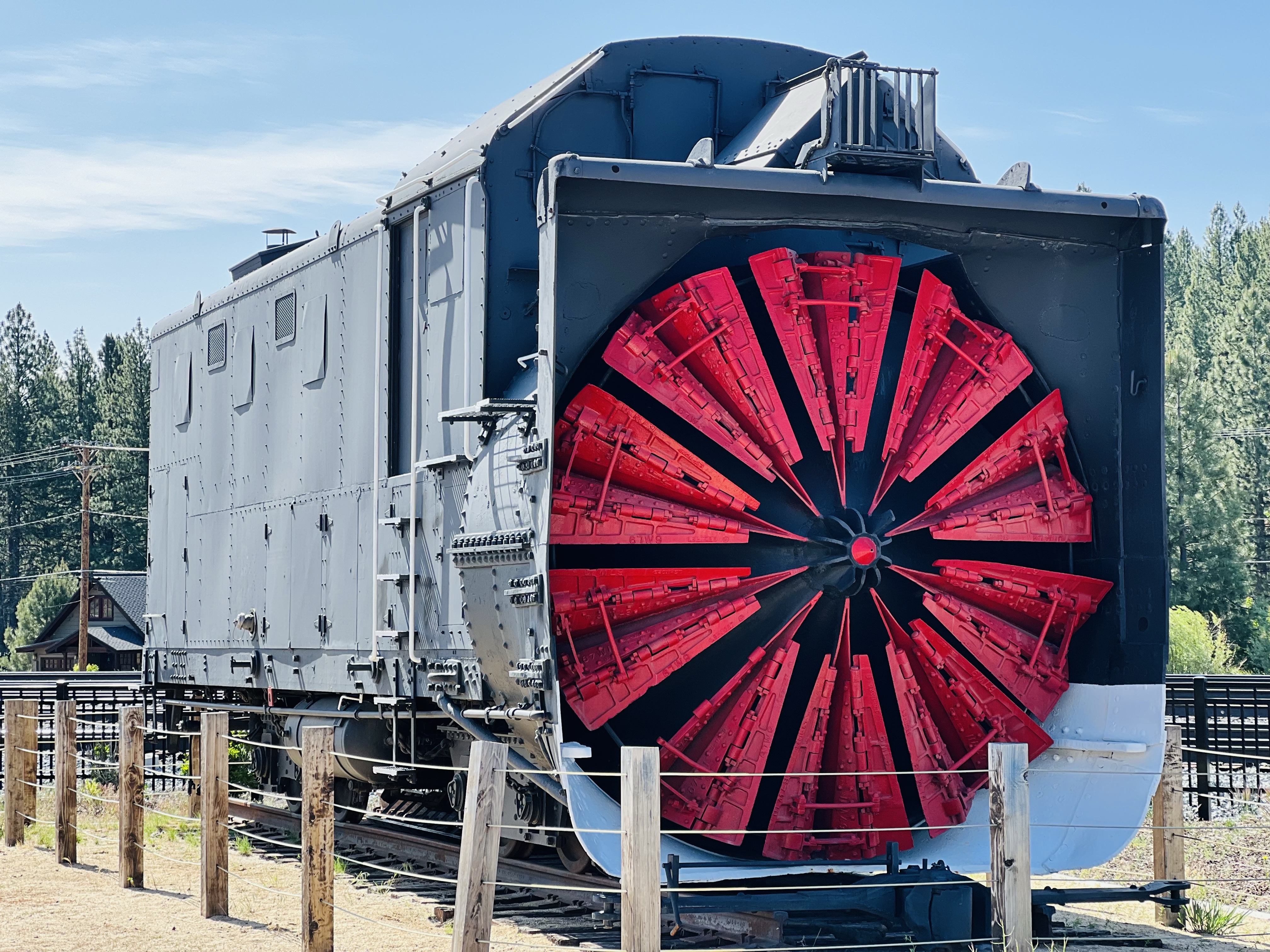
Aside from SP’s iconic cab forward locomotives, no other piece of railroad equipment is as renowned as the rotary snowplow for conquering the grades and gales of Donner Summit.

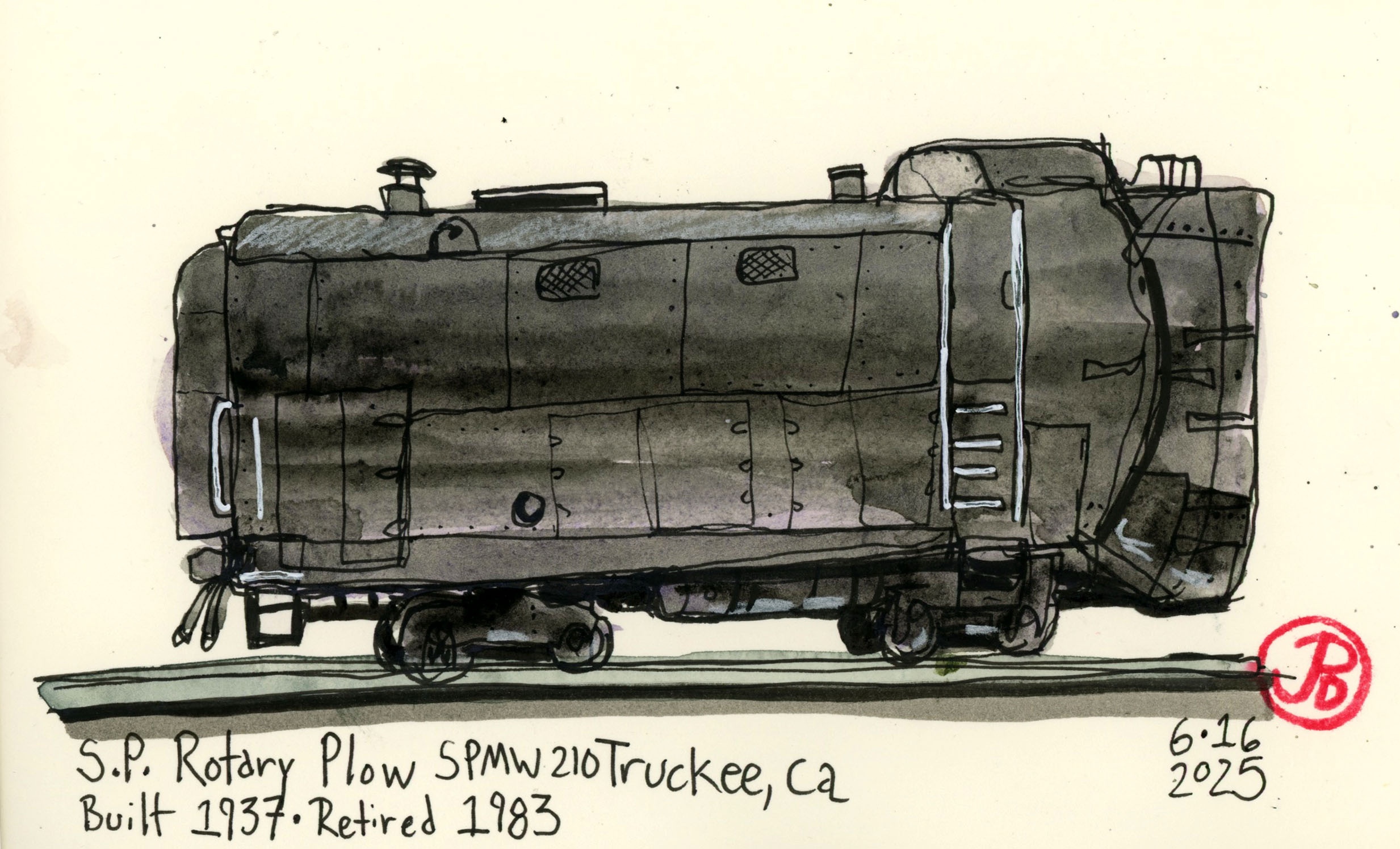
The rotary plow kept the line open in the deepest winters. And the California State Railroad Museum donated Southern Pacific’s SPMW 210. This historic piece of rail equipment now is on static display alongside the tracks it once kept open in the winter time.

This monster could cut through heavy snow. I usually sketch these plows head on but I decided on a different perspective.

While I have sketched these plows many times before, I decided to try from a different angle with a broken continuous-line sketch.

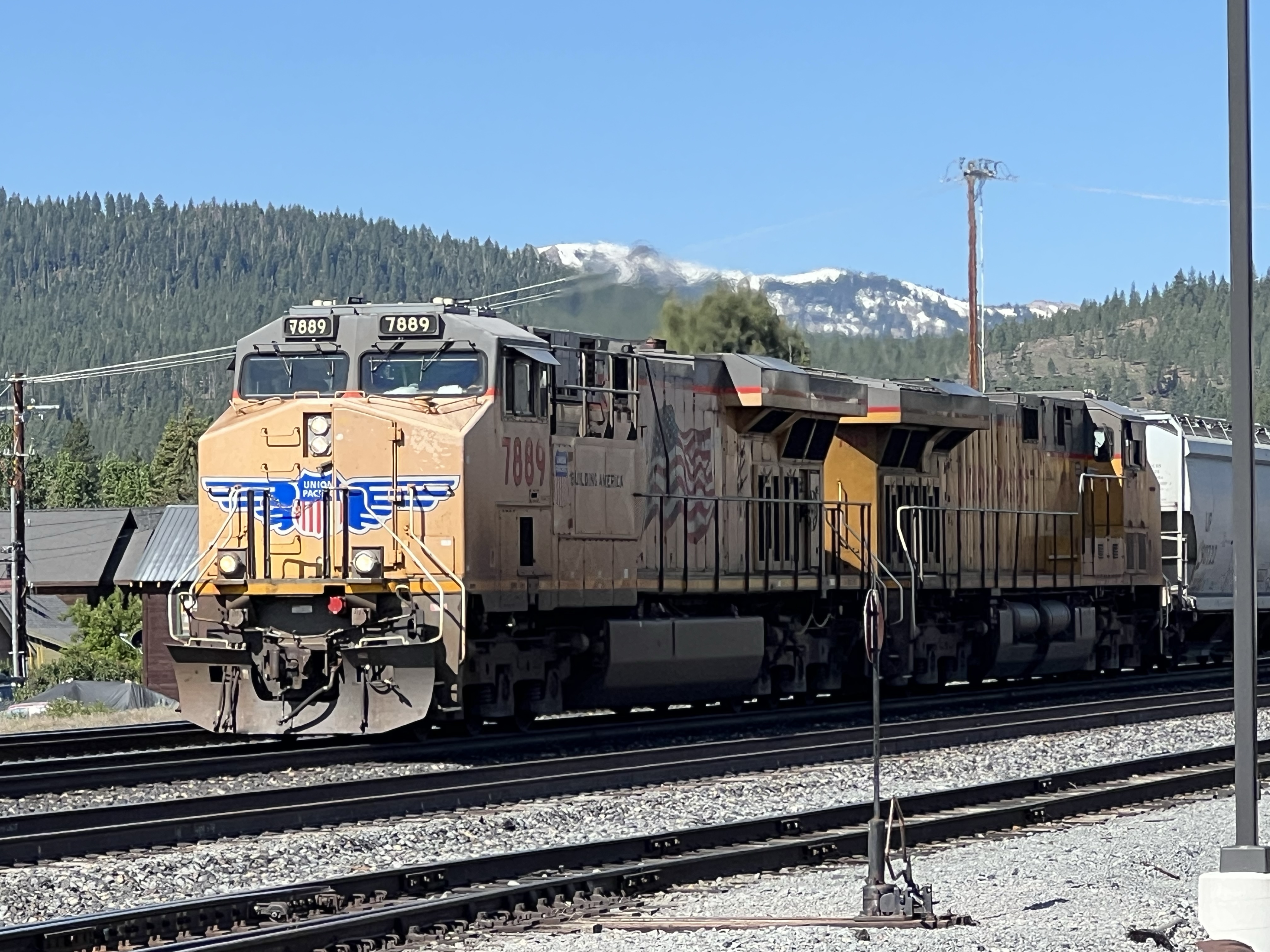
A reminder, courtesy of Union Pacific, that Truckee still remains a rail town. The eastbound freight was an empty covered hopper consist. How do I know it’s empty? Motive power. Only two locomotives on point and one at the end. If the consist was fully loaded, they would need more motive power to travel over Donner Summit.
Image

Embarcadero Sunday Sketching

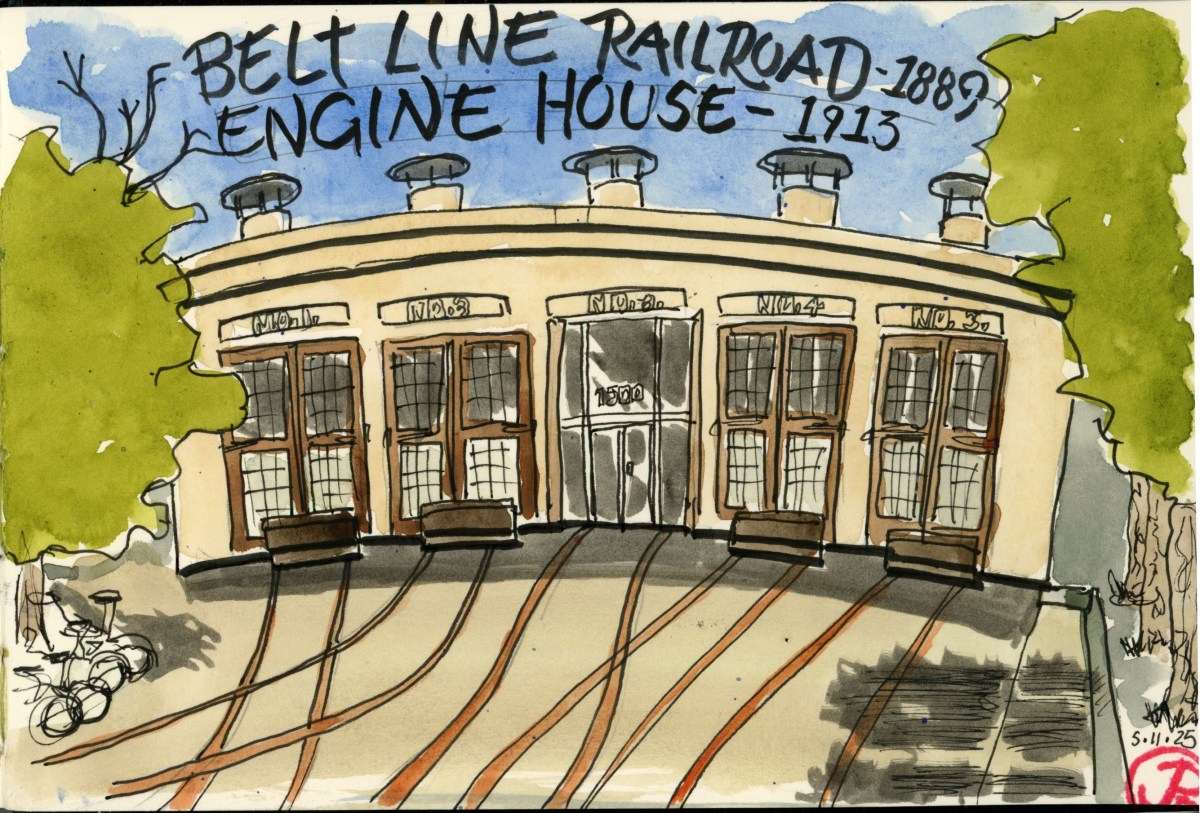
On Sunday I took the N Judah to Embarcadero Station with the intention of sketching a little San Francisco rail history. My main sketching target was the Belt Line Railroad Engine House or Roundhouse at Embarcadero and Sansome.

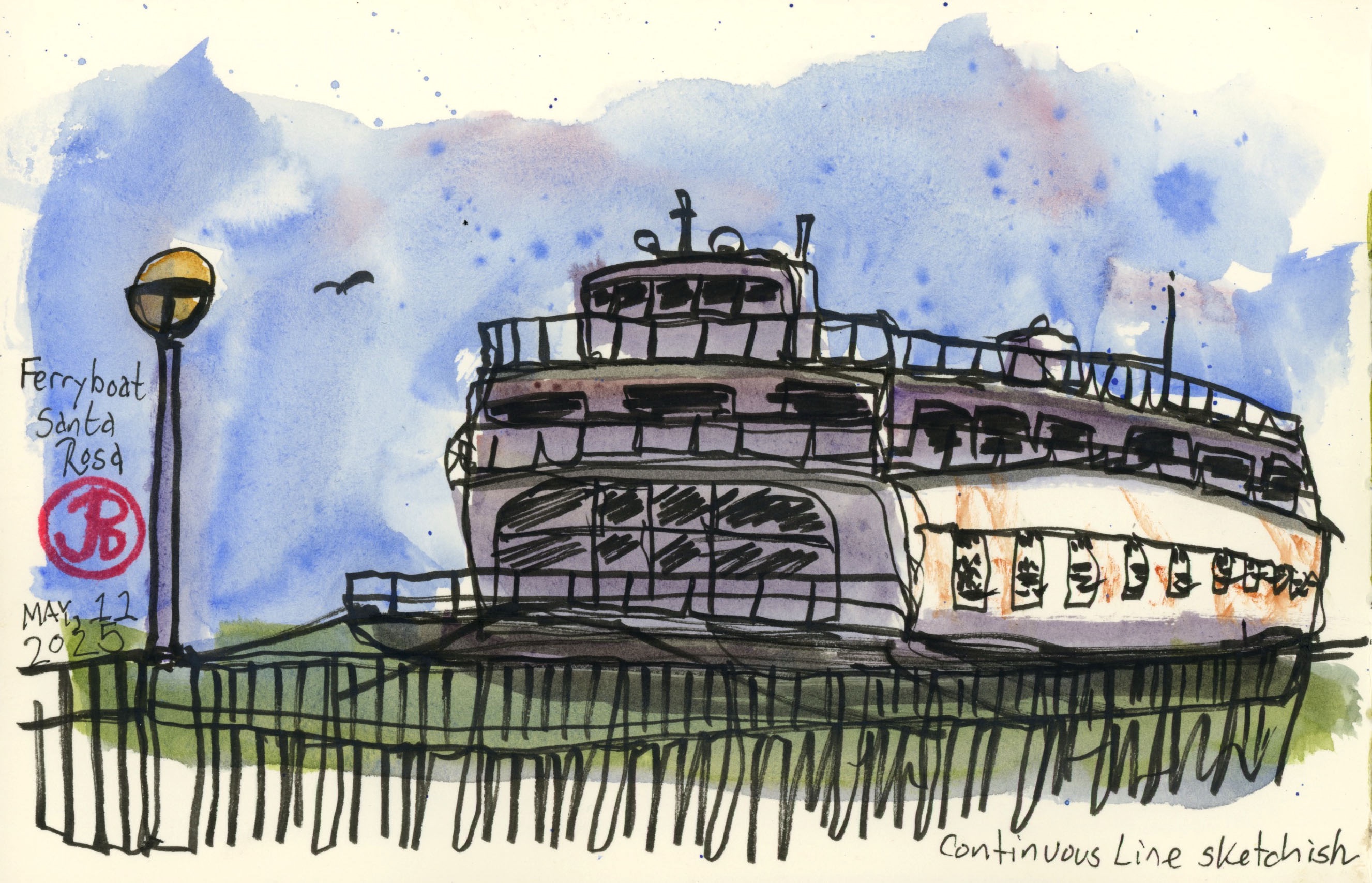
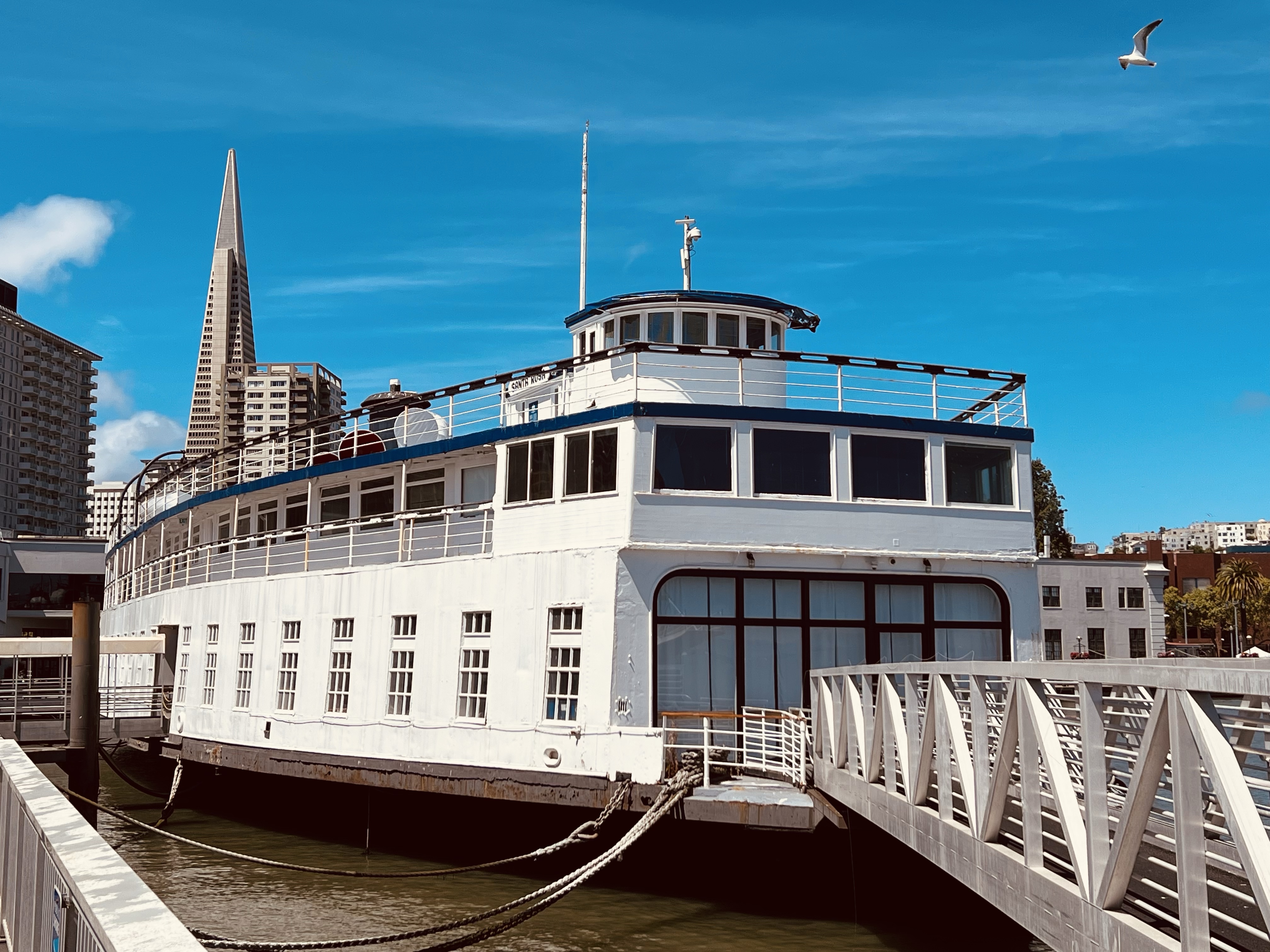
On the walk from the Ferry Building I came upon the 1927 ferry Santa Rosa at Pier 3 and I thought I would head back after my roundhouse sketch to add this piece of rail and nautical history to my spread.

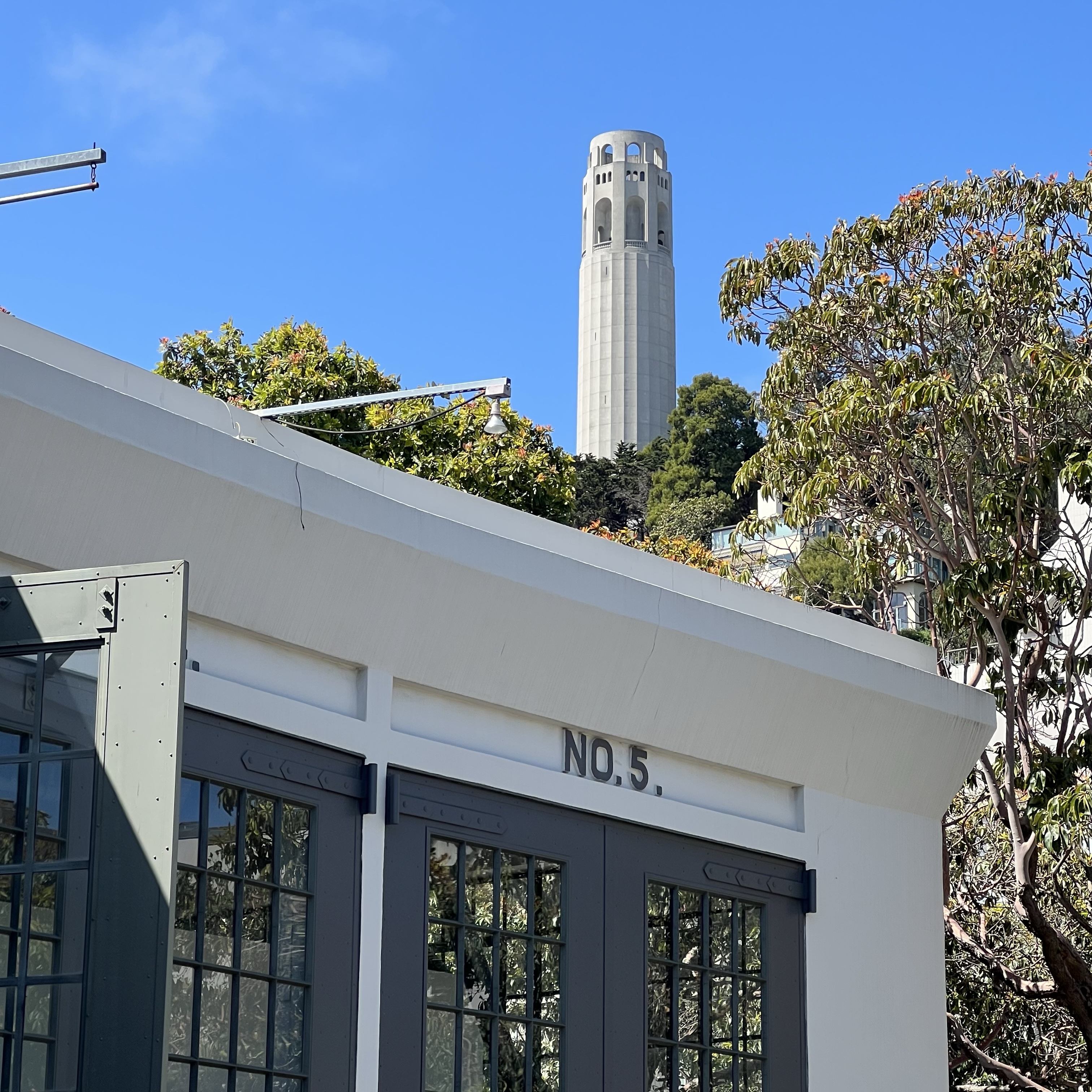
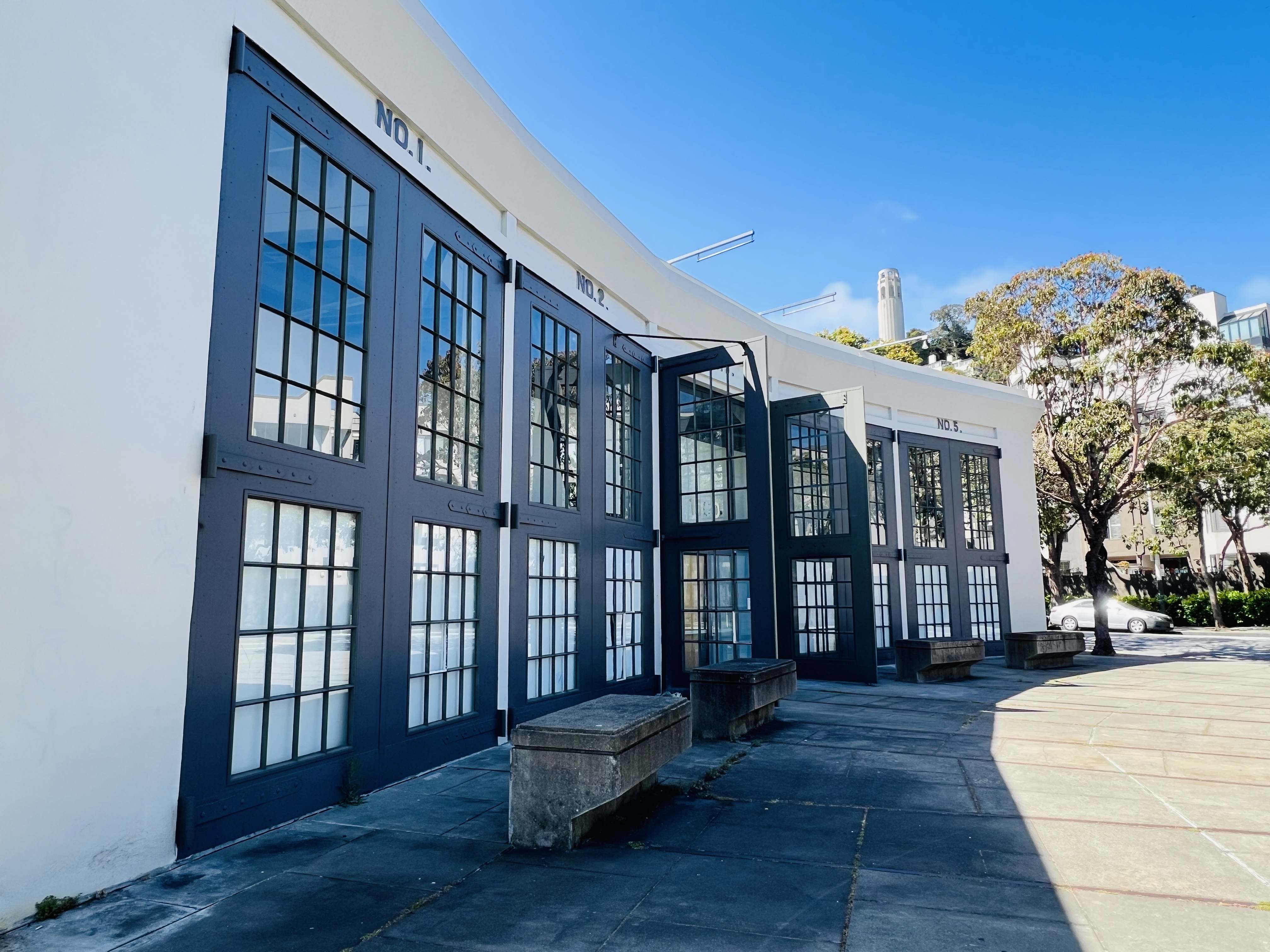
Bay No. 5 with Coit Tower in the background.

The Belt Line Railroad was founded in 1889. The railroad connected the Port of San Francisco with many of the piers and warehouses. The railroad shipped freight cars from the ferry freight terminal (at Pier 43) for railroads such as the Western Pacific, Northwestern Pacific, and the Aitchison, Topeka, & Santa Fe Railway. It also had connections with Southern Pacific on the southern portion of its line. The railroad also served Ft. Mason, the Presidio, and Chrissy Field through the Ft. Mason tunnel.

At its height, the railroad had 67 miles of track. The Belt Line operated 12 steam locomotives and six diesels.

Over time, the Port of San Francisco was eclipsed by the Port of Oakland and shipping traffic slowed. The railroad eventually folded in 1993.

Before me was the reinforced concrete Belt Railroad Engine House or Roundhouse. It was built in 1913 and is now designated as City and County of San Francisco Landmark #114.

The house contains five bays with five tracks snaking out of each bay. The tracks disappear under paving at the intersection of Chestnut and Embarcadero. It was nice to see that some of the the rails were still in place although the engine house now houses another business.

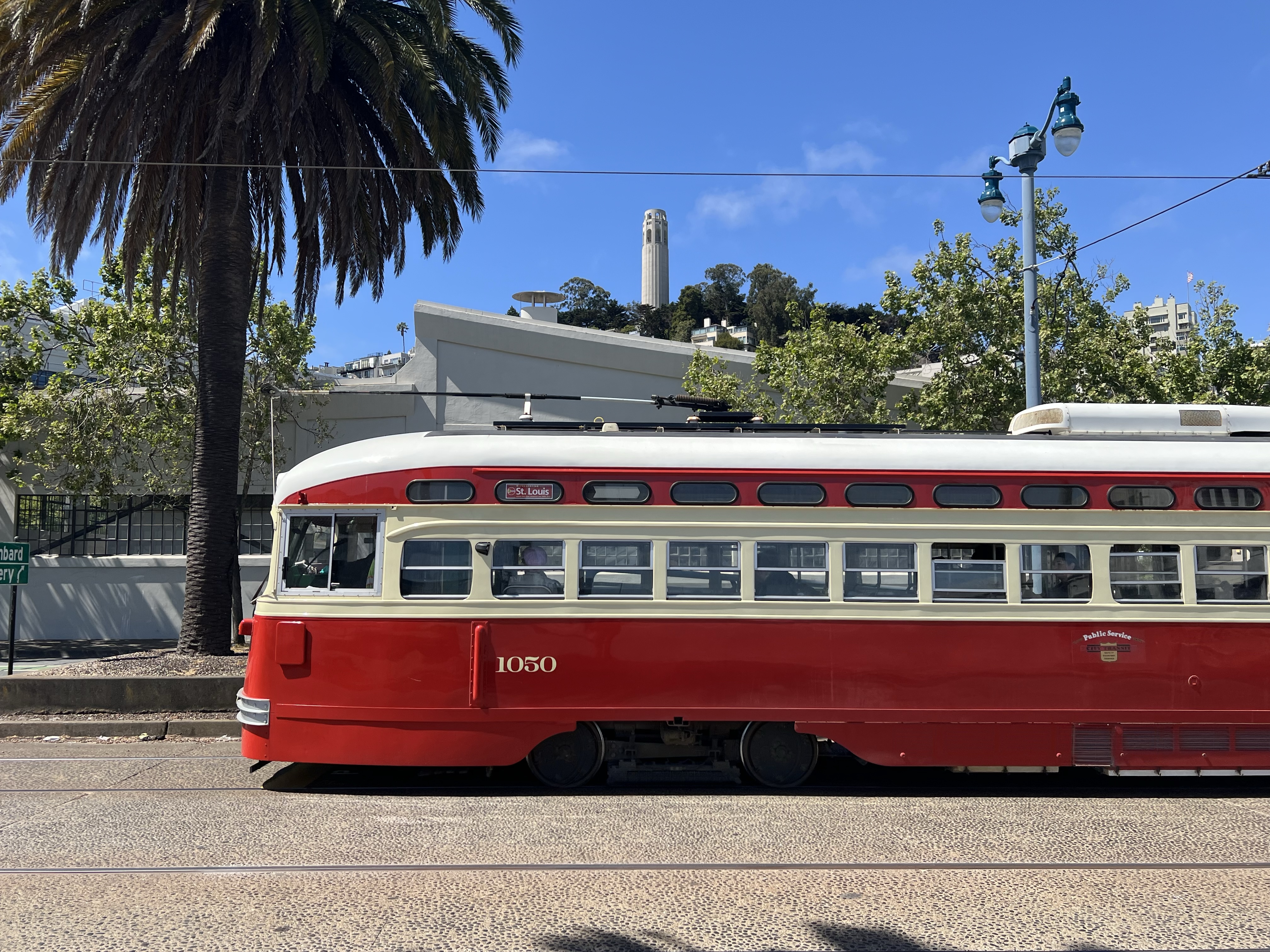
PCC car No. 1050 passes by the Engine House on the F Line. The car is painted in St. Louis livery.

After my sketch I headed back to the Santa Rosa and found a nice sketching bench.

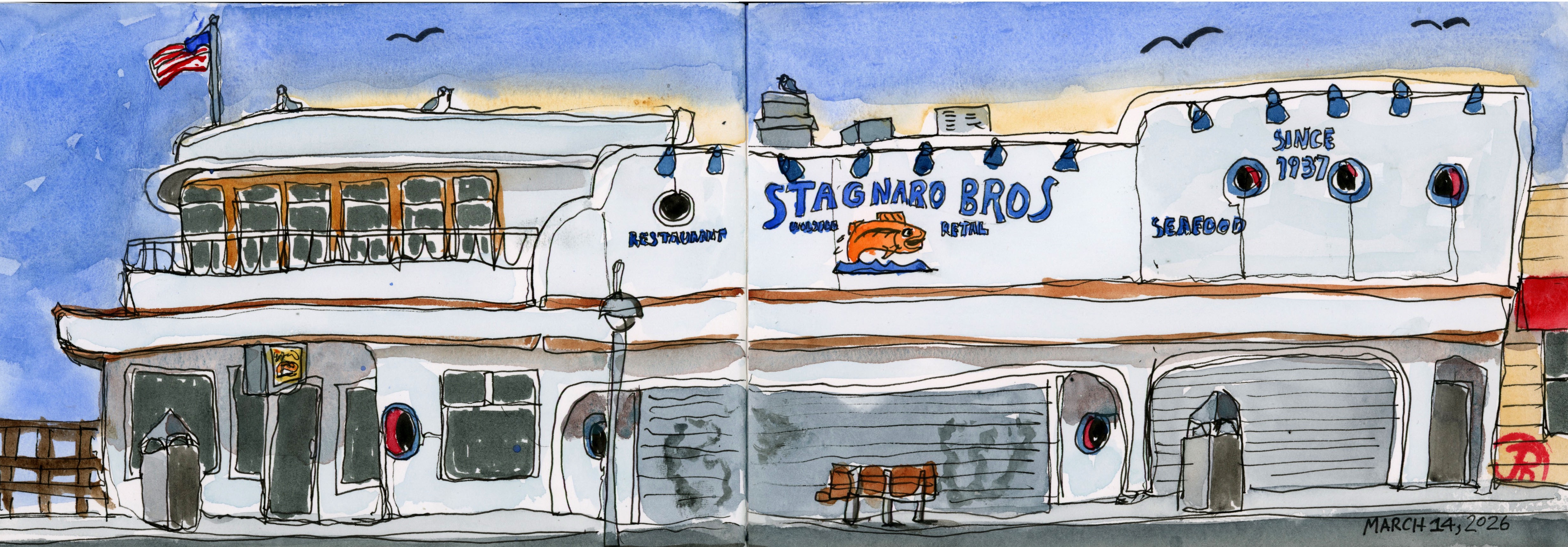
For this sketch I chose to keep it loose and render the ferry in a continuous line sketch. Although I did lift my pen a few times to add some details and shading. So I’ll call it a broken line continuous sketch. For this sketch I experimented with a thicker more expressive pen, my Faber-Castell FM (Fude Medium). I love sketching with this pen!

The Santa Rosa was built in 1927 for the Northwestern Pacific Railroad and was in service until 1968. She was sold to the Puget Sound Navigation Company in 1940 and was renamed MV Enetai. She returned to San Francisco Bay in 1968 and sat unused until Hornblower purchased the ferry in 1989.

The Santa Rosa is now the corporate offices of Hornblower.
Image

The Bayshore Yard and Roundhouse

I was on the hunt for some Bay Area rail history. I was specifically looking for some ghosts of the Southern Pacific Railroad: the Bayshore Yard.

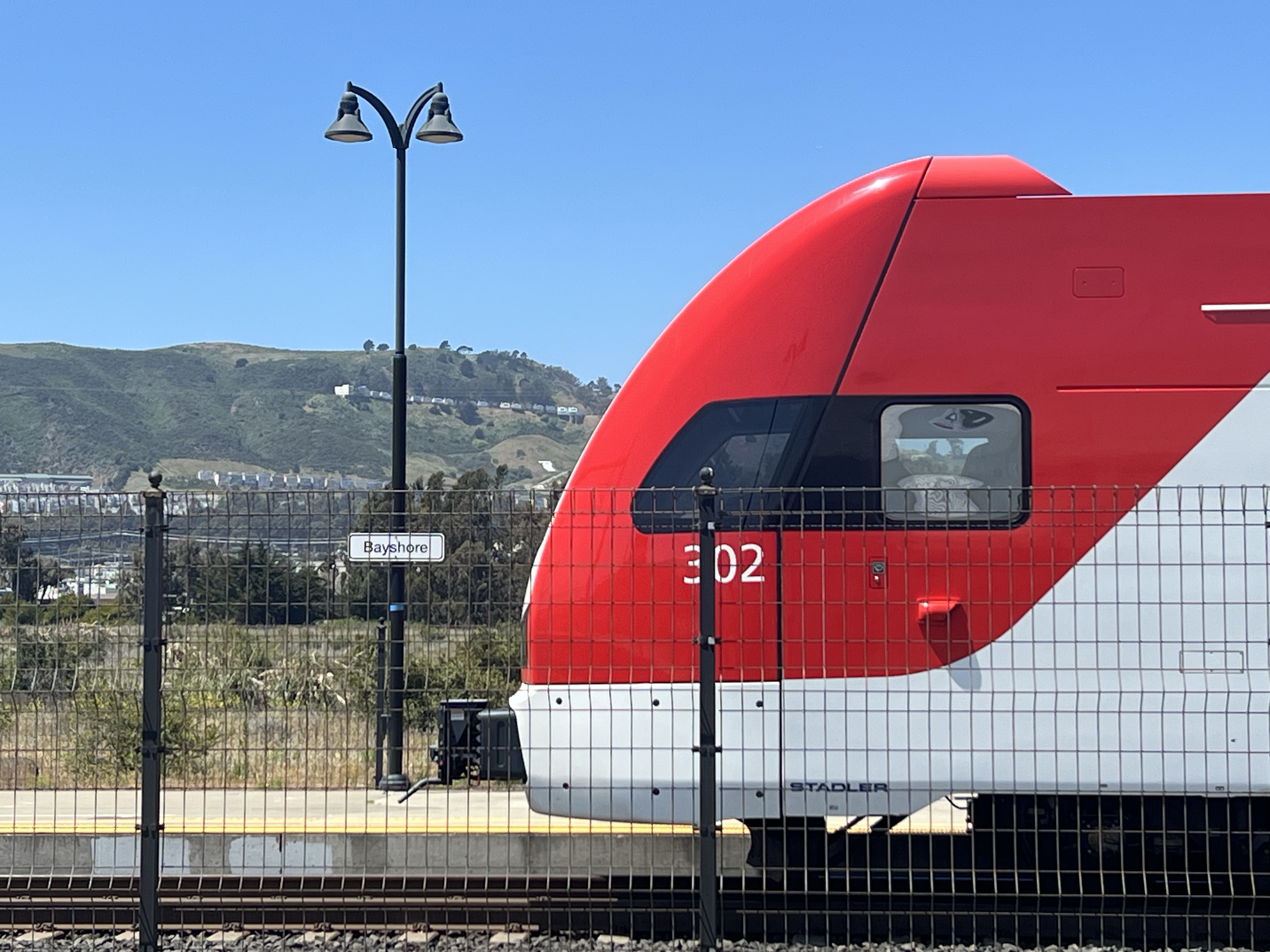
I started my search at the Bayshore Caltrain Station. Uncanny! Who would have thought?

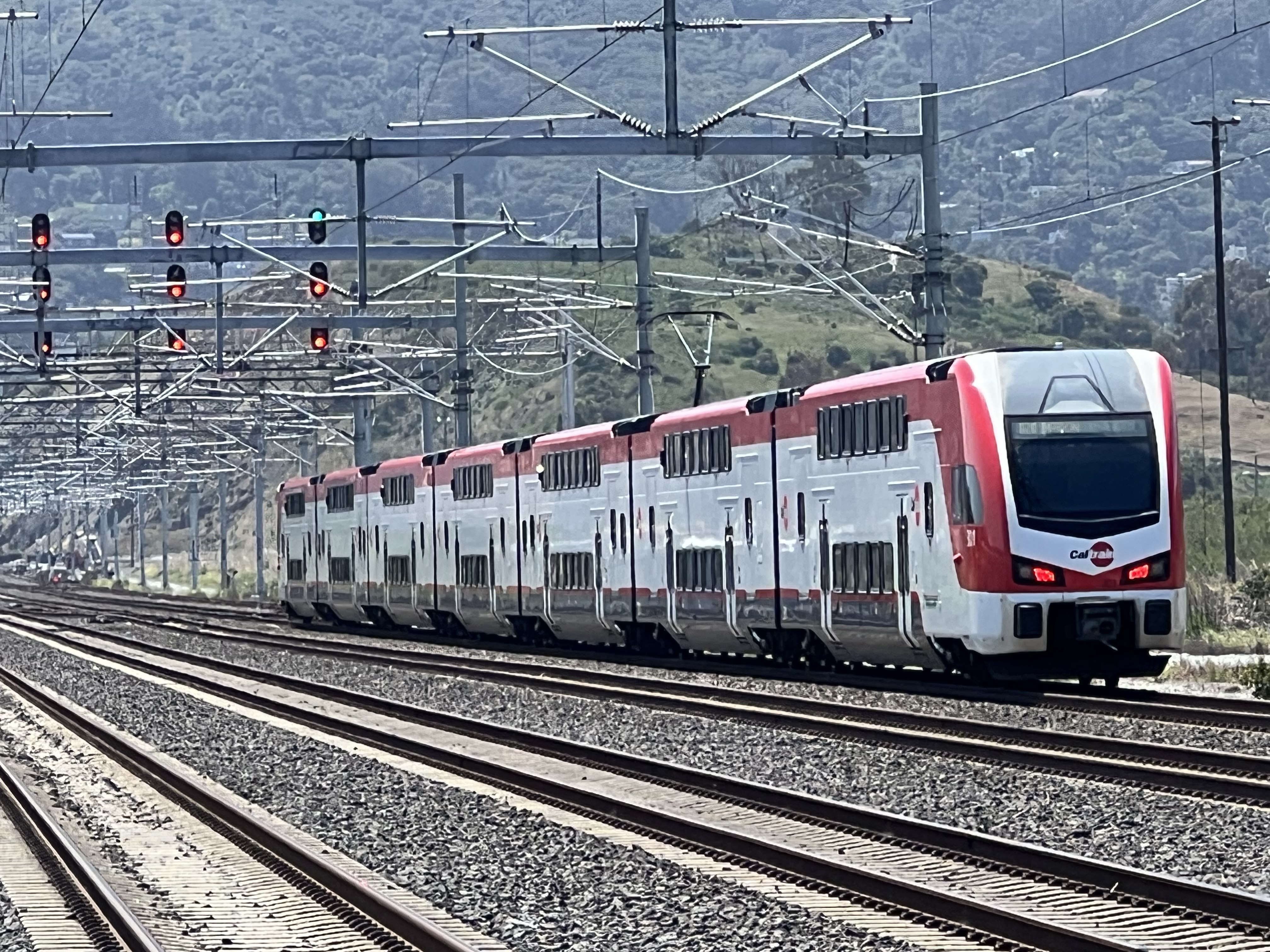
An EMU at Bayshore Station. I was here to see the overgrown fields beyond the tracks.

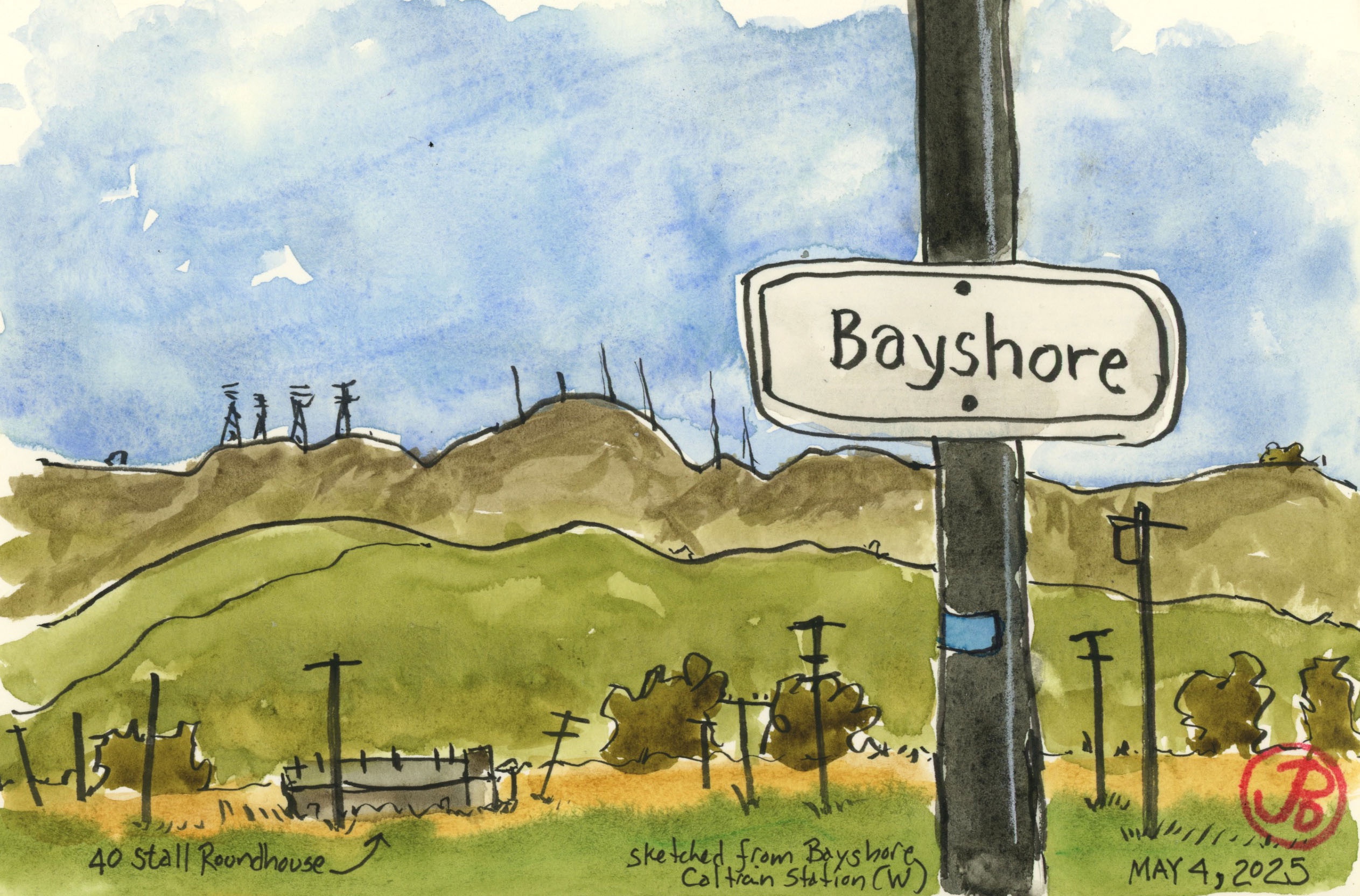
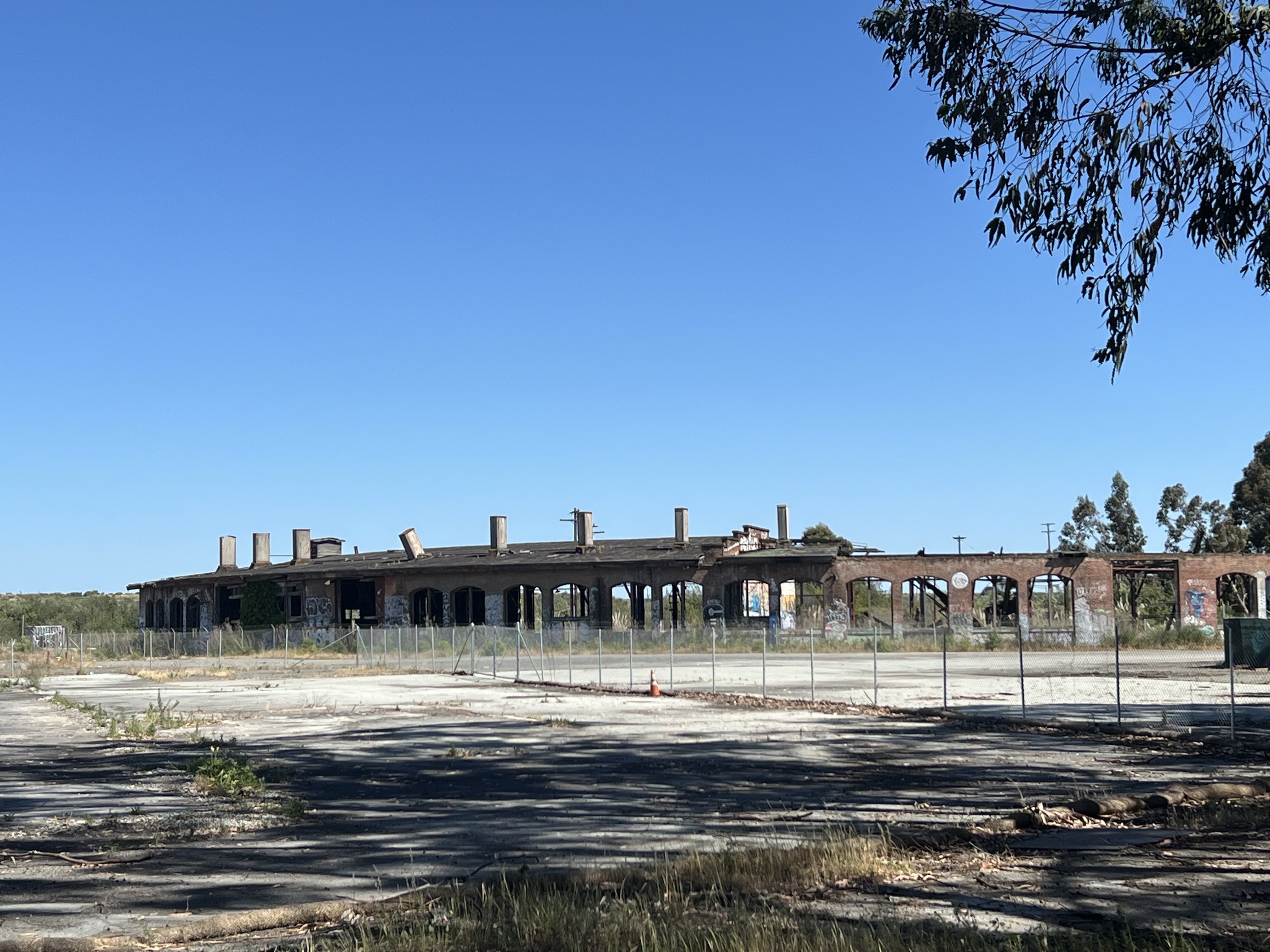
To the west of the tracks is a large overgrown open space punctuated by wooden power poles and bordered by the San Bruno Mountains. On the far edge of the open fields are some dilapidated and graffitied buildings.

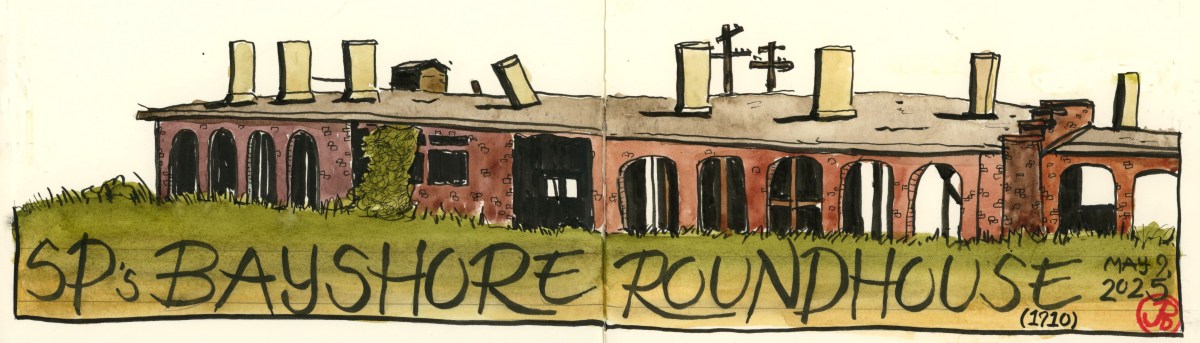
The brick roundhouse and the tank and boiler shop are the only remaining structures of a once bustling train yard and shops. How bustling?

The yard contain 50-65 miles of track, had a capacity of over 2,000 freight cars, and employed 3,000 people.

This was SP’s most heavily travelled stretch with 46.5 million gross tons per mile during WWII.

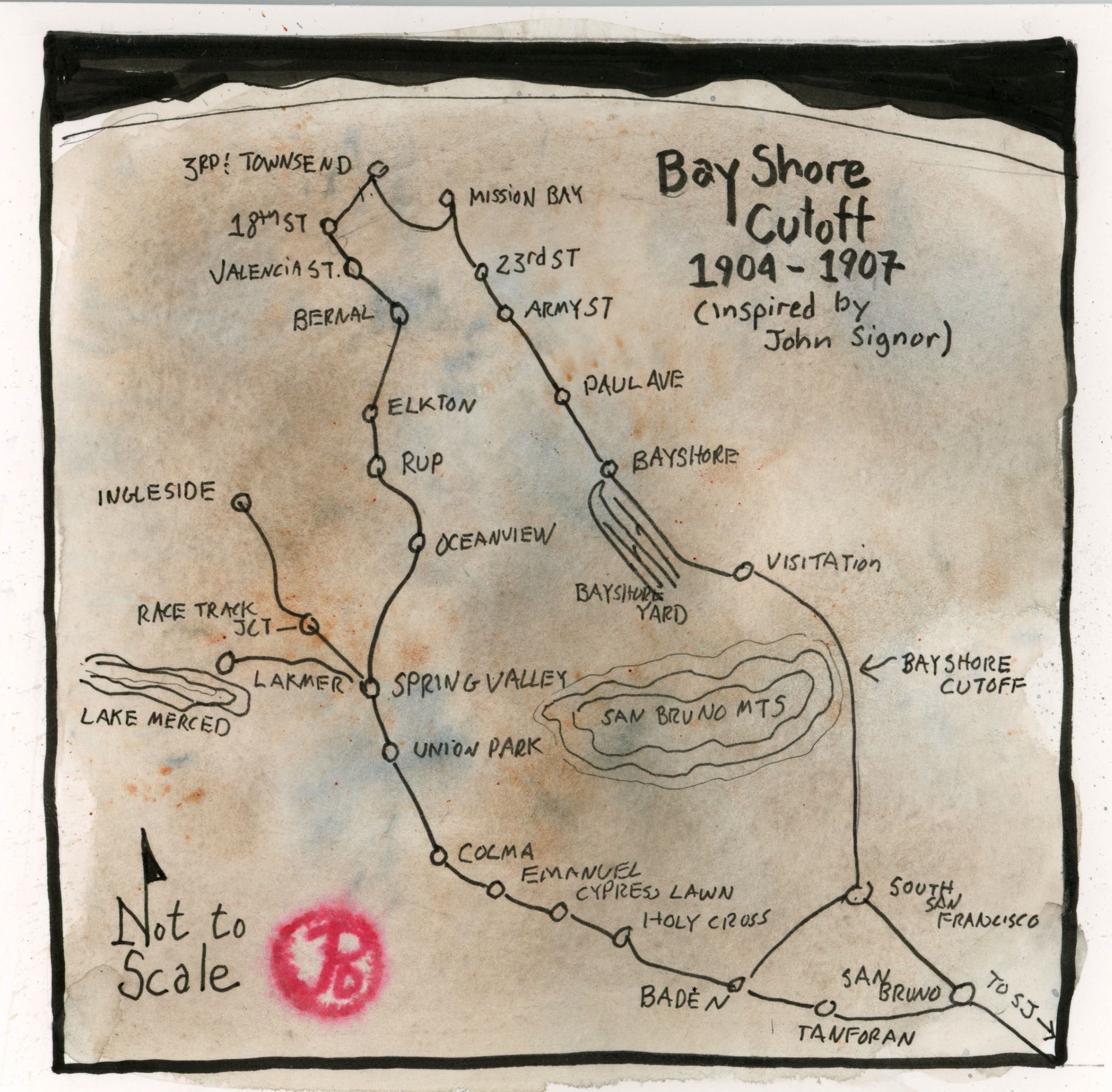
The story of the yard and shops starts with the Bayshore Cutoff.

This drawing is highly influenced by a map John Signor drew from his excellent book on the Coast Line.

As the name implies the Bayshore Cutoff is a short cut that straighten the line around San Bruno Mountain’s southern edge, from San Francisco to San Bruno.

A southbound EMU seven car set leaving Bayshore Station under the tangle of signal gantries and power lines. To the right is the former yard. The current line is along the Bayshore Cutoff.

The cutoff was completed 1907 and cost Southern Pacific $7 million. One reason for the high price tag is that the railroad had to construct five tunnels (20% of the cutoff was in tunnels). The fill from these tunnels was used to fill in Brisbane Lagoon which became Bayshore Yard and Shops.

The benefits of the cutoff were: saving more than three miles on the route, reducing the curvature of the line, and flattening the grade. The improvements cut travel time from San Francisco to San Jose by 30 minutes. The cutoff is still in use today, conveying passengers to and from San Francisco on Caltrain.

For my Bayshore sketch I took a position on the southbound platform and sketched the Bayshore Station sign in the foreground and the feral field and roundhouse in the background. In the far ground is San Bruno Mountain.

After work I headed up to Brisbane with the intent of sketching the roundhouse from Bayshore Boulevard. The roundhouse is close to the street but the former yard is enclosed in fencing. I was able to find a gap in the eucalyptus trees to get a panoramic sketch (sans graffiti) of Southern Pacific’s Bayshore roundhouse.

The brick shell of the Bayshore Roundhouse.
Image

Sketch Crockett

My Saturday morning sketch found me at the corner of Loring and Rolph Ave in the little corner park in Crockett.

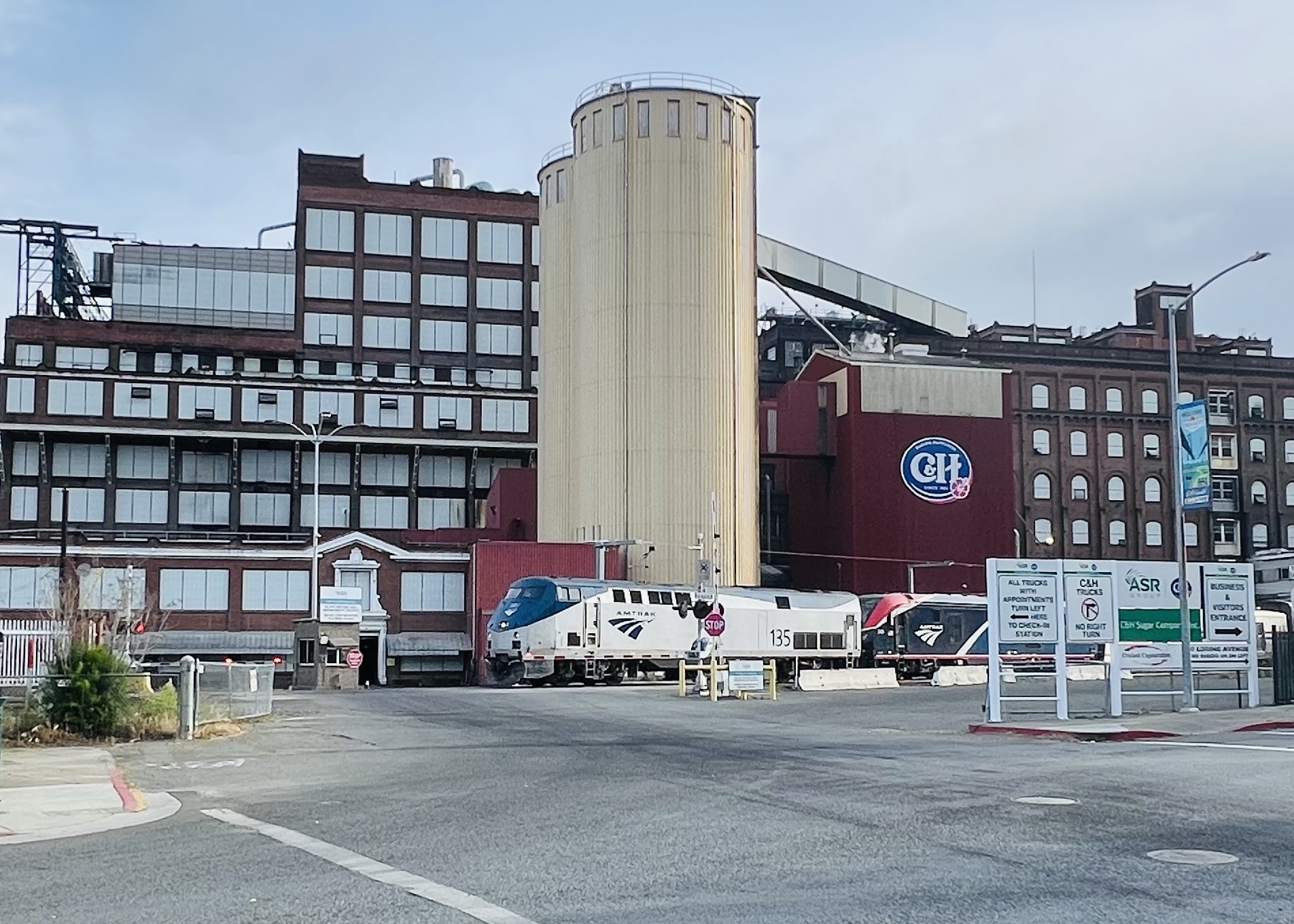
Before me was the C & H factory with the Union Pacific mainline passing in front. To my left was the former Southern Pacific station (sketched on a previous Saturday) and is now a historical museum.

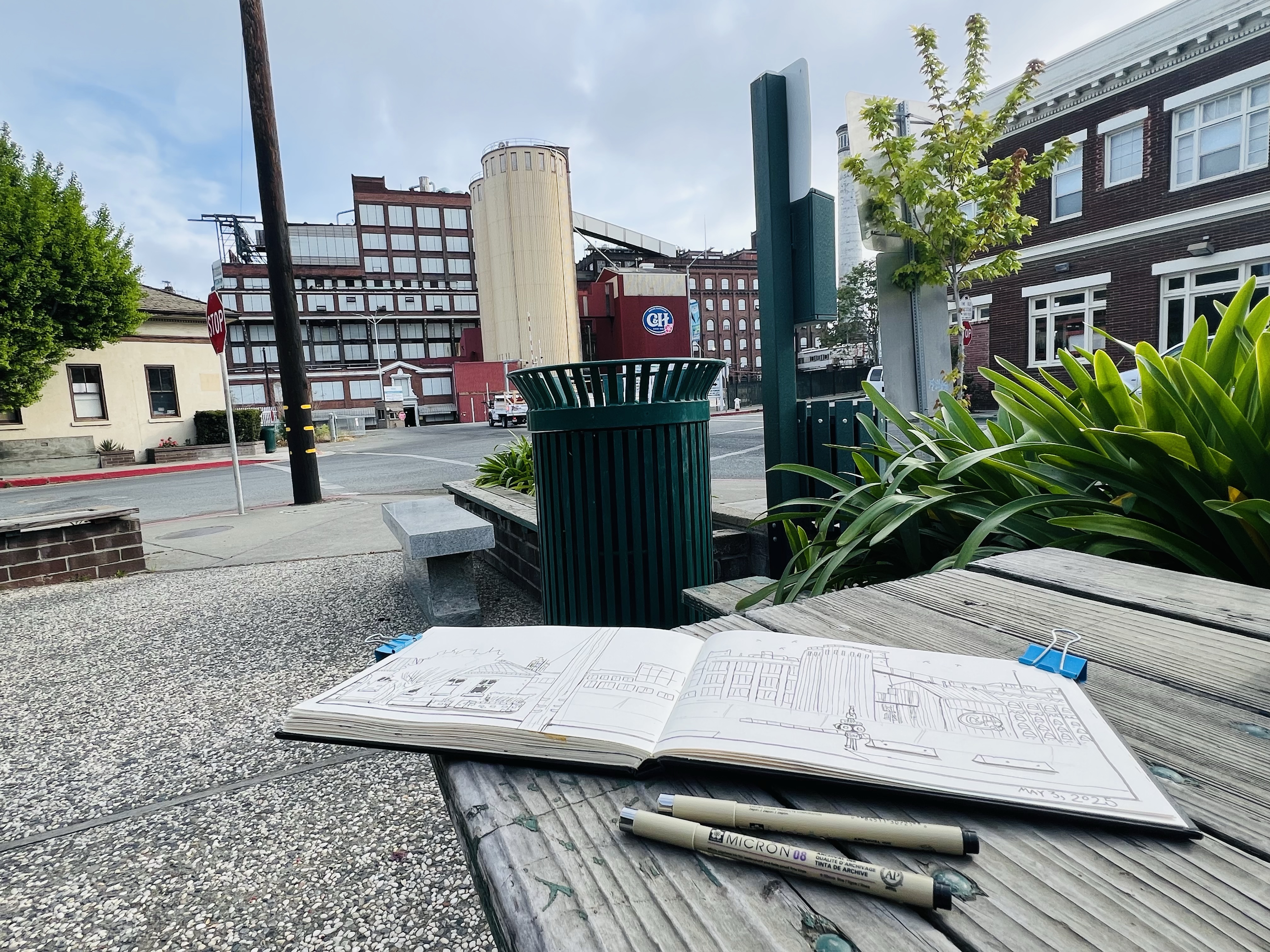
I planned to add my park perspective to my Stillman & Birn Delta panoramic journal. The factory is full of complicated angles and shapes as if the factory was built in stages and at different times (which it probably was). I employed a little sketcher’s shorthand to simplify the details.

In 1906 Crockett became “Sugar Town” when a cooperative of Hawaiian sugarcane growers bought a sugar beet factory and turned it into the California and Hawaiian Sugar Company (C & H). At the company’s peak, 95% of the town’s residents were C & H employees.

The southbound Coast Starlight No. 11 passes by the complex jumble of the C & H sugar factory at 8:01 AM.

Sketching the factory was a wonderful meditation, as it often is, turning chaos into order. I can think of few other pursuits that offers such satisfaction and peace of mind. I can almost feel my blood pressure drop when I put pen to paper.

Parkside sketching.

I employed a similar sketching techniques to past posts with putting a moving train in my sketch. I draw in the foreground and background and then add the train after it passes (usually from a photo reference).

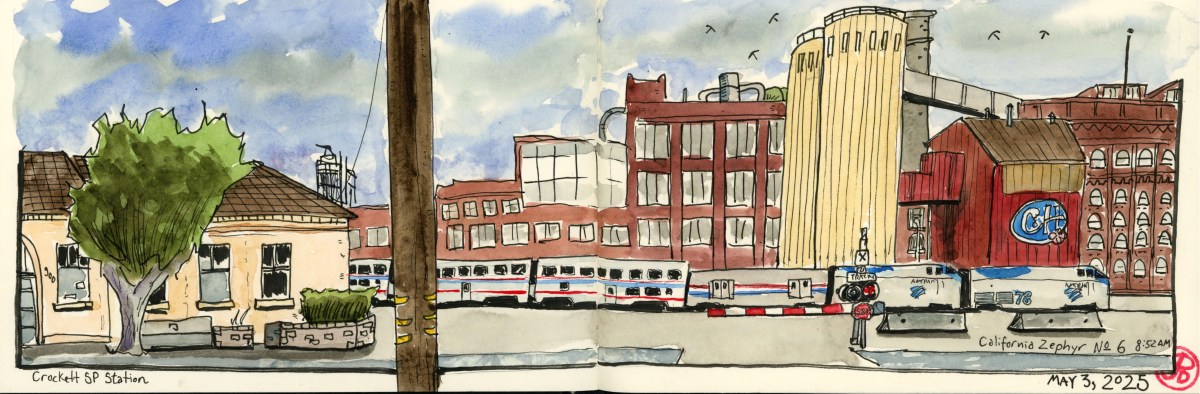
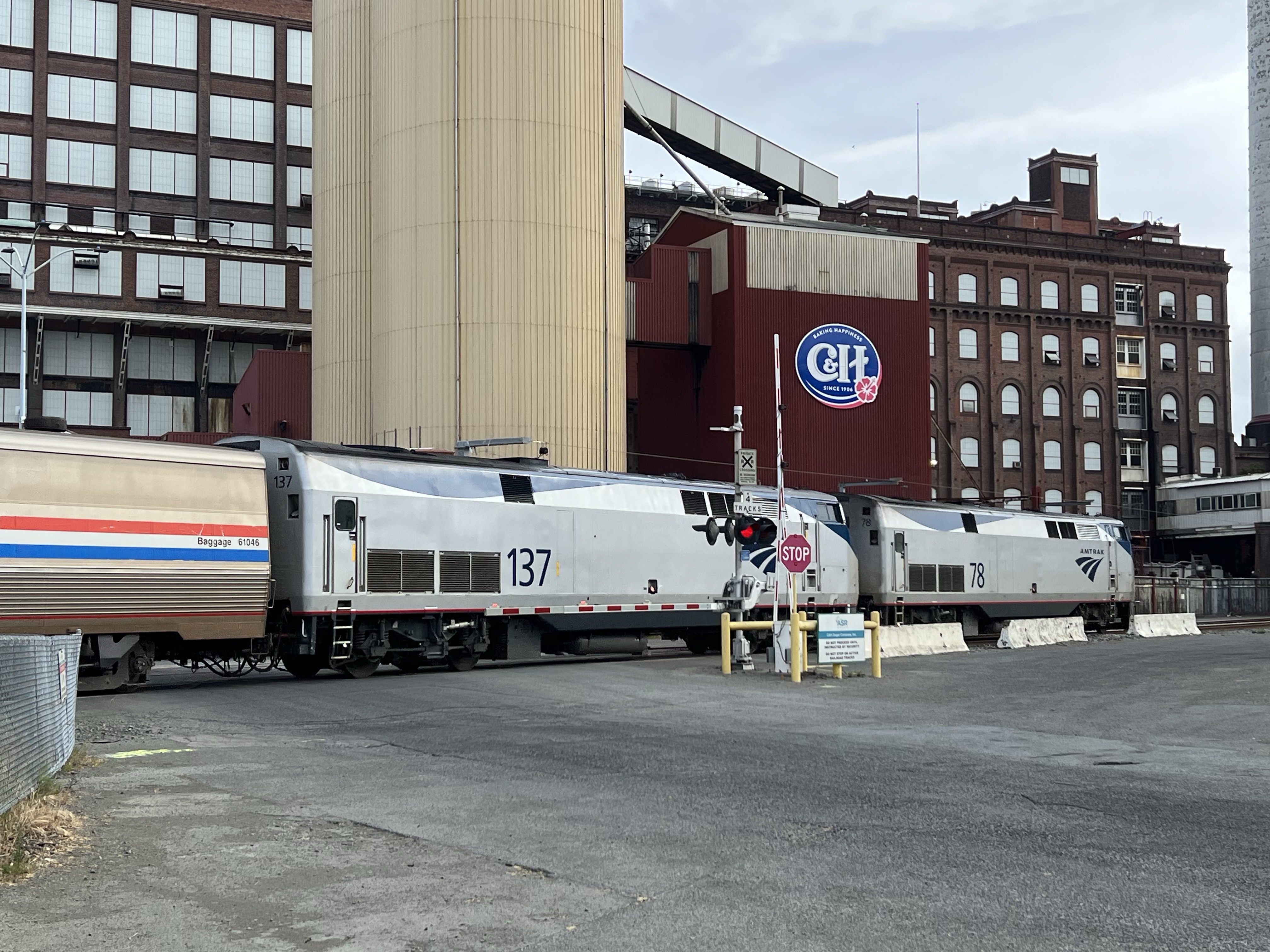
Two GE P42DCs (No. 78 and 137) on point of the California Zephyr. Next stop: Martinez, final destination: Chicago, Illinois.

The passenger train I sketched into the scene was California Zephyr No. 6. I guess I should explain my fascination with AMTRAK’s longest daily route.

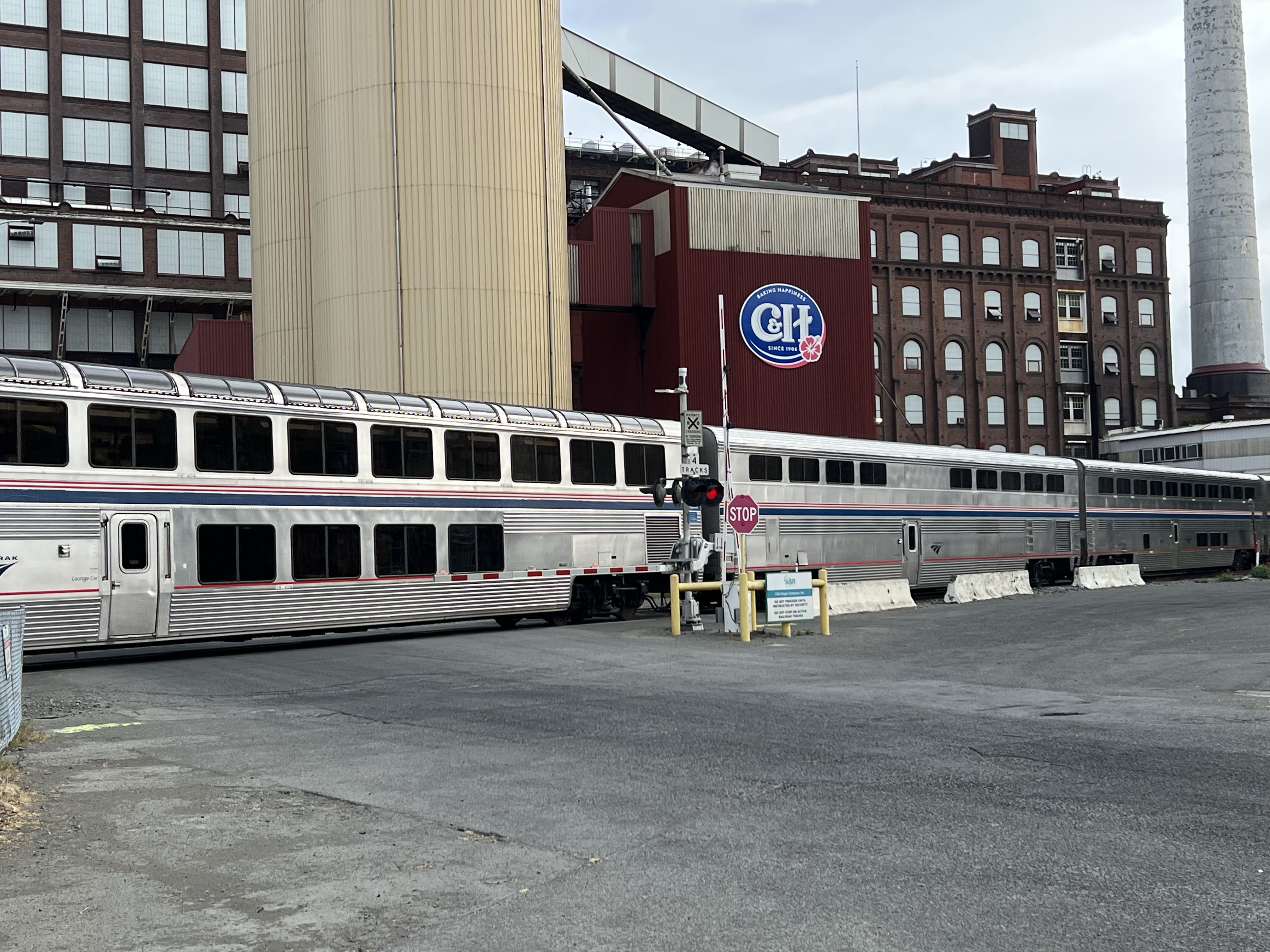
The Zephyr observation car crossing the entrance access to the C & H factory.

I have taken the Zephyr round trip twice, from Colfax, Ca to Denver, Co. The first time was for some Colorado birding and we where up in the Rocky Mountains at Loveland Pass looking for the elusive white-tailed ptarmigan.

It was here that I got a call from my mom and learned that my younger brother had died. I was leaving the next day from Union Station and it was a beautiful if not bittersweet rail journey.

The last trip I took with my stepdad was on the Zephyr and it was a great trip through one of the most scenic stretches of tracks in the United States. So whenever I see the Zephyr pass by, it puts a smile on my face.

Image

UP Eckley Crossing: 748331G (M. P. 27.30)

My Saturday morning sketch location was the pedestrian rail crossing at Eckley Pier in the Carquinez Strait Regional Shoreline.

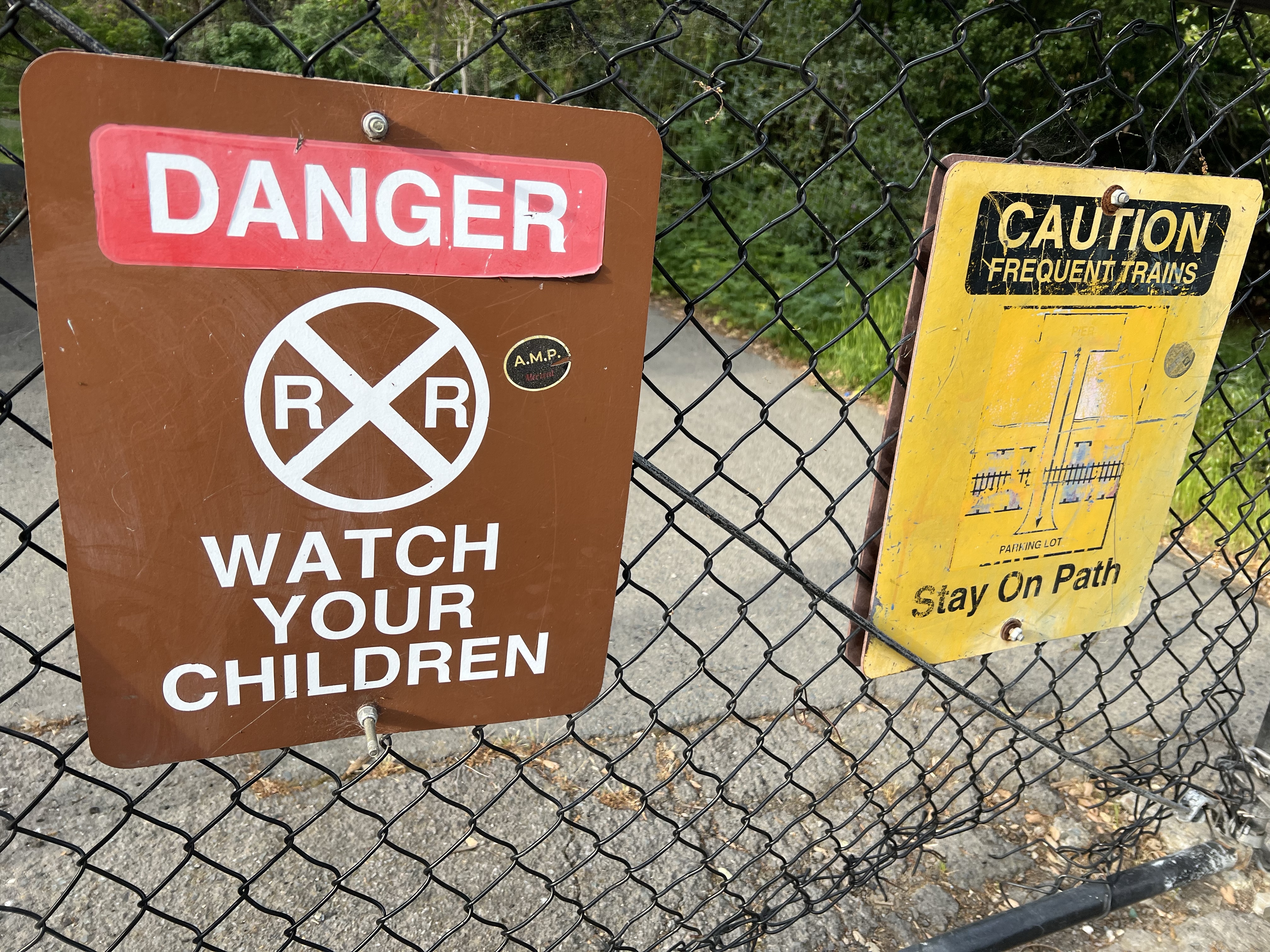
A sign any educator can appreciate.

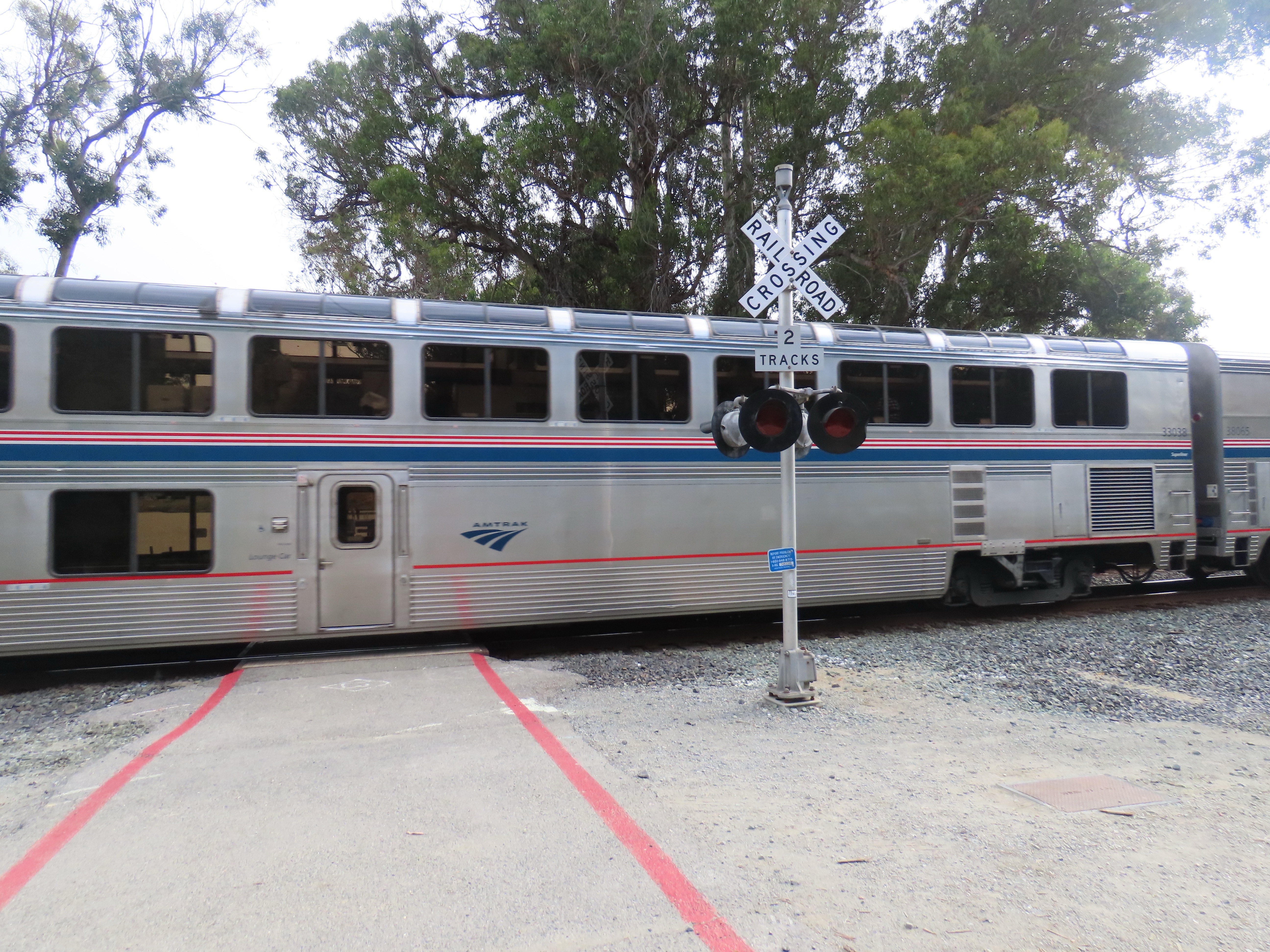
This pedestrian crossing is quite unusual because there are no crossing gates preventing pedestrians, wanting to go to the fishing pier, from heading across two very busy tracks of the Union Pacific main line.

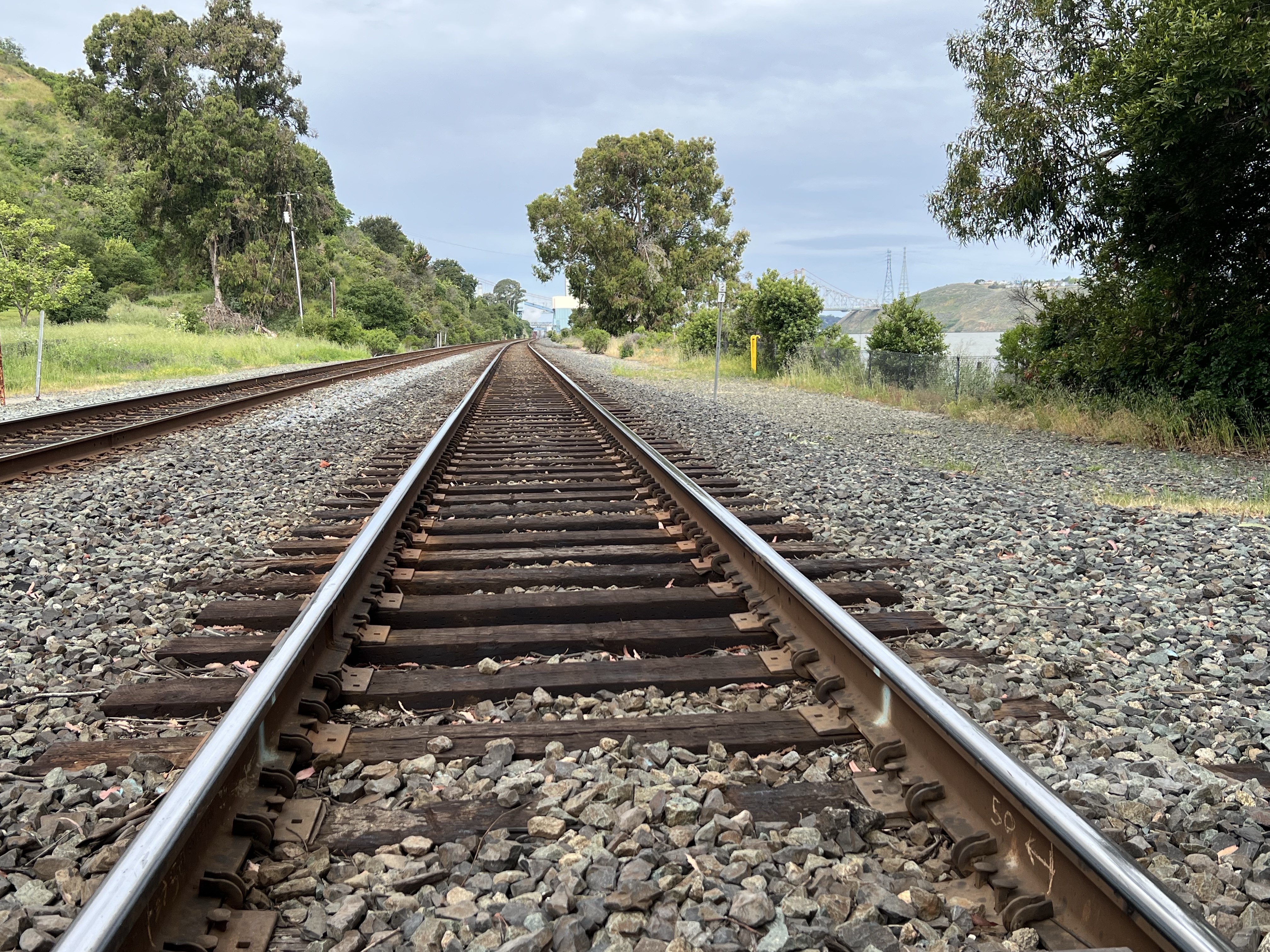
No rusted rails here but polished high iron from lots of use.

I got to the park at 8 AM, when the gates open, and I had plenty of time to catch the Chicago bound California Zephyr No. 6 as it was scheduled to skirt along the southern shore of the Carquinez Strait just shy of 9 AM.

The Zephyr is one of the longest routes operated by AMTRAK (2,438 miles) and as such has the lowest on-time percentage (33%) of any long distance route, primarily because the passenger service is at the whim of their host railroad’s (UP and BNSF) freight traffic. No. 6 should be on time because it left its western terminus of Emeryville at 8:25 AM. It usually gets behind schedule while stopped behind a freight in Nevada or Utah.

I took a position just south of the parallel tracks to sketch the light signal and crossbuck of the pedestrian crossing.

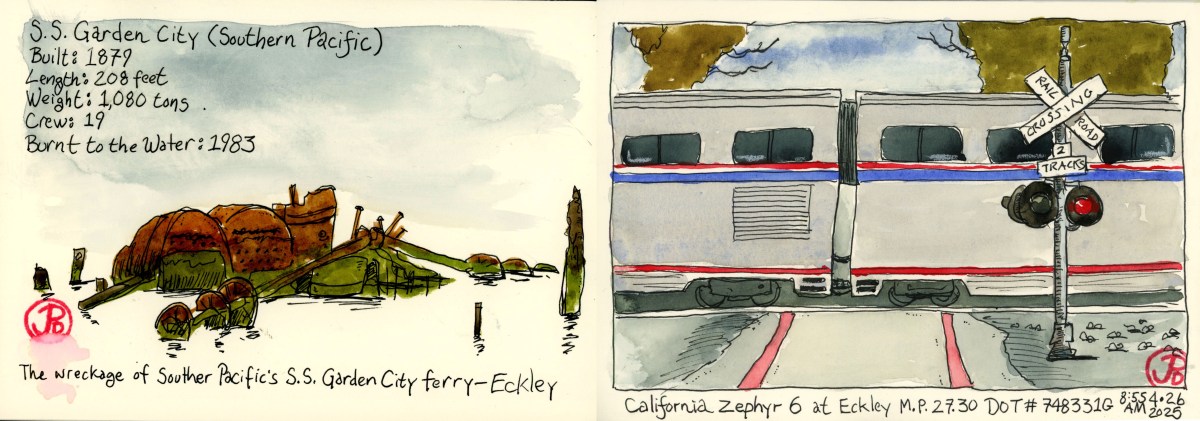
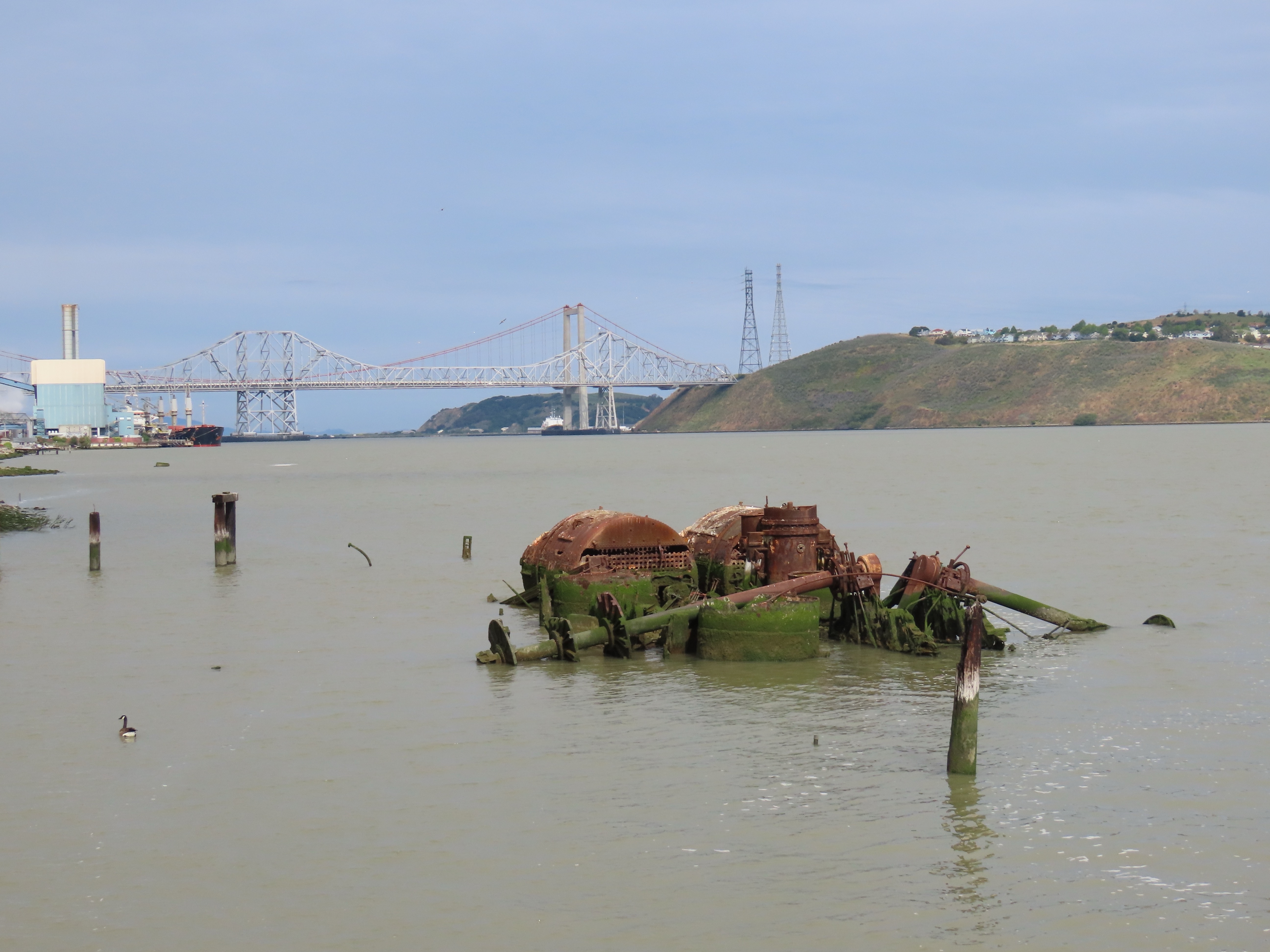
I also had time to get a sketch of another piece of railroad and nautical history: the rusted boilers and paddle wheel hubs of the SS Garden City.

The Garden City was a Southern Pacific ferry that ferried people and automobiles across the waters of the bay. She was built in 1879 and was 208 feet long and weighed 1,080 tons. The wooden side-wheeler had a crew of 19.

The construction of bridges like the Carquinez and Golden Gate rendered the ferries obsolete and in the 1930s, the Garden City was moored at a pier near the current Eckley Pier and it was used as a restaurant and fishing pier until she was abandoned in the 1970s. In 1983, the ferry burned to the boilers, which is about all that remains of this once proud vessel.

What’s left of the SS Garden City in the foreground and one of the bridges that made her obsolete in the background.

It was now nearing nine so I headed across the tracks to take up a position. Down rail the retort of the horn reached me as the Zephyr blew the crossing at Crockett. Shortly thereafter the crossing signal activated with red lights and bell and the Zephyr appeared around the bend.

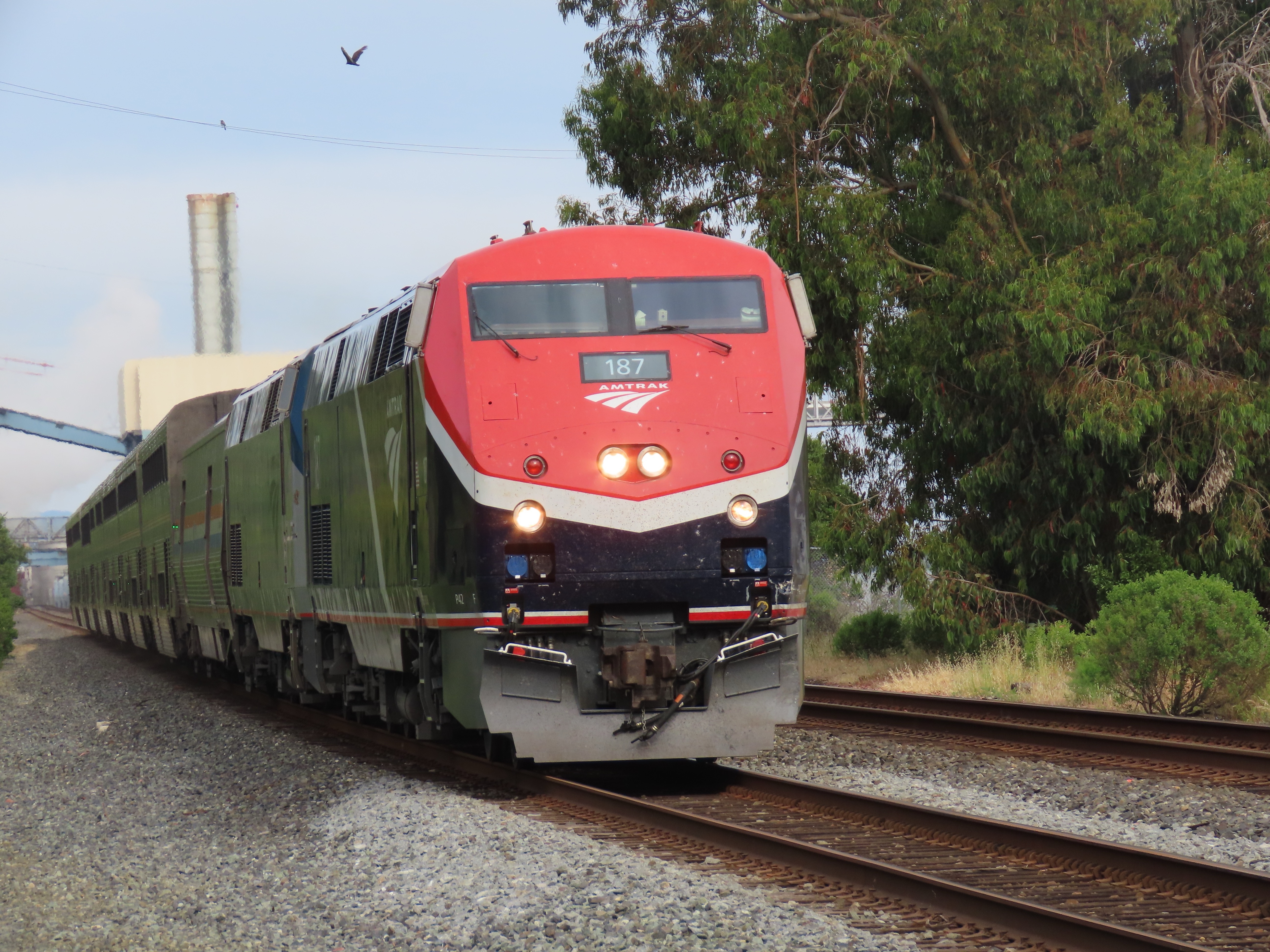
A GE P42DC 187 is on point of the California Zephyr as she heads towards her next stop: Martinez.
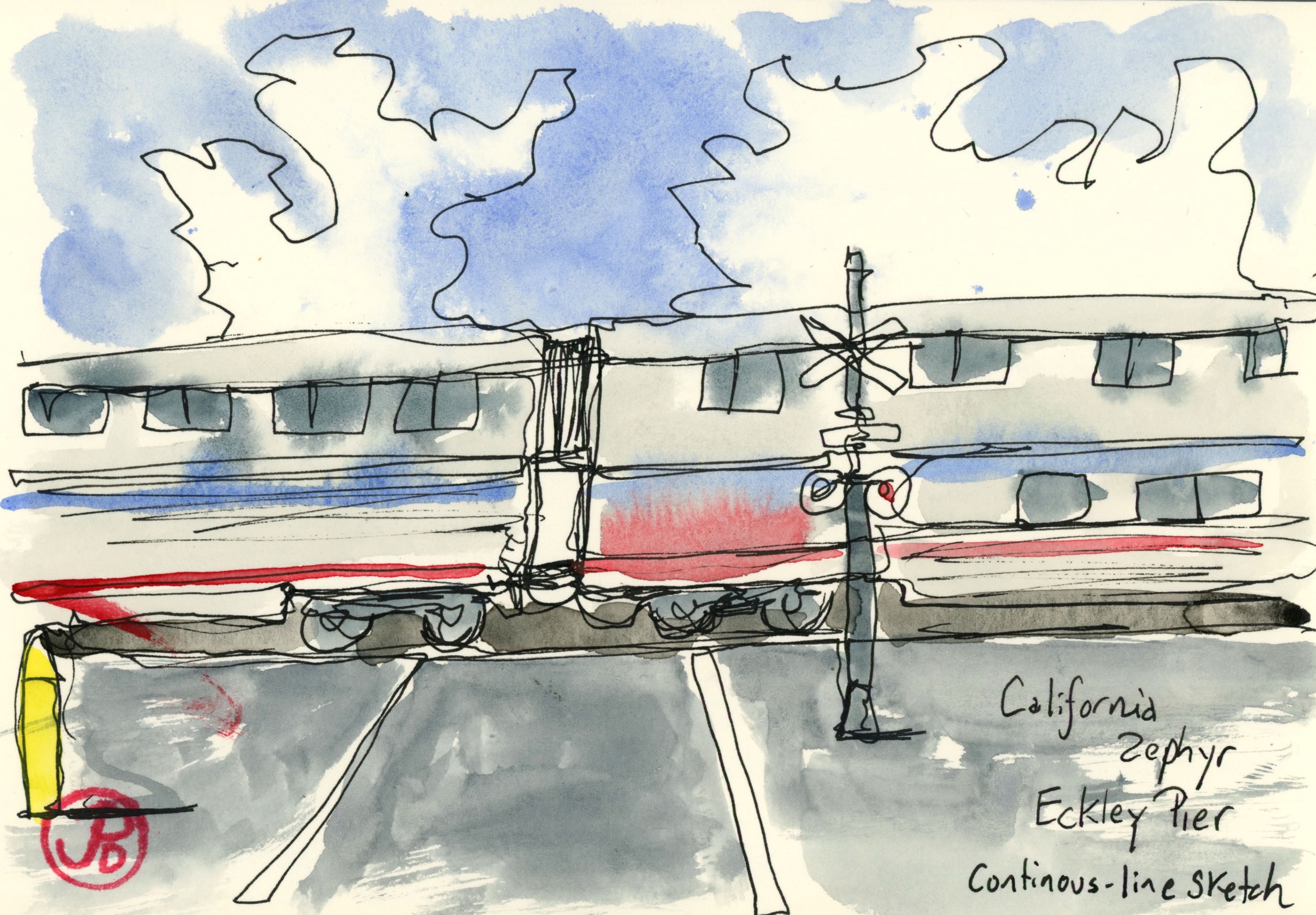
Zephyr No. 6 crossing the pedestrian walkway at Eckley. This is my favorite car to ride in while traversing the Sierras and the Rockies: the observation car!
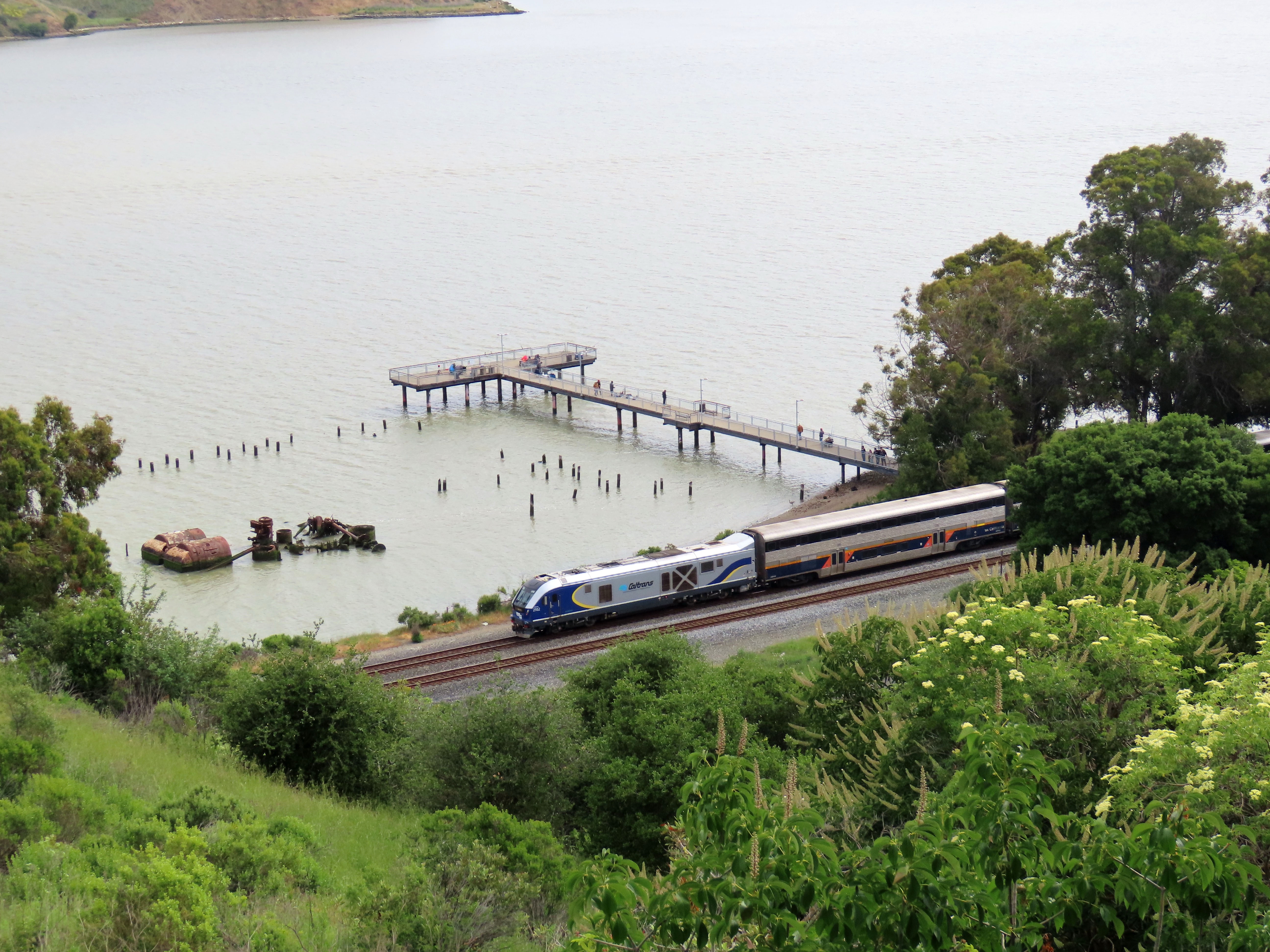
A Capital Corridor heads towards Crockett past the fishing pier and the ruins of the Garden City.

Sketching Notes

Before heading out to Eckley, I pre visualize my sketch. I practice sketching the perspective and location and drew the Superliner train cars that would be a part of the train’s consist so I would be able to draw the cars into my sketch after the train had past. This is using sketcher’s “muscle memory” so drawing the cars would become almost second nature.

A loose continuous line pre-sketch of the pedestrian crossing.

What I drew on location was the foreground and background eucalyptus and then I added the long distance Zephyr from memory. One thing I might do differently is to sketch the train looser to convey the sense of motion.

For my sketch of the Garden City, the core of the sketch was done as a continuous line sketch and I then lifted my pen and add more details.

Both sketches are with my TWSBI Eco fountain pen.

Image

Broadway Station

On Monday I did an afterwork sketch of the closed Atherton Station on the Caltrain route and now on Friday I headed to North Burlingame to do another after work sketch of a Caltrain station: Broadway.

The peeling train sticker on the sign is a living metaphor for the downtrodden Broadway Station.

With a name like Broadway, you’d think of a busy station with lots of passenger traffic and a station with a staffed ticket office, a waiting room lined with wooden benches, and perhaps a cafe. Sure that might have been the picture over 70 years ago. Now here is the ticket window:

And there is no cafe. And no passengers for that matter.

Like Atherton, the new electric EMUs speed by this station. The train only stops here on weekends, which is more than can said for Atherton, and the former station is now a restaurant. The platform has some benches, a few shelters, and a sign that reads “No Loitering”. Is sketching a form of loitering?

Looking north toward San Francisco with the former station, now a restaurant, on the left.

The Broadway Station suffers from diminishing ridership and a center loading island platform for northbound trains. This means that a hold-out rule is in effect which means that if a train is in the station, a train heading in the opposite direction must wait outside the station until the other leaves before pulling in. This creates delays and is a major reason the station was closed on weekdays on August 1, 2005.

This southbound EMU is not stopping here.

The original station was opened by Southern Pacific in 1911. The station was renamed Buri Buri in 1917 and then to its current name in 1926.

My field sketch and a southbound EMU speeding by at Broadway.

Sketching Notes

During my lunch I sketched out the scene I wanted to sketch on an index card. This is like a storyboard for a tricky scene in a film. What I wanted to do was convey a sense of stillness and motion. The stillness of the shelter and the motion of the train speeding by. In the presketch, or storyboard, I exaggerated the lines of the train. They are curved and kinetic while the shelter remains calm and pedestrian.

Perhaps I could have exaggerated the lines more in my field sketch. That would entail sketching things that aren’t there in front of me. Like sketching in another dimension.

Image

Crockett Sketching

On a Saturday morning I headed up to Sugar Town on the Carquinez Strait.

My sketching target: the former Crockett Southern Pacific Depot with the two parallel spans of the Carquinez Bridges in the background. The depot is now home to the Crockett Historical Museum. Open Wednesday and Saturday from 10am to 3pm. Ish!

This is a busy place for rail with seven trains passing by including a California Zephyr, a Coast Starlight, a San Joaquin, Capital Corridors, and a Union Pacific freight during my two hours visit.

Coast Starlight No. 11 passes by the C & H Factory to its final destination of Los Angeles’ Union Station. The train was running a little late. Shocker!

My sketching goal was to render the scene in a continuous line sketch. This means you never lift your pen for the entire sketch. No pencil, no erasing, no going back, this is truly sketching without a net!

Eastbound California Zephyr Number 6 passing the former SP Depot at 8:56 AM without stopping. Final destination: Chicago.

I set up my sketching chair across the street from the depot just at the entrance to the company that made Crockett a company town, the C & H (California & Hawaii) sugar factory. For my sketch I used my TWSBI Eco fountain pen.

Nothing like starting the weekend with a field sketch!

Continuous line sketching can be challenging and I lifted my pen off the page once or twice (to photograph Zephyr Number 6) but I restarted where I left off. So my sketch is really a broken continuous line sketch.

In the end I like the imperfect lines of the sketch. This technique is a great way to loosen up your line work and in the end I am pleased with the result. It may not be the most accurate form of sketching but it sure has a lot of soul!

I added some wet on wet washes and paint splatter, which looseness, matches the line work.

When the museum finally opened at 10:25, I was drawn to the large 460 pound taxidermy sturgeon in a glass case. So I added it to the right side of the spread.

Main Street Crockett with Toot’s bar and the new span of the 2003 Carquinez Bridge towering over the town.

The trains never stop rolling through Crockett. This is a Sacramento-bound Capital Corridor train passing the sugar factory.
Image

Martinez Sketching

I arrived a few hours early in Martinez before meeting my friend for lunch. I wanted to do some sketching around the Martinez AMTRAK Station.

The train station in Martinez is a busy place. While I was sketching, three Capital Corridor trains passed through.
On my last visit I wanted to sketch the Southern Pacific locomotive, with its odd consist of Santa Fe cars, on static display across from the station but I didn’t get around to it. I wanted to add it to a spread on my next visit (featured sketch).

Southern Pacific No. 1258 is an S-12 switcher steam locomotive built at the SP shops in Los Angeles. 38 locomotives where built in this class and there are 13 0-6-0 SP switchers preserved, more than any type of Southern Pacific locomotive built.

Switchers are not sexy nor classy like the GS locomotives. There epitomize function over form. The real workhorses of the Southern Pacific freight yards.

After sketching 1258, I headed to the other side of town to sketch the house of Martinez’s most famous resident.

This resident is the writer and naturalist John Muir. He lived here among the fruit orchards with his wife and family.

Muir married into the Strentzel family in 1880. The Strentzels had been farming the land, mainly fruit ranching, since the 1850s. Muir lived here, except when he was off traveling, from 1880 until his death in 1914.

I knew I wanted to do a sketch of the 1882 Italianate house but I needed to find the right perspective.

The touchstone for my sketch was the not-so-giant sequoia that Muir planted years ago. The tree has failed to live up to its name in the Martinez climate.

My Muir-sequoia-bench sketch.

I found a bench with the sequoia in the foreground and the Muir House in the background up the hill.

My favorite room in the Muir House. Muir’s “scribble den”.
Image

Southern Pacific GS-6 No. 4460

I had to journey to the very edge of the 42 acres of the National Museum of Transportation to see the number one locomotive on my museum sketch list. (Ironically it the first locomotive I saw driving in from Barrett’s Station Road.)

The Northern type 4-8-4 GS-6 (only ten were built) was in the far corner of the engine shed bordered by the employee parking lot. This was an unfortunate and sad location to display one of only two of Southern Pacific’s “Golden State” or “General Service” locomotives in existence.
Another name for 4460 is the “Forgotten Daylight” because it gets far less attention than her famous relative, GS-4 No. 4449. It’s placement in the corner of the engine shed, hemmed in by parked cars at the museum, gives a new meaning to the “Forgotten Daylight”.

No. 4460 with employee’s cars preventing you from getting a nice broadside view of the running gear.

The “War Baby” was built in 1943 by Lima and had to work within the limits of the War Production Board. The side skirting of the previous GSs was removed and the locomotive lacked the mars light of the GS-4, resembling the GS-2s. 4460 was the first GS-6 built at the Lima Locomotive Works in Lima Ohio. These locomotives could be used for passenger and freight trains.

4460 is the last steam locomotive operated by the Southern Pacific. In October 1958 the last run of an SP steam locomotive was between Sacramento and Sparks, Nevada over the famous Donner Pass. This was on a Goodbye to Steam excursion. 4460 ran to Sparks and then back to Sacramento, unassisted.

The iconic GS-6 was not scrapped like so many other steam locomotives but was donated to the Museum of Transportation in April of 1959.

Sketch in progress at the NMOT. This was in my “point and shoot” Hahnemuhle 100% cotton sketchbook.
The finished field sketch with watercolor.

I also sketched 4460 in profile, focusing in on its classy smoke box and headlight.

Image

Midwestern Presketching

Before any great or small journey I do some presketching.

On my October Fall break I planned to visit two midwestern states: Missouri and Illinois. I had been to Illinois before but only to Chicago. Now I planned to visit it’s capital, Springfield. And Missouri, Gateway to the West, would be a first visit for me.
My starting point would be St. Louis, Missouri. I had a few sites, destinations, and sketches on my list, chief among them was the National Museum of Transportation.
This 42 acre museum is in the St. Louis suburb of Kirkwood. Its collection of railroad history includes: Aerotrain No. 3, Big Boy No. 4006, Norfolk & Western Y-class No. 2156, UP Centennial No. 6944, the Silver Charger No. 9908, and the steam locomotive that I was really looking forward to seeing/ sketching: Southern Pacific’s GS-6 No. 4460 (featured sketch).

I also want to sketch the world’s tallest arch, the 630 foot Gateway Arch in St. Louis. I booked at ticket to take me up to the top to see the city of St. Louis and the mighty Mississippi River.

Illinois is known as the “Land of Lincoln” and the epicenter of Lincoln is the state capital of Springfield. It was here that Lincoln lived for 17 years before he left from the Great Western train station to become the 16th President of the United States. In Springfield are the station where he departed, his home, Presidential Museum and Library, and his tomb.

I had much to sketch and many miles to traverse on my short Midwestern jaunt so I drew it out as a map.

Before any trip I like to draw a map to help me visualize where I am going. I like to add travel times (St. Louis to Springfield: 1 hr 27 min) because it helps me plan my time deciding how much time to spend in either city. I’ve always been about seeing less while having quality time on the ground.

In circular inserts I illustrated four of my sketching targets: Lincoln’s house in Springfield, the Lincoln bust at his his tomb (visitors rub his nose for good luck), the National Museum of Transportation (featuring Southern Pacific’s No. 4460), and the Gateway Arch on the banks of the Mississippi in St. Louis.

Let’s go!