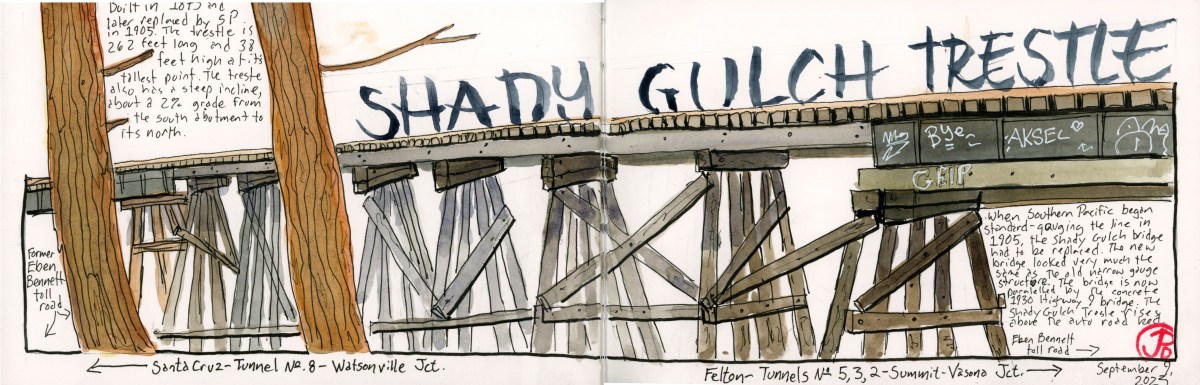
Just up the creek from my cabin is one of the remaining wooden trestles on the former South Pacific Coast Railroad (in 1887 the railroad became Southern Pacific). This is the Shady Gulch Trestle.
Not only does this trestle still exist but is still used for rail service on the Big Trees and Pacific Railway.
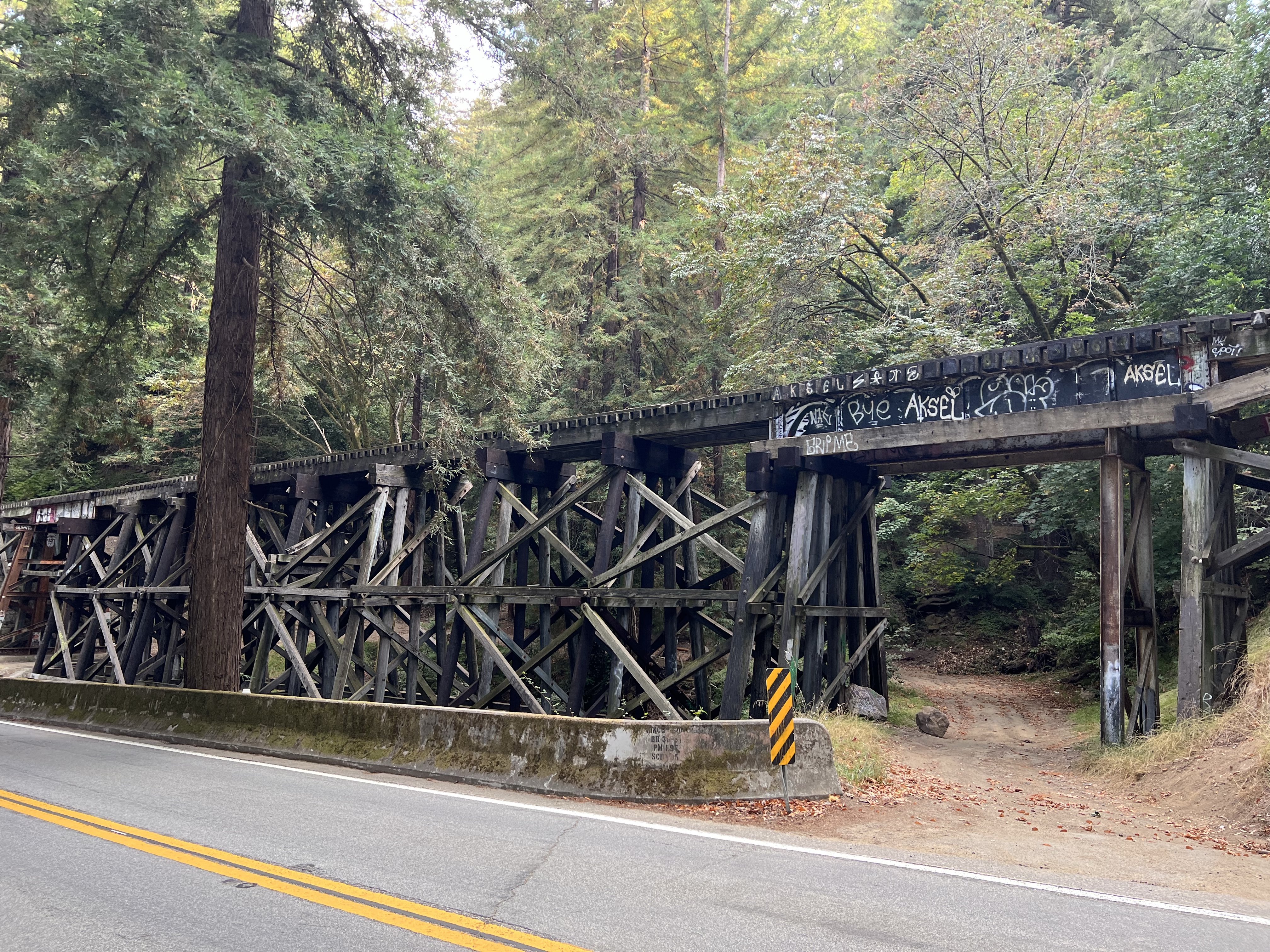
Shady Gulch Trestle with the Highway 9 concrete bridge (1930) in the foreground. The dirt road to the right is the former Eben Bennett toll road. The concrete highway bridge replaced the toll road.
The original trestle was built in 1875 to span Shady Gulch. At the time, the line was built for the narrow gauge South Pacific Coast Railroad. When Southern Pacific acquired the line they rebuilt the trestle in 1905 to accommodate standard gauge.
The trestle of today very much looks like the original narrow gauge trestle of the late 19th century, sans graffiti of course.
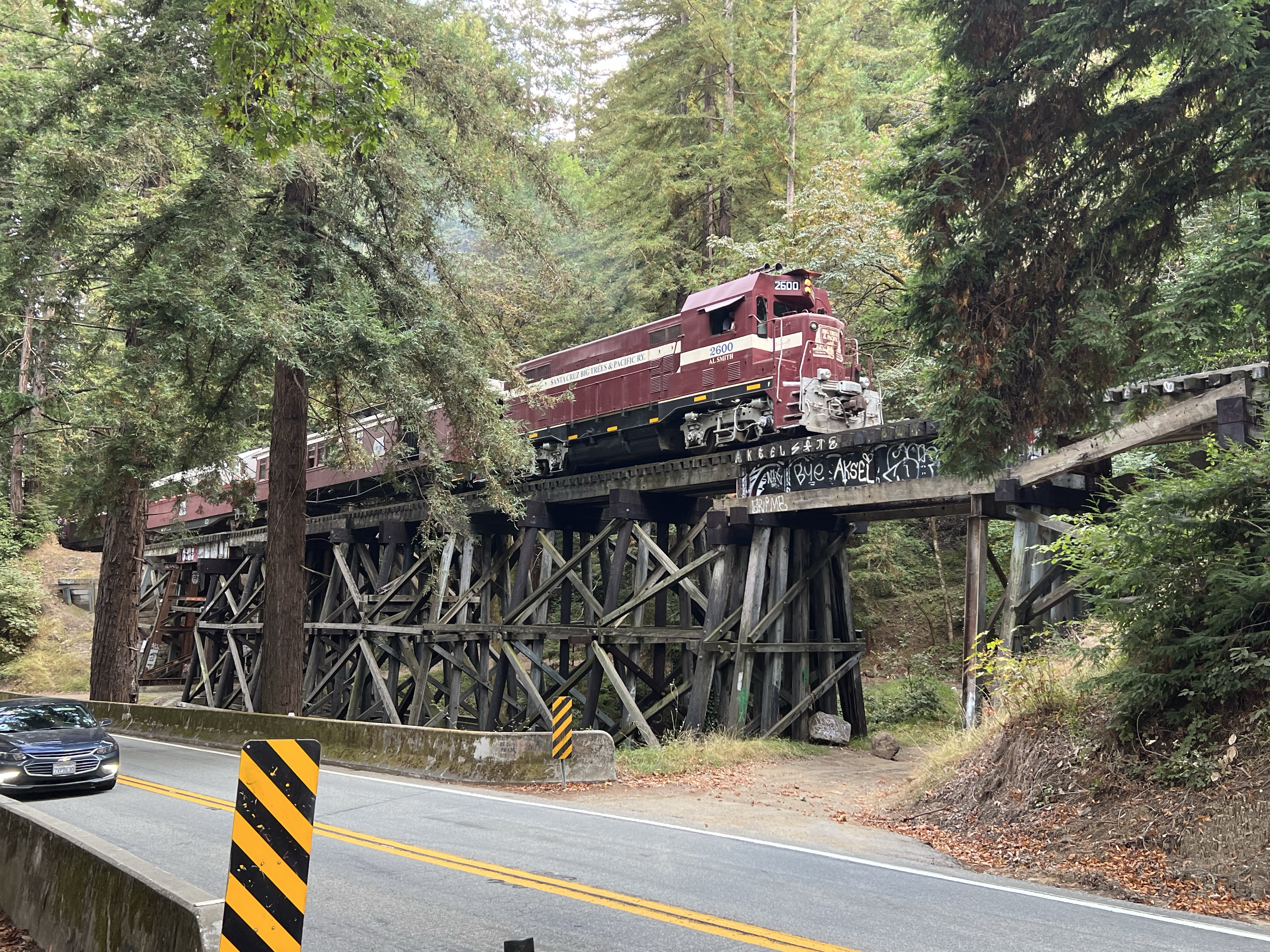
The afternoon Felton-bound Big Trees and Pacific crossing the Shady Gulch Trestle. This tourist train tends to stop traffic on Highway 9.
My father spend his childhood summers in the cabin in the 1930, 40s, and 50s. He would tell me of the time a freight would be climbing the grade on the trestle on their way to Felton on a foggy summer’s morning. The wet track would cause the locomotive’s driving wheels to slip. And after many slips and the hyperbolic “chuff-chuff-chuff” of the stream exhaust, the train would back down the grade, sanding the track as they reversed. The freight would make another attempt, this time slowly with the sanded rails helping the drivers grip the steel. And off they went to Felton.
There is a single one car pull off on the north side of the highway bridge. I made three attempts to sketch the trestle but was foiled by a camper van that was camped out in the spot.
Was this guy going to spend the night here? On my third attempt of the day, in late afternoon, the van was finally gone and I was able to park, set up my sketching chair, and start my sketch of the trestle.
I timed my sketching time with the Felton bound afternoon Big Trees and Pacific train.
One of the more interesting tunnels on the South Pacific Coast Railroad is Tunnel No. 5 in Zayante.
This is one only two tunnels on the former South Pacific Coast line that is still in use, although not by a railroad.
As the railroad climbed its way up Zayante Creek it came to a granite outcrop that the builders could not go around or over so they had to tunnel through it.
Granite is stable and solid and because of that they did not have to add any interior wooden supports. When completed Tunnel No. 5, at 250 feet, was the second shortest on the line.
The tunnel was active until the Southern Pacific’s abandonment in November of 1940.
The tunnel began it’s current use in 1952 when the Western States Atomic Vault Company bought the tunnel, sealed both ends and used Tunnel No. 5 as a fire-flood-nuclear-proof storage silo, housing records (mainly microfilm and microfiche) for many companies including Disney. The silo officially opened on May 2, 1954.
The eastern portal was made the entrance to the facility and a guard shack was built (featured sketch) where a guard was stationed 24/7. We did not see any signs of a guard so we could not ask for a tour. (The facility is currently owned by Iron Mountain).
In times past, the company would allow tours inside the facility and one visitor deemed it the “most interesting dull place in the world”.
One can only guess the nearly 70 year old “secret” files that now reside in the former railroad tunnel known as Tunnel No. 5.
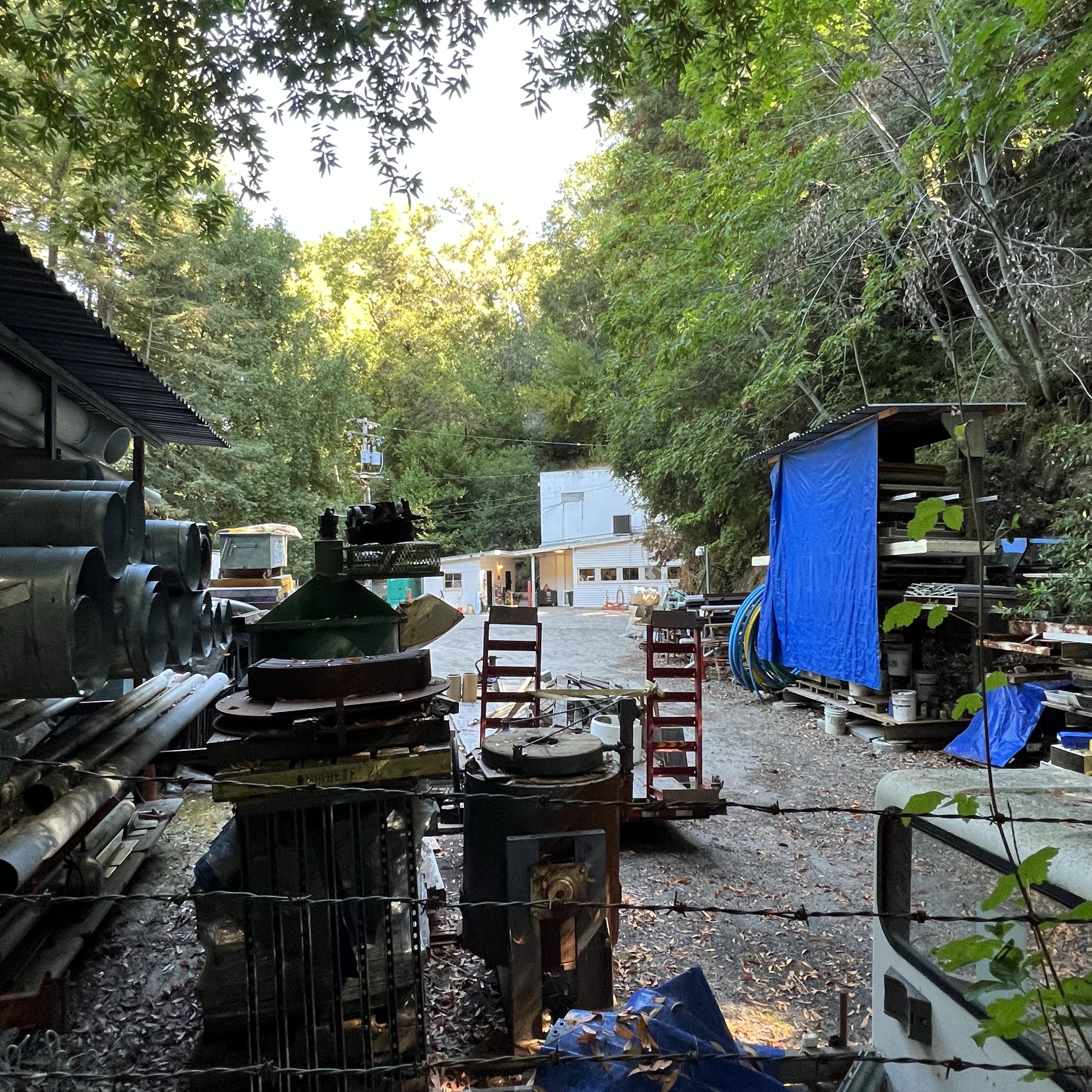
Peeping through the fencing toward the eastern portal of Tunnel No. 5. One of the two windowed buildings appears to be the guard shack. The parking lot now looks like an odd junk sale with junk that no one wants to buy!The former rail bed (sans rails) looking towards Eccles and Felton and Santa Cruz.
On a historic rail sketching adventure, Grasshopper and I headed up into the Santa Cruz Mountains to sketch a portal of one of the longest rail tunnels on the former South Pacific Coast Railroad (later Southern Pacific) route.
This 28 mile route started at Vasona Junction in Los Gatos and climbed over the Santa Cruz Mountains to the beach town of Santa Cruz.
Part of this route still exists as the Big Trees and Pacific Railroad which operates a tourist train from Felton to the Santa Cruz Beach Boardwalk.
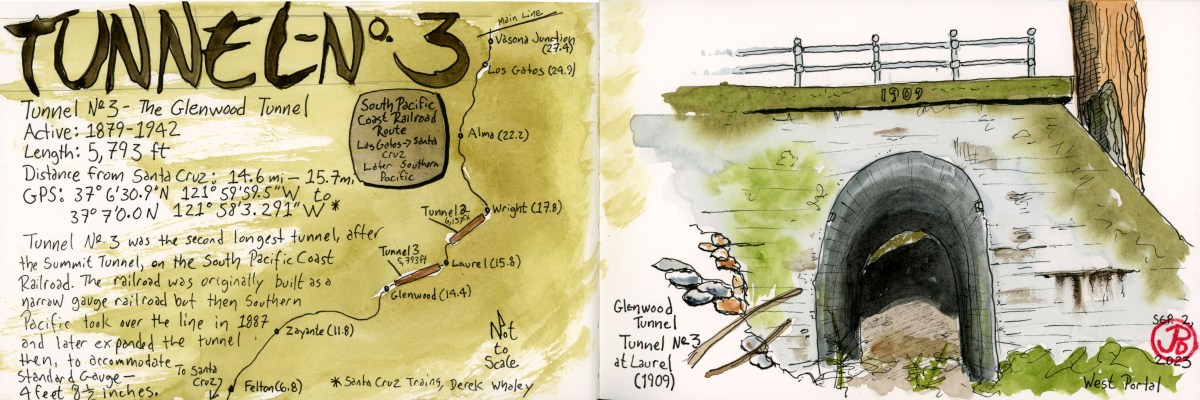
The tunnel we were looking for is the Glenwood Tunnel, also known as Tunnel No. 3. This 5,793 foot tunnel was active from 1879 to 1942. The original tunnel was built for narrow gauge but when Southern Pacific took over the line in 1887, they later converted the line to standard gauge (4 ft 8.5 in).
When the South Pacific Coast Railroad was first planned, then had to figure out how to get the road bed into the San Lorenzo Valley. To do this they had to built two one-mile long tunnels: Tunnel No. 2 (Summit Tunnel) and Tunnel No. 3 (Glenwood Tunnel).
From northbound Highway 17, we took the Laurel exit heading towards the former township of Laurel. We passed a few mountain homes and two bikers laboring up the hill as we headed down towards the former rail-bed.
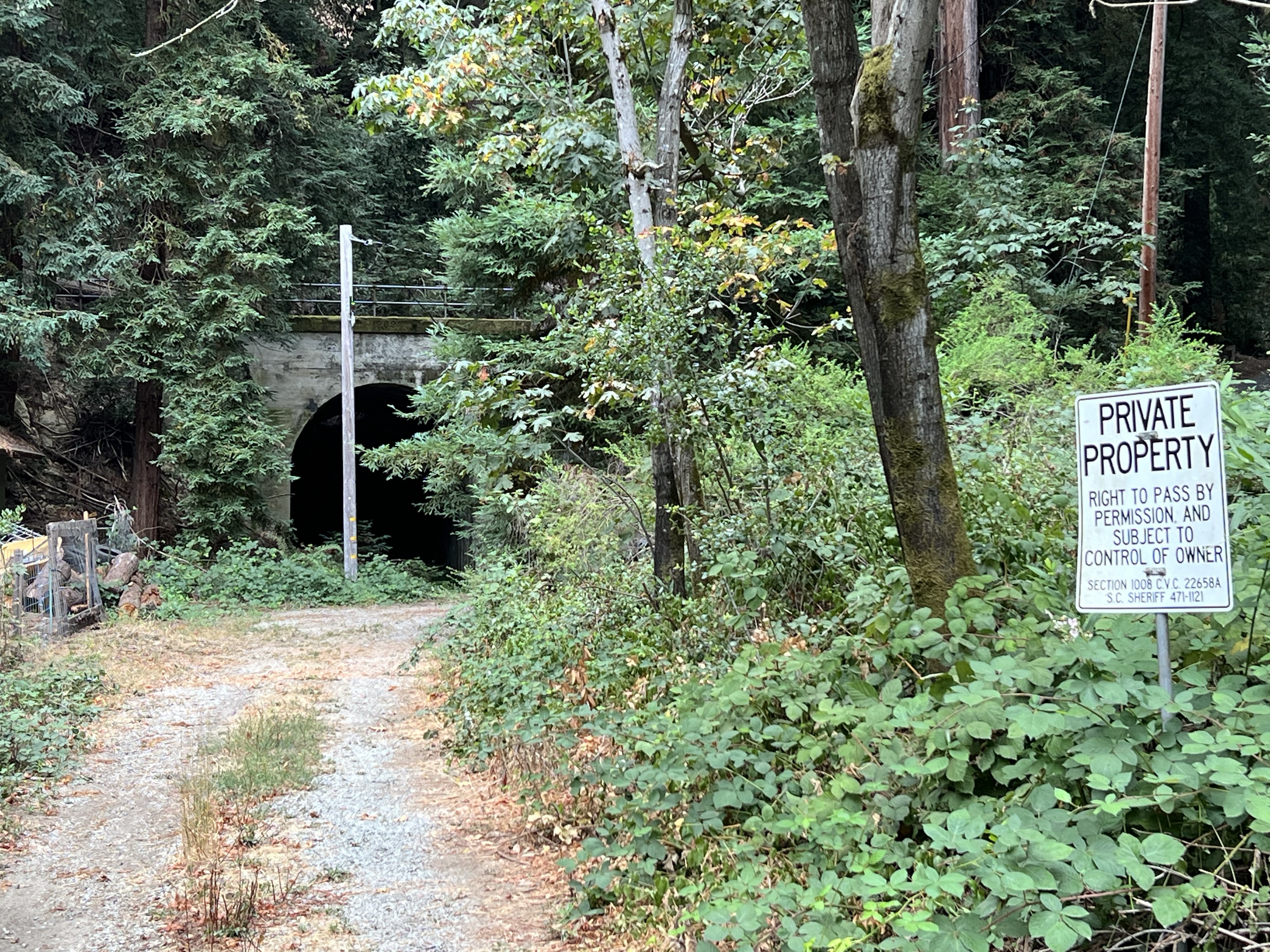
We parked and headed out to a get a better look. The west portal of the Glenwood Tunnel was visible, but parts were obscured by trees and a power pole. The “private property” sign kept us at bay. Was this the best view we would get?
The not-so-great view.
I climbed up a side road, probably also private property, that parallels the rail bed, to get a better sketching vantage point. Even here, the portal was obscured by redwoods but I started a sketch anyway (which, like Tunnel No. 3, I abandoned).
Not being satisfied with the sketch I returned to where Grasshopper was sketching. His only company was a barking dog on the other side of a fence. There was a house just to our left.
A man peeked over the fence with his cup of coffee and said, “You can walk up to the tunnel if you want.”
This was the owner of the house (let’s call him “Bill”) and we had a nice conversation with him about living in the redwoods, winter storms, history, his spring-fed water system, and trains and tunnels.
We thanked Bill and walked around the chain that crossed the rail bed and headed towards the western portal of the Glenwood Tunnel. Now this was the way to sketch the tunnel (featured sketch).
Grasshopper sketching the western portal of Tunnel No. 3. Bill’s spring-fed water system can be seen on the right.Corvidsketcher in the western portal of Tunnel No. 3.
We walked into the 1909 concrete portal. The tunnel ended in about 50 feet.
In 1940, winter storms and landslides closed portions of the route permanently. Southern Pacific made the decision to abandon the line. The major tunnels were dynamited at both ends, closing the tunnels for good. The concrete portals are all that still remain.
Now that we firmly had tunnel fever, we had to find the other side of the tunnel, the eastern portal.
Tunnel No. 3 now passes under Highway 17 so you have to cross over the highway to find the other end.
The eastern portal of the Glenwood Tunnel at Glenwood Drive.
The eastern portal of the Glenwood Tunnel is much harder to get to than the western portal. To get a comparable view you would have to scrabble down a steep hillside or trespass through a stable to reach the rail bed which now seems to be a creek bed.
So we had to make due and sketch the portal from the side of Glenwood Drive, which the concrete portal now supports.
On my latest sketching odyssey I headed to one my favorite locations in California, if not the world: Donner Pass.
Before I set out, I sketched the rail route of the East Slope of Donner Pass, heavily influenced by a map drawn by John Signor (author, artist, and former Southern Pacific employee) in his marvelous book: Donner Pass: Southern Pacific’s Sierra Crossing.
I would be driving parallel to the Central Pacific side of the first Transcontinental Railroad on Highway 80. In 1865 the railroad became Southern Pacific.
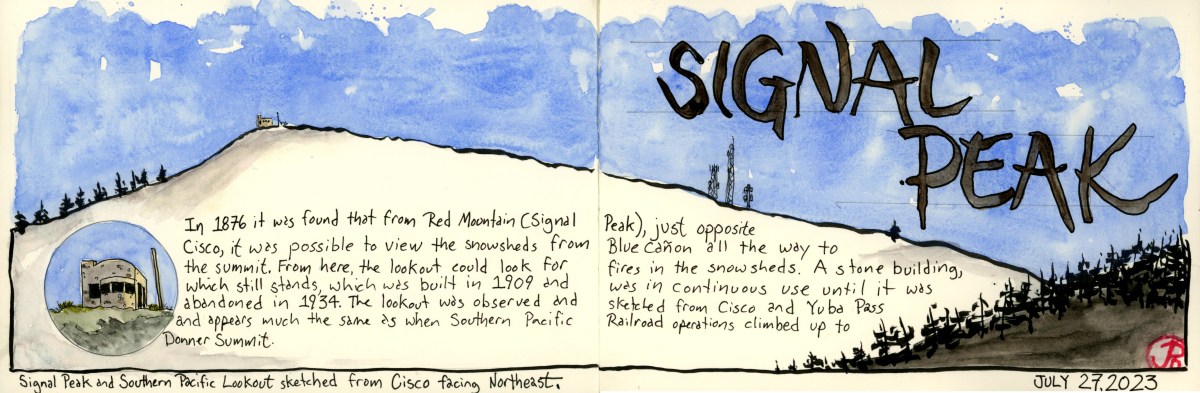
I was looking for a stone structure that was built in 1909 as a fire lookout and I reckoned that Cisco, which is directly across the valley from the building, would be my best position for seeing Southern Pacific’s fire lookout on Red Mountain.
The lookout on Red Mountain was built because, from this vantage point, the rail line from Blue Canon to Donner Summit could be observed. Because 50 miles of the trackage was above 5,000 feet in elevation, snow was a real problem for keeping the line open during the long winters. The solution was to build wooden snowsheds to keep snow off the tracks. Work on the snowsheds began in 1867 and the sheds were completed by 1873. In total, 30 miles of sheds where built.
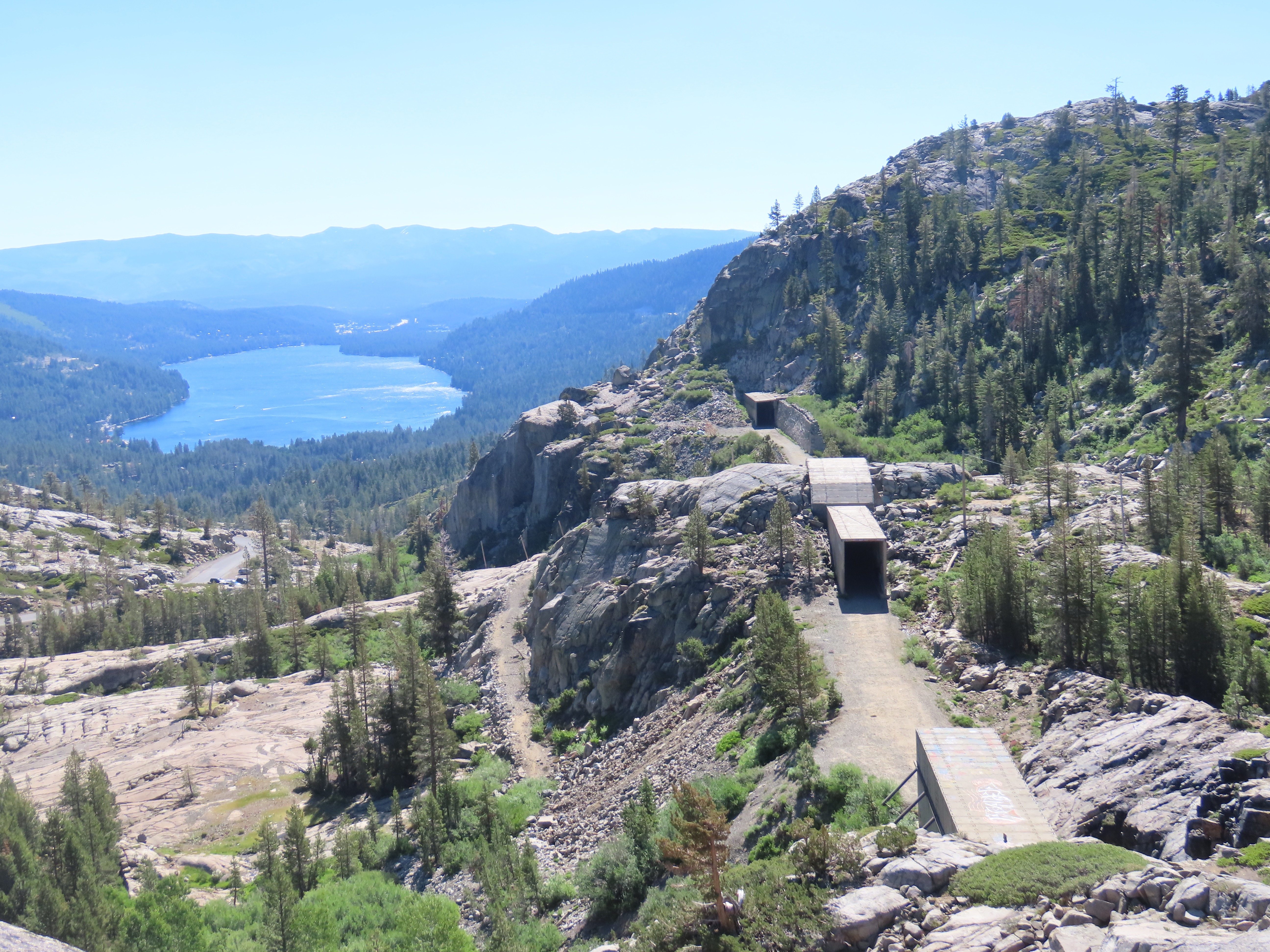
The view from Donner Summit. On the right is the original rail bed of the Transcontinental Railroad. The east portal of the Summit Tunnel (Tunnel #6) and Tunnel #7 is beyond. The snowsheds are made of concrete, replacing the flammable wooden sheds. In the middle ground is Historic Highway 40 and in the background is Donner Lake.
When you combine wooden snowsheds with wood burning steam locomotives the result can be fire.
Southern Pacific employed fire trains that could be called into action to put out fires in the snowsheds but first someone had to observe the smoke. This is where the fire lookout came into play.
The fire lookout was in continuous use until 1934 when it was abandoned.
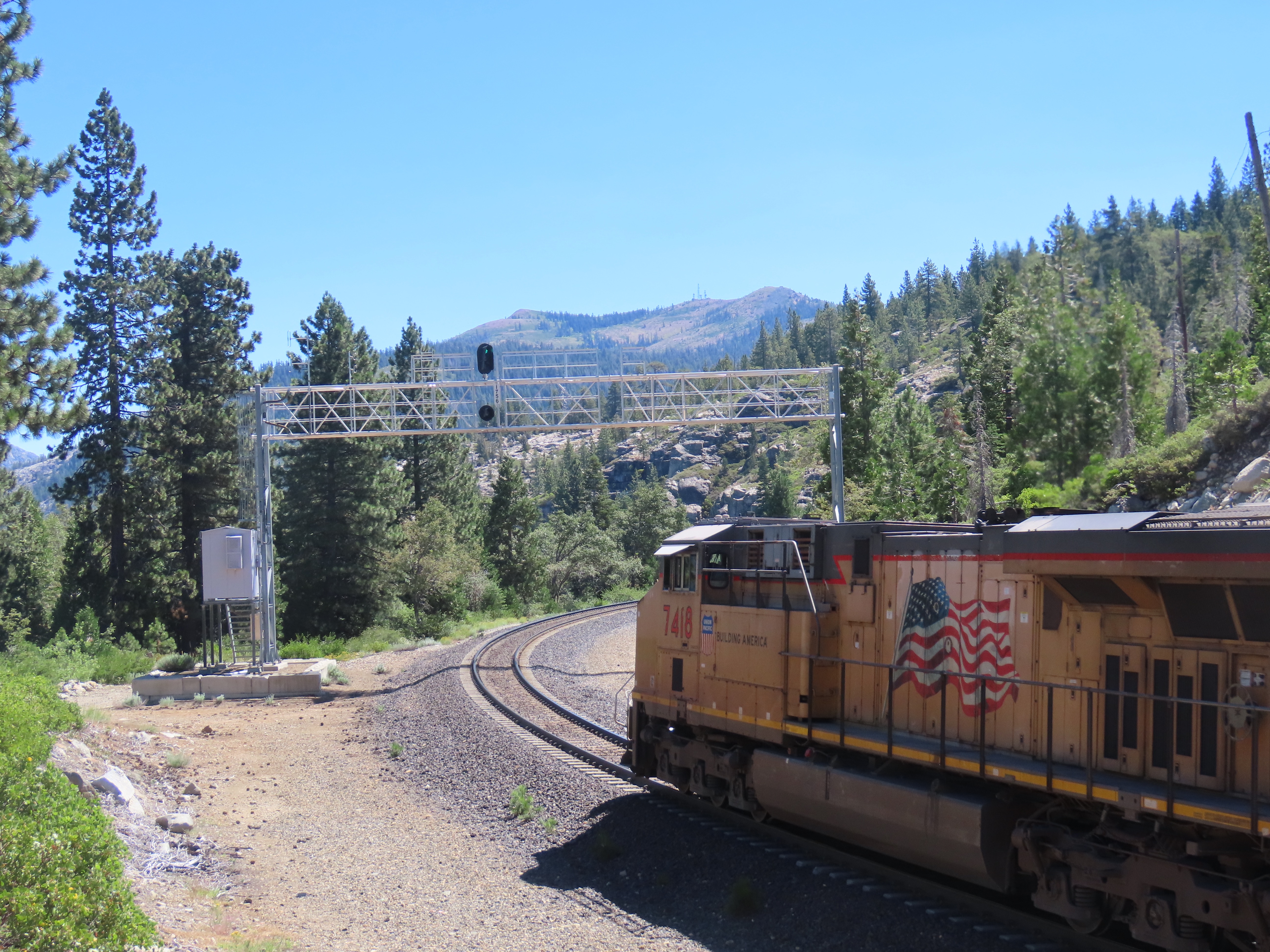
Before I got to Cisco, I pulled off Highway 20, just before it merges into Highway 80 at Yuba Pass. From here I looked down the line and just above the signal gantry was Signal Peak and to the right I spotted the prominent silhouette of the fire lookout.
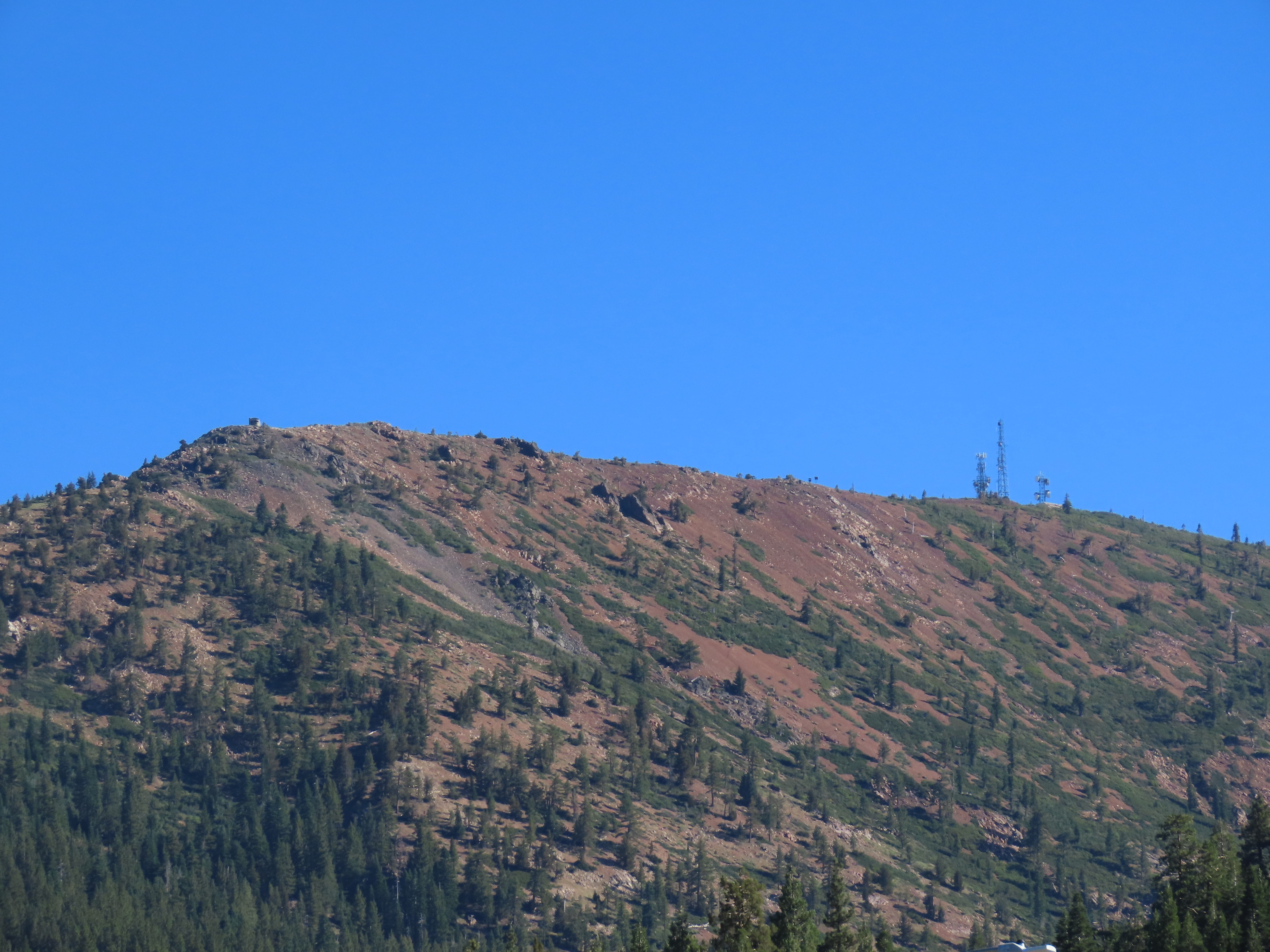
Yuba Pass with Red Mountain and Signal Peak in the background.
I headed east on 80 for one stop, I took the Cisco exit which just a service station stop. I pulled behind a parked truck and looked to the northeast across the highway.
Behind me, further up the hill was the mainline. In front of me was Red Mountain and Signal Peak. To the right was antennas and towers, to the left was the Southern Pacific fire lookout.
Red Mountain and Signal Peak.
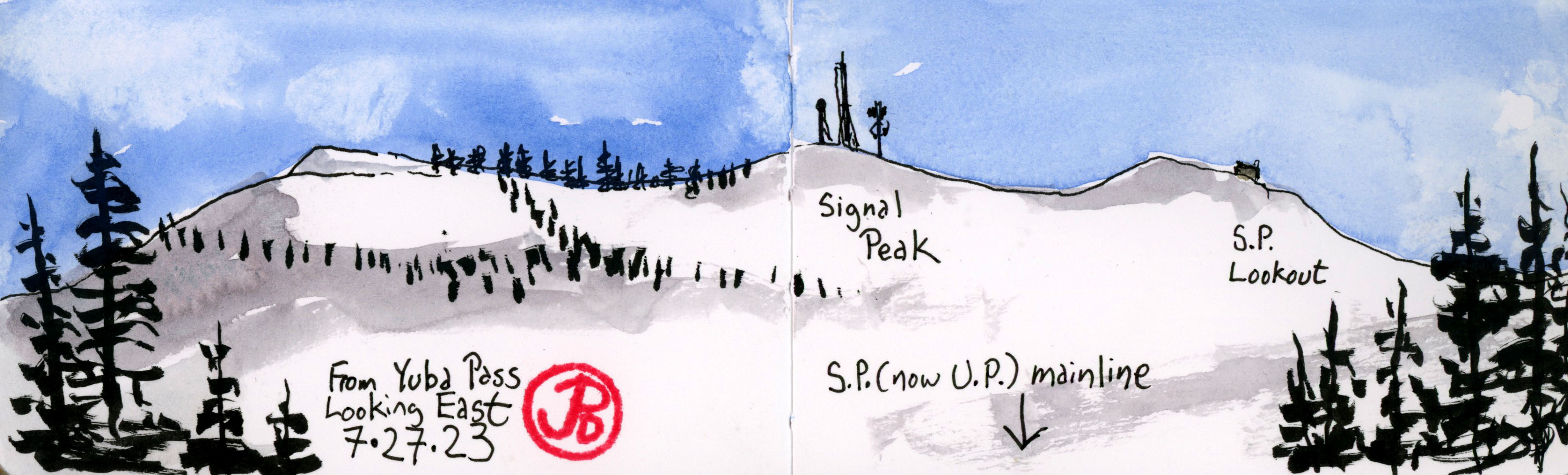
Now it was time for a sketch using my Delta panoramic journal (featured sketch) to capture the peak.
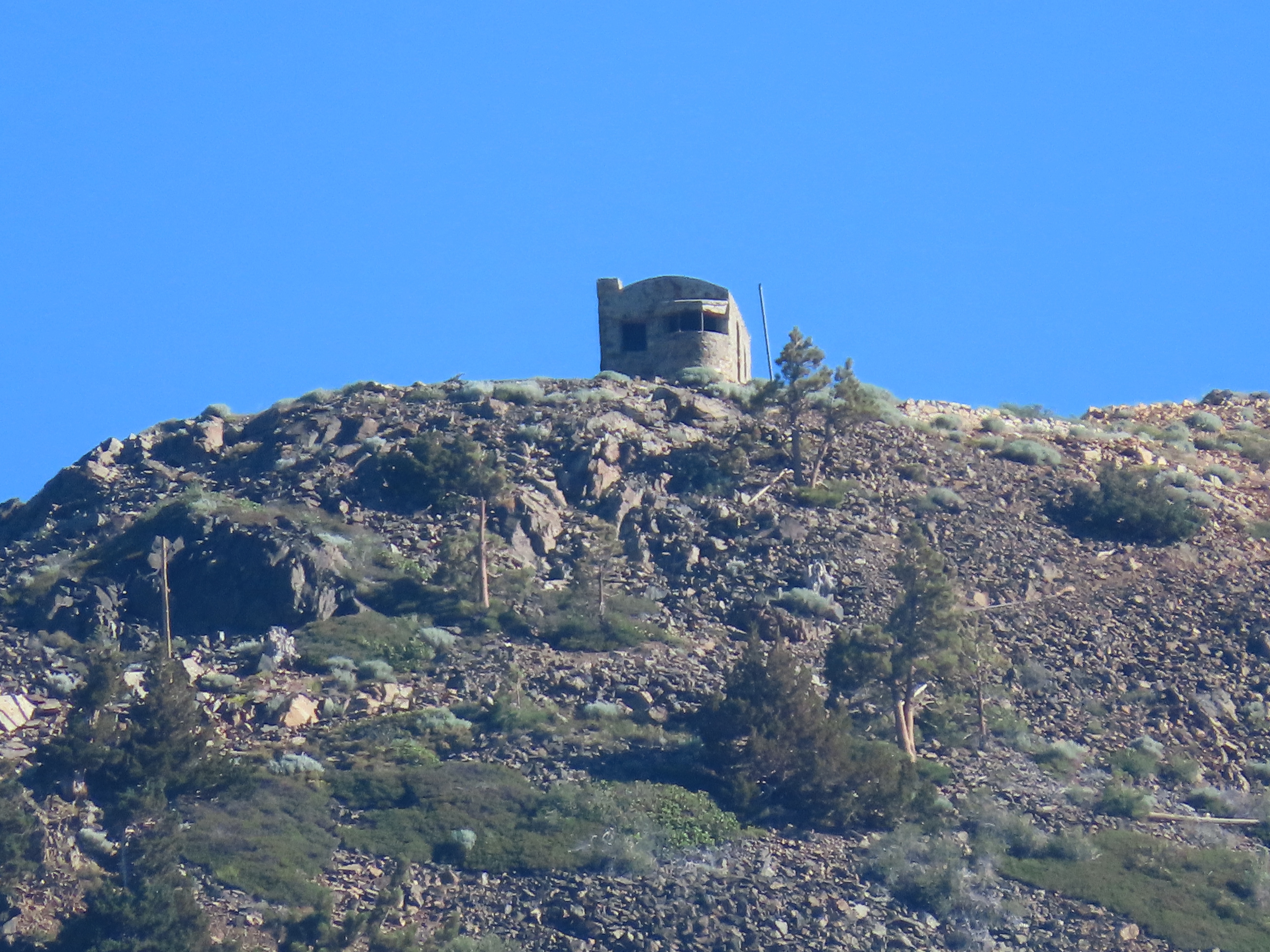
Close up of the Southern Pacific stone lookout built in 1909 and used until 1934.
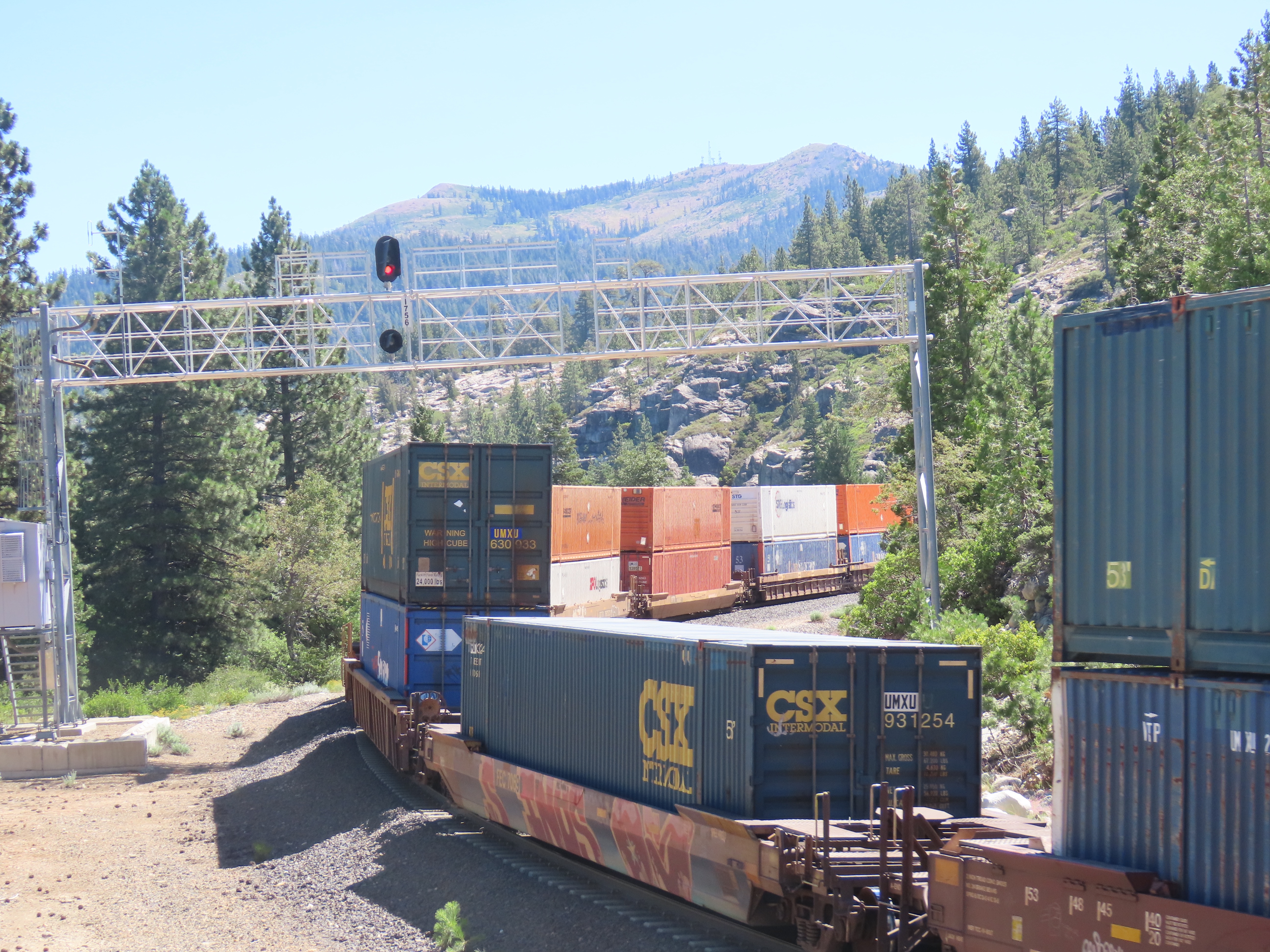
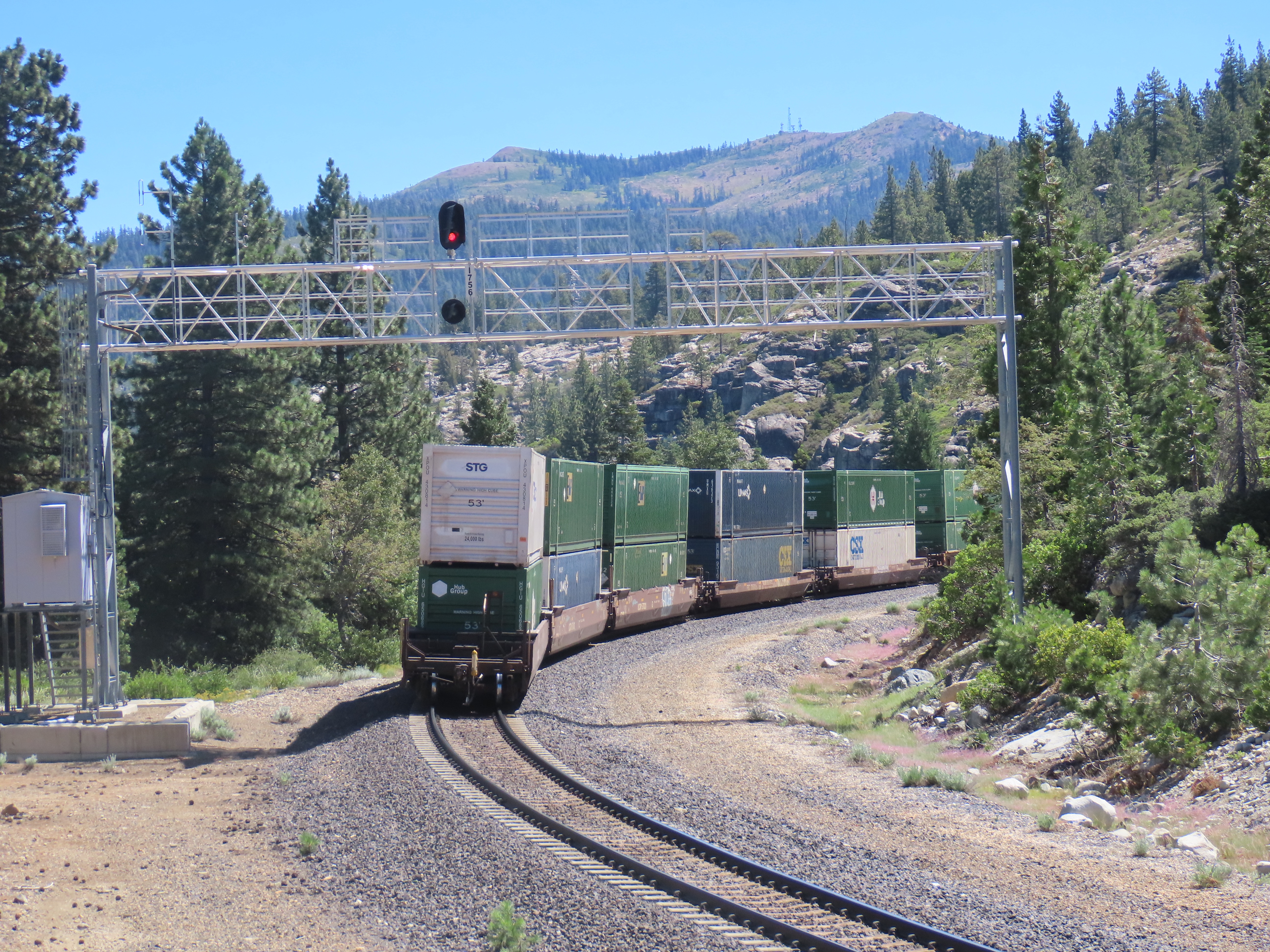
I returned to Yuba Pass to get a sketch of Red Mountain from this perspective. The signal on the gantry was green so an eastbound freight was imminent. Before long I could hear the rumble of a Union Pacific intermodal freight train climbing the grade towards Donner Summit. This consist contained six locomotives and I lost count of how many cars it train contained. (In truth I didn’t attempt to count. Seeing this long freight train mean less truck traffic on America’s highways).
What follows is a series of photographs of the UP freight making the climb to Donner Pass with Signal Peak in the background.
The caboose at the end of a freight train is a thing of the past. They have been replaced by technology as railroads cut wages and other expenses. In their place is a small box on the end of the train called a ETD (end of train device).
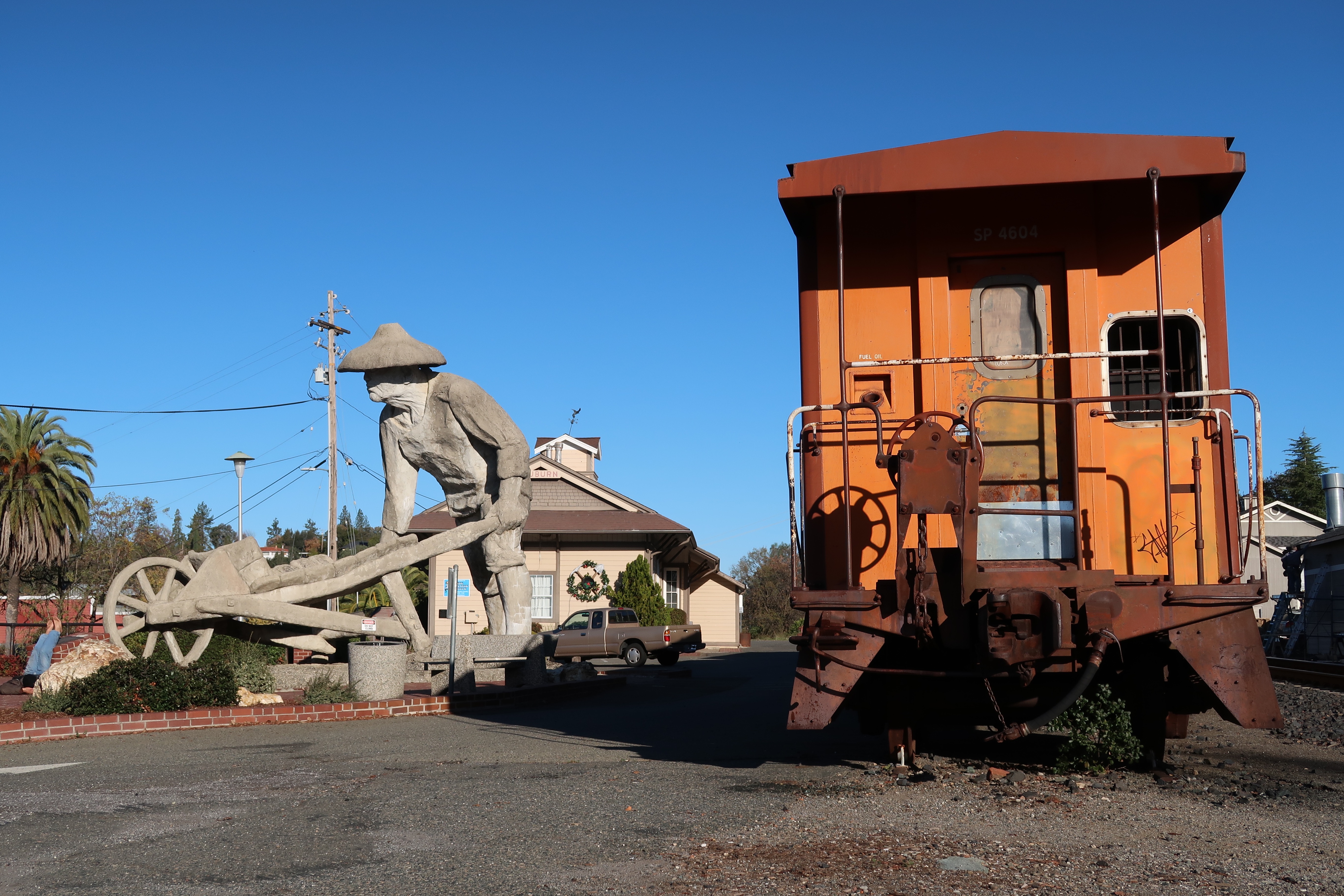
It is not uncommon to find cabooses on static display at museums or near historic railroads. In Auburn, California, an example of one of the last batch of a caboose ordered by Southern Pacific is outside the old Auburn Train Depot. This is a bay window C-50-7 caboose that was built by SP in 1978. This is a very young caboose indeed because ten years later, it was uncommon to see a caboose at the end of a freight train. SP # 4604 was coming to the end of an era.
I headed to Auburn with the intention of sketching the SP caboose. I set up my sketching chair and took up my position behind the caboose and if I was watching a freight train receded down the tracks. Only this caboose was going nowhere anytime soon.
To my left is the large concrete sculpture of a Chinese “Coolie” railroad laborer. This 22 foot tall , 70 ton statue was created by Dr. Kenneth Fox. Fox was a local dentist who created other large concrete statues. Some of the other statues can be found on the opposite side of Highway 80. As well as the gold panner representing Claude Chana near the historic downtown.
Dr. Fox passed away on November 17, 2020 at the age of 95. His massive sculptures are sill found around Auburn including his controversial nudes of mythical warriors that stand outside of his former dental office. They are collectively known as the “Great Concrete Statues of Auburn”.
Most of these statues where created in the 1960s and 70s but they were a little too graphic for Auburn at the time. School bus routes were rerouted so buses would not pass by the topless Amazonian women.
I would love to return to Auburn and sketch these oddities in concrete.
There still standing after 50 years. The archer (on the left) at 42 feet tall, is the tallest statue that Dr. Fox ever created.
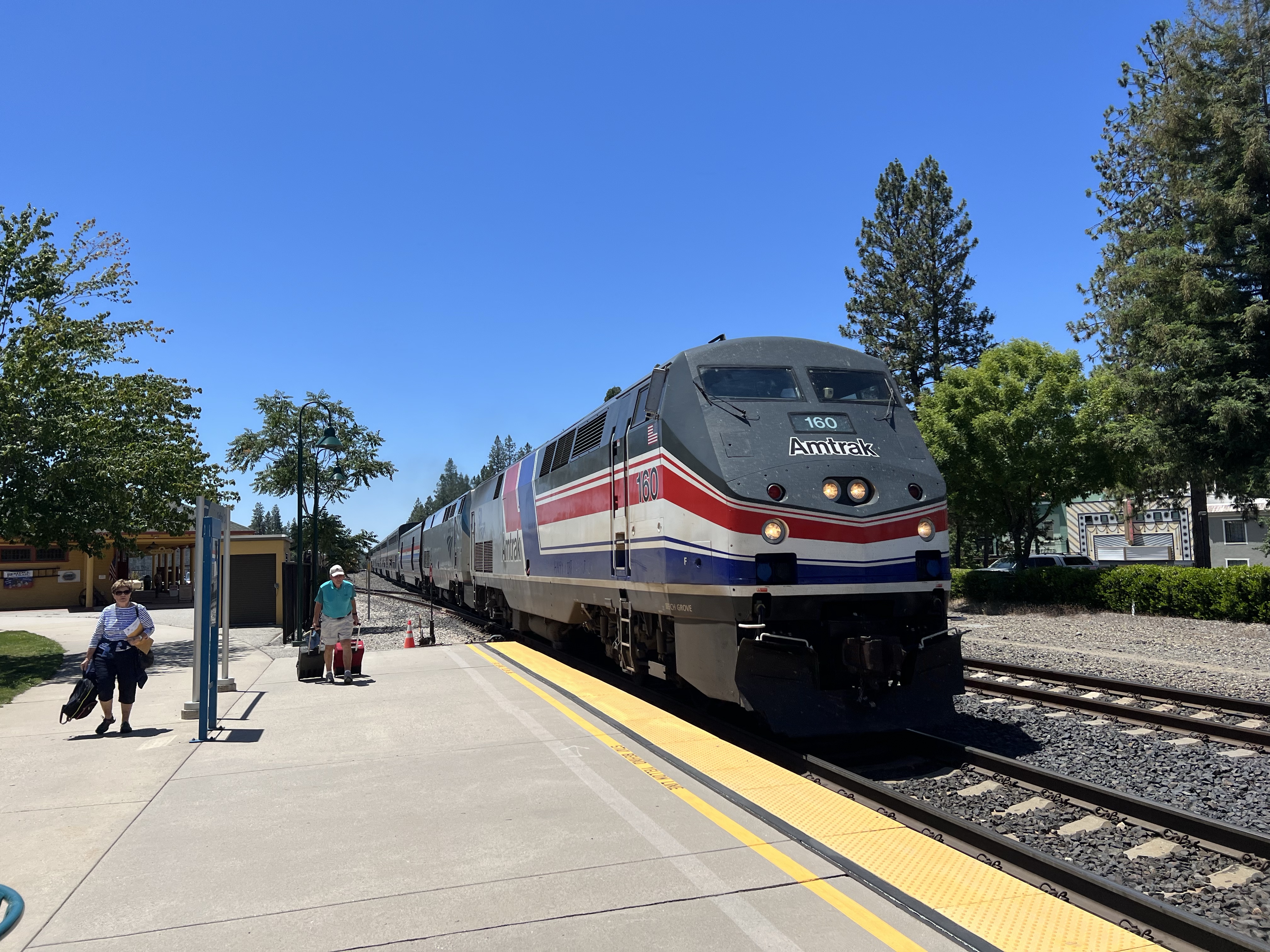
The California Zephyr Train number 6 pulled into Colfax Station running about 30 minutes late.
I was boarding the Zephyr with my mom and her husband Steve and we were heading to Denver, Colorado. We would be spending the night and eating three meals a day on the Zephyr. This is AMTRAK’s longest daily route and it is a village on rails.
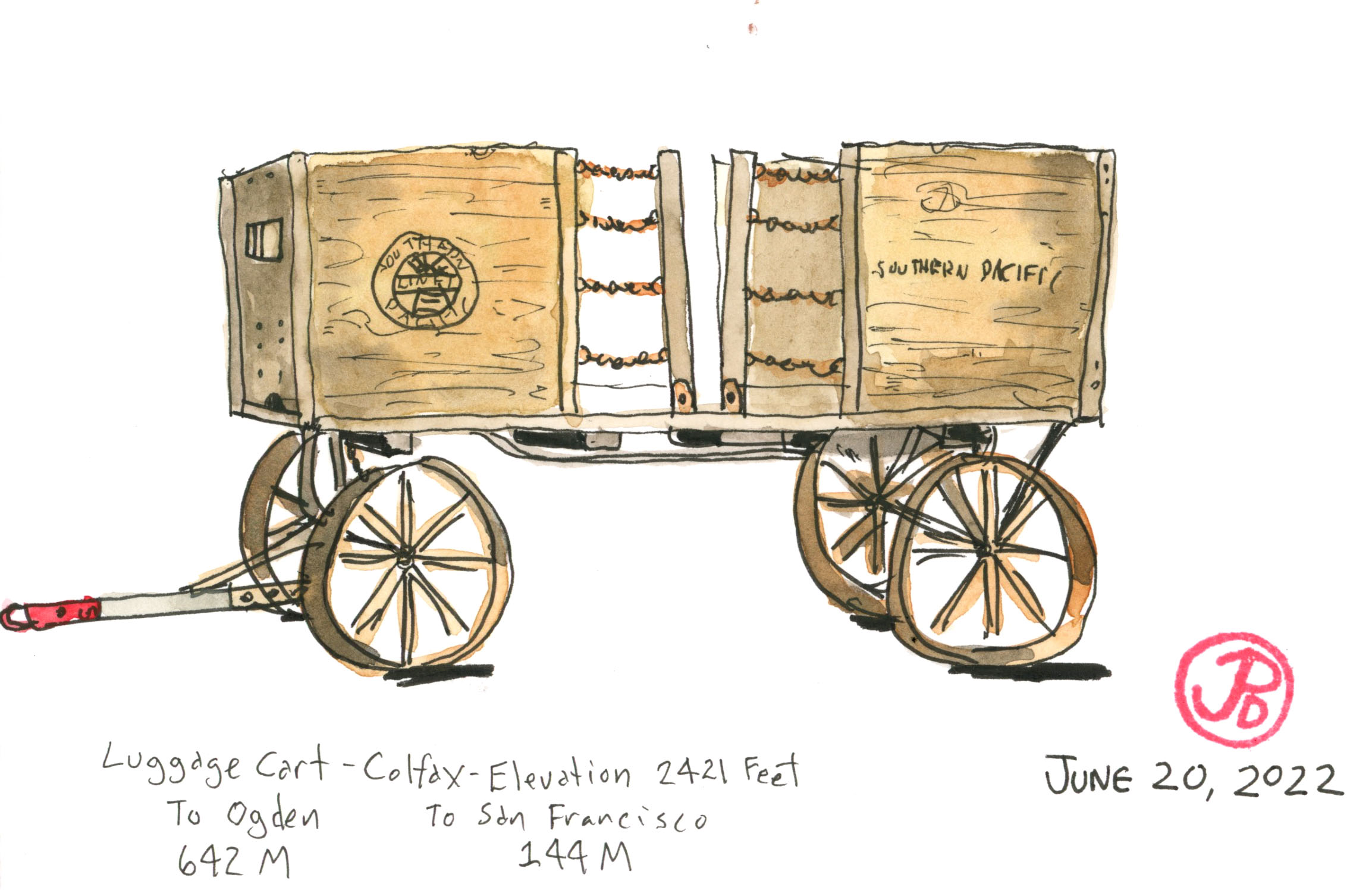
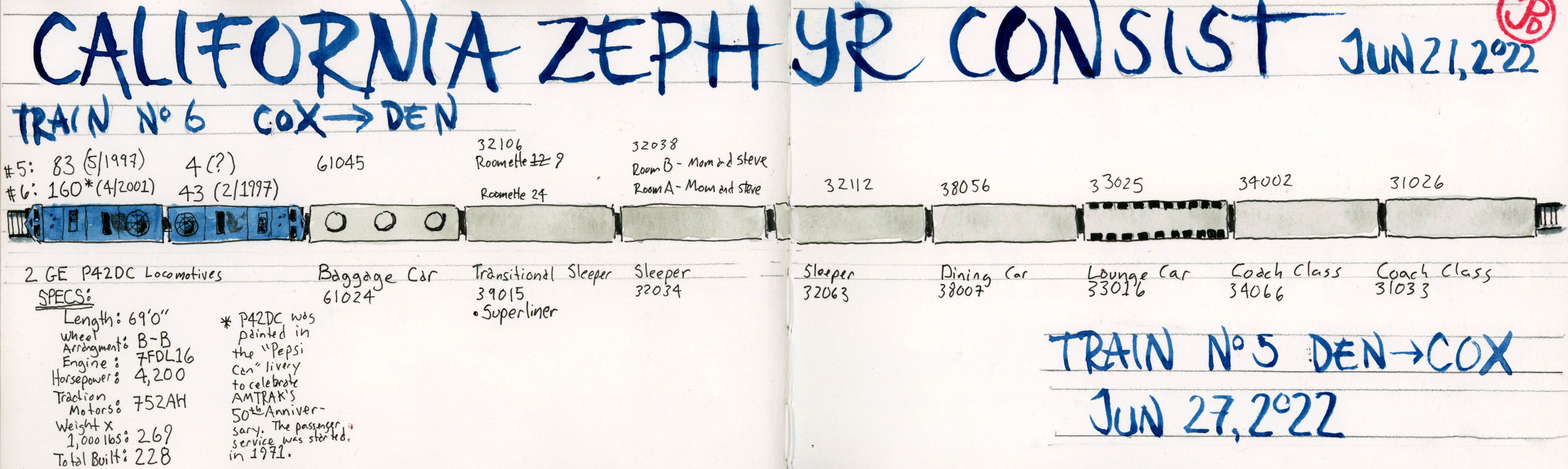
I did a few pre-trip sketches. The first is of the predicted consist of our train. A consist is the make up of the train, for instance: two locomotives, a baggage car, three sleeper cars, a diner car etc. I anticipated two locomotives and eight cars. Turns out I guessed right. I sketched them in and I would label them later during our first stretch break in Reno, Nevada. The second was the baggage cart outside Colfax Station, which I did the day before we boarded the Zephyr.
The eastbound California Zephyr pulls into Colfax. We were the only passengers who boarded. Mom and Steve are “racing” to the platform before the Zephyr’s short stop is over.
I was familiar with sketching from the California Zephyr from my previous trip last April. You have to sketch fast, taking in passing information creating an overall composite or impression. The brush pen was the perfect tool for Zephyr sketching.
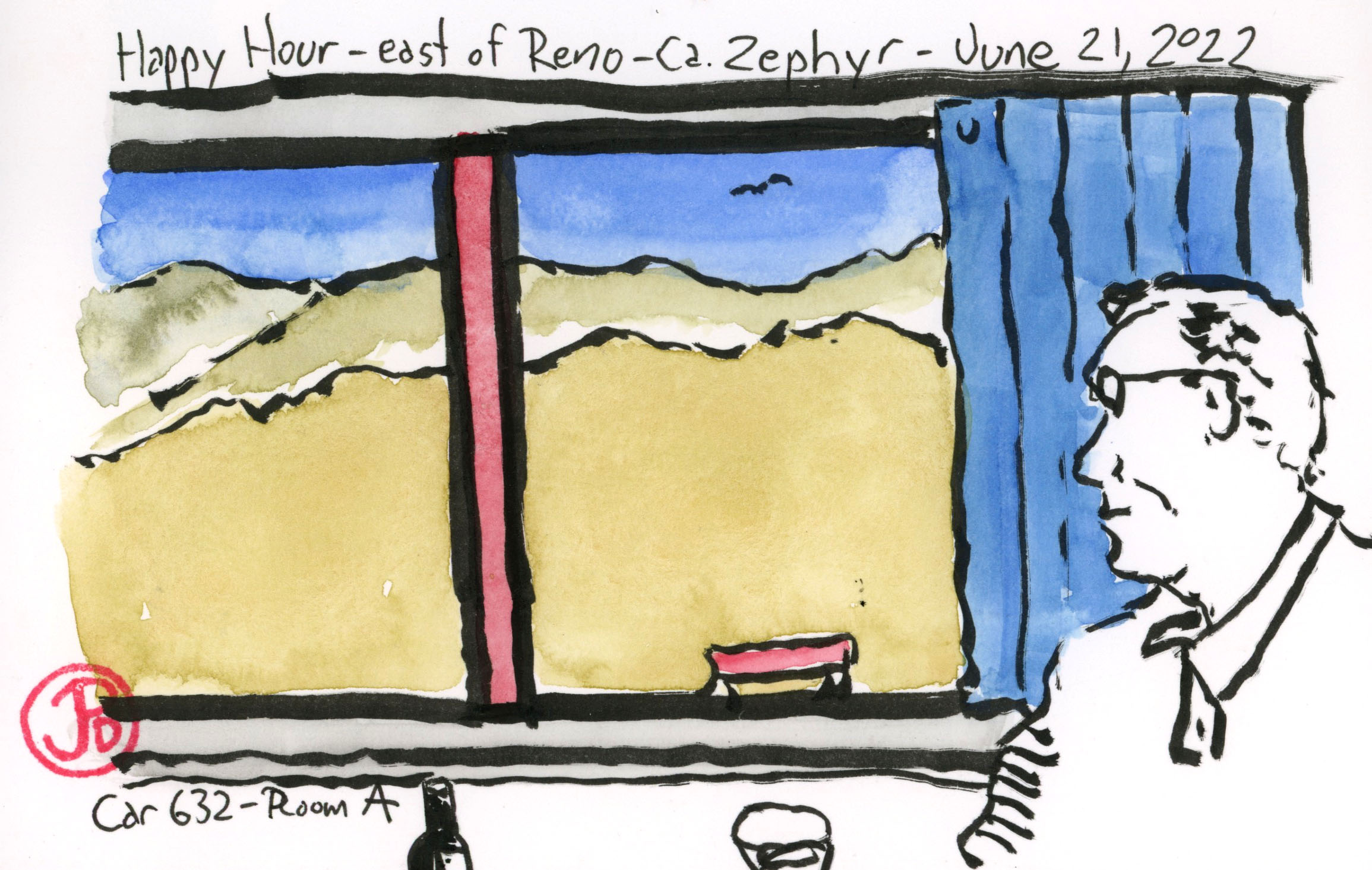
One of my favorite Zephyr sketches was done in Room A (Mom and Steve’s room) during happy hour. We where somewhere east of Reno.
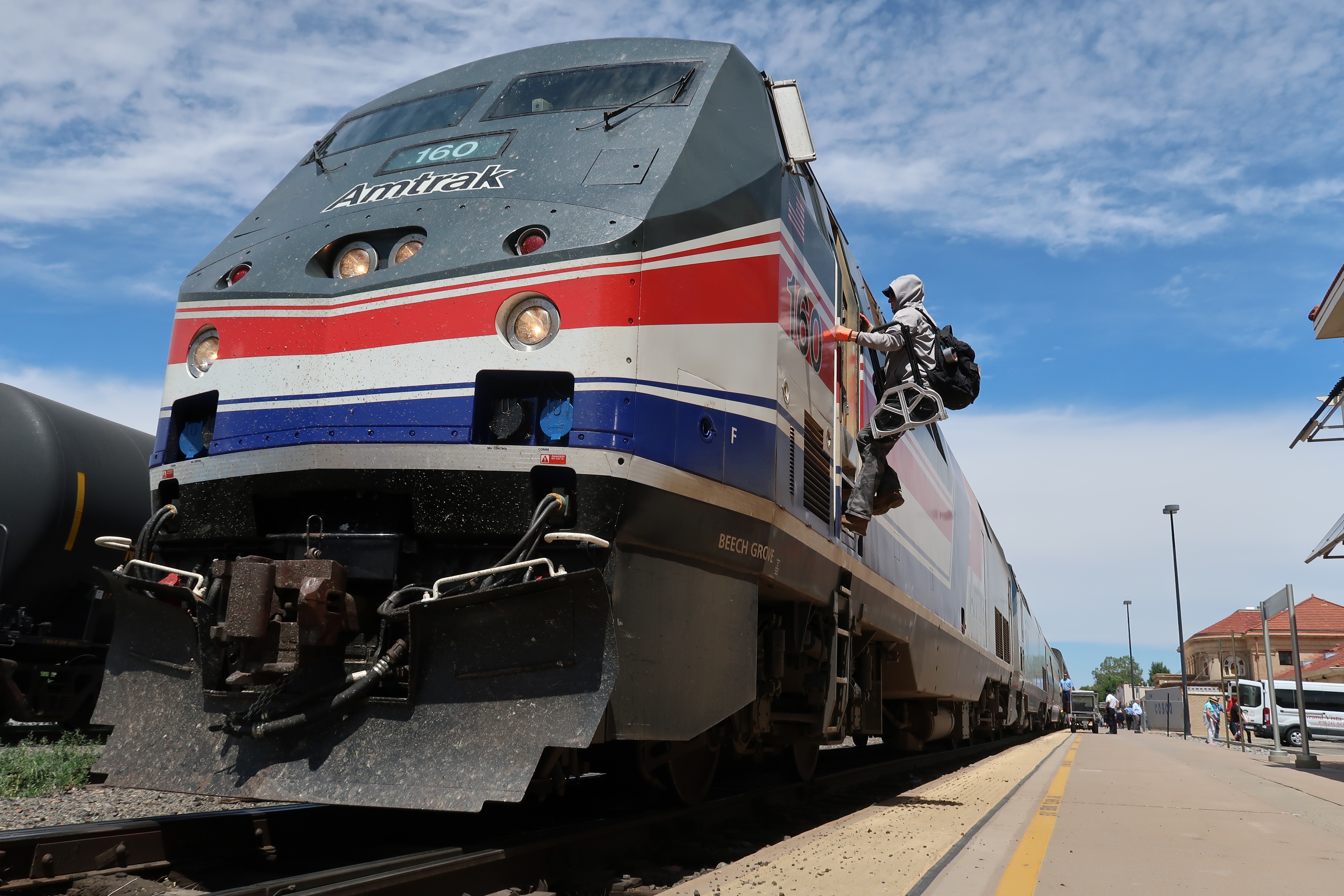
Crew change at Grand Junction, Colorado. Locomotive 160 painted in it’s “Pepsi Can” livery, to celebrate AMTRAK’s 50th anniversary.
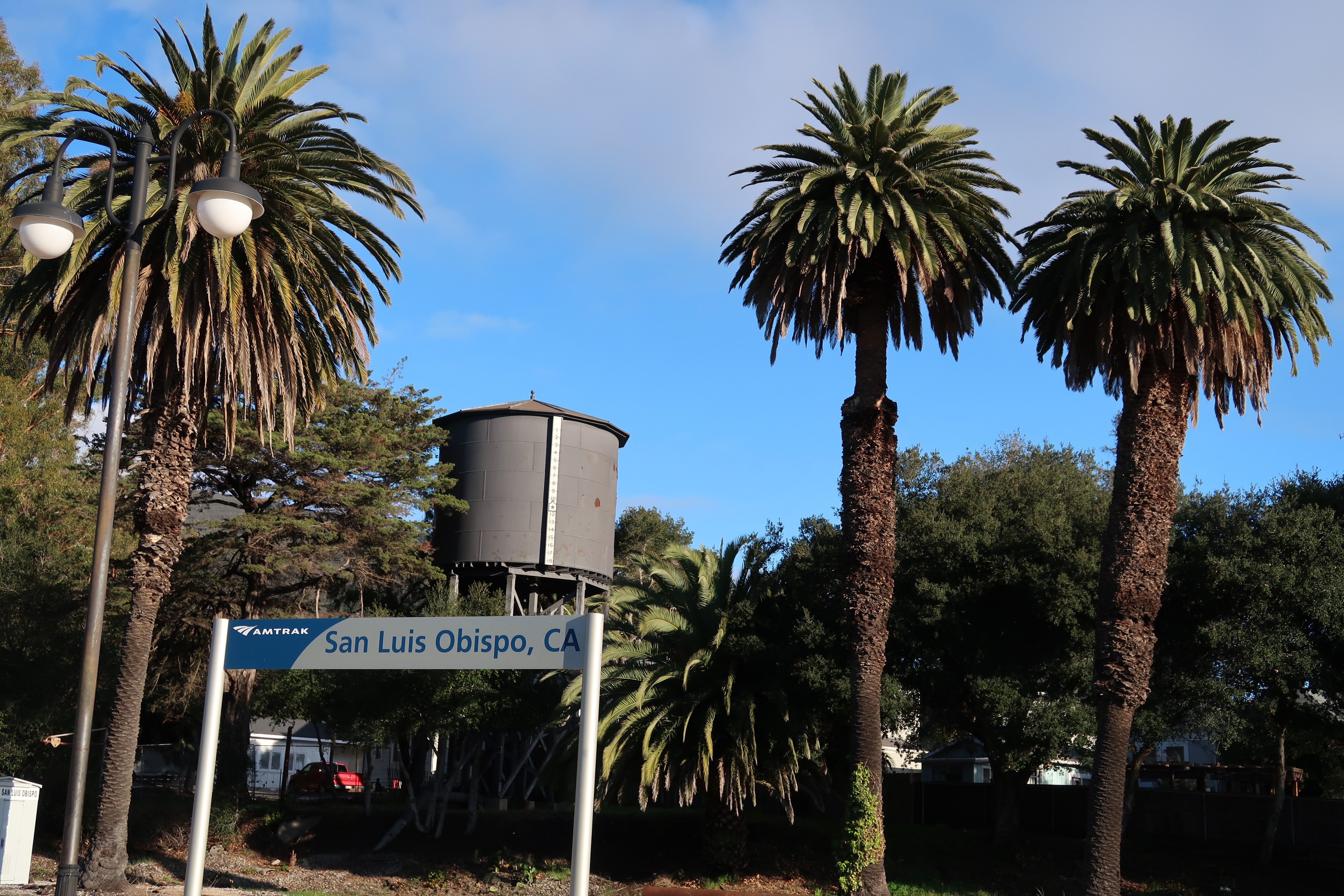
On my way back to the Bay Area from my Malibu adventure, I overnighted in San Luis Obispo. There was a water tower, across the line from the passenger depot that I wanted to add to my sketchbook. One of the few Southern Pacific water towers still standing in California.
I timed my visit with the arrival of Train # 14, the northbound Coast Starlight. This is an AMTRAK route that starts in Los Angles and terminates in Seattle, Washington.
I had about 20 minutes to sketch the water tower before the 14 pulled into San Luis Obispo. The train was already running 30 minutes late. I picked my position and started to sketch. A voice over my shoulder ask if was riding coach or had a roomette.
The voice belonged to an AMTRAK conductor who was about to board the train, SLO is a crew changeover point. I told him I wasn’t boarding the train, just sketching the tower. We had a conversation about other Southern Pacific existing water towers. He recommend a very large tower in the desert of Arizona that I should visit.
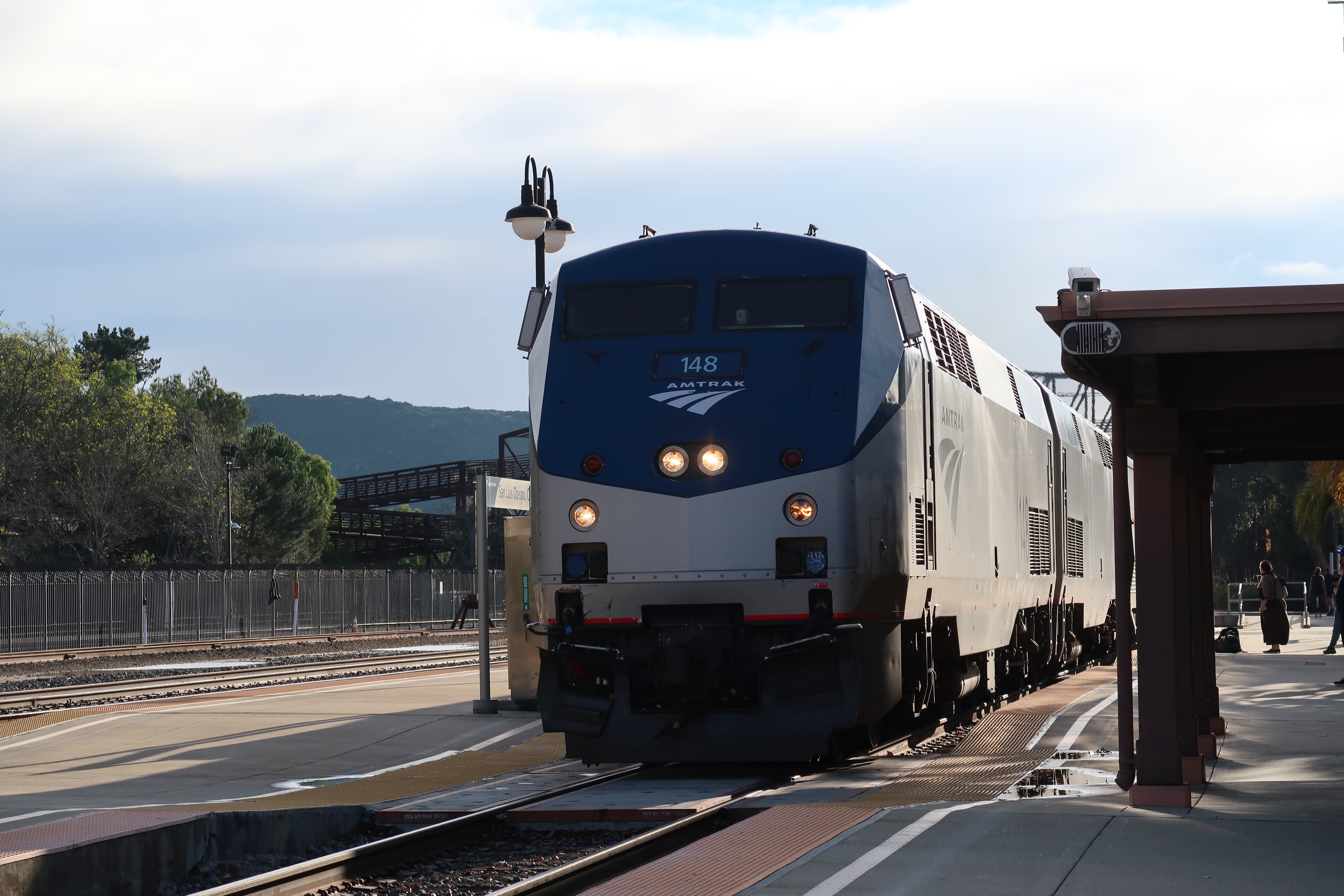
The Coast Starlight arriving at San Luis Obispo, 30 minutes late.
With the recent heavy precipitation over Donner Pass, I wondered aloud if the rotary plows at Roseville had been put to work to clear the pass. The conductor didn’t know. Before long the Coast Starlight pulled into the station and I looked down at my sketchbook and I hadn’t gotten very far but I had a nice conversation with a railroad working man. Two rail nerds chewing the fat!
SLO is was is called a stretch stop, also known in another time as a smoke stop, where the Starlight pauses for about 20 minutes so passengers can get out and stretch their legs, or poison their lungs with nicotine. This is also where crews, engineers and conductors, change over.
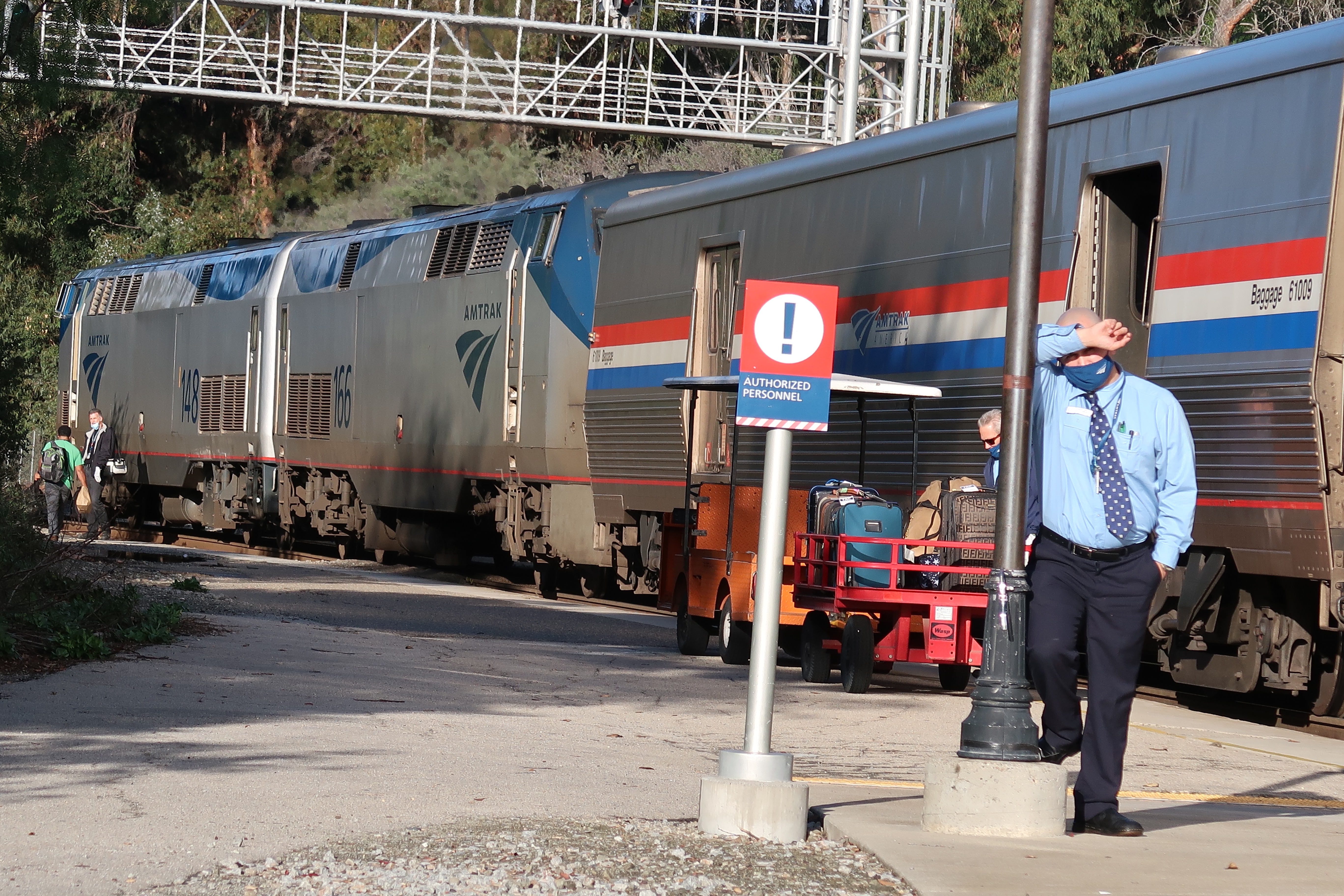
This photos says a lot. The conductor monitors the progress of boarding the train, baggage is being loading into the baggage car, and the engineers are changing over.
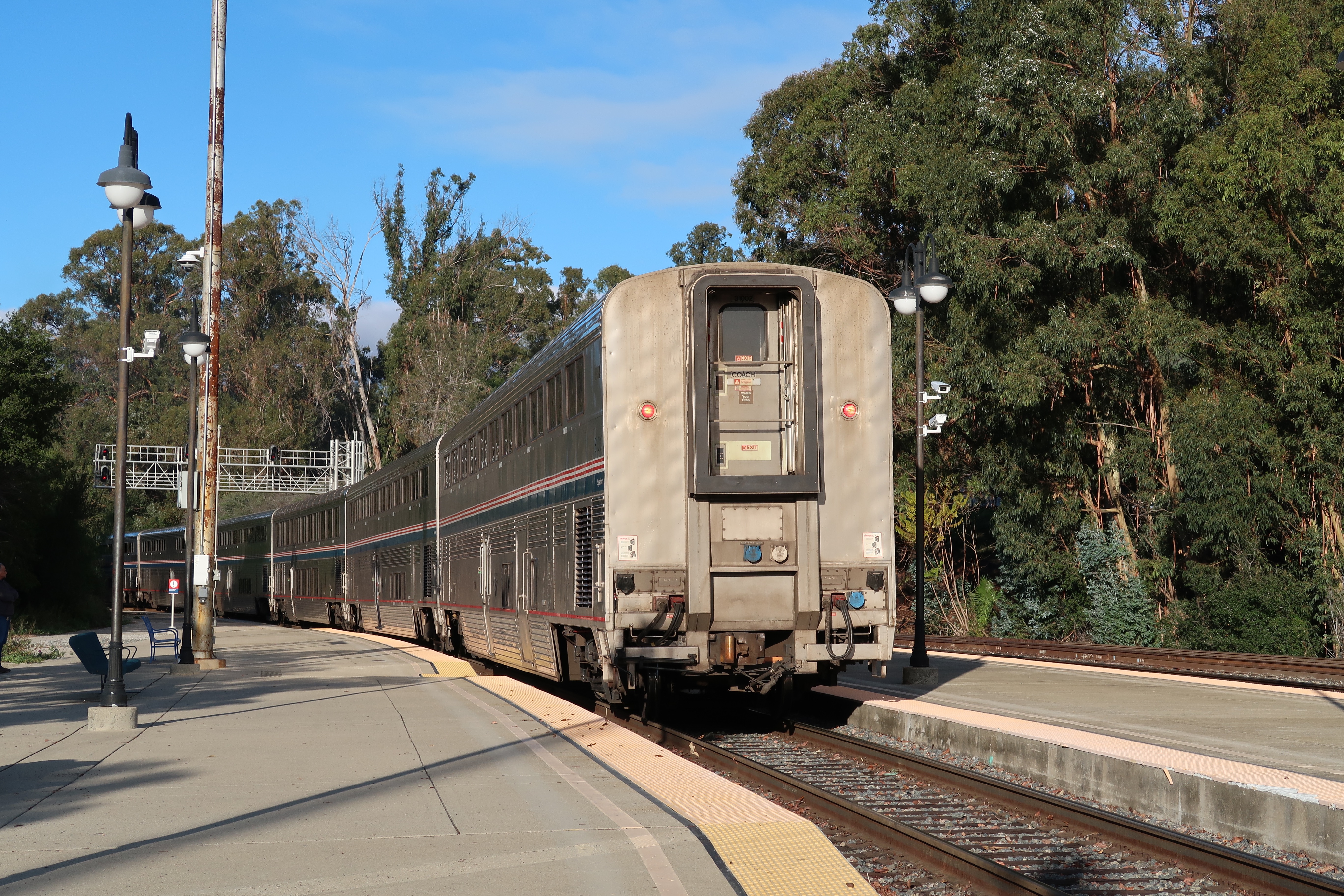
I couldn’t continue sketching because a double decker Superliner passenger car was now between myself and the historic water tower. So I watched the interactions on the platform instead. Passengers where doing laps, other where boarding, some hanging back from the train were vapping, and the train crew was in the process of changing over.
“All aboard!” And passengers filtered back into the cars. The locomotive sounded it’s horn. It was time for the Starlight to start its climb up the Horseshoe Curve on the Cuesta Grade and I watched the train slowly disappear around the curve.
I now turned back to the water tower and restarted my sketch.
The SLO 65,000 gallon water tower was built in 1940, at a cost of $2,130. The watertower was built across from the passenger station so steam locomotives could take on water without having to back into the yard further south down the track. At that time, ten passenger trains passed through SLO. The tank was in service until 1956, when steam was replaced with diesel on the coast line. The tower was preserved and restored by 1998.
On my journey from California to Colorado, I had a few historic sights I wanted to sketch along Highway 80 in Wyoming. This is Union Pacific territory, and the route over the Wasatch Mountains from Ogden Utah to Green River is legendary.
The Evanston Roundhouse and the Ames Monument are relics from a different time. The roundhouse was of a time when steam was the prime motive power of the Union Pacific and the monument the Ames brothers at Sherman Summit is no longer near the mainline (the line is now three miles to the south).
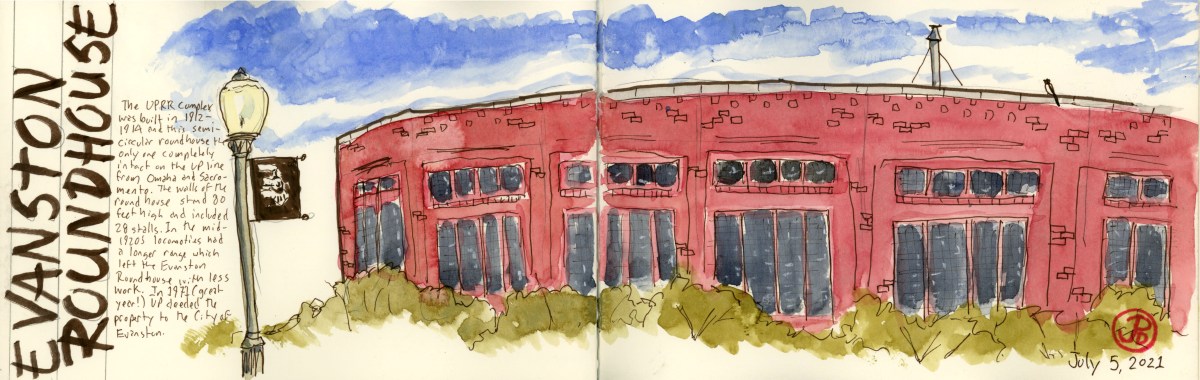
The Evanston Roundhouse is notable because it is the last completely intact roundhouse left on the Union Pacific line from Sacramento to Omaha. It had 28 stalls and is 80 feet high.
The roundhouse at Evanston on the left and the powerhouse on the right. The rusted, overgrown tracks in the foreground tells us that this complex has not been used by Union Pacific for a long time. I had to walk a ways back to photograph the whole massive roundhouse.
The roundhouse and yard was build by UP from 1912 to 1914. The roundhouse was part of a 27 acre complex to service steam locomotives. When steam locomotives became more efficient, they did not need to make so many service stops and the yard at Evanston was often bypassed. The Union Pacific deeded the property to the City of Evanston. The roundhouse is now used as a conference center and a meeting place.
Standing before the red brick semicircular roundhouse reminded me of a Plaza de Toros in Spain. Looking at just one part of the structure gives no indication of it’s form. I sketched one side of the roundhouse with the roofline slowing curving around (featured sketch). To see the entirety of the roundhouse, one has to walk back from the roundhouse by at least 100 yards to take it all in.
An intermodal freight passing through Evanston. The two locomotives on point represent the Transcontinental Railroad. The Union Pacific is pointed east towards Cheyenne and behind # 8990 is a former Southern Pacific locomotive (representing the Central Pacific) facing west toward Sacramento.
The next Union Pacific site is to be found off Highway 80 near the town of Buford (population 1). This is a monument to two brothers who were essential in creating the Union Pacific side of the Transcontinental Railroad.
The Ames Monument was built by the Union Pacific and dedicated to the brothers Oakes and Oliver Ames. It marked the highest point on the original Transcontinental Railroad at Sherman Summit at 8,247 feet. Oliver was one of the first presidents of the Union Pacific Railroad (from 1866-1871) and his brother Oakes was a U.S. Representative from Massachusetts. Both brothers, at the request of Lincoln, were put in charge of financing and building the Union Pacific portion of the railroad. Without the contribution of the Ames brothers, the railroad might never have been completed.
The 60 foot pyramid was build in 1880-1882 of granite at the cost of $64,000. On two side are base-relief portraits of each brother. In 1901, Union Pacific rerouted the mainline a few miles to the south.
On my first attempt to sketch the Ames Monument, a thunderstorm rolled in from the west. This monument being 60 feet high and at one of the highest points on the original Transcontinental Railroad, I though it would be wise to head to my car and return in the morning!
I wanted to experiment with underpainting for some recent field sketches. First I put down a loose, cool, blue wash and on another page a warm orange-red wash. I kept it loose with some paint splatter and some ghosting.
Now I had to find a subject to lay over the wash.
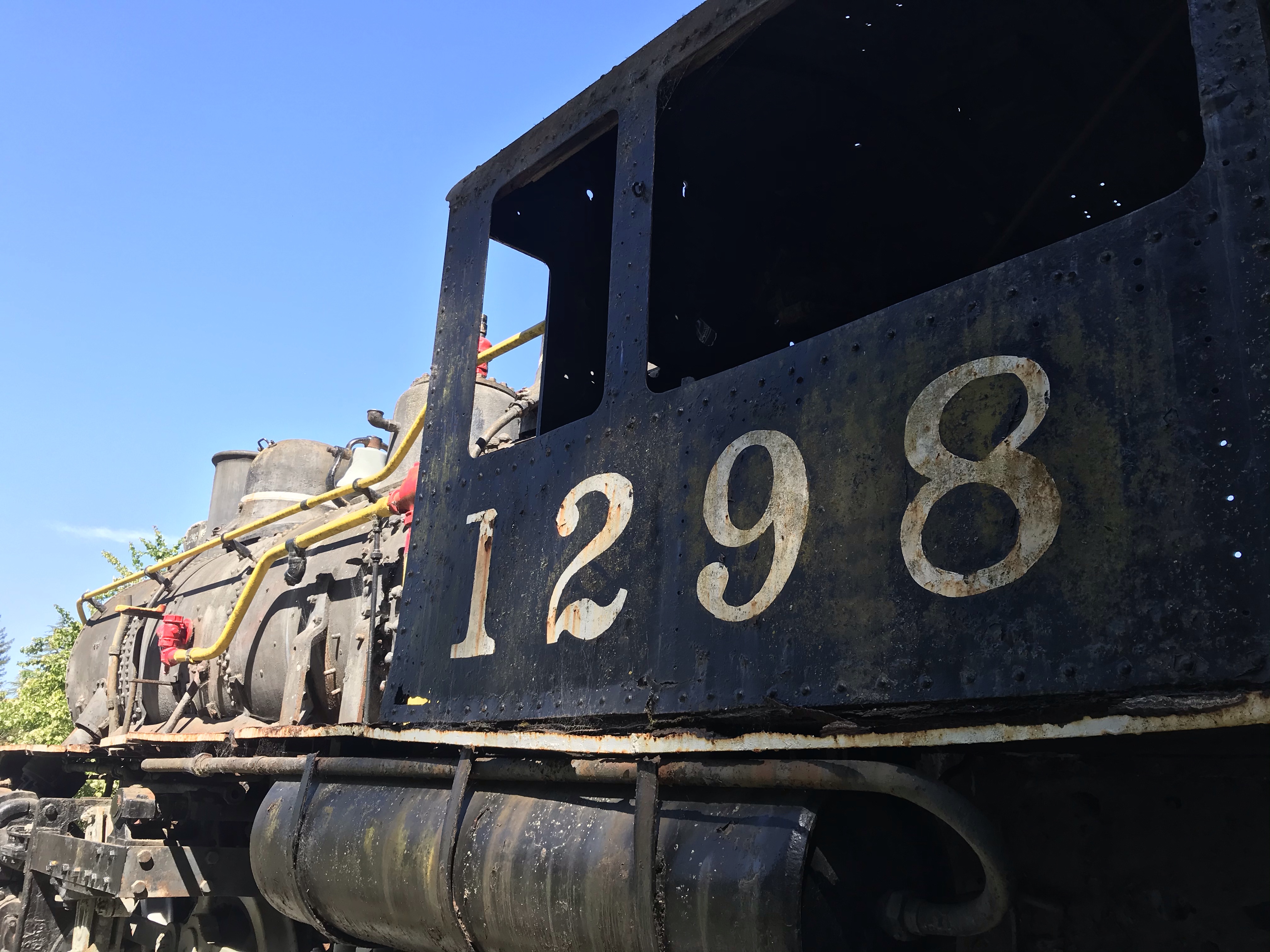
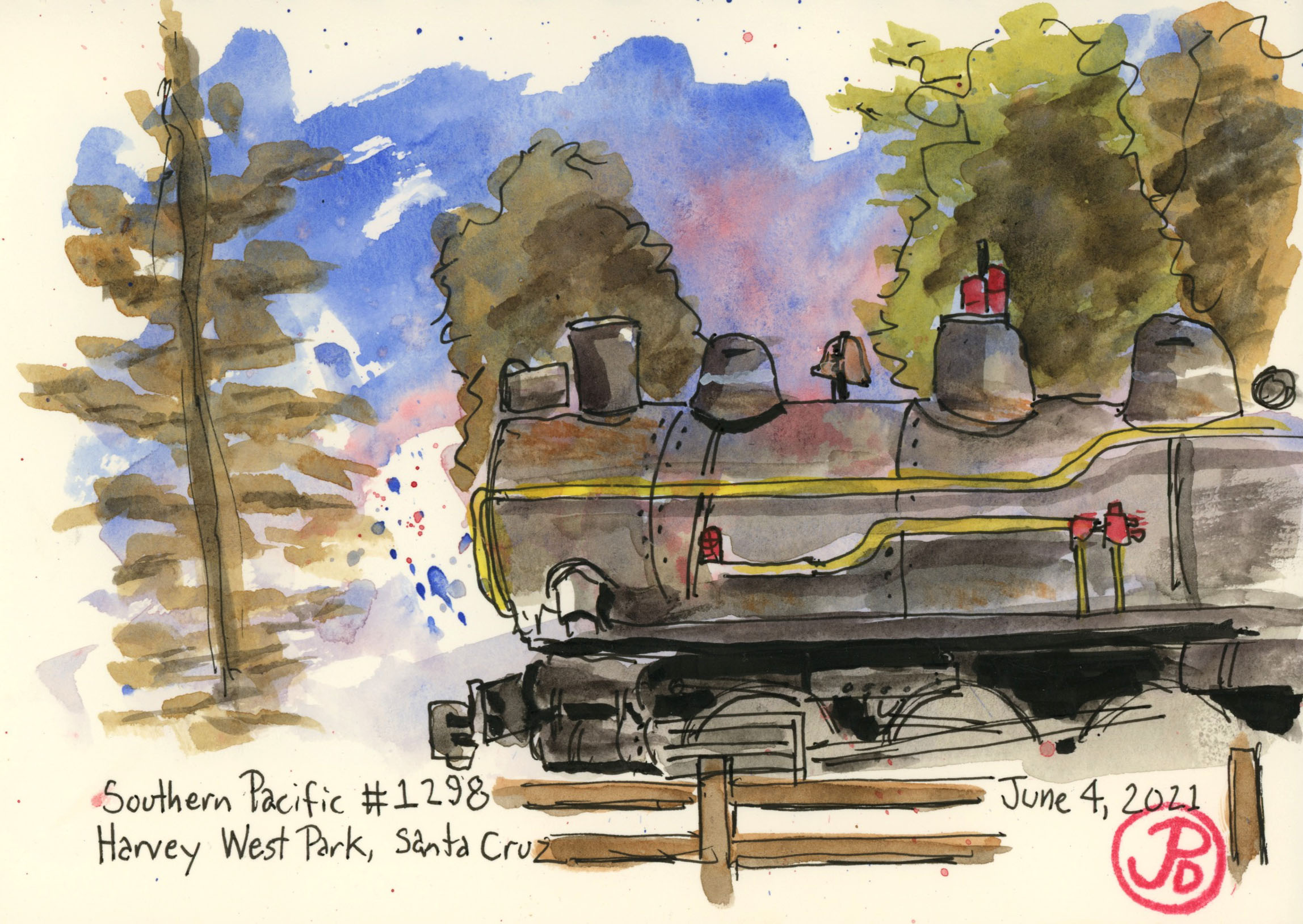
My first subject was to be found at Harvey West Park in Santa Cruz. It was a Southern Pacific 0-6-0 switcher that is on static display in the picnic area. Southern Pacific Number 1298 is an S-10 class yard switcher that was build by Baldwin in 1917. The locomotive was retired in 1956 and was put on static display in Santa Cruz in 1961. In an earlier era, when things was less litigious, children where able to climb on the locomotive and tender. Now the tender was sold and the rusting Number 1298 sits fenced in, in need of a lick of paint.
The word static, implies “not moving”, which is a perfect sketching subject because, well, 1298 is not moving. It was a great subject to capture the form of the locomotive and the trees in the background. For this sketch I chose the page with the cool blue underpainting. I figured it would also work with the sky.
I loosely sketched in the form of the locomotive, tiring to keep details to a minimum. I failed to some degree because I think I added too many details, a problems I have with sketching a highly detailed subject like a locomotive or architecture. The running gear (the driving wheels that propel the locomotive) I simplified and left out a lot of information.
When you put wet watercolor paint over dried paint, it is called glazing. When you glaze in watercolor you can build up layers and depth. Because watercolor is transparent, the underpainting shows through in unexpected ways. And with using a fairly random underpainting the result can be a bit jarring but somehow seems to work. It’s just a sketch, after all.
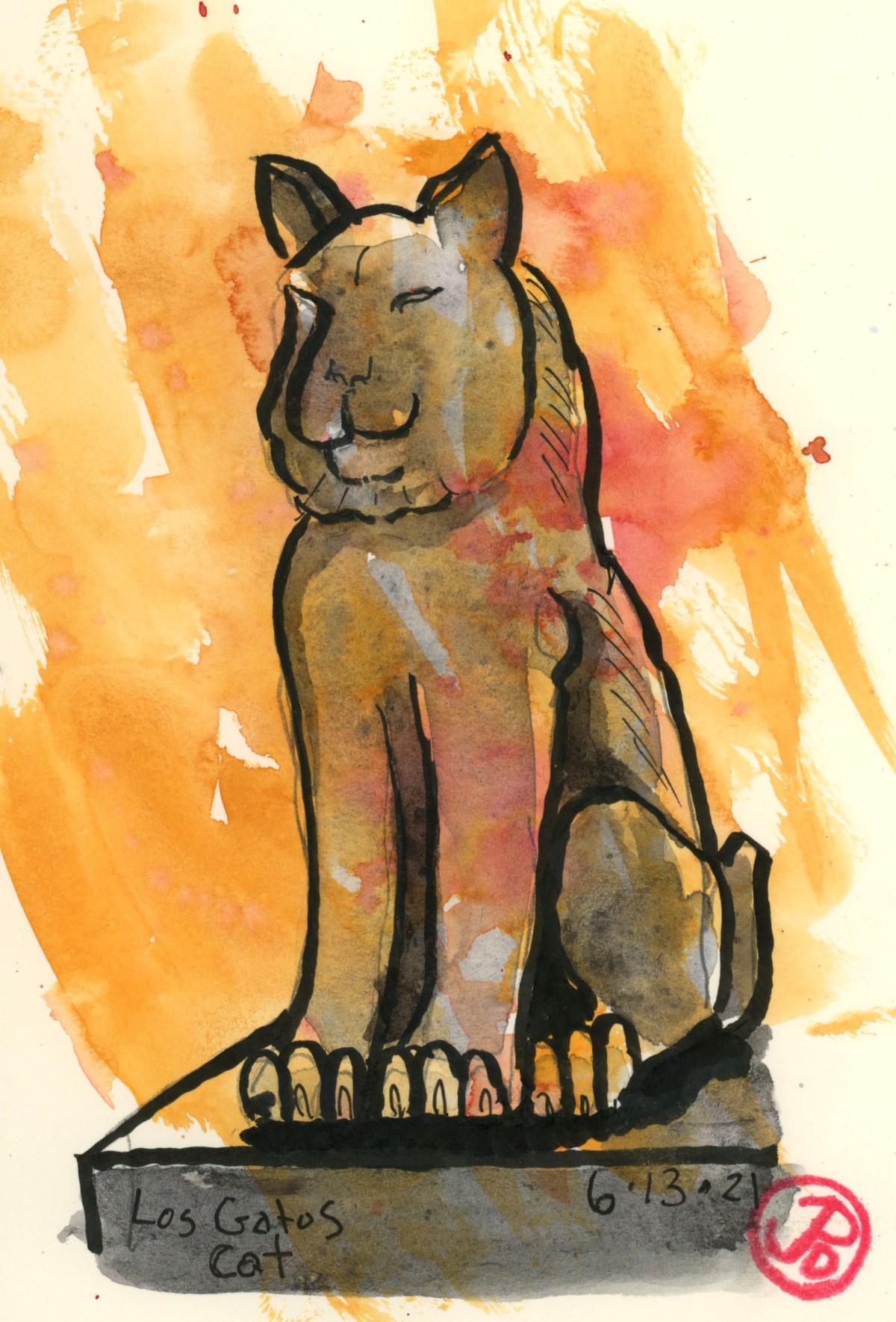
For my sketch I laid over the warm orange-red wash I choose a jarring subject.
Just outside of Los Gatos, off of Highway 17, are two stone lynx-like statues that guard the driveway to Poets Canyon. The sculptures where created by Robert Paine and are named “Leo” and “Leona”. The sculptures have been in place since 1922. To get to this location is challenging because you can only turn west on Highway 17 (the direction whence I came).
Lucky for me, two 8 foot replicas are to be found at the Los Gatos Shopping Center on Santa Cruz Ave. The new cats are carved out of white marble and weigh in at 6,500 pounds each!
The underpainting is warm and I made no concessions to the true color on the statues. I like the way the sketch turned out (featured sketch).
My brother spent almost half of his life in the Central Valley college town, Davis, California. He attended the University of California at Davis (UCD), worked in it’s public and private schools, got married, and raised his three children in “The City of All Things Right and Relevant!”
For Mother’s Day we where meeting my mother and sister-in-law in Davis so I arrived a little early to I sketch the historic train station and do a little railfanning.
Most towns start with a train station and Davisville, as Davis was then known, got their passenger depot in 1868. The original station burned down and the current station was built by Southern Pacific Railroad in 1913. The station is built in a Mission revival style. The University Farm, which later became UCD, opened five years before the current building was finished. At the time, the University wanted a befitting station to the town and the university stop. And they certainly got one!
Three passenger trains stop at Davis: the Capital Corridor, AMTRAK’s Coast Starlight, and the California Zephyr.
A view of Davis Station from Track 1. The SP stands for Southern Pacific. The bike racks in the foreground tells you this is Bike City, Davis.
I sat on the north side of the station and sketched it’s Mission Revival stylings. The station is island by three sets of tracks which at the time was an important stop on the Cal-P line. While I was sketching the station, I was very familiar with it’s curved lines, arches, and tile roof because I had sketched all of California’s Spanish Mission and a few Southern Pacific Mission Revival stations (Burlingame Station comes to mind). Davis Station and the Davis Tower are the only examples of Mission Revival in the city of Davis.
The interlocking control tower still stands just northeast of the station. This will have to be for another sketching day.A Union Pacific freight blazes through Davis Station with it’s curved track. Union Pacific owns the tracks and freight, not passengers service, pays the bills for the railroad.
There were a few clues that a train was coming down the line at Davis Station. The first was that the signal light was green, meeting that whatever train was heading down the line had the “high ball”, in other words, the train had the right of passage. The other clue was that people began to arrive at the station with their flowers in pots or plastic; it was Mother’s Day after all.
At 10:40 AM, a westbound Union Pacific freight train sped through the curve at Davis Station on track 1, the engineer giving me a thumbs up as the train rumbled through. At 10:50 AM, on track 2, the eastbound Capital Corridor train #724, pulled into Davis to take on passengers on her way to California’s capital: Sacramento.
The westbound Train # 731 was right on time and pulled into Davis at 11:10 AM. This Capital Corridor passenger train was heading to San Jose.
On point was locomotive 2004. I looked down at the front truck, containing the leading axels of the locomotive and stenciled, in yellow, where the two letters “GP”. In an odd bit of coincidence, I has replaced the initials “SP” on the Davis Station with my brother’s initials, “GP”, as an honor to his memory.
A westbound Capitol Corridor train pulls into Davis Station on it’s way to San Jose. On point is Locomotive 2004, an EMD F59PHI with “California” styling. I should say so.In one of those “I-can-make-this-sh*t-up” moments, the initials “GP”, my bother’s intials, were stenciled into the trucks of locomotive 2004. Unreal.
















 Corvid Sketcher