Image

Ghost of the GS

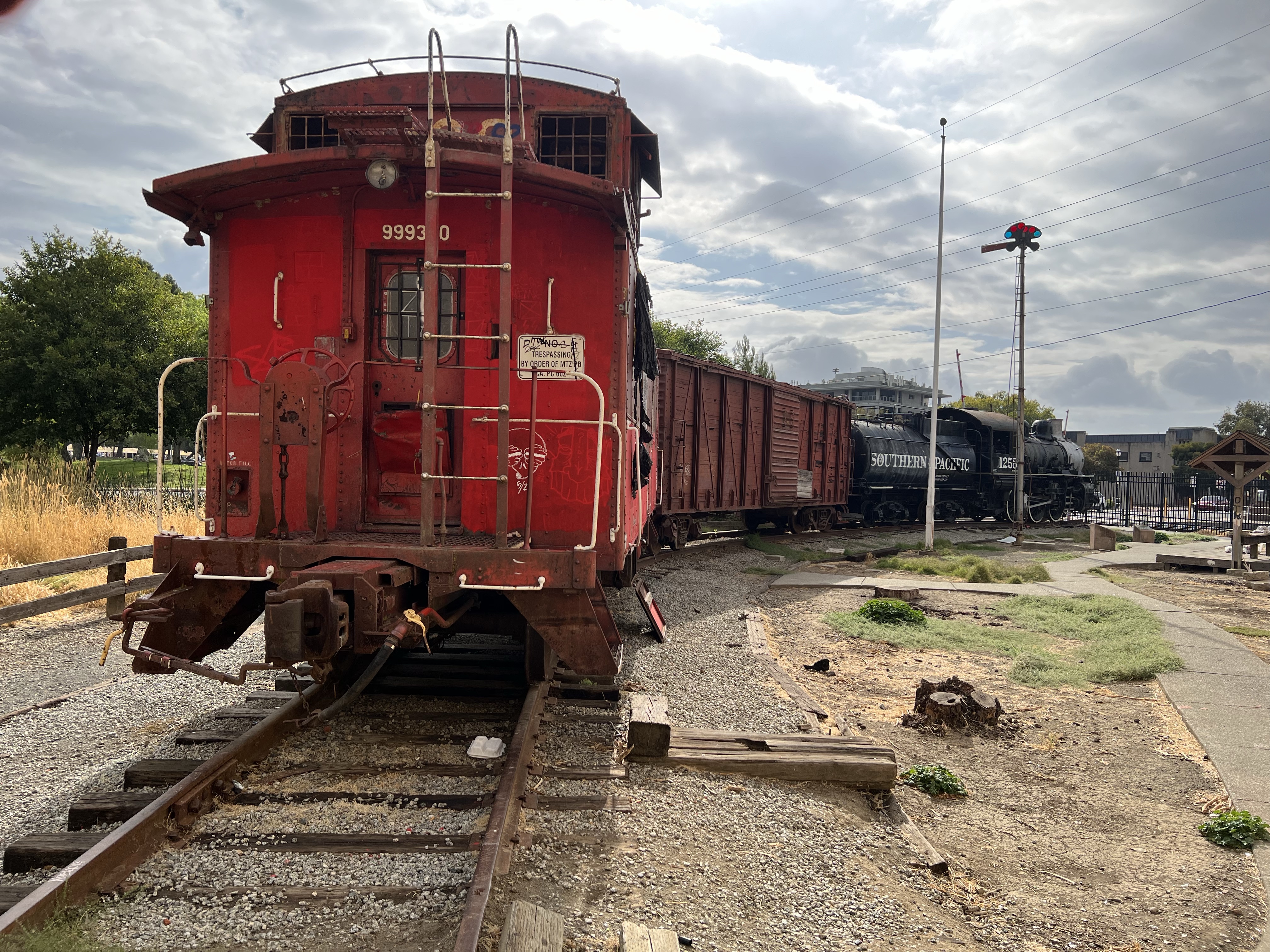
At the Western Pacific Railroad Museum, there are many pieces of railroad equipment: locomotives, cabooses, rolling stock, and maintenance equipment.

It has been said that this railroad museum has the greatest amount of equipment from a single railroad family: Western Pacific (WP).

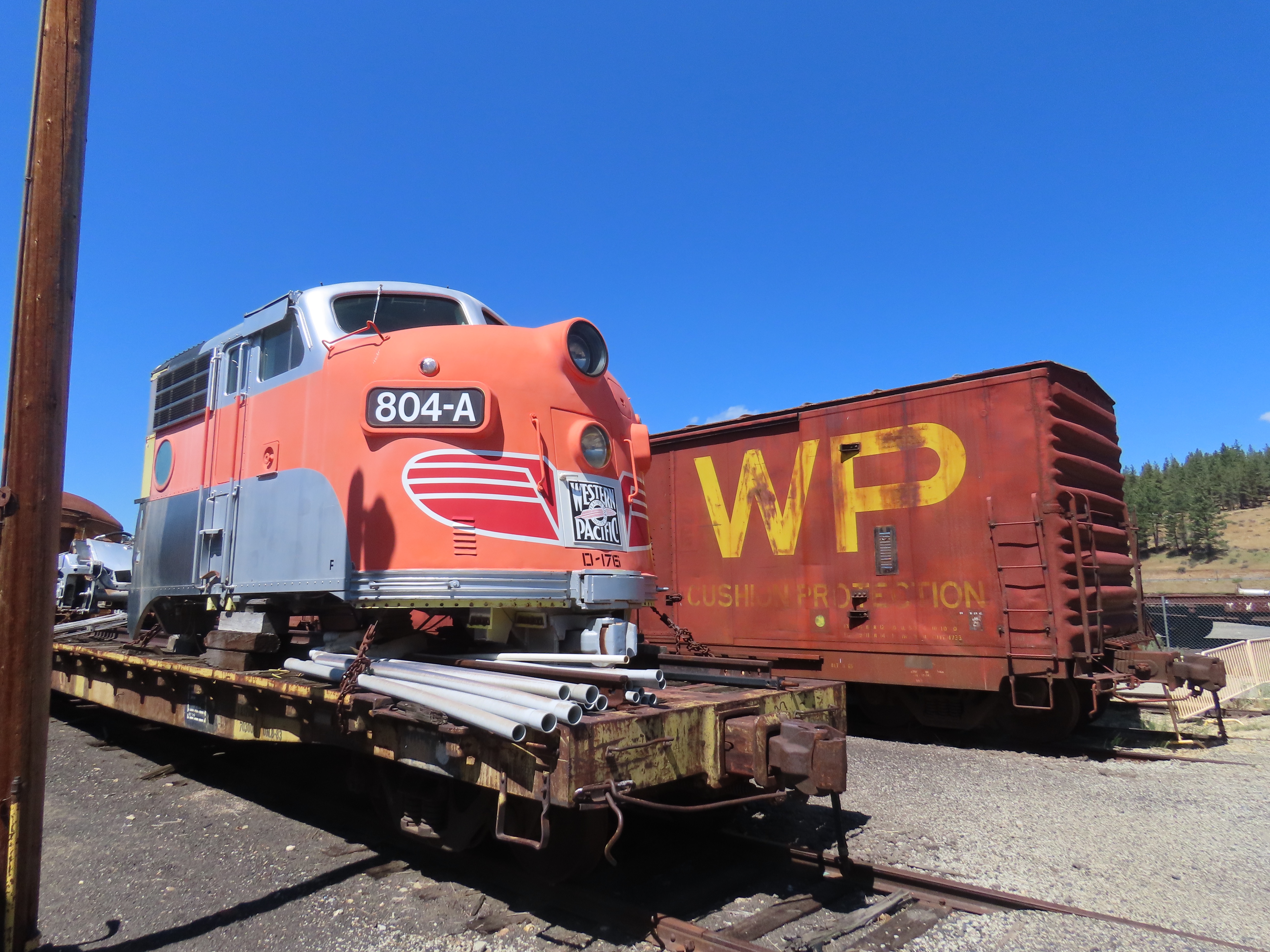
There is lots to explore at the WPRM and you are free to wander around the yard and look at the diesels and rolling stock. I was in search of an FP7 mock up of WP No. 804-A that was used to pull the California Zephyr. The mockup was just of the cab section and it was on display at Disney’s California Adventure park.

While looking for the cab I came upon an old tender that had the faded WP logo on its side. It was a six axle tender so it must have been attached to a substantially sized steam locomotive.

The mysterious tender.

I thought perhaps that this tender once belonged to the largest locomotive that WP owned and operated the 2-8-8-2 mallet or perhaps a 4-6-6-4 Challenger. The railroad owned 27 mallets, some of which operated up and down the Feather River Route. Sadly all 27 mallets were scrapped as the age of diesels took hold. Was this tender a last relic of the mighty mallets of the WP?

Turns out the answer was much more exciting!

I found out from one of the volunteers that the tender belonged to a GS-6, No. 484. These Northern type 4-8-4s were some of the best passenger locomotives ever made for the Southern Pacific.

The GS originally stood for Golden State and the streamlined locomotives were on point of one of the most beautiful passenger trains, the Coast Daylight. The train took passengers from San Francisco to Los Angeles in under 10 hours. During the war when the GS-6s were produced in 1943, the GS meant “General Service” because the locomotives were designed for freight as well as passenger service.

During the war railroads needed approval from the War Production Board to order new locomotives. SP and WP both petitioned for a new order of passenger locomotives. They were turned down because they didn’t think streamlined passenger locomotives were necessary for the war effort.

The zenith of the GS class (Golden State or General Service) was the GS-4.

28 GS-4s were built by the Lima Locomotive Works in 1941-42. 10 GS-6s were built in 1943 under war time restrictions, meaning the locomotives had to also be used for freight service and lack the streamlining of the GS-4s. What I was unaware of is that Western Pacific had six GS-6s on its roster (No. 481-486).

During the end of the age of steam (the 1950-60s) many railroads scrapped their steam locomotive fleet. The idea of steam preservation did not take hold until the 1960s and 70s.

One GS locomotive that was preserved and put on static display in Oakes Park in Portland, Oregon was Southern Pacific GS-4 No. 4449. The locomotive was restored to working order and pulled the Freedom Train across the United States in the late 1970s.

A 2016 field sketch of the GS-4 No. 4449 at the Oregon Rail Heritage Center in Portland, Oregon.

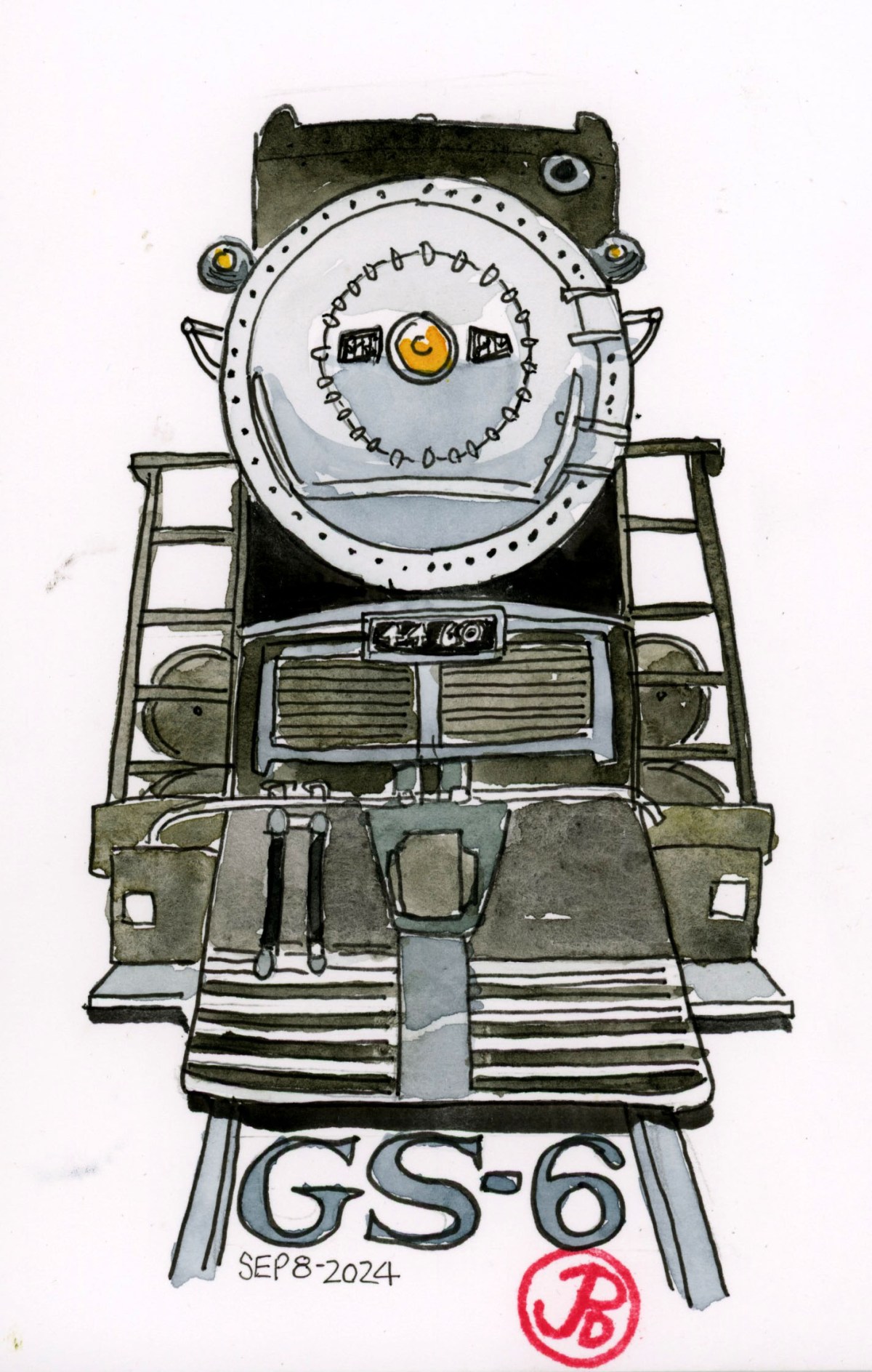
There is only one other GS class locomotive that is still is in existence. This is the GS-6 No. 4460.

4460 was the first GS-6 manufactured (built in July of 1943) and it is the last steam locomotive to operate on the Southern Pacific when it made an excursion run from Sacramento to Spark, Nevada in October 1958.

4460 was donated to the National Transportation Museum in St. Louis, Missouri in 1959.

Until my visit to Portola, I assumed there were only two relics of the Southern Pacific’s mighty GS class and finding the tender in the yard was like finding a piece of railroad history gold!

Image

Western Pacific Railroad Museum

You really have to like trains to make it out to Portola, Ca. From my mom’s house it was a two hour drive over windy roads to reach the small town where the former diesel shops of the Western Pacific were.

These shops and the rails around it, are now the Western Pacific Railroad Museum. The museum is adjacent to the tracks of the Union Pacific which acquired the WP in 1982. Heading west from Portola you enter the Canyon Subdivision which is the WP’s Feather River Route. This is one of the most scenic sections of the the former WP. It was the route the original California Zephyr took from the Bay Area to Chicago.

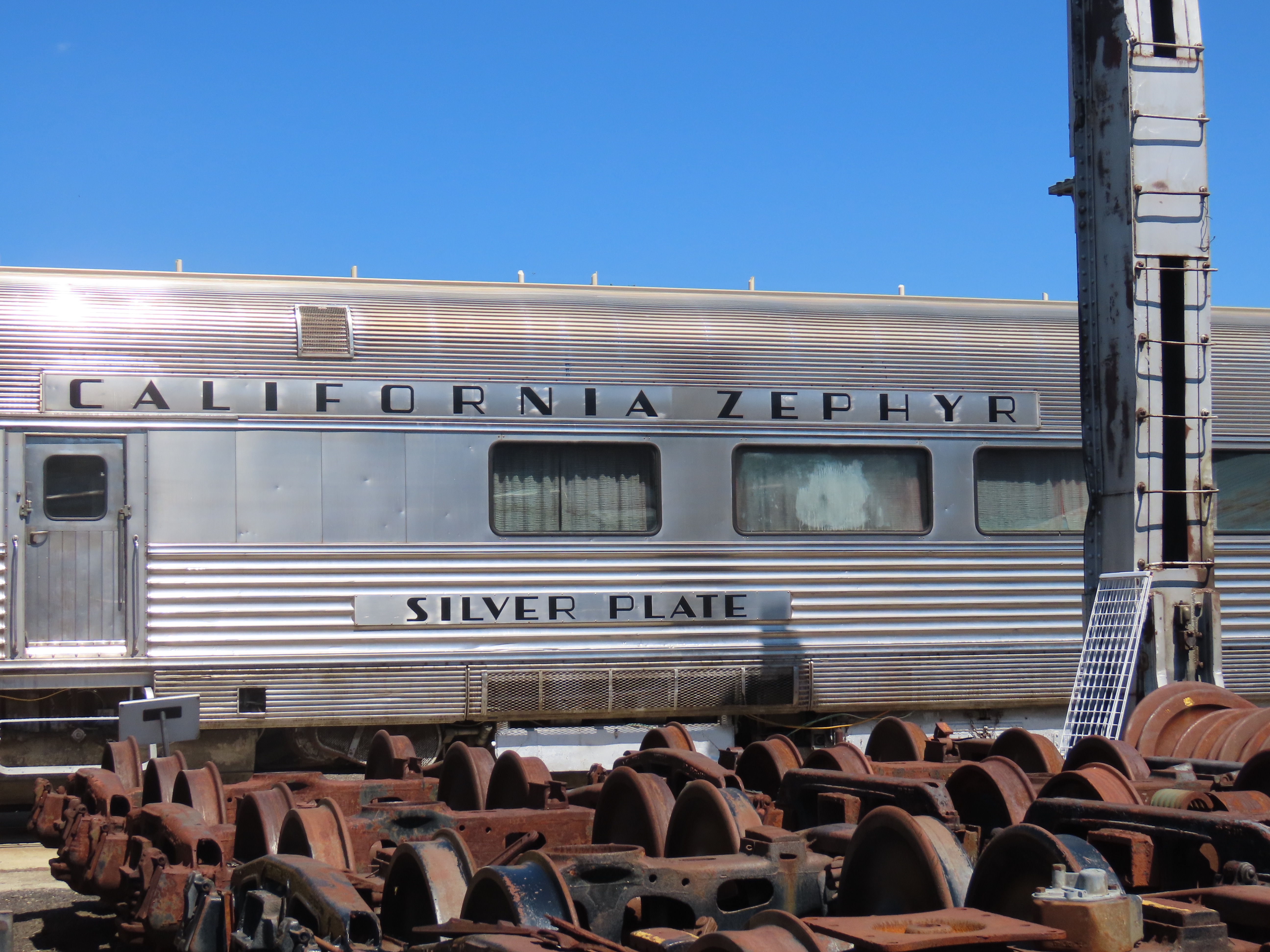
The museum has four cars from the streamliner, the California Zephyr.

While many railroad museums focus on the age of steam, the WP was one of the first major railroads in the west to dieselize. The museum has 29 diesels in its collection.

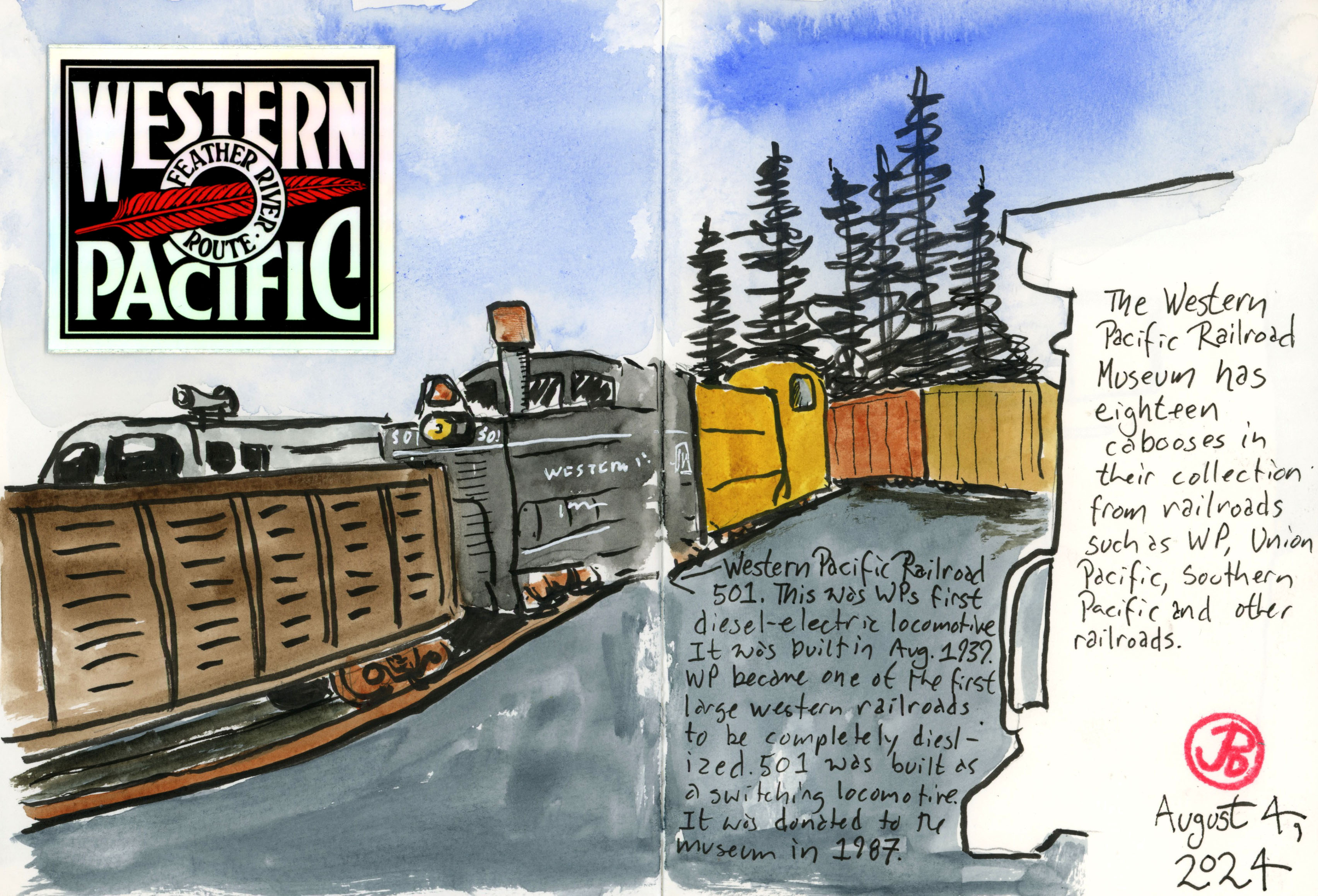
The WP acquired its first diesel in 1939. The SW1 switcher was built by the Electro Motive Corporation for an original cost of $64,525. It was built to work in the yard and with a top speed of 45 MPH, it was not designed to be out on the mainline.

The WP tested out the diesel (No. 501) and liked what it could do. It later ordered two more sister locomotives and 14 years later the Western Pacific was completely dieselized. The genesis of WP’s diesel age is now part of the museum’s collection.

A sketch of some of the WPRM’s collection including WP’s first diesel: No. 501.

The museum has many classic, epic, and iconic diesel-electric locomotives in its collection and I added a few to my sketchbook.

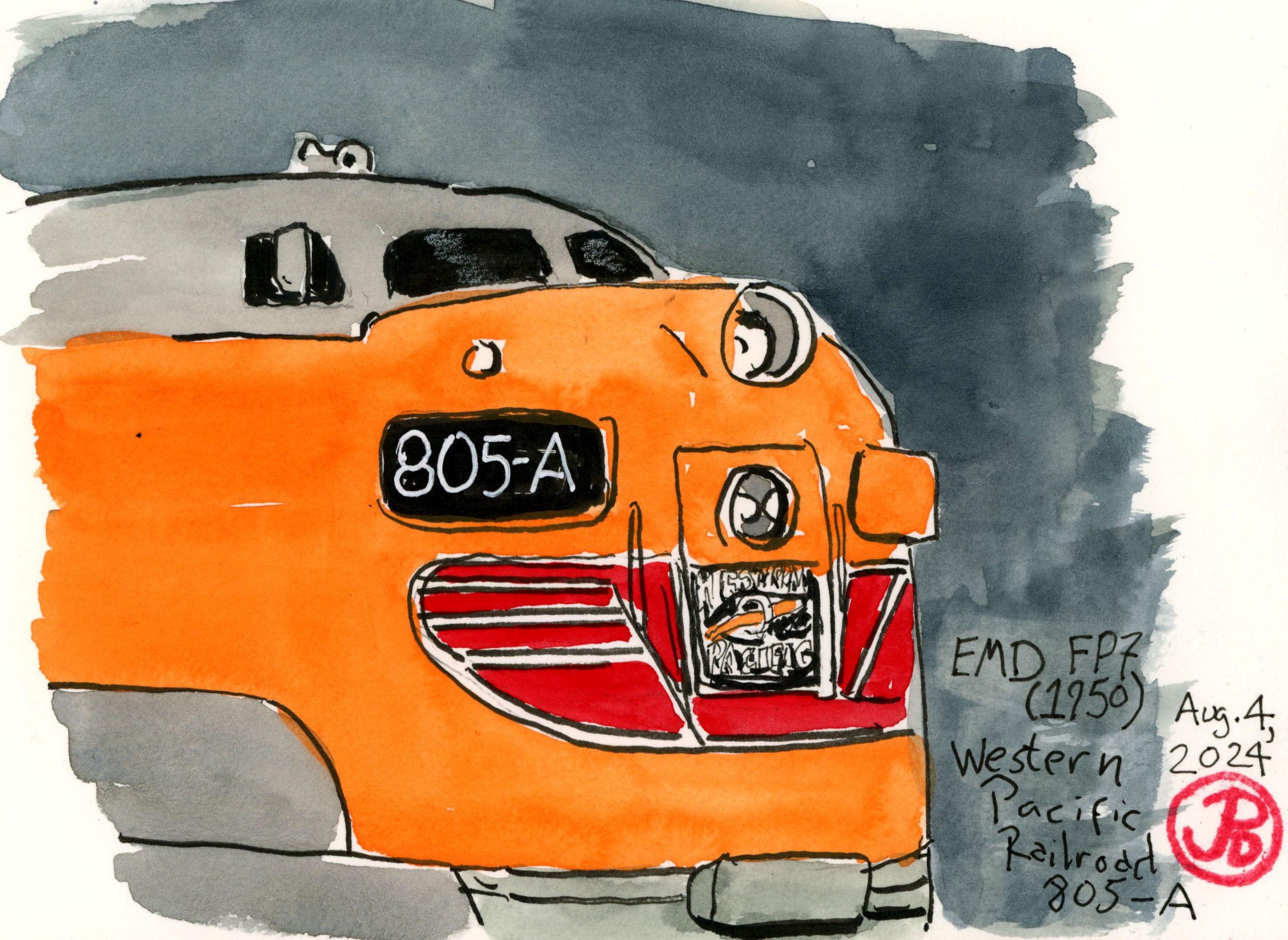
An iconic locomotive is the WP 805-A. This is an EMD FP7. This hood unit was on point of the California Zephyr from Oakland to Salt Lake City. The diesel was in service on the Zephyr from 1950 to the route’s end in 1970.

805-A is the last WP California Zephyr locomotive in existence, so I had to sketch it.

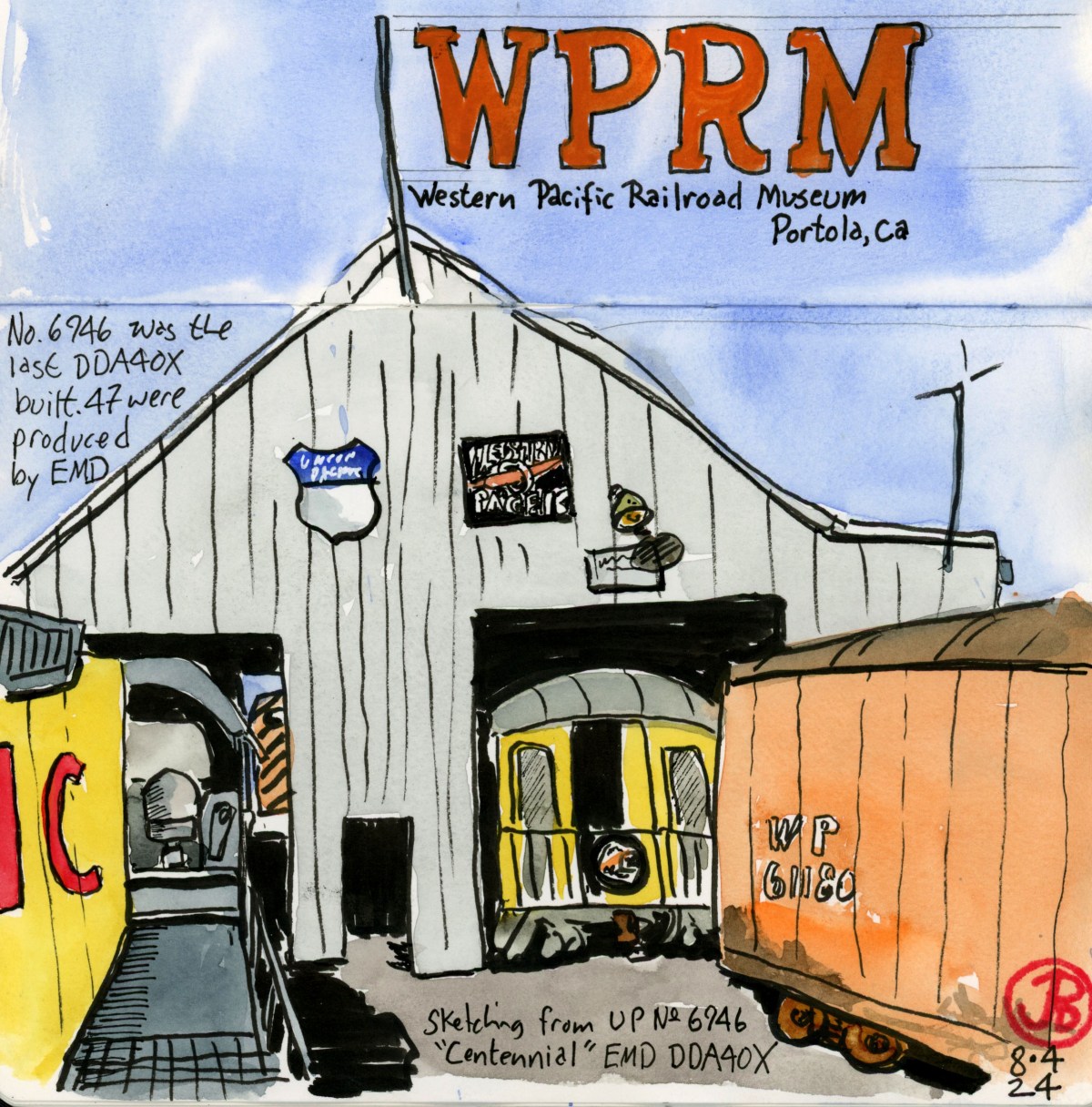
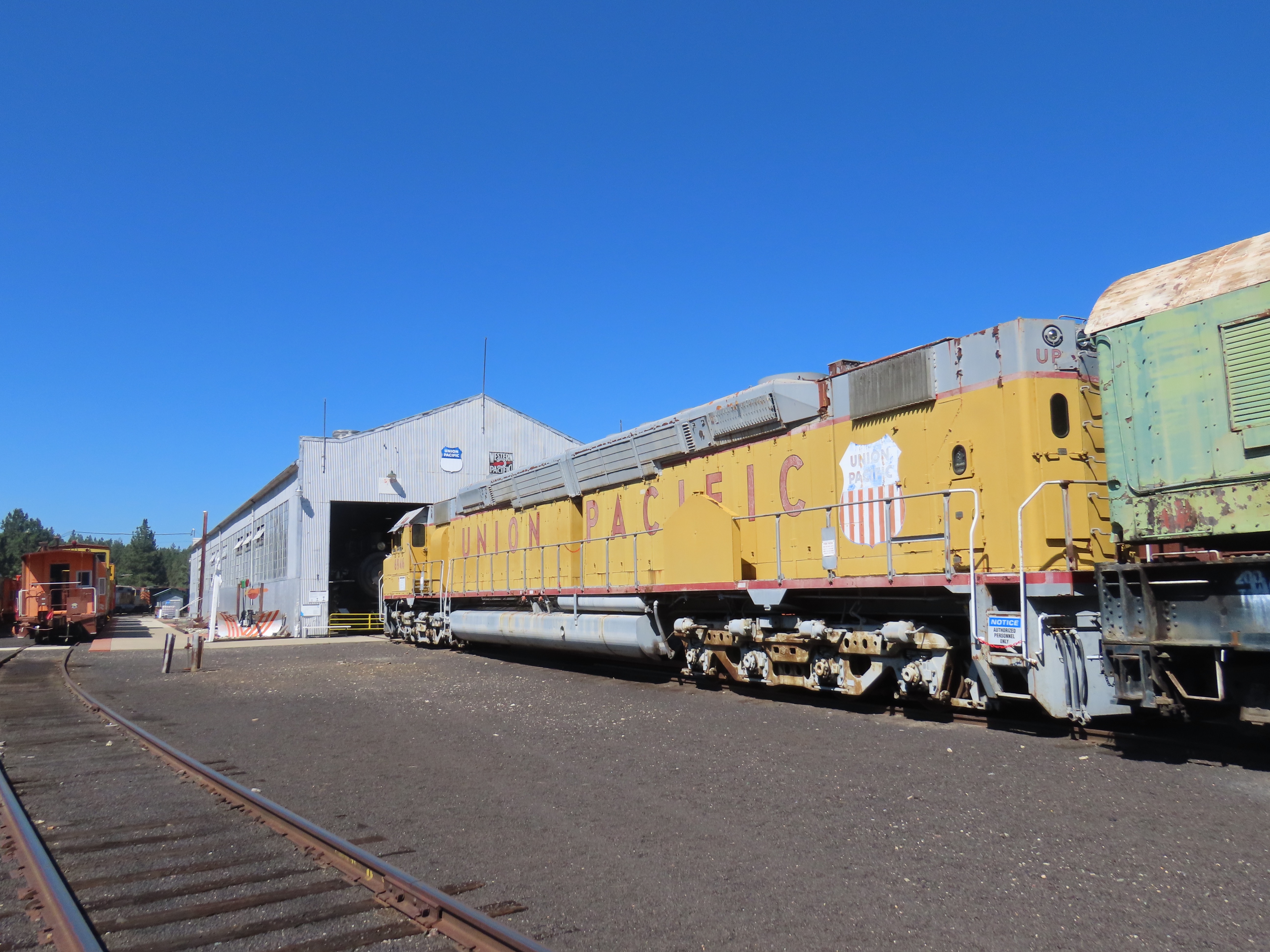
One of the epic diesels in the museum’s collection is perhaps the most epic diesels ever built, this is Union Pacific No. 6946. This 6,600 horsepower behemoth is EMD Class DD40AX “Centennial”, the largest and most powerful diesel-electric locomotive ever built and is the successor of UP’s Big Boy. 6946 is the last (out of 47) Centennial ever built. Only 13 Centennials still exist, the large locomotives having been retired from the UP fleet in 1986.

The beast that is the last Centennial ever built. Like the Big Boy, it’s two locomotives smashed into one mighty powerful machine.

A docent told me I could climb aboard the duel engine workhorse and I walked along the gangway to the cab.

I liked the view so I sketched the 1953 diesel shop from the gangway of 6946 (featured sketch).

Image

4014 on the Mountain Sub

One of the legendary railroad routes is the section of the Transcontinental Railroad that climbs the western flank of the Sierra Nevada Mountains up to Donner Pass. The construction of the railroad was an engineering marvel and much of the original route is still in use.

Southern Pacific used their AC articulated cab-forwards to tackle the grades and heavy freight over the pass and now the world’s largest articulated locomotive would be climbing up to Donner Pass for the very first time. And I planned to be there.

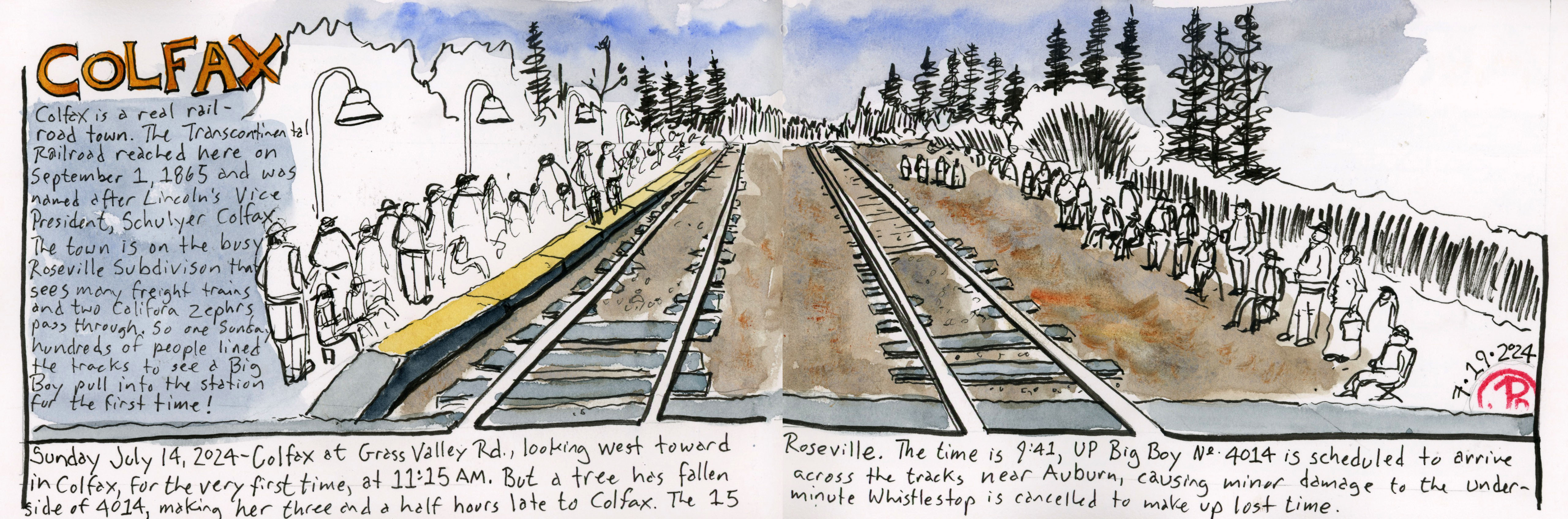
There was a planned 30 minute whistle stop at the historic railroad town of Colfax at 11:15.

I was in Colfax an hour and a half before arrival and more and more people were streaming into town.

4014 left Roseville on time but was halted when the train hit a tree that had fallen near Auburn. The UP tracking app noted that 4014 was “currently stopped near Auburn”. At first I thought it was just a maintenance stop but then word spread that Big Boy had hit a tree and there was some damage to the underside. This was not good. Especially for the hundreds of people waiting in the heat for 4014 at Colfax.

Word spread that the locomotive might have to be towed back to Roseville. The train was now an hour late. I decided to head back to Penn Valley, to air conditioning and the second half of the European Cup Final. I would continue to monitor the UP tracking site. But I had to beat the heat in Colfax.

Just after the game ended (Spain was European champions for the fourth time), the tracker read, “4014 currently moving near Auburn”.

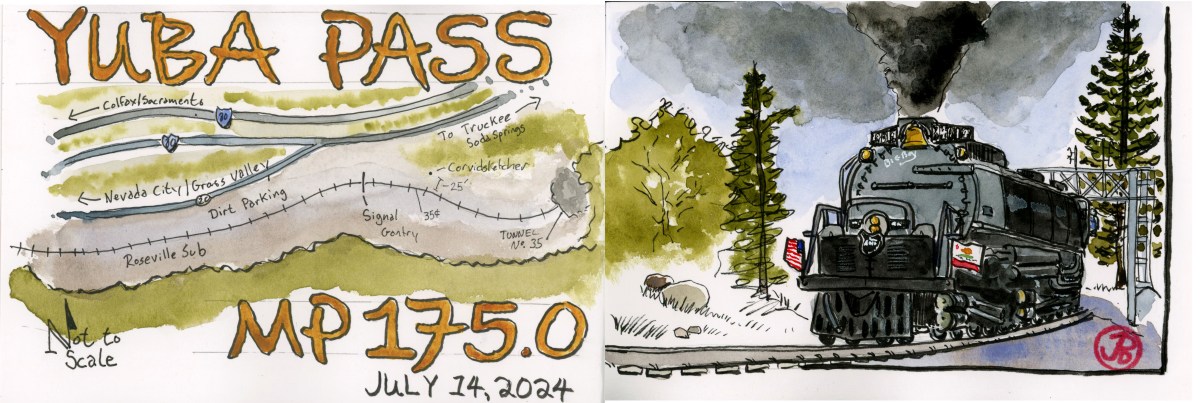
My plan was to drive on Highway 20 to where it merged with Highway 80. This was Yuba Pass and I wanted to see Big Boy in this historic location.

I arrived and there were plenty of other rail fans lining the tracks at Yuba Pass. This was a good sign because 4014 was still climbing the grade and had not reached my position.

After about a 45 minute wait a plume of steam exhaust appeared down line and the mighty roar of the Big Boy filled the cut.

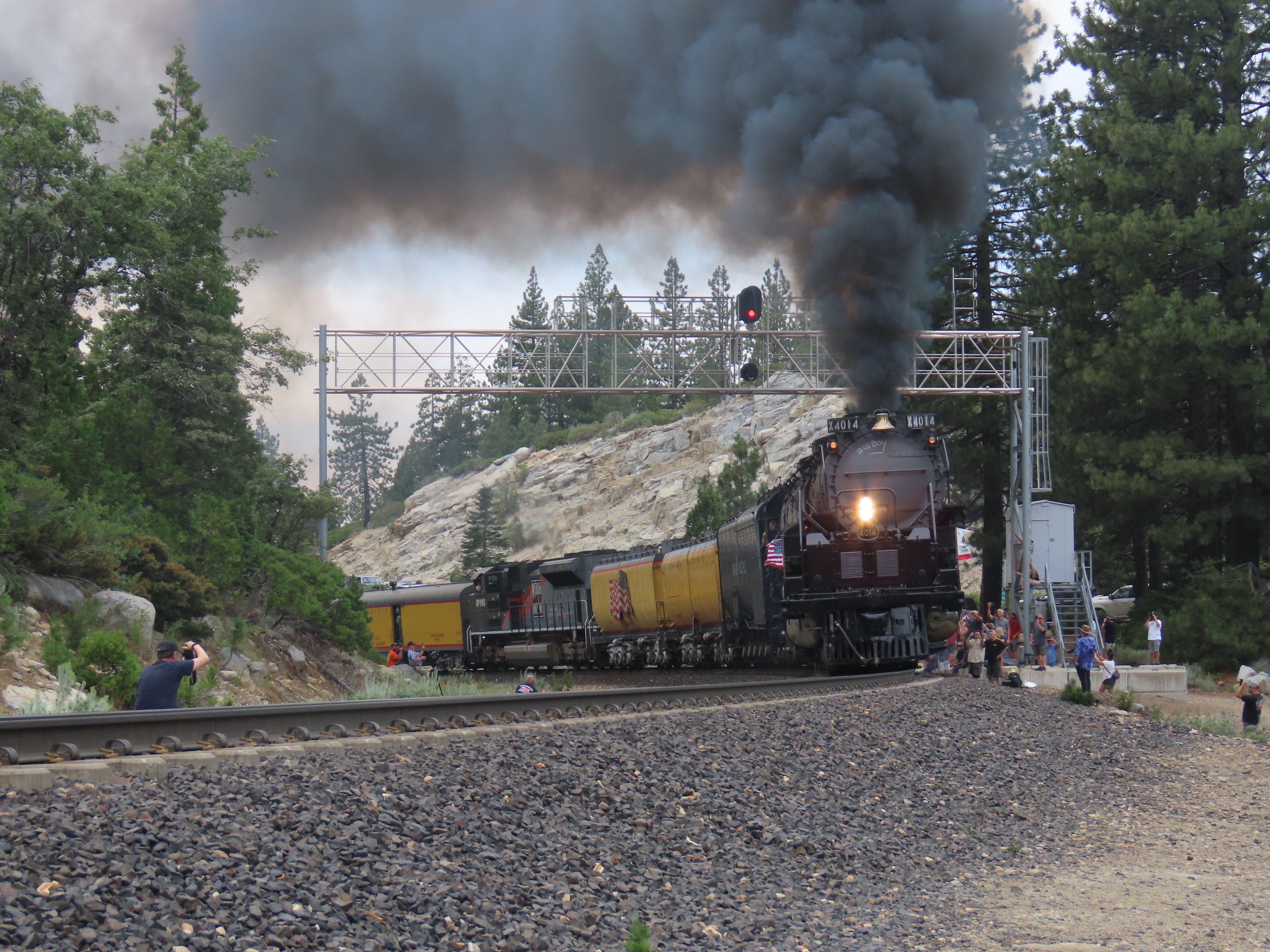
Then the iconic articulated giant appeared working up grade towards my position near the signal gantry. 4014 was putting on a show that enveloped all the senses.

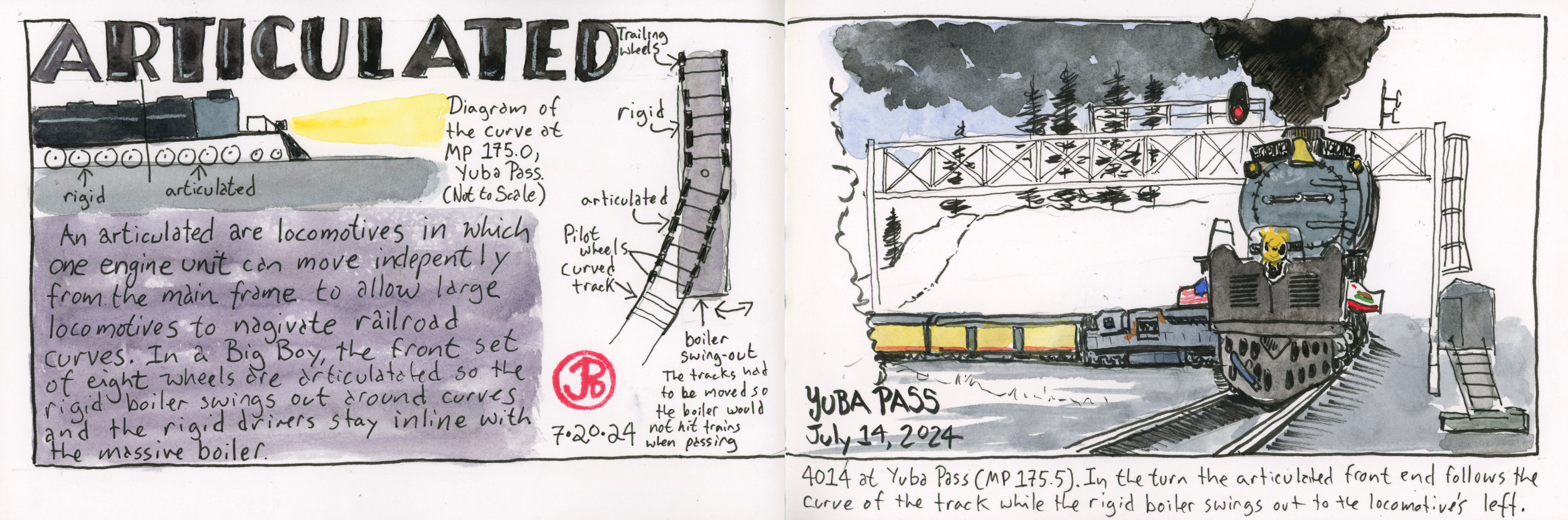
As 4014 rounded the curve, the articulated properties of the design were in full display. While the leading truck and front drivers rounded the curvature of the track the boiler remained rigid making it appear that the drivers and boiler were separating. Afterwards I did a spread to understand the articulation design (below).

After the train disappeared into the tunnel, I headed back to my car and was soon driving east on Highway 80. To my right, I could see the tell-tale exhaust up the hill on the railroad grade. Soon I was pacing with 4014 and I then pulled ahead and planned to head to Soda Springs to see the steam mammoth as she neared Donner Summit.

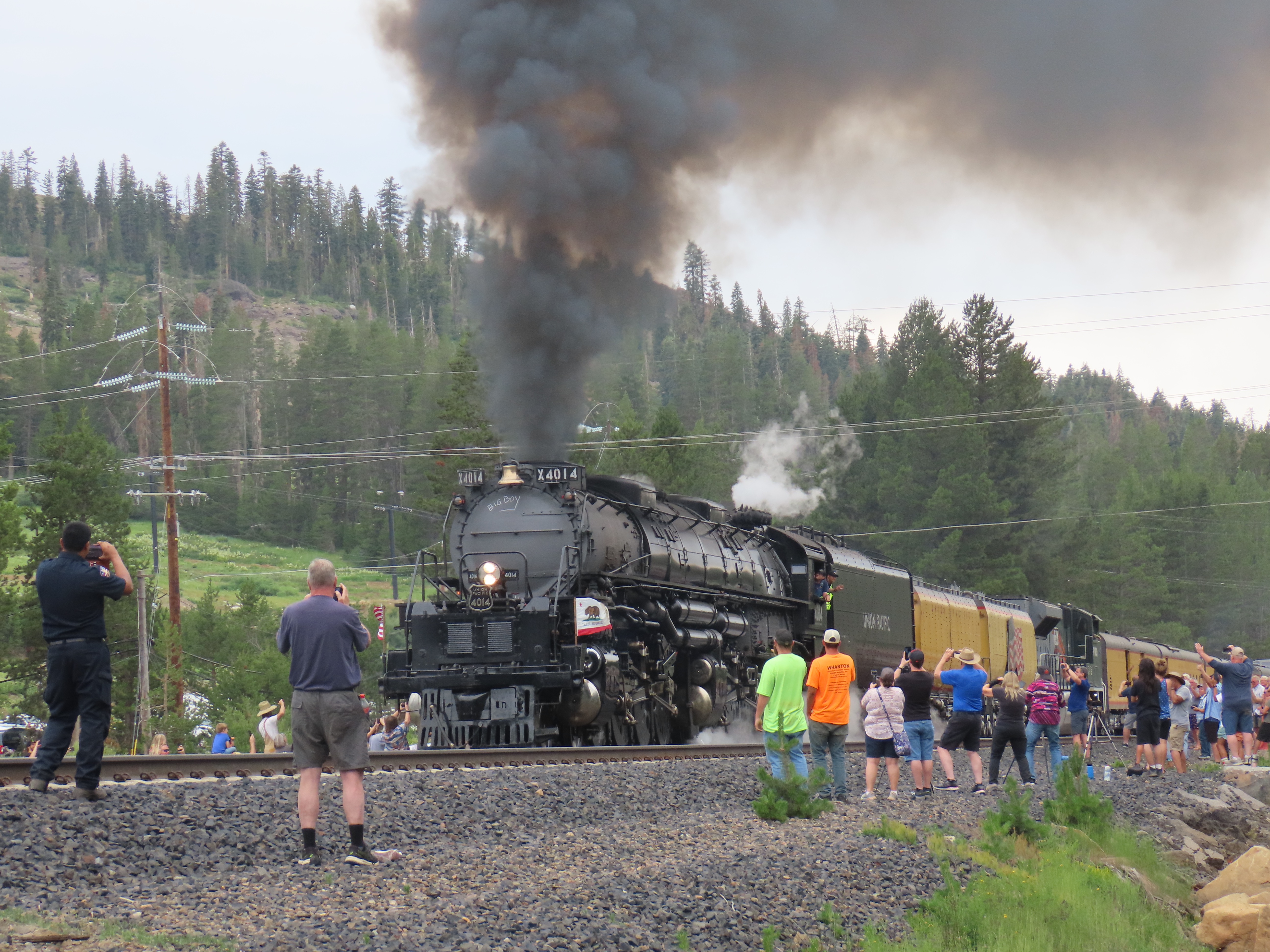
I made it to Soda Springs off Historic Highway 40 and the biggest challenge was finding a place to park as there were many people waiting trackside for the arrival of the Big Boy.

I found a parking spot and headed down to the grade crossing. There was a festive atmosphere around the tacks and to the south many Cal Fire trucks and personal (including Smokey) looked and listened down track for the first appearance of the 4-8-8-4.

4014 at Soda Springs.

Image

Overnighter in Roseville

4014 would be spending two nights in the important rail hub of Roseville.

Roseville is at the base of the climb up the Sierra Nevada Mountains to Donner Pass. It is here where the tools to conquer the Donner extreme winters are kept. Across the tracks, near the depot, the spreaders and flangers could be seen. A little further down the siding, the ultimate snow fighting machine could be seen: the rotary plows.

But on this July Friday and Saturday an army of foamers, rail fans, history buffs, and the curious would be invading the city of Roseville.

They were all here to see the largest steam locomotive in the world, Union Pacific’s Big Boy No. 4014. For the two display days the largest operable locomotive would be static and not moving. The Goliath would be brought up to steam and boiler pressure to conquer the Sierra Nevadas on Sunday.

I arrived early on Saturday to find a parking spot and to spend some quality time with the 4-8-8-4 before she, or he, was besieged.

Roseville is a busy point on the railroad with many freight trains starting the climb or descending the Sierra Nevadas. The passenger service is alive and well in Roseville with the California Zephyr and the Capital Corridor stopping at the passenger depot.

The present and the past of Union Pacific freight. A eastbound freight passes 4014 at Roseville.

4014 now had a consist of Union Pacific passenger cars. I heard a ticket for the trip from Roseville to Reno, Nevada would set you back $700. The train was parked near the intersection of Atlantic and Vernon Streets near Southern Pacific’s 2252 and a rotary snowplow on display.

Roseville is a very busy point on the line and it was about to get much busier with the influx of people coming into town to see a Big Boy’s first visit.

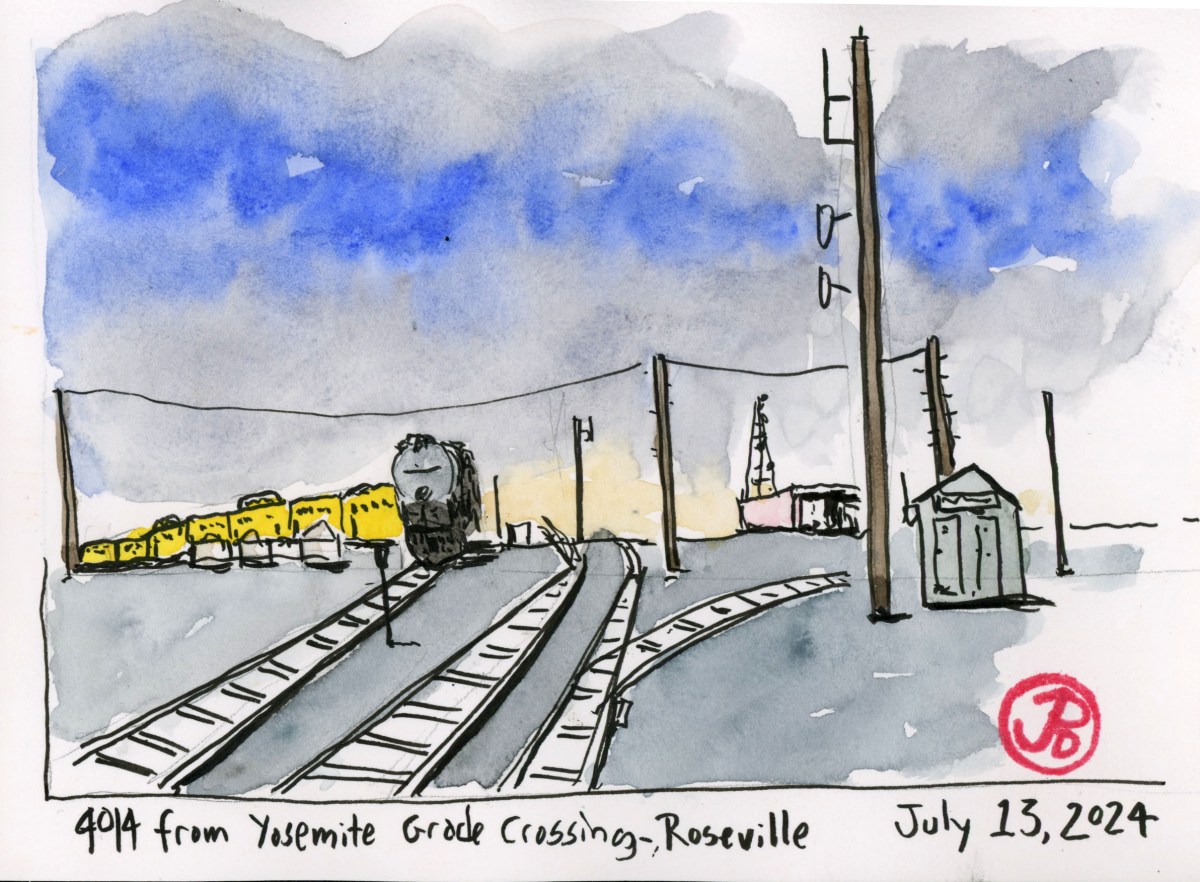
I walked to the grade crossing at Yosemite Street and looked west (towards Sacramento) and sketched 4014 and the Roseville yard (featured sketch).

The viewing of 4014 officially opened at 9:00 AM and there was already a group lined up to get a closer look at the Big Boy.

As the clock ticked closer to 9:00 AM, more and more people were showing up to see the first visit of a Big Boy to Roseville.

This important railroad town was the home of Southern Pacific’s articulated, the cab forward. These massive locomotives were designed to haul freight over the pass and the locomotive was reversed with the cab in front (hence the name) so the crew would not suffer from smoke asphyxiation while traveling through the many tunnels and snow sheds on the route. In the age of steam Roseville had two roundhouses, one was specifically designed for servicing the labor intensive cab forwards. At one point Roseville was home to 60 cab forwards.

Only one Southern Pacific cab forward still exists, the AC-12 No. 4294. She is on static display at the California State Railroad Museum in Sacramento. But unlike Union Pacific’s 4014, 4294 is not operable.

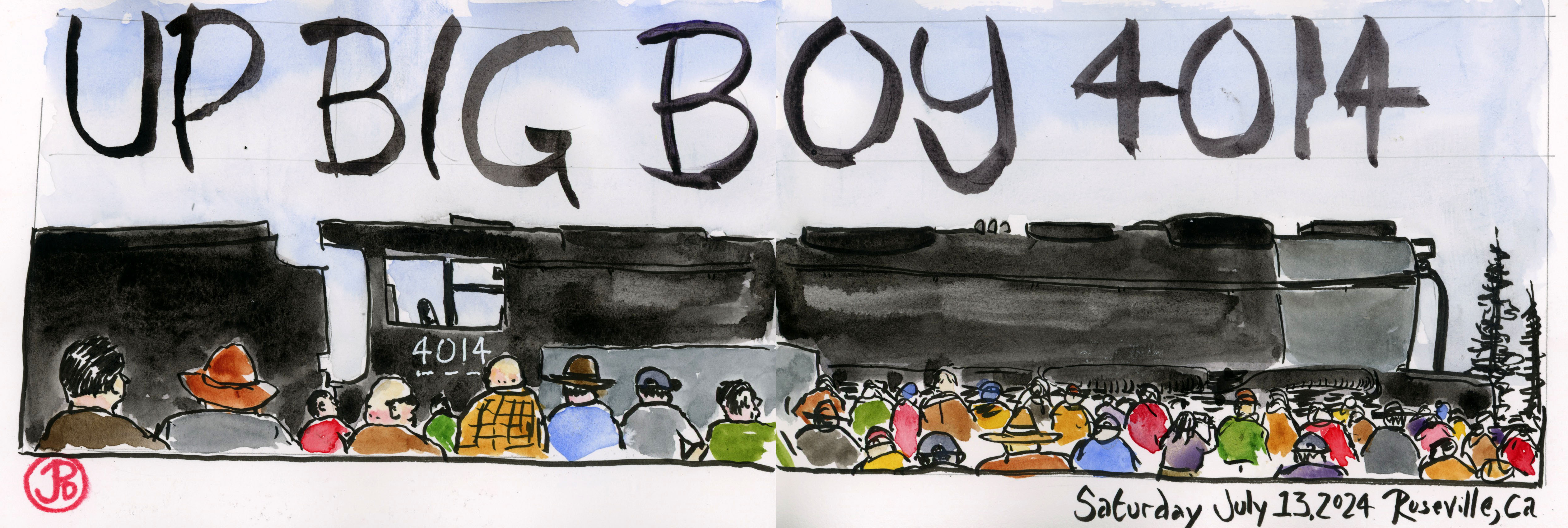
Soon it was hard to see the Big Boy through the forest of people surrounding it. So I did a sketch to capture the experience.

Image

Big Boy 4014 on the High Iron: Oroville

In an old railroad book from my youth, The Illustrated Encyclopedia of North American Locomotives by Brian Hollingsworth, one locomotive featured always caught my attention. It is a locomotive built late in the steam age (1941) and found on page 136. This is Union Pacific’s Big Boy 4-8-8-4.

The last sentence about Union Pacific’s Goliath reads, “Six are preserved at widely-spread locations from California to New Hampshire, but none are operable”.

None were operable until 2019 when that California Big Boy, No. 4014, was restored by Union Pacific’s Steam Shop to work the high iron again.

And I was not going to miss the first visit of the world’s largest steam locomotive to Northern California.

Although 4014 was on static display in Pomona, California, the Big Boys were designed as a freight locomotive to tackle the Wasatch Mountains between Cheyenne, Wyoming and Ogden, Utah.

I planned to see the steam Goliath at Oroville Depot where the locomotive would be making a 30 minute whistle stop after threading its way through Feather River Canyon from Portola.

Now there was just one problem: heat. Intense heat. The forecast high for Oroville was 112! Now that’s way too hot for a coastal inhabitant like me who had just spent a week in the high Arctic!

I figured while it was hot just standing in the shade waiting for 4014, it was even hotter for the fireman and engineer in the cab.

Big Boy was scheduled to pull into Oroville Depot at 2:15, right at the hottest part of the day.

Luckily I found a parking spot under a shady tree. Even though it was a Thursday afternoon, I knew there would be a large turnout to see the first time a Big Boy pulled into Oroville.

As I walked up to the depot, there were more and more people lounging or languishing in the shade. I had arrived about an hour early and we all waited in anticipation for the roar of the whistle announcing the arrival of the visitor from the eastern high plains.

I took up a position across from the depot and a few minutes before 2:15 we could hear the whistle down the track which made the gathered crowd erupt in a cheer. The crowds on either side of the tracks leaned in, waiting for their first view or picture of No. 4014.

Through the sea of people I first saw 4014 decked out with the Golden State flag. Big Boy was back in California, under her own power.

In my featured sketch, the crowds that turned out to see Big Boy were a big part of the story for me. So while 4014 is in the background, the locomotive is obscured by people.

While 4014 was on public display in Roseville, two days later, I had Ed Dickens, engineer and head of Union Pacific’s Steam Program, sign my sketch. He wrote “Big Boy” under his name just as he does every morning on 4014’s smoke box.

The other two signatures are of the firemen. Both the engineer and fireman work as a team to propel Big Boy down the high iron.

I caught 4014 a little further down the line at the Woodruff Lane grade crossing near Marysville.

Image

Sketchbook Roundup

On my 18 day Scandinavian trip to Norway, Svalbard, and Denmark I brought three sketchbooks (small, medium, and large.) Okay the large was not impressively large.

My prediction at the start of the trip was that if I brought smaller journals I would sketch more (point and shoot journals!)

My prediction proved correct. I sketched 29 sketches in my small sketchbook, 29 in my medium, and 14 in my large sketchbook (although some of the sketches cover two pages).

Getting sketchy and caffeinated in Copenhagen.

This trip proved to be very sketchy for me as I averaged four sketches per day for a grand total of 72 sketches over 18 days!

Some of this may have to do with the amount of downtime on my seven day cruise. But it is equally true that I was very inspired to sketch more of the impressive sights I found before me.

Sketching the sea ice east of Spitsbergen.
Image

World Bike City Copenhagen

There are 675,000 bicycles (including tricycles) in the city of Copenhagen and just 120,000 automobiles. Bikes outnumber cars by a 5 to 1 ratio.

There are bikes everywhere. Bike lanes in every street. According to WIRED magazine, 62% of Copenhageners ride bikes to school or work. 65% of children ride their bikes to school. Nine out of ten people own a bike.

Bikes, bikes everywhere. The corner near my Copenhagen digs.

It was refreshing to see a city with a great public transportation system with buses, metro, and regional rail that could get you anywhere.

One of the quicker ways to get around the city’s streets is on two or sometimes three wheels. There are designated bike lanes everywhere. As a pedestrian you had to be careful not to wander into the bike lanes and look like a clueless tourist.

As a Californian driver I appreciated that cyclists always used their hand signals in Copenhagen to indicate where and what they were about to do, including coming to a sudden stop.

Finding a motorist using their turn signals in the Bay Area is as rare as seeing snow in San Francisco!
Image

The Five Ships of Roskilde

One of my Viking sketching targets was 20 minutes, as the train flies, from Copenhagen. This is the fjord-side city of Roskilde.

Roskilde boasts a cathedral where all the royals are buried, but I was here to see the famous Viking Ships of Roskilde.

It was easy to make my way west on Denmark’s very frequent and efficient metro and rail system. Everyone, if you are not already on a bike, rides the trains in Denmark.

After a 20 minute train ride, I alighted at Roskilde Station and proceeded to walk north from the station to the Vikingeskibene. After about 20 minutes I came to the edge of the fjord and the Viking Ship Museum. The museum would open in 30 minutes so I sketched the Sea Stallion of Glendalough, a reconstruction of the long ship Skuldelev 2.

What’s amazing about the long ship before me is that is not just a show piece but a real sailing ship. In 2007, the Sea Stallion sailed from Roskilde to Ireland (where the original was built).

The harbor area around the museum is full of Viking ships, built with the ancient building techniques of the Viking age.

A replica Viking ship “Roskilde”, pulls into the harbor.

At ten, the museum opened and I was the first one in. The exhibit hall is impressive because it features parts of five Viking ships.

Why parts? Well these ships were deliberately sunk about 1,000 years ago to block a navigable channel that led to Roskilde. The ships were discovered in 1962. The most intact ship is about 75% complete.

The pieces are supported by a metal frame to give you the size and shape of the boats.

I sketched the ships from the top of the staircase, the perspective was challenging but you don’t always get to select your angles to sketch from.

I then walked around all the ships noting the various sizes, including the impressive size of the King’s longship. I gave up trying to sketch the ships and returned outdoors to the bench where I sat before the museum opened. Now this was a perspective I could handle (featured sketch).

I think I produced my favorite sketch of my Scandinavian adventures. This was a fun perspective the draw and a sketch within a sketch self portrait to boot!
Image

Rundetarn: the Round Tower

In the Latin District I wanted to ascend the Round Tower to take in the panoramic views of Copenhagen.

The red brick tower was built in 1642 as Europe’s first and oldest observatory.

But it was about an hour before the tower was open and so I found a bench and sketched the tower (featured sketch).

It was a little challenging to get the cylindrical perspective correct. This is why the pencil sketch is so important before you add any ink to the page. I think of it as the skeleton of the sketch before adding the muscle (pen and watercolor.)

I was second in line, behind an American family of four whose teen boys seemed more interested in looking at their phones rather than the amazing architecture and history that surrounded them. I was certainly glad that smartphones didn’t exist when I first visited Europe in the late 1980s.

What is unusual about the tower is that instead of climbing steps to get to the top, you climb a brick paved circular ramp.

It is rumored that Czar Peter the Great rode his horse up the 34.8 meter tower. In 1902 an automobile repeated the feat. Apparently there are still skid marks from the drive but I could not find them.

The staircase to get to the observatory is so narrow that there is a stoplight because it is only one way traffic. After a short wait I was the first at the top, having passed the American family on the circuitous way up. The view was certainly worth it!

The view from the top looking east towards Christiania.

On top of the Round Tower is an observatory, which is the oldest in all of Europe.

The observatory at the top of the Round Tower.
Image

Saturday Morning Sketching: Copenhagen

I wanted to get to the very popular Nyhavn (New Harbor) before the tourists hordes descended upon it. So I headed out from my Nørreport digs and walked 25 minutes to the picturesque harbor.

I had the place almost to myself (I was only asked to take one photo). I walked around until I found the right vantage point. I wanted sail boats in the canal with the pastel colored builds in the background.

My canalside sketching stool was a mooring cleat. It was the perfect height. After a few pencil lines I commenced the sketch with my uni Pen brush pen (I have really favored this pen on this journey).

After sketching and cafinating in Nyhavan, I headed back whence I came and entered the park around Rosenborg Castle. I walked around the castle until I found a park bench perspective and started to sketch. The benefit of heading out early is that the park and castle were largely devoid of tourists. It was the time of the morning that the locals strolled through or walked their dogs.

For this sketch I wanted Rosenborg Castle to be the main focus so I left the tress in the park unpainted.