Image

California Western Railroad: The Skunk Train

For my second road trip of the summer, I chose my base camp: Fort Bragg on the Mendocino County Coast. I knew that one adventure I wanted to experience was a ride on the Famous California Western Railroad, also known as the Skunk Train.

The Skunk Train runs from Ft. Bragg to Willits, a train journey of 40 miles. A round trip of seven hours. The former logging railroad crossed 30 bridges and trestles and travels through two long tunnels.
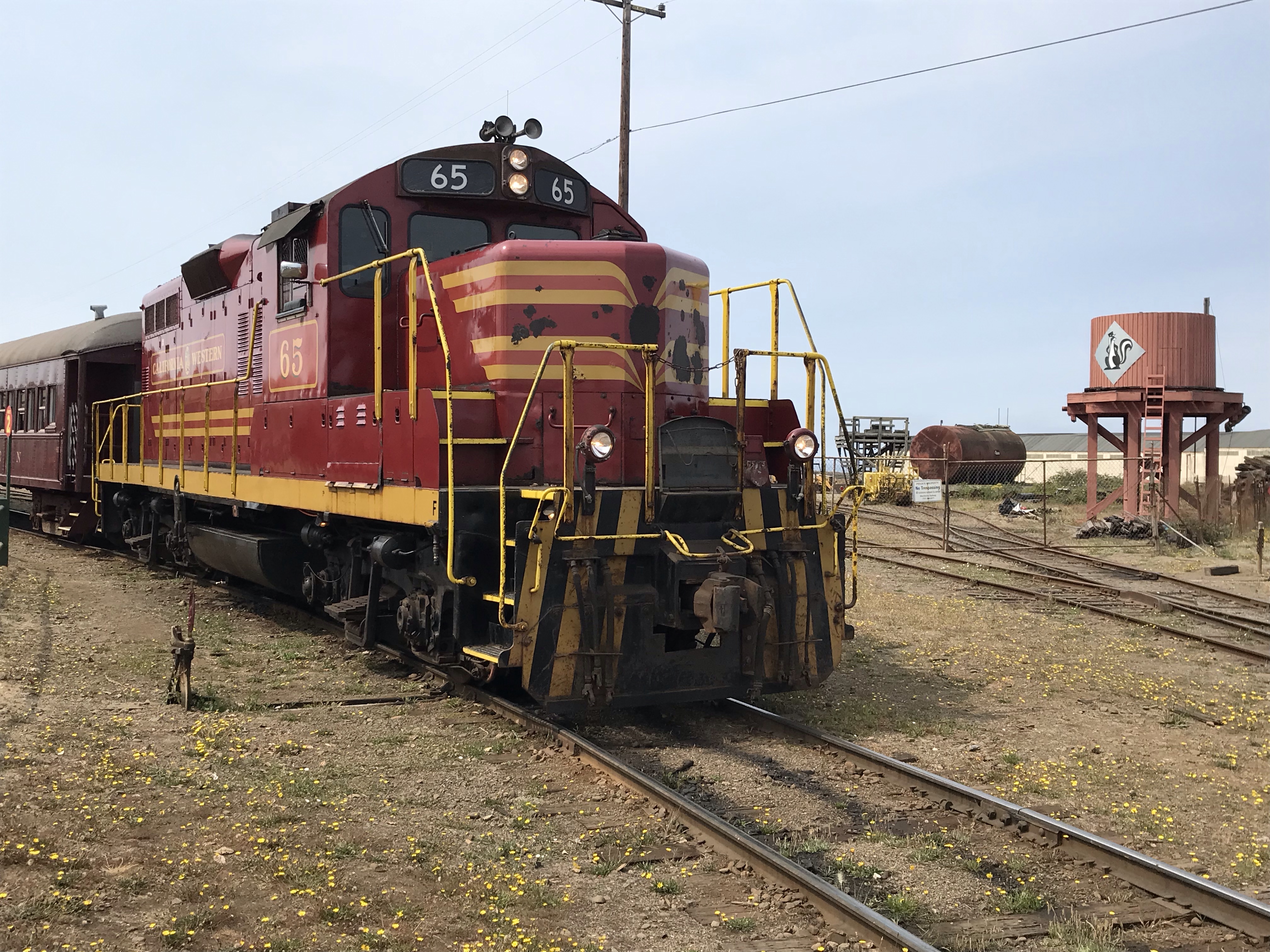
The Skunk at Ft. Bragg. The water tower is for No. 45, a Mikado steam locomotive. Our train (No. 65) was pulled by a former Southern Pacific GP9 diesel built in 1955 by EMD.

The Skunk is a poor reflection of its former self because of the April 11, 2013 partial collapse of the 1,200 foot Tunnel No. 1. The tunnel was built in 1893 and it is in an area known for hill slides. This means that the Skunk Train only runs from Ft. Bragg to Glen Blair Junction, a distance of 3.5 miles. It seems like just when the train gets going, it stops 30 minutes later.

The railroad has also been without an operable steam locomotive. The 2-8-2 No. 45, was built by Baldwin Locomotive Works in 1924. The locomotive is currently being restored and may be once again under steam in the upcoming year.

The end of the line, for now. Plans are underway to open the line in about a year. In the background is the western portal of collapsed Tunnel No. 1.

It is a pleasant ride on the “Pudding Creek Express”, although “express” is hyperbole of the highest order! I chose to get out and explore the area and then catch the second train back to Ft. Bragg. There are a few hiking trails and I hoped to get in a few sketches before the train returned, so I had time to sketch and paint and had extra time to let the paint dry!

I started by sketching the caved in western portal of Tunnel No. 1. The tracks were covered in dirt and rocks filled the entrance. Vegetation was growing up, almost threatening to cover the portal. A train has not passed through here in almost eight years. A maintenance worker told me that they hoped to have the tunnel open in about a year. I’m not sure they could move a mountain but I’m sure that have the funds and the manpower to clear a tunnel.

Motor car M-100 at Willits, facing west towards Ft. Bragg.

On the following day, on a flight of fancy, I decided to drive to Willits to see the eastern end of the line. From Coastal Ft. Bragg to Willits was about an hour with temperature difference of about 30 degrees! I pulled up to the beautiful redwood station in time to see the eastern Skunk pull into the station. The Willits train is a two hour,16 mile, round trip. This trips travels to the highest point on the line (1,740 feet) and travels past the “”Wolf Tree”, a large coast redwood.

The line at Willits is isolated from the Ft. Bragg side of the railroad because of the collapse of Tunnel No. 1 so what ever motive power and cars are what ever was here, prior to April 11, 2013.

On the Ft. Bragg side of the line sits the Motor car M-300 (sketched in the featured sketch). These gas powered cars where used for passenger service in 1925. These motor cars gave the railroad it’s name, because the locals named the cars “skunks” because, “you can smell ’em before you can see ’em.”

The M-100, which is on a siding in Willits, was built by the Edwards Rail Car Company in 1925. It is still operable and used when ridership is down instead of using a diesel with passenger cars.
Image

Underpainting

I wanted to experiment with underpainting for some recent field sketches. First I put down a loose, cool, blue wash and on another page a warm orange-red wash. I kept it loose with some paint splatter and some ghosting.

Now I had to find a subject to lay over the wash.

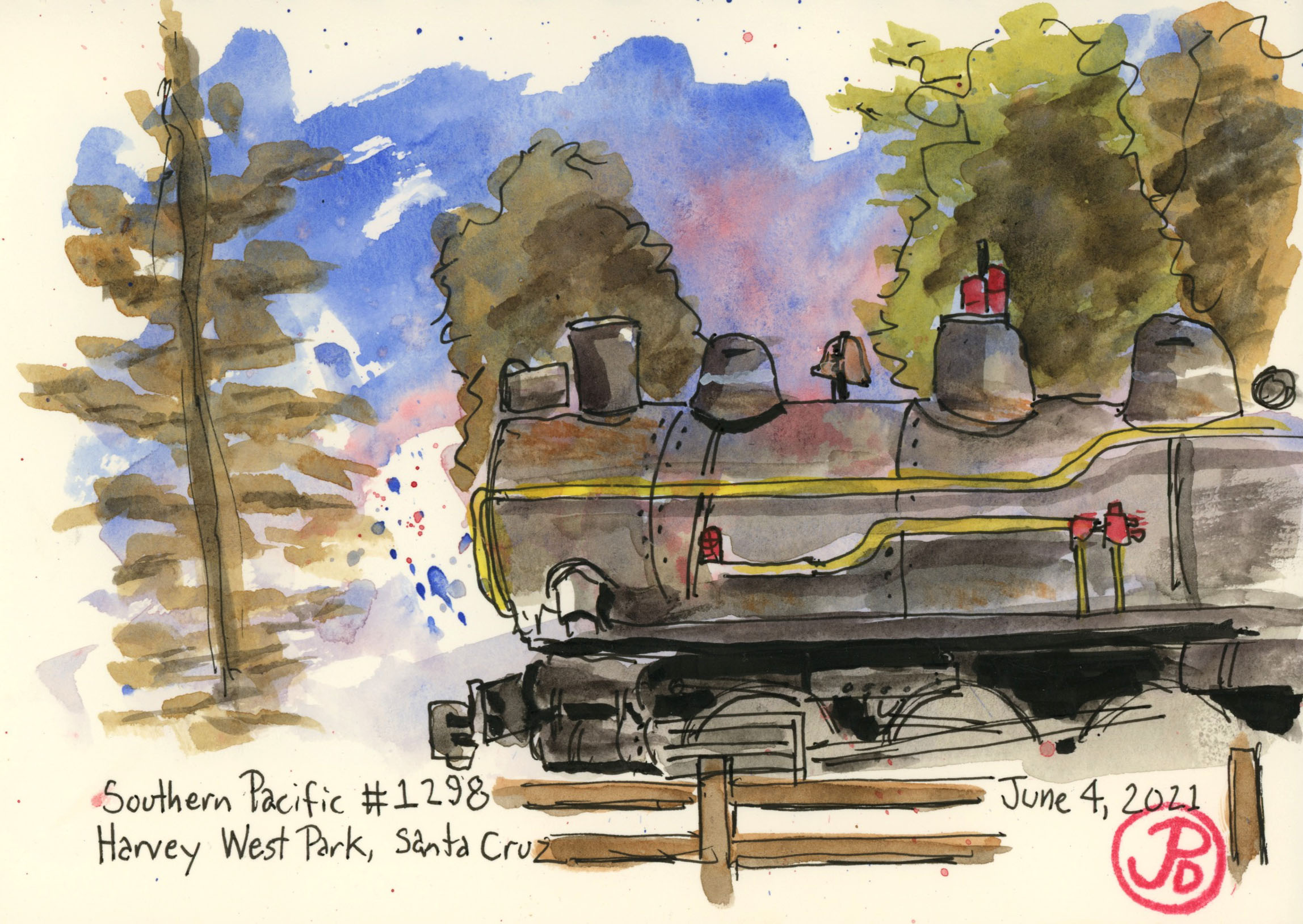
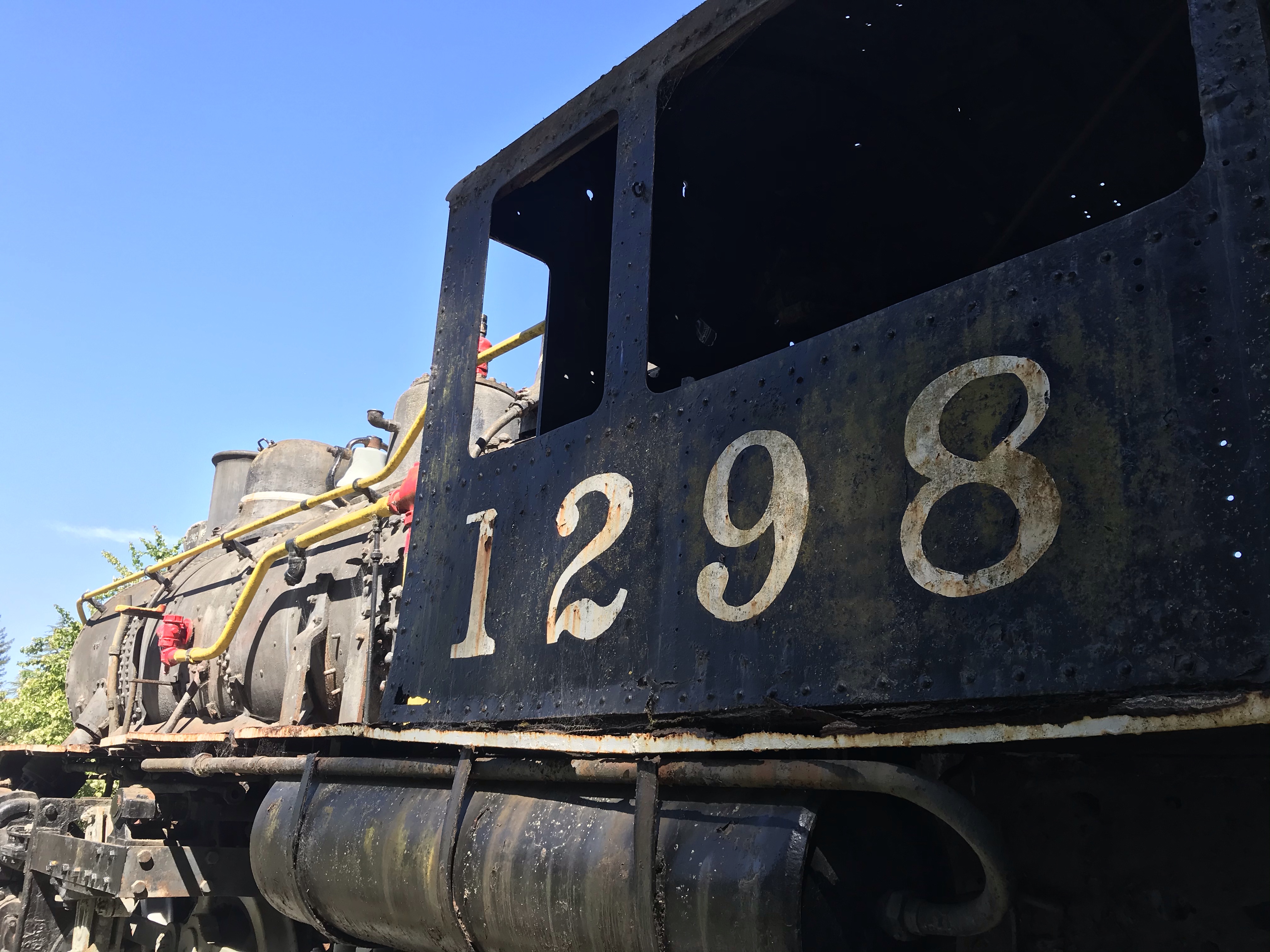
My first subject was to be found at Harvey West Park in Santa Cruz. It was a Southern Pacific 0-6-0 switcher that is on static display in the picnic area. Southern Pacific Number 1298 is an S-10 class yard switcher that was build by Baldwin in 1917. The locomotive was retired in 1956 and was put on static display in Santa Cruz in 1961. In an earlier era, when things was less litigious, children where able to climb on the locomotive and tender. Now the tender was sold and the rusting Number 1298 sits fenced in, in need of a lick of paint.

The word static, implies “not moving”, which is a perfect sketching subject because, well, 1298 is not moving. It was a great subject to capture the form of the locomotive and the trees in the background. For this sketch I chose the page with the cool blue underpainting. I figured it would also work with the sky.

I loosely sketched in the form of the locomotive, tiring to keep details to a minimum. I failed to some degree because I think I added too many details, a problems I have with sketching a highly detailed subject like a locomotive or architecture. The running gear (the driving wheels that propel the locomotive) I simplified and left out a lot of information.

When you put wet watercolor paint over dried paint, it is called glazing. When you glaze in watercolor you can build up layers and depth. Because watercolor is transparent, the underpainting shows through in unexpected ways. And with using a fairly random underpainting the result can be a bit jarring but somehow seems to work. It’s just a sketch, after all.

For my sketch I laid over the warm orange-red wash I choose a jarring subject.

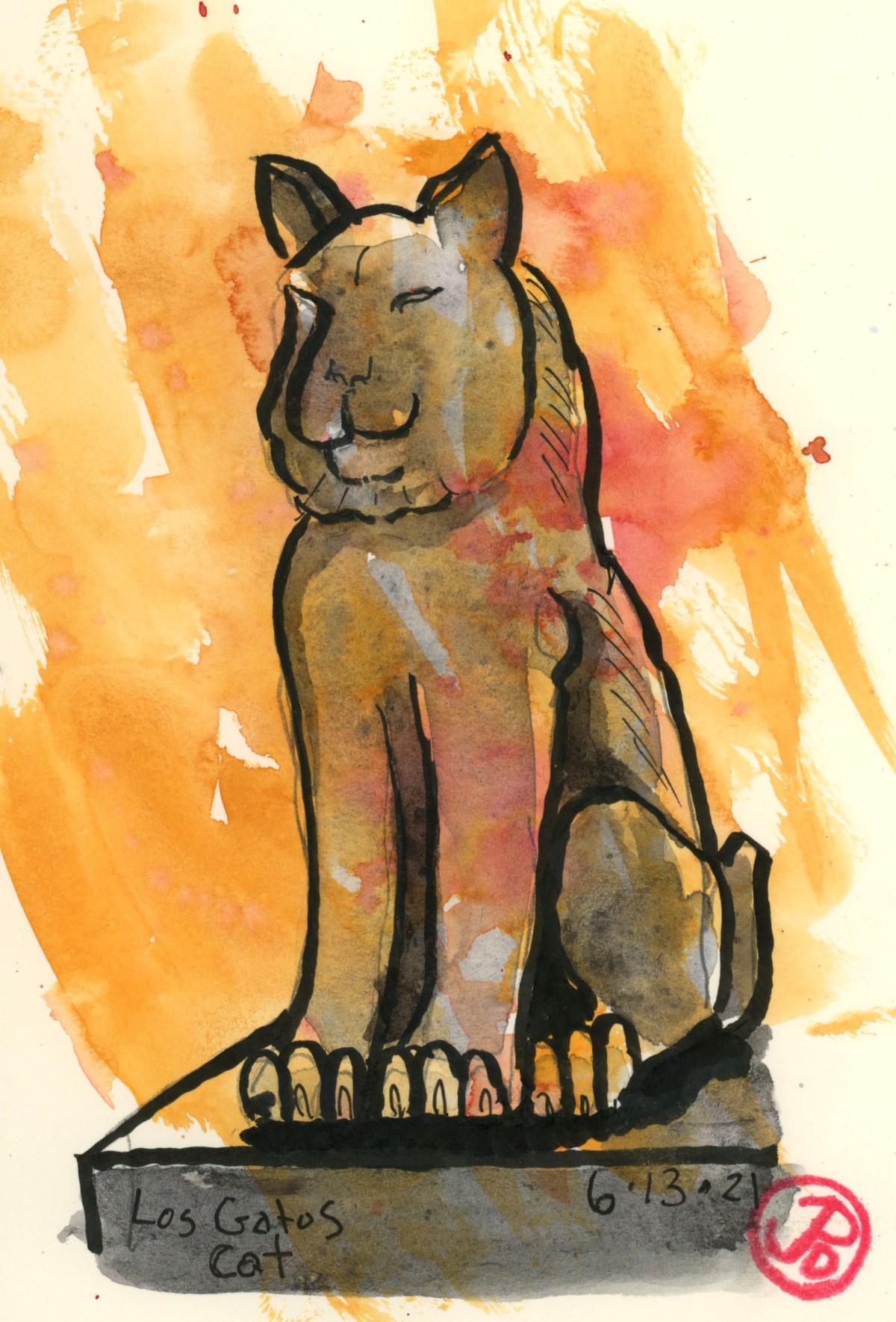
Just outside of Los Gatos, off of Highway 17, are two stone lynx-like statues that guard the driveway to Poets Canyon. The sculptures where created by Robert Paine and are named “Leo” and “Leona”. The sculptures have been in place since 1922. To get to this location is challenging because you can only turn west on Highway 17 (the direction whence I came).

Lucky for me, two 8 foot replicas are to be found at the Los Gatos Shopping Center on Santa Cruz Ave. The new cats are carved out of white marble and weigh in at 6,500 pounds each!

The underpainting is warm and I made no concessions to the true color on the statues. I like the way the sketch turned out (featured sketch).

Image

Lassen Volcanic National Park

Lassen was the final National Park in California that I needed to visit in order to visit al the National Parks in my home state. It always seemed less well known and remote than other parks in the state, with the exception of Channel Islands National Park because you have to take a one hour boat ride to get there. California has the most National Parks in the Union with nine.

Lassen Volcanic is an apt name for this National Park because volcanos and Lassen Peak dominate the landscape of this northeastern part of California.

A pre-trip sketch of the four types of volcanos and their examples, found in Lassen Volcanic National Park: Cinder Cone (Cinder Cone) Composite (Brokeoff Mountain), Shield (Prospect Peak), and Plug Dome (Lassen Peak). Lassen Peak is the largest example of a Plug Dome volcano in the world.

This 106,000 acre park features all four types of volcanos and Lassen Peak represents the last volcano to erupt in California. Even through that was just over one hundred years ago, that eruption, or more accurately, eruptions, left its mark all over the landscape. This is easily seen in the part of the park northeast of Lassen Peak called the Devastated Area.

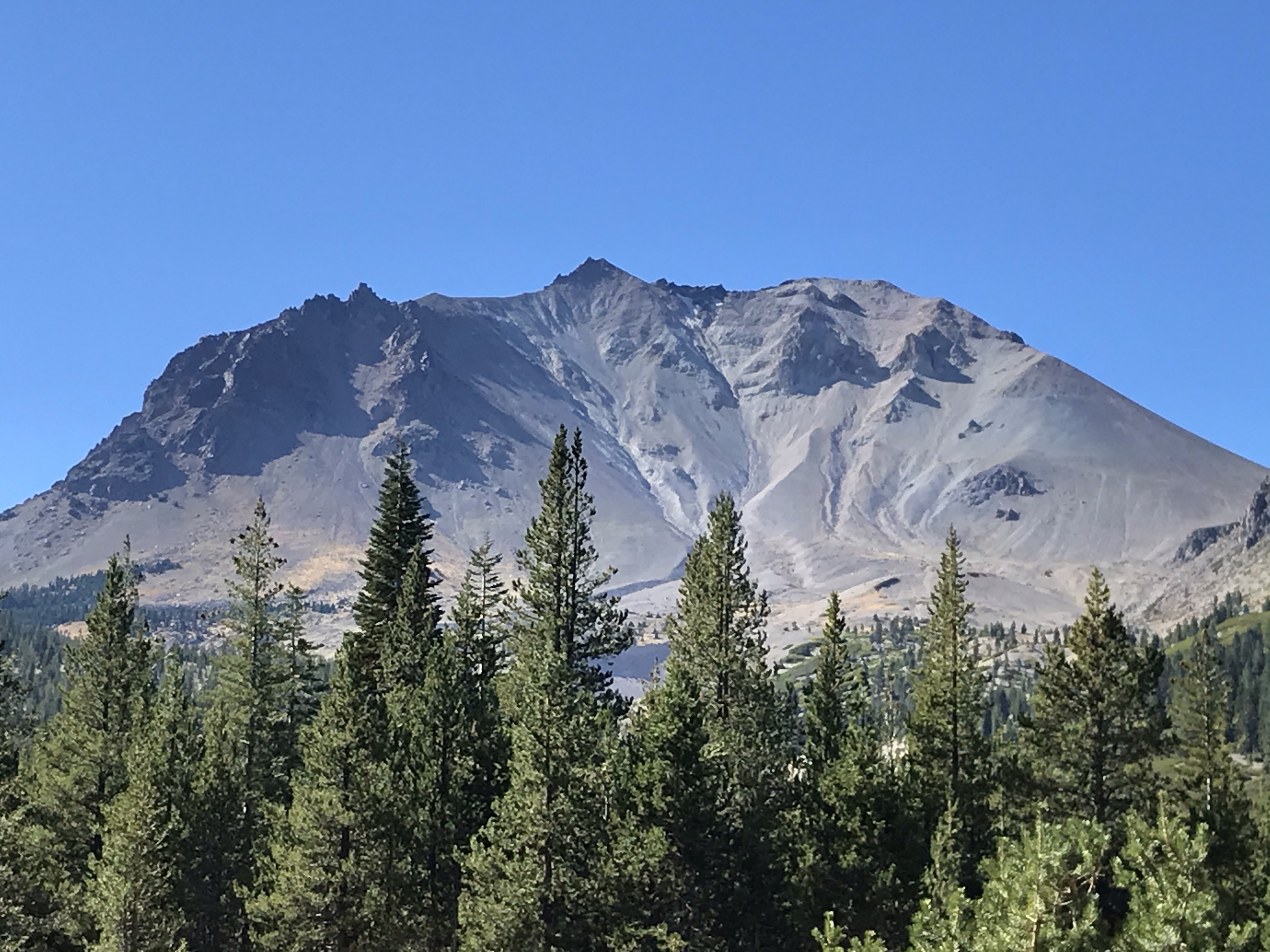
The view of Lassen Peak from the Devastated Area.

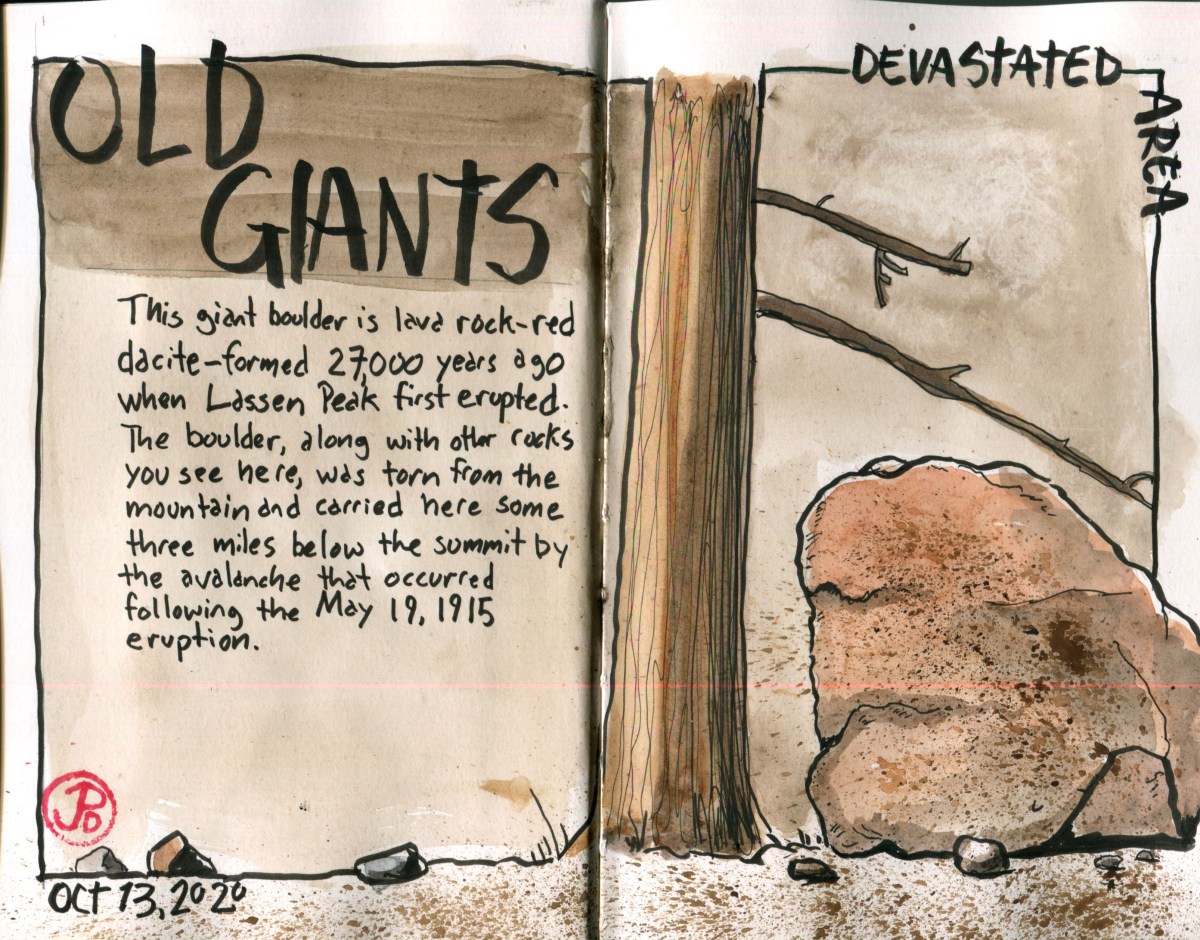
The short interpretive trail features giant boulders that had travelled over three miles to find their angle of repose after an avalanche on May 19, 1915. Some of the massive boulders are estimated to have travelled at over one hundred miles an hours on their journey from the summit.

Lassen was active between 1914 and 1917 but it’s largest eruption occurred on May 22, 1915 when a massive eruption sent gas and ash 30,000 feet into the air. The eruption could be seen 50 miles away to the west in Anderson. The flows headed down the Lost and Hat Creek waterways, destroying everything in it’s path. This is now the area called the Devastated Area. The trees and vegetation has grown back but the large volcanic boulders tell of a turbulent time.

I picked a spot on the ground near the trail and sketched a large reddish dacite boulder formed about 27,000 years ago. Reading about this boulder’s journey helped understand these erratic rocks. It’s reddish hue reflected the origins of it’s birth, the reds I was seeing at the peak of Lassen.

Image

Lassen Volcanic N. P.

Before most trips I like to create a map of my travels in my journal to help me get the lay of the land. For my fall break I decided to keep it local and visit one of California’s least visited National Parks: Lassen Volcanic National Park. This remains the last National Park in California that I have yet to visit.

This National Park gets about 500,000 annual visitors compared to Yosemite’s 4.4 million. It can be hard to find solitude among the masses at Yosemite, which is California’s most visited National Park. So I was looking forward to the solitude I would find on the trails, lakes, and meadows at Lassen during the fall.

Volcanoes dominate the landscape, history, and name of Lassen Volcanic National Park. The volcano in question is the last volcano to erupt in California and only the second volcano (the other is Oregon’s Mount St. Helens) in the Continental United States to erupt in the 20th century. This of course is Lassen Peak.

This is a sketch taken from a famous Benjamin Loomis photograph of Lassen eruption in 1914. This is also the first sketch in my Stillman & Birn Zeta Series watercolor journal. I love breaking in a new journal and I hope to fill it’s pages with Lassen sketches.

The first major eruption of Lassen occurred on May 22, 1915 and ash was spewed high in the air drifting as far east as 280 miles. Lassen continued to be active until 1921. In August of 1916, Lassen became a National Park and Lassen became a sleeping giant.

The landscape around Lassen still show signs of the last eruption in the early years of the 20th century. I can’t wait to sketch this volcanic history.

Image

The Skies of Mars

But Oh! as to embrace me she inclin’d,
I wak’d, she fled, and day brought back my night.

—John Milton, Sonnet 23

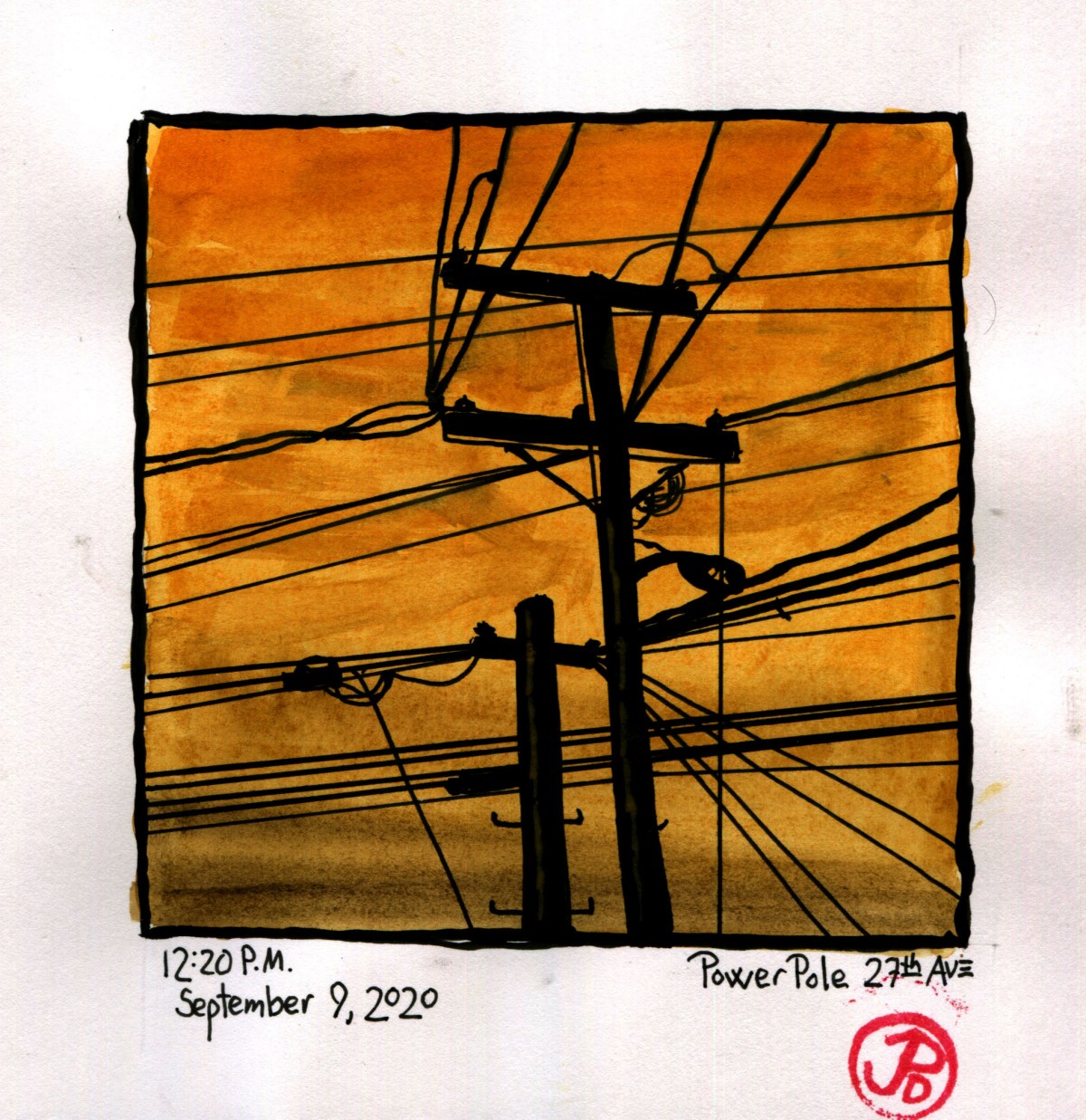
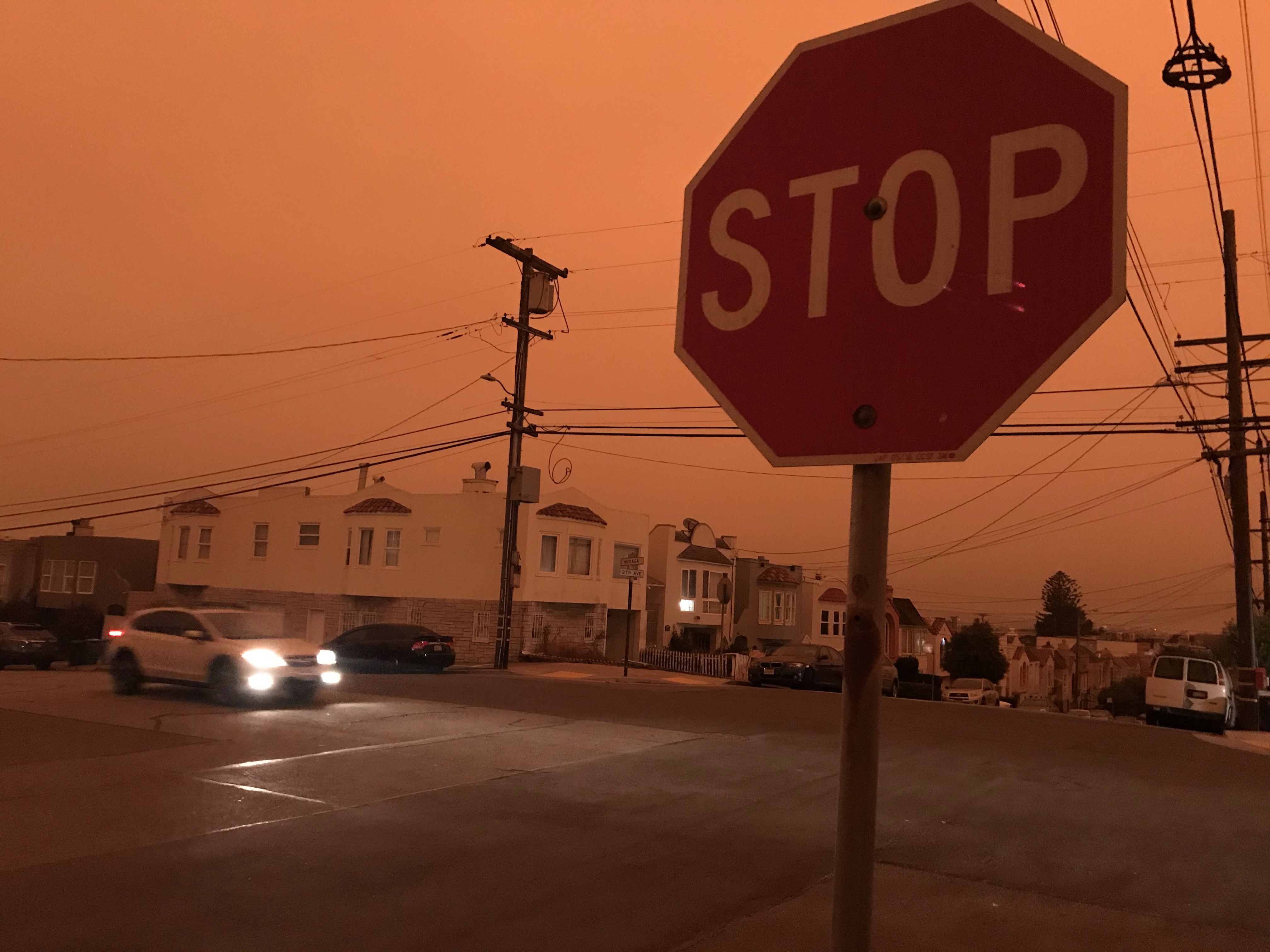
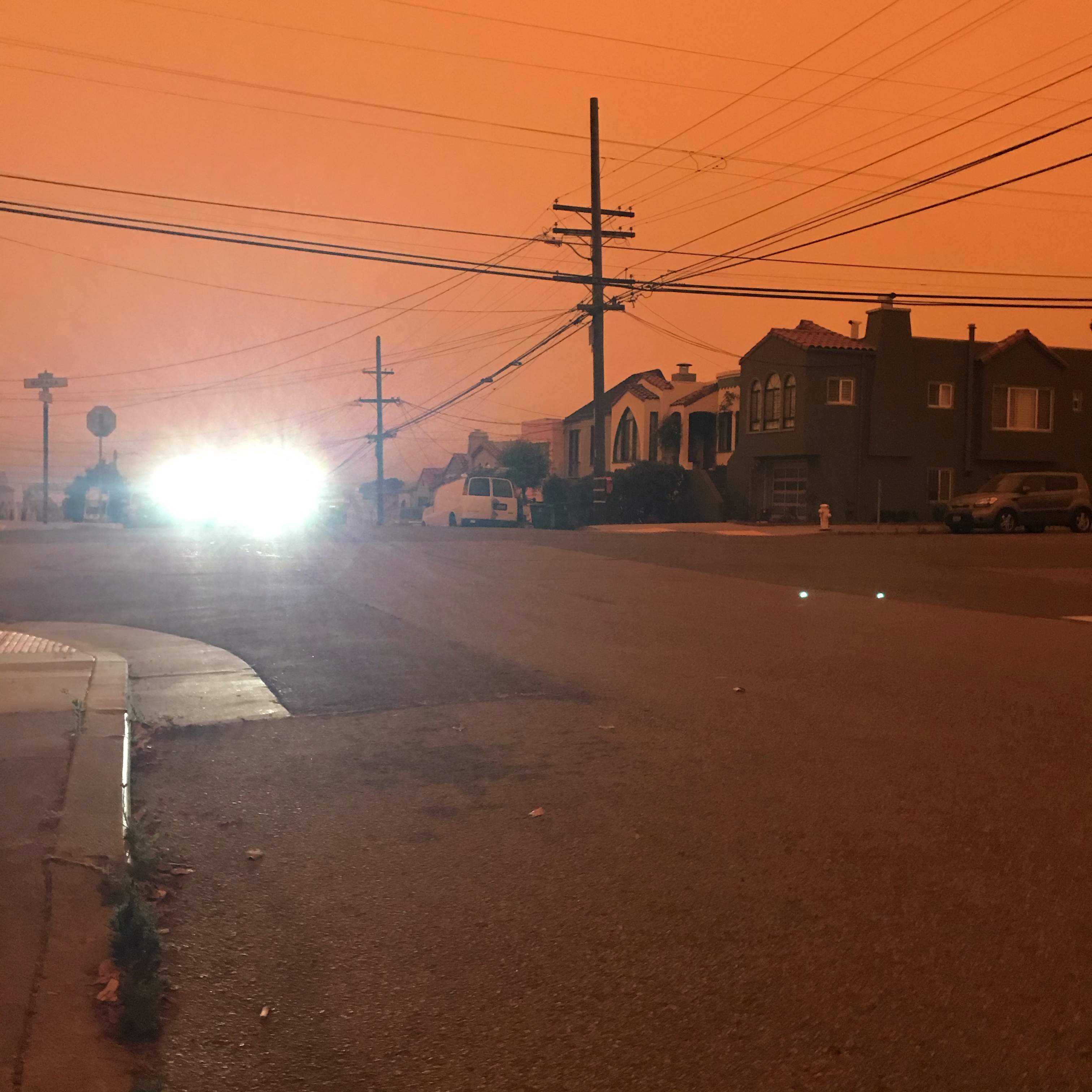
The morning skies of Wednesday September 9, 2020 where an odd orange hue. This dawning day looked like a sepia colored night from a Film Noir based in the foggy, hilly streets of the City By the Bay (think: Out of the Past).

The sun was shrouded by a high, smoky fog. The street lights were on, motorists had their headlights bright, and the birds where silenced by the false-night.

There are currently 28 major wildfires burning in California that have consumed over 2.5 million acres. The smoke from these fires lay thickly in our upper atmosphere, above the coast marine layer (fog) creating the sun’s orange-tinged light.

Many forecasts predicted temperature highs to be in the 90s but the smoke blocked out so much sunlight that many areas in the Bay Area could only muster temps in the 60s.

The only bird that broke the silence was the local California scrub-jay. All other life seemed silent and shrouded in a apocalyptic nightmare!

This photo was taken at 11:30 AM, you could not drive in the gloom without your headlights on!
Looking north down 27th Avenue. The Golden Gate Bridge is out there somewhere!
Image

The Founders Tree

“The redwoods, once seen, leave a mark or create a vision that stays with you always. No one has ever successfully painted or photographed a redwood tree. The feeling they produce is not transferable. From them comes silence and awe. It’s not only their unbelievable stature, nor the color which seems to shift and vary under your eyes, no, they are not like any trees we know, they are ambassadors from another time.” – John Steinbeck, Travels With Charley

Over the past 15 years I have spent much time sketching around my cabin in the Santa Cruz Mountains among the redwoods, douglas-firs, big leaf maples, and bay laurels. I have sketched all of the trees but one of these stands above the others. That would be Sequoia sempervirens, the coast redwood.

I have always loved sketching coast redwoods and I have sketched them many times and I understand their visual language. For one, they are not too hard to sketch, a straight trunk that reaches up to the sky like a giant sundial. These trees are so massive that when I sketch them, I only seem to capture a small part of them as the tree grows off the page. As Steinbeck noted, “No one has ever successfully painted or photographed a redwood tree.” I agree with this because I have attempted both, with mixed results. And I love the idea that you can sketch or photograph a subject but never truly capture it’s essence.

The coast redwood is a California native, growing along the coast (as it’s name implies) with it’s northern range just crossing the border into Oregon. In every sense the coast redwood talked about in superlatives. They are considered the tallest trees on planet earth. The tallest specimen is 379 feet high. They are also long lived, living between 1,200 to 1,800 years old. They are also one of the oldest species on earth.

In Paradise Park, most of the redwoods and Douglas-firs are second growth and are not necessarily considered superlatives of their species. The giants of the species are usually found further north. Except for one exception.

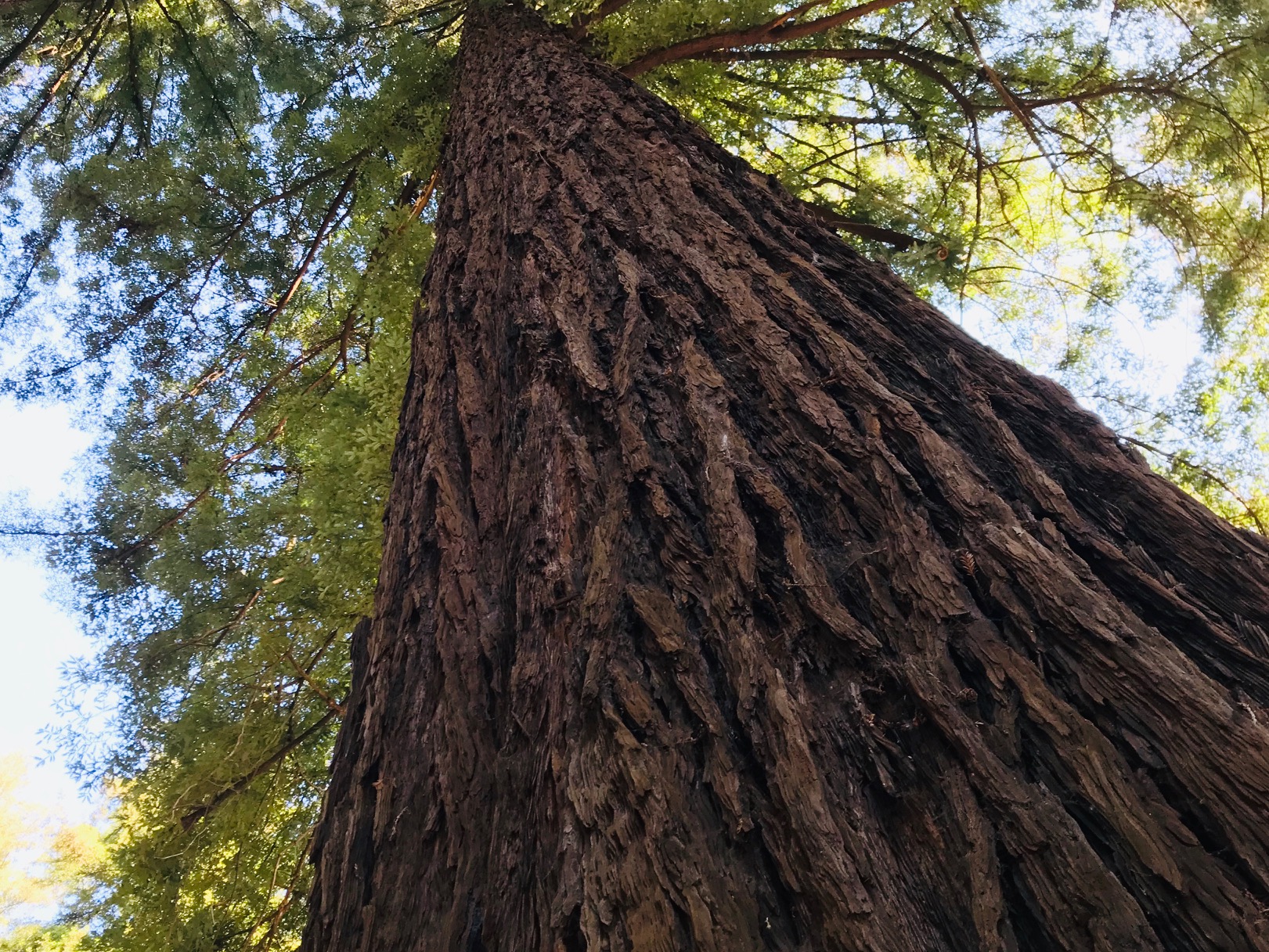
This redwood is known as the “Founders Tree” and it is believed to be the largest and tallest tree in Paradise Park. It is 24 feet in circumference and about 200 feet tall. The tree is estimated to be about 350 years old. Just for context, this tree is older than the government of the United States of American by about 100 years.

Your neck gets sore looking up toward the top of the Founders Tree.

The stone marker notes that the the Founders Tree was dedicated on August 12, 1974 and celebrated the foundation of Paradise Park on August 12, 1924. It is certainly a paradise for me in these tough and uncertain times.

Image

End of the Line: Davenport

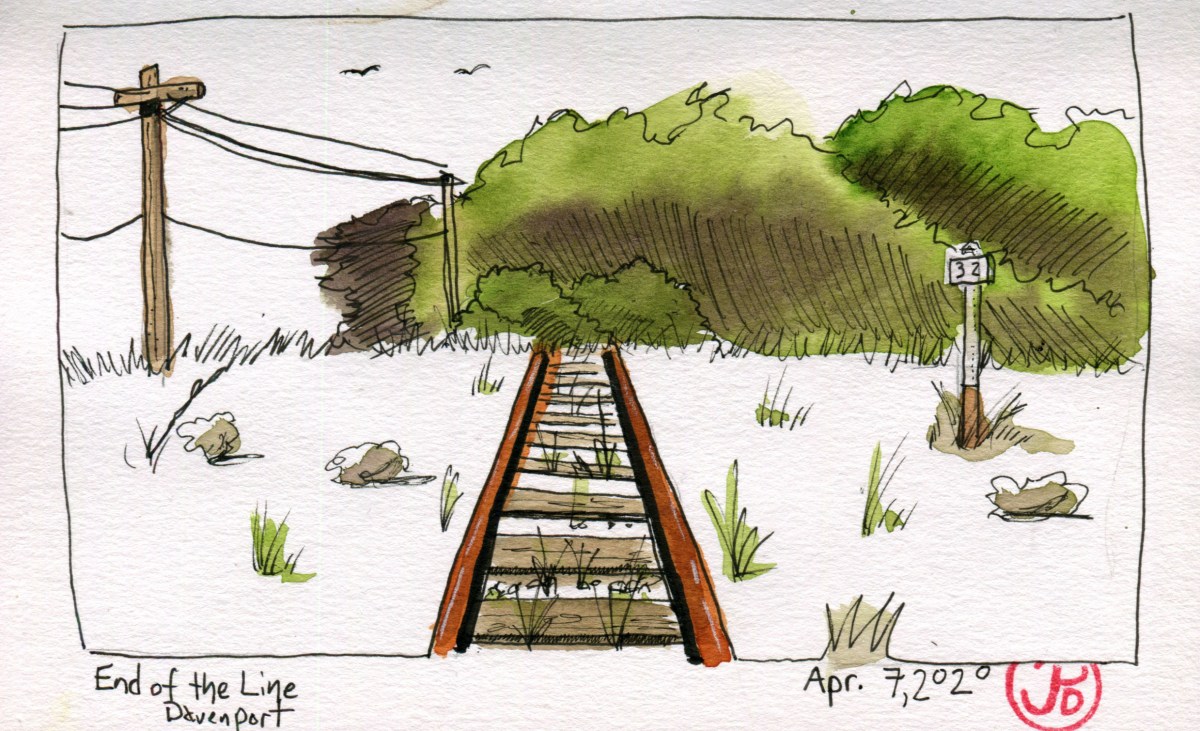
In these times of social isolation, I headed north out of Santa Cruz on Highway One. My destination was the small town of Davenport.

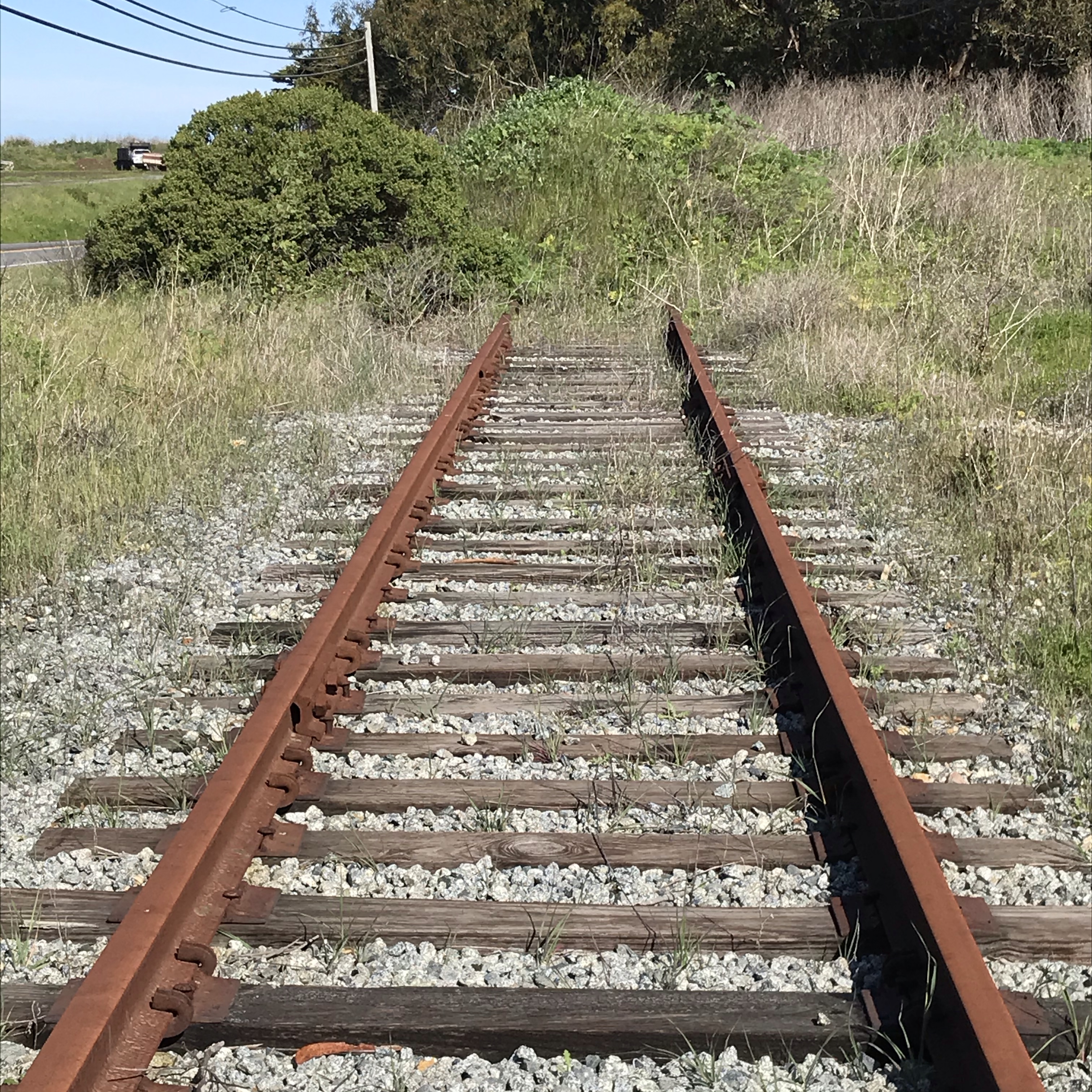
A branch line runs from the coast mainline at Watsonville Junction to Santa Cruz, north along the coast to the Davenport Cement Plant. The plant was built in 1907 by the Santa Cruz Portland Cement Company. This cement plant became one of the largest producers of cement. At the height of it’s production, during World War II, the plant shipped out 700,000 barrel of cement a year. Cement from this plant helped rebuild San Francisco after the 1906 earthquake and fire and also supplied cement for such major construction projects as Pearl Harbor and the Panama Canal.

The cement plant was later acquired in 2005 by Mexico’s CEMEX. The plant was closed for good, in 2010 and now the rails stand rusted, overgrown and the end of the line disappears into vegetation.

The Davenport railroad to nowhere sums up the plight of America’s railroads. At it’s height, in 1916, the United States Railroad network consisted of 254,000 miles of track, the largest rail network in the world. From 1916 to the present day, 160,000 miles of track have been closed down and abandoned. The current rail network stands at about 94,000 miles of trackage.

Railroad companies saw passenger service as a losing hand, as trains were competing with the automobile and the increasing use of passenger air travel. The railroads were in dire straights in the 1960’s and passenger service was saved by the creation of AMTRAK in 1971 (the year of my birth). This service is a government subsidized and controlled service which now serves an average of 30 million passengers annually.

Railroads companies still exist to this day but they earn their profits from freight and not passenger service. They keep America moving and most Americans are unaware both of their legacy in creating the United States and there present impact in moving goods around the county. As Christian Wolmar notes in his excellent book, The Great Railroad Revolution, “America needs to relearn the joys of railroads that have served them so well in the past and, indeed, continue to do so today, albeit invisibly.”

The American railroad stands at a crossroads as the plight of high speed rail in California seems like a far off dream.

Image

The Daily Routine in a Time of Shelter in Place

Last week I knew for sure that I would be working for much of the three weeks leading up to Spring Break working from home. Add to that the Shelter in Place order that restricted much travel and social gatherings in the City and County of San Francisco. I knew I would be spending a lot of my time indoors, working remotely on my laptop. Communicating with students, lesson planning, talking with my fourth grade team, and assessing student work.

I knew that I would have to create a daily weekday routine that would give my day form and structure. So I created a daily routine diagram to flesh out the blocks of time during my waking hours.

For this diagram I used one of my favorite fonts, Sara Elizabeth. I discovered this font in the Dover publication: Rustic and Rough-Hewn Alphabets by Dan X. Solo. I have used this font in many of my illustrations from Central and South America. I also added illustrations to parts of each chunk of time. I intentionally didn’t add times because I knew that in relation to this weekly schedule, I had to be fluid in such an ever-changing time.

In one of the blocks I added “Creative Time” because for me it is like breathing air. And that is when I created this illustrated timetable.

I will go over every chunk of time:

Wake: This is when I wake up. Represented here by the crowing rooster, if we had roosters in my urban neighborhood, which we don’t. Otherwise I would be woken up much earlier. My wake up time is listed as 7AM. This is a little later than a “normal” working day because I only had to commute from my bed to my computer.

Break the Fast: Breakfast, usually of oatmeal and coffee. Keep it simple.

Teacher Time: This is when I open my work laptop and connect with my students. I do this through messaging on Google classroom. There were many questions the first day and I reminded then that patience is required in the weeks ahead as we are all learning in a new way. The title of this block comes from the name of the 30 minutes we have with our own students during our Coloma overnight trip, which we have, unfortunately, had to cancel.

Lunch: Lunch is from noon to one and I try to be consistent with eating healthy. Something that helps me stick to the normalcy of the working day.

Distance Learning: At this time I might arrange a Google chat and invite my students. They are jazzed to see each other (and what the interior of their houses look like) and I found that I had to do a lot of redirecting (just like in the real classroom) to keep my students focused and not all talking at the same time. I have employed the phrase, “You have the floor!”, just keep it Parlimentary.

Exercise: Physical and mental health are so important in this time of sequestration. I plan to walk down to the Pacific Ocean (25 minutes one way) or down through Golden Gate Park. My goal is to get 45 minutes to an hour of walking in each day, including weekends.

Creative Time: I live to create so this is a must in my day. At this time I can draw, paint, write, or play music. I may also do some field sketching as part of my daily exercise.

HH ~ Read: I love to read and I set about 60 minutes of reading time every day. I have a few books in my reading queue. I am currently reading non-fiction, a wonderful book by Christian Wolmar: A Short History of the Railroad. I am reading this in anticipation of my trip on the California Zephyr to Chicago which I had to cancel in light of the current pandemic. I also have three graphic novels that are extremely popular with my students by local author Raina Telgemeier: Ghosts, Sisters, and Guts. I also love to revisit poems by: Mary Oliver (one of my favorite poets), Basho, William Stafford, Shakespeare, John Donne, Pablo Neruda, Borges, Naomi Shihab Nye, Gary Soto, and Billy Collins. Just to name a few.

Dinner: I have enough healthy food to last me for three weeks (I think!). The Shelter in Place order should be no excuse to eat unhealthy foods.

Great Movies: This is a time to revisit some of my favorite films in my extensive collection of DVDs. Many of these films are considered masterpieces of world cinema. A partial list includes: Amelie, 49 Up (Roger Ebert called the series, “on my top ten greatest films of all time”), Amores Perros, Being There (much better than Forrest Gump), Butterfly (Spanish film about the early days of the Spanish Civil War), Cabaret, Chushingura (The Japanese tale of the 47 Ronin), Citizen Kane, Cria Cuervos (Title refers to the Spanish saying, ” Raise ravens, and they’ll gorge your eyes out”), Das Boot, Delicatessen, Grave of the Fireflies (a Japanese animated heartbreaker), Harakiri, Ikiru, Jean de Florette/ Manon of the Spring (Just amazing!), The Lives of Others, Playtime, Odd Man Out (one of the best soundtracks ever created for film), Once Upon a Time in the West, Rashomon (Seminal piece of World Cinema), Rio Bravo, Senna (a great documentary and I could care less about Formula One), Seven Samurai (one of my all time favorites), Shadow of a Doubt (Hitchcock’s favorite film), Spirited Away (Miyazaki’s masterpiece of animation), The Spirit of the Beehive (a dense film but probably the best Spanish film ever made), The Third Man, Sunset Boulevard, Tokyo Story, Watership Down (love the book and the animated film), Ugetsu, Vertigo (Often recognized as the best film ever made), and Unforgiven. I have many more films on this list but these are the films that speak to me at the moment.

ZZZZZ . . . Repeat: Perhaps a little bedtime reading but this is the time to rest in a time of unrest. I need all the sleep I can get to recharge the batteries to repeat the day and keep to the same route. Again and again. But hopefully not again.

I challenged Grasshopper Sparrow to create his own Daily Route in this time of shelter in place, and I would have to say that he rose to the challenge!
Image

Santa Barbara Station

The Surfliner was an hour late and I would have even less time to spend with Santa Barbara’s beautiful station. I had to catch the number 14, Coast Starlight back to SLO at 12:40 PM. So I figured I had time for a quick 45 minute sketch and an even shorter lunch but I couldn’t wander too far from the station. Revisiting the “Queen of the Missions” was out of the question.

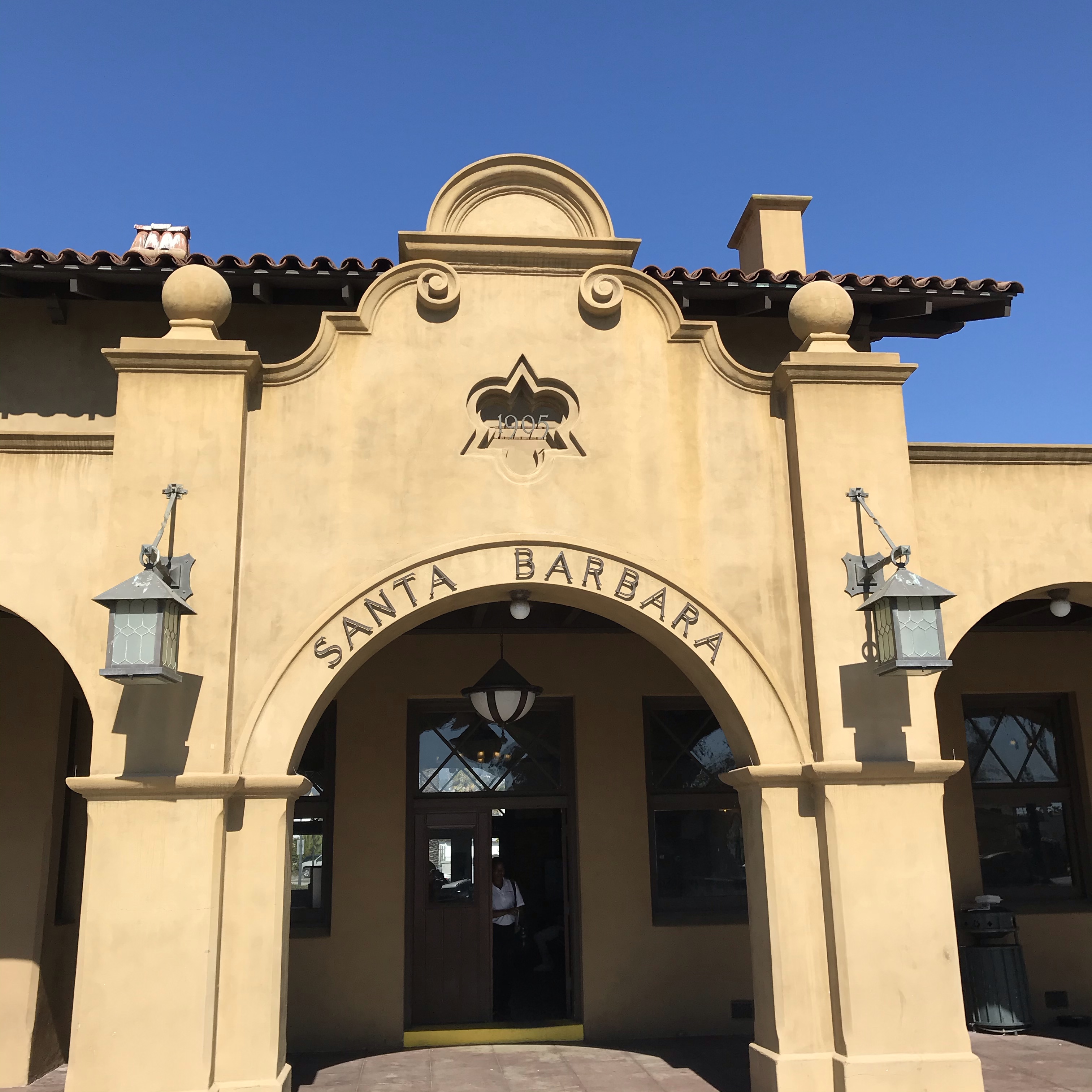
I walked around the station, “shaking hands”with the place. The Santa Barbara passenger station was completed in 1905 and designed in a Spanish Mission Revival style, very much reminiscent of Burlingame Station. This building has all the hallmarks of Mission Revival: arches, a star window (in imitation of Mission Carmel), and adobe tiled roof.

The woman’s waiting room at Santa Barbara Station. Above the fireplace is a base relief representation of Father Serra, founder of the Alta California Missions. He is spreading his arms wide, waiting to hug any neophytes that happen to be in the Station’s waiting room.

Santa Barbara Station was one of seven stations that the Coast Daylight served. The route parallels El Camino Real, the Royal Road, that connected 21 of the Spanish Missions along Alta California’s Coast.

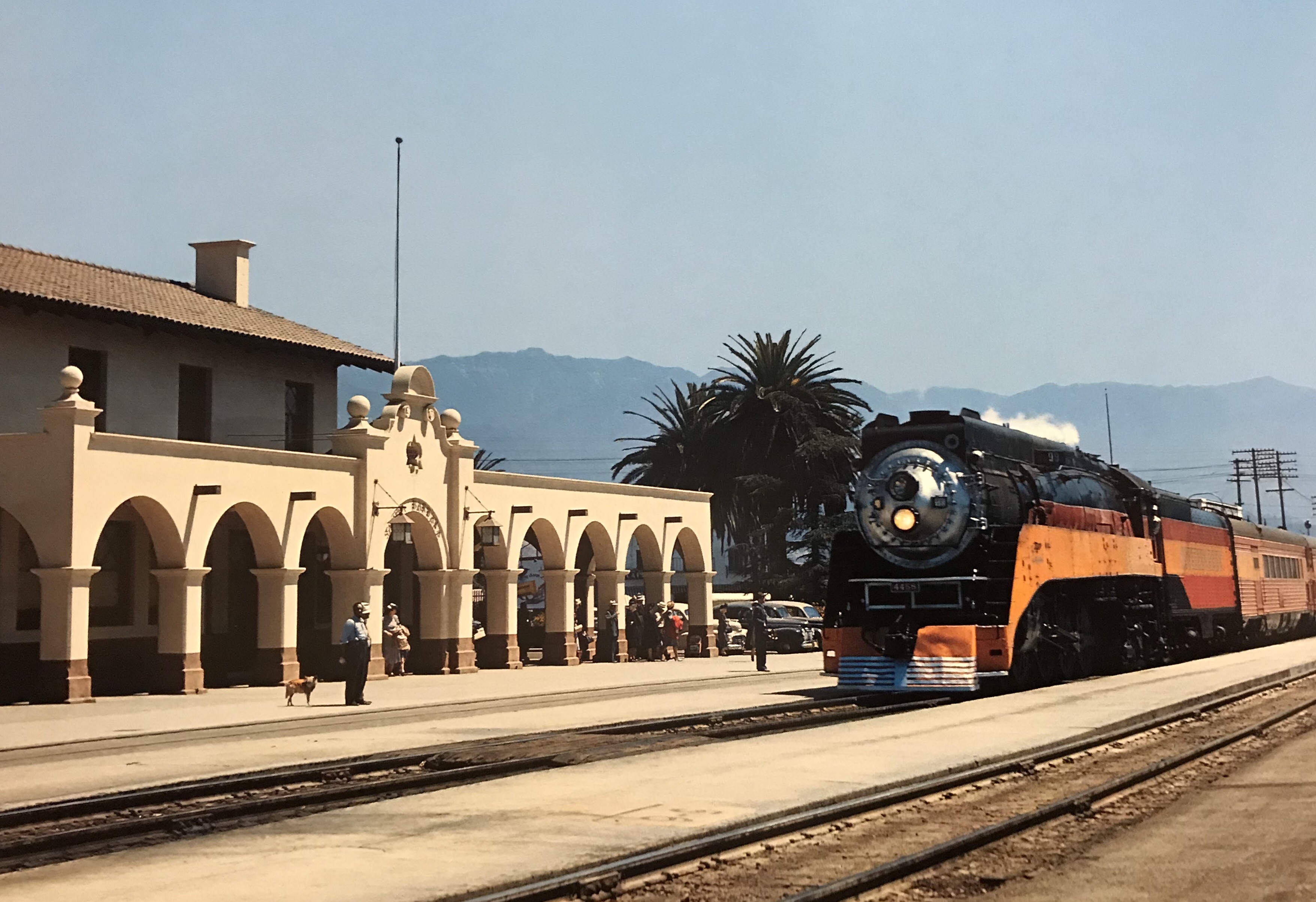
GS-5 Number 4458, pulls into Santa Barbara Station at an unspecified date. The loco pulls train No. 99, a northbound Daylight to San Francisco. There were only two GS-5 locomotives built. Numbers 4458 and 4459. (Union Pacific Museum Collection: SP photo)
Golden State-4 number 4443 taking on water at Santa Barbara in January 1948. The train stopped in Santa Barbara for only four minutes before heading south towards Los Angeles. (Alan Miller Collection: Frank Peterson photo)

The train station served the ever growing resort town on the Pacific Ocean that catered towards the high-end.

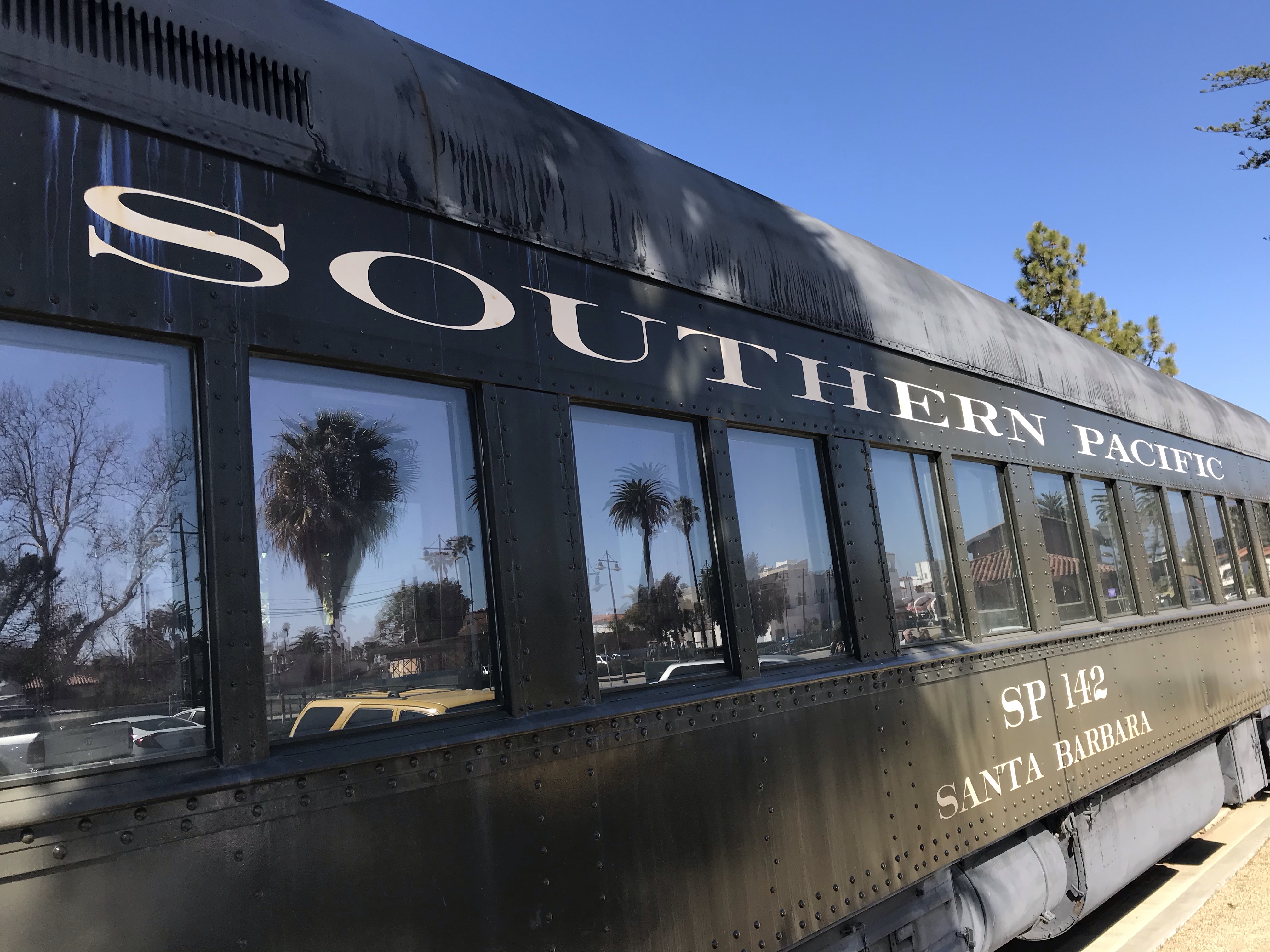
A sign of the wealth and affluence of this area is the Pullman car that is on static display near the train station. Pullman passenger cars where a huge improvement in comfort and safety from the rickety, wooden cars that were uncomfortable and sometimes downright dangerous. They were the height of luxury at the time, for the well-off passengers who could afford to ride on one.

But the Pullman car at Santa Barbara is something very different. In the later part of the 20th century, Pullman produced passenger cars for the extremely wealthy, that could cost up to half a million dollars, which was twenty times the cost of a standard Pullman passenger coach. These cars were considered “mansions on wheels”. They where coupled to the end of a passenger train and at Santa Barbara there were siding tracks where these luxurious cars would over-winter as their owners stayed in nearby posh hotels.

After my sketch I walked down State Street toward the Pacific Ocean and I was passed by a twenty-something driving by in a brand new Rolls Royce, a modern Santa Barbarian mansion on wheels.

Some things like the station and mission remind us of a very different time while others show us that things remain very much the same.

Image

Menlo Park Station

It was now time for an after work train station sketch.

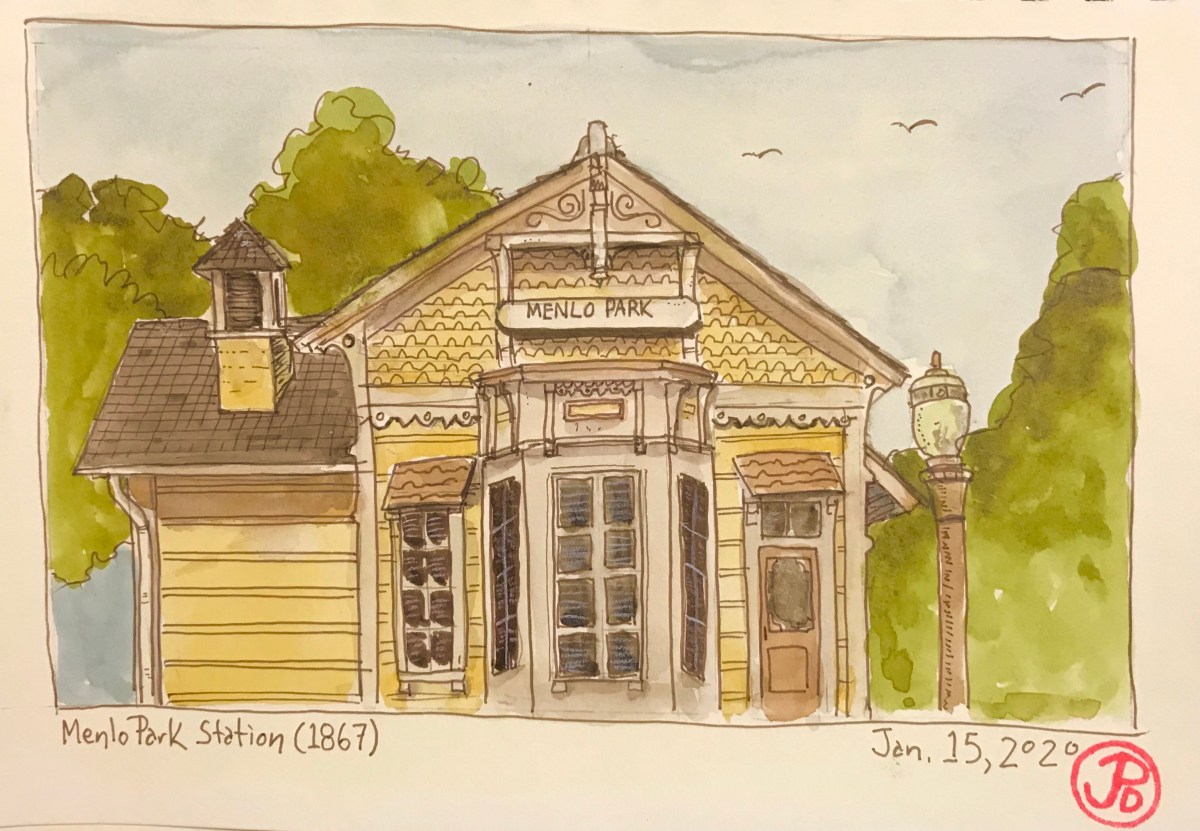
I headed south to one of the oldest stations in San Mateo County and one of the stations furthest south on the line before heading into Santa Clara County. Menlo Park Station is the oldest active train station in San Mateo County. Rail service to Menlo Park began on October 18, 1863. At that time, a simple shelter was on the site before the depot was built. It is considered the oldest active passenger railway station in California. It was built by the San Francisco and San Jose Railway in 1867. The Queen Anne expansion, included a Ladies Parlor, was added to the south side which is featured in the sketch.

When Southern Pacific consolidated the line (in 1870), Victorian ornamentation was added in the 1890s to appeal to the students (and parents) of nearby and newly built Stanford University.

At one time Menlo Park Station had two separate waiting rooms, one for men and one for women. In the office, Stanford University co-founder, Jane Stanford, wife of rail tycoon Leland Stanford, would wait for her train in a private room by herself. In 1905, Jane Stanford died of strychnine poisoning and her murder has never been solved. It is claimed that her ghost has been seen pacing back and forth in the station.

The station is on the same level as the main line just as it was when it was first constructed. The interior is no longer used as a passenger waiting room. Southern Pacific closed the station in 1959. It now houses the Menlo Park Chamber of Commerce.

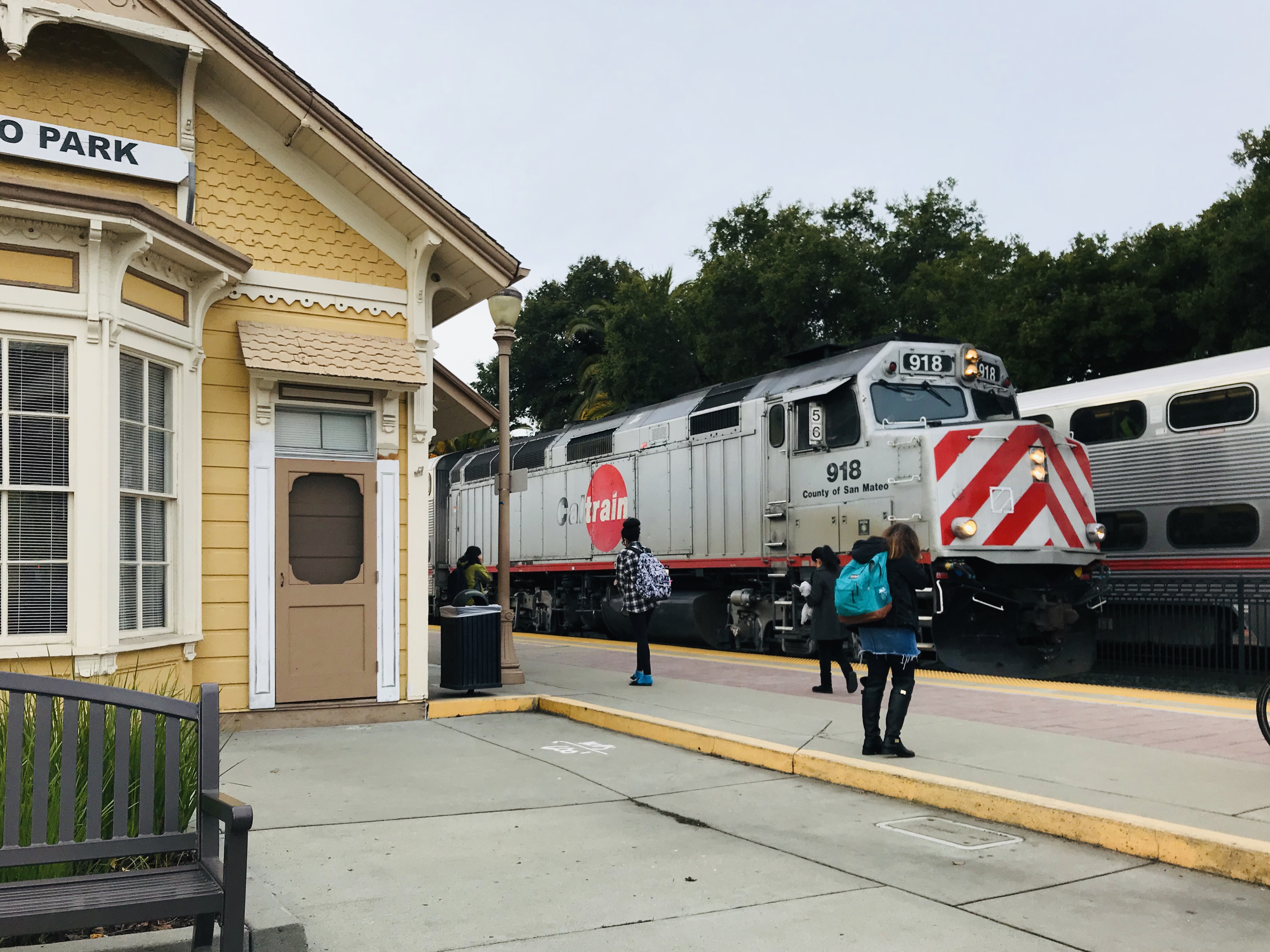
This fancy vending machine has replaced passenger stations on Caltrain. I always prefer to buy my train tickets from a human being. You can’t do that here in Menlo Park. Nor can you buy tickets on the train from the conductor. Although you can chat with the friendly people at the Chamber of Commerce.

I sat on a north facing bench and started to sketch the elevation view of the station. There was something very comforting about this sketching experience. All around me I was surrounded by commuters. Both high school students and high-tech workers with their bikes milling about the platform or sitting on benches texting their friends waiting for their train. The overall feeling was of a vibrant station that is still in use and gave me hope for transit in the Bay Area. The scene at 4:30 PM in 2020 could not be too much different from a weekday scene at this same station, 70 years ago. Of course it helps to squint.

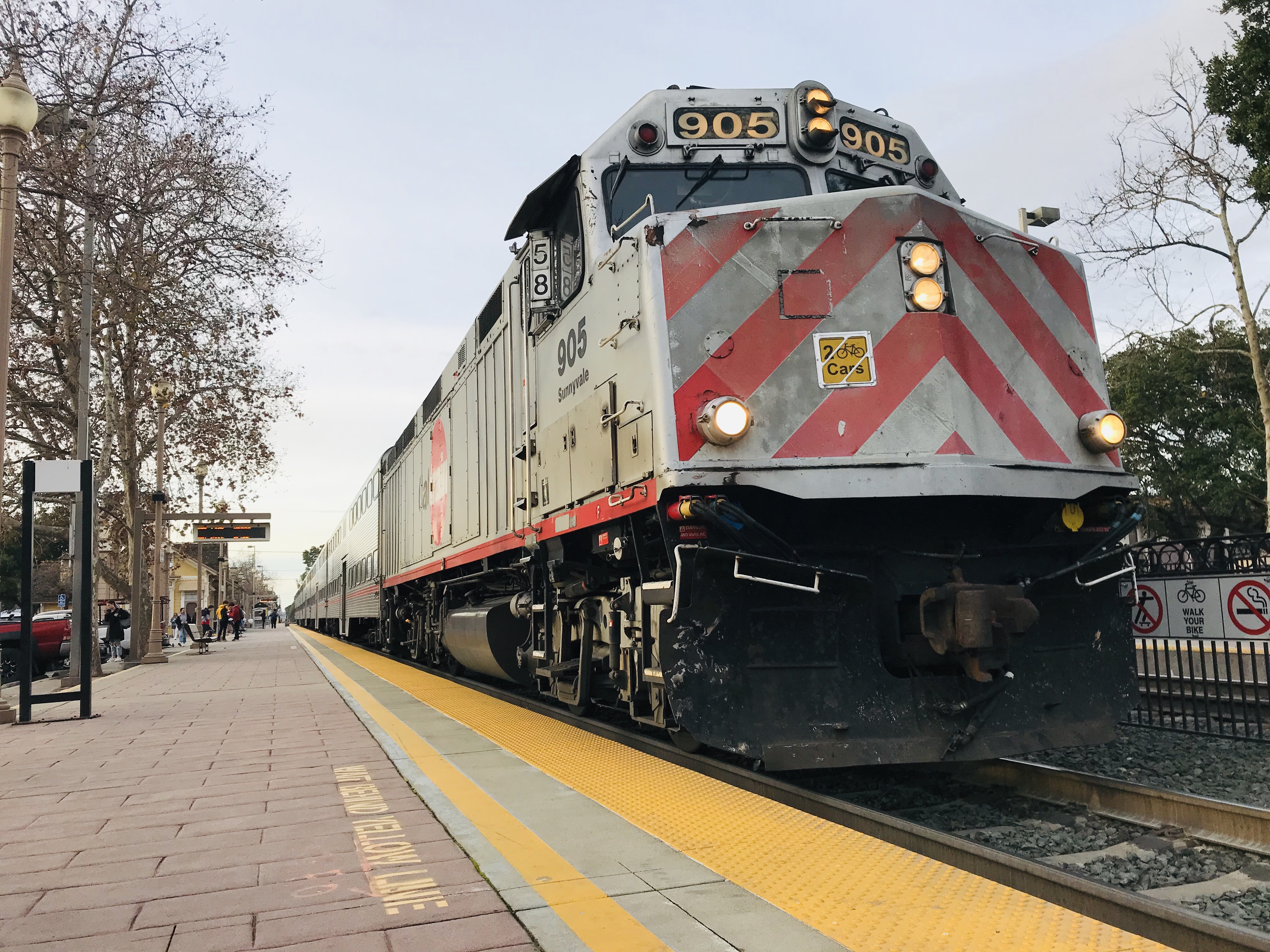
Menlo Park is a busy station on a Wednesday late afternoon. A southbound and northbound train pull into the station.

Engine Number 905 “Sunnyvale ” is on the point of a southbound train to San Jose. This engine is named after my hometown.

The train station at Sunnyvale is long gone. I never remember it as being an amazing piece of Southern Pacific architecture. The station has been replaced with a ticket shelter that connected to a parking shelter.

Quenching my thirst after my sketch at the redesigned British Bankers Club. I raised a glass to my father, who had to come to Menlo Park when he was at “The Farm” to buy spirits because Palo Alto was a dry town.