Bishop Peak

One SLO goal on my three day weekend visit was to summit Bishop Peak, and at 1,546 feet tall, it’s the tallest of the Nine Sisters.

The Nine Sisters, aka the Morros, are volcanic peaks stretching from Morro Bay to San Luis Obispo. Bishop Peak, named after the shape of the summit rocks, is a much sought after destination for hikers and climbers.

With forecasts for the day in the high 70s, I got an early start, hitting the trailhead at Highland Drive at 7:30 AM.
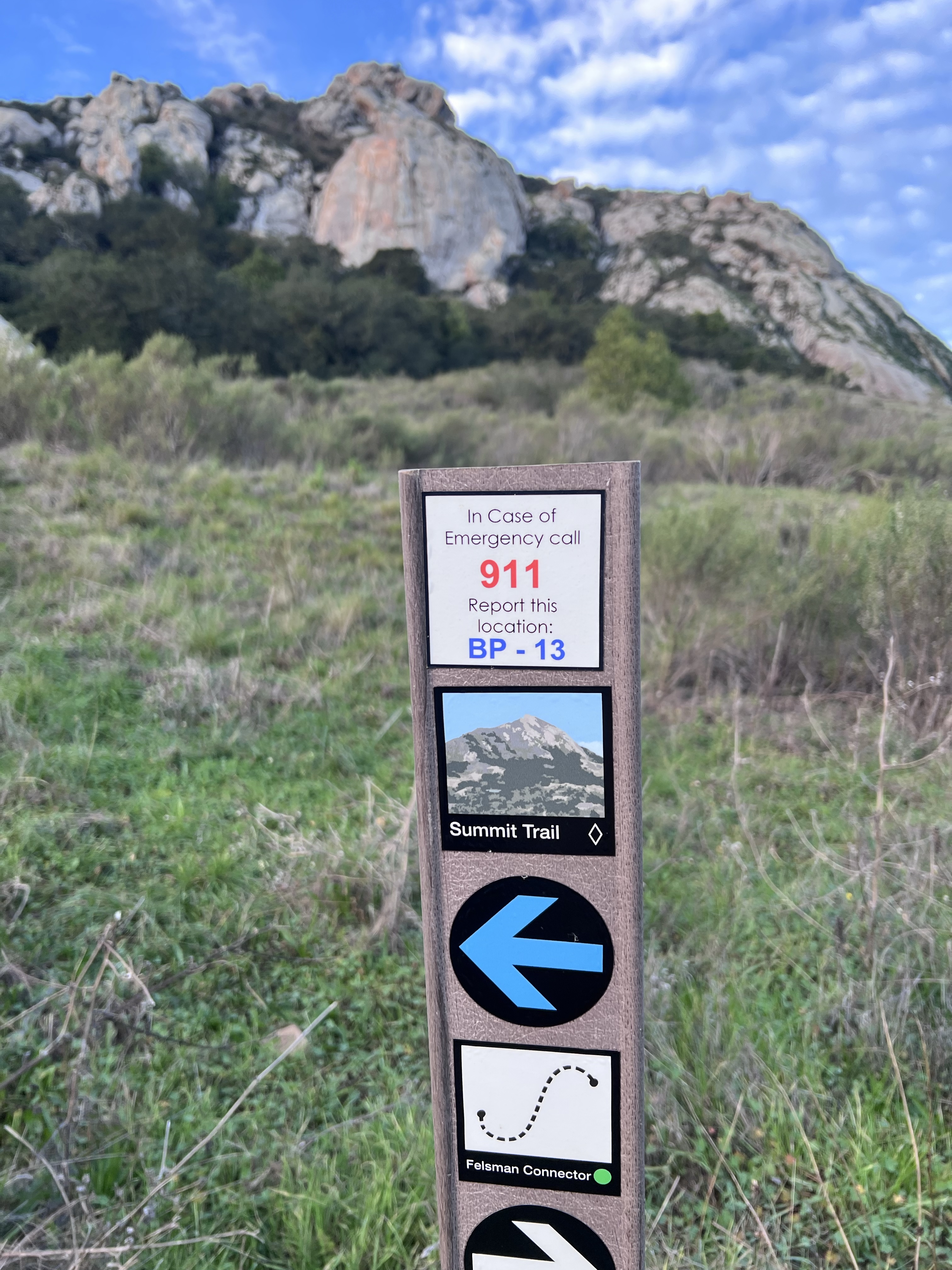
The trail marker lists the Summit Trail as a black diamond. This is not for the weak kneed and out of shape (which could describe me). I duly noted the 911 sign, giving me my location.

One change in my fairly recent hiking gear is trekking poles. I once ridiculed them as useless pieces of hiking chic. But as I grew older I now see them as an essential part of my hiking get up, so much so that I keep a pair in the trunk of my car at all times. They give me more points of contact, improve balance, and take pressure off the knees. And in a pinch I recommend they could fend off a mountain lion or bear. All of which is very necessary on the over 1,200 feet elevation gain thought uneven boulder terrain that is the Summit hike.

The first part of the hike led me to the base of the peak, past a cattle pond. At the top I could see a few hikers that had already summited. They must have gotten a much earlier start and hiked under headlamps. Cal Poly student no doubt.

I passed a climbing wall to my right and my climb to the peak really began in earnest when I reached the first of many switchbacks.
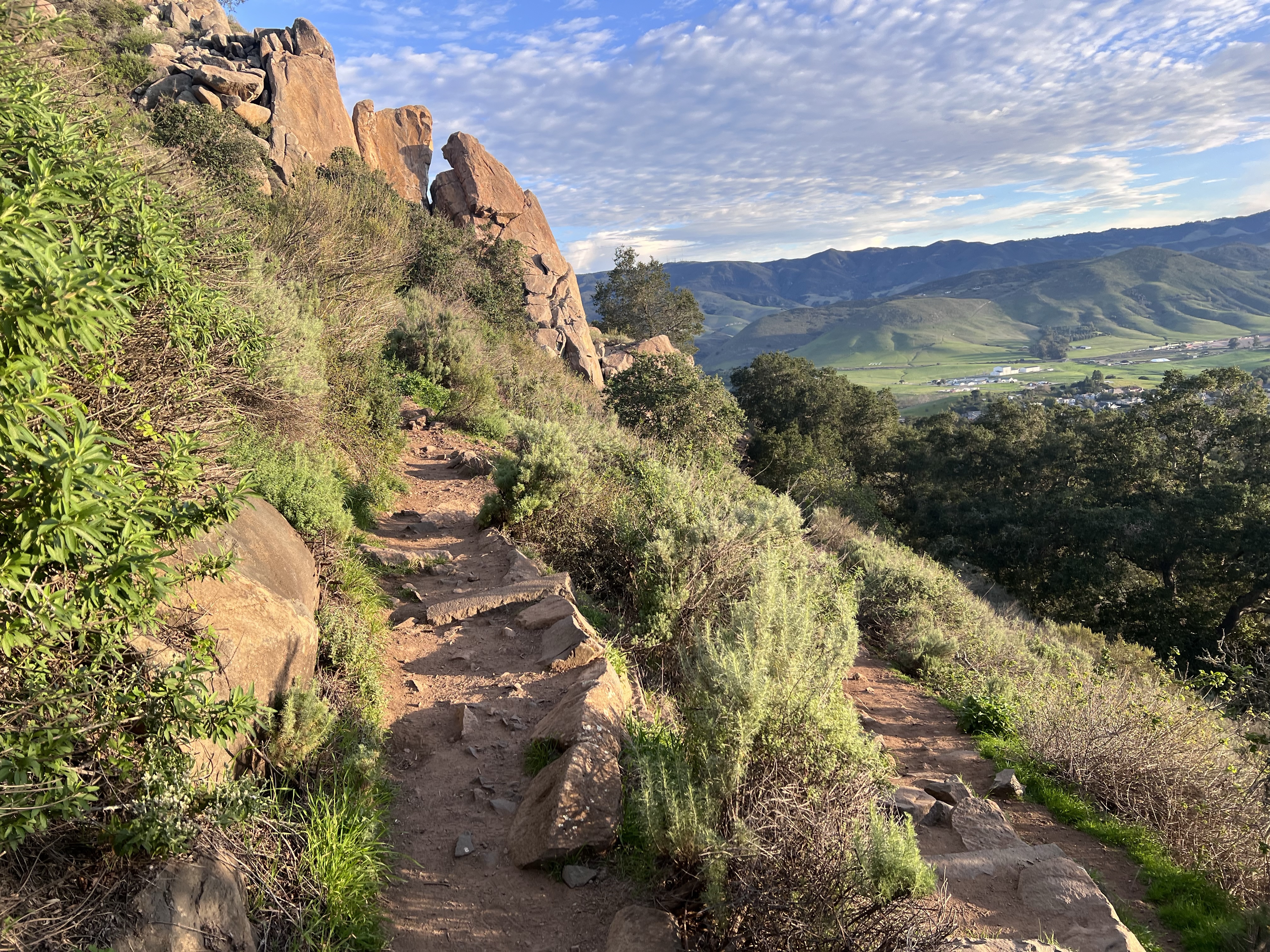
The first of many switchbacks to the summit.

There was a dad with his two teenage sons who passed me. They had far less gear and no trekking poles!! I used them as a pacer, a reminder of my much slower pace, as I saw them on the switchbacks above mine. I would see their heads always moving forward above the chaparral. They were getting farther and farther ahead.

I soon started passing hikers coming down from the summit who had gone up to watch the sunrise. They had far less gear, water, and some were not even wearing hiking shoes. One group of girls had forgotten their headlamps so they had to use their phone light instead. Ah youth!

I was glad to have full sunlight and the views kept getting better and better the higher I climbed.

After hiking an hour, I could see the reddish rocks of the summit. The rocks that give the peak it’s name.
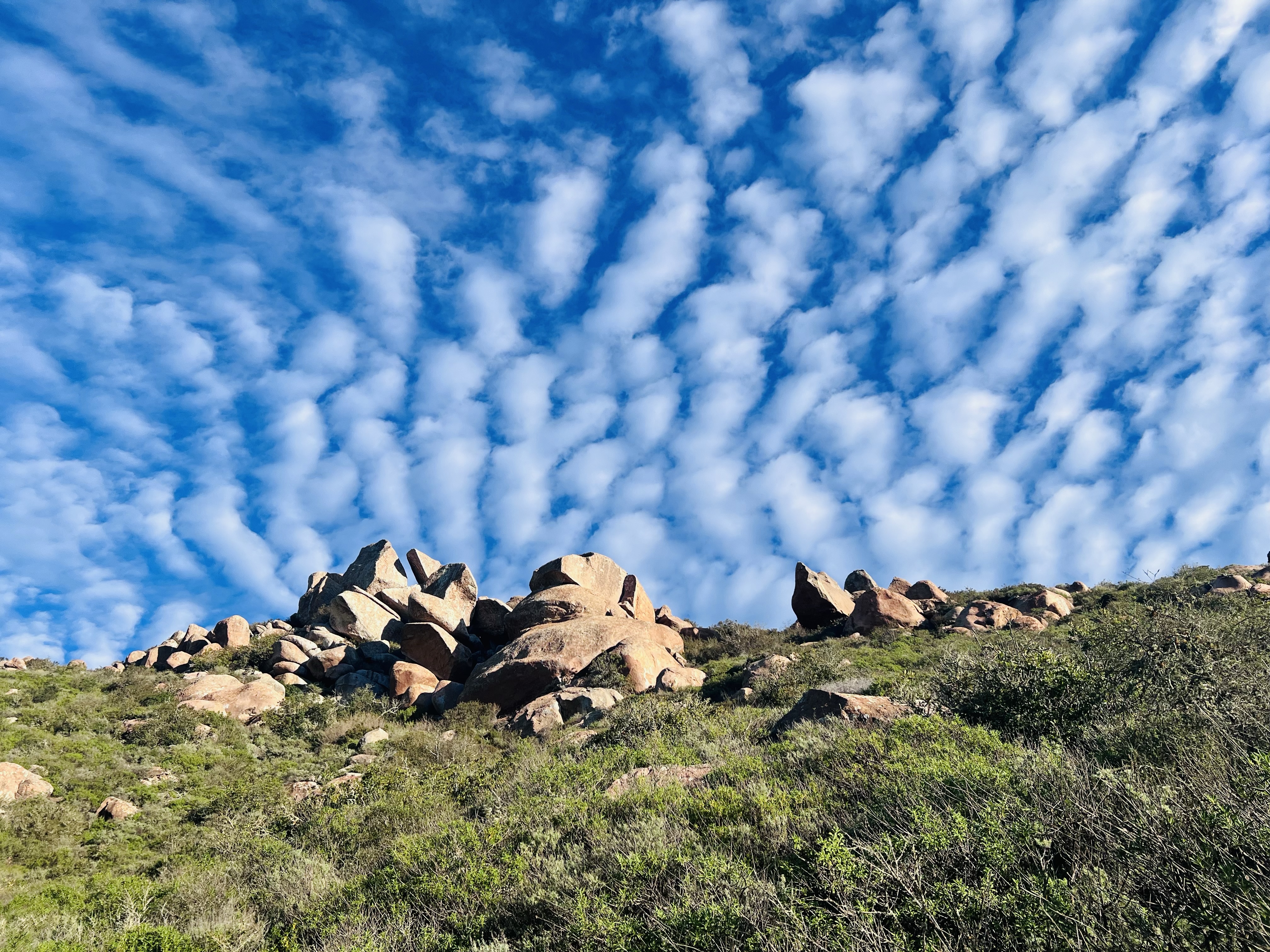
As I got closer to the summit there seemed to be a few false summits and the trail branched off in different directions, hemmed in by brush. One final scramble and I was greeted by a much appreciated bench. It was 8:35 and I had reached the top!
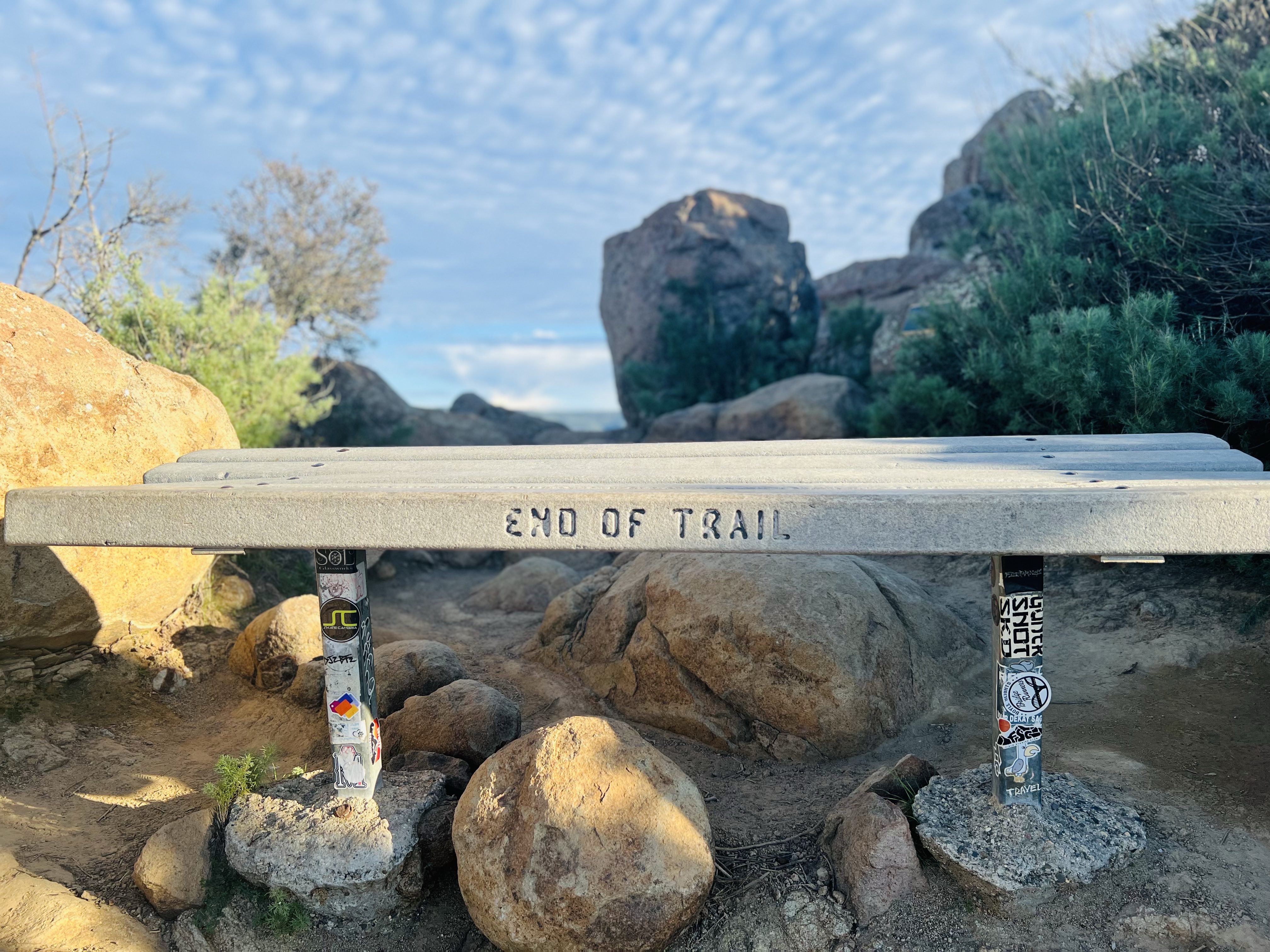
The much appreciated “End of Trail” bench at the summit.

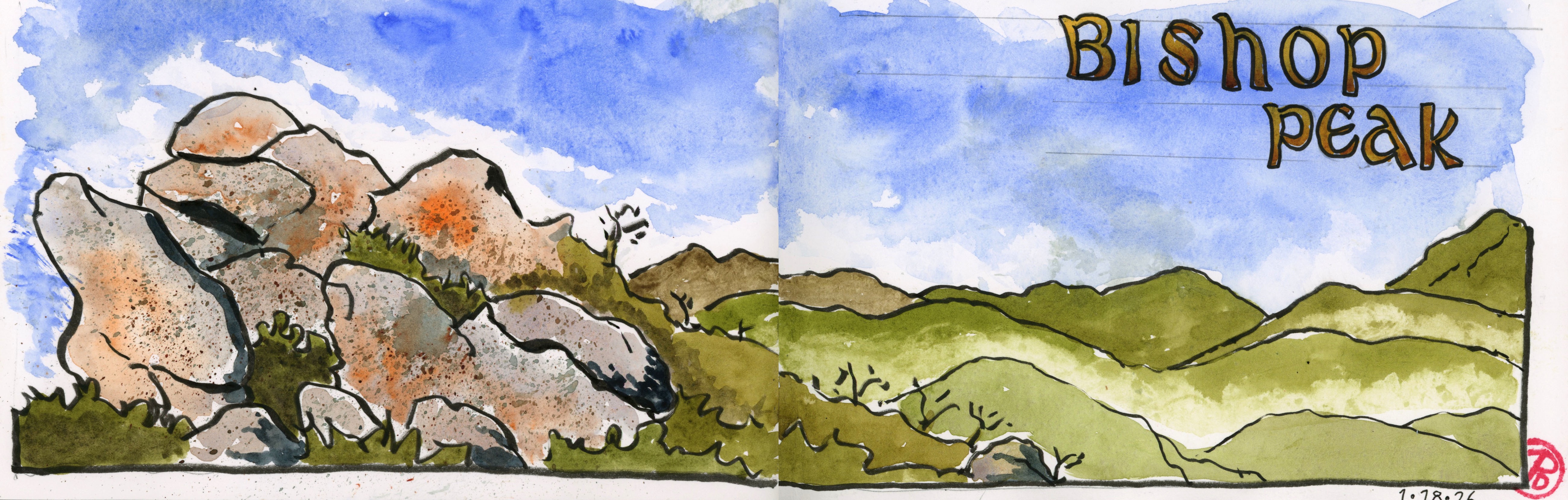
I drank some water, had some trail mix, and unpacked my panoramic sketchbook. It was sketch time.
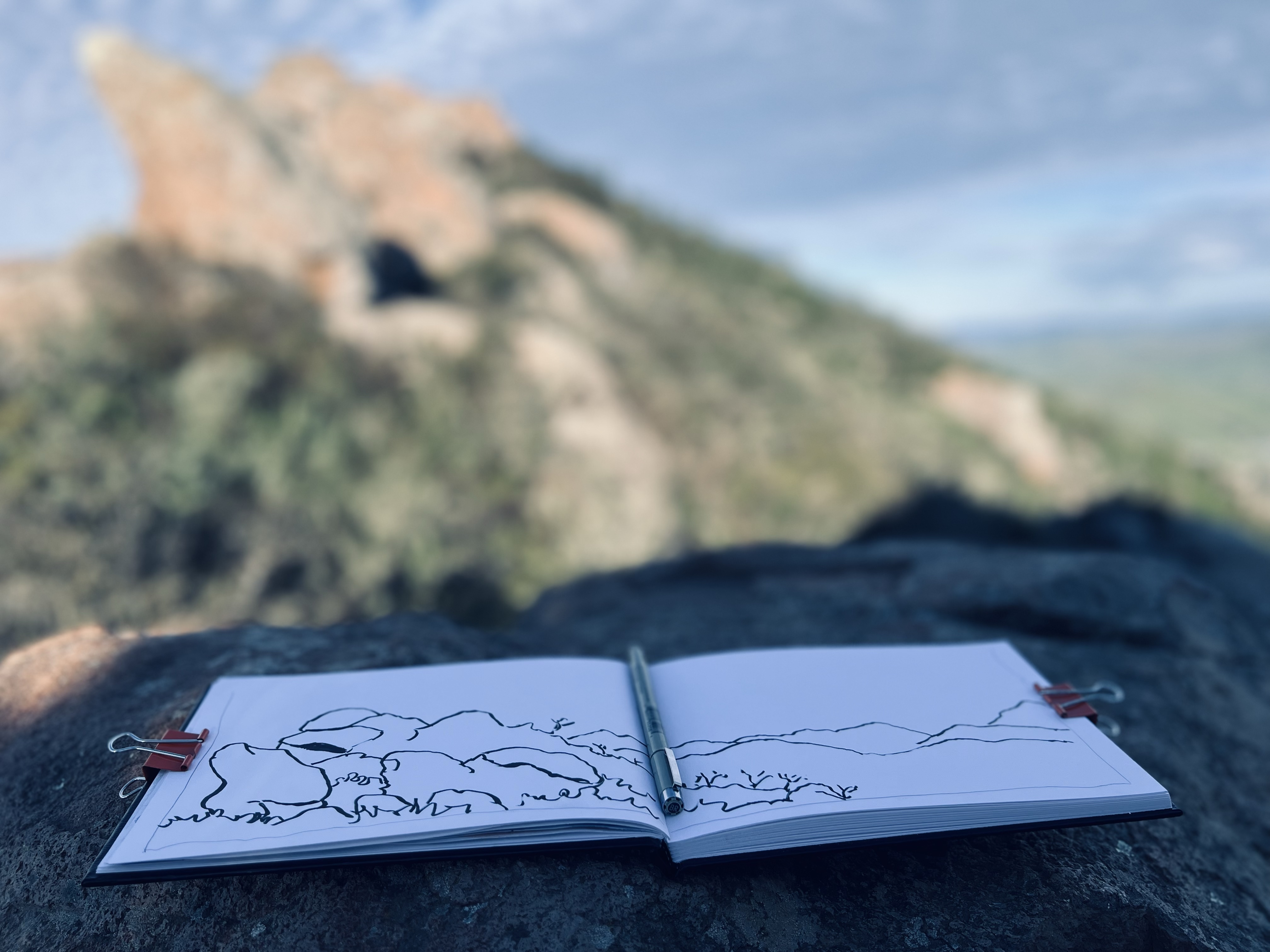
After my sketch, it was time to descend, which I figured would be much easier than the climb up. It was five minutes to nine.

On my way down I passed about 30 people on their way up, including two large families with toddlers. The summit was soon to be one crowded place. Another great reason for an early start.

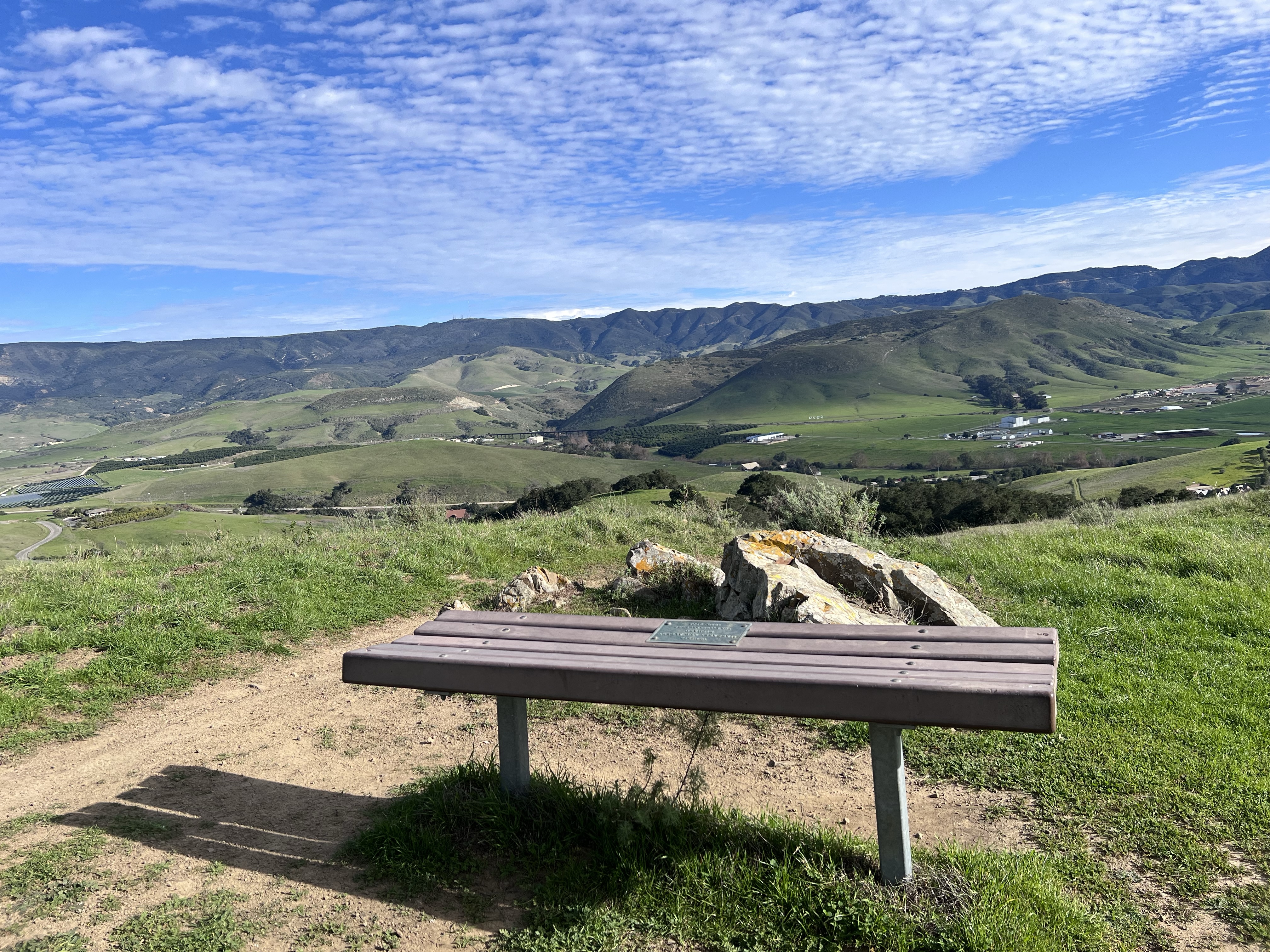
At the end of my descent, I turned left at the cattle pond and walked out on the Felsman Loop Trail toward a sketching bench.
The view before me was an acknowledged Historic Civil Engineering Landmark, the 16.6 mile portion of railroad that climbs the Cuesta Grade and the series of tunnels near the summit. From my vantage point, Stenner Creek Trestle was before me and the line snakes around in the famous Horseshoe Curve.
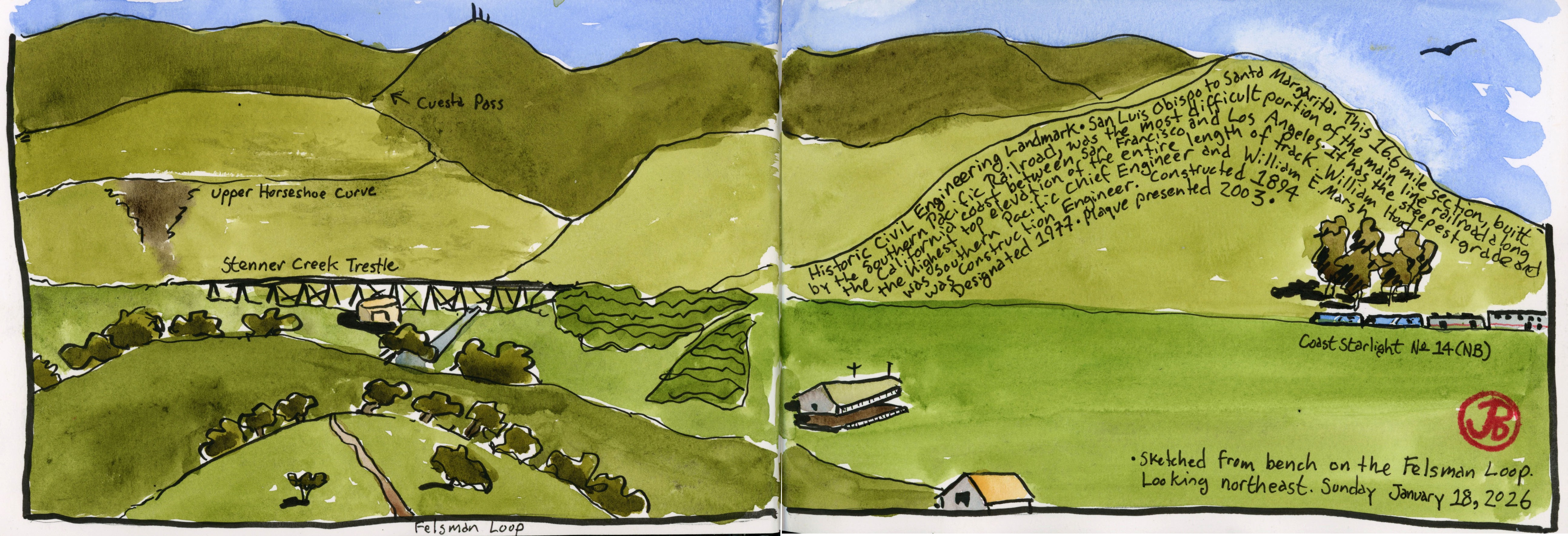
I sketched the beautiful green Californian curvaceous hills. This was a great time to be here!
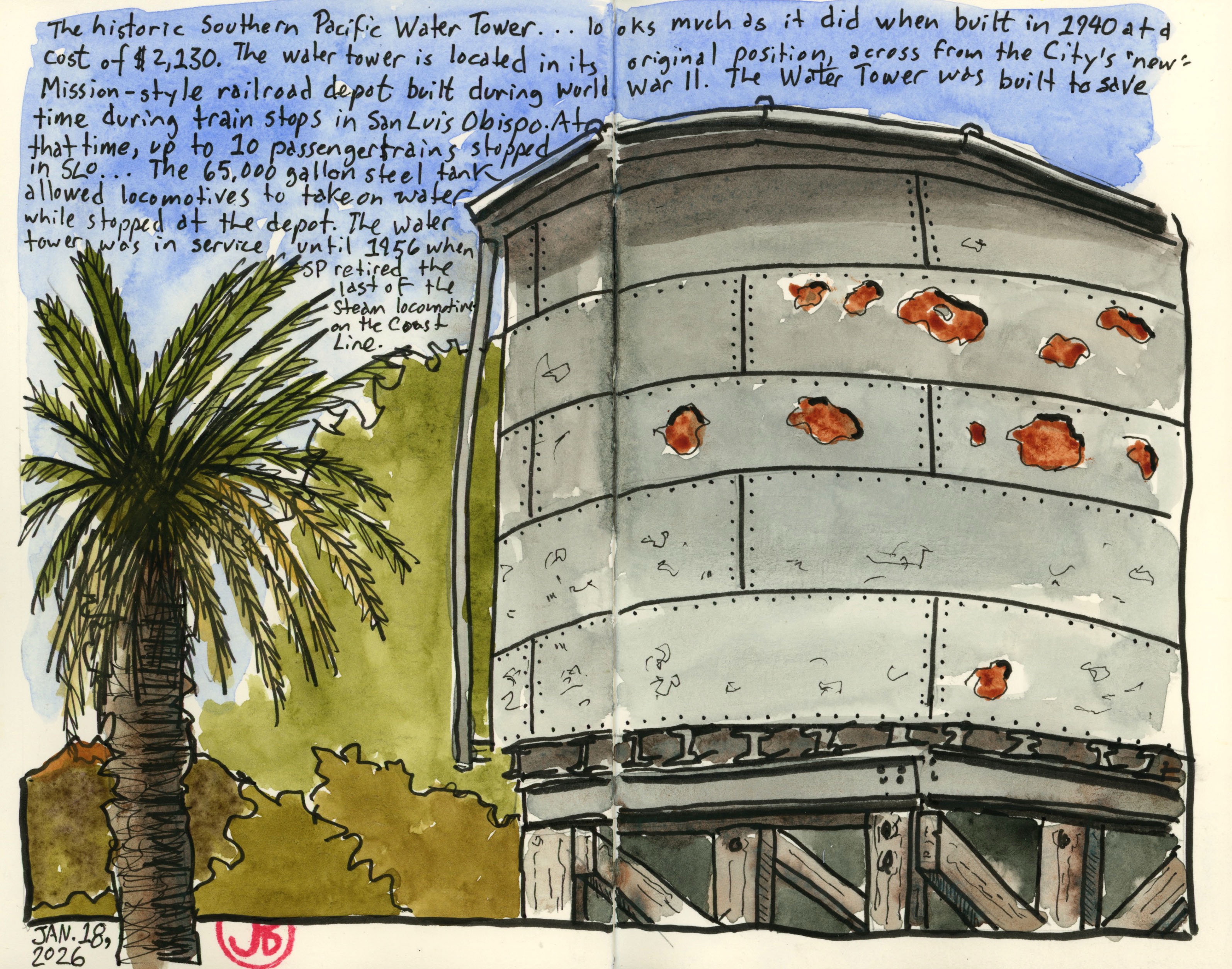
SLO’s Southern Pacific Water Tower

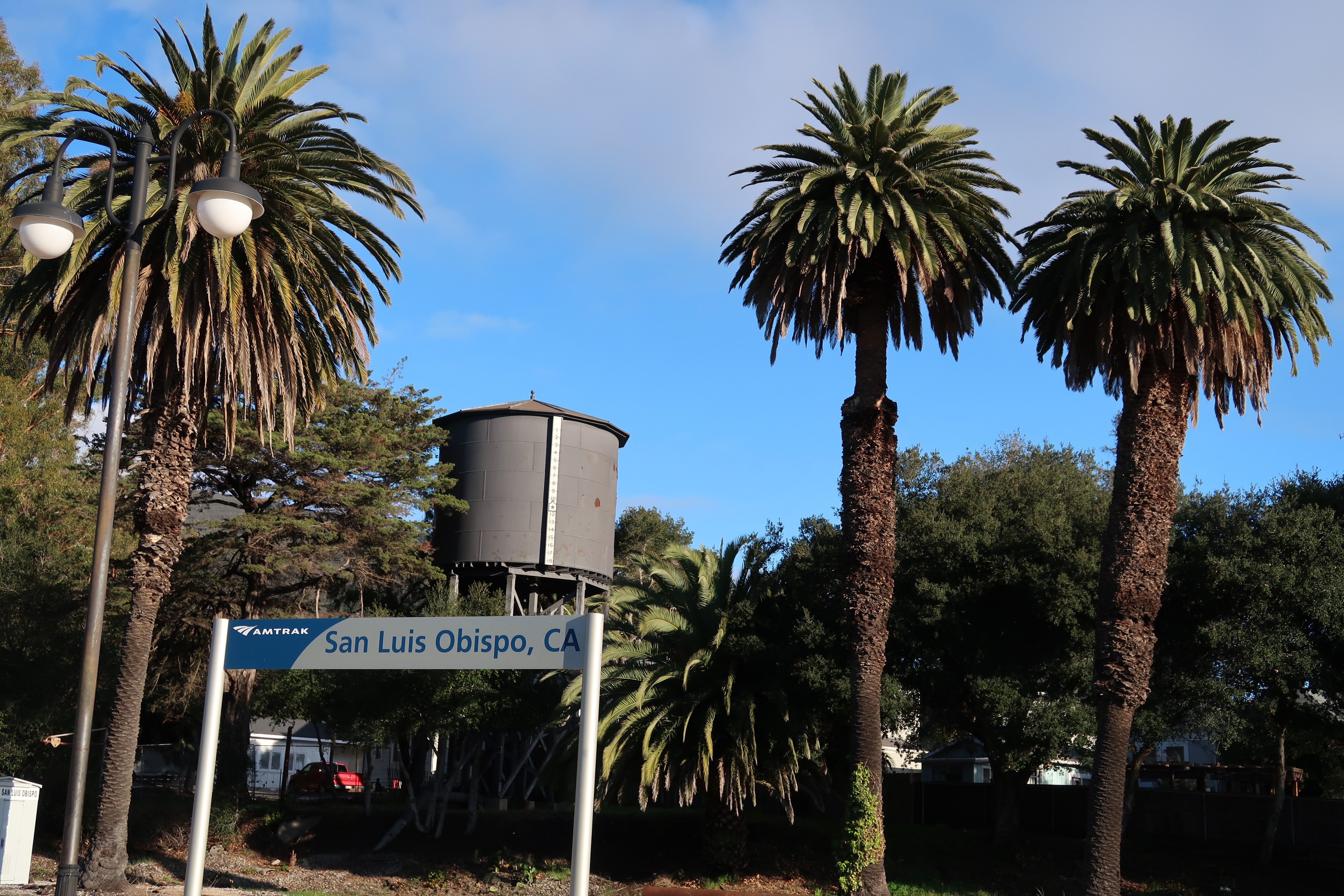
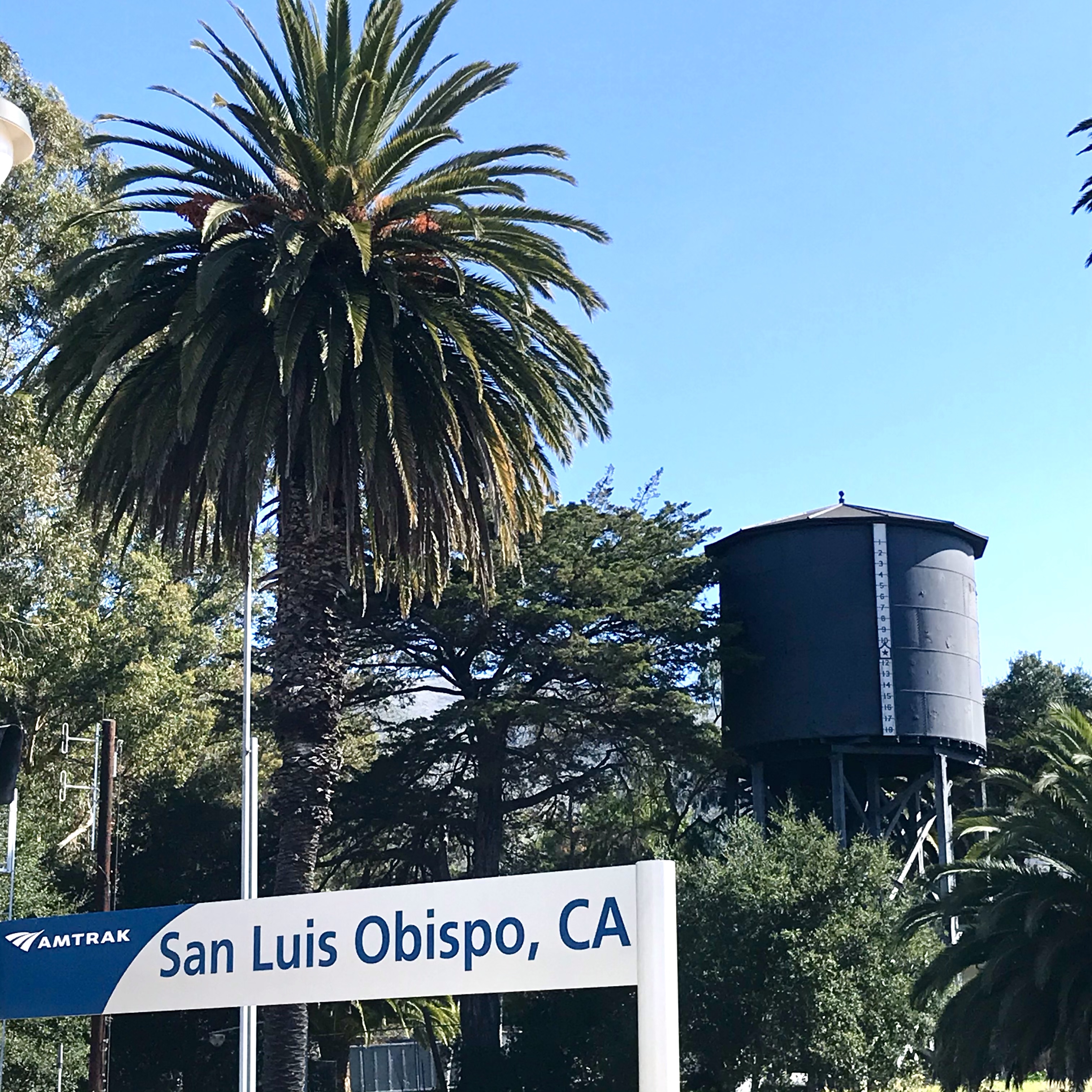
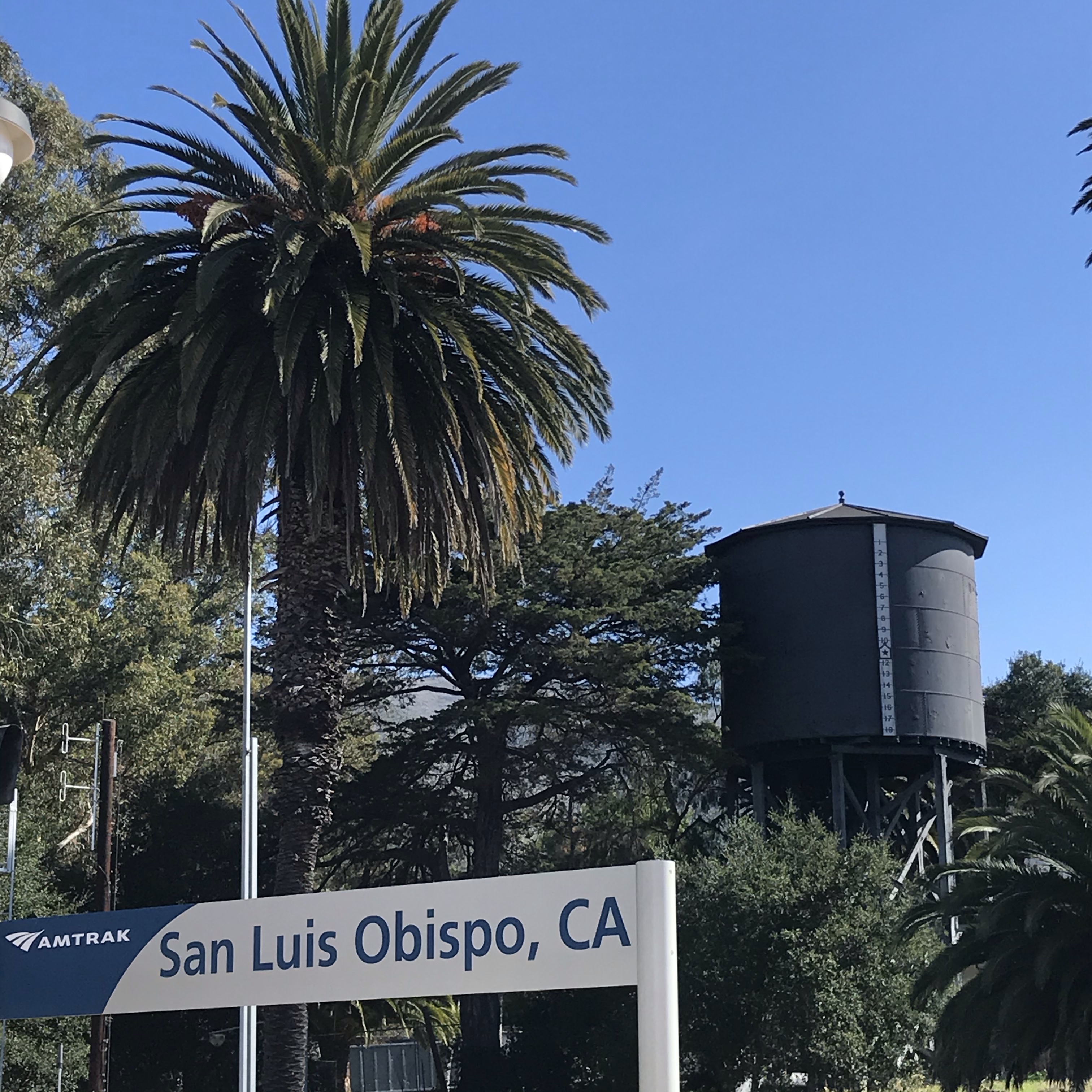
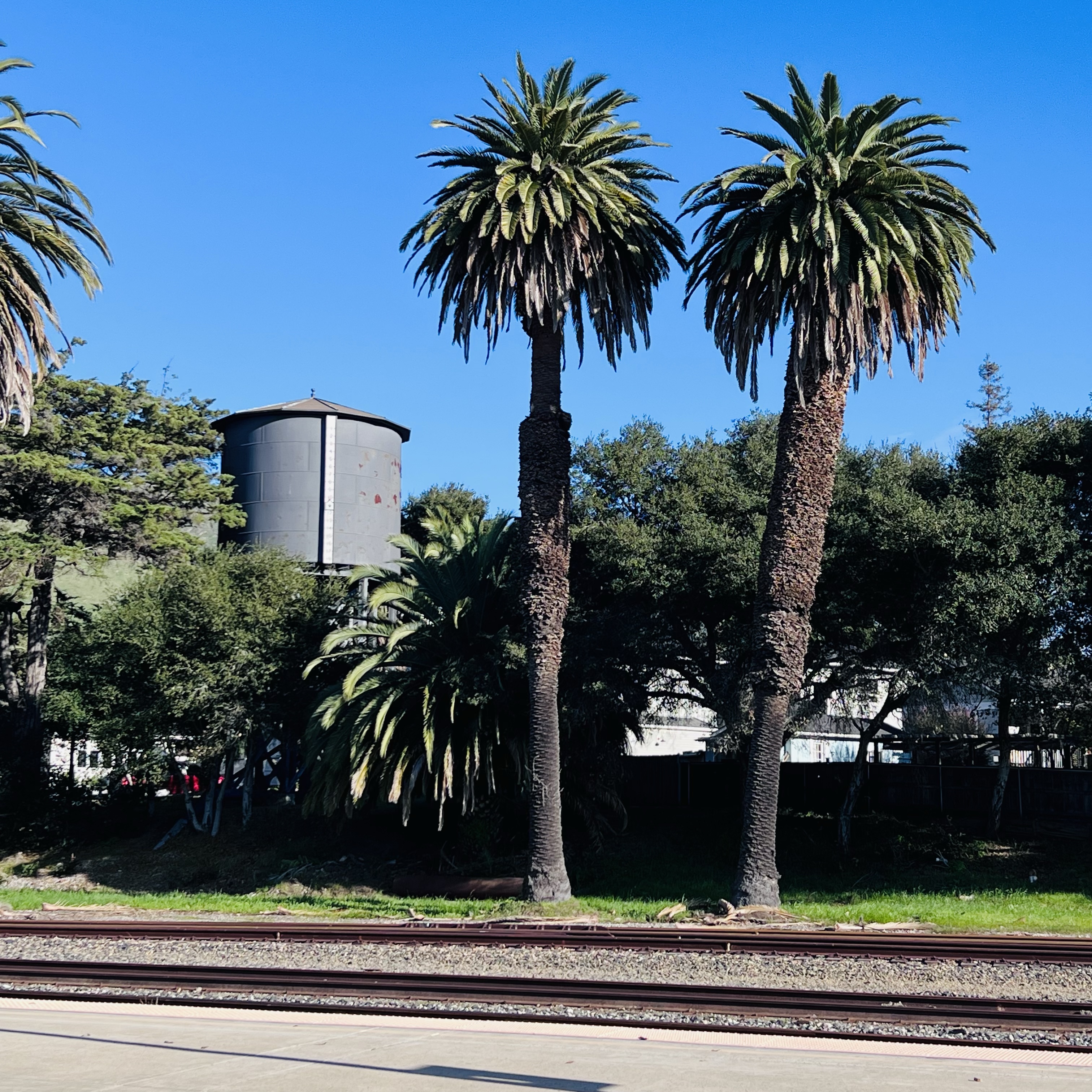
The view from my front door of my San Luis Obispo digs was a looming symbol of SLO’s railroad history. This is Southern Pacific’s 65,000 gallon water tower.

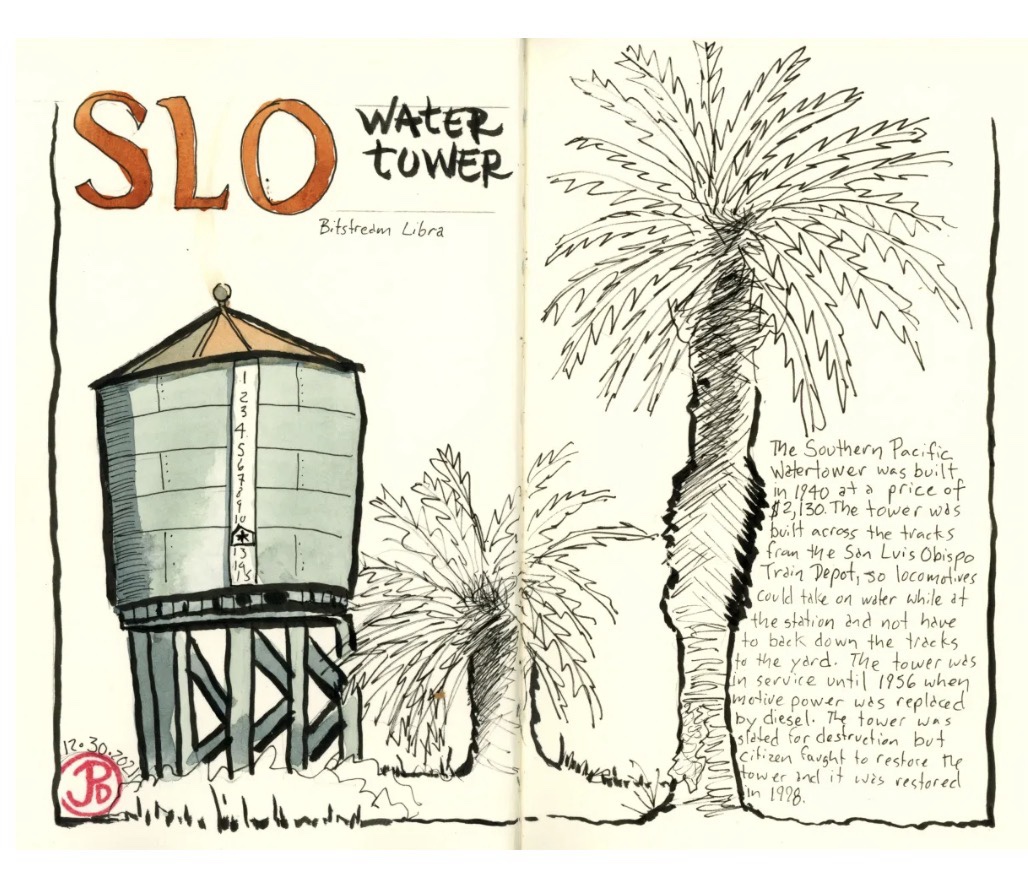
The tower was built in 1940 for the sum of $2,130 (about $50,000 in 2026). It solved a problem at SLO because steam locomotives that needed watering would have to leave the station and head down track for about a half a mile, to the water tower near the roundhouse. Now with the new tower, locomotive’s tenders could be watered while at the station, saving much needed time.

At the time that the new Mission Revival station was built in 1943, ten passenger train stopped at the station including the iconic Coast Daylight with the classic GS locomotives on point sporting the black, orange, and red livery of this premier passenger service. At SLO a helper would be added to assist the Daylight up Cuesta Grade and the helper would be cut off at the top in Santa Margarita.

With the end of steam at the hands of less labor intensive diesel-electric locomotives, the water tower stood unused and time took its toll. In the 1980s Southern Pacific planned to demolish the tower and the city stepped in and bought the water tower.

The water tower was saved and restored, starting in 1989, by the city of San Luis Obispo as a landmark of the deep Southern Pacific history. The full restoration was complete by 1998. Railroads have been part of SLO since 1894.

The SP Watertower as seen from the station platform. My front door is just behind the low palm tree.

I had sketched the water tower before but not from the up close and personal perspective from the front door of my apartment.

My 2021 sketch of the water tower. This is from the station platform.
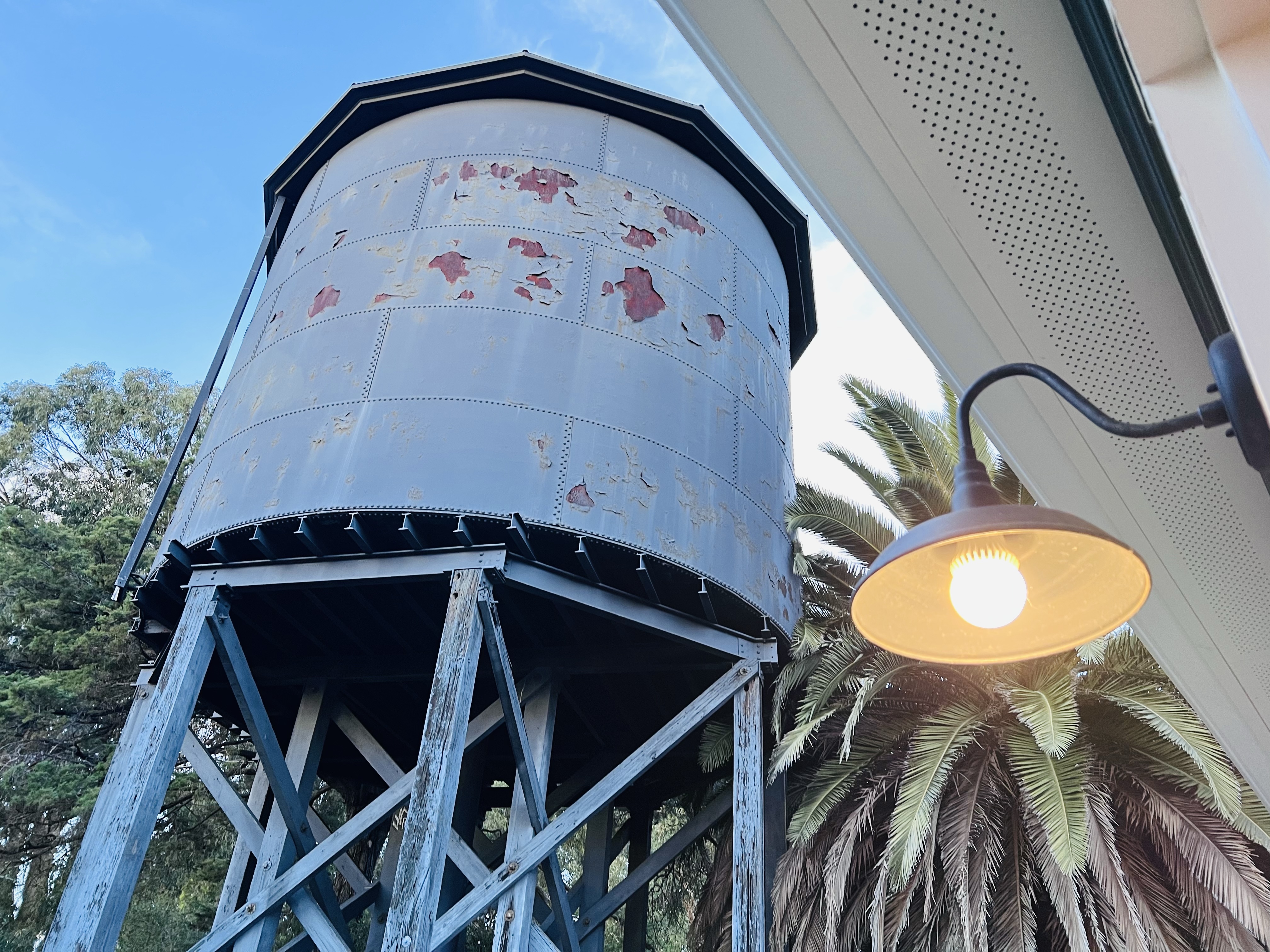
The water tower and my front porch light.
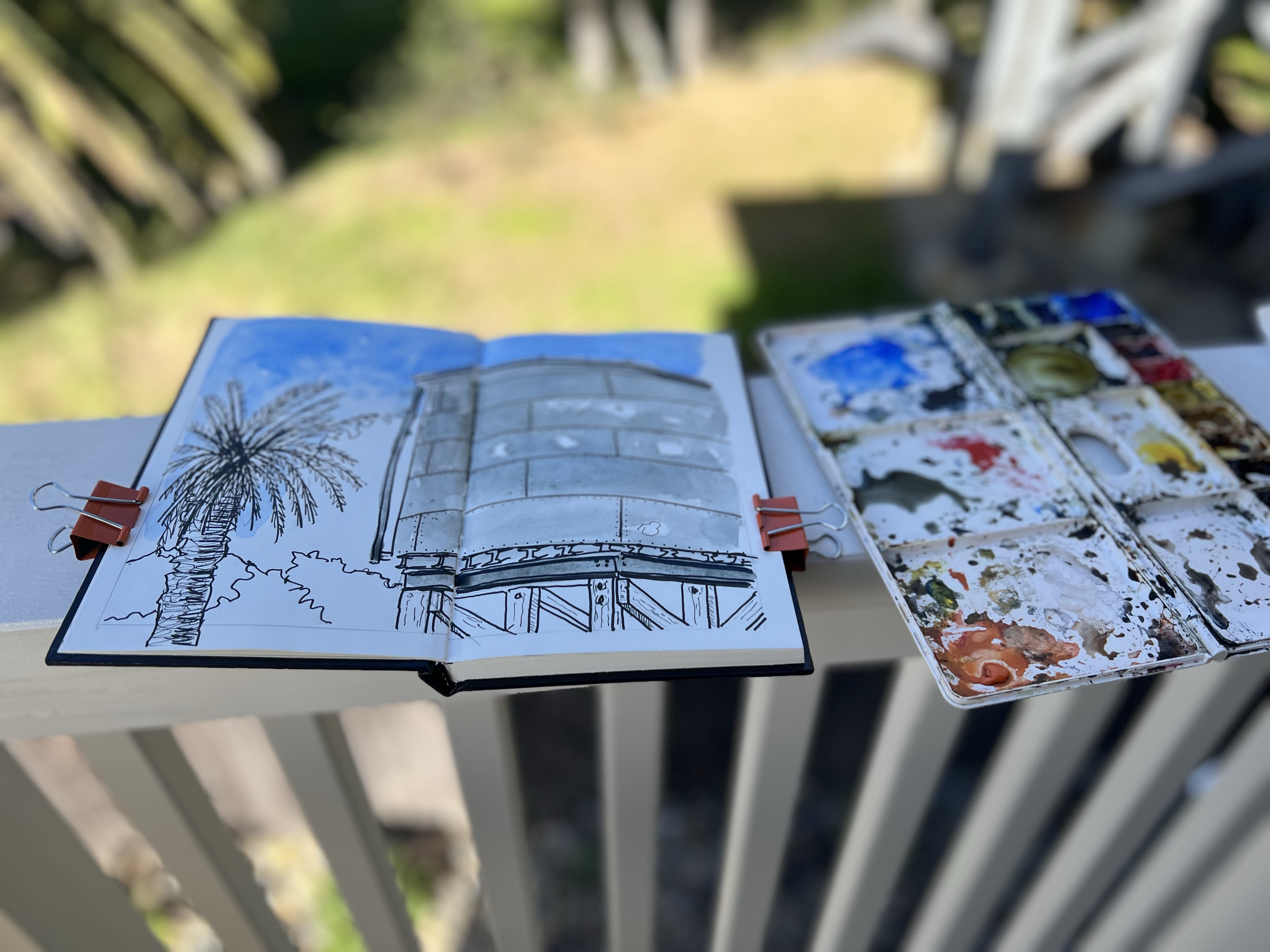
Plein air porch painting.

SLO Coast Starlight

The AMTRAK route that parallels the west coast from Los Angeles to Seattle is the Coast Starlight, a journey of 1,377 miles.

In those 1,377 miles the only place that both the northbound and southbound (Trains 14 and 11) meet at a station is San Luis Obispo.

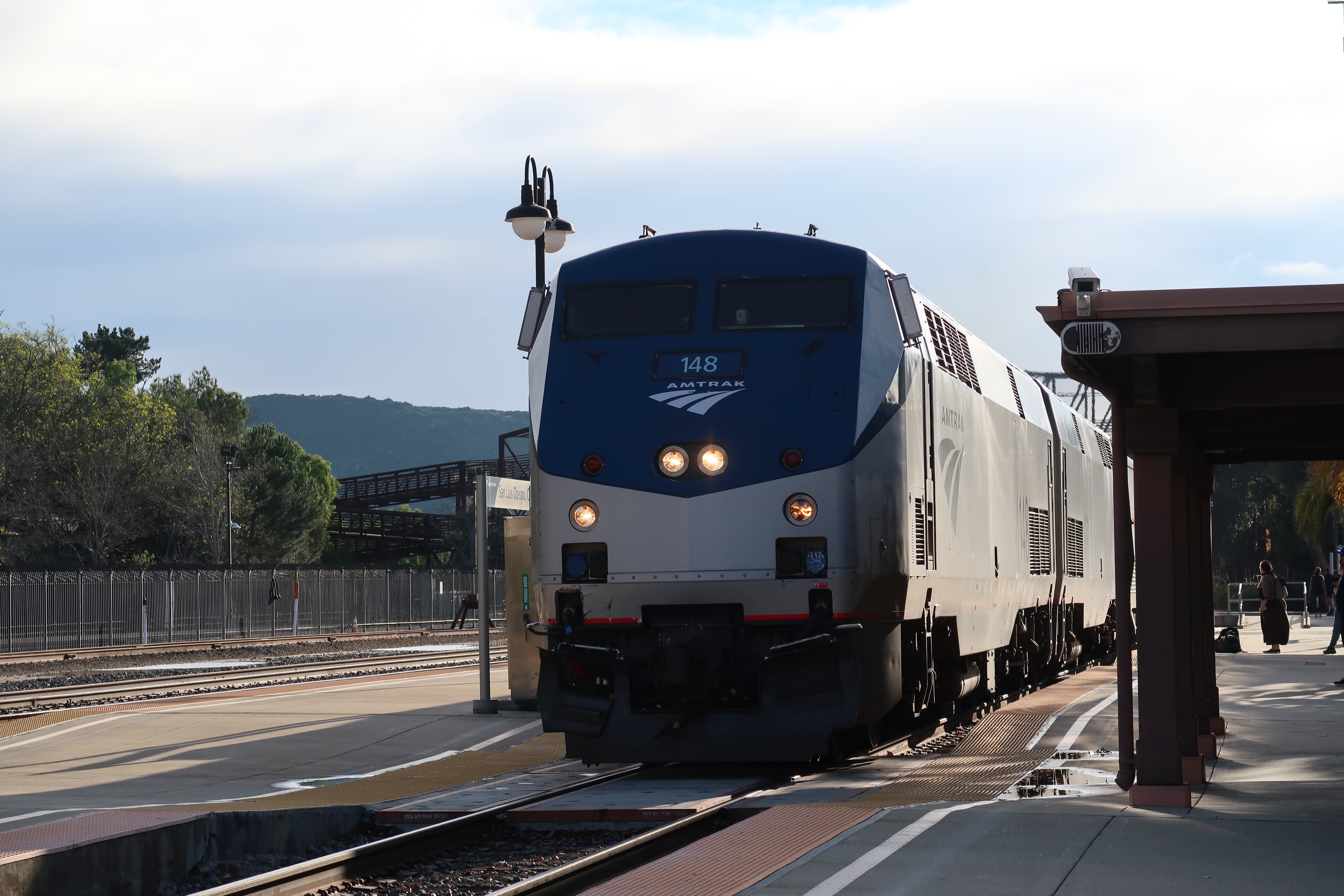
Northbound 14 arrives from Los Angeles at 2:50 PM (if on time) and waits for southbound train 11 (due at 3:24) to descend the single track down Cuesta Grade. And I planned to be there to do some sketching.

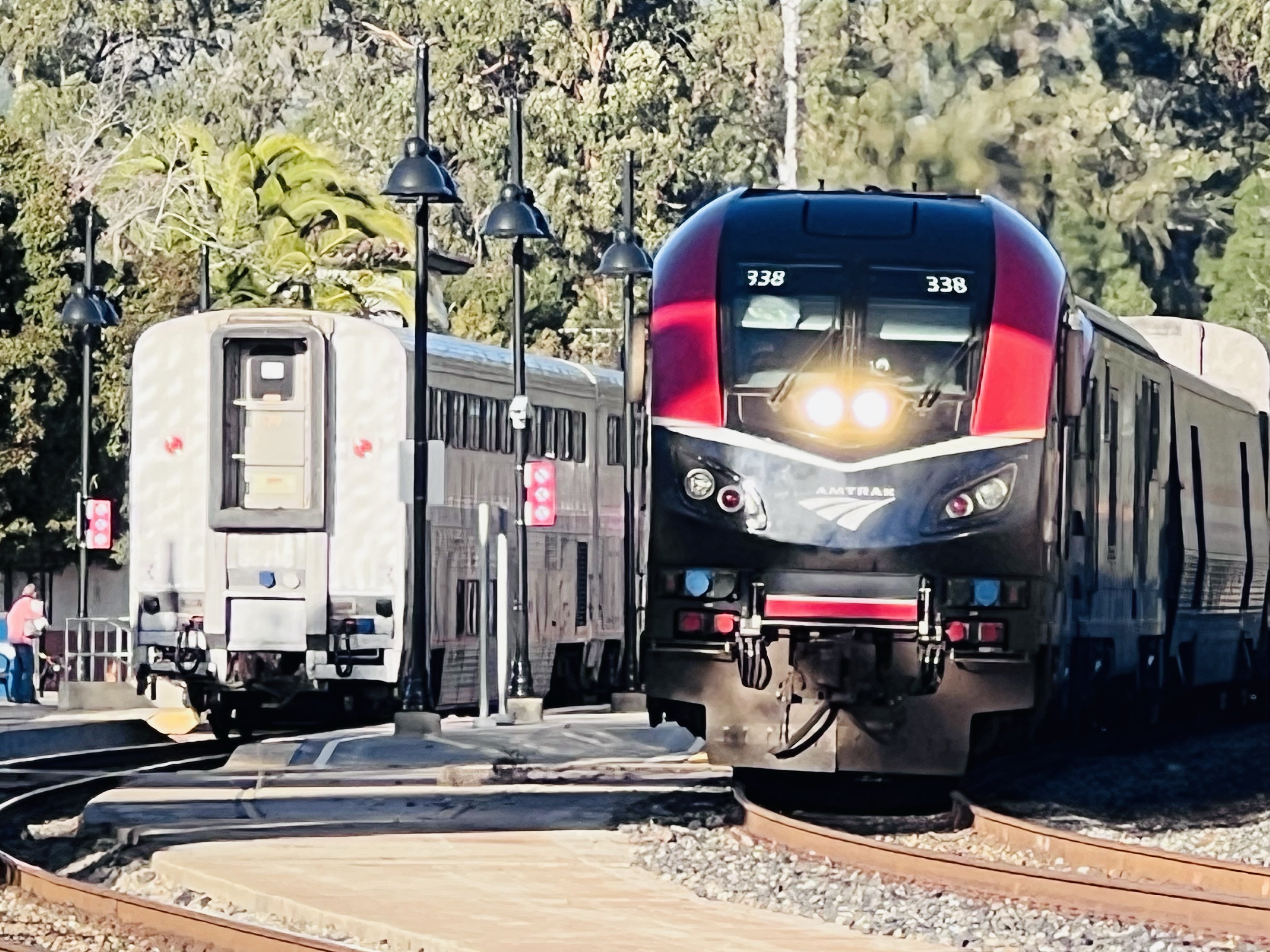
Both Coast Starlights at the station in SLO. Train 14 to the left and 11 on the right.

My plan was to sketch the northbound Train 14 at SLO station. In the age of steam, the Coast Daylight (SF to LA) stopped for only three minutes at San Luis Obispo in order to keep to its timetable.

During this short stop the Southern Pacific GS (Golden State or General Service) steam locomotives would be serviced and tender topped off with water. A helper locomotive would either be cut in or cut off depending on the direction of the Daylight.

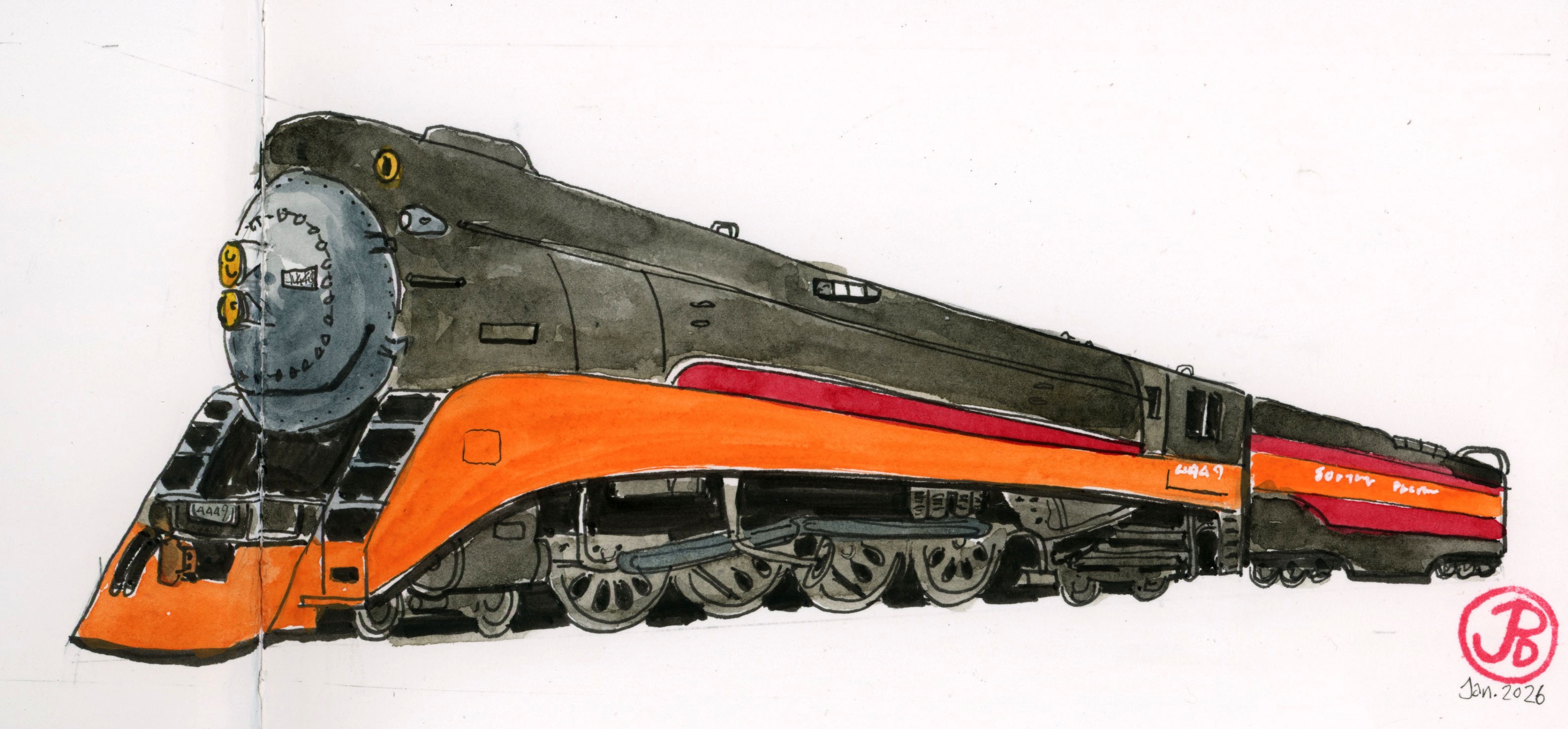
My sketch of one of the most famous steam locomotives in the world, Southern Pacific’s GS-4 No. 4449. This has been deemed “the most beautiful passenger train in the world” and SLO was one of her stops.

Now the AMTRAK train would stop for about 15 minutes, allowing passengers a stretch break, for some passengers this is also known as a smoke break.

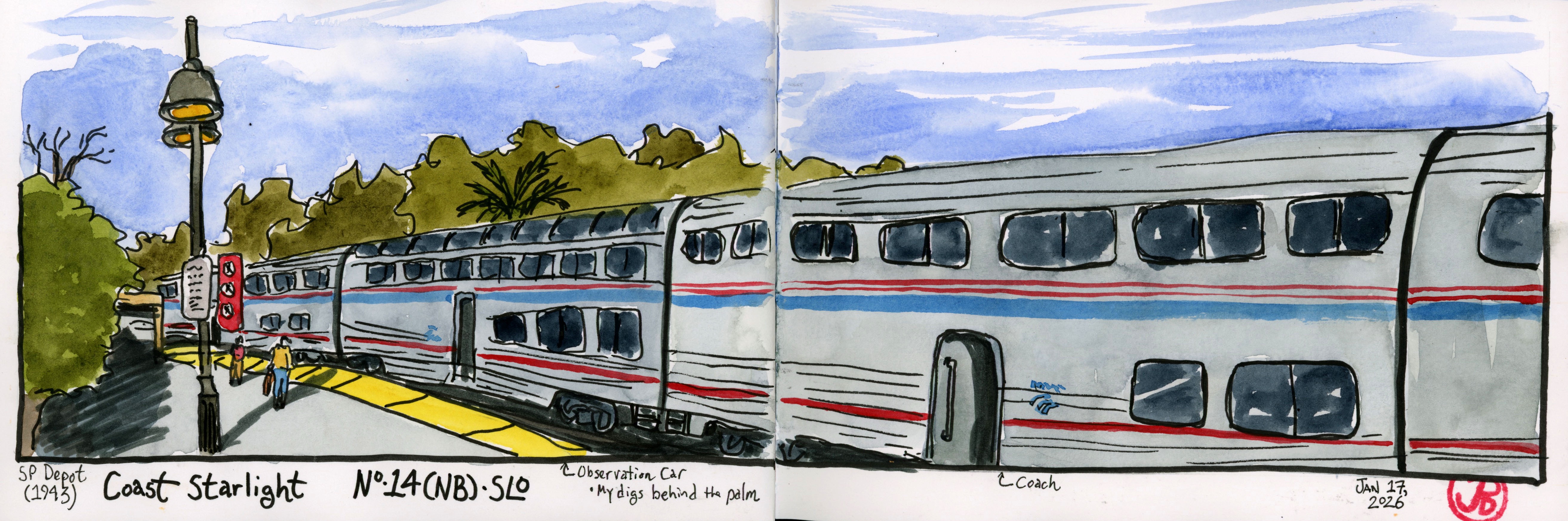
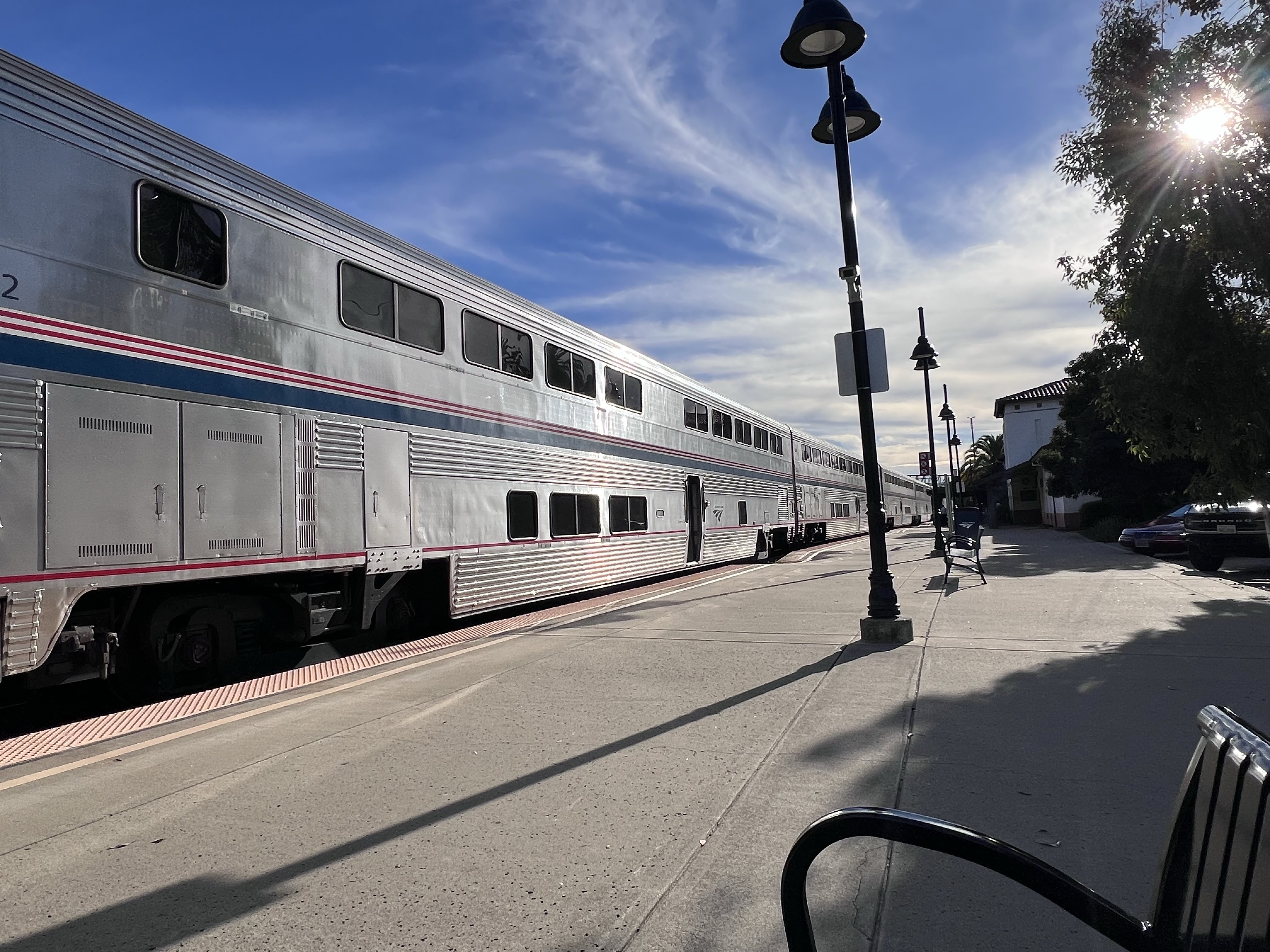
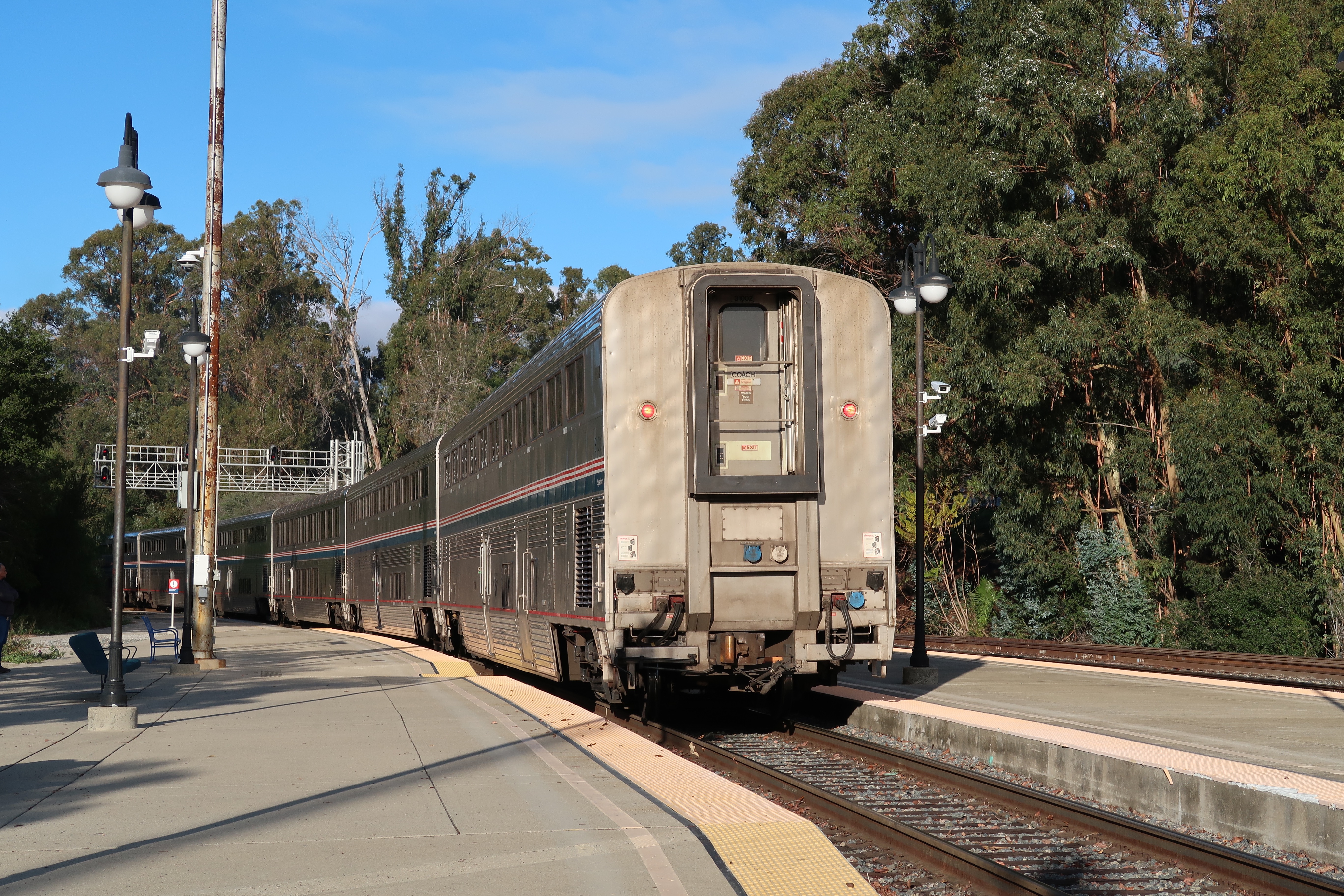
The Superliners at San Luis Obispo under beautiful January sun.

I figured 15 minutes was more than enough time to get a quick sketch in of the train at the platform before the locomotive’s loud retort announced its continued journey up the Cuesta Grade towards Seattle.

I took up my sketching position a little before the Starlight’s arrival. I penciled in the foreground and the trees in the background, not knowing which trees would be eclipsed by the double decker Superliner cars. The answer was: most of them.

When the train pulled into the station, I switched to pen. I love sketching without a net!

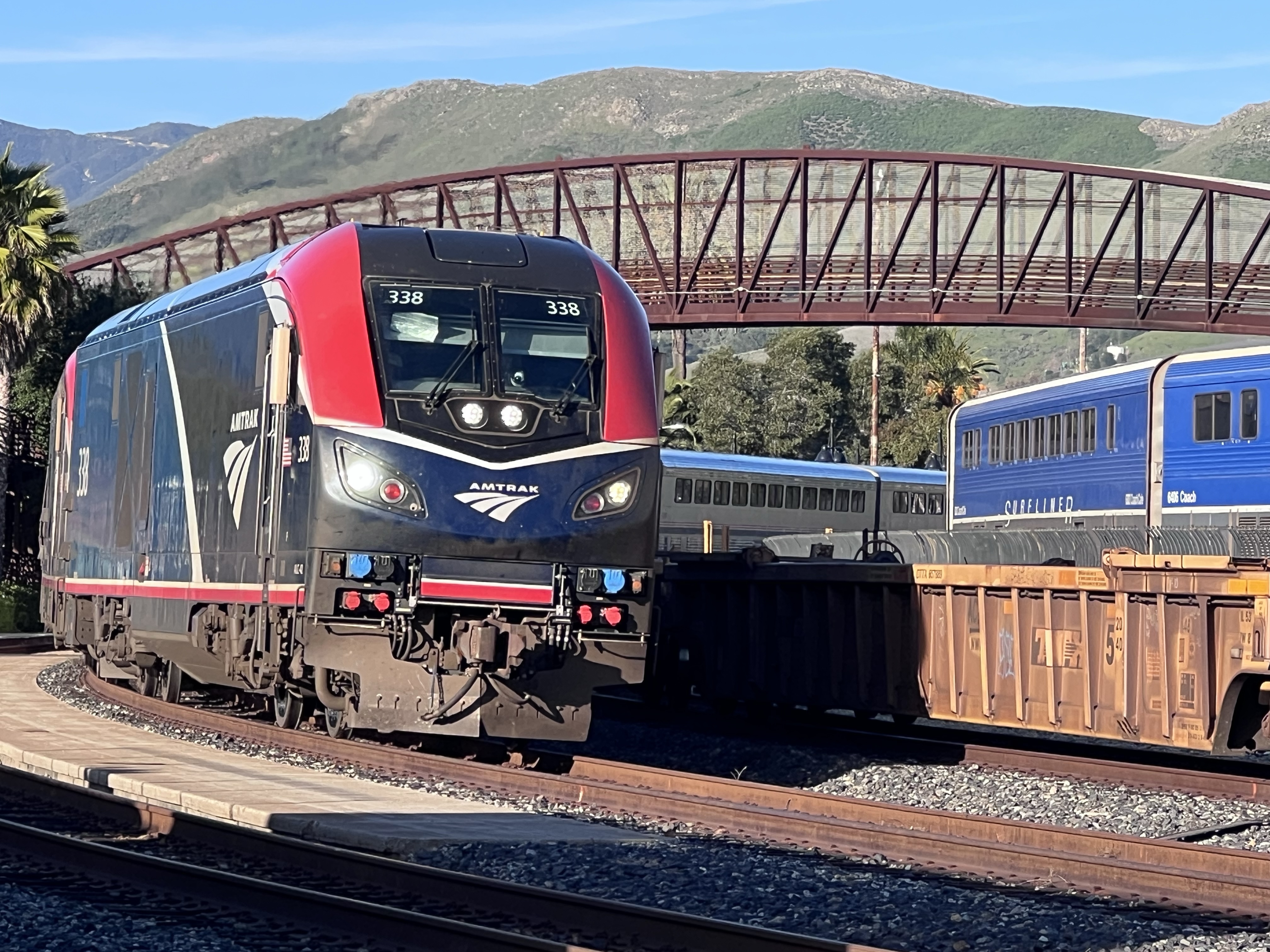
Train 11 heading towards Los Angeles with the AMTRAK’s new motive power, Seimens Charger on point. On the right is the Surfrider train on a side track.

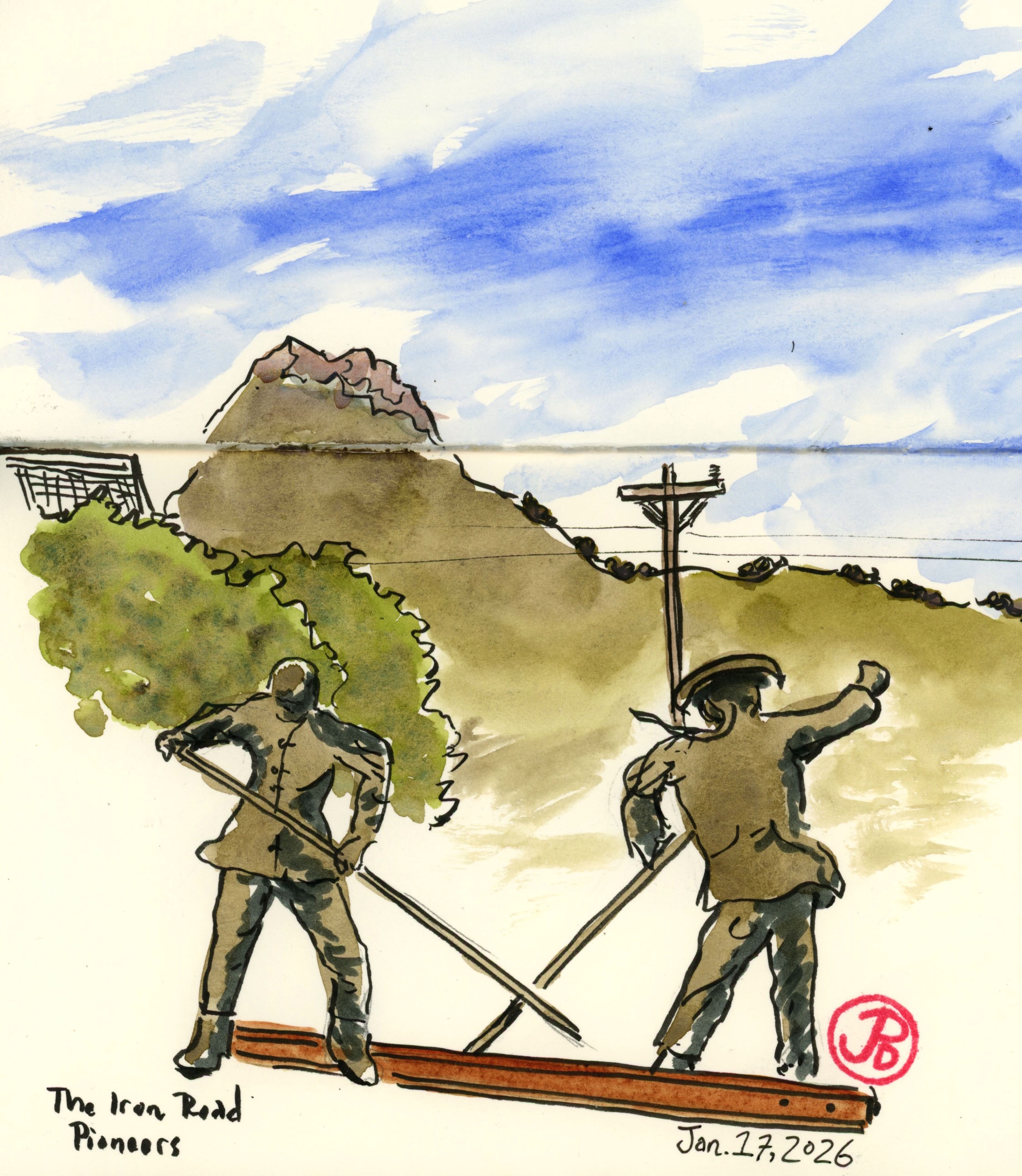
While waiting for the northbound Coast Starlight, I found a bench and sketched the statues near the station called the Iron Road Pioneers, with Bishop Peak in the background.

The statues are a monument to the Chinese immigrant workers who built much of the railroads on the central coast as well as other seminal railroads such as the Transcontinental Railroad.

Image

SLO Sketches

I have always enjoyed sketching in San Luis Obispo. Its hard not to stray too far from the town’s railroad past.

SLO is at the base of Cuesta Grade on the former Southern Pacific’s Coast Division. The town, midway between San Francisco and Los Angeles, was a major division point on the railroad.

It was here that the roundhouse facilities employed 44 men at it’s peak. Trains heading north had to take on helpers to climb the Cuesta Grade (the steepest grade on the Coast Line). In the age of steam, SLO was a real railroad town.

In the present day, the passenger station and freight station (now a train museum) sit beside the Union Pacific mainline.

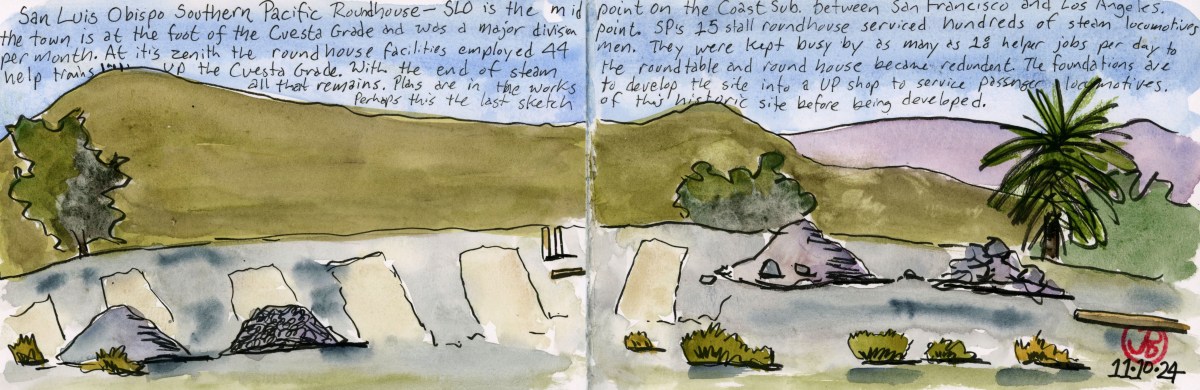
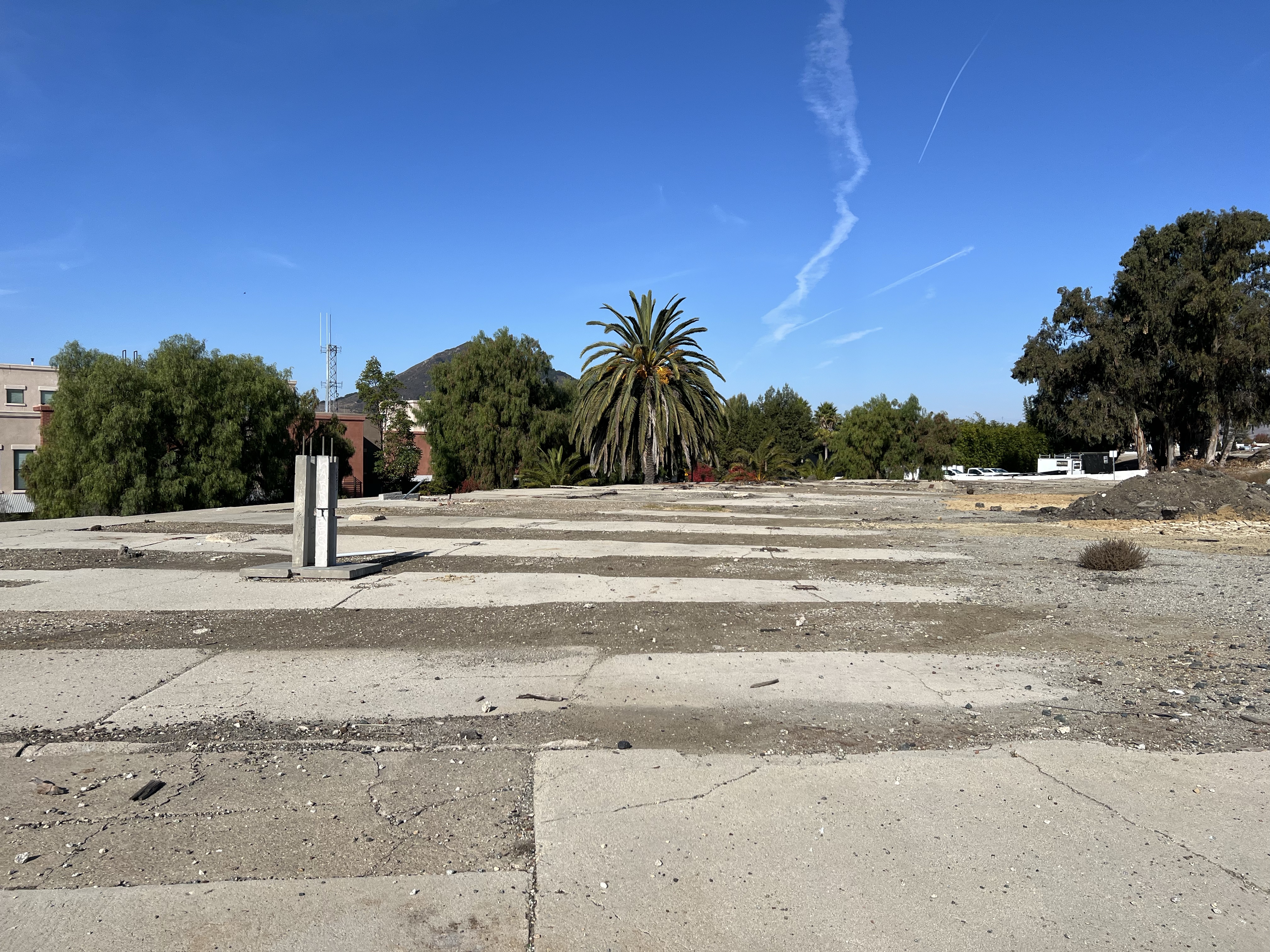
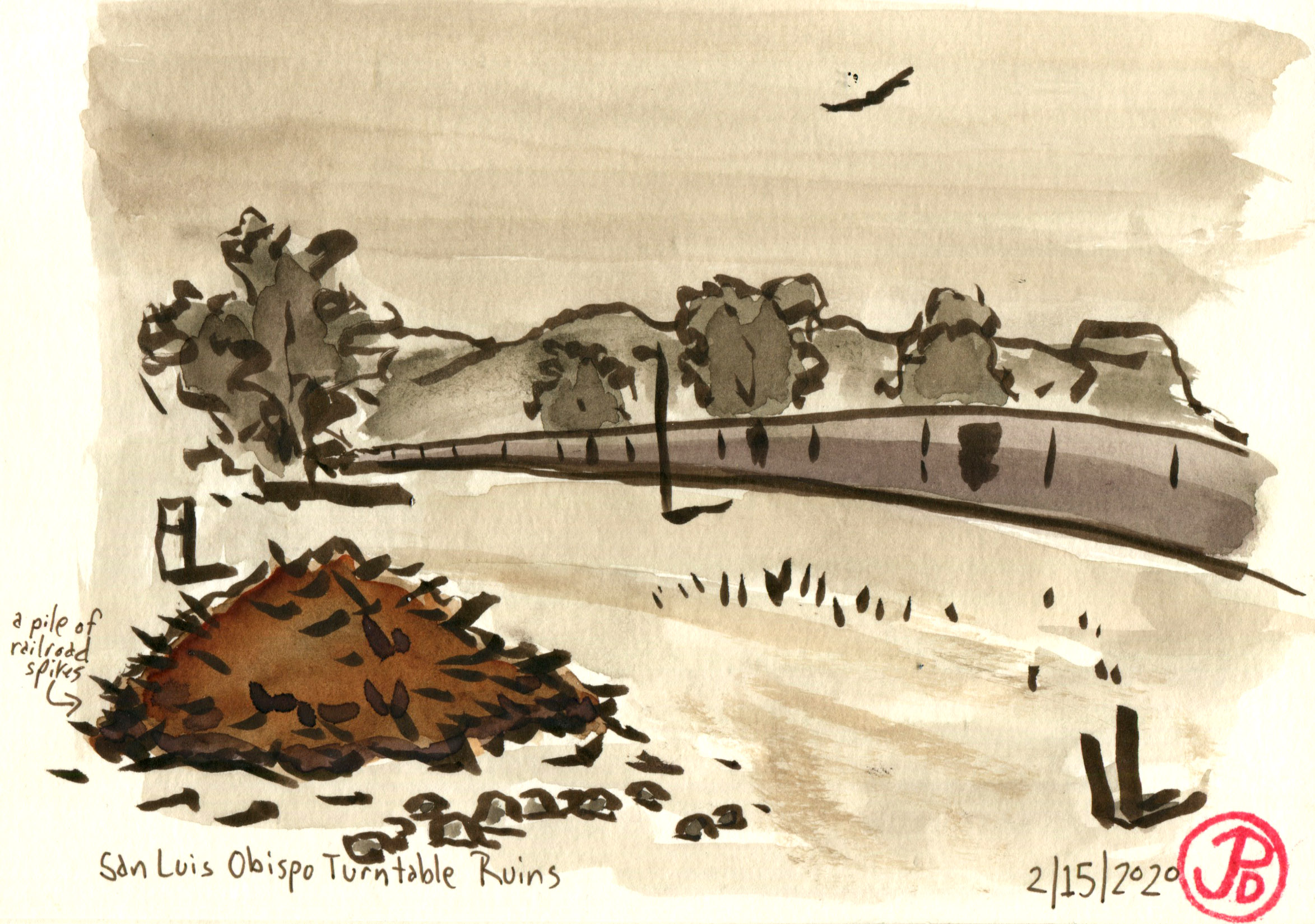
You have to look a little harder to find SLO’s steam past. South from the freight depot is the site of the 17 stall roundhouse. All that remains are the concrete semicircle foundation.

The roundhouse foundation looking north.

The last steam locomotive pulled out of the roundhouse in September of 1956. The roundhouse was torn down three years later.

On Sunday morning I sketched the remains of the roundhouse. There are plans in the works to develop the site as a Union Pacific maintenance facility. So this might be the last time I would be able to sketch the ghosts of steam’s past in SLO.

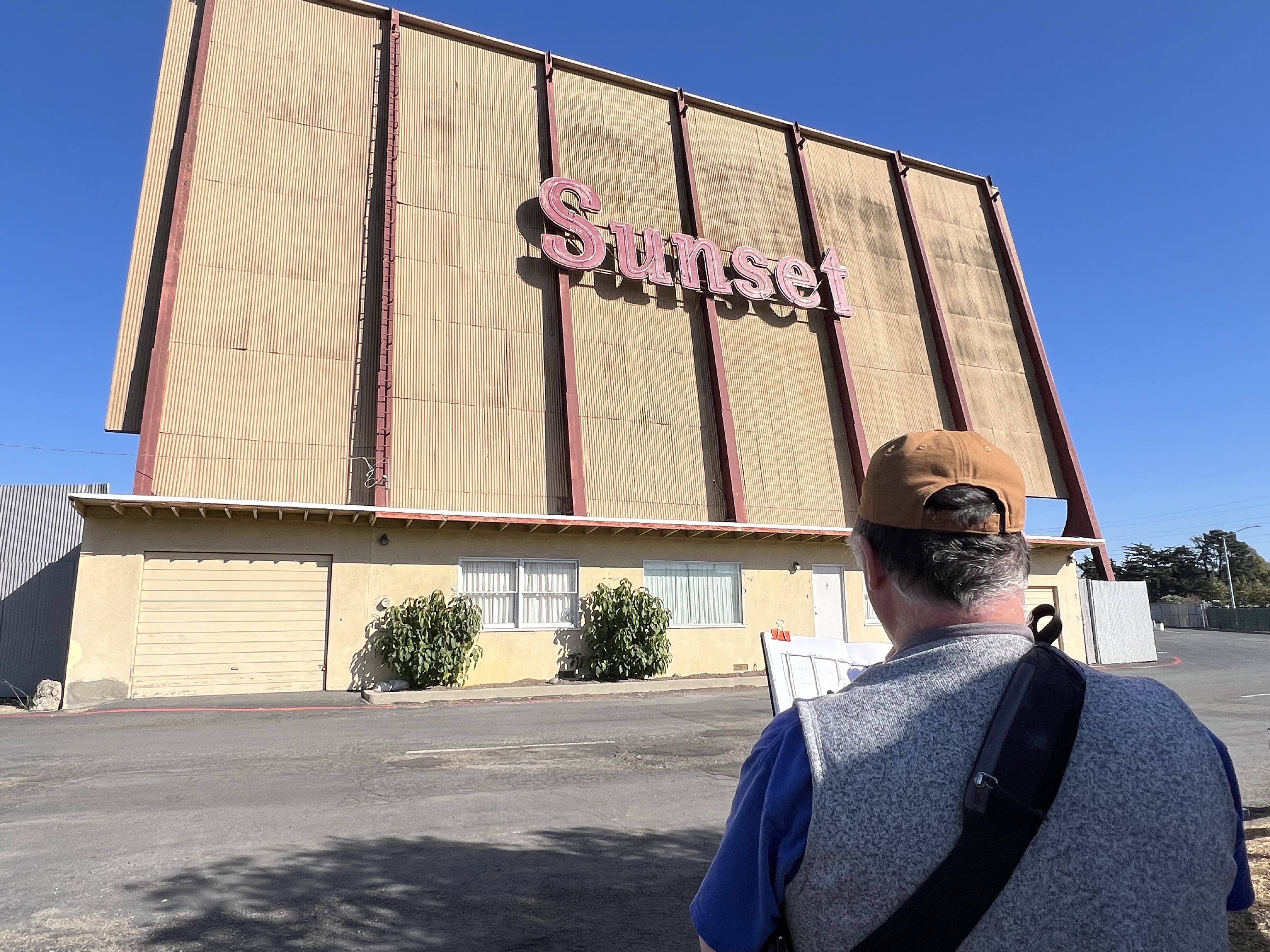
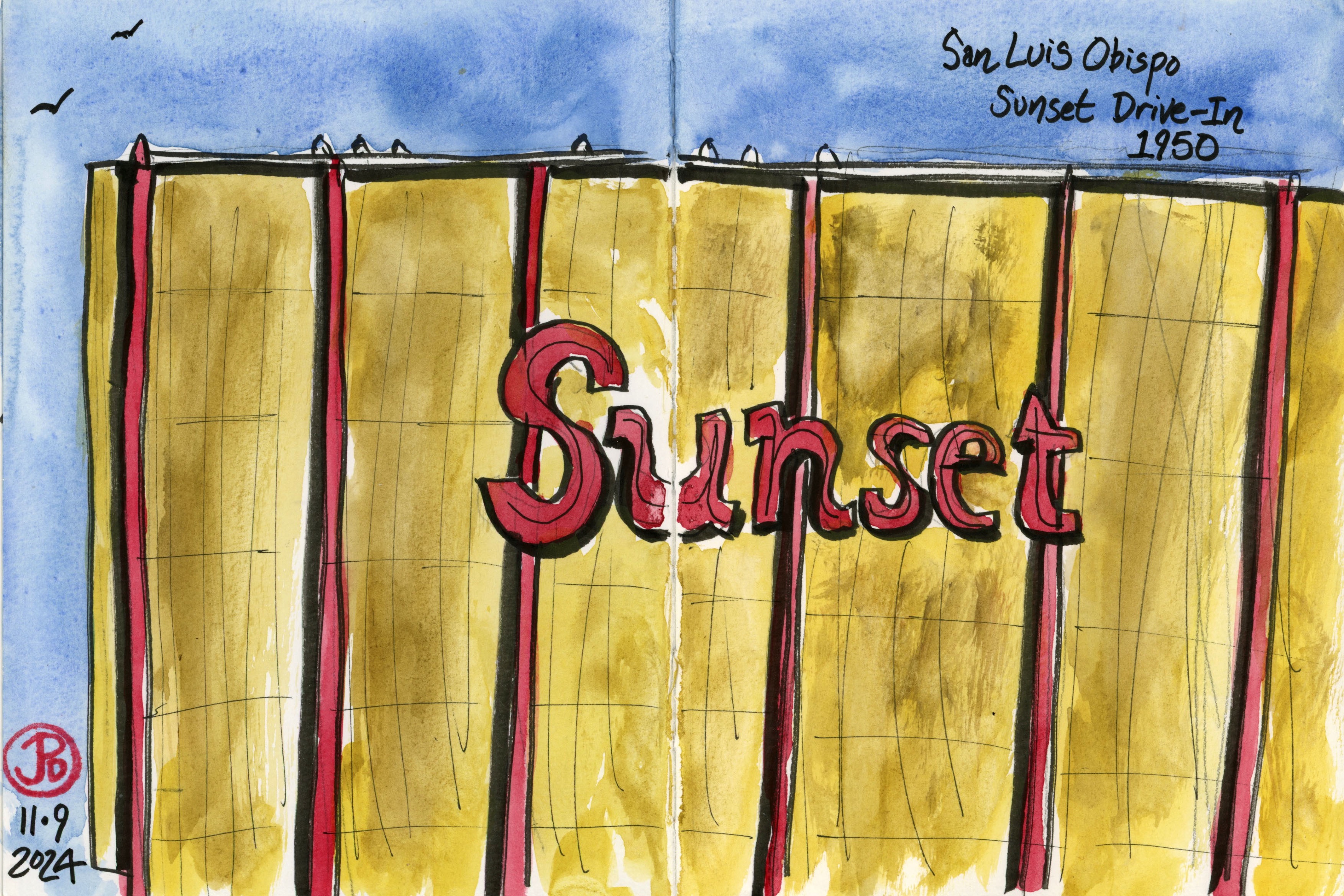
Another sketching location I was looking forward to adding to my sketchbook was a more recent part of the city’s history, the Sunset drive-in, opened in 1950.

What is amazing about this drive-in is that it’s still open. There are only 16 drive-ins still open in California and about 300 in existence nationwide. This is a steep decline of about the 4,000 drive-ins in the late 1950s, which was the zenith of outdoor movie going.

Image

The Madonna Inn

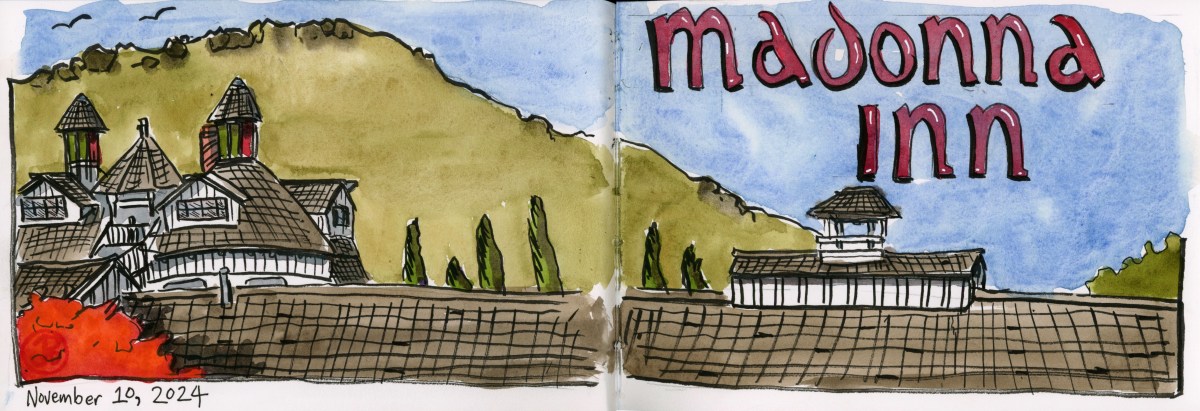
A friend’s 50th Shindig in San Luis Obispo provided me the opportunity to stay at the historic Madonna Inn for the first time.

The roadside hotel was opened in 1958 and has grown to the sprawling compound that it is today featuring five buildings on its 1,500 acre site.

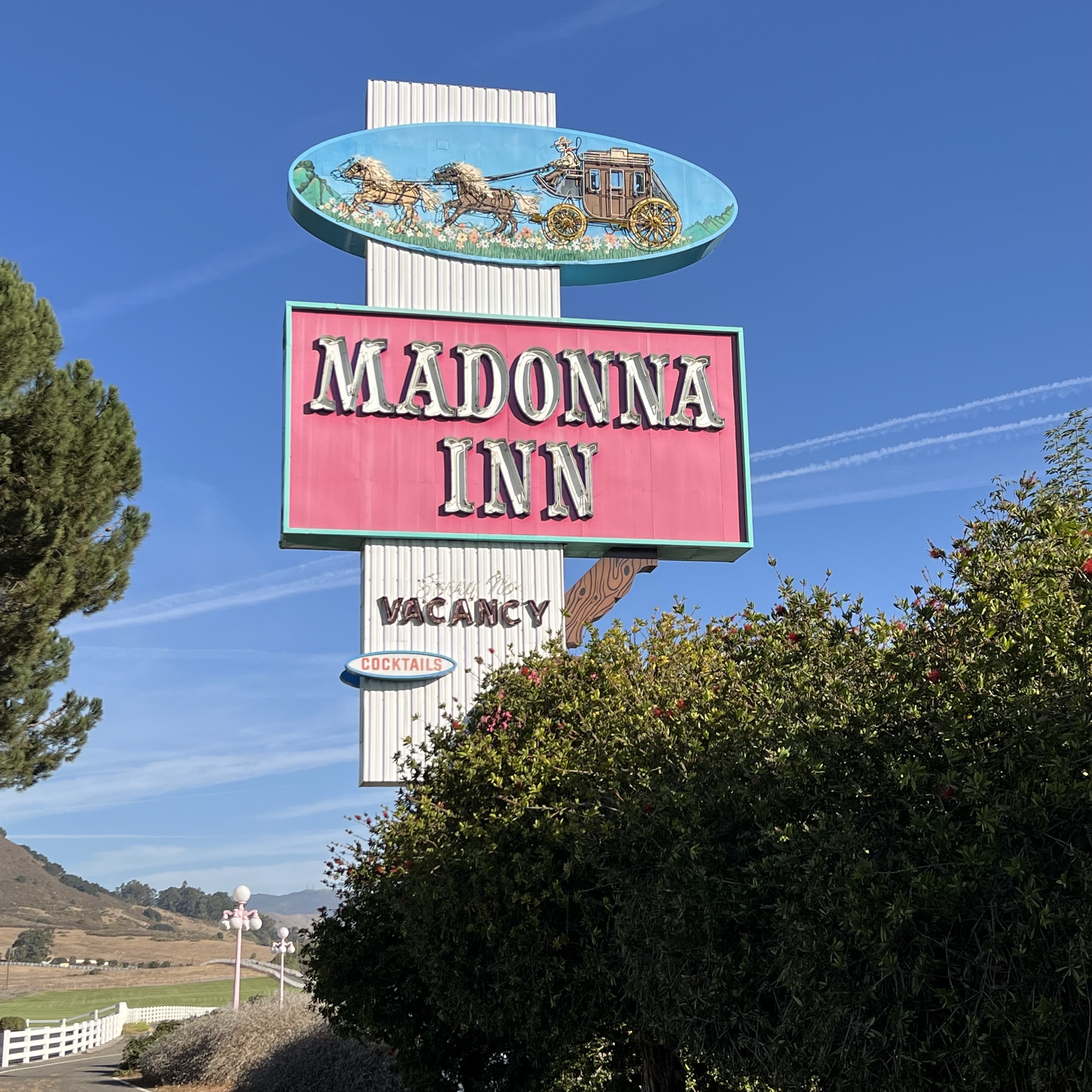
The Madonna Inn sign calling visitors in from Highway 101. San Luis Obispo lies between San Francisco and Los Angeles.

The hotel is known for its oddball decor, its hot pink accents, western murals, and 110 themed rooms.

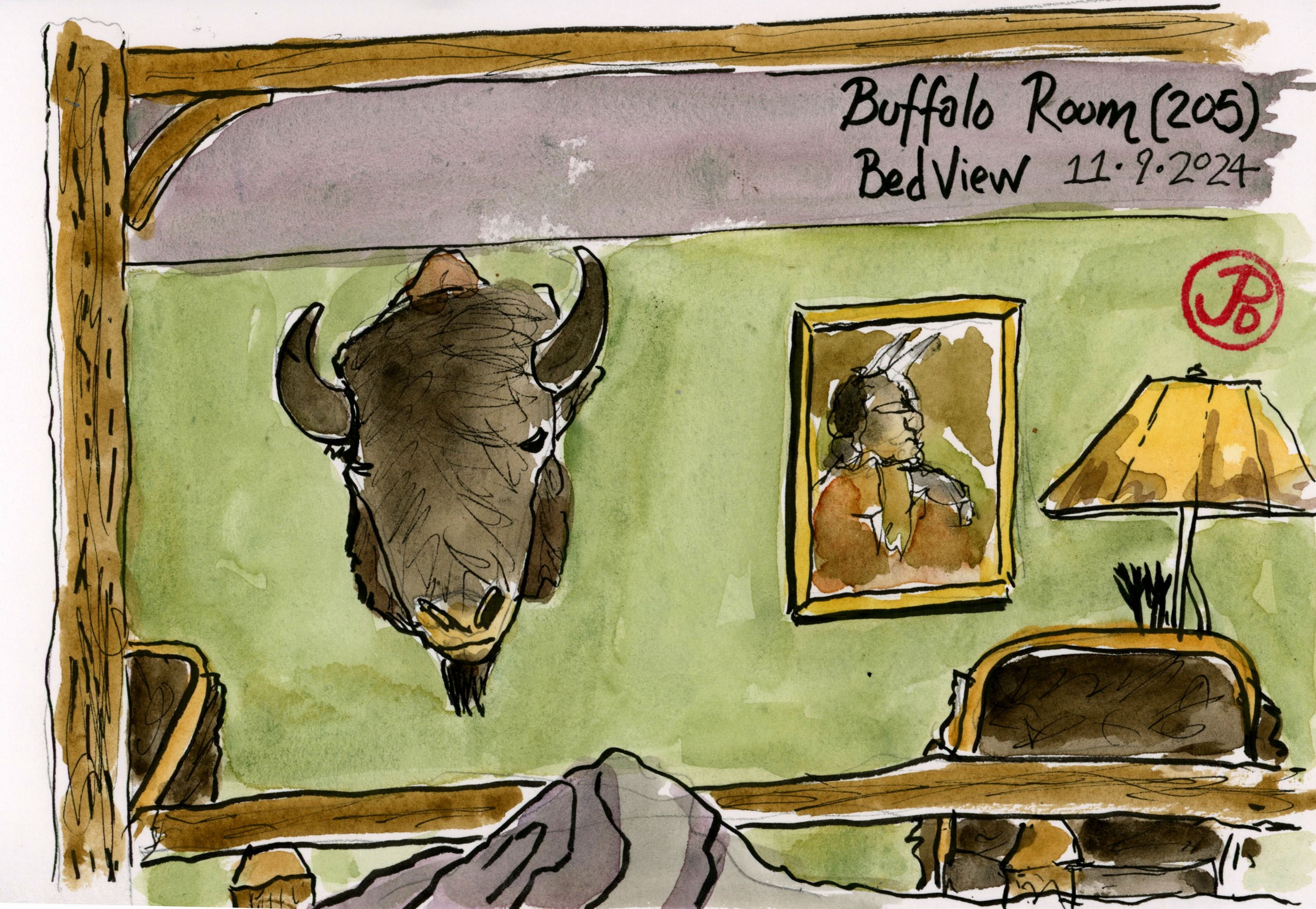
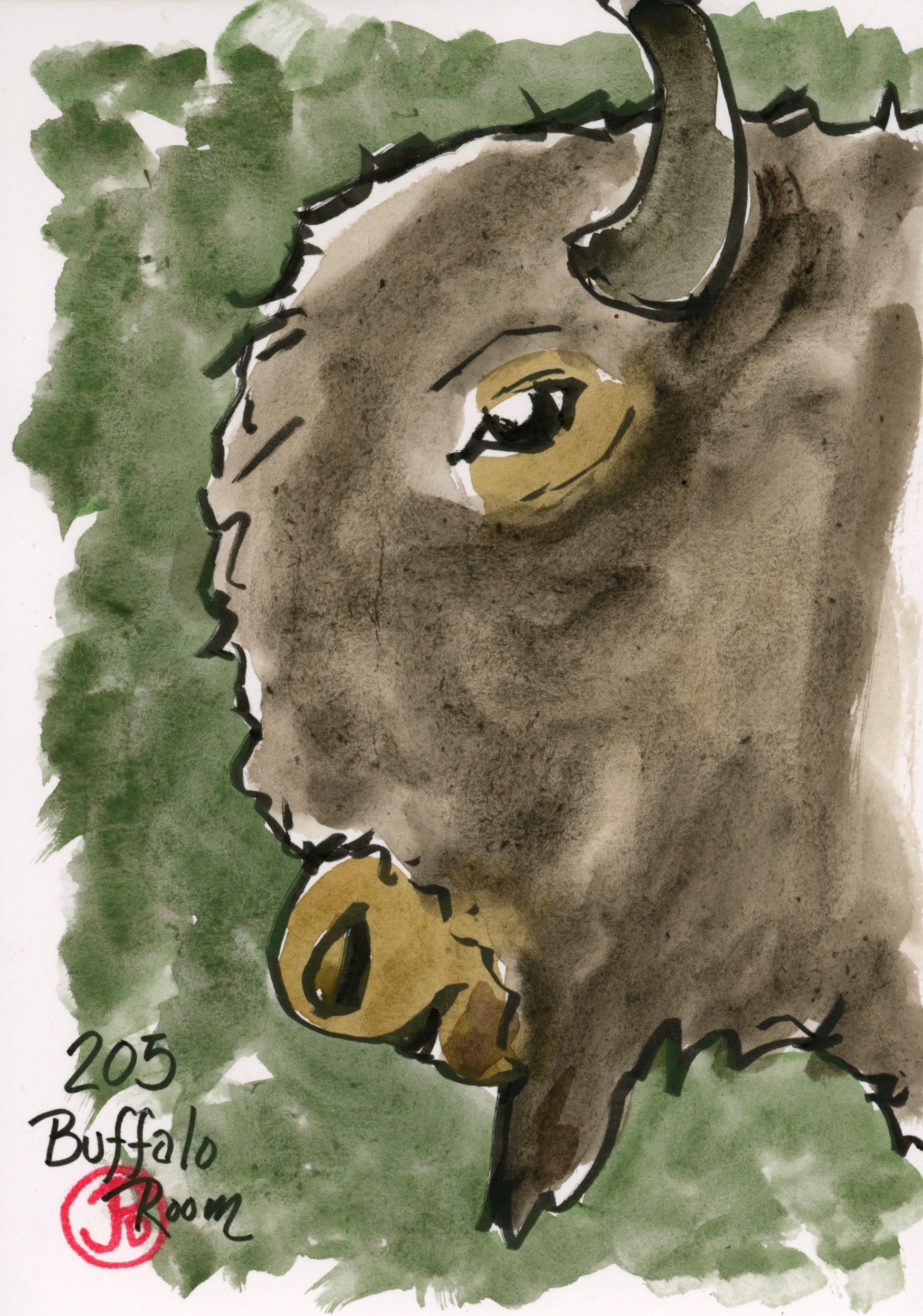
I was staying in room 205, the Buffalo Room. The room has western/Native American themed accents, a rustic wooden four poster bed, and a huge American bison head hanging on the wall. This was sketcher’s paradise.

I just hoped the bison head didn’t give me nightmares!

A bed sketch from room 205.
Buffalo head detail. It seems to be looking at you no matter where you stand in the room.
Image

SLO Watertower

On my way back to the Bay Area from my Malibu adventure, I overnighted in San Luis Obispo. There was a water tower, across the line from the passenger depot that I wanted to add to my sketchbook. One of the few Southern Pacific water towers still standing in California.

I timed my visit with the arrival of Train # 14, the northbound Coast Starlight. This is an AMTRAK route that starts in Los Angles and terminates in Seattle, Washington.

I had about 20 minutes to sketch the water tower before the 14 pulled into San Luis Obispo. The train was already running 30 minutes late. I picked my position and started to sketch. A voice over my shoulder ask if was riding coach or had a roomette.

The voice belonged to an AMTRAK conductor who was about to board the train, SLO is a crew changeover point. I told him I wasn’t boarding the train, just sketching the tower. We had a conversation about other Southern Pacific existing water towers. He recommend a very large tower in the desert of Arizona that I should visit.

The Coast Starlight arriving at San Luis Obispo, 30 minutes late.

With the recent heavy precipitation over Donner Pass, I wondered aloud if the rotary plows at Roseville had been put to work to clear the pass. The conductor didn’t know. Before long the Coast Starlight pulled into the station and I looked down at my sketchbook and I hadn’t gotten very far but I had a nice conversation with a railroad working man. Two rail nerds chewing the fat!

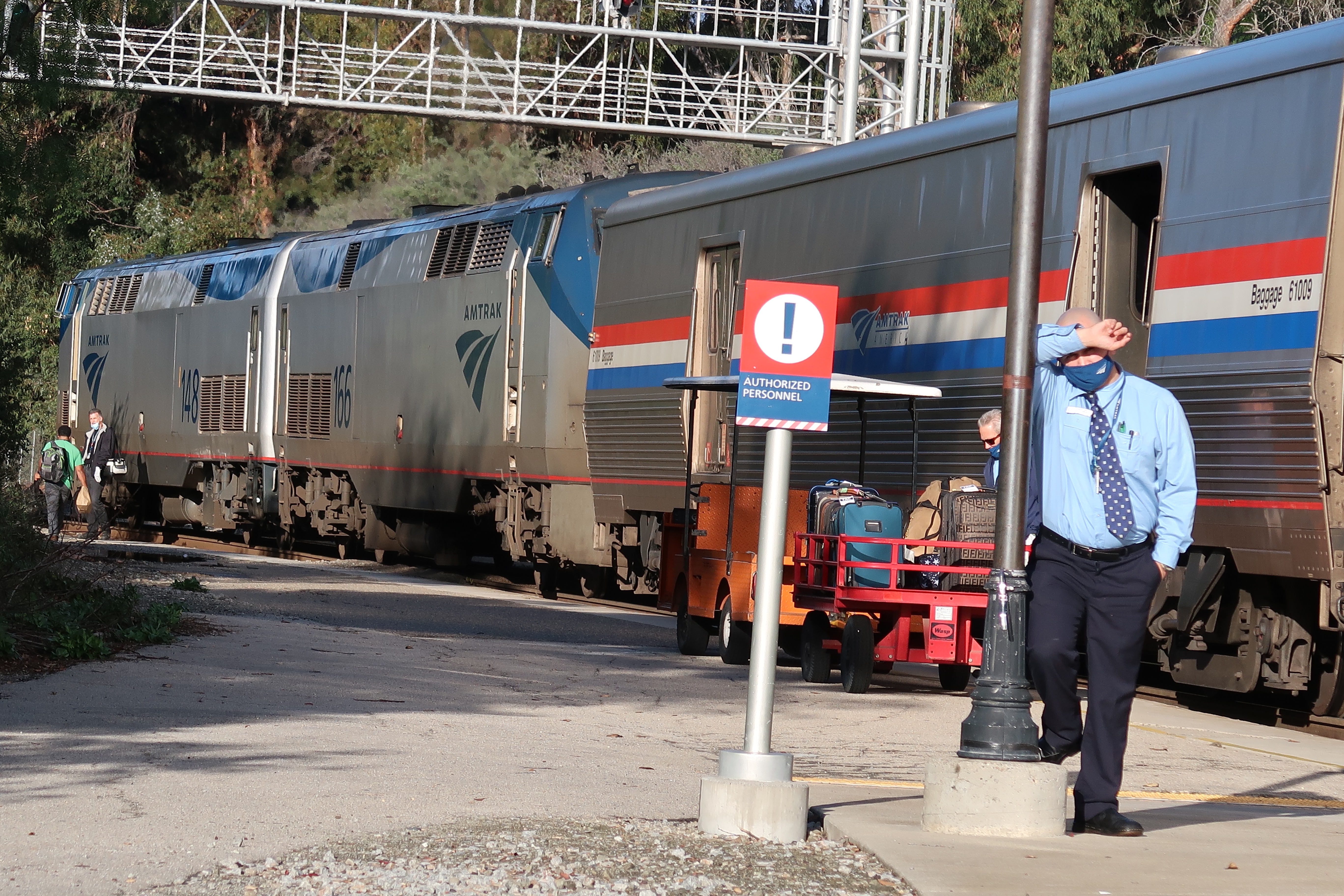
SLO is was is called a stretch stop, also known in another time as a smoke stop, where the Starlight pauses for about 20 minutes so passengers can get out and stretch their legs, or poison their lungs with nicotine. This is also where crews, engineers and conductors, change over.

This photos says a lot. The conductor monitors the progress of boarding the train, baggage is being loading into the baggage car, and the engineers are changing over.

I couldn’t continue sketching because a double decker Superliner passenger car was now between myself and the historic water tower. So I watched the interactions on the platform instead. Passengers where doing laps, other where boarding, some hanging back from the train were vapping, and the train crew was in the process of changing over.

“All aboard!” And passengers filtered back into the cars. The locomotive sounded it’s horn. It was time for the Starlight to start its climb up the Horseshoe Curve on the Cuesta Grade and I watched the train slowly disappear around the curve.

I now turned back to the water tower and restarted my sketch.

The SLO 65,000 gallon water tower was built in 1940, at a cost of $2,130. The watertower was built across from the passenger station so steam locomotives could take on water without having to back into the yard further south down the track. At that time, ten passenger trains passed through SLO. The tank was in service until 1956, when steam was replaced with diesel on the coast line. The tower was preserved and restored by 1998.

Image

Southern Pacific Water Tower: Elmira

I planned to sketched the water tower at Black Butte, in the shadow of Mt. Shasta in Northern California.

I wanted to sketch this Southern Pacific water tower because of it’s historical significance and also because this is one of the few water towers still in operation as Union Pacific (it’s current owner) keeps this active to water any of UP’s heritage steam engines and other steam excursions that might pass this way. (SP 4449 topped up her tank here in the summer of 1991). The tower was built in 1926.

But not all plans come to fruition. I headed up to Weed to sketch the water tower only to find that the road leading to it was gated and all the signs around the area read “No Trespassing, Do Not Enter”. This area was still very much an active Class I railroad and I’m sure UP didn’t appreciated railroad gawkers and sketchers near their tracks.

So in order not to become a headline in the local paper, I chose to turn back towards Dunsmuir.

Steam engines cannot function without water. If water runs too low in the boiler it can result in a deadly boiler explosion. Therefore railroads built water tanks or towers near railroads, spaced out so there would be water along the line, when the locomotive became “thirsty”.

But I still wanted to sketch a more accessible Southern Pacific water tower so I did some research. I found that in the State of California, there are 16 Southern Pacific water towers still in existence. While I was not able to access one of those, there were still 15 left to find.

I hade seen the 65,000 gallon restored water tower across from the passenger station in San Luis Obispo. It was built in 1940 and was retired in 1956. I did have it on my sketch list but I didn’t get to it. One down, fifteen to go.

The restored Southern Pacific water tower in San Luis Obispo. This tower was slated to be torn down but local interests intervened and saved it from destruction.

I set my sights on the Southern Pacific water tower in the small Solano County town of Elmira (population 188).

Elmira was a major railroad stop in the early part of the 20th century as it was on the Cal-P line between Vallejo and Sacramento. At Elmira, there was a spur that went to Vacaville, Winters, and Rumsey as part of the Vaca Valley and Clear Lake Railroad. It is easy to understand why a water tower was built here because of the rail traffic and the spur.

Then U.S. Route 40 (now Interstate 80) was created as one the the first Interstate Highways in 1926. It was the first major east-west route, starting in Atlantic City, New Jersey and terminating in San Francisco. The route passed west of Elmira, through the town of Vacaville. Since that time the town of Elmira never recovered. As the population and development in Vacaville grew, the town of Elmira became a rural backwater with a shrinking population.

The same growth in the Nation’s Interstate Highway system also was the death knell for many railroads across the country with trucks and cars replacing freight and passenger service.

The last freight train to run on the spur to Vacaville was in 1985. After that the rails between Vacaville and Elmira were abandoned and then later removed.

The abandoned but still standing Southern Pacific water tower at Elmira. The tower is not fenced in and there are no historic signs about the tank. It looks to be similar to the 65,000 gallon tower in San Luis Obispo and I imagine that it was built in the 1930s or 40s and used up until the mid 1950s.

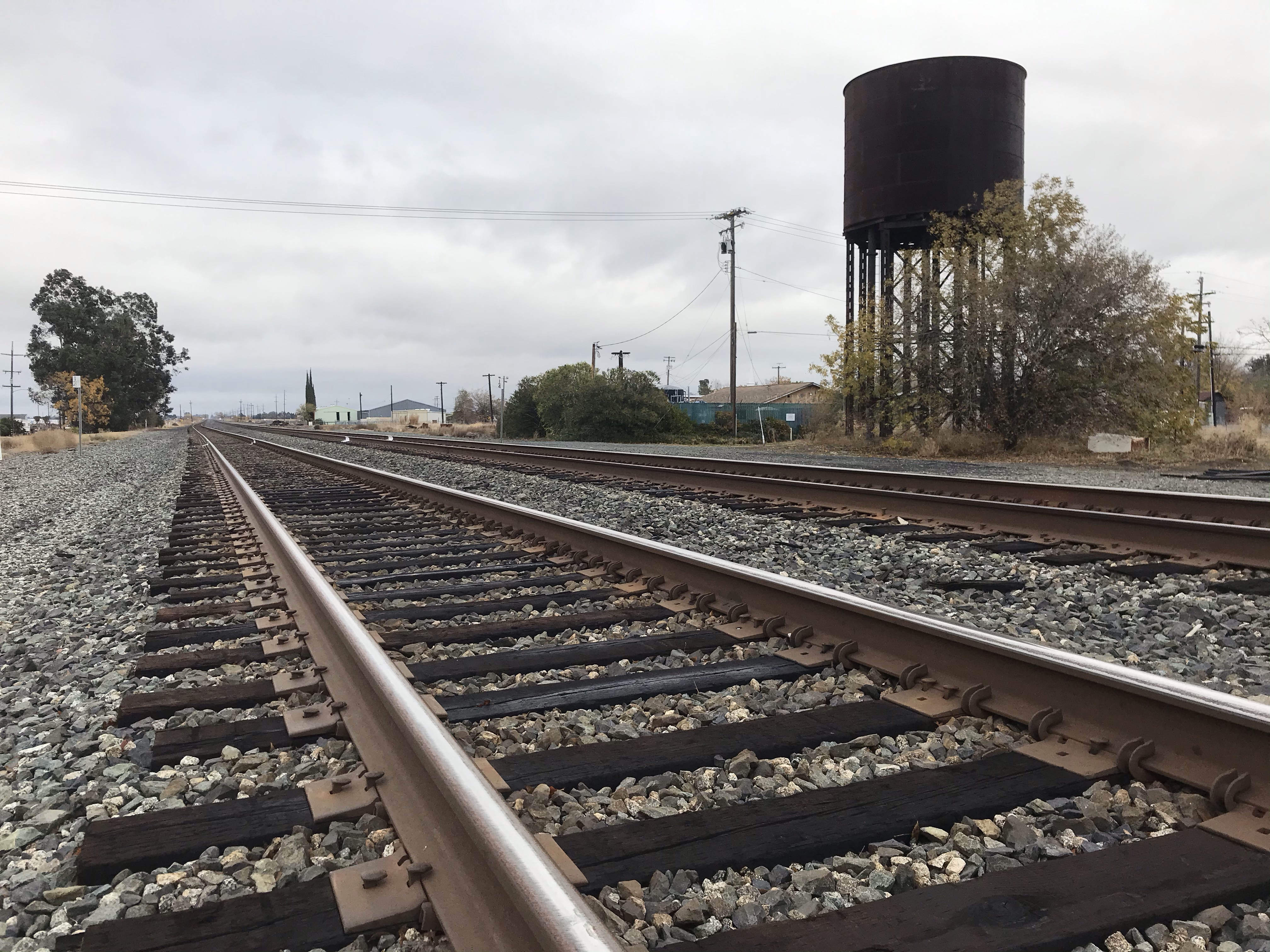
The passenger station is now gone but active double tracks still pass the abandoned and rusted water tower at Elmira. The Capital Corridor passenger service runs 16 trains every weekday. The 168 mile service runs from San Jose to the state capital in Sacramento. A few trains head further north to Auburn.

Looking north towards Davis and Sacramento. Two sets of polished tracks pass through Elmira. These rails get lots of use with 16 passenger trains on a normal weekday.
Westbound train number 729 passes by Elmira’s water tower at 9:28 AM on a Saturday morning at a rapid clip. There is no longer a passenger station in Elmira. The closest station is to the south at the Fairfield-Vacaville Station. On point is an EMD F59PHI with “California styling”.
Image

San Luis Obispo Station (Post #300!)

San Luis Obispo marks the midway point on the Coast Daylight passenger route between San Francisco and Los Angeles.

The town is named after the Spanish mission that was founded in 1772 by Father Junípero Serra. It became an important railroad town because it was at the southern end of Cuesta Grade.

It was a division point on the then Southern Pacific Railroad (now Union Pacific) and because of it, the town had shops to service the locomotives, a roundhouse to turn engines around, and a wye to turn the massive cab-forward around (because it could not fit on the turntable.) This large articulated 4-8-8-2 engine was designed to go through the long show sheds and tunnels over Donner Summit but later, in the 1950s, pulled freight over the coast line and acted as a help engine.

SLO Roundhouse

A quick brush-pen sketch of the site of the roundhouse and turntable. While now little is left of the roadhouse, at the height of operations, the yard employed 44 men. The pile in the foreground are rusted railroad spikes. The line of boxcars in the background have been waiting in storage on a track siding for three weeks.

It was here at San Luis Obispo that northbound Daylights took on a helper to make it over the Cuesta Grade and its where a southbound train had their helper locomotives taken off.

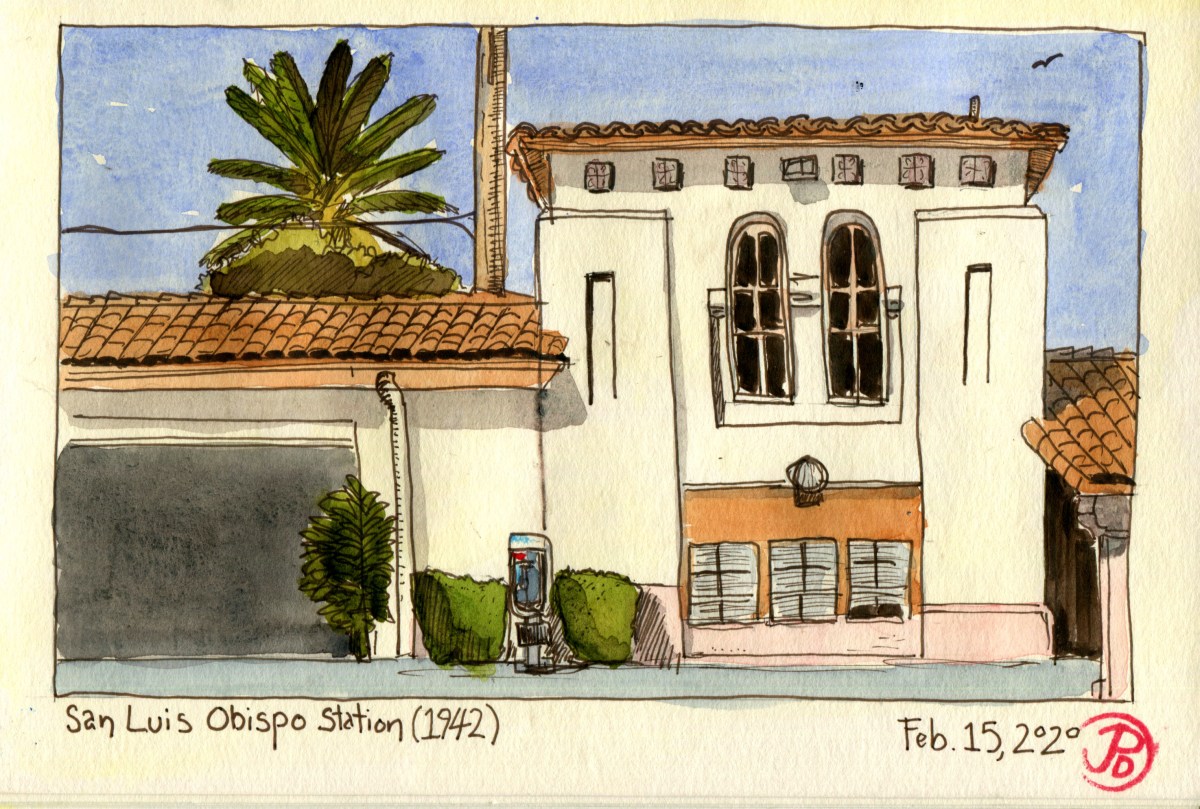
The passenger depot was built in 1943 in a Mission Revival Style, slightly echoing the Spanish Mission that the city is named after.

Across the tracks from the station is the 65,000 gallon water tower used to water the steam locomotives that worked this division. The tower was built in 1940 and has been saved from destruction by the city of SLO. Often engines and crew where changed here but the Daylight GS-4 locomotive would make the entire San Francisco to Los Angeles run without being changed out at San Luis Obispo.

The station is still used as a passenger station although freight trains over Cuesta Grade have stopped. Both the Coast Surfliner and the Coast Starlight stop at this station. But more on these routes in a later post.

Three hours after leaving Santa Cruz, I set up my camp/sketch chair across from the station and sketched an elevation view of SLO Station. It was a glorious morning!