Image

Parque Nacional Monfragüe

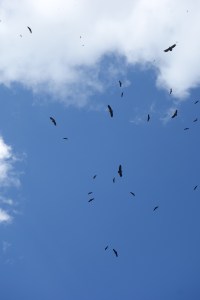
Monfragüe National Park is the crown jewel of the Extremadura region. This is one of Spain’s 15 National Parks and was established in 2007. The 17.852 hectare park is recognized by UNESCO as a Bioshere region. But of course we were here for the raptors. Monfragüe hosts 15 regular breeding species, including the world’s largest breeding concentration of Eurasian black vultures. The real highlight for a birder in Monfragüe is to see the blue Iberian skies covered in raptors: vultures, kites, hawks, and eagles and we were not let down.

This is the land of the old world vultures, the ones with long, snake-like necks and a billowy scarf of feathers. These were the vultures of National Geographic, the Jungle Book, and Ferdinand the Bull.
DSC05819

The skies full of vultures (three species), kites (two species), and eagles (one species) at Monfragüe. In California we would describe this scene as “raptorlicious”.

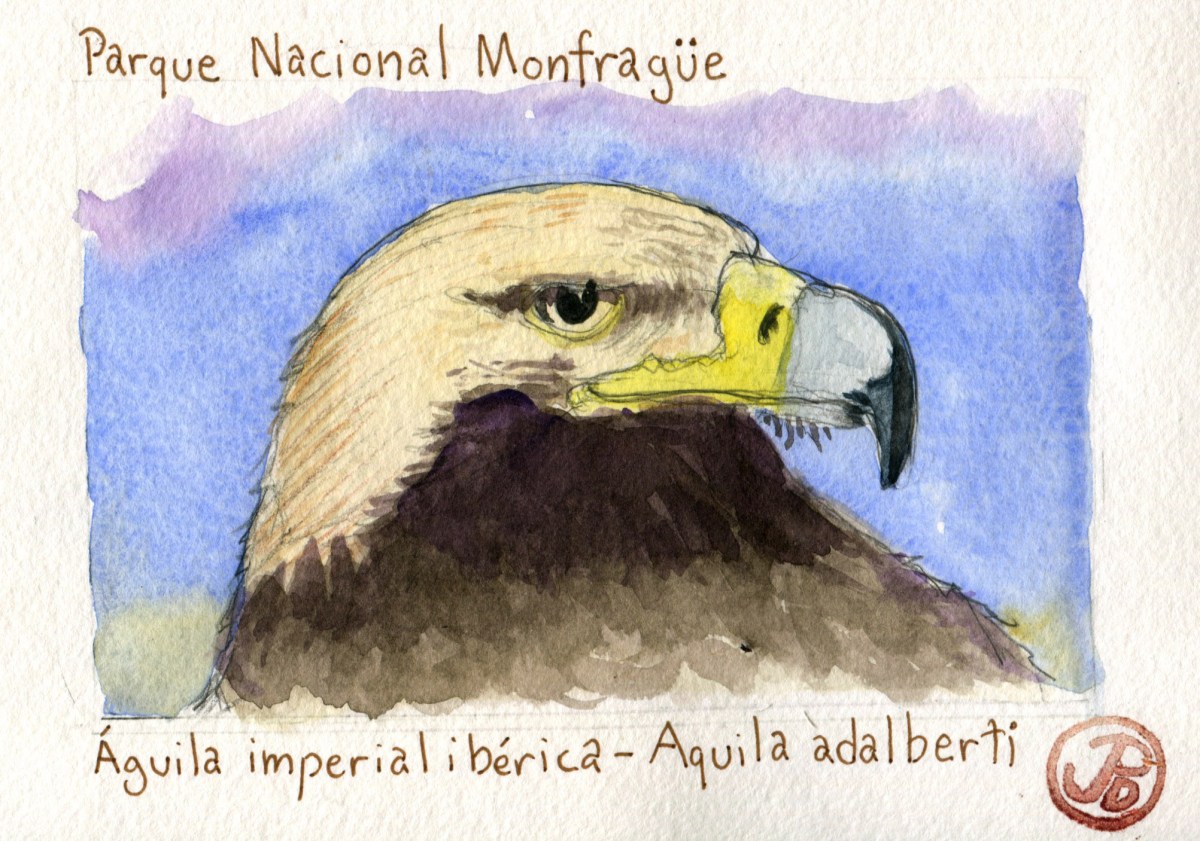
When Pau and I set out from Las Canteras early on a misty morning, our destination was Monfragüe and our prize was the bird that the two English brother twitchers would inevitable ask us about as they indeed greeted us in the evening with, “Did you get Spanish imperial eagle?” This eagle is the the prize bird for any birder visiting Monfragüe. It is a very rare bird, in the 1960’s only 30 pairs existed. Powerlines, poisoning and habitat destruction where the causes of the eagle’s decline. Through conservation efforts the eagle’s population has slowly increased. In 2011, there were 318 pairs in Spain. On the drive to the National Park, I told Pau that I wanted to find the imperial eagle by myself. I picked through the many huge kettles of raptors looking for the eagle with snowy white leading shoulders. No luck. No yet anyway.

We came to a stretch of road that was across the river from steep cliffs that rose above the water. The road was lined with birders and their scopes. Their attention was fixes on the cliffs and the skies above. Pau pulled over and I reminded him, “Leave the imperial to me.”

I stepped out of the car and looked up. Above me was a large raptor rising on the thermals of the warm road. I raised my binos to my eyes. It turned to the left, slightly dipping it’s wing. A dusting of “snow” on it’s shoulders. I love when life birds, especially rare ones, are this easy to find! Spanish imperial eagle.

Pau later showed me the female on a nest. This eagle and the precious eggs she was incubating was a good sign that the Spain Imperial eagle would continue to thrive in Extremadura.
IMG_4302

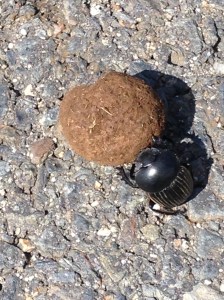
 “Will Break for Dung Beetles”, Monfragüe, it’s not just about the raptors, it pays of to look down.

My guide in Extremadura was Pau Lucio. I would highly recommend him if you plan to bird this amazing part of Spain. His guiding company is called Birdwatching Spain and more info can be found at their website: http://birdwatchingspain.net
Image

Extremadura and Las Canteras


Why Spain? You ask. The answer has been the same on recent trips both when boarding a plane or hitting the road. Birds, birds, birds.

Extremadura, the province southwest of Madrid, boasts an amazing array of avian riches in Europe, a high consentration of raptors and a handful of endemics which are birds that are found nowhere else in Europe.

Birders come from all over Europe to make a pilgrimage to this rural part of Spain to see Spainish imperial eagle (which once graced the flag of Franco’s Spain), Egyptian, griffon, and black vultures, black stork, Iberian magpie, bee-eater, lesser kestrel, great and little bustard. Many of the twitchers hailed from the mighty triad of birding nations of Northern Europe: the Netherlands, Germany, and Great Britain.

Extremadura sits on the flyway that bridges Northern Europe with Africa. This part of the Iberian Peninsula provides breeding habits for the colorful European bee-eater and roller as well as providing a year round habitat from many other species.

For this expedition I hired the services of a guide to take me to the birds, work as a translator and go-between with the locals, and help me navigate rural Spanish cuisine (which for me meant cheese, bread, and beer but sometimes augmented with wine.)

Las Canteras

My mastery of Castilian is clearly demonstrated by my different spelling of Las Canteras in this spread. It’s great to know that my spelling is appalling in any language!

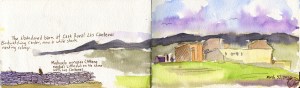
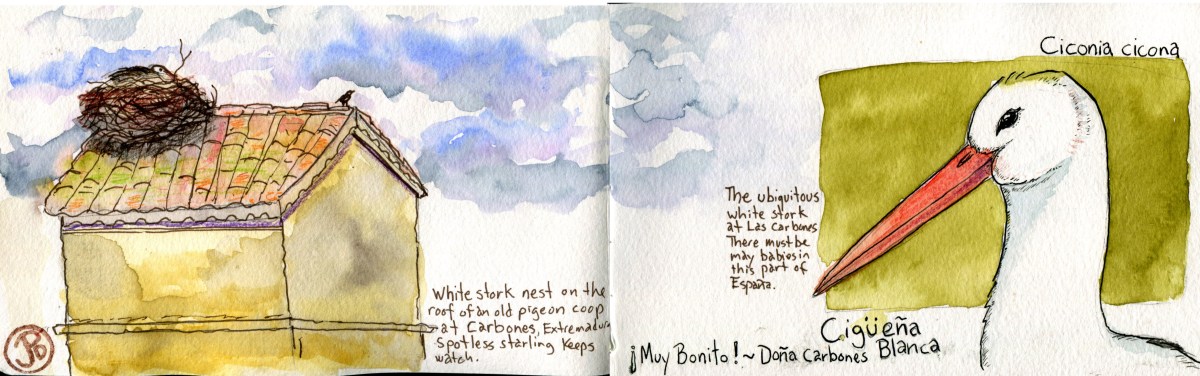
My guide, Pau, chose Casa Rural Las Canteras Birdwatching Center as our base camp. From the front porch you could view the crumbling stone barn that had been reclaimed as a white stork rookery, containing at least eight active nests.  On the other side of the porch was a scope fixed on a little owl. No I mean that’s what the owl is called: Athene noctua ( odd name for a daylight owl). It seemed that no matter when you looked through the scope, the little owl is always perched on the stone wall. Uncanny! Well I had to sketch the owl on it’s permanent perch.

2016-03-31 18.55.26

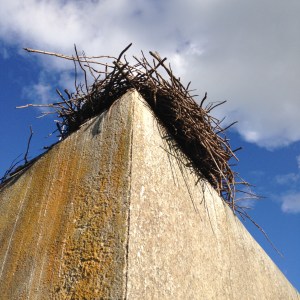
So this is where babies are made! White stork nest at Las Canteras.

Las Canteras (or Carbones) is run by the innkeeper and his mother, whom I dubbed Doña Carbones. She looked at my white stork sketch and offered a little art criticism: “¡Muy bonito!” I’ll take it!


Image

Guggenheim Bilbao: A Chameleon Silver-Flying Fish

The Guggenheim Museum Bilbao, a review: there is nothing in the galley halls that matches the architectural sculpture of Frank Gehry’s masterpiece.

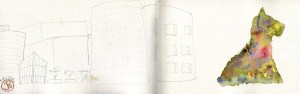
Sketching the Guggenheim Bilbao provides it’s challenges; there is not a straight line in the building. The sketch starts in one place and then ends in another. The organic nature of the architecture dictates a less systematic approach that can leave the sketch a little  disoriented. It seems to be a building that is impossible to truly capture. Its curvaceous lines and the color of the titanium sides, mirrors the ambient colors that are constantly changing with the overcast skies that shift to sunshine, then rain, and back to the grey skies of the Basque Country.The Guggenheim is a chameleon silver-flying fish that cannot be defined in the halls of science.

Puppy

Jeff Koons ‘”Puppy”

After two attempts to capture this strange beast (interrupted by the ubiquitous Basque rain), I settled for a much more agreeable Bilbao icon to sketch. The dog that “guards” the contemporary art museum: Jeff Koons’ flower sculpture, known to the locals simply as “puppy”.

I again became part of the scenery and experience to a bunch of French teenagers and a geriatric, cane-wielding, beret-wearing Basque, the Spanish love their daily afternoon constitutionals. He looked at my painting and commented, “¡El perro!” I’m still trying to determine if it was a statement of fact, a question, or a bit of art criticism.

I think this is one of my favorite sketches from Spain. It was very loose and freeing to use a wet on wet technique and let the unpredictable nature of watercolor do what is does best. I call it organized chaos.

Snake

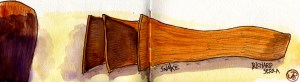
One of the pieces that matches the magnificence of Gehry’s Guggenheim, Richard Serra’s sculpture: Snake.

Image

Guernica and El Clásico

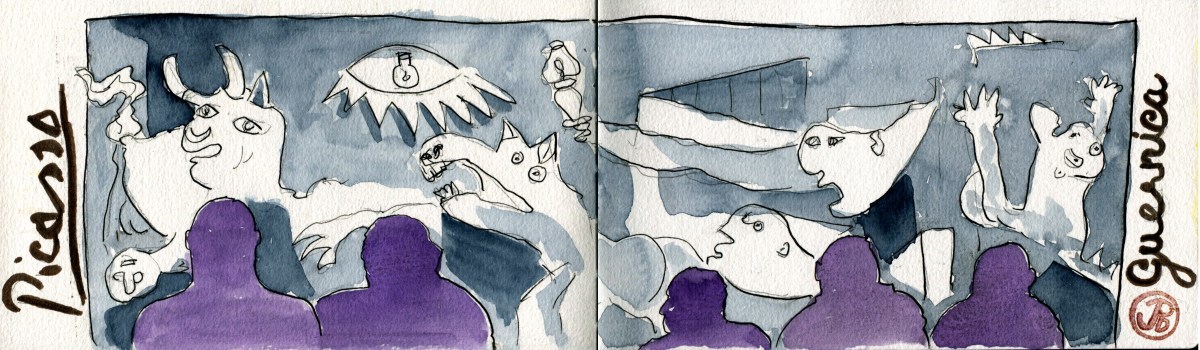
On Saturday it was about unfinished business from over 25 years ago, which was the last time I was in Madrid. Back then I had a backpack and a Eurorail pass. We stayed in Madrid for a short time and visited the Prado. I knew that Picasso’s masterpiece was just down the road but we must have been suffering from art museum fatigue (it’s easy to contract at the Prado) and the oppressive heat of Madrid in summer. This trip I was not going to miss Picasso’s massive work (I mean that in many ways): Guernica. This painting has been called, “the most famous single work of the 20th century”.

I was staying in the Lavapiés neighborhood in Madrid which was within walking distance of three points of the Madrid Art Triangle, which includes three of the most famous art museums in the world, the Prado, the Thyssen-Bornemisza, and the Reina Sofia. My destination on Saturday afternoon was the Reina Sofia, home to Picasso’s ultimate statement about war and it’s atrocities. Guernica refers to the small town in the Basque Country, near Bilbao. This was the setting of a tragedy, when on a Monday market day civilians were bombed by German and Italian aircraft in April of 1937 during the Spanish Civil War. This  was in someways a dress rehearsal for the bombing of cities and civilians during World War II. The painting  has gone on represent all victims of wars.

The painting hung in New York because the creator only wanted Guernica to hang in the Prado in a democratic Spain. Franco outlived Picasso and Guernica returned to Spain in 1981, six years after the dictator’s death.

Before visiting gallery 206, I already envisioned how I wanted to sketch Guernica. I knew that it was one of the most popular attractions in all of Madrid, if not Spain. I also knew that photography was not allowed anywhere near the painting (they sell more postcards and posters that way). I placed myself towards the back of the gallery sketching Guernica filtered through the crowd standing in front of me. I was in no way going to sketch every detail of the complex painting, that’s why it’s called a sketch after all.

After a siesta I headed to the bar La Fontana de Oro  just off Puerta del Sol to watch one of the most viewed sporting rivalries in history: El Clásico. Real Madrid vs Barcelona. Just to give you some numbers, it is estimated to have a worldwide viewing audience of 400 million. Keep in mind that this is just a normal league game that is played twice a season. By contrast, the highest  viewing audience for the Super Bowl was 114.4 million. They don’t call Futbol the world’s game for nothing. El Clasico

My version of  watching El Clásico in Madrid at La Fontana de Oro as Real Madrid defeated their bitter rivals Barcelona 2-1.

I wanted Los Blancos to win but judging from past contests Real would end the match with ten men and Barca  would win yet again Barcelona were on a 39 game  winning streak and they were heavily favorited to win on their home pitch, Camp Nou. But it was not to be, Los Blancos ended the match with ten men but Real equalized with a Benzema overhead kick and Ronaldo scored the winner with amazing technique and ball control. It was a great experience to be in Madrid when they defeat their southern rivals and to commemorate the experience I made the sketch above on the bus ride up to Bilbao the following morning. The influence of Picasso and Guernica is evident, as I peopled La Fontana de Oro with characters out of a Picasso painting. This sketch however is the anti-Guernica. Unless of course you are a Barcelona fan.

Image

Sketches of Spain

For my two week spring break I headed to the Iberian Peninsula with two sketch books, paints, my Escoda Prado synthetic sable travel brushes, and binoculars. This is the first time I had sketched in a foreign country (no Texas jokes please). It took a little while to “shakes hands with the place” as Goldsworthy would say. A little while to warm up to Spain.

My travels took me to two of the greatest sporting venues in the world, two of the greatest art museums in the world, the top birding destination in Europe, and an art museum that is an architectural masterpiece. Madrid, Extremadura, and Bilbao.

Over the next series of posts I will share pages of my sketchbooks from the Corrida De Toros at the Plaza de Toros de Las Ventas, to the 107 species of birds I saw in Extremadura and the chameleon-silver flying fish that is the Guggenheim Museum in Bilbao.

Enjoy the rich colors, traditions, and cuisine of Spain!

Drinks

Care for a drink with your sketch?

Image

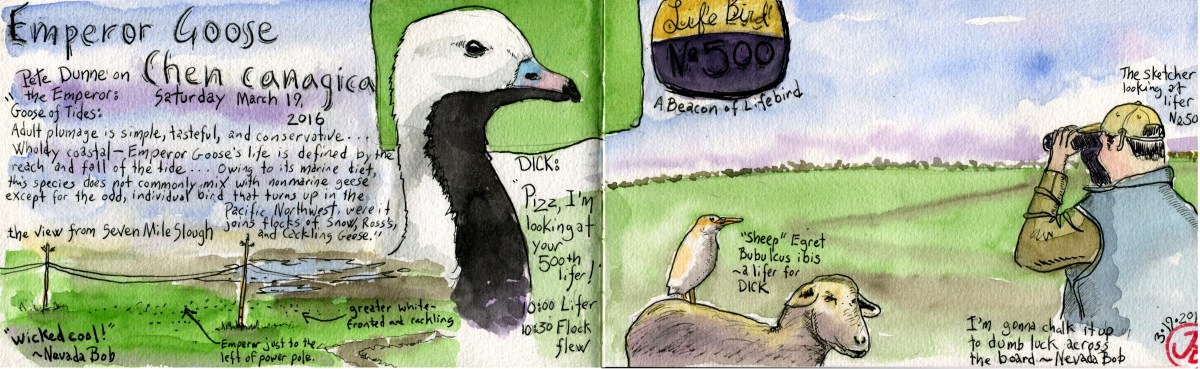
500! The Emperor!

As I headed out the door on The Quest for 500, the light rain that constitutes fog in San Francisco, was heavy, making visibility limited to a few blocks. I wondered how I was going to find a needle in the haystack, a single goose among thousands of other geese, in a thick blanket of fog.

As I headed north into Marin County, blue sky started to appear over Mt. Tam. I was on my way to pick up DICK and then we headed northeast on Highway 12, past the riverside town of Rio Vista to green fields, framed by a levee to pick through the thousands of greater white-fronted and cackling geese. Our prize was a pied-headed marine goose that usually forages through the tidal flats on the islands of the Bering Sea, where it breeds, and winters on the Aleutian Islands in Alaska. A few individuals wander south to Washington and Oregon and an even fewer number, the needles, head farther south into California. Since 1884 there have been only 38 accepted sightings in California. This was the quest for the Emperor goose.

We had a vague idea where the goose might be, other birders had whiffed on it earlier in the week and our best case scenario would be that we come upon a group of birders that already had the Emperor in their scopes and we check it off our lists. Once we turned off Highway 12 I was surprised to find only one Prius load of birders. It looked like we had to find this goose on our own.

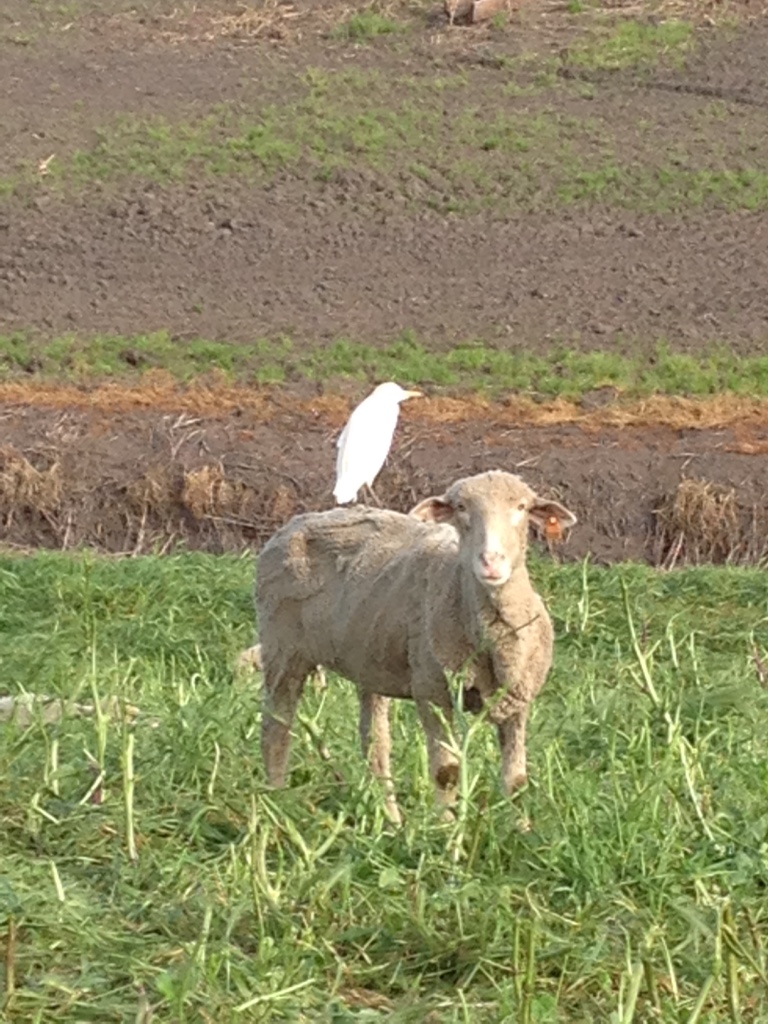
Over the vast green fields we could see little grouped specks as far as the eye could see. This was going to be a tough lifer.We turned right on the levee road, Seven Mile Slough to our left and the fields to our right. A herd of sheep grazing the hill appeared to the right. On one sheep was a “sheep” egret, a small white bird that associates with livestock. Lifer for DICK.

thumb_IMG_4141_1024

The “sheep” egret on its movable perch, otherwise known as cattle egret, Bubulicus ibis.

We stopped every time we saw a flock of foraging geese and scanned the groups for the beacon. No luck. We approached a turn in the road, leading back north towards Highway 12. We stopped and surveyed the vast mass of geese that were forging on either side of the power poles that bisected the field. They were close enough that we didn’t need a scope but there were a lot of geese to pick through. The tall green grass and the up and down feeding dance of the geese made our search even more difficult.

Five minutes into the search DICK said, “I’m looking at your 500th lifer!” I raised my glasses and looked at the flock of geese just to the left of the power pole. The Emperor raised it’s head like a beacon of light, standing out, an exclamation point that announced itself amid all the white-fronted and cackling geese. Life bird No. 500!

thumb_IMG_4151_1024

Corvidsketcher looking at life bird No. 500, Emperor goose, Chen canagica.

We were soon joined by another birder and his two dogs. Then another and another car stopped to see the goose. One couple, Nevada Bob and his wife, had left Nevada a 6 AM to see the Emperor. In all we we had great looks with the sun at our backs for about 30 minutes until something spooked the birds and the flock erupted into the air and the geese and the needle disappeared. The show was over.

Coda

Like the Emerpor’s unique head and neck, a contrast of black and white, light and dark, the experience was also mixed with pathos. Directly across the creased and pock-marked levee road  from where we found the Emperor was a handmade wooden cross with the name Tony Paul Ludricks painted across the top. I later learned that on May 24, 2015, a car veered off the levee road and into the slough. The 20 year old passenger was able to swim to safety but the driver was not so lucky. Tony was 16 years old.


Image

Aves de España

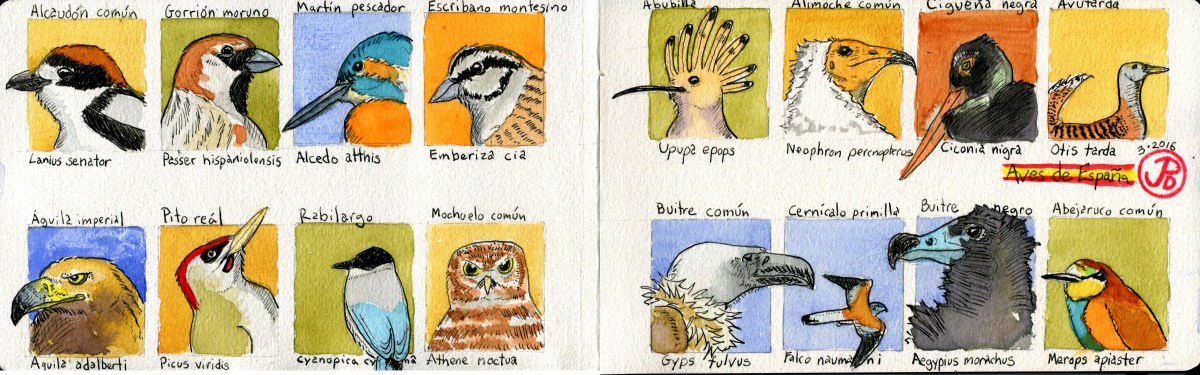
Before heading out on a birding trip I like to sketch the birds I might see. By sketching their form, painting their plumage, and writing down their name, I internalize the bird so when I see it in the field for the first time, a recognize the species in the same way that when you write something down or draw it, you tend to remember it better.

For a good part of my time in Spain I will be birding one of the best birding locations in Europe. Extremadura, southwest of Madrid, is world renown because it sits between Northern Europe and Africa, generating birds that are found few other places in Europe. It is the home of many raptors: Spainish imperial eagle, griffon, Egyptian, and black vultures, lesser kestrel. Not to mention the non-raptors: bee-eater, bustards, and hoopoe! Virtually every bird will be a lifer!

Each portrait includes their Spanish common name and their binomial scientific name.

The birds in English, from top left to bottom right are : woodchat shrike, Spanish sparrow, kingfisher, rock bunting, hoopoe, Egyptian vulture, black stork, great bustard, Spanish imperial eagle, green woodpecker, azure-winged magpie, little owl, Eurasian griffon vulture, lesser kestrel, black vulture, and European bee-eater.

Image

Sketch Poetry

Poetry frequently makes it’s way into my journal.

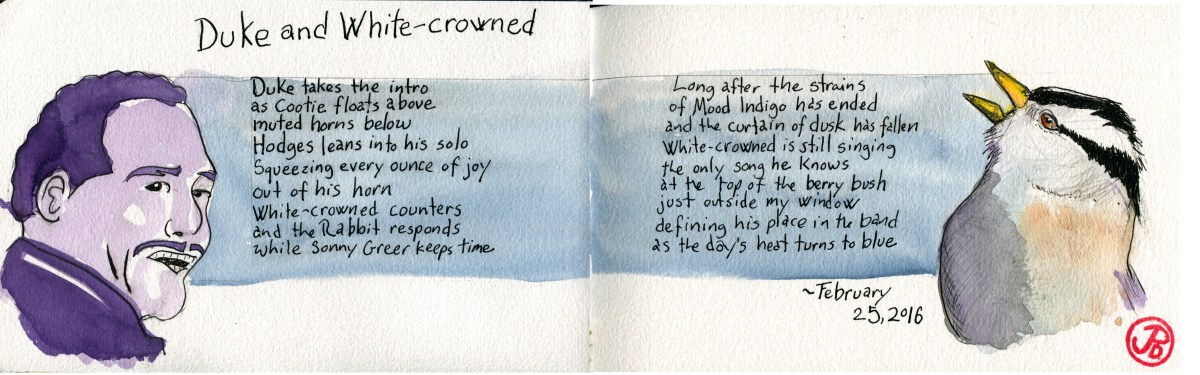
One afternoon I was listening to one of my father’s Duke Ellington CDs, a CD that I had gotten him for Christmas a while ago. My father loved big bands and he saw Ellington, Basie, and Ella as well as west coast greats Brubeck, Cal Tjader, and Vince Guaraldi. It was one of those beautiful February afternoons where the trees have blossomed early and the White-crowned sparrows were singing at the tops of trees to mark out their patch. It seemed to me, and the sparrows, that it was a spring day. As I was listening to Ellington the white-crown in the backyard seemed to be singing with the band so I wrote a poem about it and created a spread.

Duke and White-crowned

Duke takes the intro

as Cootie floats above

muted horns below

Hodges leans into his solo

squeezing every ounce of joy out of his horn

White-crowned counters

and the Rabbit responds

while Sonny Greer keeps time

Long after the strains

of Mood Indigo had ended

and the curtain of dusk has fallen

White-crowned is still singing

the only song he knows

at the top of the berry bush

just outside my window

defining his place in the band

as the day’s heat turns to blue.

I added two illustration as “bookends” to the text, one was sketched from the Ellington CD cover and the other was from a photograph of a white-crowned sparrow.

Condor

This spread was about my experience watching California condors at Grimes Point in Big Sur. it was a magical day with about ten condor perched by Highway One. The drawing is based on a photograph that I took and the condor’s massive wingspan seems to span the coastal hills in the background. I wrote a poem about the condor, included underneath it’s wings.

Bee

This poem is about my philosophy of nature, that we should not fear nature but embrace it. The poem is dedicated to three of my students as I taught them not to fear the honey bee. During recess on day, I found a bee on the blacktop and I picked it up and showed my students that they had nothing to fear. I then let the bee crawl on their hands and they learned that if you treat nature with respect and acted with confidence the bee will not cease its life by stinging you. I don’t think that lesson is a California State Standard!

Leaves

This spread was created to illustrate a poem I wrote shortly after my fathers passing in October. It’s really about accepting what life has dealt you and coping with change.

Image

Life List

We all seem to like making lists. Ingredients for a new recipe, the starting line for a football match, our favorite books or records (a top ten list) or the list of friends we want to invite to a dinner. The list goes on for ever.

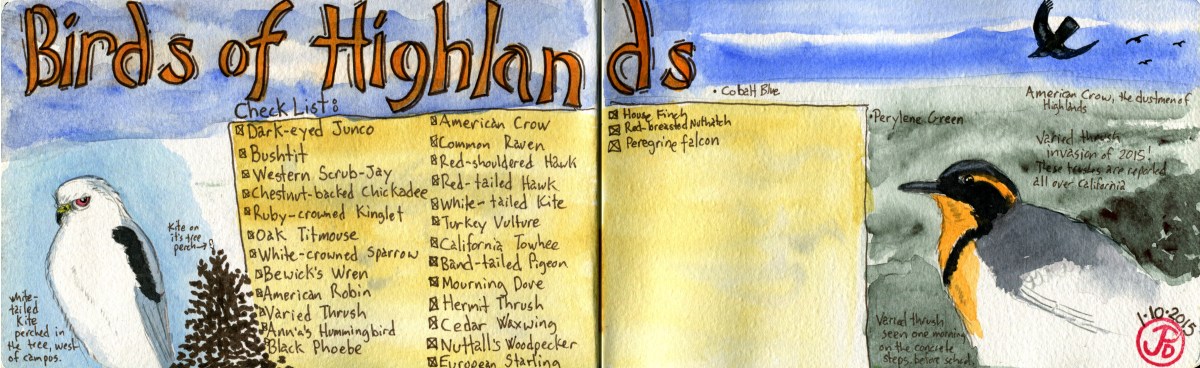
And birders are absolutely obsessed with lists. Life list, country list, state list, county list, backyard list, room list, car list, bike list, or walking list. I have never been too obsessed with lists and the list that is most important to me is the number of species of birds I have seen in the United States, because birds do not recognize country, state or county lines. I am currently one bird away from 500 North American birds. I wonder what No. 500 will be?

I have recently kept a school list, that is, all the species of birds seen from my school site. The birds could be on the green field, in the trees and bushes, or high above. The only criterion is that I have to see the bird with my feet firmly planted on campus in order to put the bird on the school list.

Let me give you an example of a bird that I was not able to put on my list. One morning as I pulled off the freeway and turned left over the overpass, I spotted a raptor circling off to the south. I pulled off, grabbed my binoculars from the trunk and focused on the raptor catching the warming air off the roadbed. The bird came into focus: adult bald eagle!

I rushed back to the car and headed up the hill to school. Pulling into the parking lot I scanned the horizon for the eagle. My view was obscured by houses and trees. Despite my search, I could not add bald eagle to my school list. But I tired.

What drives a man to want to put a bird on a list?

One of the main problems with listing is that birding becomes more of a sport than an encounter with nature. It becomes simply ticking off a name on a list rather than a celebration of recognizing a bird, that bird, turning on that branch above my head. A birder might say, “It’s just a robin.”  And master birder Rich Stallcup would reply, “ Yes but have you seen that robin?” There is much that is lost with listing and I have been guilty as any birder.

My current school list sits at 28 species. Bird 28 came one morning before school. I was on the yard asking a colleague a question when I looked up, as I am prone to do when I am out doors, an I saw the helmeted flying crossbow. I pointed skyward  and yelled to any students that were within earshot, “Peregrine!” School list bird #28. Can I get an witness, Amen?

Once you travel outside the United States, the world of listing takes on a whole new, a massive, perspective. Now you are in the realm of World List! There are currently about 8,669 bird species on planet Earth. So I have a lot of  birding to do.

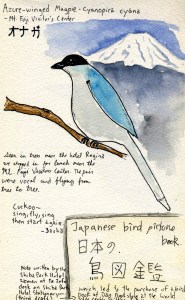
My first experience birding outside of the States was a 2008 trip to Japan. I was not really birding because I left my binoculars at home but there was a freedom in birding with my brown one by ones. I was not on this trip to bird but once you start to bird you can’t take your eyes and ears off of birds. On this trip I, for the first time, used a Moleskine watercolor sketch book, and I have fallen in love with the format ever since. The following three sketches came from the life list that I kept in my Moleskine.

AW Magpie

The azure-winded magpie has a very odd distribution. It is found in Japan, where I saw it, and it is found in eastern Asia and there is an island population in southern and central Spain. I will see the bird again at the end of March as I will be going on a birding trip to Spain.

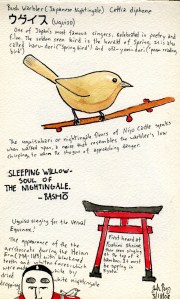
Bush Warbler

There was one bird which I desired to hear more than any other bird in Japan: the bush warbler (Japanese nightingale). This bird is celebrated in Japanese poetry, prose, and film as the harbinger of spring. I finally heard the bird in Kyoto at the beautiful Fushimi Shrine on my final morning in Japan. I first heard the unmistakable call and I rushed over the where I finally spotted the drab bird calling in a tree.

I added that bird to the world life list!Tree Sparrow

The tree sparrow was an ubiquitous bird in Japan.

Image

PEFA

“No flesh-eating creature is more efficient, or more merciful; it simply does what it was designed to do.”

-J. A. Baker

On one Saturday I was birding Natural Bridges State Park when I saw a bird in direct flight. Stiff wingbeats, with prey clutched in it’s talons. It perched in the top of a Monterey pine at the back entrance to Natural Bridges. I knew what the bird was and I headed closer to affirm my hunch and see what it had taken for it’s mid afternoon repass. Dark helmet with sideburns, a bird that is affectionately called “Elvis” by hawk watchers on Marin Headlands Hawk Hill. Peregrine Falcon, Falco peregrinus, the fastest animal on planet Earth.

Continue reading