I have always loved that crossover between the ariel insectivores, between the swallows and the bats. Between the diurnal and the nocturnal. In a word: twilight.
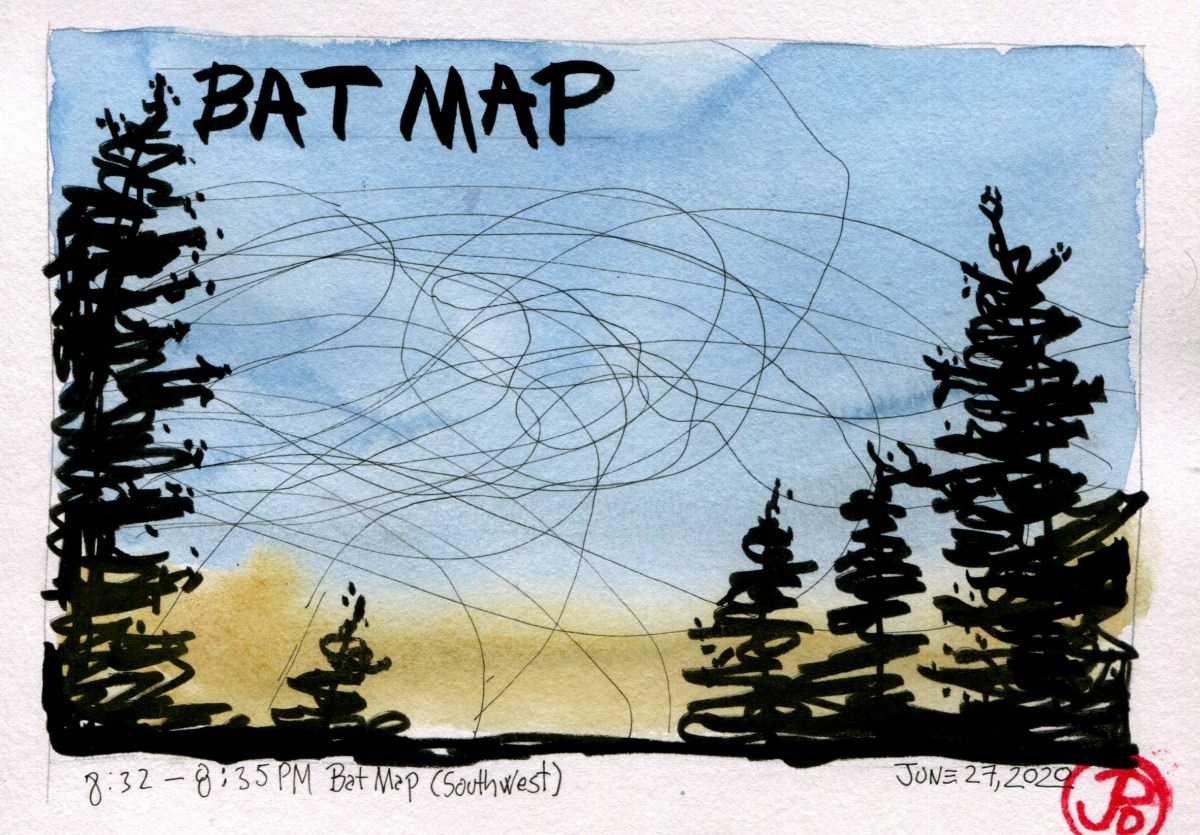
Looking to the southwestern skies, framed by silhouetted redwoods, I watched for the appearance of the first bat. The change over of swing to graveyard. At 8:30 PM there were still a few violet-green swallows catching insects on the wing. At 8:32 the unmistakeable flap-flap-flap of a flying mammal appeared from stage right, while the last swallow made it’s last foray. This is the time of the bats!
I wanted to sketch a bat map, a record of bat movement over a finite time period. I mean really finite, I mean three minutes.
Before the bats appeared, I sketched the silhouetted redwoods as a way to frame the composition and as a way to give me points of reference when it came time to map their flight across the sky.
I may be able to identify all the common species go birds by sight and sound that inhabit the area around my cabin but I have no clue how to identify the 12 common species of bats that live in Santa Cruz County. There are over 1,400 species bats worldwide and the are the second numerous order of mammals after rodents! I know, by default, that they are micro bats because mega bats don’t occur in North America.
Once the two bats appeared it was about going from the eye to the hand as I traced their path in the twilight sky, a sort of flittermouse Etch A Sketch. I felt like a vessel and the bats were dictating the line through their flight path. The bats were creating the sketch, I was just taking notes!
Being out in nature, whether I am birding, hiking, or simply nature loafing, always rewards the observant sketcher. I notice interesting behaviors from common species, which I have never seen before.
On a recent “big loop” hike in Fall Creek State Park, in the Santa Cruz Mountains. I decided to created a few pages based on field notes from observations in the park.
I hiked up the Fall Creek Trail and then headed up to the ridge on the Big Ben Trail and then skirted the edge of the Fall Creek watershed on the Truck and Ridge Trails and then looped back to the trailhead.
I made three observations on my six mile hike that I wanted to illustrate: a singing Pacific wren, a western grey squirrel climbing up a Douglas-fir, and two observations of North America’s largest woodpecker: the pileated woodpecker.
I made my sketches once back at the cabin and I used the Grinnell Method as a guide for my notes. The Grinnell Method was created by Berkeley Field Biologist Joseph Grinnell as a way to make precise notes about species behavior.
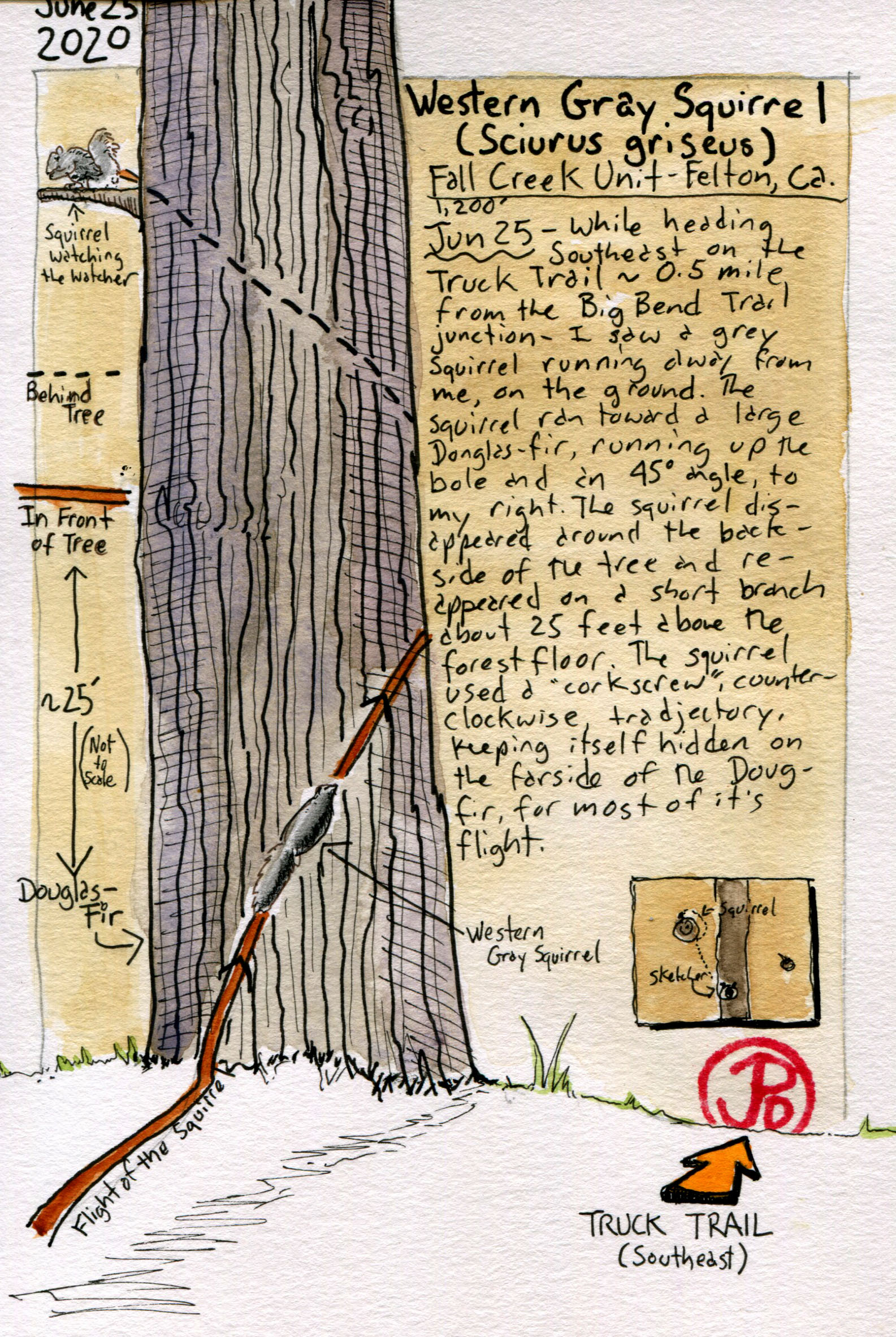
As I was headed down the Truck Trail (named I assume, because you could drive a truck on this wide fire road) I noted a western gray squirrel on the ground off to my left. When it saw me, it does what most arboreal squirrels do: head to the nearest tree. In this case it was a Douglas-fir. I noted that he squirrel did not head straight up the tree. Instead it corkscrewed up the bole at a 45 degree angle, keeping the tree between itself and the threat (me). It appeared on a short branch about 20 to 25 feet above the ground and observed the observer.
Now this squirrel is common species in Redwood/Douglas-fir forests but because I was present and open to nature, I wondered why this behavior benefits the squirrel. Was this a latent response to hunting? How would the squirrel react if the threat came from above, like a red-tailed hawk or great horned owl? I may not have any answers but it always pays to question nature because the answer always make sense, even if we cannot quite figure them out.
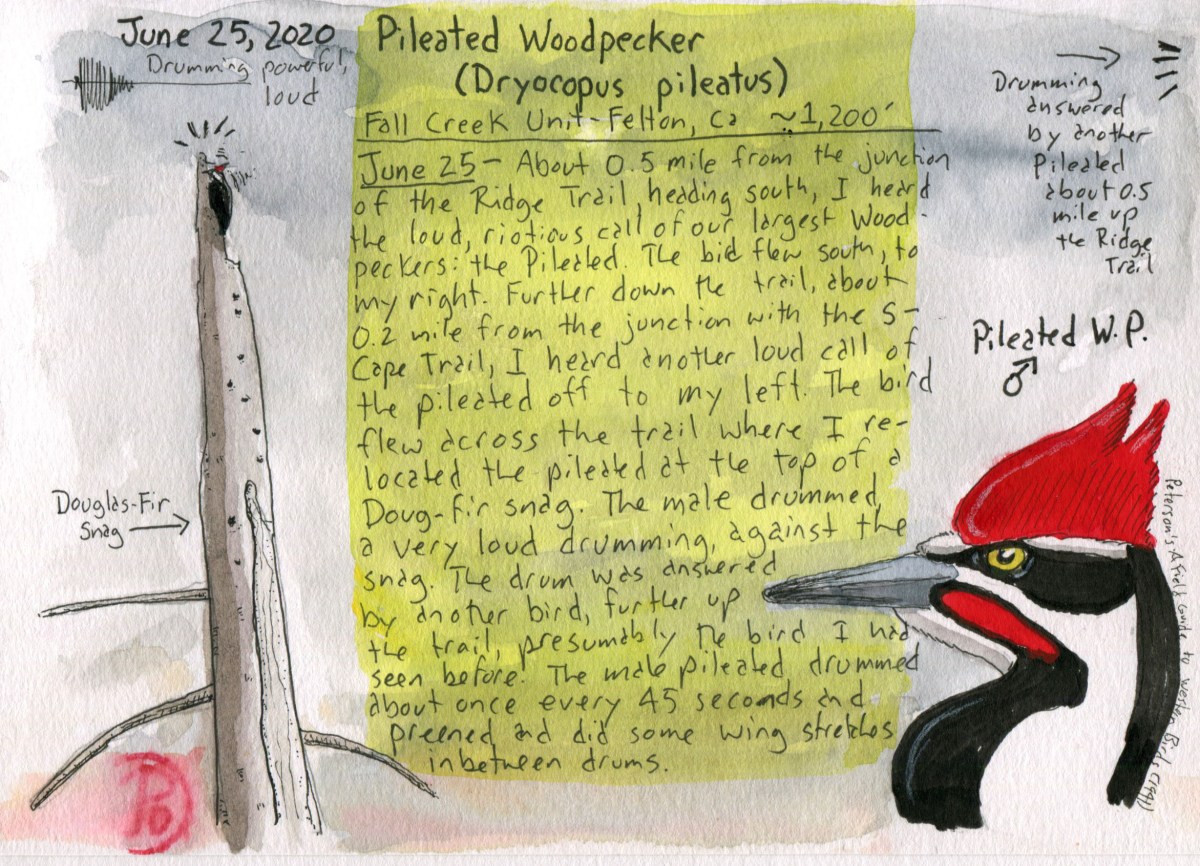
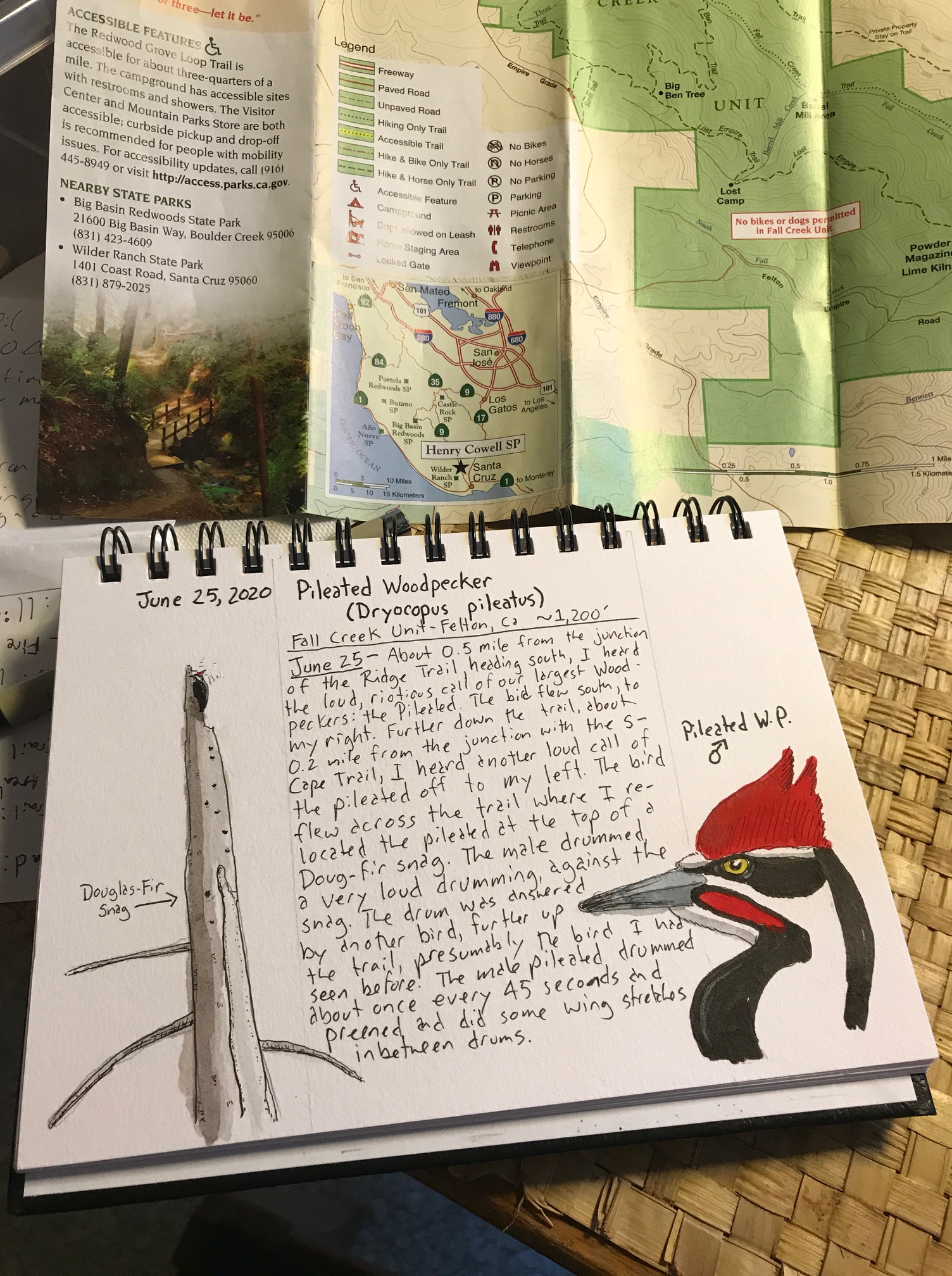
The Truck Trail turns to the left and the Ridge Trail begins. About 0.5 of a mile down the trail I heard a must sought after bird. I heard the raucous almost prehistoric call of the pileated woodpecker. I got a brief look of the crow-sized woodpecker as it flew south down the tail.
Further down the trail I had an even better sighting. Another pileated flew to a Douglas-fir snag near the trail. The male stayed at the top of the snag and started drumming. Woodpeckers drum as a way to communicate with other woodpeckers as a way to proclaim territory and also to attract a mate. The pileated’s drum is powerful and loud. The male’s drumming was answered by the drum of another, presumedly the other pileated I had seen further up the trail.
These two sketches where not done in the field. The sketch on the left was from memory and the portrait of the pileated is from a Peterson’s A Field Guide to Western Birds (1941).
“To enter a wood is to pass into a different world in which we ourselves are transformed.” ~Roger Deakin, Wildwood: A Journey Through Trees
When a sketcher is in the woods it’s hard not to sketch trees.
There is something special being at the base of a coast redwood and looking at it massive bole which would take an extended family, with linked hands, to encircle the circumference.
Looking up, following the redwood to it’s crown is literally a pain in the neck! Coast Redwoods, after all, are the tallest trees in the world.
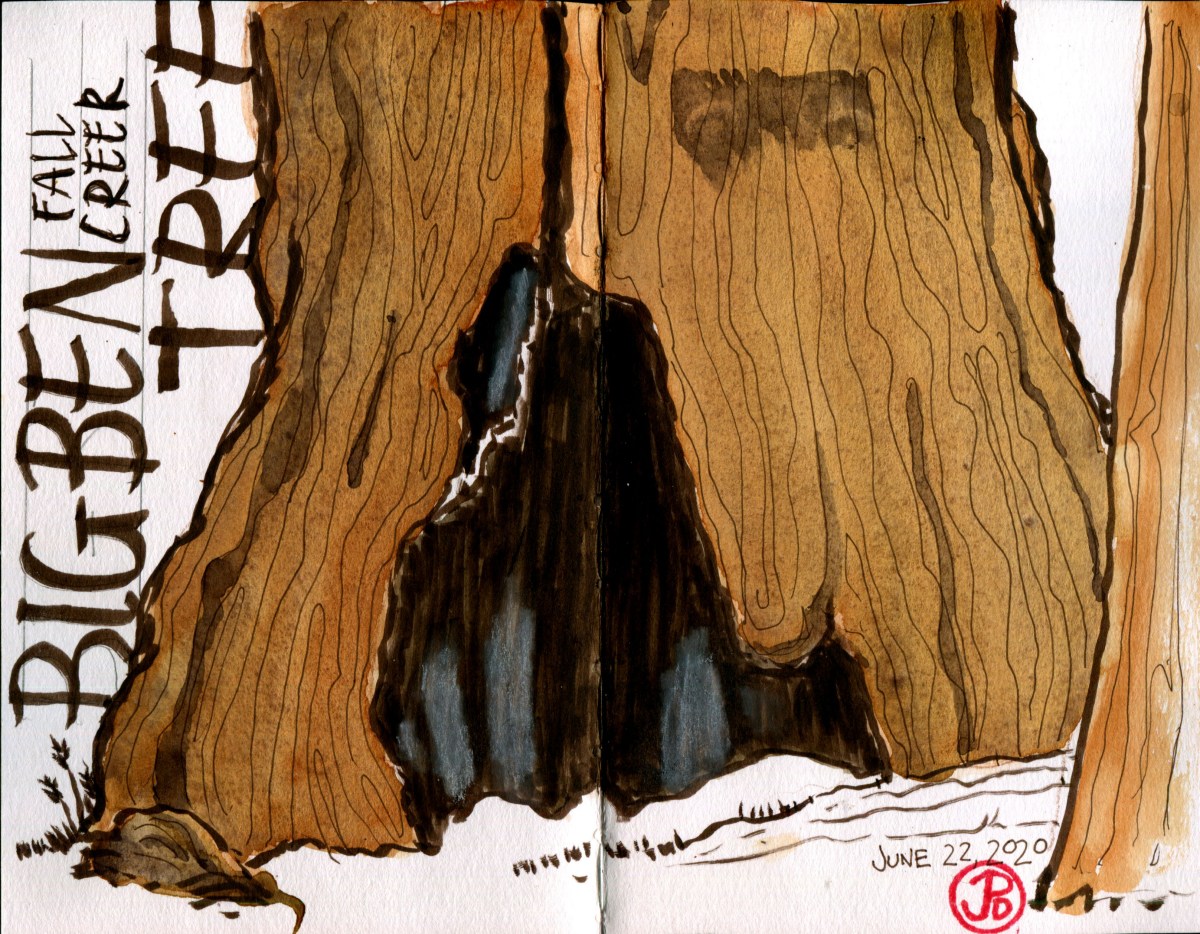
On a Monday morning I hiked out and sketched an impressive specimen of Sequoia sempervirens in Fall Creek State Park, a redwood named the Big Ben Tree.
The Big Ben Tree is a giant amongst many second growth redwoods. The tree stands at one if the highest points on a hiking trail in Fall Creek.
From the trail junction, the tree is impressive. I walked around to the other side and the massive bole was scarred by fire, perhaps many centuries before. Here I wanted to sketch this scar, a record of the tree’s history. Redwoods can live to 1,500 to 1,800 years. They do have a long life line; a very long history.
Sketching is a language that is created over a series of experiences. I have sketched redwoods many times and over time, I have gotten to understand their language. Their shape, mass, contour, and there undefinable essence. This helps me create an artistic shorthand to render the infinite, finite.
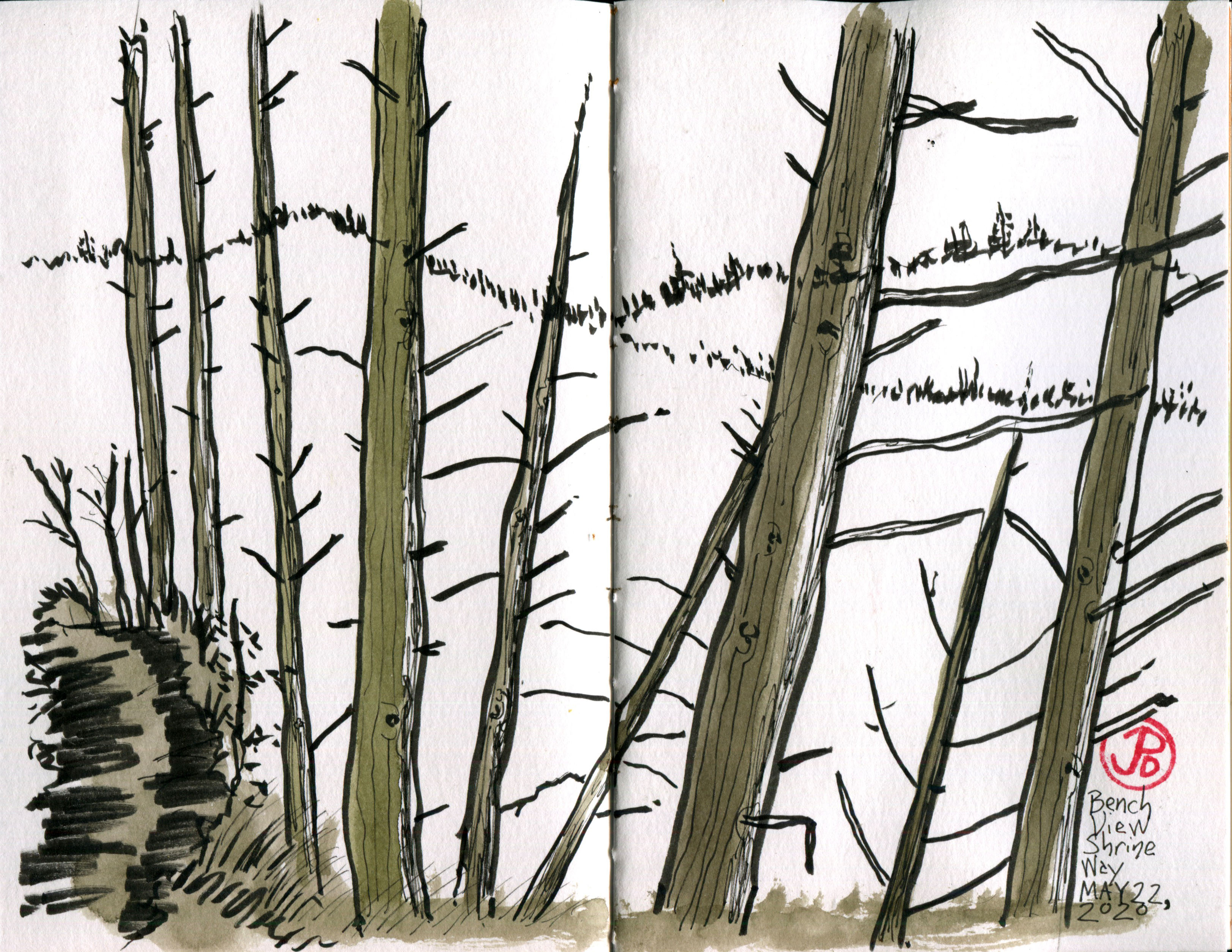
A bench view sketched of mixed woods of redwood and Douglas-fir from the end of Shire Way.
Most of my sketches start with graphite (pencil) but soon disappears under ink work and watercolor and any stray graphite lines are erased.
My generation is very familiar with graphite in the form of the Number 2 pencil used to shade in answer sheets on standardized tests in school. An HB pencil is the equivalent to the old school Number 2 (I really shouldn’t say “old school” because the Number 2 pencil is the go-to pencil for my students today). The HB pencil is usually the first pencil I start with.
It was time to sketch with a form for drawing stemming from the 17th century. This form of mark making was given it’s name in 1789 by a German Mineralogist named Abraham Werner. Graphite comes from the Ancient Greek graphein, meaning to write or draw.
Sketching in graphite and painting in watercolor bears some similarities. Both conveys depth through the building up of layers and use the white of the paper for highlights. But graphite is much more forgiving, you can erase your mistakes in graphite and you can’t in watercolor. The nuances of blending the graphite with a blending tool such as a blending stump or tortillons, make etherial and realistic tonal transitions.
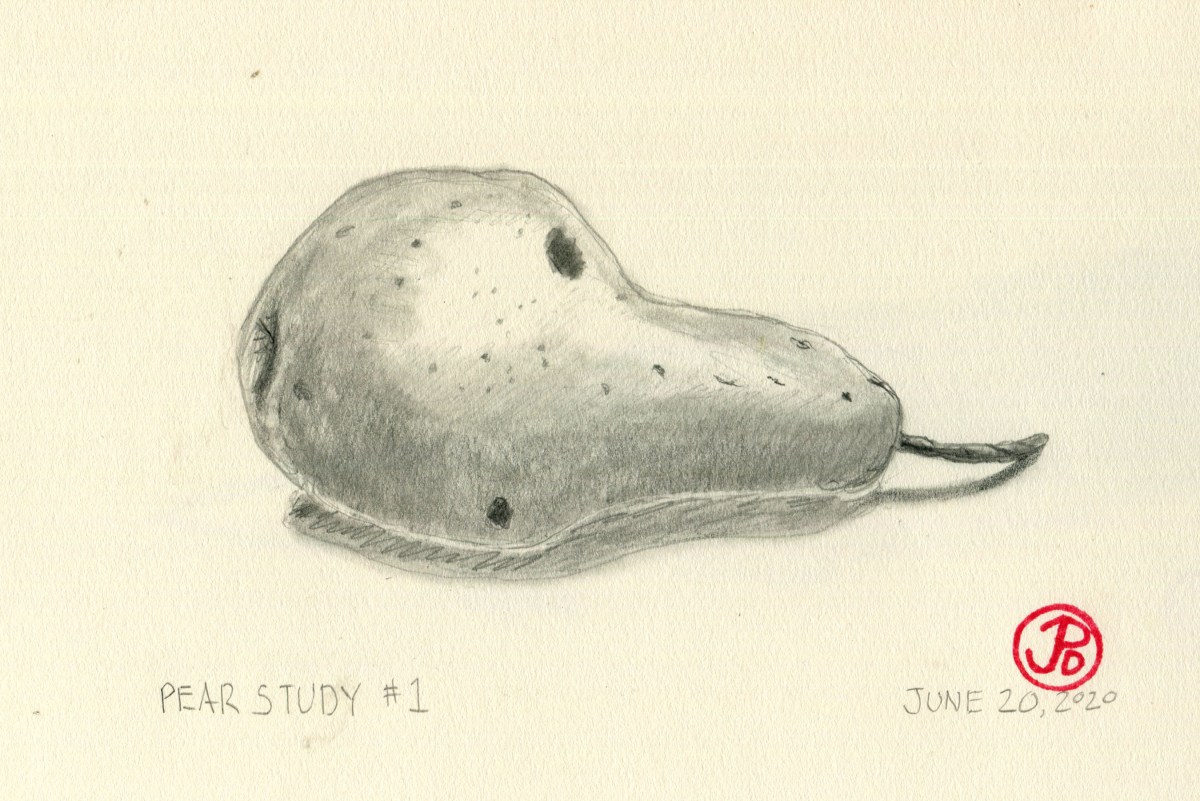
Now that Palace Arts was now open after three months, I headed over to Capitola to pick up some graphite drawing tools and drawing paper. On the way back to the cabin I stopped at Whole Foods to pick up two Bosc pears, not to eat, but to draw.
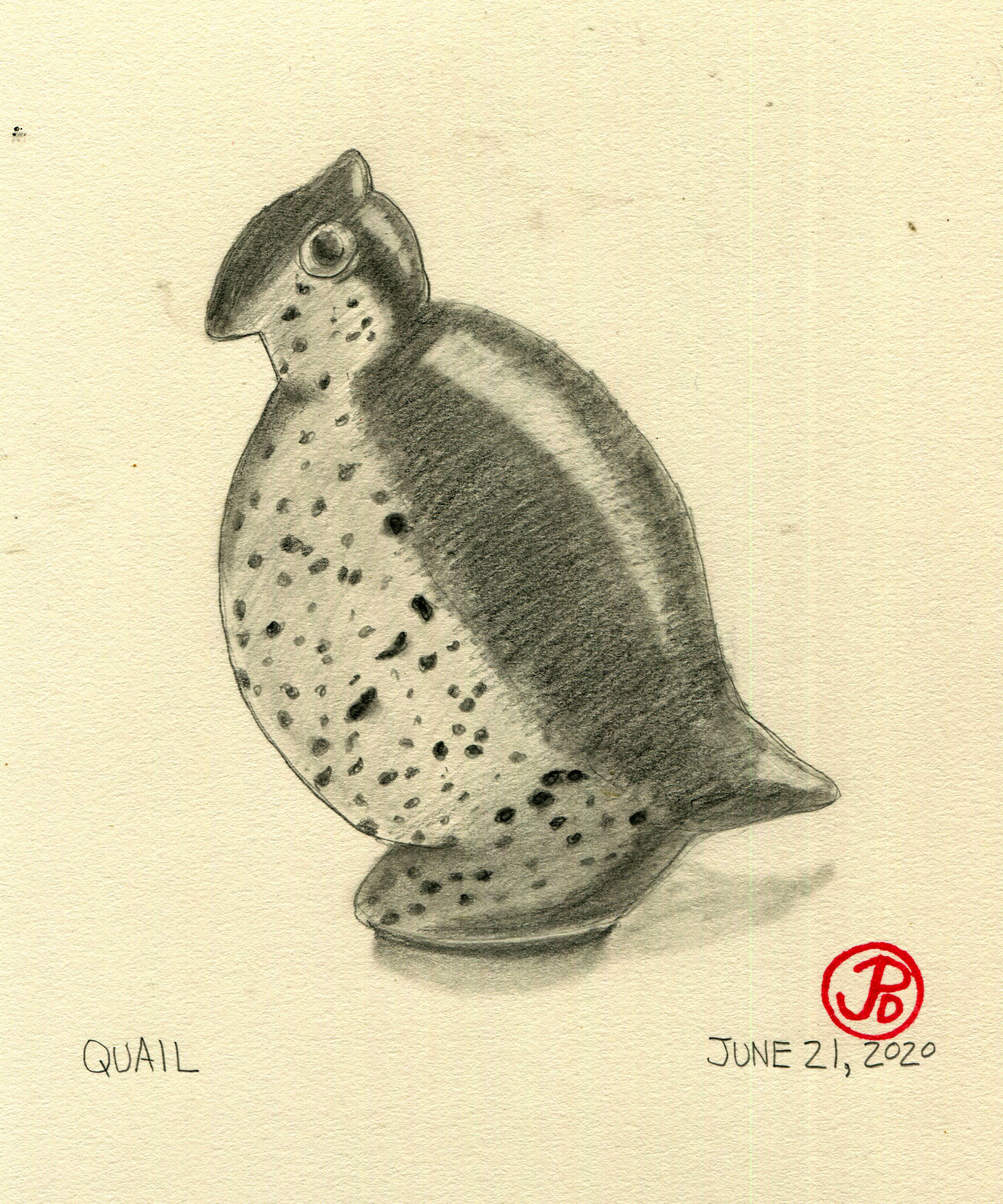
A graphic sketch of a quail sculpture that my grandma collected, I often hear the “Chicago” call of California’s state bird: the California quail from my deck.
Along the Santa Cruz coast, just northwest of Natural Bridges State Beach, is a historic relic that is just shy of 100 years old.
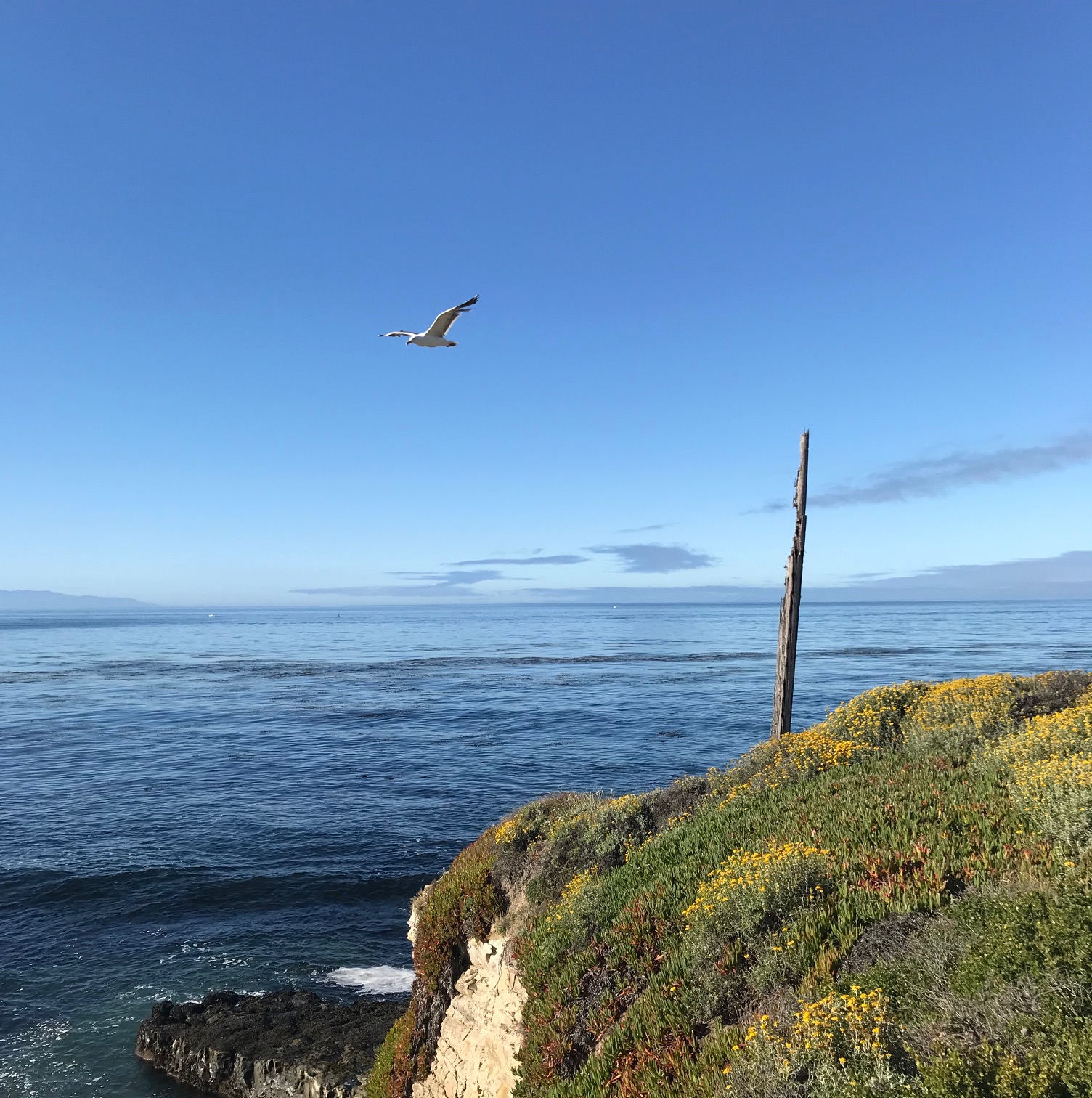
It looks like a weathered flag pole that is leaning slightly shoreward, placed on a cliff above the rocky reefs. In reality it is the mast of the 72-foot freighter La Feliz, leaning against the cliff.
On the night of October 1, 1924, violent waves pushed the coastal freighter onto the rocky reef below where the Seymour Center at the Long Marine Laboratory (temporarily closed) now sits. Locals helped rescue all 13 crew members from the floundering ship.
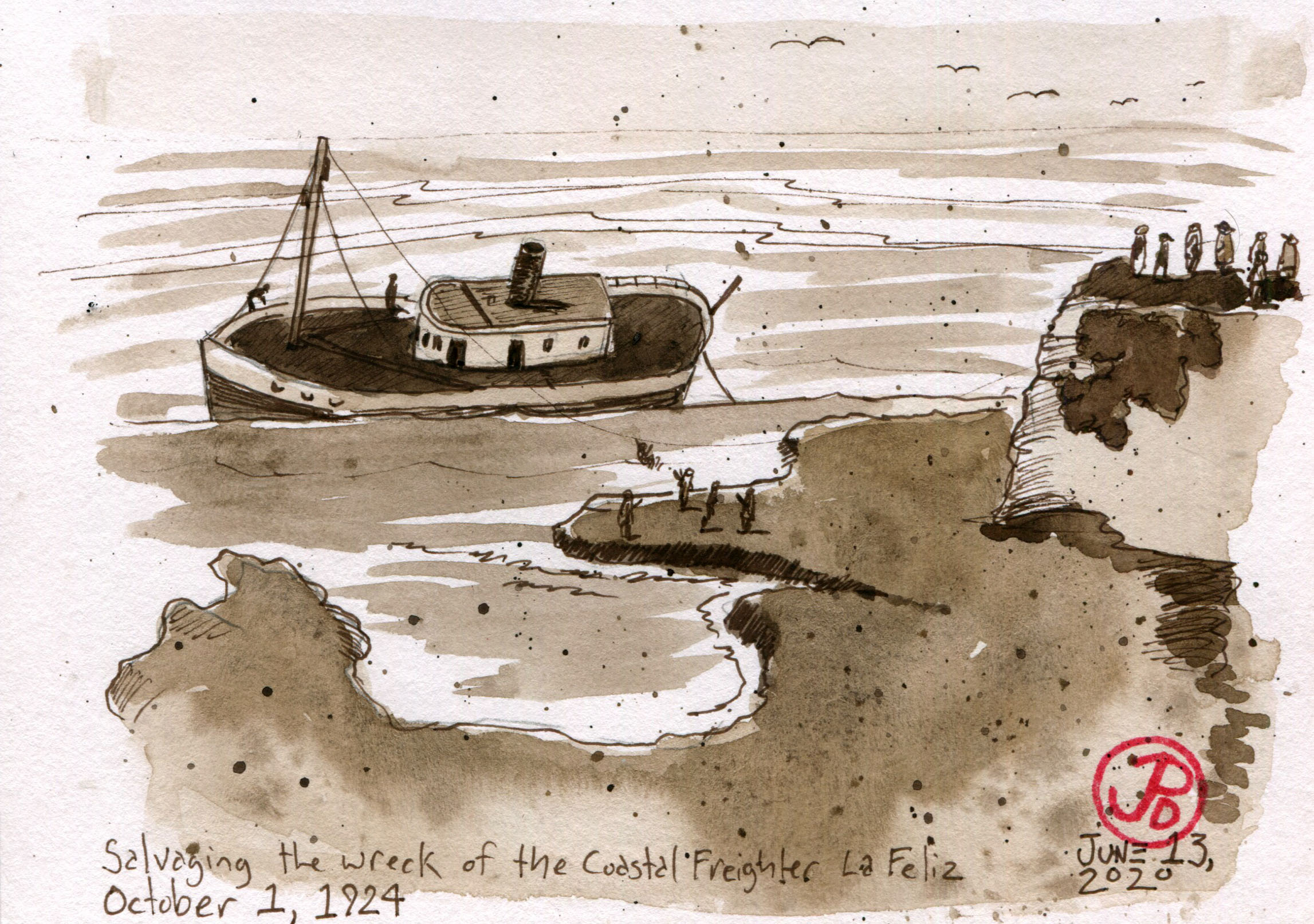
Sketched and painted in sepia from a period photograph of the salvage of the La Feliz.
The mast was laid against the cliff in order to salvage the cargo and other equitment of the La Feliz. The cargo consisted of 3,100 cases of sardines from Cannery Row in Monterey.
There have been over 450 shipwrecks recorded in the Monterey Bay National Marine Sanctuary. Few relics of these wrecks exist today, except for the La Feliz auxiliary mast.
A beautiful Sunday morning, looking to the Northwest.
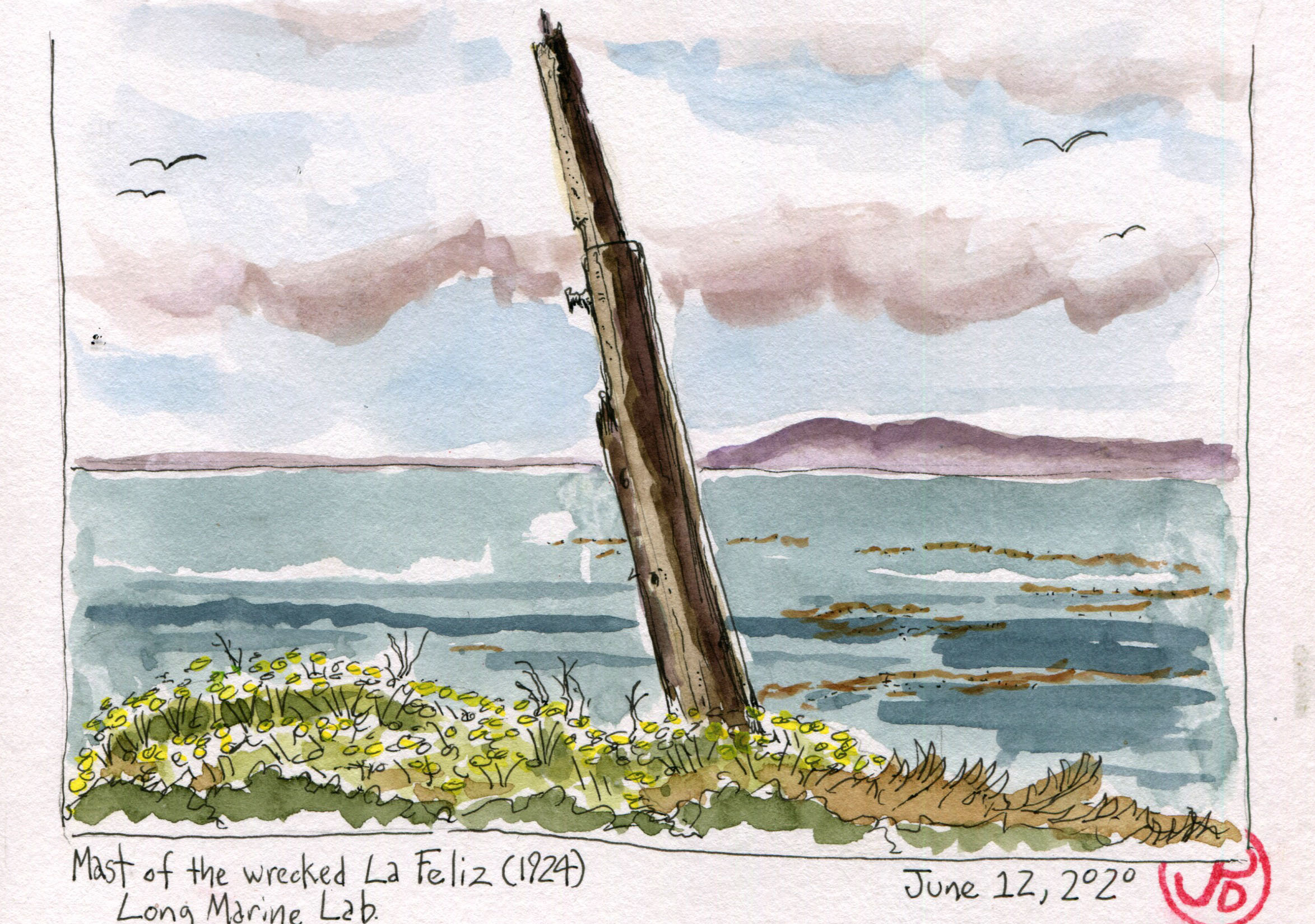
I did what I always do when I want to learn more about something, I sketch it! I hiked out to the mast on two different occasions and sketched it both times. It is always nice to sketch something more than once. I feel each time that I understand the subject at little more and each time I learn more and more about the mast of the La Feliz.
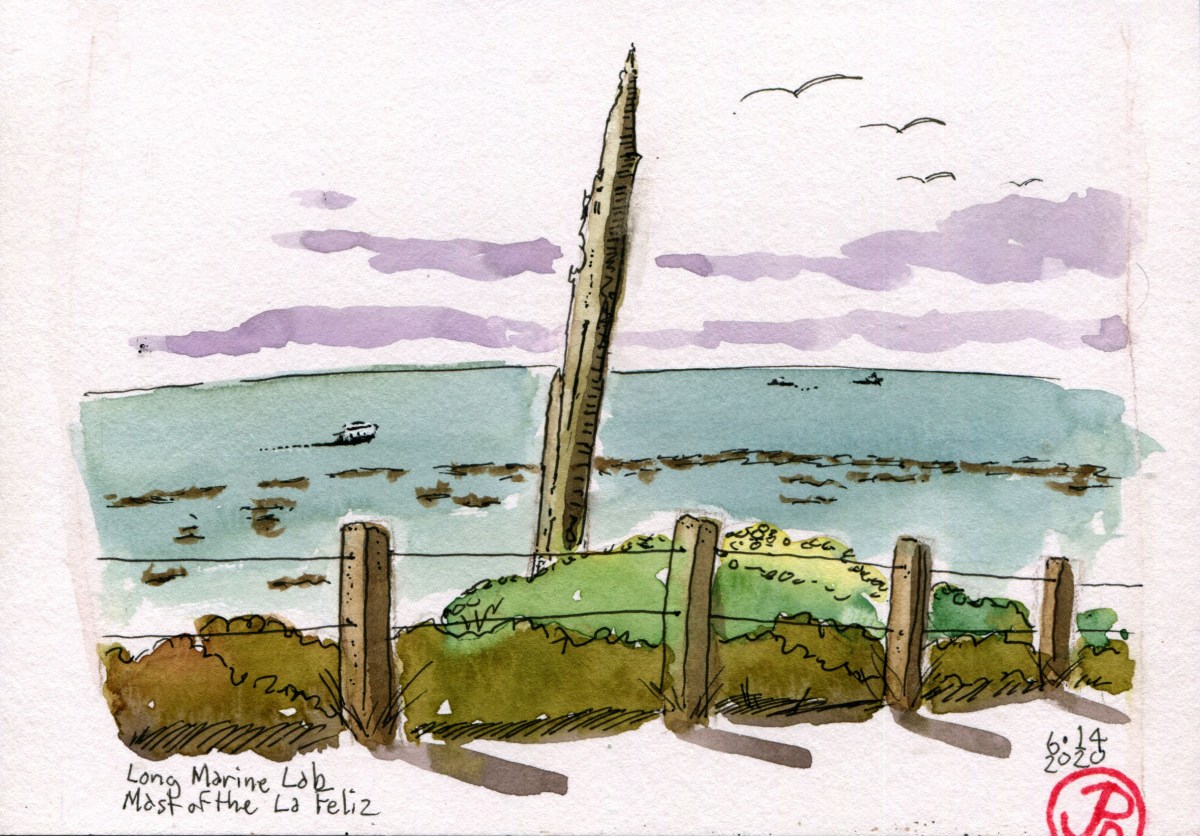
A Friday after work sketch of the mast of the La Feliz, looking south.
For my first sketch of the mast, I first drew with pencil them inked in the lines with a Uni-ball Micro Deluxe pen. I erased the pencil lines and then added watercolor the scene.
On my next sketch (featured image) I did the exact opposite. I loosely sketched in the scene with a water-soluble colored pencil (walnut brown) and then I painted the scene, letting some of the watercolor washes run into each other. Once the paint dried, I added ink lines with my Uni-ball. Both were sketched on location.
It’s not easy bein’ green It seems you blend in with so Many other ordinary things And people tend to pass you over ’cause you’re Not standin’ out like flashy Sparkles on the water Or stars in the sky
~Kermit the Frog
In the past I have always used green straight out of the tube for my watercolor paintings. I usually use Sap, Hooker’s and Olive green.
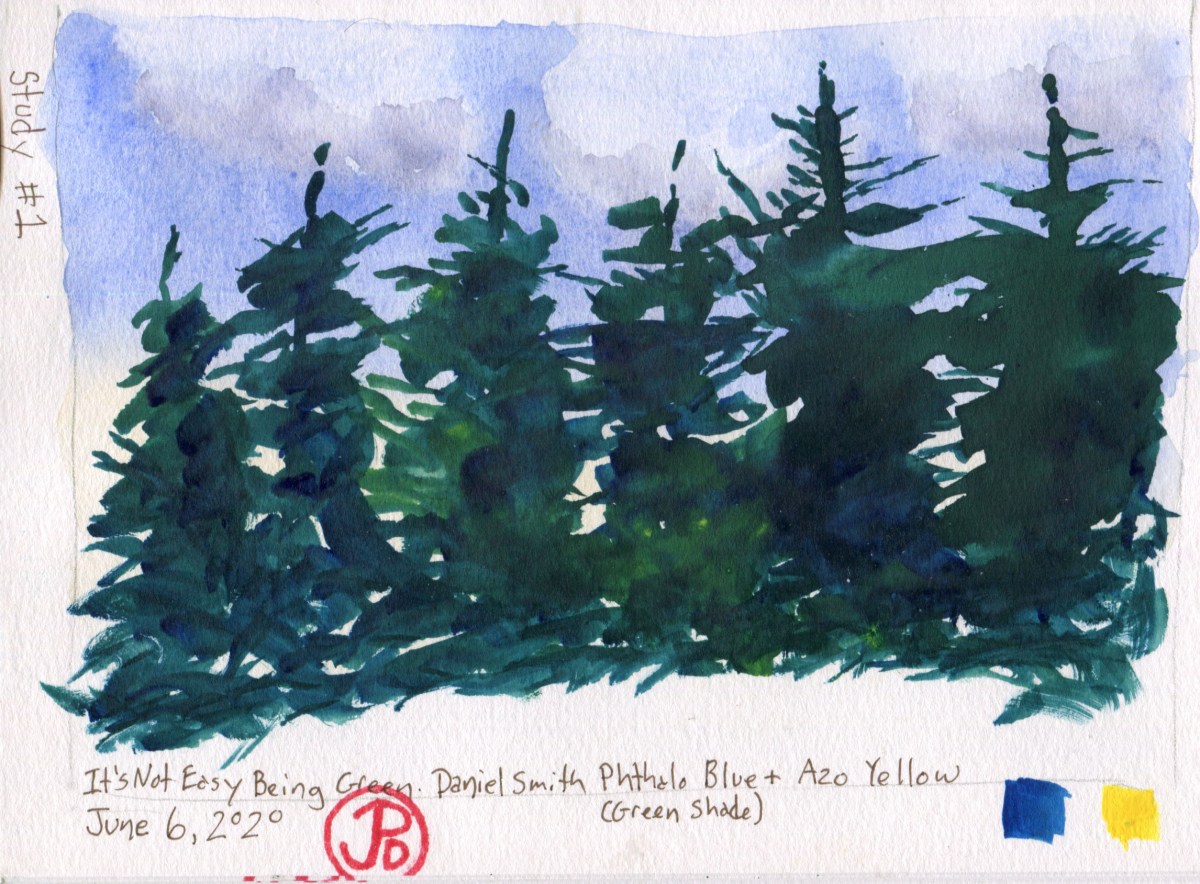
Sometimes these greens can look too intense and at other times, too plastic. I wanted to try mixing greens and doing test paintings using a confer tree line against a cobalt blue sky.
To mix green you combine blue and yellow. And there are lots of blues and yellows to choose from. For instance, Daniel Smith lists almost 20 different Yellow and Blue hues. Now I was going to do a little watercolor alchemy on my quest for a green.
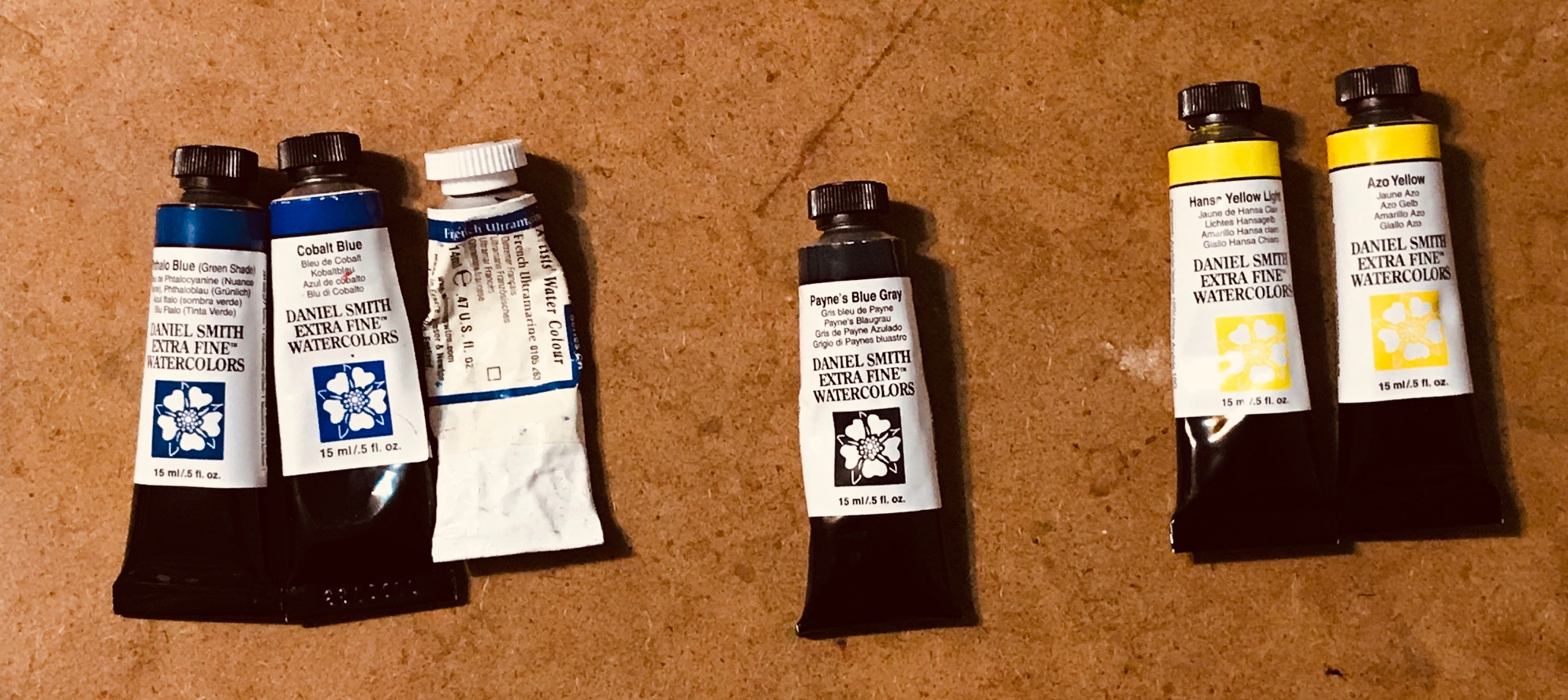
The watercolors I used for mixing green: (from left to right) Daniel Smith Phthalo Blue (Green Shade) and Cobalt Blue, Winsor & Newton French Ultramarine, Daniel Smith Payne’s Blue Gray (to darken mixes). For Yellows I used Daniel Smith Hansa Yellow Light and Azo Yellow.
I painted in a background sky with cobalt blue and then mixed blues and greens to make a green mix that I painted with a 3/4 inch flat brush create a conifer tree line.
By far my favorite mix is shown in the featured image. It is with the very potent Phthalo Blue (Green Shade) and Azo Yellow. I left varied mixtures of each hue, sometimes letting a bit of yellow dominate and letting the Phthalo blue take over in the shadows.
Around my cabin there is a gardener that eats weeds. At a slow but steady pace. And dead weeds at that.
There are a few slugs that favor the steps, entry way, and pathway to the cabin. This is the second largest slug in the world, growing up to 9.8 inches (25 centemeters) long. And one of the world’s slowest animals, moving about 6.5 inches a minute. This is the California banana slug Ariolimax californicus.
Their slow pace means that are easier to sketch than the other animals around the cabin such the hyperactive Wilson’s warblers or the violet-green swallows that are always on the wing or the common mergansers that seem to disappear underwater as you are about to put pencil to paper. When sketching banana slugs you can take your time, they’re not going anywhere, anytime soon.
As I was going for a noon time walk, the local banana slug was climbing up the front steps, so I headed back in and got my sketching things. Oddly enough, the slug was still where I found it (banana slugs are hermaphrodites and prefers the pronoun “it”).
A banana slug on the front steps. I sketched this slug.
I am an alumni of the University of California at Santa Cruz. This youthful university (founded in 1965) was built on land that Henry Cowell donated to the state of California; a land in the moist forests of Douglas-fir and coast redwood. This is the ideal habitat for the banana slug.
The University’s chancellor supported name “Seal lions” as the mascot of the University but this was slowly overruled (in slug time) by a strong and determined student body that eventually caused the banana slug to be adopted as the UCSC’s mascot.
Now when I return from my walk, I always look down as I head towards the front steps and I see the two banana slugs on their patch. One is about twice the size as the other and I’m not sure what the relationship is between the two but I am glad to see them, slowly munching away at the weeds that line the pathway.
In the last post I was reexploring the Old Ways, hikes and routes that I had travelled years ago, a pathway of the mind as well as the soil.
On the Saturday of the Memorial Day weekend, I decided to do the Big Loop, a route I had hiked with my friend Erik, at least 30 years ago when we were both much younger, full of confidence, and much closer to birth than death. Now I would do the Big Loop solo.
The start of the loop was heading up Shrine Way and then hiking up Powder Mill Creek. I had done this hike the week before but I had stopped at the falls, pausing to sketch and then turned back. But not today. Today I was going to scale the waterfall.
I’m sure in my 20s, climbing this three-tiered waterfall didn’t cross my mind as something that could be dangerous. I thought no more about the challenge than breathing. But now, the night before the hike, I knew that this was going to be the most challenging and technical part of the journey.
The three pitches required some unaided technical climbing. I had confidence in my climbing ability having spent hours in the climbing gym (a few years ago) but climbing outdoors certainly provides other challenges. The challenge on this route was that the rocks were wet and in some places I would be climbing in the waterfall. Here I was not roped in. A fall from one of the waterfall pitches probably wouldn’t kill me but it could introduce a bit of maim into my life. And I would have no one around to help me out to safety in the event of a fall, midway between the cascade.
These thoughts went through my mind as I headed up Powder Mill Creek. I reached the bottom of the falls at 8:15 AM. While the sky was clear, in the cold shade of the canyon, it was cold.
I folded up and stowed my trekking poles, bowed to the creekside alter, and started up the first pitch of the climb on the right side of the lower falls. Just to get to rock, I had to struggle through a fallen branch tangle to get a hand and then foothold on rock.
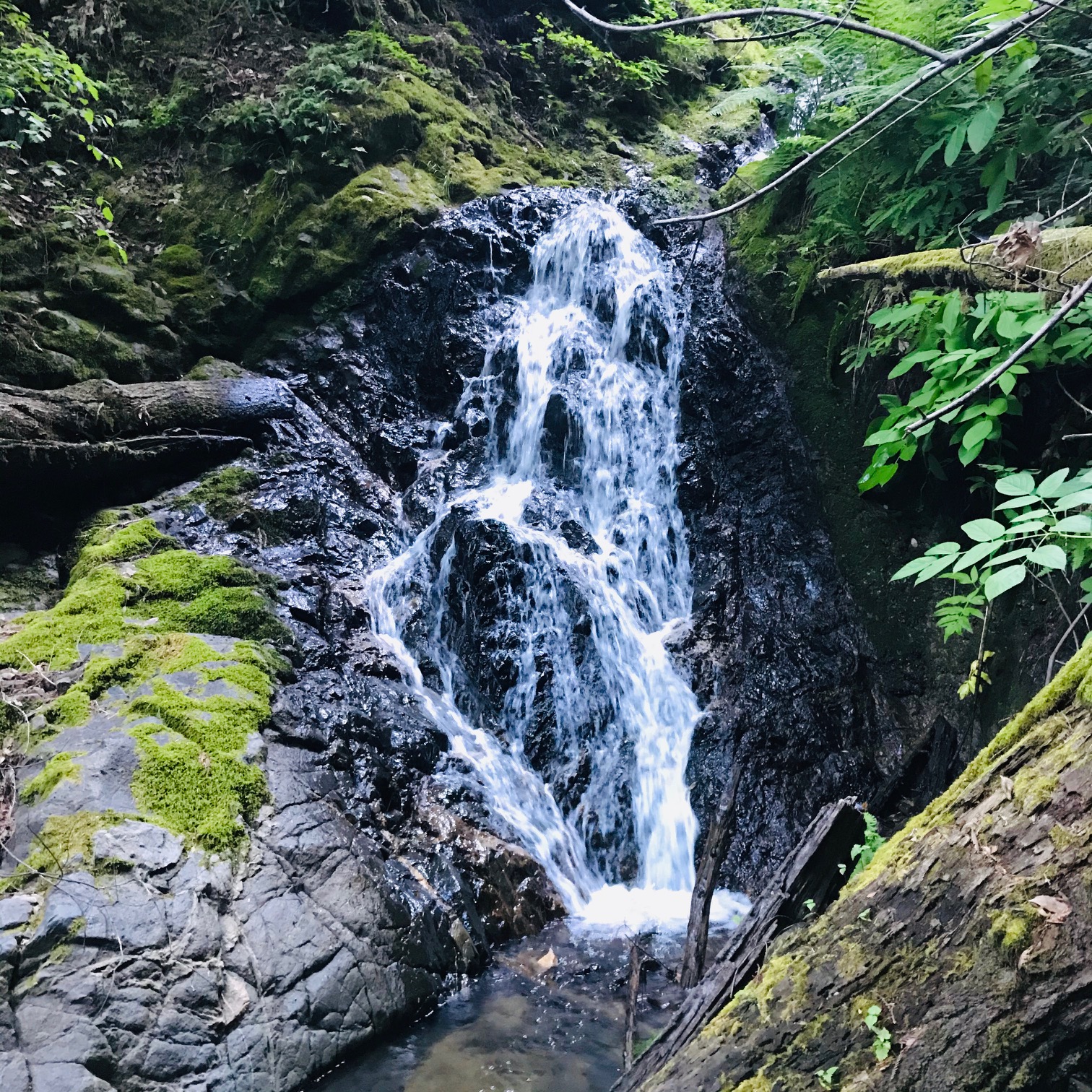
I methodically completed the first pitch, no need for speed climbing here. I was rewarded by the beautiful middle falls, which fell into a pool, surrounded in luscious greens.
The middle cascade of Powder Creek Falls. I paused here to catch my breath and did a brush pen sketch. On this pitch I climbed up the wet and mossy rock on the left side of the falls. The height of the middle falls was abut 15 to 20 feet.
Once up the middle falls I came to the final upper falls. This was the last technical part of the journey and once this was behind me, I could really get hiking. With each pitch I was gaining confidence as I understood the rock more and more.
It is all about keeping three points of contact with the rock. I read the rock, looking for the best hand and footholds. Often times, young trees where perfect handholds as I looked to place a foot in a position to raise me upward towards the point where the watershed flattened out.
I had made it, the toughest part of the journey was now behind me! Now the creek canyon flatten out and the only challenge now was climbing over or under fallen redwoods and not fully immersing my feet in creek.
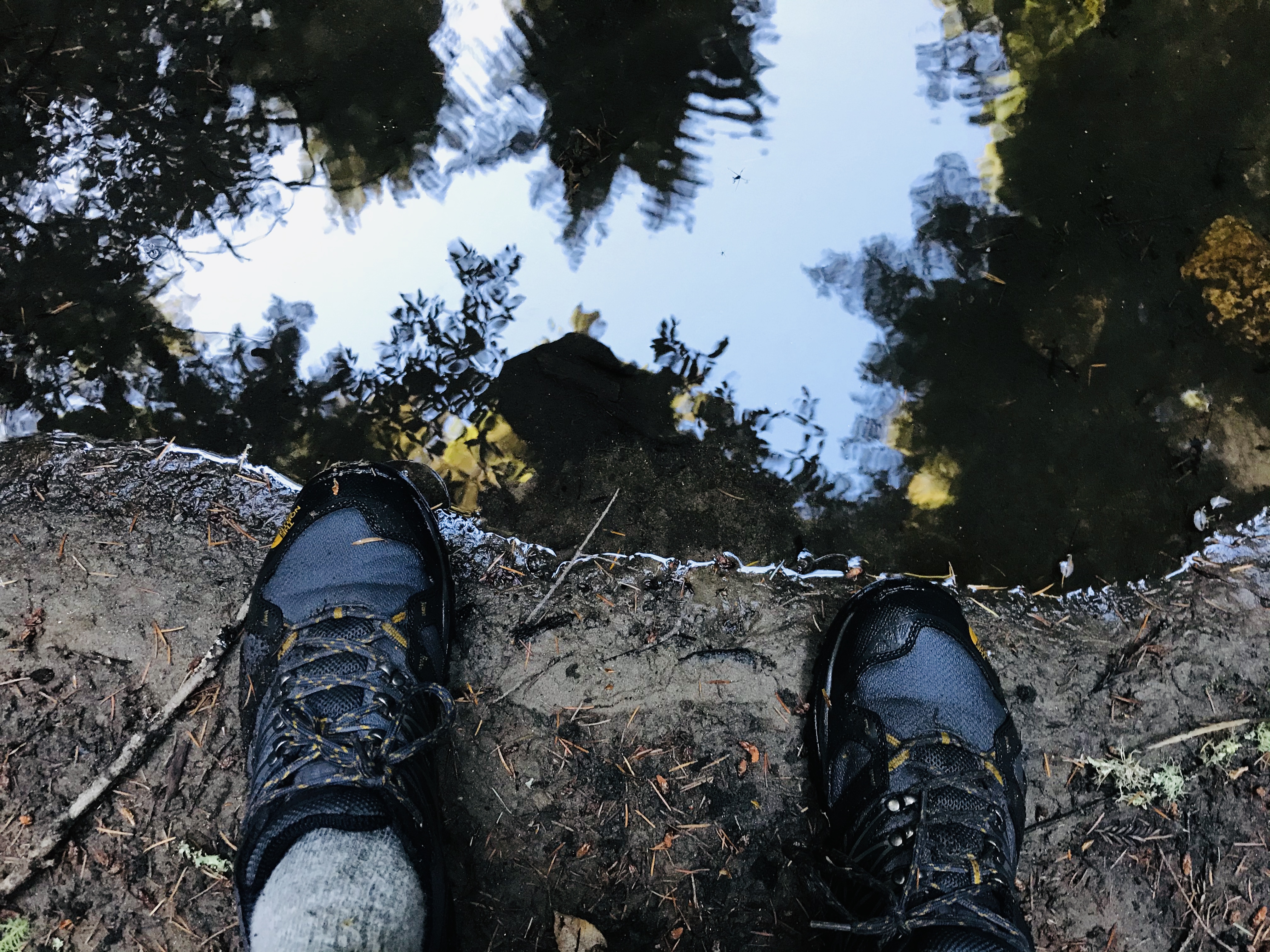
Since I was a boy, I can never get close to water without getting wet. On the Big Loop I grabbed a fallen log that proved not be as secure as I thought and before I knew it, I was up the creek and in the creek! I know myself and my attraction to water well, so I came prepared. I had packed an extra pair of socks.
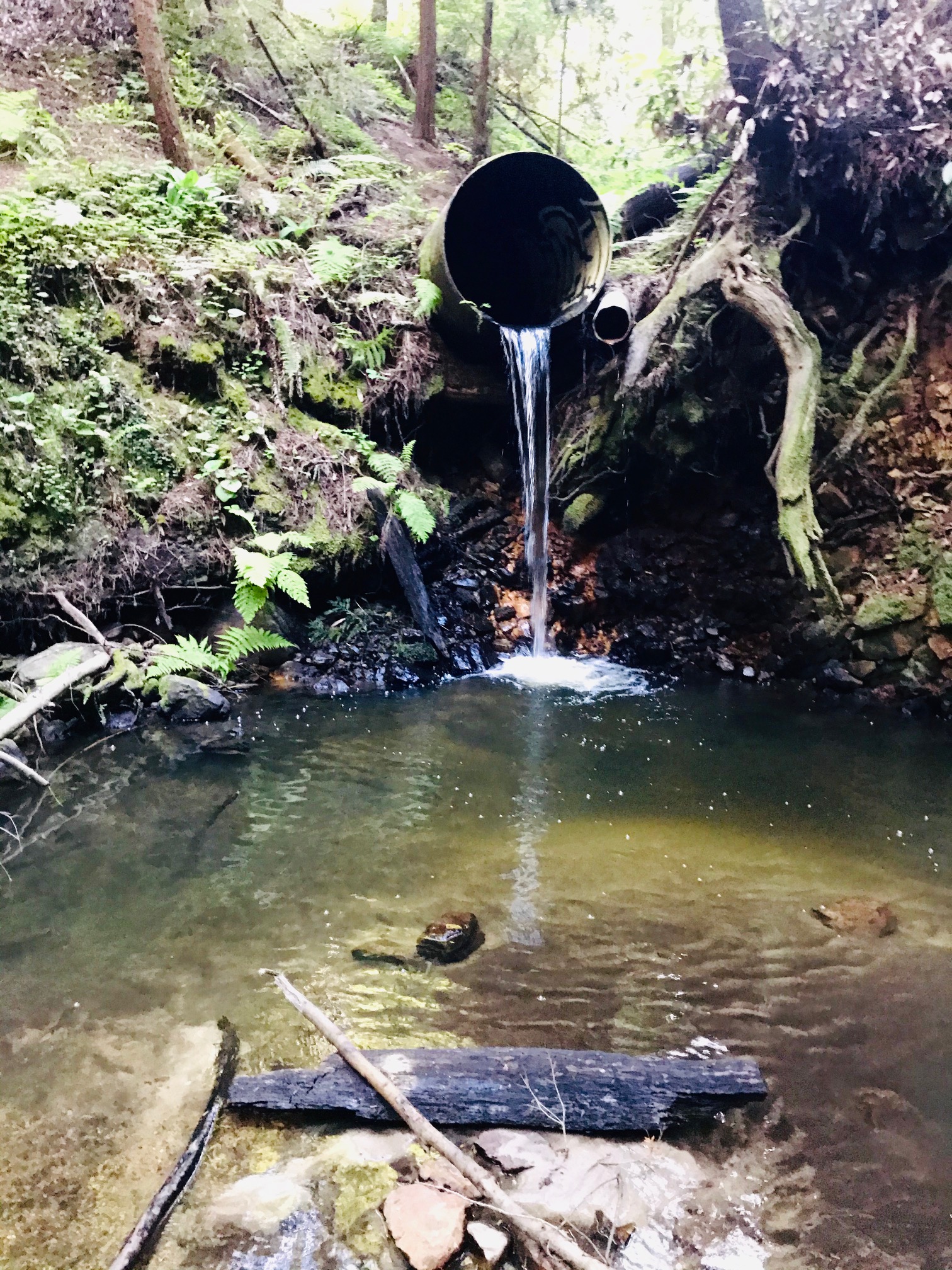
The whole hike, from the base of the lower falls to Pipeline Road, was perhaps just under a mile. I covered the distance in 25 minutes. The romance of the wild Power Mills Creek is dashed when you come to the point where Pipeline Road in Henry Cowell State Park, crosses over the creek. The creek is routed under the road in a pipe and falls out the other side into a pool.
I scrambled up and out of the creek on to Pipeline Road. I was now in Henry Cowell State Park. Pipeline is a paved road, a much different substrate than what I had just traversed. I not headed northwest up the road.
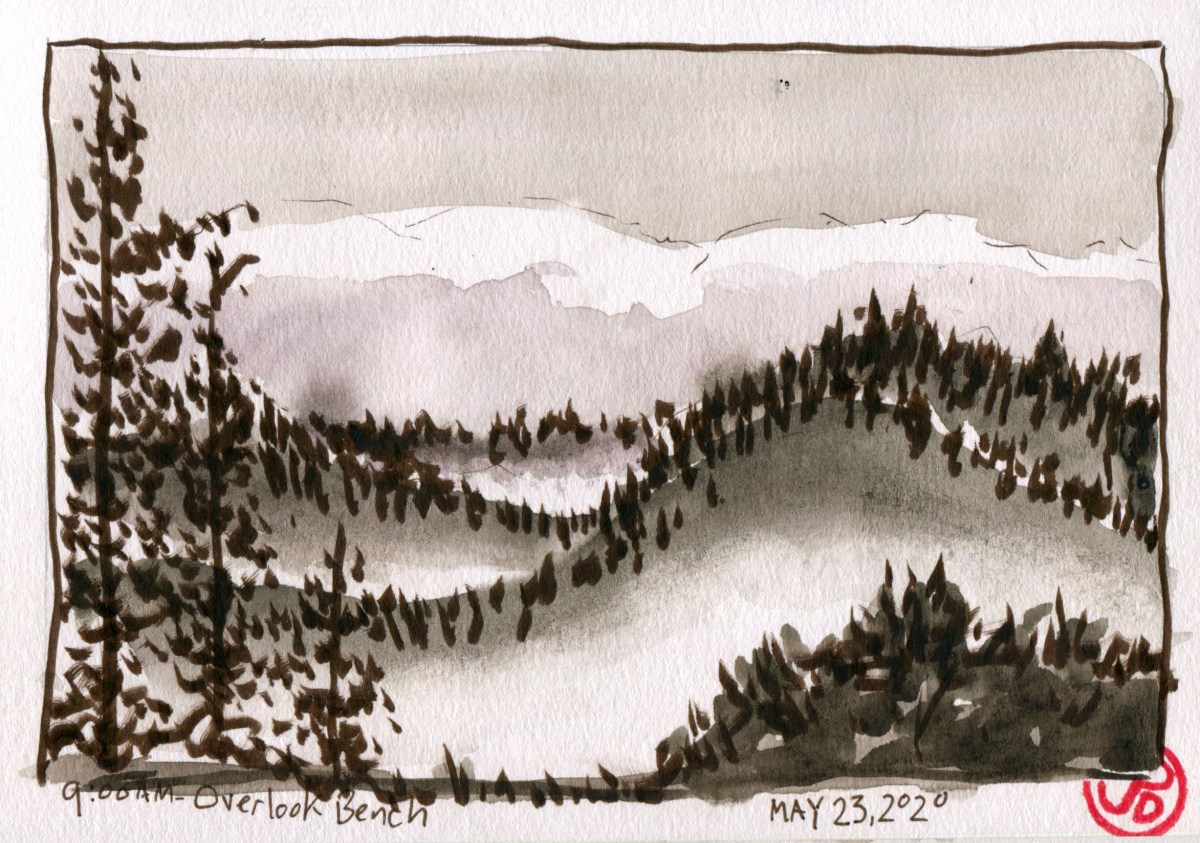
Twenty-five minutes later I was at the Overlook Bench. At this viewpoint you look out to south with wooded ridges overlapping wooded ridges giving way to the flats of Santa Cruz with the Giant Dipper roller coaster silhouetted against Monterey Bay.
I pulled out my Stillman & Birn Beta Series spiral sketchbook and sketched in the view with my sepia brush pen (featured sketch). This finished sketch has a Japanese feel to it, reminiscent of the sumi ink paintings of Japanese-Californian artist Chiura Obata.
To complete the loop, I continued northwest along Pipeline Road, off on a hiking trail to Cable Car Beach (where I swapped socks) and then along the River Trail to the 1909 Railroad Trestle which I used to cross the San Lorenzo River and then back south along the railroad. I passed over Coon Gulch with the osprey nest on my left. At this point I was about 40 minutes from my cabin.
I completed the Big Loop in three hours and 40 minutes. This included a few snack stops and sketches and a chinwag with a ranger who was guarding the entrance to Garden of Eden Beach from the hordes of three-day weekenders.
“No hay camino, se hace camino al andar” -“there is no road, the road is made by walking”. ~ Antonio Machado
As an omage to Robert McFarlane’s incredible book, The Old Ways: A Journey on Foot, I decided to revisit some of the old pathways traveled both by my father and my younger self.
To connect, once again, with the journeys on foot, made me feel a part of the landscape as well all who had also travelled this way, the people and the deer and mountain lion. These were the tracks that marked the land like the slime trail of the banana slug, weaving it’s way, often finding the path of least resistance.
The previous Friday I headed out of Paradise Park along the fire road to the railroad grade. This was a route taken by my father and his friends when he was a teenager. He would frequently hike up to the old rock quarry, which is now part the campus on UC Santa Cruz. (It is the quarry where my graduation ceremony was held). I’m sure he also hiked upstream, as I did, toward Henry Cowell State Park and the osprey’s nest.
Today afterwork, I wanted to hike up a water way to a waterfall. I had hiked up here, from my cabin, many times. Although it has been a while since I have hiked up Powder Mill Creek. My destination was Powder Mill Creek Falls, which was a short ramble up the creek.
From the very start of the hike, there is a clearly defined trail, but once you cross the creek it seems to be a “Choose-Your-Own Adventure” type of hike . There are no correct paths, it just depends on how wet you want to get.
I paused along the way to look at my favorite fern, the five-fingered or western maidenhead fern, (Adiantum aleuticum). This fern favors damp habitats usually near small turbulent streams. Native Californians use it’s dark veins to weave baskets.
The hike is maybe a quarter of a mile but it can be a tough scramble and progress is slow as I favored a methodical approach rather than a reckless bush-whack! (the path of youth). The way has been constantly reformed by the waterway and the trees that have fallen into the watershed, making the pathway ever changing and ever challenging. I was not traversing this old way in my youthful self but as a middle aged shelter-in-placer. This was the first time I had used trekking poles on this hike. I need all the points of contact I can get!
I made it to the falls and I love the feeling of arrival, like coming into camp after a long trudge with a 40 pound pack. I was here and I found a good vantage point and I do what all sketchers would do in my situation, I started sketching. I settled on using my sepia brush pen to keep things loose and bold. There was a lot to take in and I simplified the scene with ink strokes.
Try to keep it simple stupid. I succeed and fail in equal measures.
There is a price to pay with a bush-whack in the San Lorenzo Watershed on deer trails, and that was an unwelcome traveller, a deer tick, firmly attached to my left side. This was the first tick in almost 50 years to have found purchase on my flesh. A fair price to pay for a sketch I think.
One of my neighbors knew I was struck with the affliction of birding and told me about the osprey’s nest on top of a Douglas-fir along the railroad about a 30 minute hike up river from my cabin.
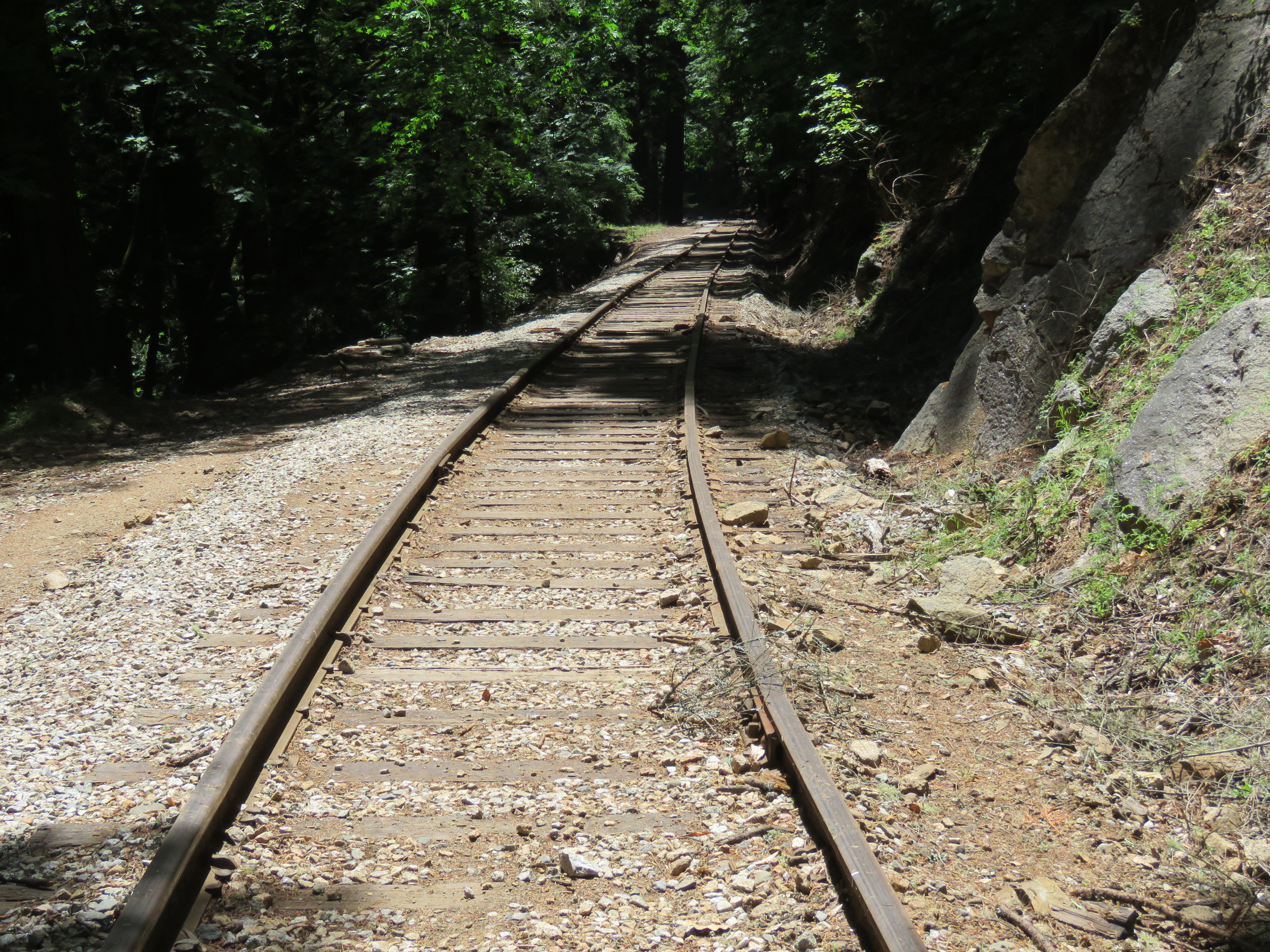
After work on Friday, I hiked out of Paradise Park via the fire road and scrambled up a deer trail to the even grade of the railroad. This railroad is now operated by the Santa Cruz, Big Trees and Pacific Railway and takes tourists from Felton to Santa Cruz Beach Boardwalk. At one time the railroad went over the Santa Cruz Mountains to Los Gatos but now does not go very far beyond Felton. I have hiked this railroad since my youth and it had been a few years since I played hopscotch on railway ties up the San Lorenzo Valley.
Walking along this rustic railroad always feels like I’m participating in a scene from Stand By Me on a quest to find a dead body. But in this case I was in search of a big bunch of sticks on top of a fir, high above the San Lorenzo River.
I kept one eye on the rails and one on the trees off to my right. My neighbor had given me good directions to the nest and when I was 30 minutes out of Paradise, I thought that maybe I had passed the nest. But how could I miss it? So I continued hiking upstream.
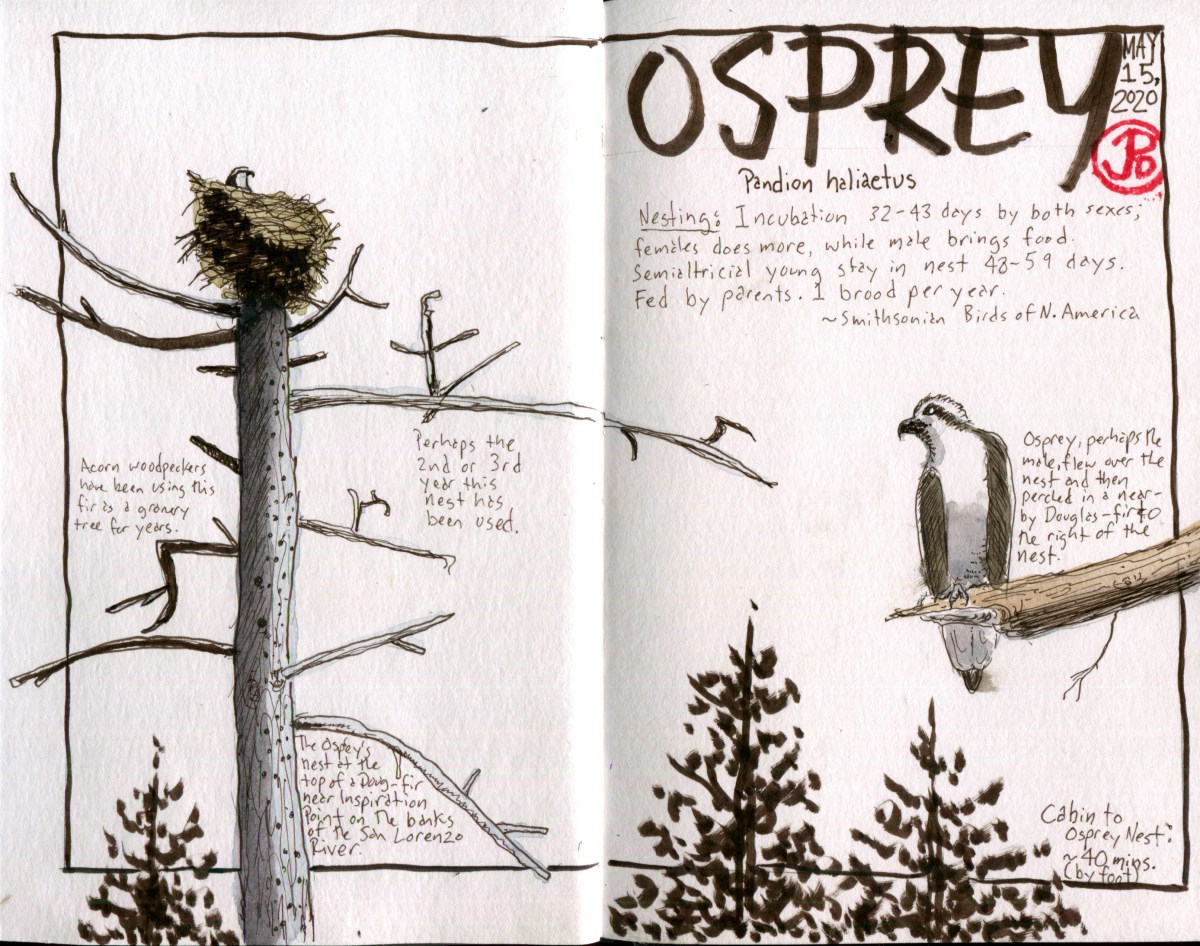
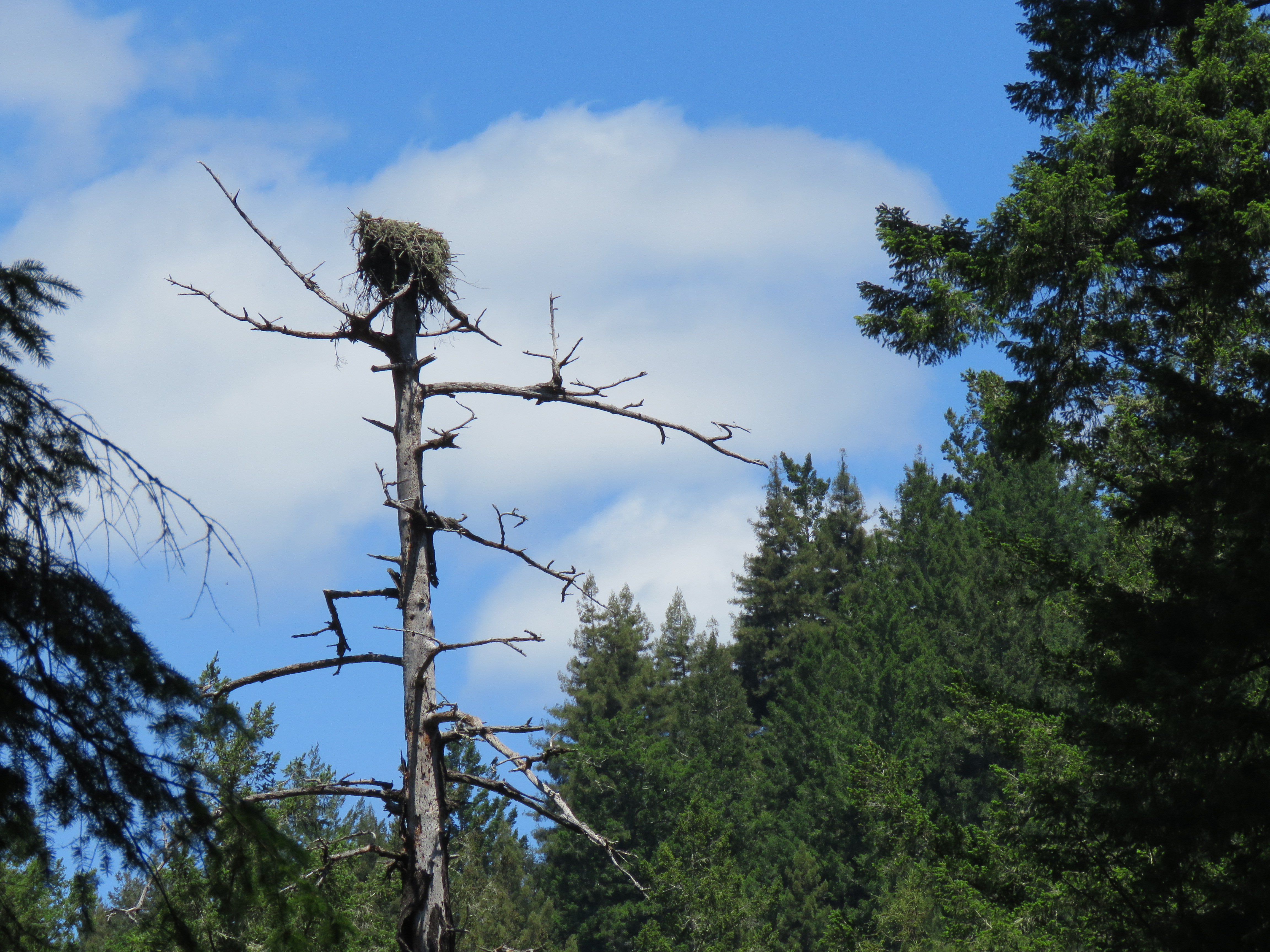
Ten minutes later the osprey nest appeared across the river between a break in the redwoods and firs. I put bins on the nest and could not detect any occupants. But osprey nests are deep and the osprey could be laying low. The only sign of life were the acorn woodpeckers that looked to have used the fir as their granary tree, their acorn larder, for years.
I was at a point in the line where the railroad curves gracefully over a curved viaduct. The concrete arched bridge was build by the Southern Pacific Railroad in March of 1905 and spans Coon Gulch. At this point the San Lorenzo River takes a turn and you can get an amazing view upstream. This point in the line is known as Inspiration Point.
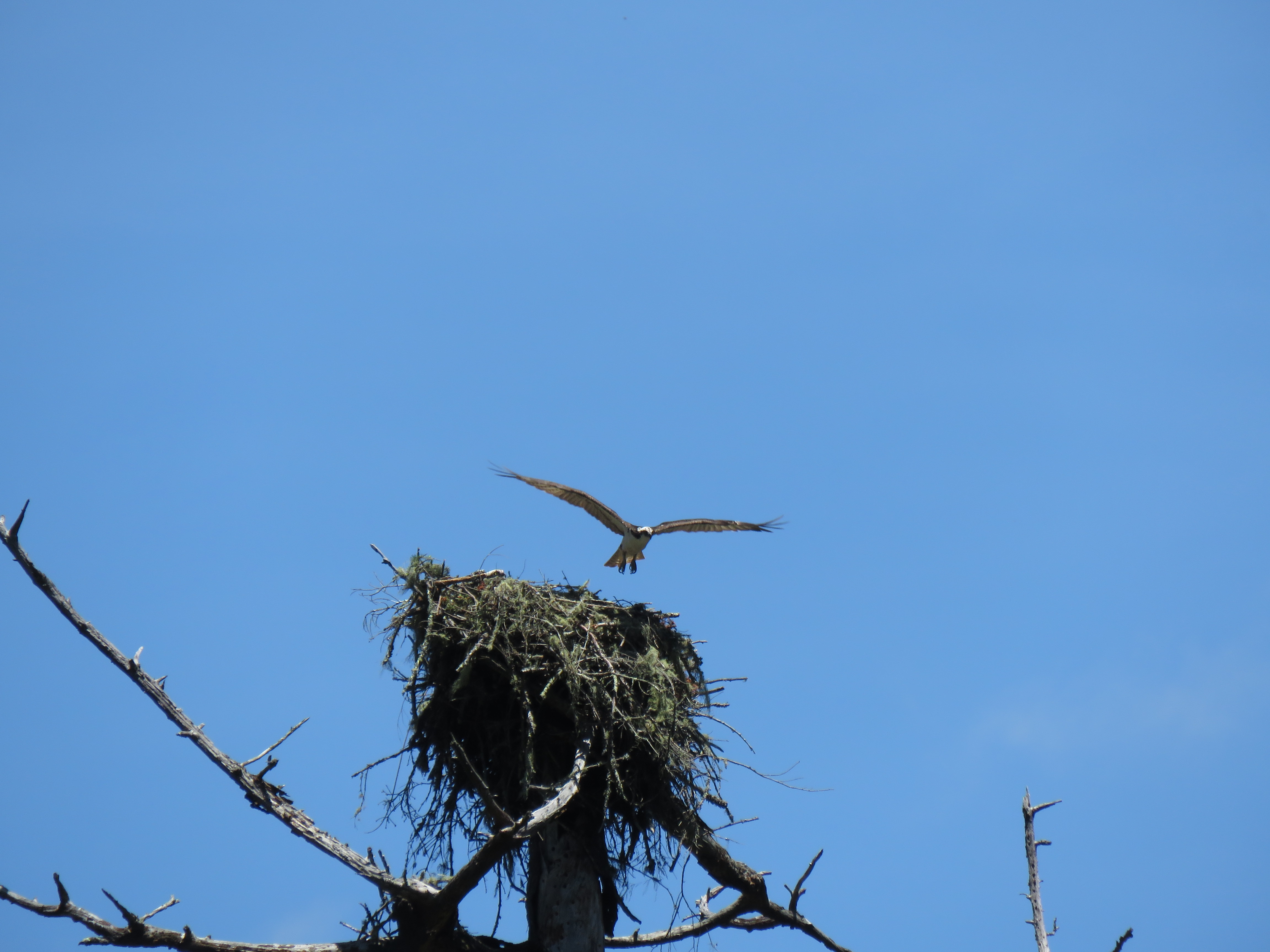
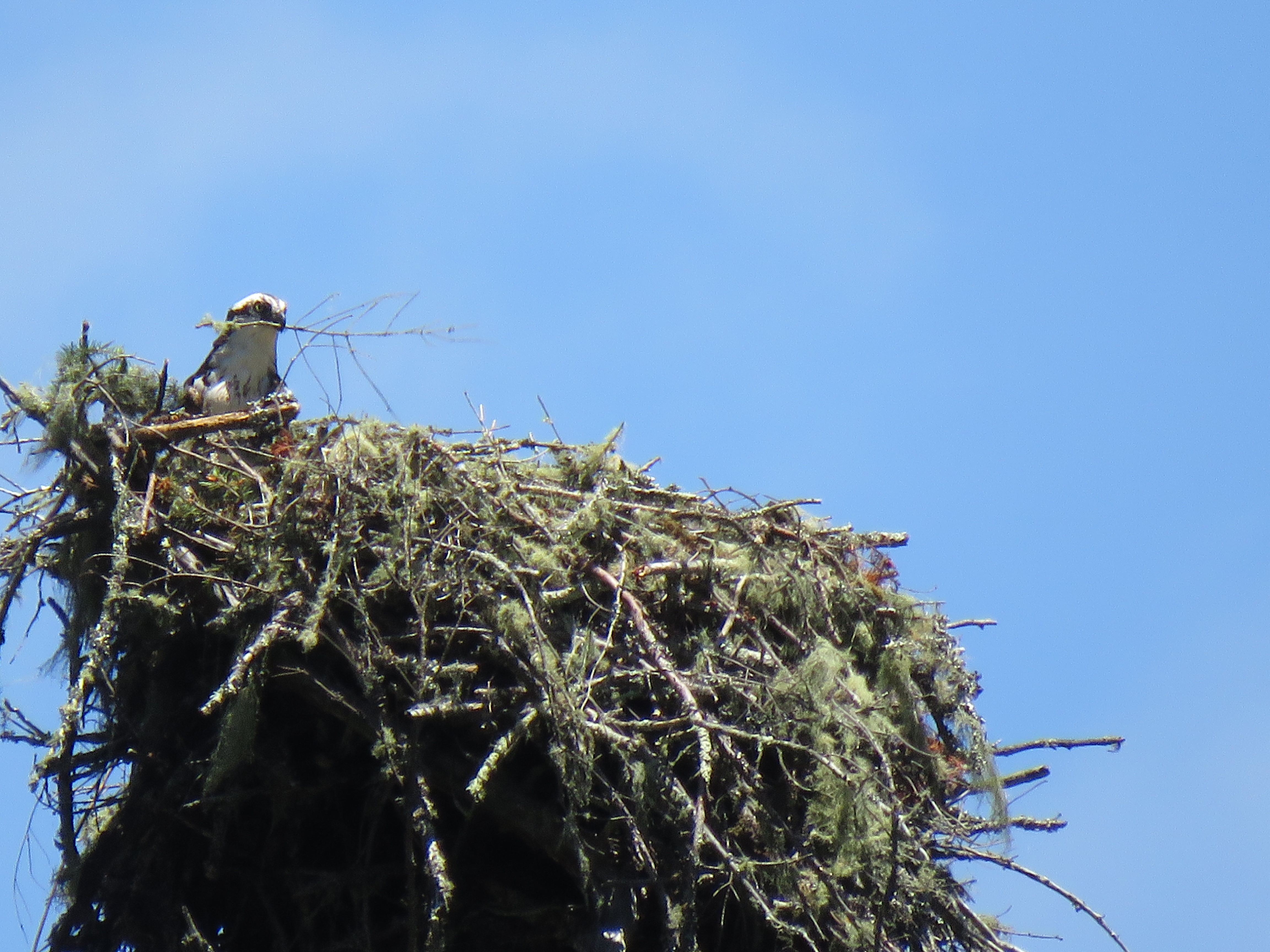
It didn’t take long to see signs of life. An osprey flew in and briefly alighted on the nest. Bingo! The nest is occupied after all. The unseen osprey, presumedly sitting on eggs, sat up in the nest and became visable.
The osprey that flew in could have been the male who is responsible for bringing fish to the nest while the female does most of the incubating of the two to three eggs. The male perched near the nest on a Doug-fir and preened.
First sign of life at the osprey’s nest. Perhaps the male dropping off fish.
I stood by the railside and sketched the nest. On the left side of the spread is my field sketch (first in pencil then in dark sepia pen) of the Douglas-fir crowned by the osprey nest. The osprey perched on the right was drawn from a field photo I took of the presumed male. The title and text were added back at the cabin. In the end, I decided to create a spread that is almost monochromatic. I resisted the urge to paint in the sky because I didn’t want anything to distract from the form of the Doug-fir and nest.
The osprey doing a little housekeeping at the nest. This is presumedly the female who does most of the incubation of the eggs. Both sexes build the nest. A hiker who stopped to look at the nest told me that the nest had been there for past two or three years.Ospreys reuse their nests each breeding season. A lot of work has gone into this nest over the past two or three seasons.