Image

Muir Trestle, Martinez

I was meeting a friend in the East Bay city of Martinez and I had a little time to sketch before lunch.

Martinez is a hotbed of railroading with both the Union Pacific and BNSF passing through as well as some marquee passenger trains such as the Coast Starlight and the California Zephyr making stops at the Martinez AMTRAK station. And the Capitol Corridor commuter takes on passengers traveling north and south on shorter journeys.

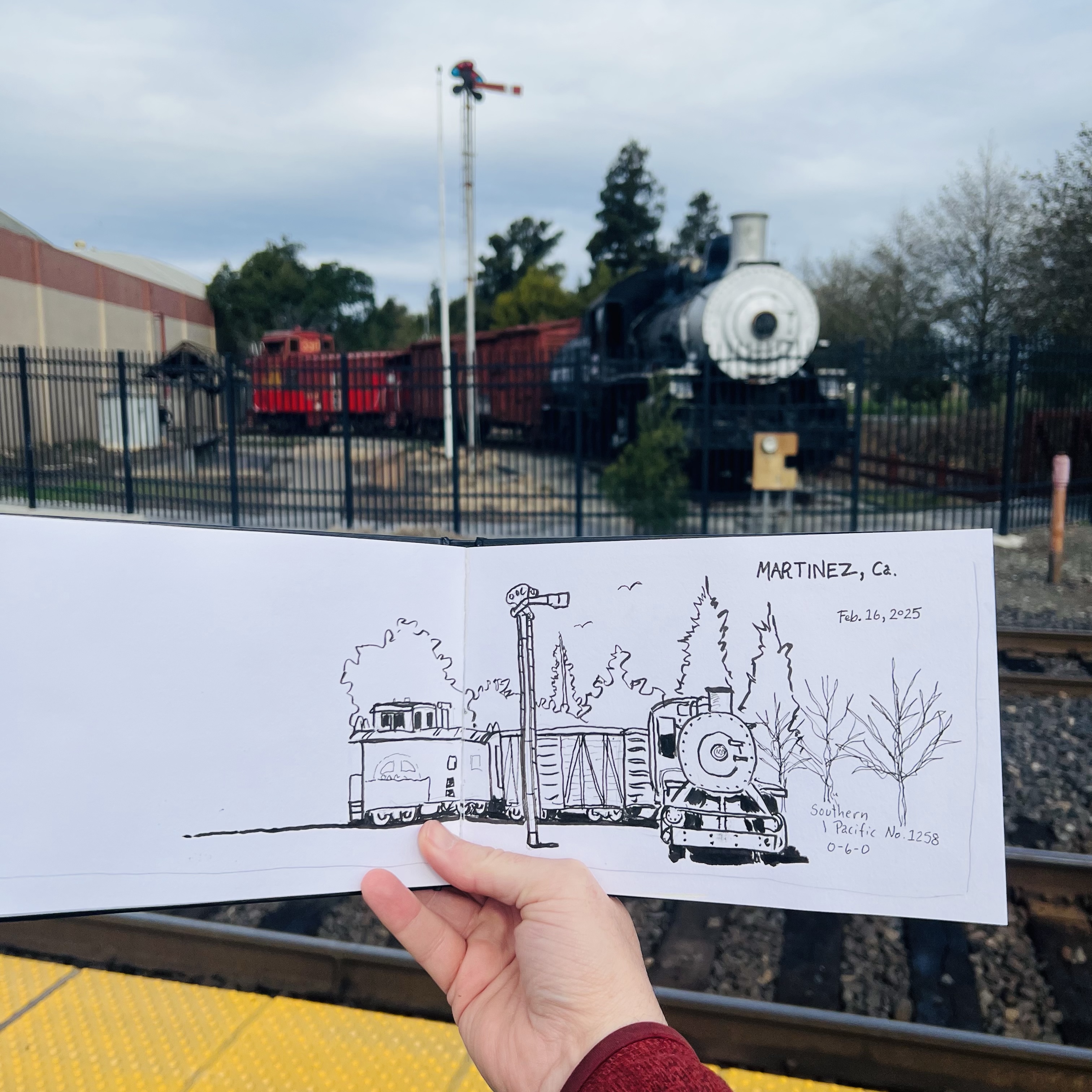
The California Zephyr Train No. 6, at the old Southern Pacific Depot in Martinez. This train is heading east to Chicago. To the right in the background is SP switcher 1258 on static display.

There would certainly be something to sketch here and I was going to start with a historic train trestle.

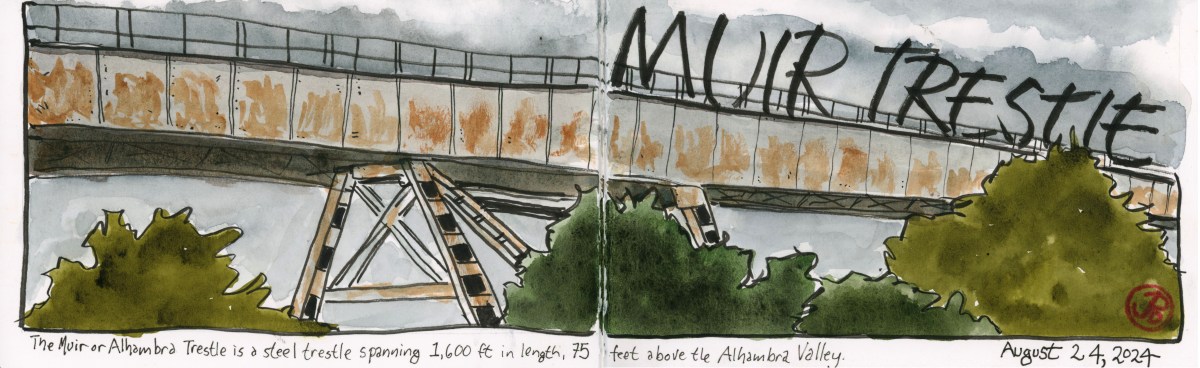
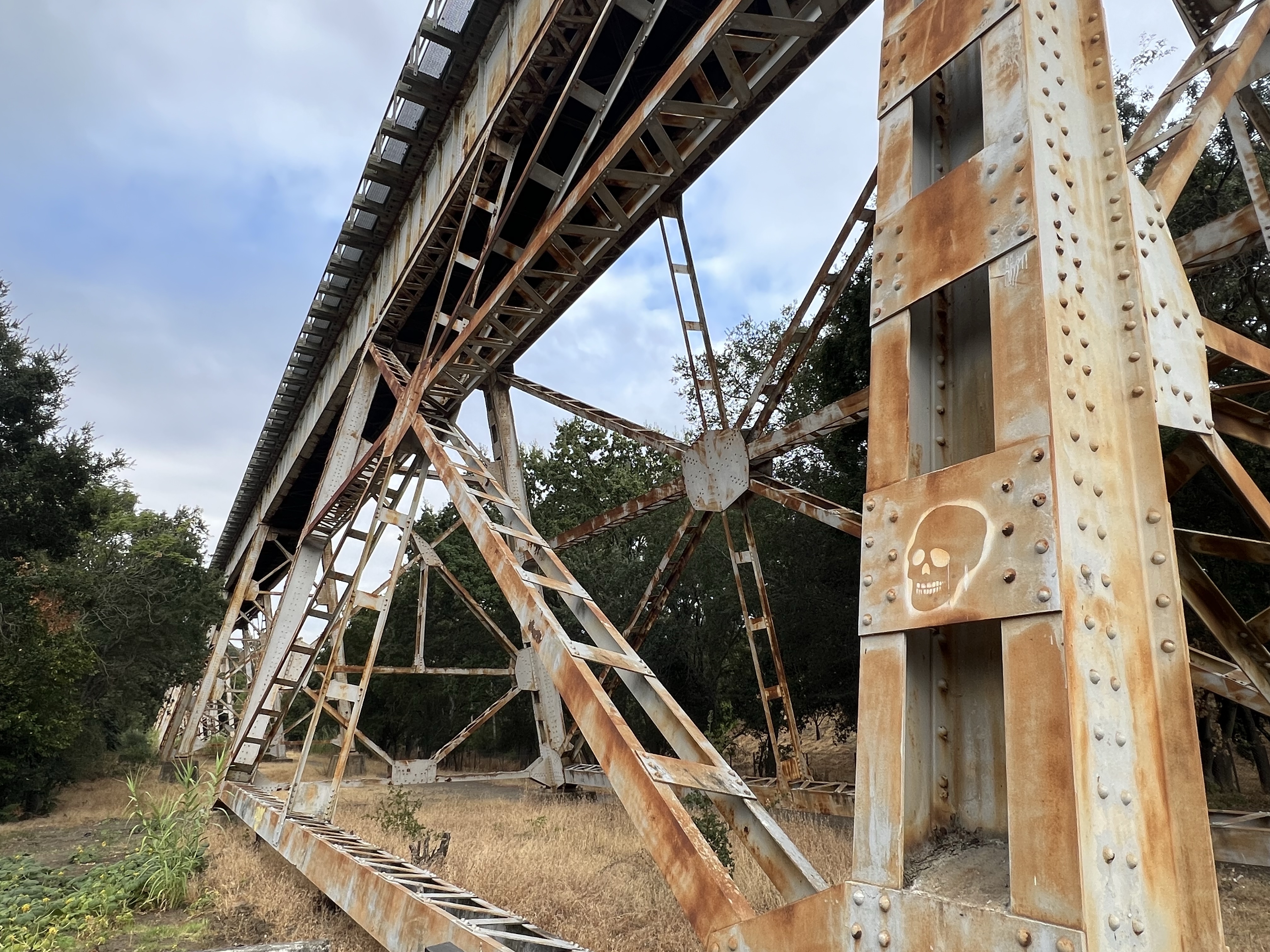
I parked at the Mount Walda Trailhead. Soaring above me was the 1,600 foot long steel Muir Trestle (aka the Alhambra Trestle). The single track trestle was so long that I could only see and sketch one section of it before it disappeared into the trees to the east. The trestle rises 75 feet above the roads, trees, and houses it crosses over.

A detailed view of the steel supports of the Muir Trestle.

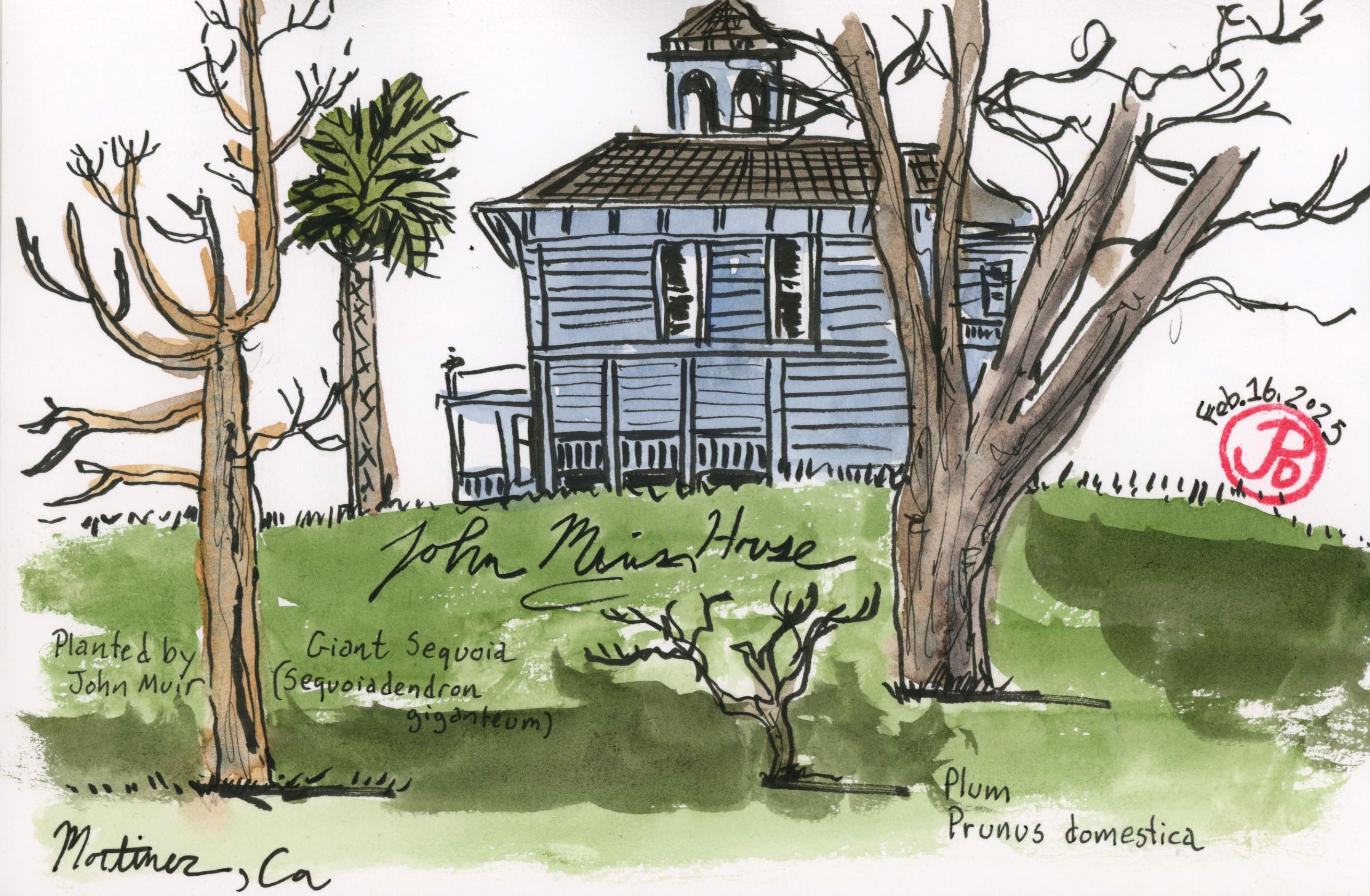
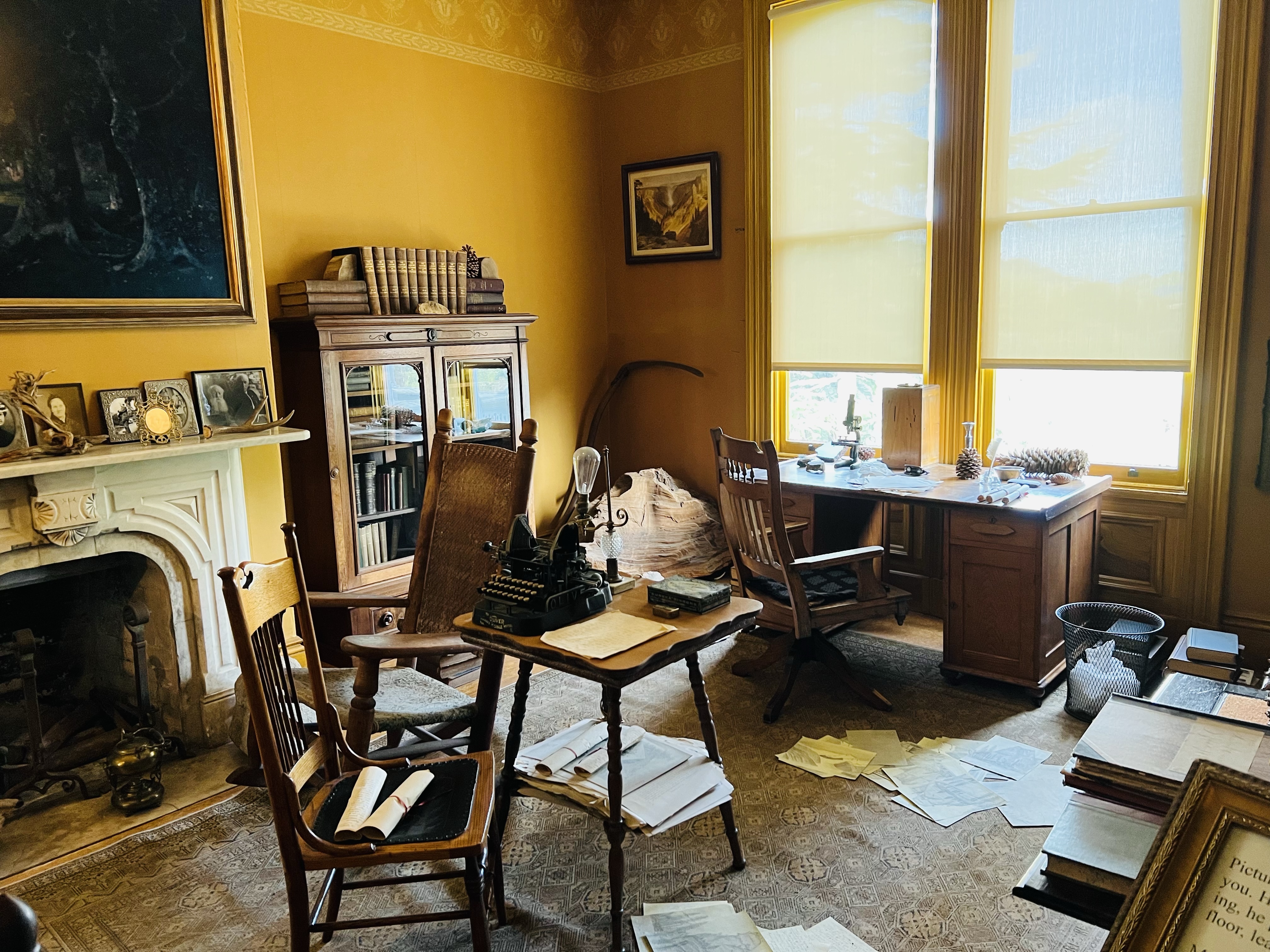
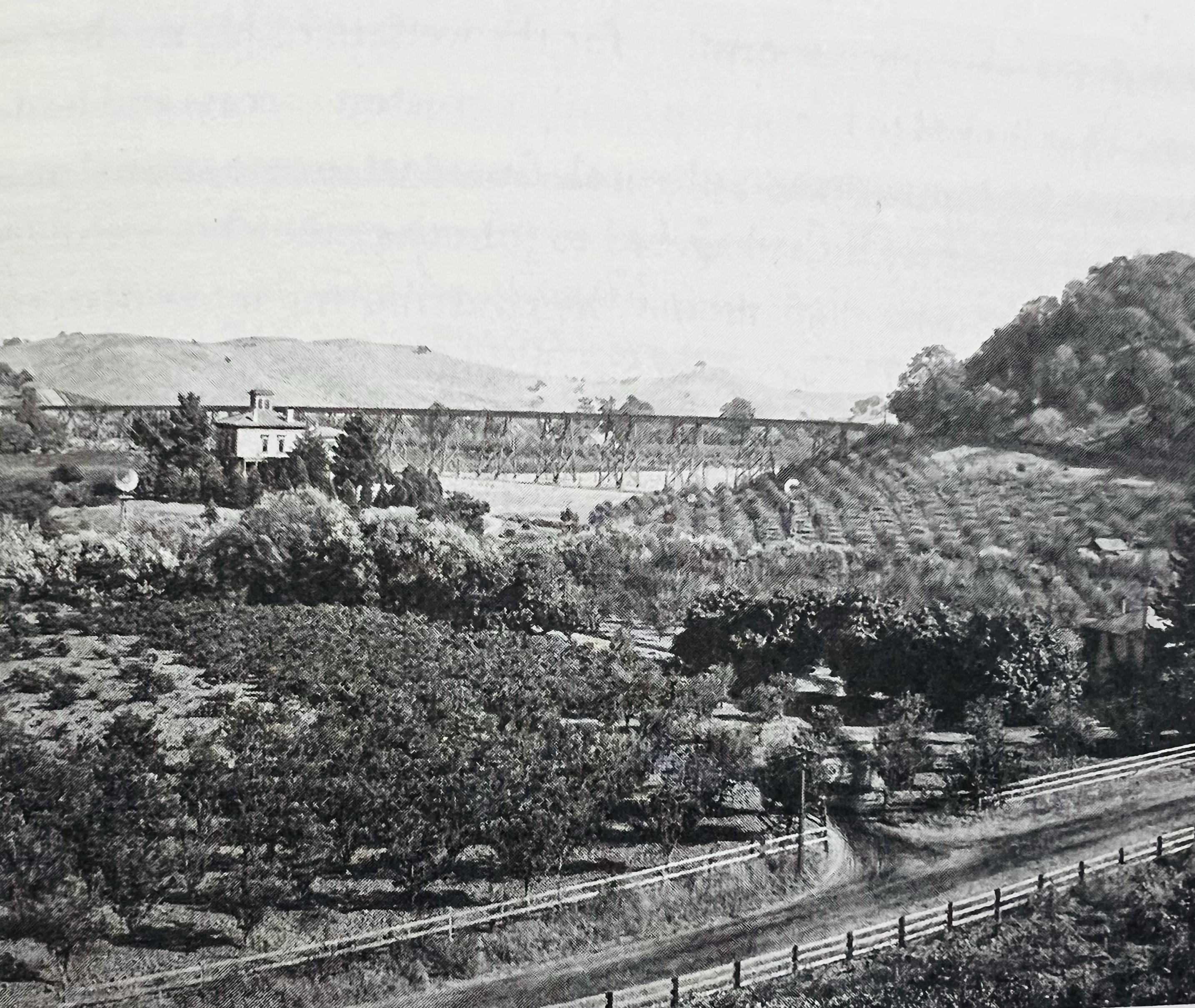
The trestle is within the John Muir National Historic Site. To the north is Muir’s Martinez home. Muir and his wife Wanda sold the land for the trestle for $10 and a lifetime rail pass to the San Francisco and San Joaquin Valley Railway. The original wooden trestle was built through a pear orchard and completed in 1897.

This is a historic photograph of the Stengel-Muir ranch in 1897. The Muir house is on the top left and the trestle is viable behind the house. At the time of the photograph, the trestle was constructed of wood.

At the eastern end of the trestle there was a passenger and freight station named Muir Station. The station is now long gone but is immortalized in a street that parallels the rails named Muir Station Road.

From this station Muir could ship his produce to Oakland or to the port in Martinez.

One of Muir’s neighbors in the Alhambra Valley was John Swett, Muir close friend. Swett was the State Superintendent of Public Education and is known as the “Father of California Public School”.

In 1898, Santa Fe purchased the line and it became their Valley Division. This division still exists as BNSF’s route from Richmond to Fresno.

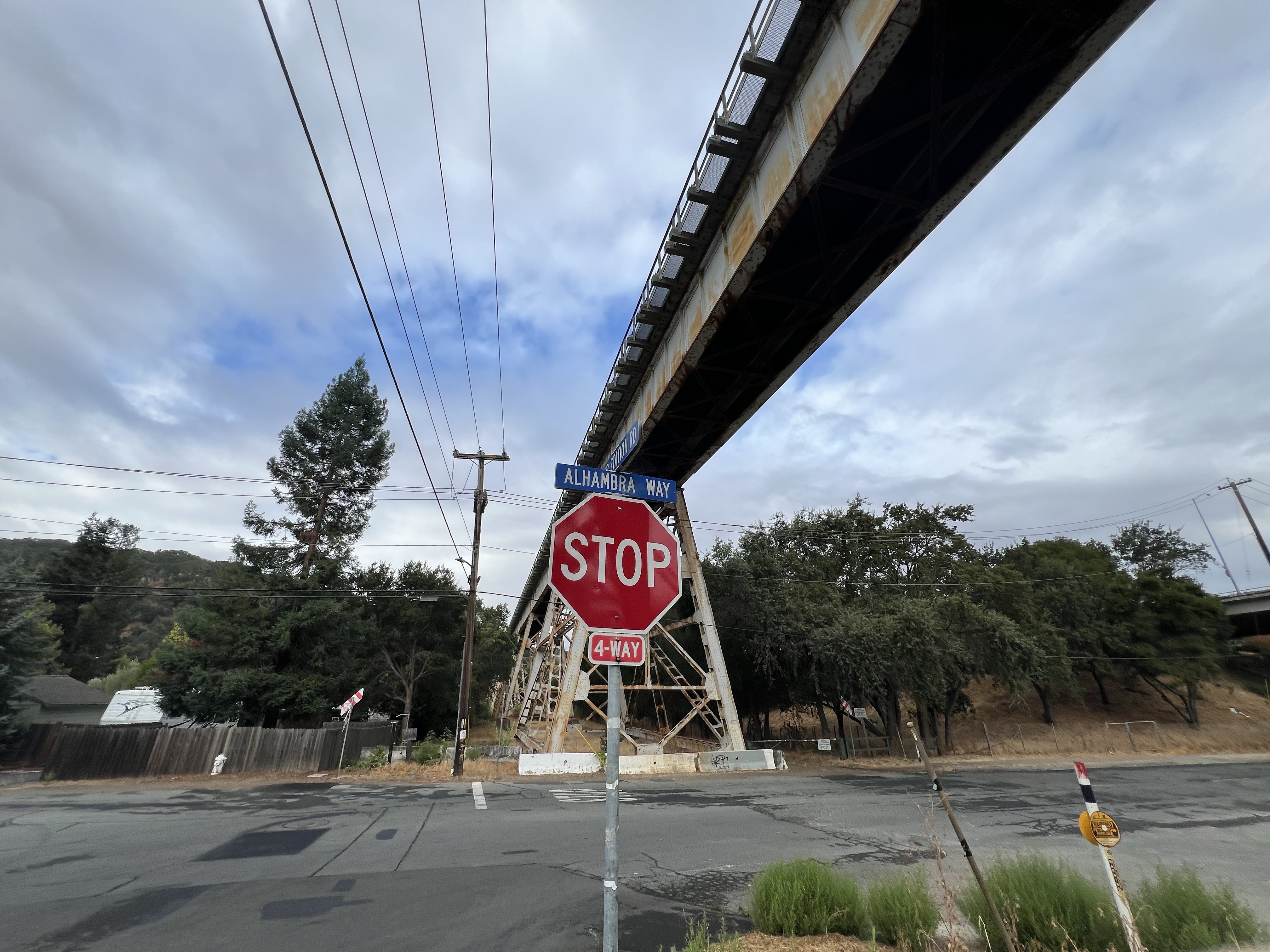
The Muir Trestle from the intersection of Alhambra Way and Muir Station Road.

I took up a sketching position near the trailhead and started my drawing. The trestle above me is on the Stockton subdivision and is used by BNSF intermodal freight. There was no train crossing during my sketch.

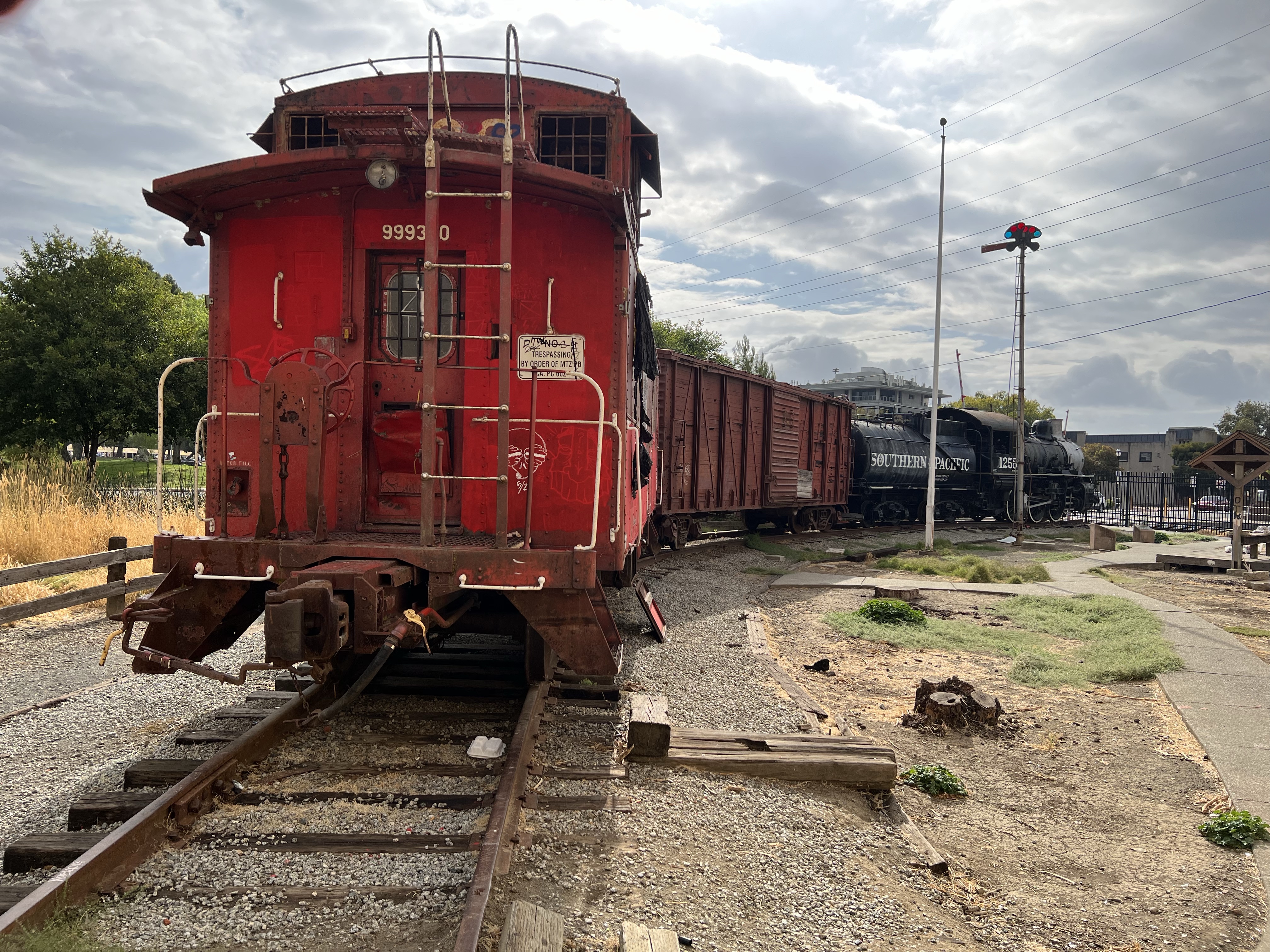
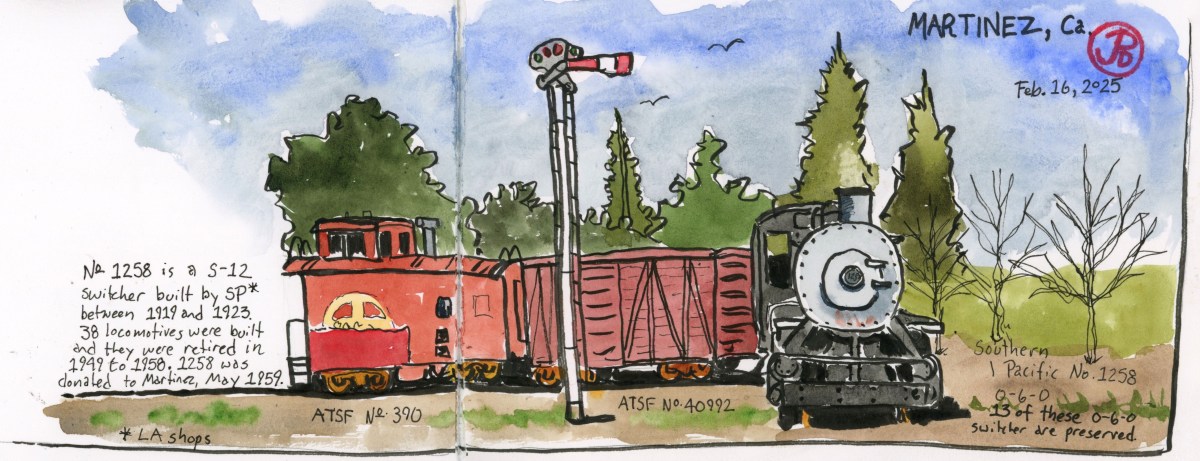
SP 0-6-0 switcher No. 1258 and its consist of a wooden box card and Santa Fe caboose 390 on display across the tracks from the AMTRAK station. The locomotive is in sad shape, missing some hardware like her bell and whistle.
Image

Keddie Wye

One of the Seven Marvels of the Feather River Route is to be found a few miles north of Quincey.

The Feather River Route, also known as the Canyon Subdivision, stretches between Oroville and Portola, Ca and competed with Southern Pacific’s route over the Sierras at Donner Pass.

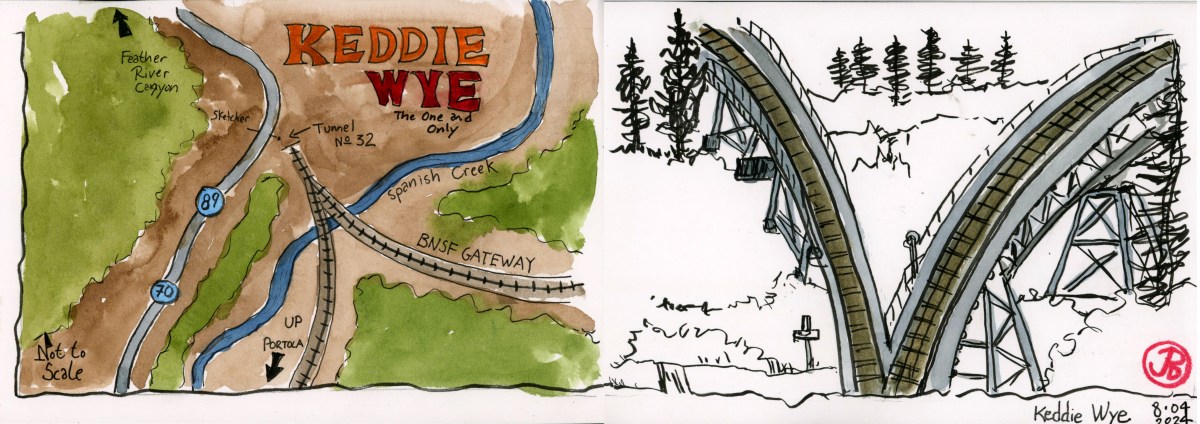
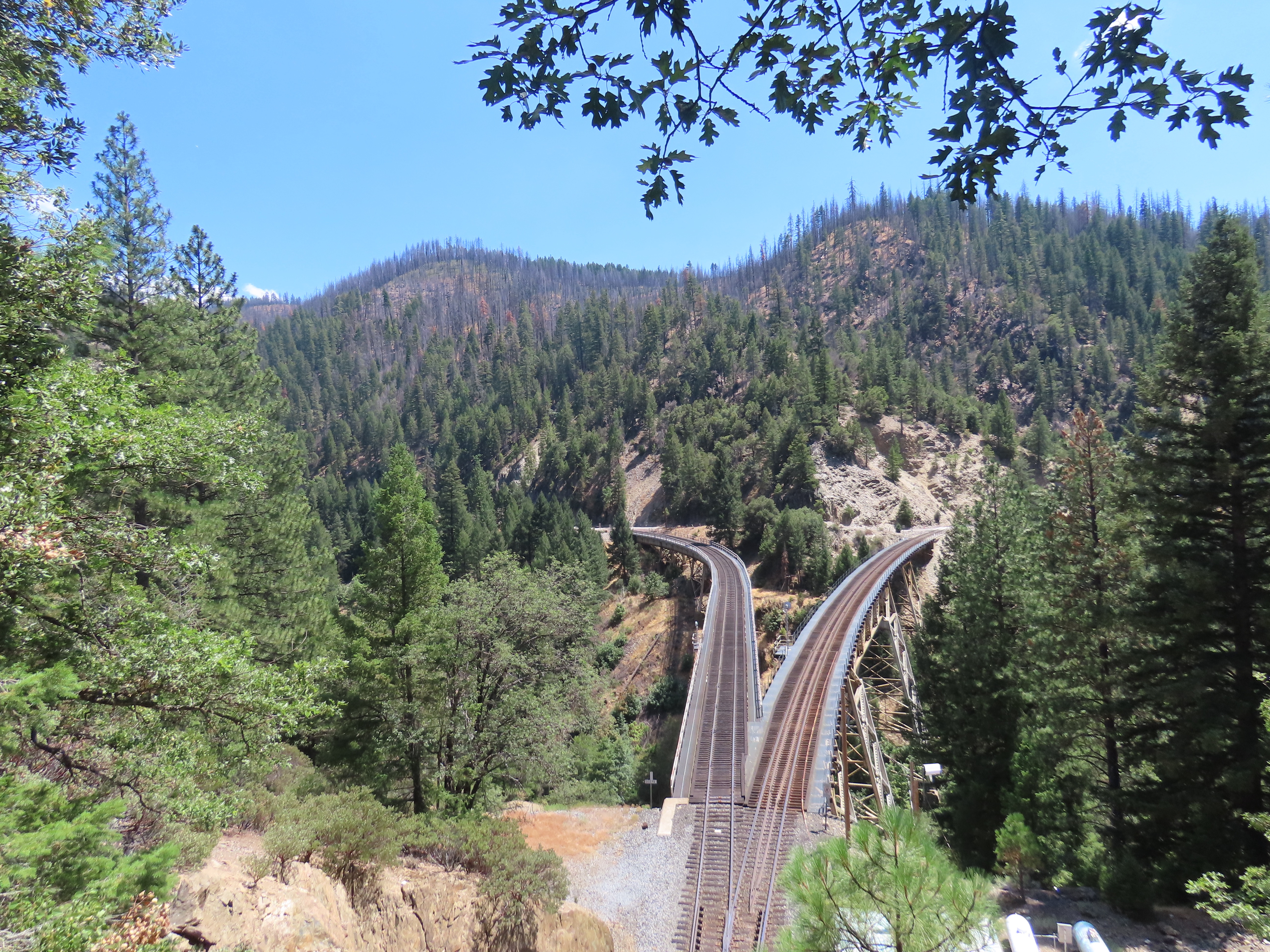
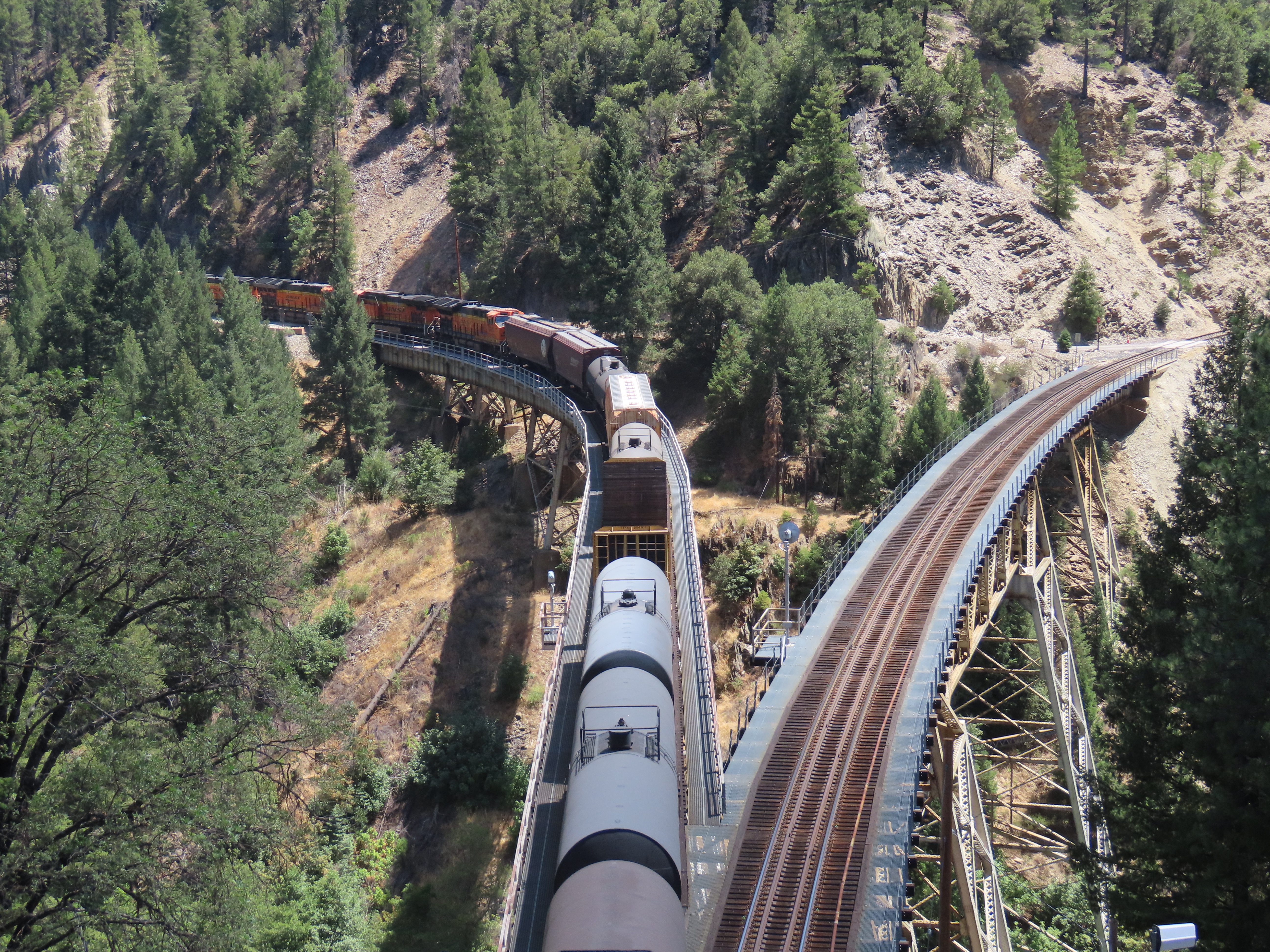
The Marvel is known as the Keddie Wye. This is where two tracks comes together to form one track, looking like the letter “Y”. Now this in itself isn’t much to write home about but when both sides of the “Y” are on trestles above a creek that joins together before entering a tunnel and then you know this is a special piece of railroad engineering.

The two forks of the “Y” are also where two different railroads meet. On the right is the former Western Pacific Railroad, now Union Pacific, and one the left is the BNSF (Burlington Northern and Santa Fe).

After about a 45 minute drive from Portola on Highway 70, the famous Keddie Wye appeared to my right. I pulled over and found a vantage point to sketch. I perched on a narrow trail above Tunnel No. 32 looking out to the two forks of the wye.

Now the only thing missing was a freight train. It would have been nice to see a train traverse one side of the “Y”. As I was told at the Western Pacific Railroad Museum, Sunday is a quiet day on the high iron.

After my sketch (right side of the spread), I headed down Highway 70 into the Feather River Canyon proper. The Highway parallels the railroad and the Feather River. This is a beautiful drive and I periodically looked off to left at the rails across the river. No trains.

I was about 20 minutes from the wye when I heard the screech of steel wheels on rail. I looked to the left and a Burlington Northern and Santa Fe (BNSF) was climbing up the canyon with a mixed freight consist.

I found the nearest pullout and then reversed direction as I chased the BNSF up canyon. I wasn’t going to miss the freight on Keddie Wye!

As I climbed up Feather River Canyon I kept an eye to my right for glimpses of the train. I should have no problem overtaking the train as the line speed limit was 25-30 mph.

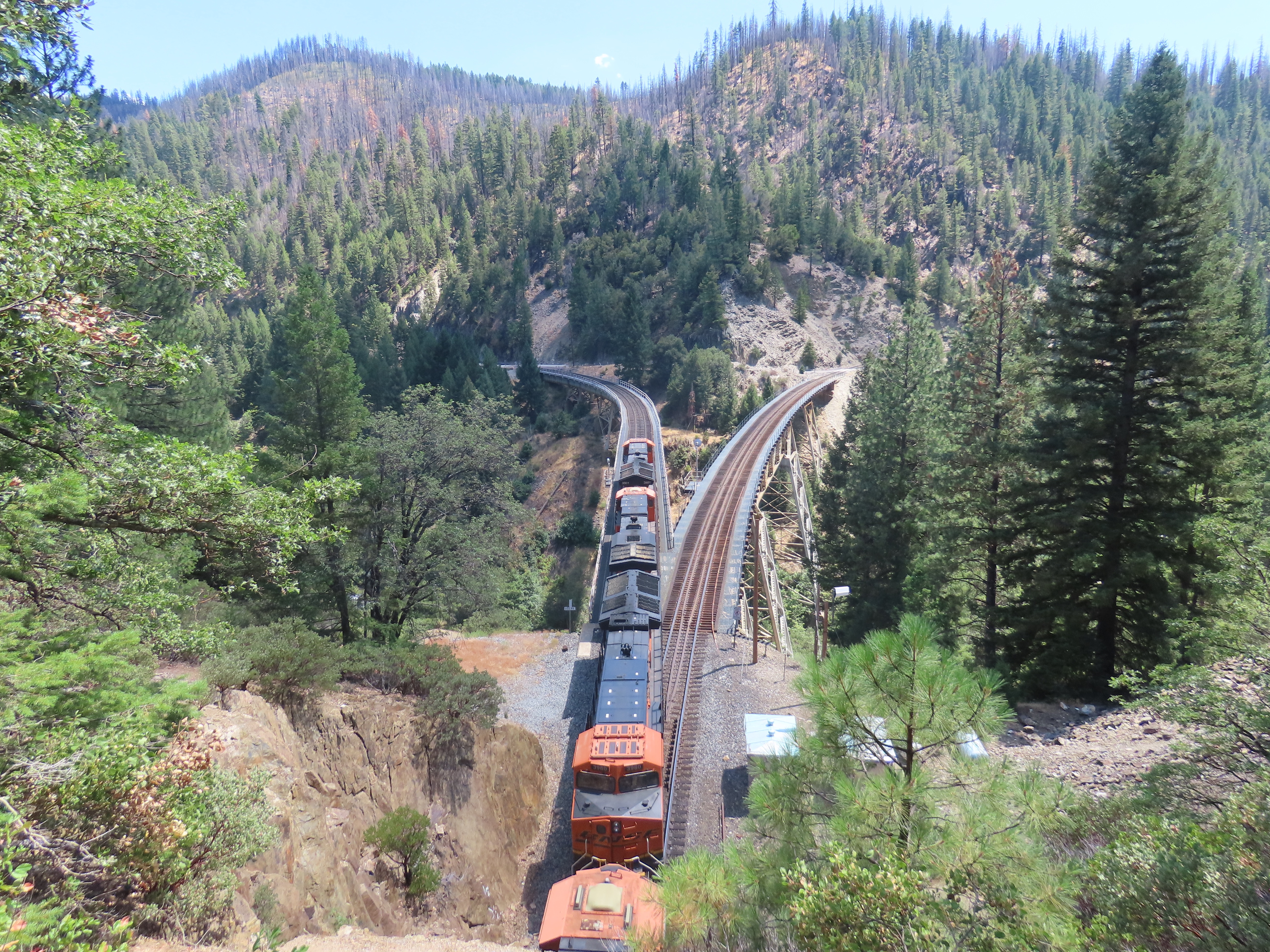
I soon came to the end of the train and before long I was approaching the five bright orange diesels on point. I passed them with time to spare.

Once I reached the wye I reversed direction again and parked at the pull out. I figured I was about ten to fifteen minutes ahead of the freight and I took my position on the narrow path above Tunnel 32. Now I had to just wait, wondering if I would be able to hear the approaching freight from my position.

Within ten minutes I could hear the diesels working up grade and the first locomotive appeared below me. The train headed onto the left side of Keddie Wye onto the BNSF Gateway heading north towards Lookout and Klamath Falls.

What a memorable experience to see a piece of railroad history that is not a static museum piece isolated in time but in use today.

Image

Western Pacific Railroad Museum

You really have to like trains to make it out to Portola, Ca. From my mom’s house it was a two hour drive over windy roads to reach the small town where the former diesel shops of the Western Pacific were.

These shops and the rails around it, are now the Western Pacific Railroad Museum. The museum is adjacent to the tracks of the Union Pacific which acquired the WP in 1982. Heading west from Portola you enter the Canyon Subdivision which is the WP’s Feather River Route. This is one of the most scenic sections of the the former WP. It was the route the original California Zephyr took from the Bay Area to Chicago.

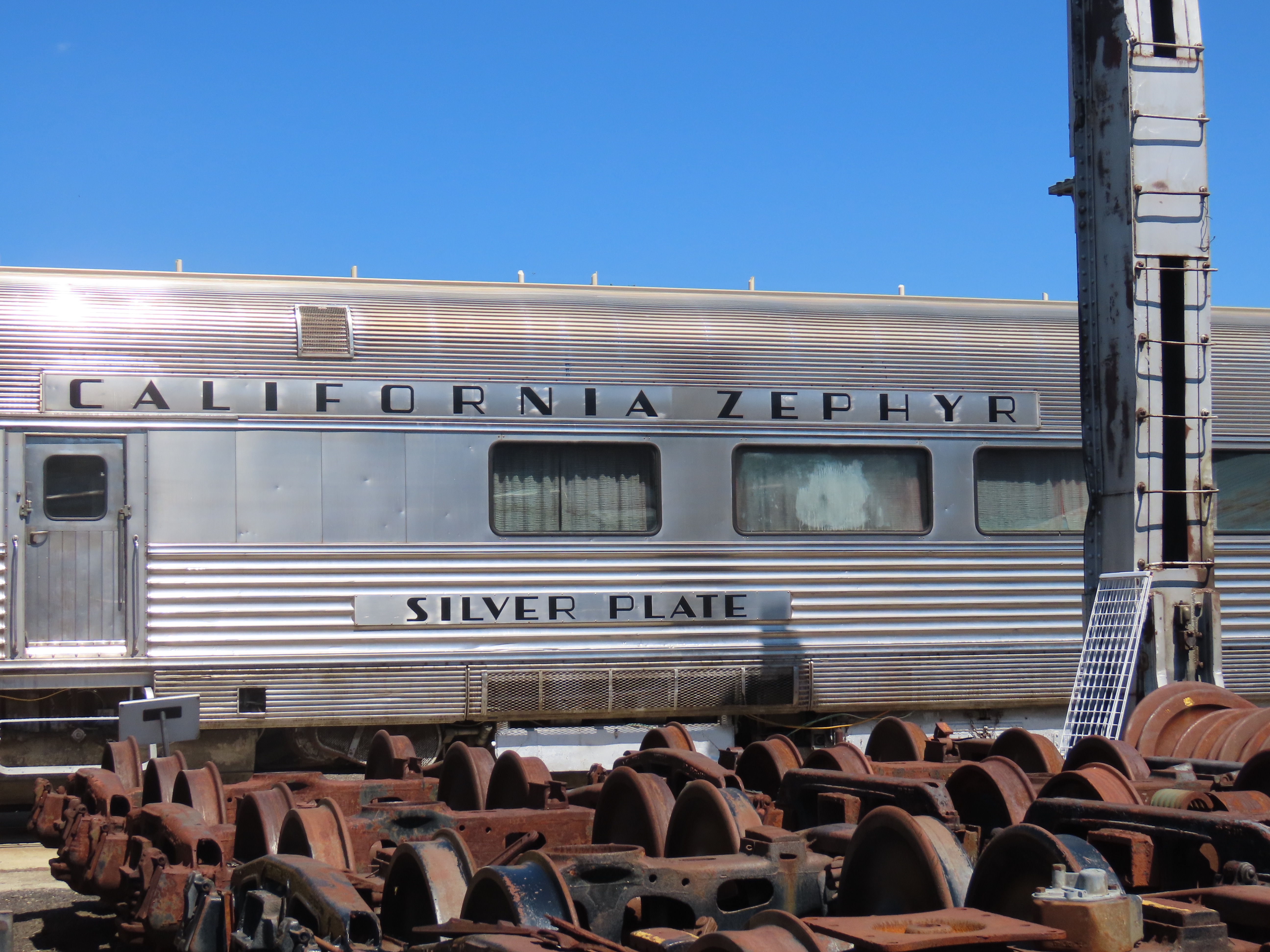
The museum has four cars from the streamliner, the California Zephyr.

While many railroad museums focus on the age of steam, the WP was one of the first major railroads in the west to dieselize. The museum has 29 diesels in its collection.

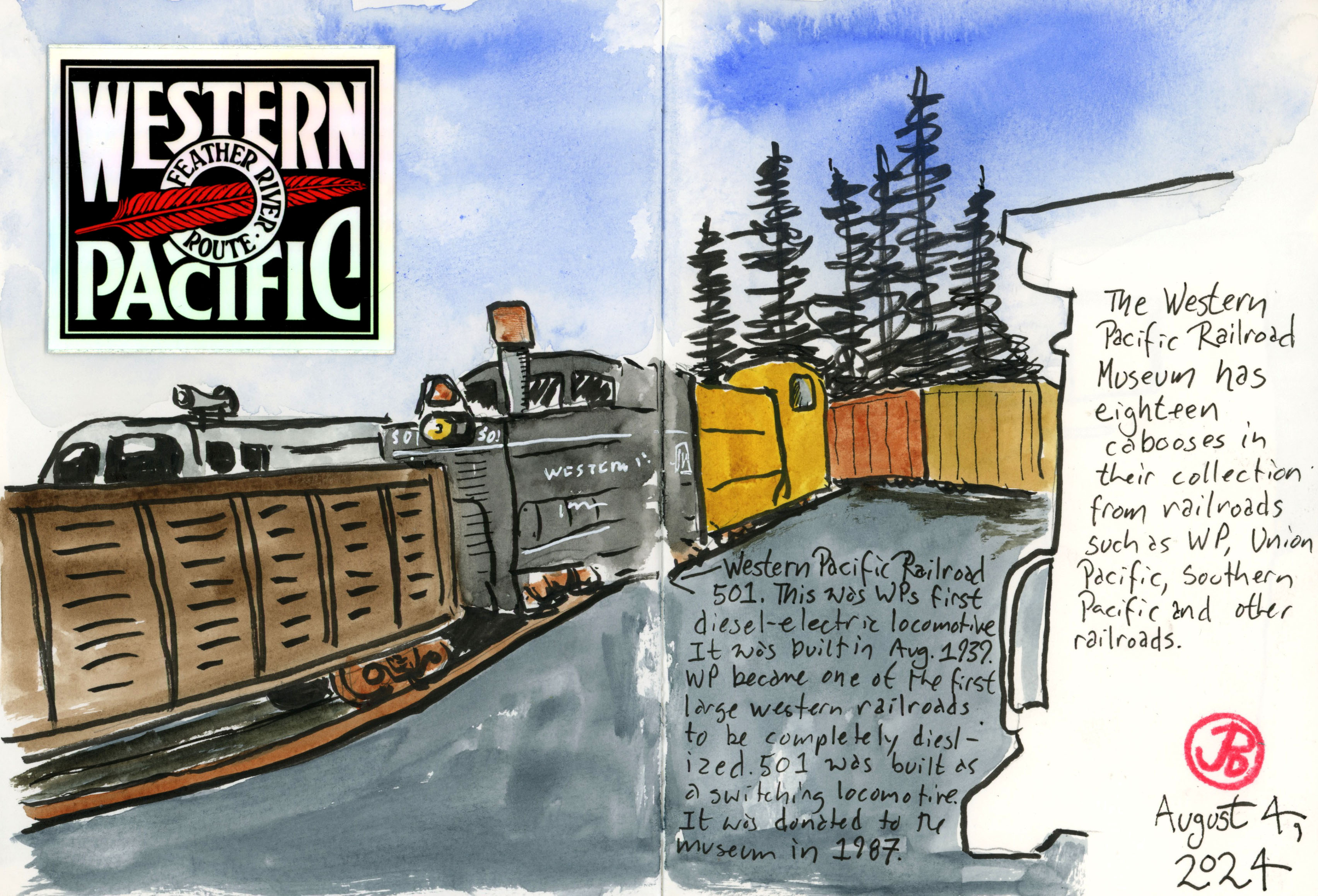
The WP acquired its first diesel in 1939. The SW1 switcher was built by the Electro Motive Corporation for an original cost of $64,525. It was built to work in the yard and with a top speed of 45 MPH, it was not designed to be out on the mainline.

The WP tested out the diesel (No. 501) and liked what it could do. It later ordered two more sister locomotives and 14 years later the Western Pacific was completely dieselized. The genesis of WP’s diesel age is now part of the museum’s collection.

A sketch of some of the WPRM’s collection including WP’s first diesel: No. 501.

The museum has many classic, epic, and iconic diesel-electric locomotives in its collection and I added a few to my sketchbook.

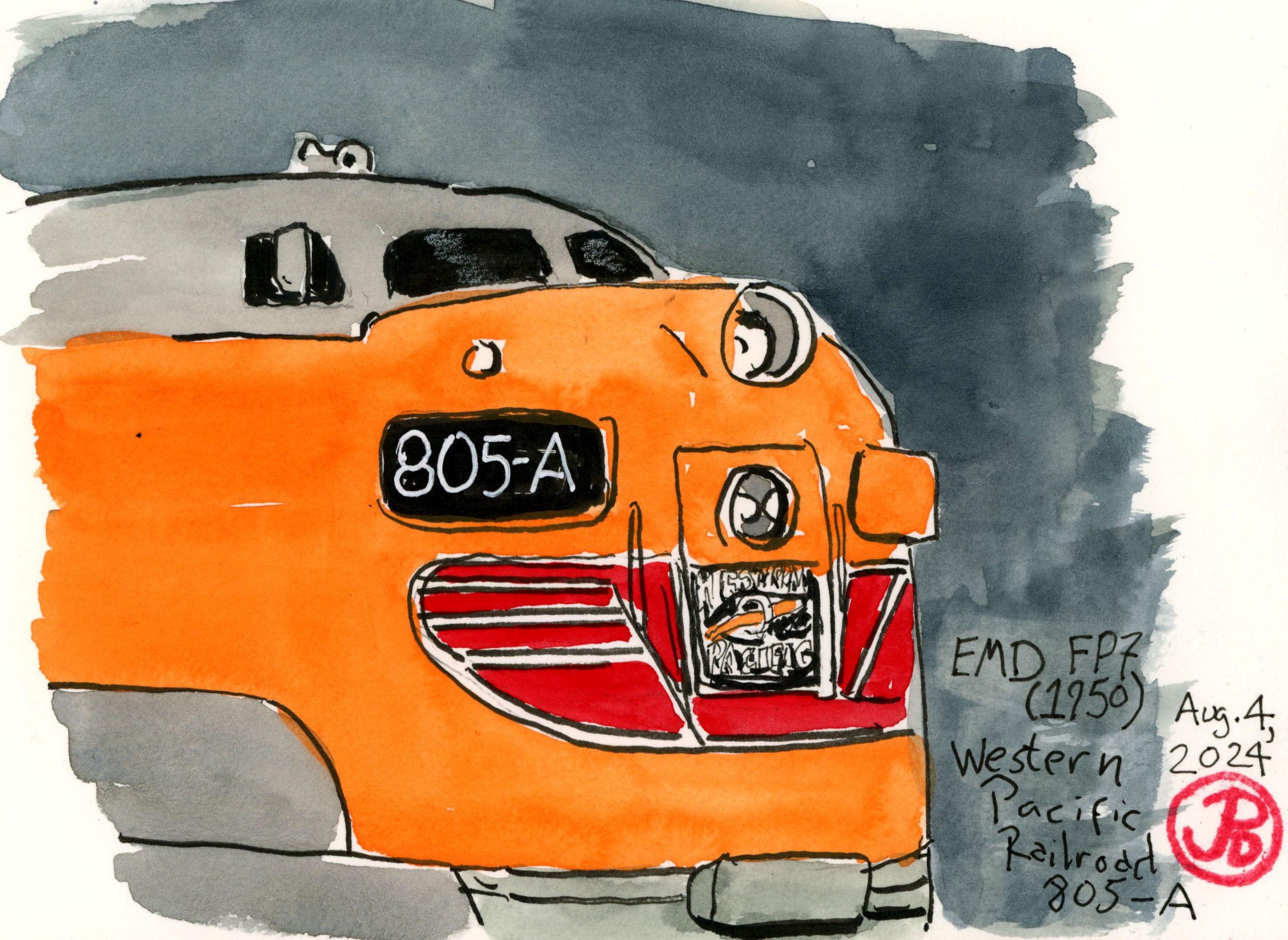
An iconic locomotive is the WP 805-A. This is an EMD FP7. This hood unit was on point of the California Zephyr from Oakland to Salt Lake City. The diesel was in service on the Zephyr from 1950 to the route’s end in 1970.

805-A is the last WP California Zephyr locomotive in existence, so I had to sketch it.

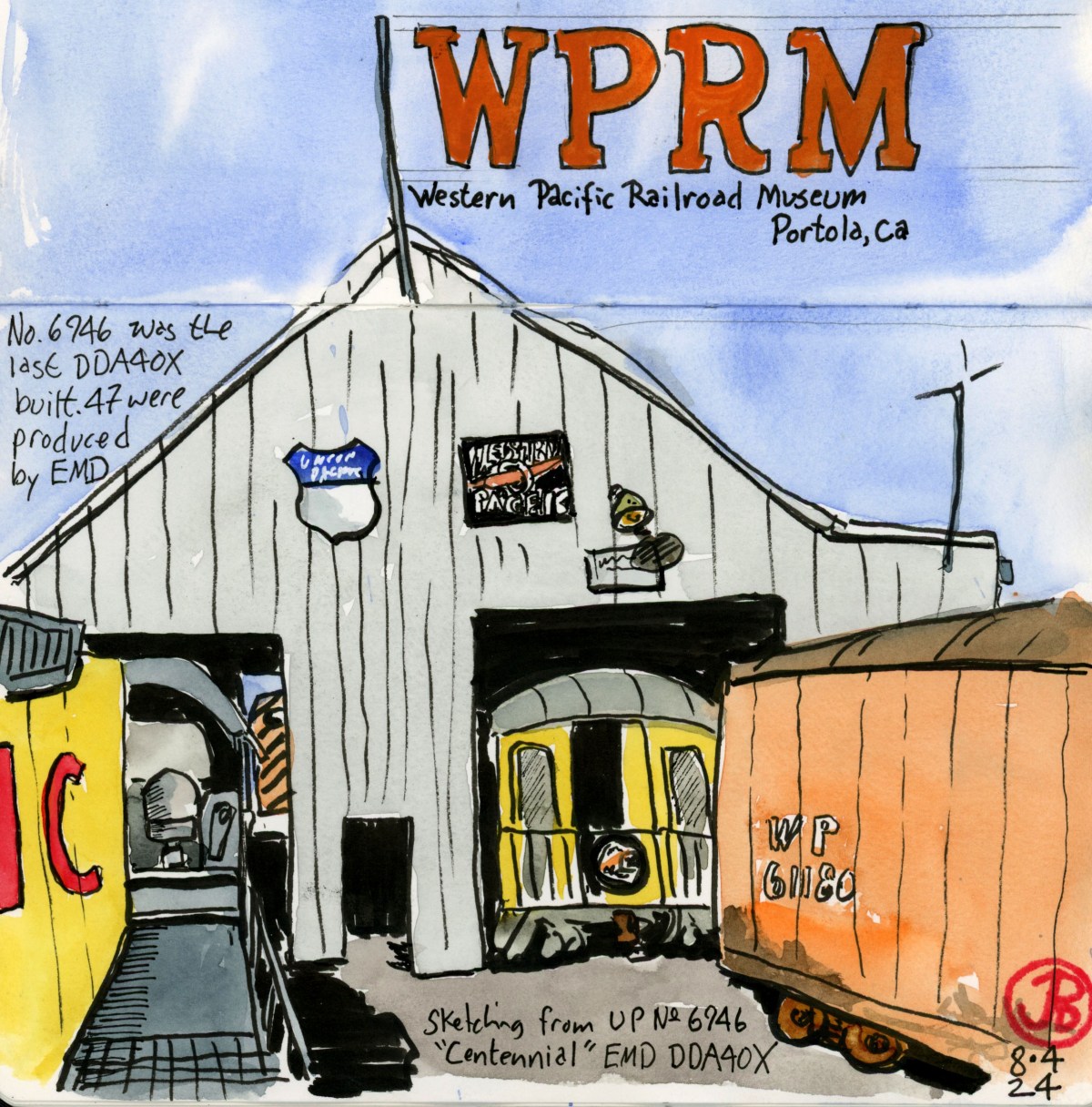
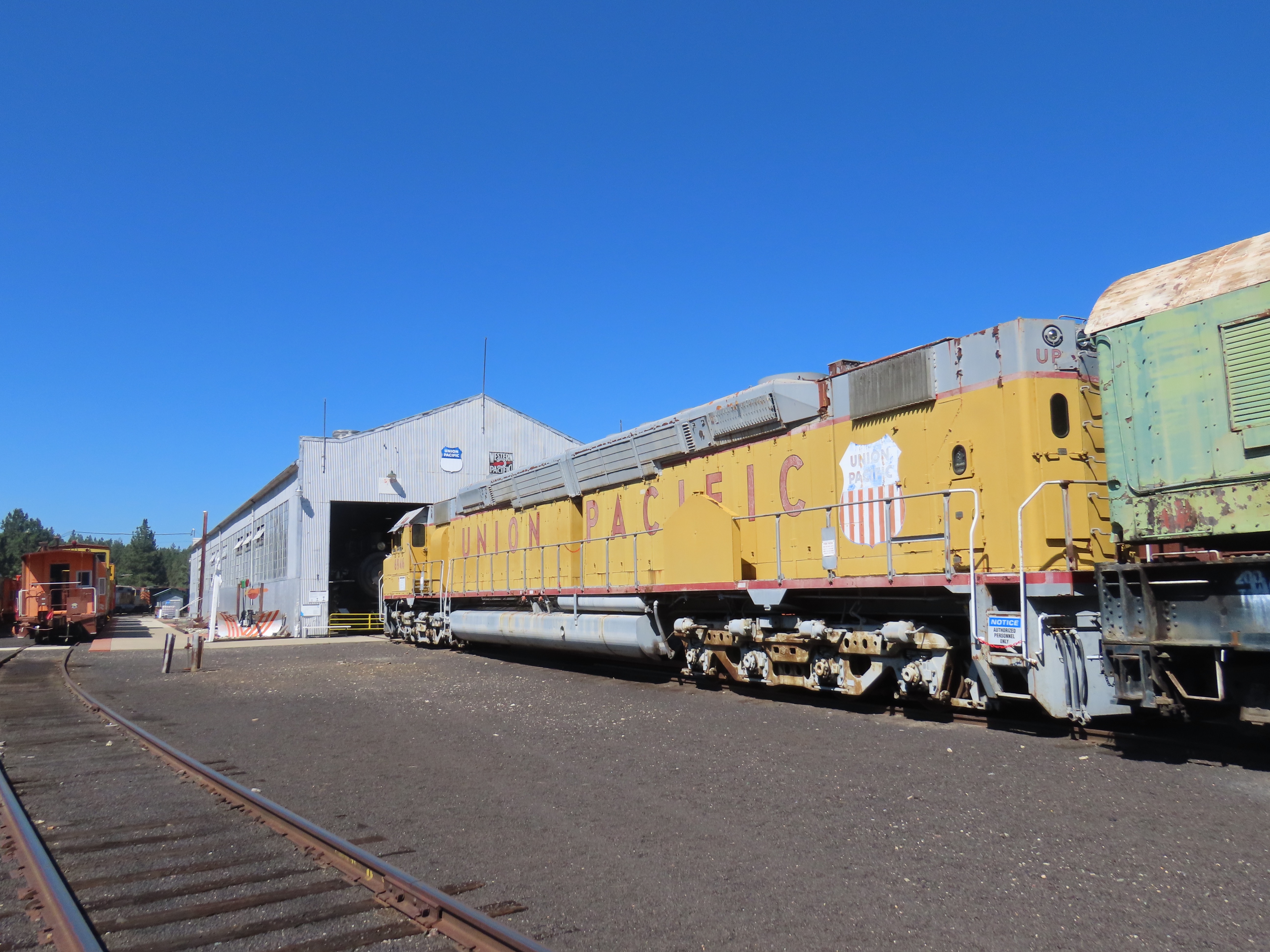
One of the epic diesels in the museum’s collection is perhaps the most epic diesels ever built, this is Union Pacific No. 6946. This 6,600 horsepower behemoth is EMD Class DD40AX “Centennial”, the largest and most powerful diesel-electric locomotive ever built and is the successor of UP’s Big Boy. 6946 is the last (out of 47) Centennial ever built. Only 13 Centennials still exist, the large locomotives having been retired from the UP fleet in 1986.

The beast that is the last Centennial ever built. Like the Big Boy, it’s two locomotives smashed into one mighty powerful machine.

A docent told me I could climb aboard the duel engine workhorse and I walked along the gangway to the cab.

I liked the view so I sketched the 1953 diesel shop from the gangway of 6946 (featured sketch).

Image

Overnighter in Roseville

4014 would be spending two nights in the important rail hub of Roseville.

Roseville is at the base of the climb up the Sierra Nevada Mountains to Donner Pass. It is here where the tools to conquer the Donner extreme winters are kept. Across the tracks, near the depot, the spreaders and flangers could be seen. A little further down the siding, the ultimate snow fighting machine could be seen: the rotary plows.

But on this July Friday and Saturday an army of foamers, rail fans, history buffs, and the curious would be invading the city of Roseville.

They were all here to see the largest steam locomotive in the world, Union Pacific’s Big Boy No. 4014. For the two display days the largest operable locomotive would be static and not moving. The Goliath would be brought up to steam and boiler pressure to conquer the Sierra Nevadas on Sunday.

I arrived early on Saturday to find a parking spot and to spend some quality time with the 4-8-8-4 before she, or he, was besieged.

Roseville is a busy point on the railroad with many freight trains starting the climb or descending the Sierra Nevadas. The passenger service is alive and well in Roseville with the California Zephyr and the Capital Corridor stopping at the passenger depot.

The present and the past of Union Pacific freight. A eastbound freight passes 4014 at Roseville.

4014 now had a consist of Union Pacific passenger cars. I heard a ticket for the trip from Roseville to Reno, Nevada would set you back $700. The train was parked near the intersection of Atlantic and Vernon Streets near Southern Pacific’s 2252 and a rotary snowplow on display.

Roseville is a very busy point on the line and it was about to get much busier with the influx of people coming into town to see a Big Boy’s first visit.

I walked to the grade crossing at Yosemite Street and looked west (towards Sacramento) and sketched 4014 and the Roseville yard (featured sketch).

The viewing of 4014 officially opened at 9:00 AM and there was already a group lined up to get a closer look at the Big Boy.

As the clock ticked closer to 9:00 AM, more and more people were showing up to see the first visit of a Big Boy to Roseville.

This important railroad town was the home of Southern Pacific’s articulated, the cab forward. These massive locomotives were designed to haul freight over the pass and the locomotive was reversed with the cab in front (hence the name) so the crew would not suffer from smoke asphyxiation while traveling through the many tunnels and snow sheds on the route. In the age of steam Roseville had two roundhouses, one was specifically designed for servicing the labor intensive cab forwards. At one point Roseville was home to 60 cab forwards.

Only one Southern Pacific cab forward still exists, the AC-12 No. 4294. She is on static display at the California State Railroad Museum in Sacramento. But unlike Union Pacific’s 4014, 4294 is not operable.

Soon it was hard to see the Big Boy through the forest of people surrounding it. So I did a sketch to capture the experience.

Image

CalTrain Electric

On a recent Saturday morning I had a pleasant surprise as I drove north on El Camino Real at San Carlos. At San Carlos Station was one of the new electric CalTrain sets.

The new trains are built by Stadler, a Swiss-based train manufacturer. The company was founded in 1942 and is headquartered in Bussnang, Switzerland. The company has a factory in Salt Lake City, where Stadler will build 24 train sets for Caltrain.

The train sets are known as BEMUs which stands for battery-equipped electric multiple unit.

I parked, thinking that the train would surely have left the platform by the time I walked to the station but as I walked down San Carlos Avenue, the train was still stationary at the station.

As I crossed El Camino, a placard stated “No Train Service”. The line was closed all weekend.

The line was closed from San Francisco to San Jose so Caltrain could test eight of the new electric train sets. The electrification of the line started in 2017 and electric trains are scheduled to start running on September 21, 2024.

If you think of some of the most iconic passenger trains in modern rail: Japan’s Shinkansen (“Bullet Train”), France’s TGV, Eurostar, Amtrak’s Acela, Chinese Railways CRH, the Bay Area rail corridor was finally being electrified to catch up with the rest of the world, although it would not come close the top speeds of modern Shinkansen (186 mph).

Three quarters of the world’s passenger service are powered by electricity. About time!

This is what powers the new train sets: the pantograph that delivers power from the wires above to the train set below.
Not sure if these new trains sets earn any style points. They look like a large streetcar or tram.
Image

Coastal Rail Trail

On a gray Saturday morning I decided to explore a recently opened section (opened in December 2020) of the Coastal Rail Trail in Santa Cruz.

The section I was exploring (Segment 7) is between Natural Bridges Drive and Bay Street. The walk takes about 30 minutes and the round trip covers about two miles.

As the name implies, the paved pedestrian trail parallels the former Southern Pacific Davenport branch line from Watsonville to Davenport.

As of the date of writing only two sections of the trail have been opened, one in Watsonville and the section I was walking on in Santa Cruz.

At grade crossings there are pedestrian signals that stops cars so you can cross the street safely. Well that’s the theory anyway. With the trail recently open, pedestrians should still use caution and not assume all vehicles will stop for you.

When the trail is completed, it will cover 32 miles from Davenport to Watsonville. There are also plans to introduce electric rail service using the former Southern Pacific right of way and trackage.

I started where the rail trail ends: Natural Bridges Way.

The Rail Trail passes by the former Wrigley Chewing Gum plant (left). The plant was in operation for more than 40 years and produced 20 million sticks of gum per day. The plant had a rail siding that is still visible today.

In my college days I remember visiting the gum factory with my roommate in an unsuccessful attempt to get a plant tour. The receptionist told us that they didn’t give tours but asked us if we would like some gum! We answered in the affirmative and then opened a drawer full of gum. I went for Big Red while my roommate picked Juicy Fruit.

The trail is level as it parallels the rail grade. Railroad grades normally don’t exceed 2%. The steepest mainline railroad grade is 3.3% on the Raton Pass grade in New Mexico. A railroad grade is expressed as a percentage the grade rises or falls over 100 feet of horizontal distance. So a 2% grade rises and falls two feet over a 100 feet distance. These gentle grades are ideal for walking and biking.

I passed by the New Leaf Market at Fair Ave, often my first stop when I head into town, as the trail and line turns slightly to the left skirting the Westside Circles neighborhood.

I came upon a scenic curve in the trail at Lennox Street as the rails and trail curve off to the right as it nears Bay Street. I pulled my sketchbook out of my bag and started sketching the view (featured sketch).

On the right of the spread I sketched the grade crossing sign at Dufour Street with Coastal Rail Trail sign below the crossbuck.

Image

Summit Fog Birding

Early on a Saturday morning, Grasshopper and I headed up on winding Summit Road. Our birding destination the Bay Area birding hotspot: Loma Prieta and the “Saddles”.

About 10 miles in from Highway 17 the road devolves into a pock-marked rural ramble as it threads its way over the spine of the summit, defining the line between Santa Cruz and Santa Clara Counties. Near the junction with Loma Prieta Way the asphalt ends entirely and the graded dirt begins.

We parked in the dirt lot, light drizzle covering the windshield. This didn’t look like great birding weather. Wet, windy, with limited visibility. Would be able to pick out a blue-gray gnatcatcher or a black-chinned sparrow in these conditions? Both would be lifers for Grasshopper. And it was my goal to get him life birds number 321 and 322.

Grasshopper looking at water droplets.

We got out of the car, geared up, and surveyed the wall of grey to the west. I had a feeling we would be birding by ear, something Grasshopper can always get better at.

We headed down Loma Prieta Way stopping and listening as we went. Wrentits, spotted towhees, a far off California quail but none of our target birds, so we walked on. Luckily the damp, windy weather did not stop the birds from their spring songs.

After we were about a quarter of a mile down from the parking lot I heard something different, a cat-like mewing on the upslope. This was not the fooler Bewick’s wren (who had almost fooled me a few yards back) but one of our target birds!

Now we needed to get eyes on it. The younger eyes of Grasshopper found it out on a tree branch: blue-gray gnatcatcher!

After getting so-so looks of the energetic gnatcatcher, we headed a little further down and I first heard our second target bird far up the hill. An accelerated bouncing ball of a song.
I willed the bird down by saying a little prayer to the Birding Gods and soon enough the sparrow flew over the road and landed downslope on a charred snag. Our binos swung up and we enjoyed prolonged views of a singing male black-chinned sparrow!

The foggy silhouette of one of our main targets: the black-chinned sparrow singing on a burnt snag. The black-chinned is an early adopter of burnt out areas.

Lifer number two for Grasshopper!

By this time we were coated with dizzily dampness and we headed back up to the parking lot. On the way up Grasshopper saw birds flying below the road. It was a pair of lazuli buntings! This is not a lifer for me or Grasshopper, but it has been a while since I have seen or heard this neotropic migrant.

A stunning male lazuli bunting. I never get tired of seeing and hearing this bird.

This is why birding remains a passion for me. I’m still excited to see and hear birds that I have seen many times before but the excitement remains.

And so it will always remain.

Image

Montgomery at the Hiller

After sketching in Evergreen, I headed north up the Peninsula to San Carlos. My destination: the Hiller Aviation Museum.

I was here to see and sketch three gliders and look at a plaque. The three gliders are replicas of the Gull, Santa Clara, and Evergreen, all designed by John J. Montgomery. Two are suspended from the ceiling and the Evergreen sits in a dark corner with a dubious mannequin, representing John Montgomery, sitting at the controls.

The odd mannequin of John Montgomery really looks like he’s three sheets to the wind!

The plaque sits off to the left of the replica of the Evergreen and mannequin. I have seen a plaque like this before, last fall in Roanoke, Virginia and also at the California State Railroad Museum in Sacramento.

The plaque in Roanoke honored the engineering achievements of Norfolk and Western’s J-Class No. 611. The plaque at the Hiller, by the American Society of Mechanical Engineers, designates the glider as an International Historic Mechanical Engineering Landmark. The plaque reads:

Montgomery Glider

1883

This replica represents the first heavier-than-air craft to achieve controlled, piloted flight. The glider’s design was based on the pioneering aerodynamic theories and experimental procedures of John Joseph Montgomery (1858-1911), who designed, built, and flew it. This glider was way ahead of its time, incorporating a single parabolic, cambered wing, with stabilizing and control surfaces at the rear of the fuselage, with his glider’s success, Montgomery demonstrated aerodynamic principles and designs fundamental to modern aircraft.

The plaques placement is a bit unfortunate because it actually refers to the Gull, which hangs above and not the Evergreen (the curator I talked to admitted that this part of the museum has been neglected).

John Montgomery was a true Californian, born in Yuba City. He was many things in the Golden State: inventor, pilot, engineer, physicist, and a professor at Santa Clara University.

He studied the soaring flight of hawks, eagles, pelicans, turkey vultures, and gulls around San Diego Bay and further inland and then tried to design his gliders influenced by nature’s own design. He referred to birds as, “tutors in the art of flying”. Montgomery put this understanding the flight of birds with creating a heavier than air glider this way, “It has always seemed to me that the secret of aerial navigation lay in the discovery of the principle of bird’s flight.”

In 1883 the flying professor made pioneering flights near the Mexican border at Otay Mesa. His flights lasted up to 600 feet. He had not yet learned how to design a glider that could soar upwards like a turkey vulture.

Here he flew the Gull, the replica now hangs in the Hiller Aviation Museum.

So I did a loose sketch of the Gull.

I chose to sketched the Gull loosely with another mannequin of Montgomery (as a younger man) perched uncomfortably on the glider’s “saddle”. I left out all the other aircraft around it and used my artistic license to add the setting: Otay Mesa.
Image

Professor John Montgomery and Evergreen

Previously I had written about aviation history above the skies of Aptos on the Monterey Bay. The man who designed the glider was a Professor John L. Montgomery.

Montgomery had a long history of flight development in California. He is overshadowed by aviation developments in Europe and on the East Coast. And his accomplishments are eclipsed by the Wright Brothers, who must have had a better PR man.

There are a few reasons for this. Montgomery had trouble securing patients for his flight inventions and being far away on the west coast and far from the national media in New York and Boston meant that his exploits didn’t get the same coverage as the Wrights. Even though he flew a glider 20 years before the famous Wright Brothers.

I wanted to visit and sketch the hillside where be flew his last glider. This is in the Evergreen neighborhood of East San Jose. The hillside is now named Montgomery Hill in his honor and is behind present day, Evergreen Valley College.

I arrived at the collage early on Sunday morning, free parking! My plan was to walk up to the observatory and sketch Montgomery Hill.
The Observatory at Evergreen Valley College.

I positioned myself so I could sketch the dome of the observatory in the foreground and the hill that stretched off into the distance (featured sketch right).

The hill before me was where Montgomery did many test flights with the glider her designed. The glider was named after this area: Evergreen.

A 1911 photograph of Montgomery flying the Evergreen, shortly before his death. The location is now called Montgomery Hill.
In was on this hill on October 31, 1911, that Professor Montgomery crashed his glider Evergreen, and died of his injuries. He was 53 years old.
Montgomery Hill, the sight of Montgomery’s last flight.

John J. Montgomery is starting to get the recognition in aviation history that he so rightly deserves. In the Evergreen neighborhood at the intersection of San Felipe and Yerba Buena, there is a 30 foot wing that stretches up to the sky (featured sketch).

This Public art is titled “Soaring Flight” (2008) by artist Kent Roberts.

On an interesting side note, sculptor Kent Roberts (1947-2019) was a Bay Area artist. Before attending the San Francisco Art Institute, he served as an officer in the US Navy aboard an aircraft carrier. The ship’s name: the USS Kitty Hawk.

Uncanny.

Image

Sunset Reservoir

I live a hop, slip but not even a jump from San Francisco’s largest reservoir: Sunset Reservoir.

This terminal reservoir was completed in 1960 and has an impressive capacity of 270 acres. To put this into context the sides of the reservoir are four blocks north and south and two blocks east and west. The surface area is 11 acres.

The reservoir is covered and fenced off. Over half of the reservoir is blanketed in 25,000 solar panels. The Sunset Reservoir Solar Project started in December 2010 and has tripled San Francisco’s solar generation capacity.

The irony is that the Sunset is the foggiest part of the city.

Some of the 25,000 solar panels of Sunset Reservoir.

While the reservoir itself is not a sight to behold, the northwest corner (featured sketch) affords some of the best views in the Sunset. Along the embankment are walking paths and at the northwest corner are a line of benches.

The bench-view to the north. I can almost see the Farallons. These paths are popular with dog walkers.

Here you can look out to the west towards the Pacific Ocean and on a clear day, you can see the Farallon Islands perched on the horizon like a large, gray battleship.

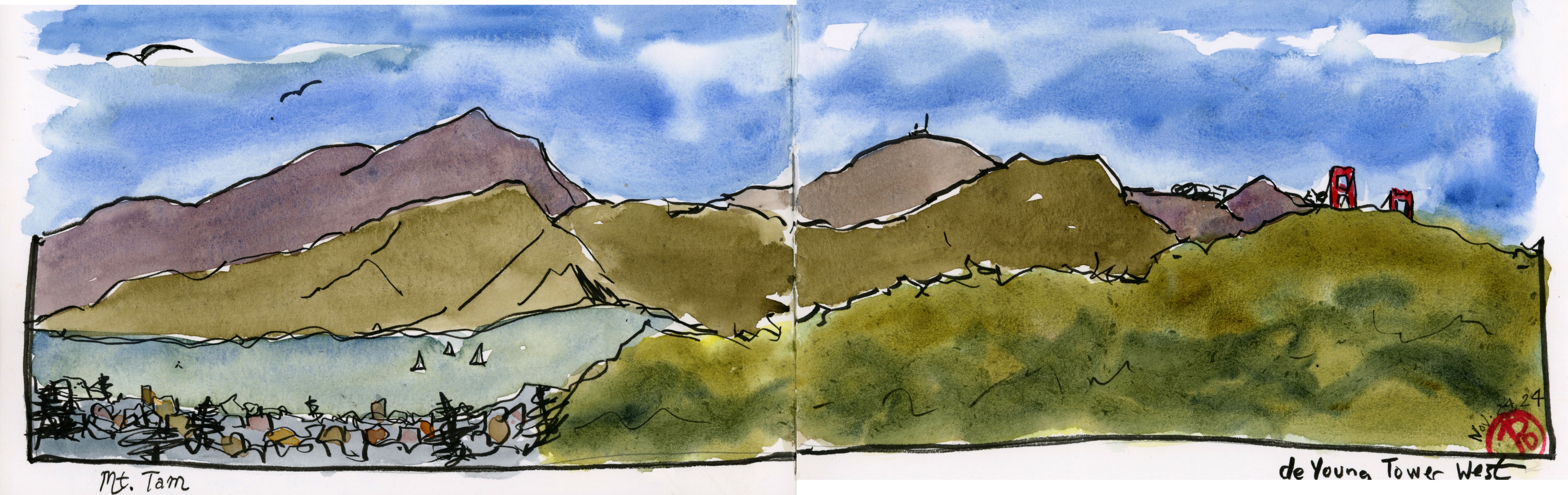
The views to the north as just as stunning taking in Golden Gate Park, the Richmond District, the Golden Gate Bridge, Marin Headlands, and Mt. Tam. On really clear days you can see outer Pt. Reyes.

Looking north down 27th Avenue towards the Golden Gate from one of the walking paths.