There is one art museum and one art exhibition from my youth that is at the fore of my memory.
I was in third grade when I visited San Francisco’s de Young Museum and the King Tutankhamen exhibit.
In 1979, the King Tut exhibit was a huge deal in the Bay Area. It seemed everyone had King Tut fever and wanted to see the treasures of his exhumed tomb.
The exhibit featured 55 objects including Tut’s golden death mask and sarcophagus. I have memories of marveling at the superb death mask.
The museum was founded in 1895. It moved to its present site in Golden Gate Park in 1919.
The building was damaged in the 1989 Loma Prieta Earthquake and was demolished. The museum was rebuilt in its current form in 2005.
Looking west from the tower with the galleries of the de Young.
I admit that I wasn’t a fan of the new building. But the view from the top is amazing. The building is slowly growing on me.
On a recent visit I did a western facing sketch from the top of the de Young tower of the Golden Gate and the Marin Headlands (below).
On a SLO Saturday morning with a breakfast at the Copper Cafe at the Madonna Inn (celebrity sighting: Steve Perry), Grasshopper and I headed out west past the Men’s Colony to do some birding-hiking-sketching at Morro Rock.
The 581 foot tall Morro Rock is a volcanic plug on California’s coast. A volcanic plug is the extinct neck of a volcano. It is a prominent landform that is a beacon for wildlife. The extinct volcano formed about 23 million years ago.
We birded around the rock. Avian highlights included white-throated swift, Bewick’s wren with common loons on Morro Bay and willets, black oystercatchers, and brown pelicans on the breakwater.
Around the base of the rock were “No Climbing” signs because Morro Rock is a peregrine falcon reserve. On our visit there were no signs of peregrine falcons.
Sketching Morro Rock with Grasshopper.
We left the trailhead and found a sketching perspective with Morro Bay in the foreground and found a sketching boulder to sketch from (featured sketch).
A friend’s 50th Shindig in San Luis Obispo provided me the opportunity to stay at the historic Madonna Inn for the first time.
The roadside hotel was opened in 1958 and has grown to the sprawling compound that it is today featuring five buildings on its 1,500 acre site.
The Madonna Inn sign calling visitors in from Highway 101. San Luis Obispo lies between San Francisco and Los Angeles.
The hotel is known for its oddball decor, its hot pink accents, western murals, and 110 themed rooms.
I was staying in room 205, the Buffalo Room. The room has western/Native American themed accents, a rustic wooden four poster bed, and a huge American bison head hanging on the wall. This was sketcher’s paradise.
I just hoped the bison head didn’t give me nightmares!
A bed sketch from room 205. Buffalo head detail. It seems to be looking at you no matter where you stand in the room.
Early Saturday morning found me in Capitola Village.
Capitola was founded in 1874 as a beachside resort and in the age before the personal automobile it owed its early popularity to the railroad.
The Santa Cruz Railroad, opened in 1876 and brought sun worshippers to Camp Capitola.
Southern Pacific took over the railroad in 1882. The SP brought beach goers to the small seaside town, passengers detraining at the new depot near the east end of the trestle, this location is known as Depot Hill.
I chose my sketching position above Soquel Creek on the historic Stockton Avenue Bridge (1934) which parallels the trestle. The seaside air was wet with fog, I hoped it wouldn’t smear my ink drawing.
The wooden trestle over Capitola Avenue looking towards Soquel Creek. The Capitola Depot is about 100 yards behind me and up the hill. I have always loved the parking spots under the trestle (parking is a premium in Capitola Village).Colorized postcard (early 20th Century) of a double header passenger train with three baggage cars, crossing the trestle over Soquel Creek taking beach goers to Santa Cruz. This perspective is close to where I chose to sketch. Looking down the trestle in direction of the Capitola Depot and beyond, the connection to the mainline at Watsonville Junction (15.7 miles down the line). The green growth around the tracks shows this track has not been active in over ten years.
I was meeting a friend in the East Bay city of Martinez and I had a little time to sketch before lunch.
Martinez is a hotbed of railroading with both the Union Pacific and BNSF passing through as well as some marquee passenger trains such as the Coast Starlight and the California Zephyr making stops at the Martinez AMTRAK station. And the Capitol Corridor commuter takes on passengers traveling north and south on shorter journeys.
The California Zephyr Train No. 6, at the old Southern Pacific Depot in Martinez. This train is heading east to Chicago. To the right in the background is SP switcher 1258 on static display.
There would certainly be something to sketch here and I was going to start with a historic train trestle.
I parked at the Mount Walda Trailhead. Soaring above me was the 1,600 foot long steel Muir Trestle (aka the Alhambra Trestle). The single track trestle was so long that I could only see and sketch one section of it before it disappeared into the trees to the east. The trestle rises 75 feet above the roads, trees, and houses it crosses over.
A detailed view of the steel supports of the Muir Trestle.
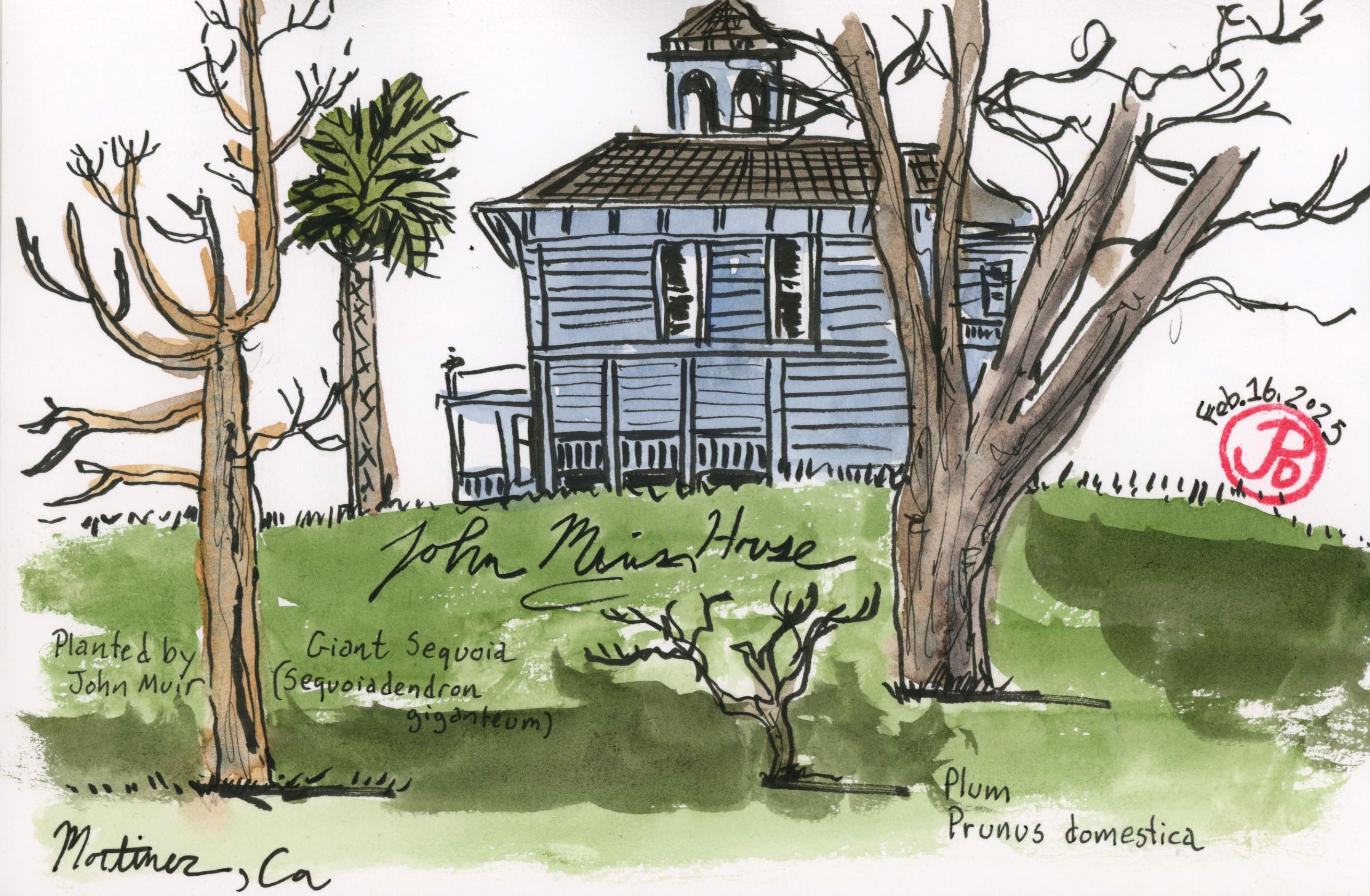
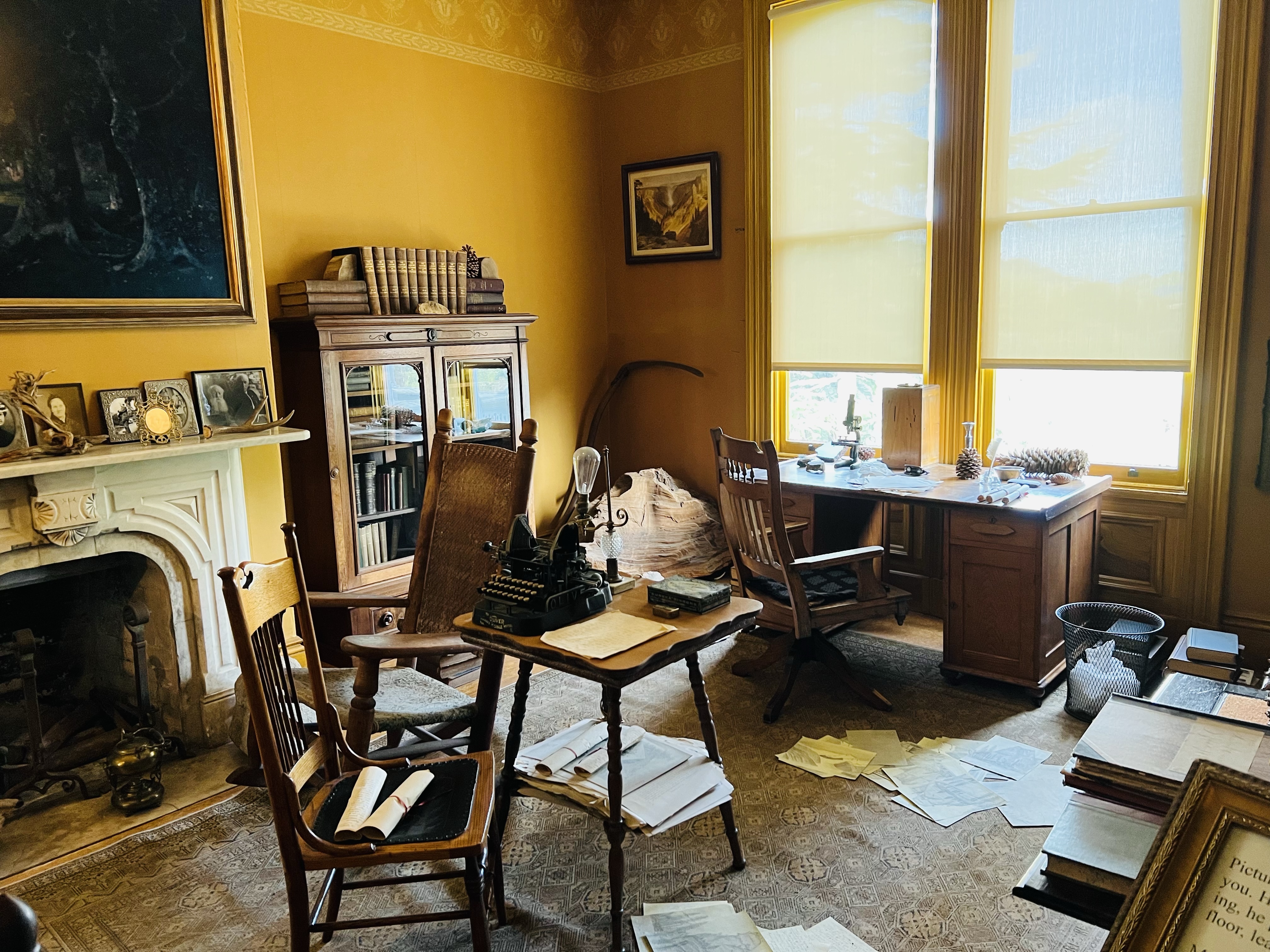
The trestle is within the John Muir National Historic Site. To the north is Muir’s Martinez home. Muir and his wife Wanda sold the land for the trestle for $10 and a lifetime rail pass to the San Francisco and San Joaquin Valley Railway. The original wooden trestle was built through a pear orchard and completed in 1897.
This is a historic photograph of the Stengel-Muir ranch in 1897. The Muir house is on the top left and the trestle is viable behind the house. At the time of the photograph, the trestle was constructed of wood.
At the eastern end of the trestle there was a passenger and freight station named Muir Station. The station is now long gone but is immortalized in a street that parallels the rails named Muir Station Road.
From this station Muir could ship his produce to Oakland or to the port in Martinez.
One of Muir’s neighbors in the Alhambra Valley was John Swett, Muir close friend. Swett was the State Superintendent of Public Education and is known as the “Father of California Public School”.
In 1898, Santa Fe purchased the line and it became their Valley Division. This division still exists as BNSF’s route from Richmond to Fresno.
The Muir Trestle from the intersection of Alhambra Way and Muir Station Road.
I took up a sketching position near the trailhead and started my drawing. The trestle above me is on the Stockton subdivision and is used by BNSF intermodal freight. There was no train crossing during my sketch.
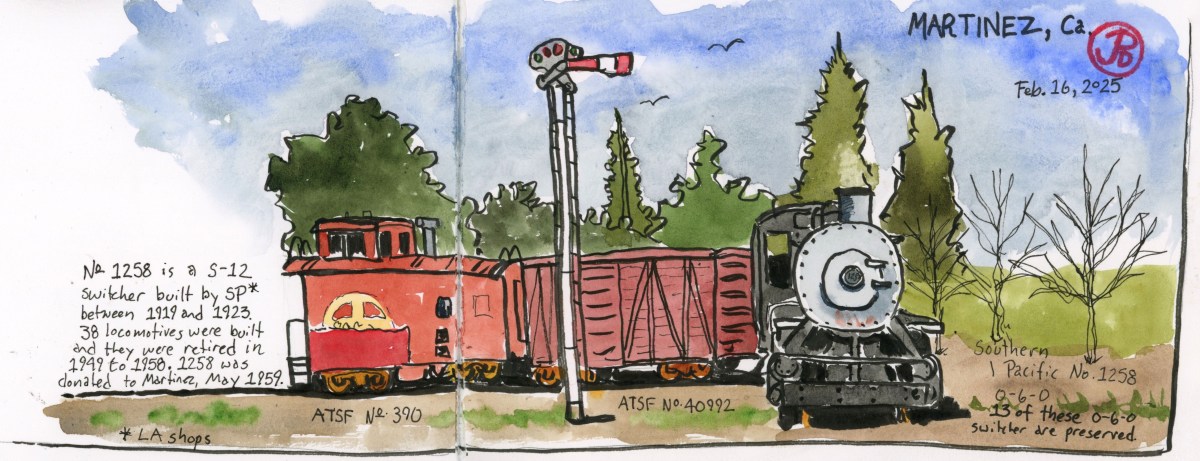
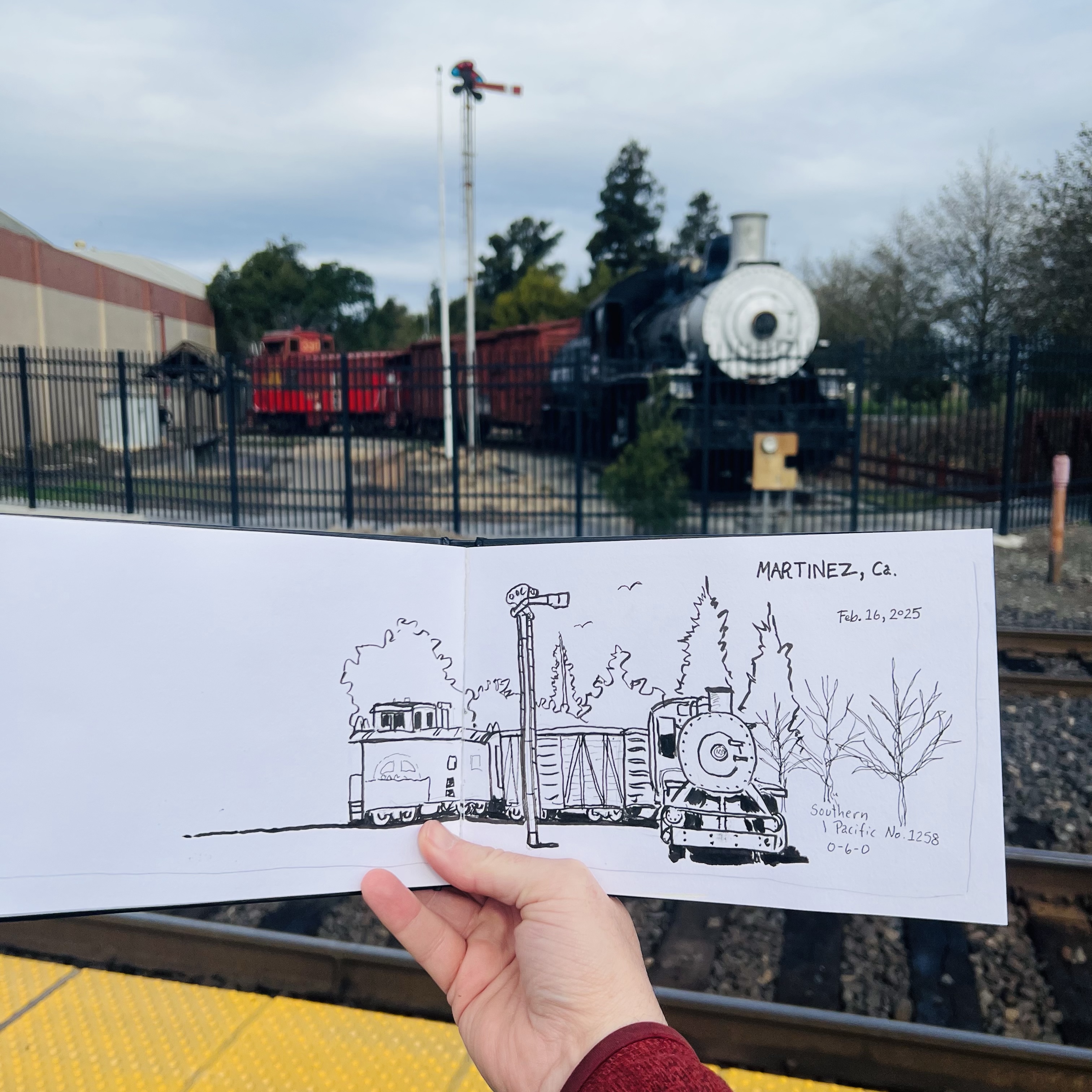
SP 0-6-0 switcher No. 1258 and its consist of a wooden box card and Santa Fe caboose 390 on display across the tracks from the AMTRAK station. The locomotive is in sad shape, missing some hardware like her bell and whistle.
One of the Seven Marvels of the Feather River Route is to be found a few miles north of Quincey.
The Feather River Route, also known as the Canyon Subdivision, stretches between Oroville and Portola, Ca and competed with Southern Pacific’s route over the Sierras at Donner Pass.
The Marvel is known as the Keddie Wye. This is where two tracks comes together to form one track, looking like the letter “Y”. Now this in itself isn’t much to write home about but when both sides of the “Y” are on trestles above a creek that joins together before entering a tunnel and then you know this is a special piece of railroad engineering.
The two forks of the “Y” are also where two different railroads meet. On the right is the former Western Pacific Railroad, now Union Pacific, and one the left is the BNSF (Burlington Northern and Santa Fe).
After about a 45 minute drive from Portola on Highway 70, the famous Keddie Wye appeared to my right. I pulled over and found a vantage point to sketch. I perched on a narrow trail above Tunnel No. 32 looking out to the two forks of the wye.
Now the only thing missing was a freight train. It would have been nice to see a train traverse one side of the “Y”. As I was told at the Western Pacific Railroad Museum, Sunday is a quiet day on the high iron.
After my sketch (right side of the spread), I headed down Highway 70 into the Feather River Canyon proper. The Highway parallels the railroad and the Feather River. This is a beautiful drive and I periodically looked off to left at the rails across the river. No trains.
I was about 20 minutes from the wye when I heard the screech of steel wheels on rail. I looked to the left and a Burlington Northern and Santa Fe (BNSF) was climbing up the canyon with a mixed freight consist.
I found the nearest pullout and then reversed direction as I chased the BNSF up canyon. I wasn’t going to miss the freight on Keddie Wye!
As I climbed up Feather River Canyon I kept an eye to my right for glimpses of the train. I should have no problem overtaking the train as the line speed limit was 25-30 mph.
I soon came to the end of the train and before long I was approaching the five bright orange diesels on point. I passed them with time to spare.
Once I reached the wye I reversed direction again and parked at the pull out. I figured I was about ten to fifteen minutes ahead of the freight and I took my position on the narrow path above Tunnel 32. Now I had to just wait, wondering if I would be able to hear the approaching freight from my position.
Within ten minutes I could hear the diesels working up grade and the first locomotive appeared below me. The train headed onto the left side of Keddie Wye onto the BNSF Gateway heading north towards Lookout and Klamath Falls.
What a memorable experience to see a piece of railroad history that is not a static museum piece isolated in time but in use today.
You really have to like trains to make it out to Portola, Ca. From my mom’s house it was a two hour drive over windy roads to reach the small town where the former diesel shops of the Western Pacific were.
These shops and the rails around it, are now the Western Pacific Railroad Museum. The museum is adjacent to the tracks of the Union Pacific which acquired the WP in 1982. Heading west from Portola you enter the Canyon Subdivision which is the WP’s Feather River Route. This is one of the most scenic sections of the the former WP. It was the route the original California Zephyr took from the Bay Area to Chicago.
The museum has four cars from the streamliner, the California Zephyr.
While many railroad museums focus on the age of steam, the WP was one of the first major railroads in the west to dieselize. The museum has 29 diesels in its collection.
The WP acquired its first diesel in 1939. The SW1 switcher was built by the Electro Motive Corporation for an original cost of $64,525. It was built to work in the yard and with a top speed of 45 MPH, it was not designed to be out on the mainline.
The WP tested out the diesel (No. 501) and liked what it could do. It later ordered two more sister locomotives and 14 years later the Western Pacific was completely dieselized. The genesis of WP’s diesel age is now part of the museum’s collection.
A sketch of some of the WPRM’s collection including WP’s first diesel: No. 501.
The museum has many classic, epic, and iconic diesel-electric locomotives in its collection and I added a few to my sketchbook.
An iconic locomotive is the WP 805-A. This is an EMD FP7. This hood unit was on point of the California Zephyr from Oakland to Salt Lake City. The diesel was in service on the Zephyr from 1950 to the route’s end in 1970.
805-A is the last WP California Zephyr locomotive in existence, so I had to sketch it.
One of the epic diesels in the museum’s collection is perhaps the most epic diesels ever built, this is Union Pacific No. 6946. This 6,600 horsepower behemoth is EMD Class DD40AX “Centennial”, the largest and most powerful diesel-electric locomotive ever built and is the successor of UP’s Big Boy. 6946 is the last (out of 47) Centennial ever built. Only 13 Centennials still exist, the large locomotives having been retired from the UP fleet in 1986.
The beast that is the last Centennial ever built. Like the Big Boy, it’s two locomotives smashed into one mighty powerful machine.
A docent told me I could climb aboard the duel engine workhorse and I walked along the gangway to the cab.
I liked the view so I sketched the 1953 diesel shop from the gangway of 6946 (featured sketch).
4014 would be spending two nights in the important rail hub of Roseville.
Roseville is at the base of the climb up the Sierra Nevada Mountains to Donner Pass. It is here where the tools to conquer the Donner extreme winters are kept. Across the tracks, near the depot, the spreaders and flangers could be seen. A little further down the siding, the ultimate snow fighting machine could be seen: the rotary plows.
But on this July Friday and Saturday an army of foamers, rail fans, history buffs, and the curious would be invading the city of Roseville.
They were all here to see the largest steam locomotive in the world, Union Pacific’s Big Boy No. 4014. For the two display days the largest operable locomotive would be static and not moving. The Goliath would be brought up to steam and boiler pressure to conquer the Sierra Nevadas on Sunday.
I arrived early on Saturday to find a parking spot and to spend some quality time with the 4-8-8-4 before she, or he, was besieged.
Roseville is a busy point on the railroad with many freight trains starting the climb or descending the Sierra Nevadas. The passenger service is alive and well in Roseville with the California Zephyr and the Capital Corridor stopping at the passenger depot.
The present and the past of Union Pacific freight. A eastbound freight passes 4014 at Roseville.
4014 now had a consist of Union Pacific passenger cars. I heard a ticket for the trip from Roseville to Reno, Nevada would set you back $700. The train was parked near the intersection of Atlantic and Vernon Streets near Southern Pacific’s 2252 and a rotary snowplow on display.
Roseville is a very busy point on the line and it was about to get much busier with the influx of people coming into town to see a Big Boy’s first visit.
I walked to the grade crossing at Yosemite Street and looked west (towards Sacramento) and sketched 4014 and the Roseville yard (featured sketch).
The viewing of 4014 officially opened at 9:00 AM and there was already a group lined up to get a closer look at the Big Boy.
As the clock ticked closer to 9:00 AM, more and more people were showing up to see the first visit of a Big Boy to Roseville.
This important railroad town was the home of Southern Pacific’s articulated, the cab forward. These massive locomotives were designed to haul freight over the pass and the locomotive was reversed with the cab in front (hence the name) so the crew would not suffer from smoke asphyxiation while traveling through the many tunnels and snow sheds on the route. In the age of steam Roseville had two roundhouses, one was specifically designed for servicing the labor intensive cab forwards. At one point Roseville was home to 60 cab forwards.
Only one Southern Pacific cab forward still exists, the AC-12 No. 4294. She is on static display at the California State Railroad Museum in Sacramento. But unlike Union Pacific’s 4014, 4294 is not operable.
Soon it was hard to see the Big Boy through the forest of people surrounding it. So I did a sketch to capture the experience.
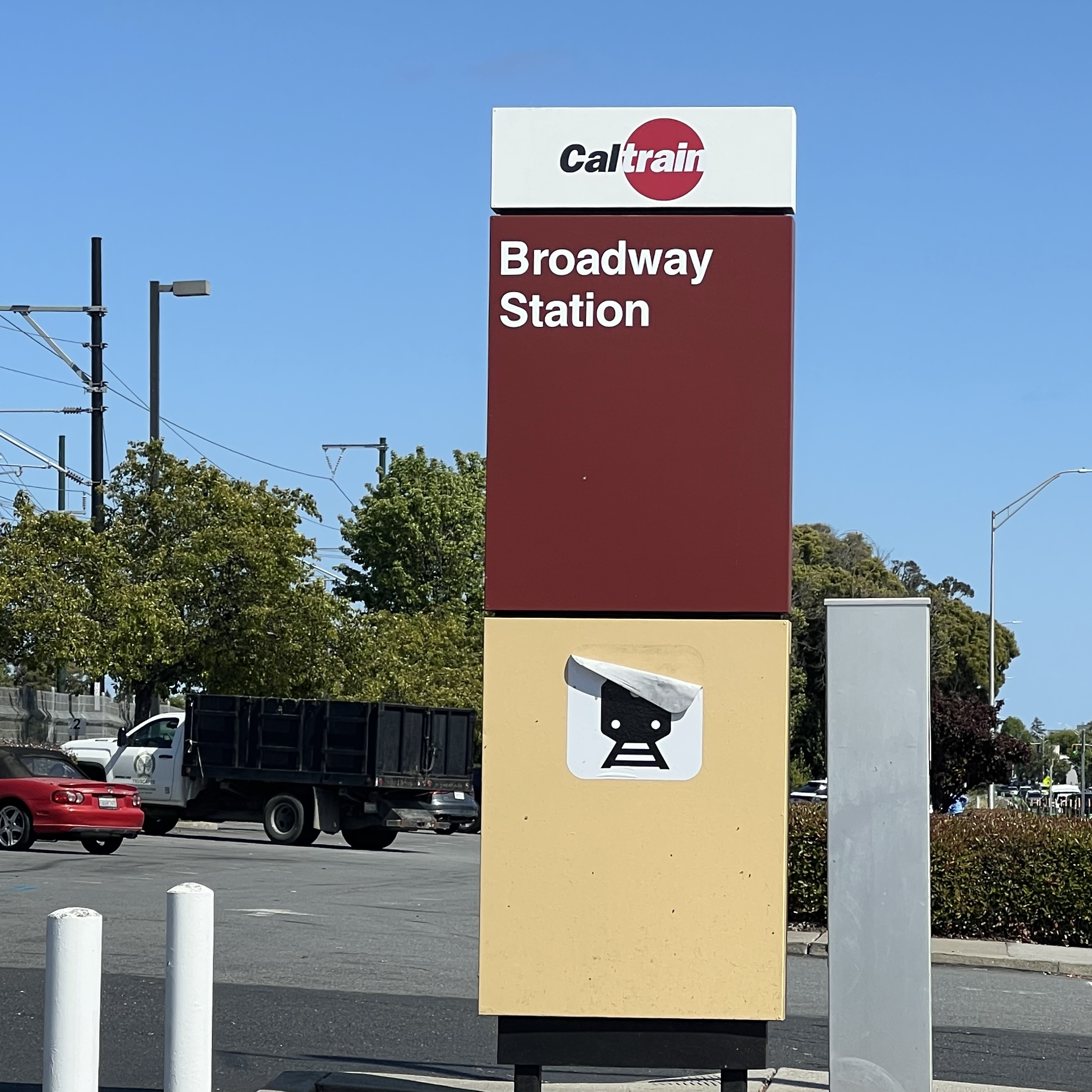
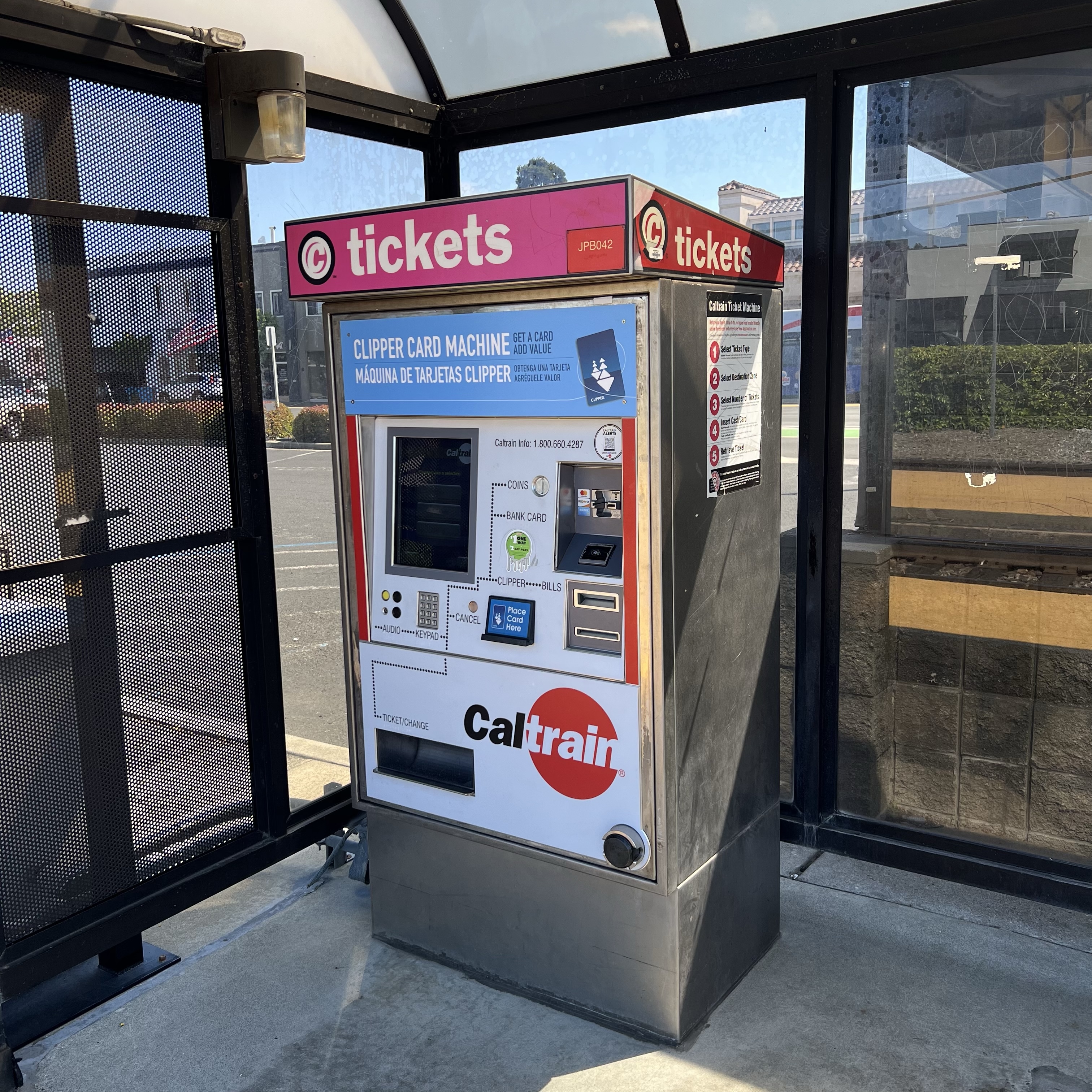
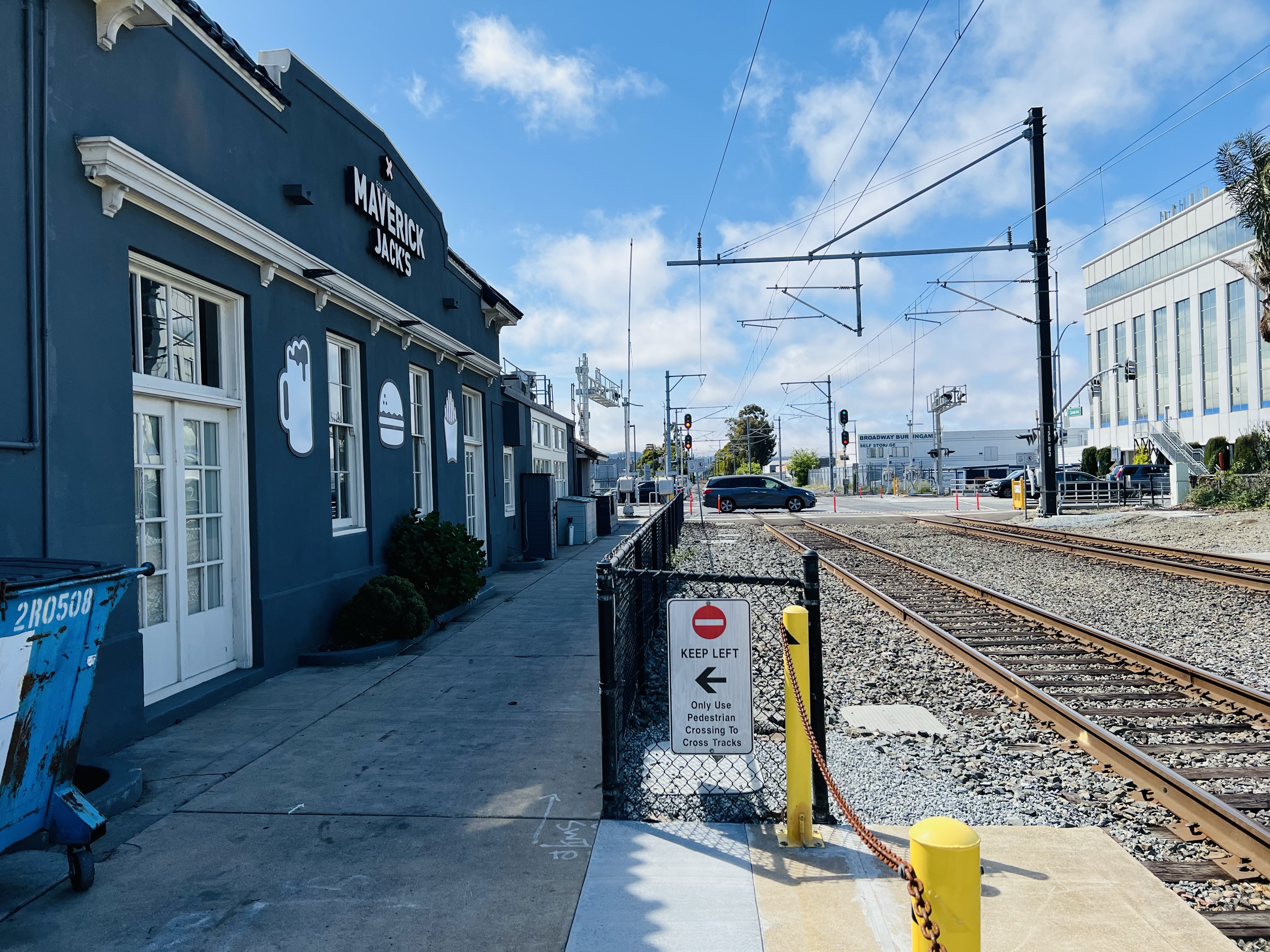
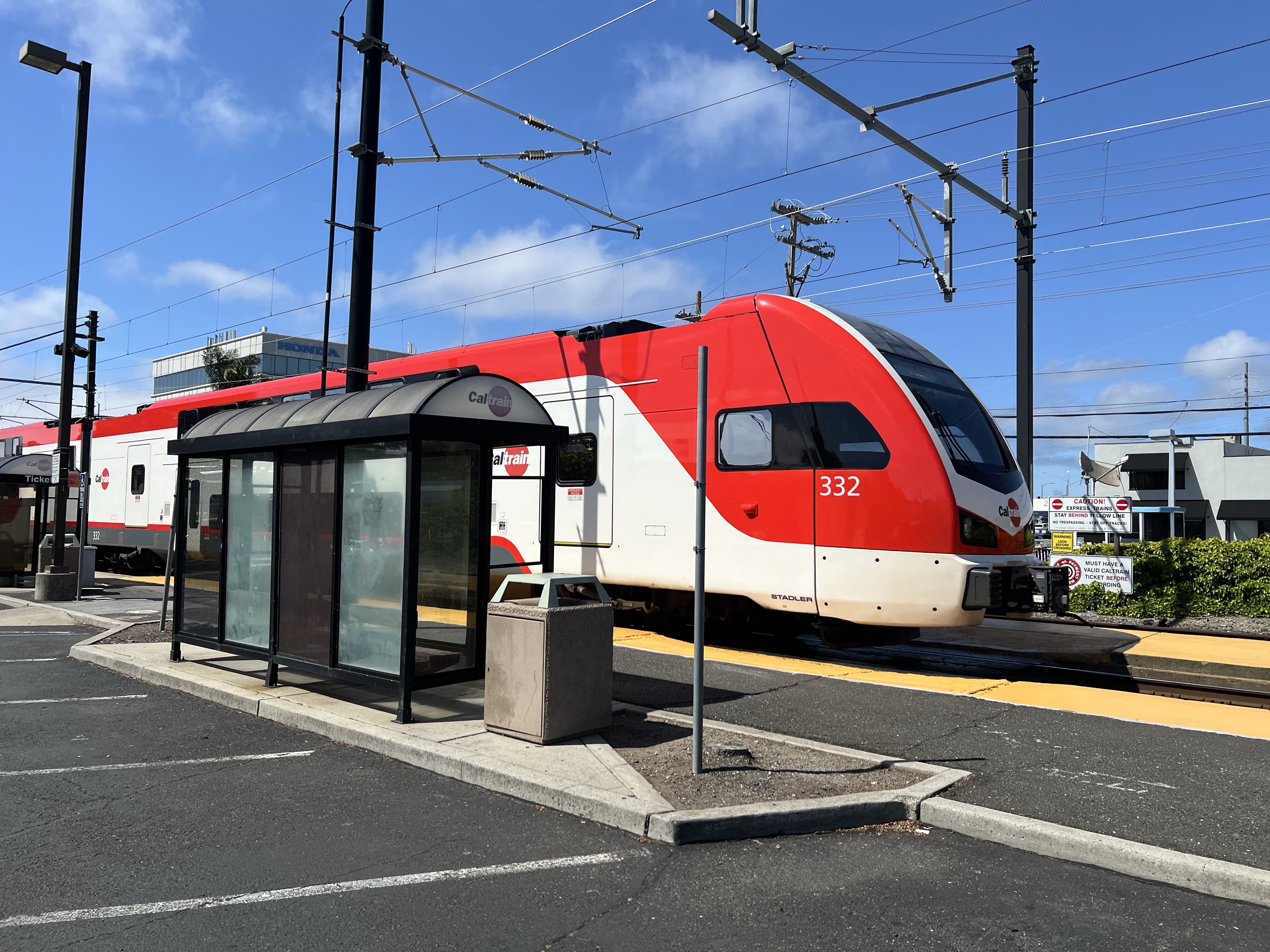
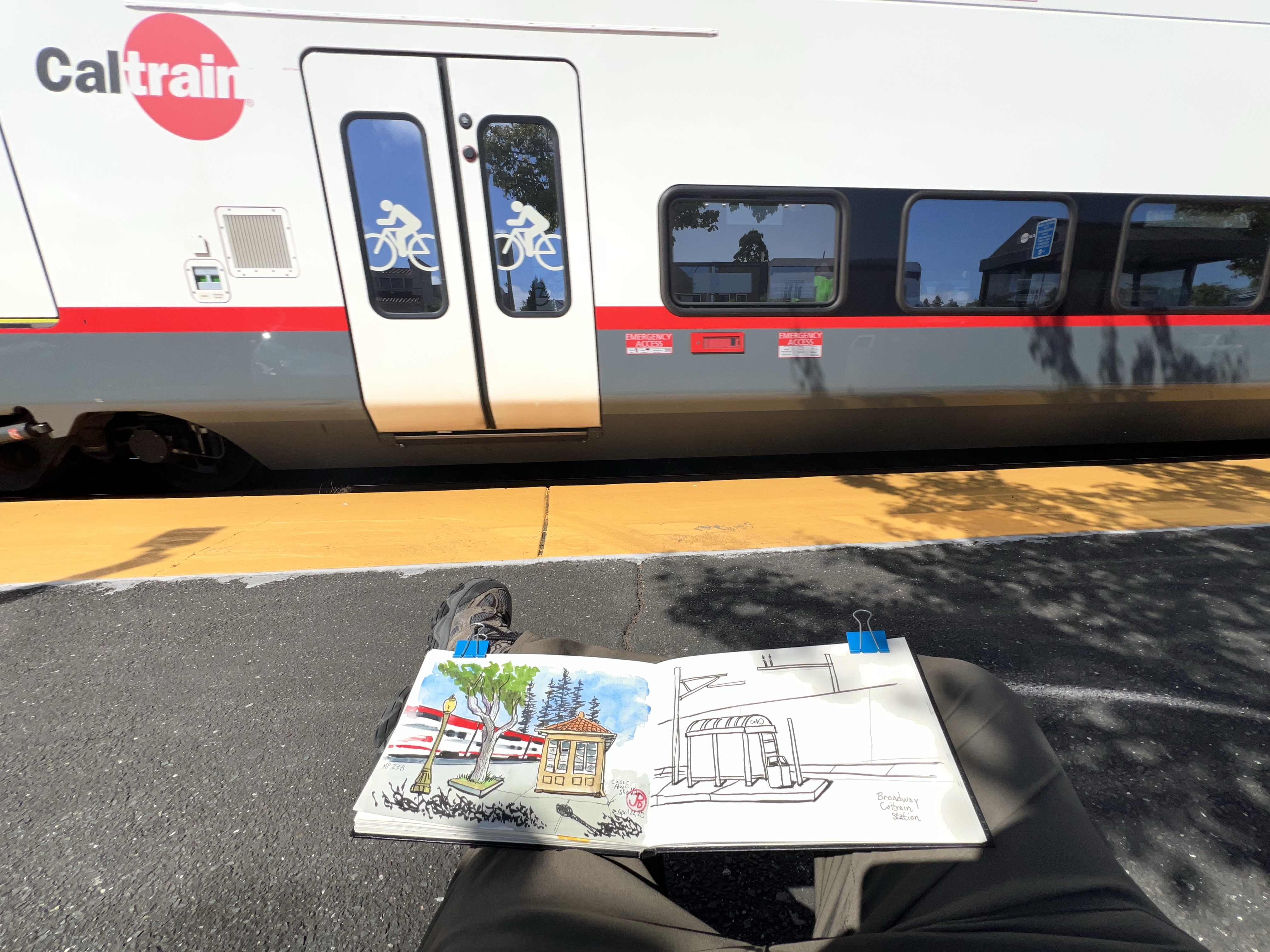
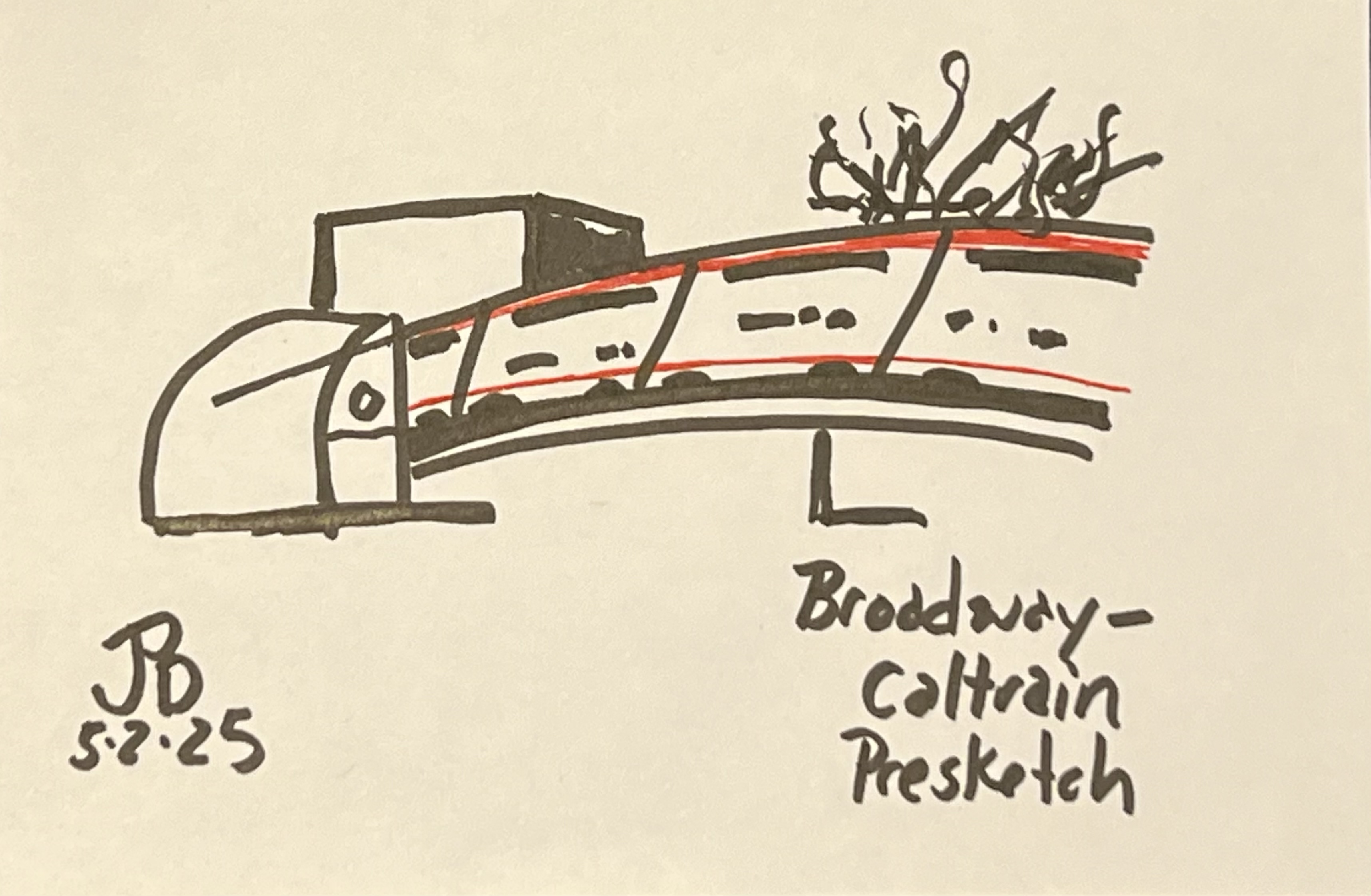
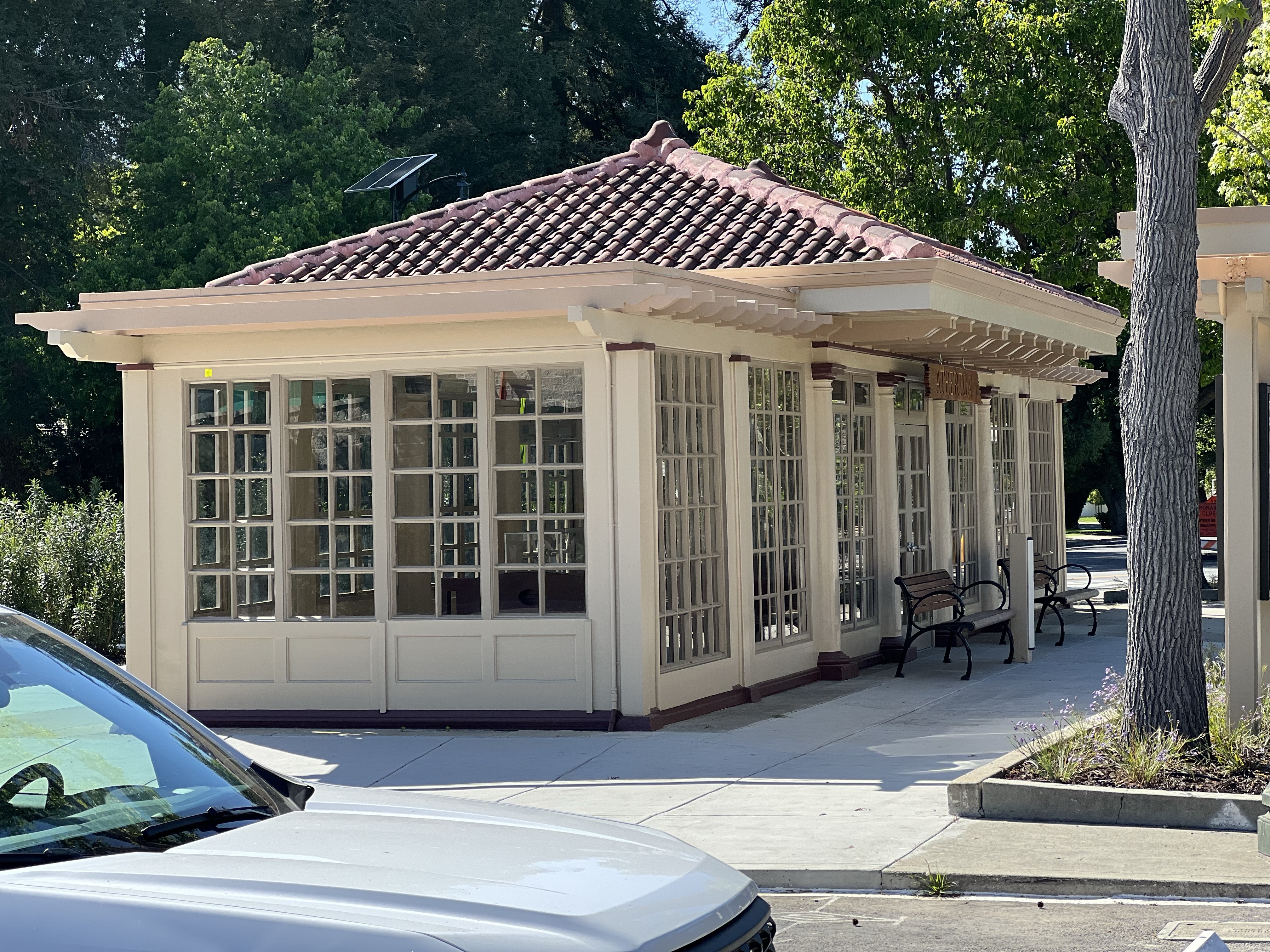
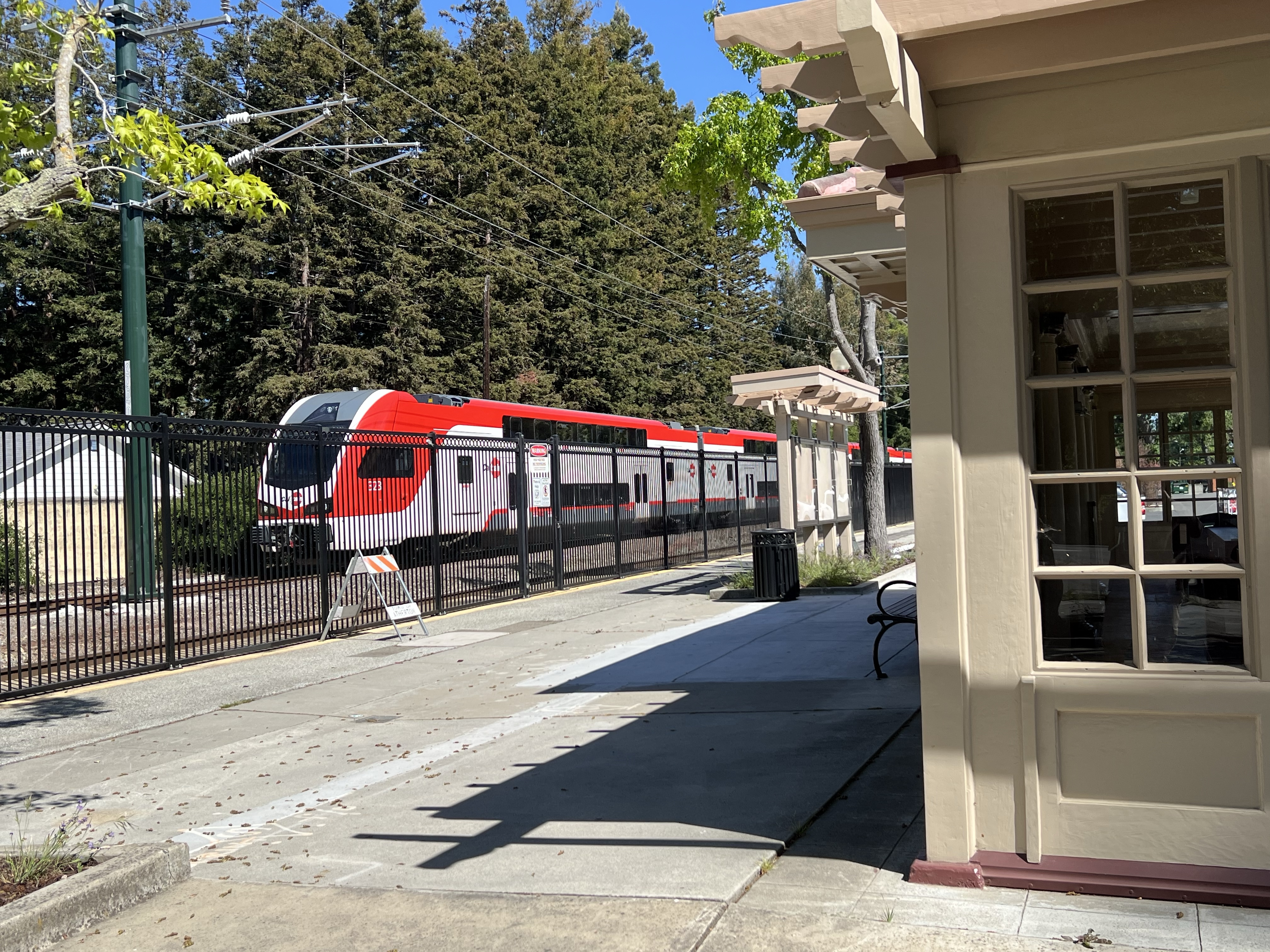
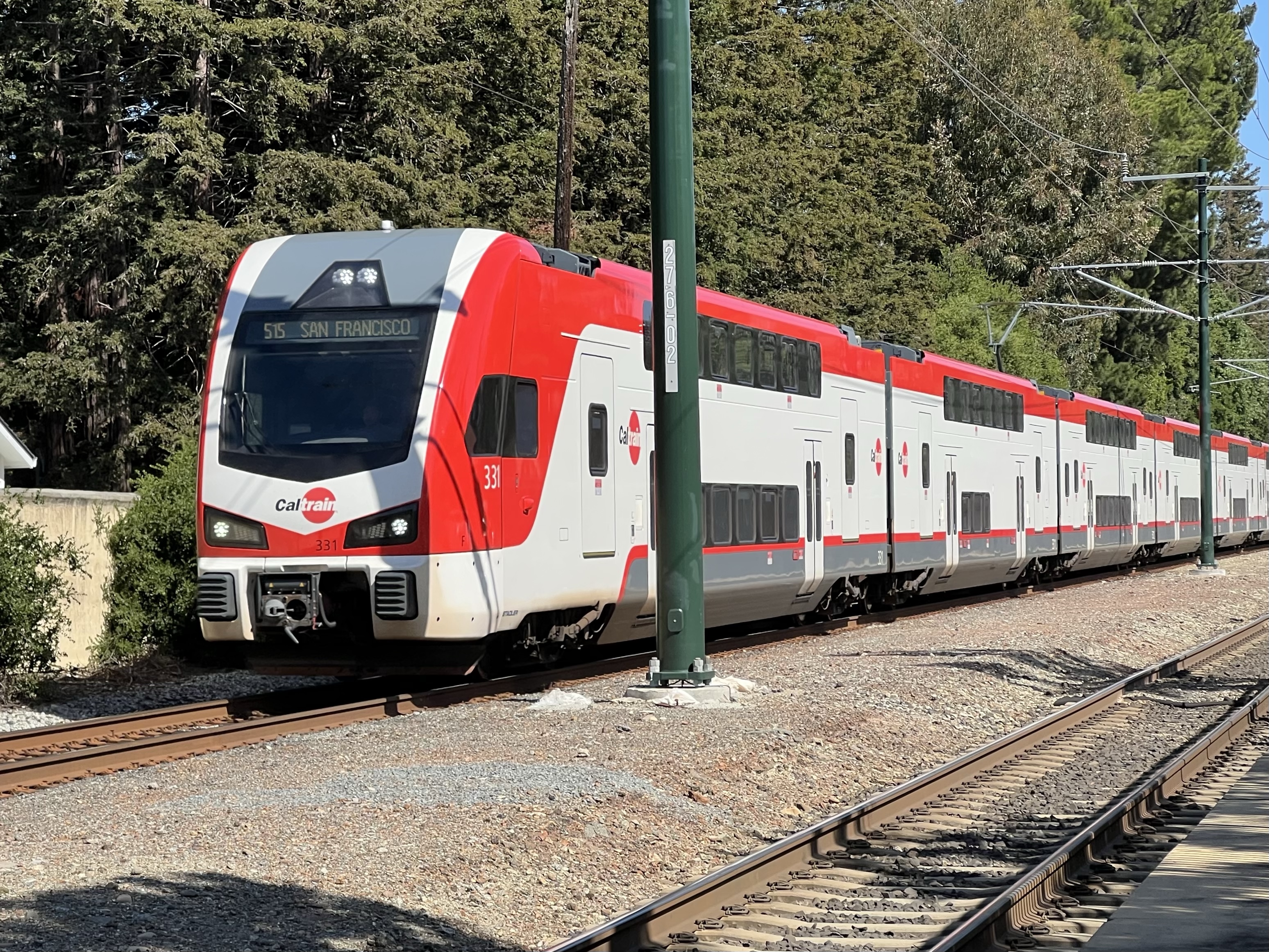
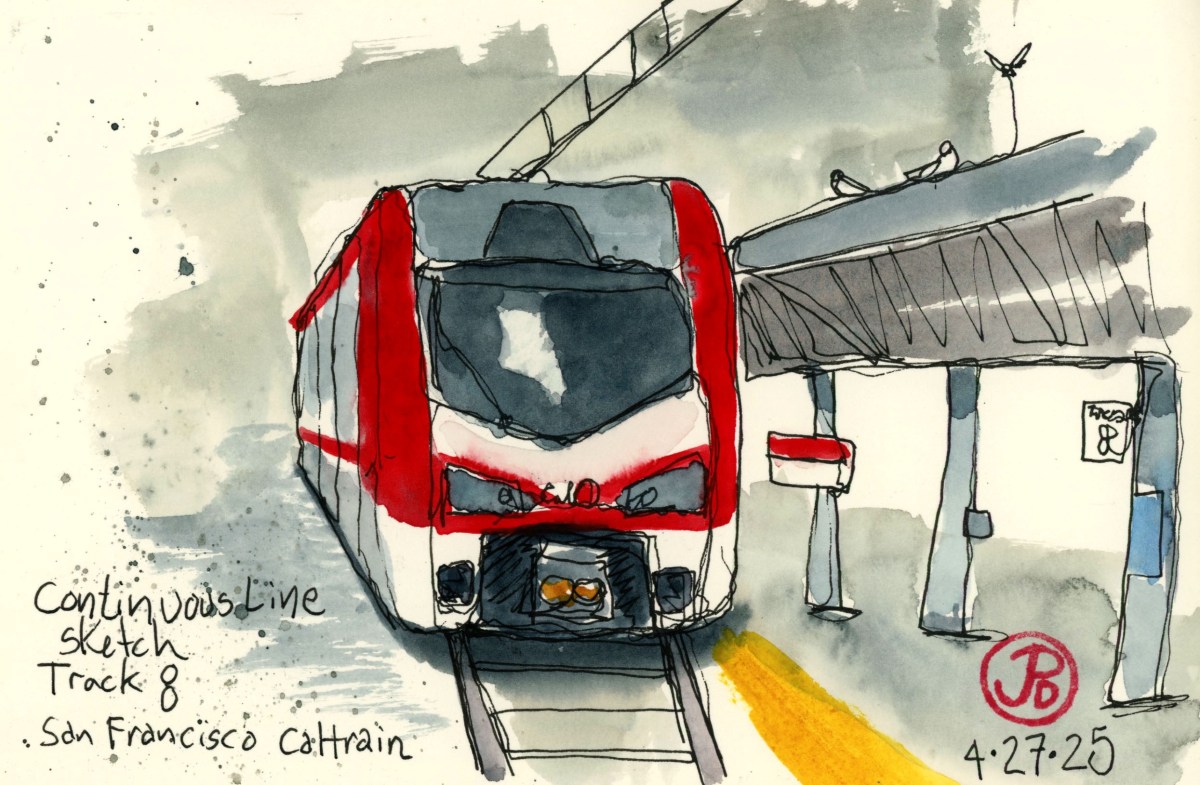
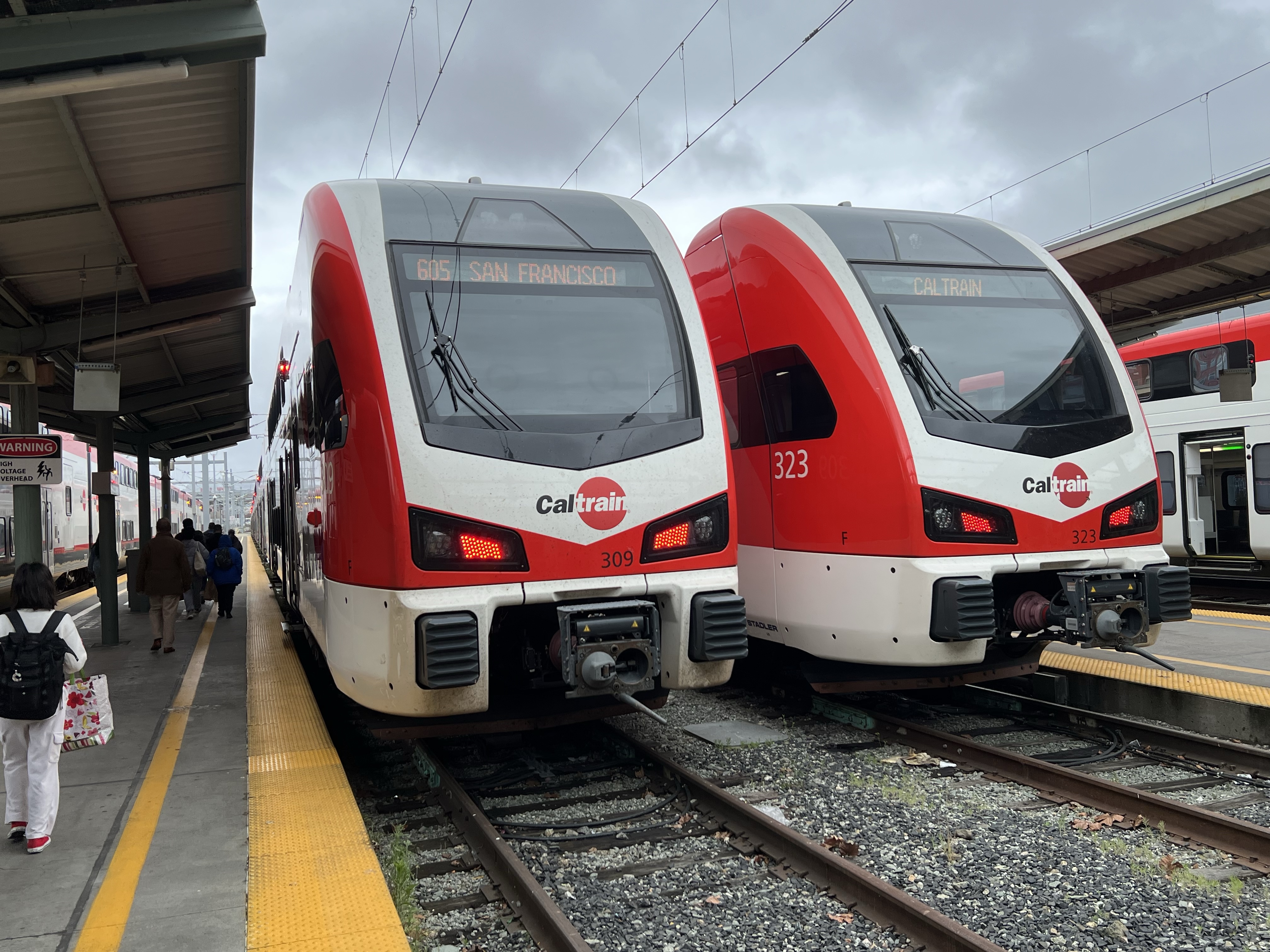
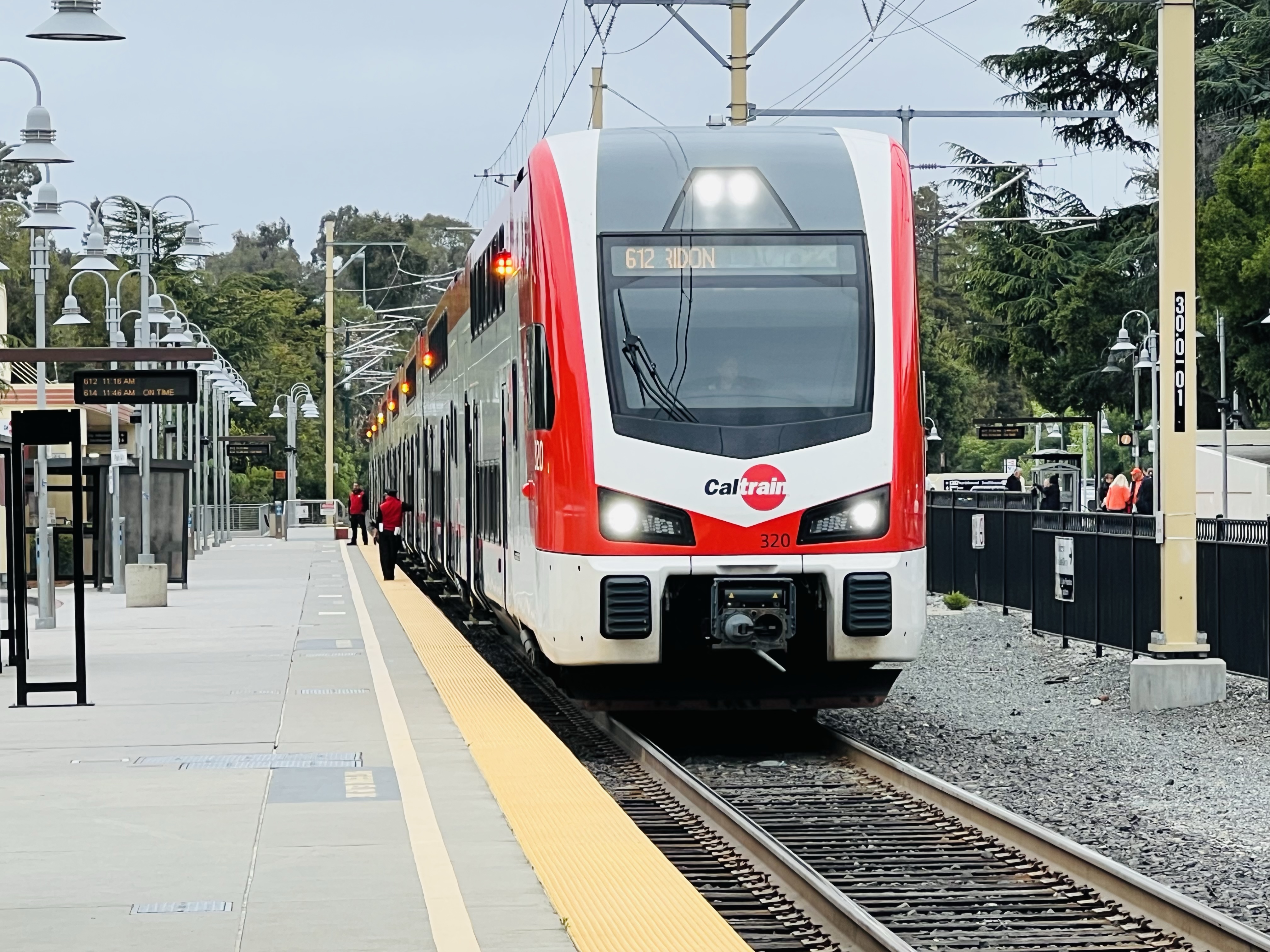
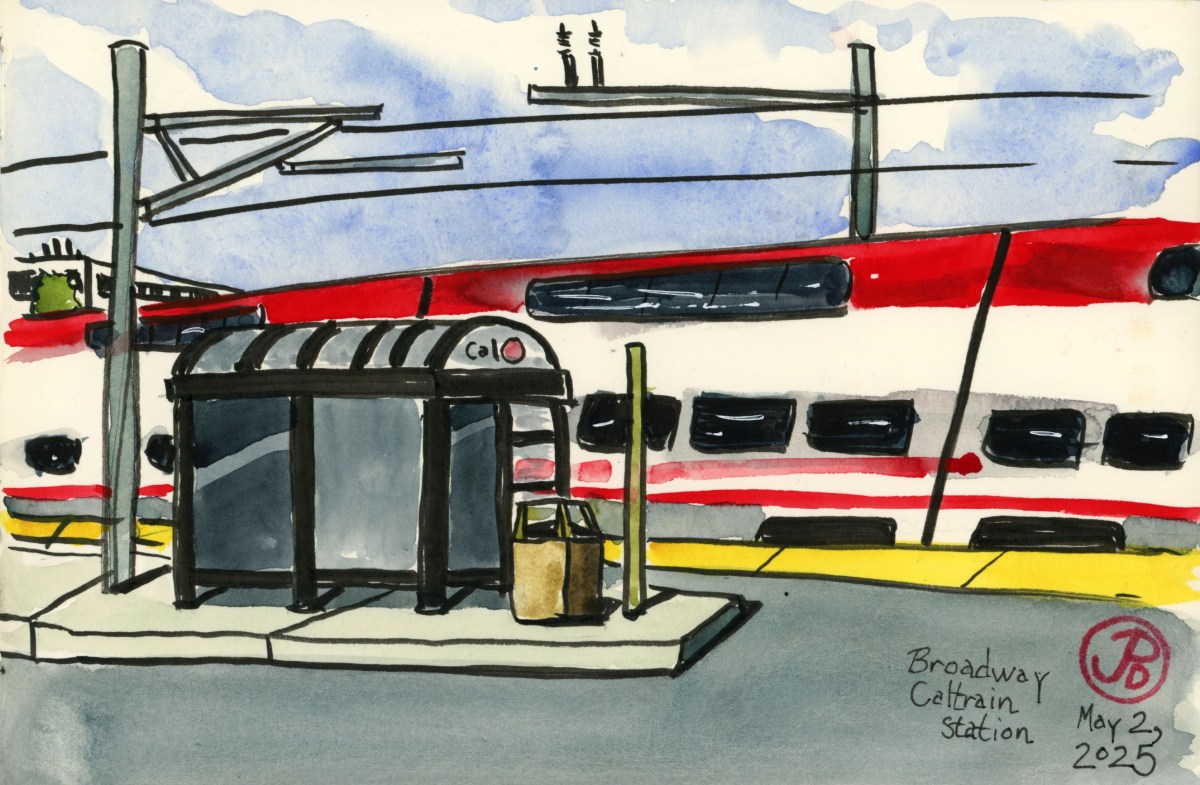
On a recent Saturday morning I had a pleasant surprise as I drove north on El Camino Real at San Carlos. At San Carlos Station was one of the new electric CalTrain sets.
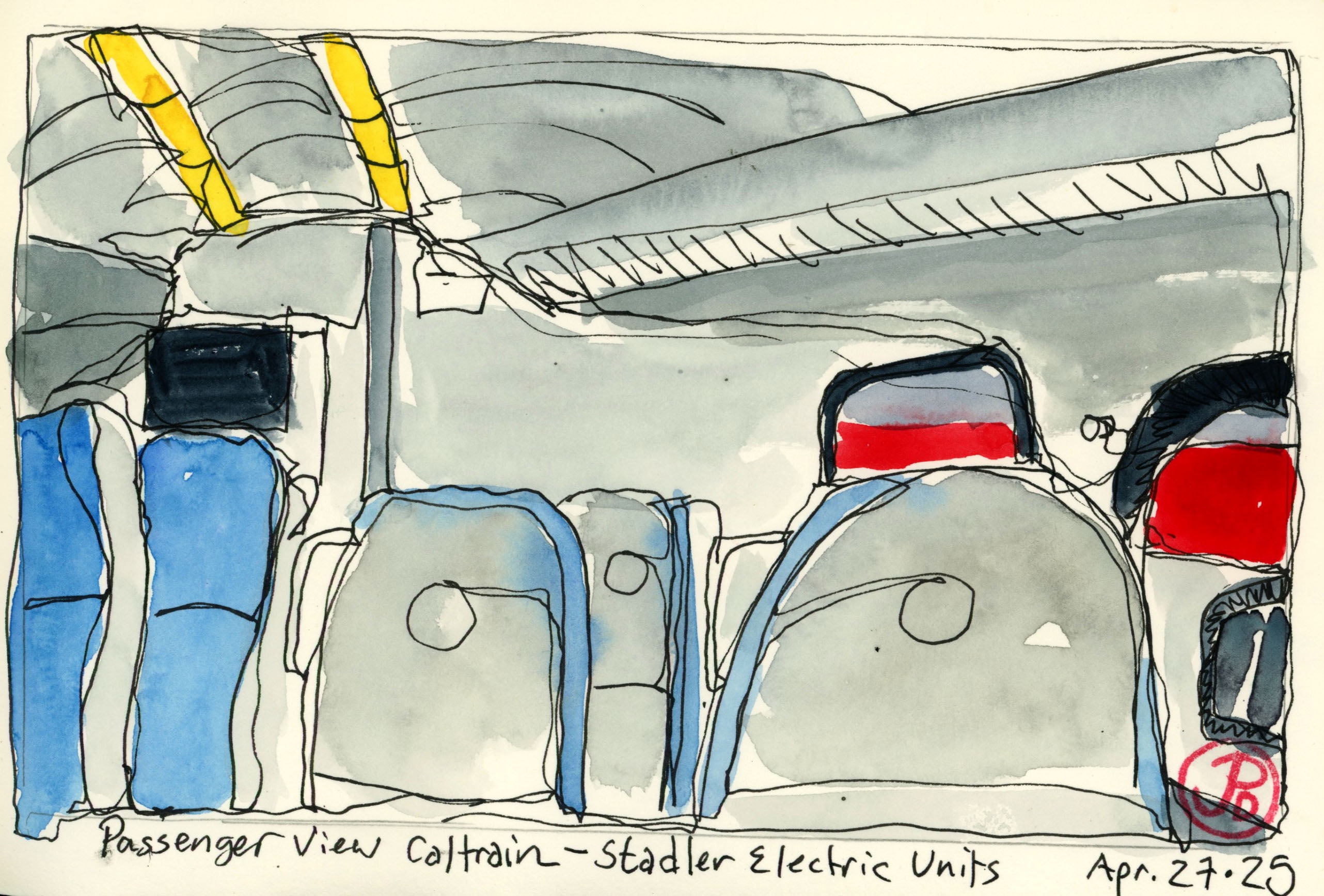
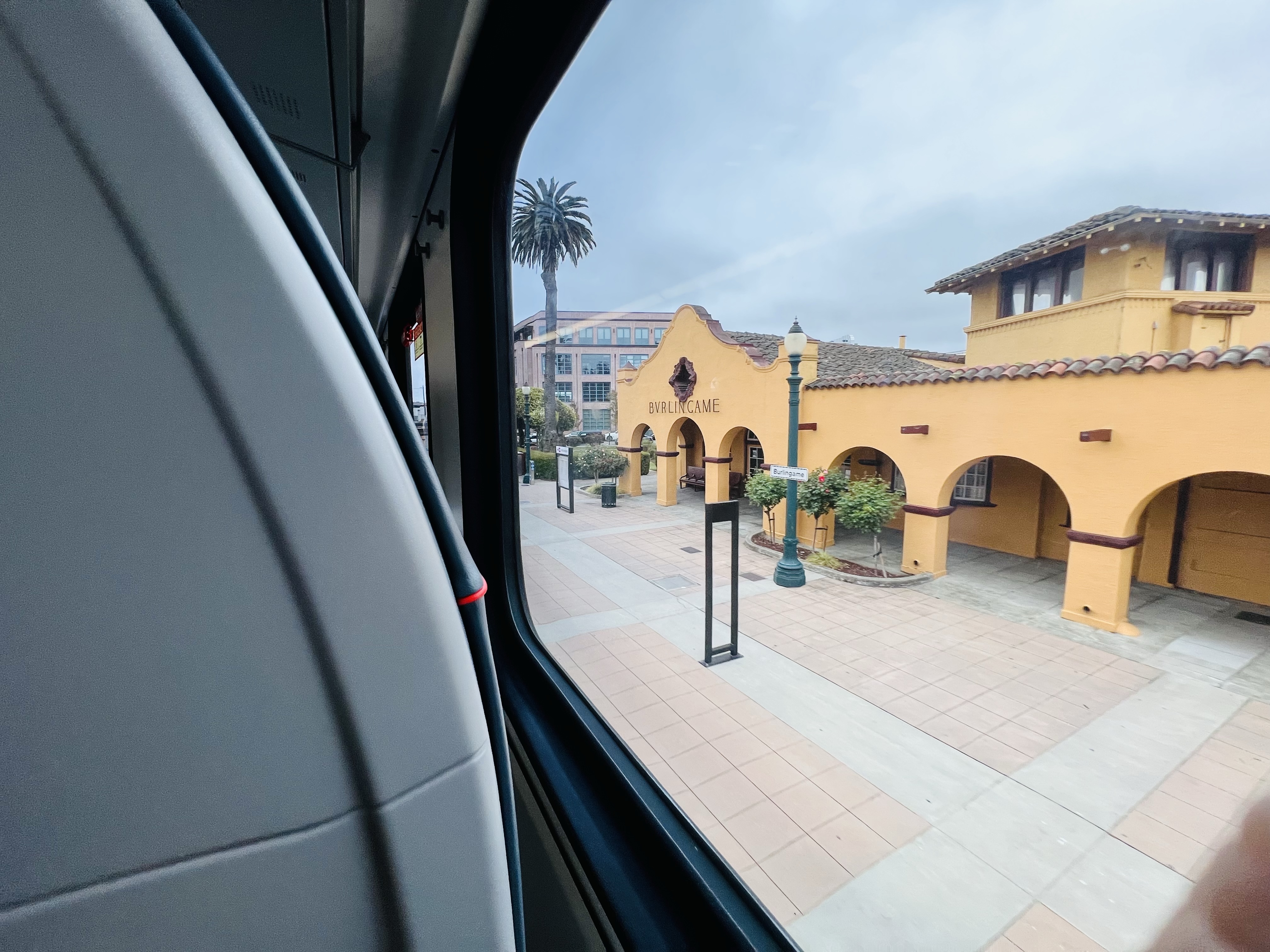
The new trains are built by Stadler, a Swiss-based train manufacturer. The company was founded in 1942 and is headquartered in Bussnang, Switzerland. The company has a factory in Salt Lake City, where Stadler will build 24 train sets for Caltrain.
The train sets are known as BEMUs which stands for battery-equipped electric multiple unit.
I parked, thinking that the train would surely have left the platform by the time I walked to the station but as I walked down San Carlos Avenue, the train was still stationary at the station.
As I crossed El Camino, a placard stated “No Train Service”. The line was closed all weekend.
The line was closed from San Francisco to San Jose so Caltrain could test eight of the new electric train sets. The electrification of the line started in 2017 and electric trains are scheduled to start running on September 21, 2024.
If you think of some of the most iconic passenger trains in modern rail: Japan’s Shinkansen (“Bullet Train”), France’s TGV, Eurostar, Amtrak’s Acela, Chinese Railways CRH, the Bay Area rail corridor was finally being electrified to catch up with the rest of the world, although it would not come close the top speeds of modern Shinkansen (186 mph).
Three quarters of the world’s passenger service are powered by electricity. About time!
This is what powers the new train sets: the pantograph that delivers power from the wires above to the train set below.Not sure if these new trains sets earn any style points. They look like a large streetcar or tram.
On a gray Saturday morning I decided to explore a recently opened section (opened in December 2020) of the Coastal Rail Trail in Santa Cruz.
The section I was exploring (Segment 7) is between Natural Bridges Drive and Bay Street. The walk takes about 30 minutes and the round trip covers about two miles.
As the name implies, the paved pedestrian trail parallels the former Southern Pacific Davenport branch line from Watsonville to Davenport.
As of the date of writing only two sections of the trail have been opened, one in Watsonville and the section I was walking on in Santa Cruz.
At grade crossings there are pedestrian signals that stops cars so you can cross the street safely. Well that’s the theory anyway. With the trail recently open, pedestrians should still use caution and not assume all vehicles will stop for you.
When the trail is completed, it will cover 32 miles from Davenport to Watsonville. There are also plans to introduce electric rail service using the former Southern Pacific right of way and trackage.
I started where the rail trail ends: Natural Bridges Way.
The Rail Trail passes by the former Wrigley Chewing Gum plant (left). The plant was in operation for more than 40 years and produced 20 million sticks of gum per day. The plant had a rail siding that is still visible today.
In my college days I remember visiting the gum factory with my roommate in an unsuccessful attempt to get a plant tour. The receptionist told us that they didn’t give tours but asked us if we would like some gum! We answered in the affirmative and then opened a drawer full of gum. I went for Big Red while my roommate picked Juicy Fruit.
The trail is level as it parallels the rail grade. Railroad grades normally don’t exceed 2%. The steepest mainline railroad grade is 3.3% on the Raton Pass grade in New Mexico. A railroad grade is expressed as a percentage the grade rises or falls over 100 feet of horizontal distance. So a 2% grade rises and falls two feet over a 100 feet distance. These gentle grades are ideal for walking and biking.
I passed by the New Leaf Market at Fair Ave, often my first stop when I head into town, as the trail and line turns slightly to the left skirting the Westside Circles neighborhood.
I came upon a scenic curve in the trail at Lennox Street as the rails and trail curve off to the right as it nears Bay Street. I pulled my sketchbook out of my bag and started sketching the view (featured sketch).
On the right of the spread I sketched the grade crossing sign at Dufour Street with Coastal Rail Trail sign below the crossbuck.